*Corresponding author: [email protected] 2018 UTHM Publisher. All right reserved.
Generation of Four-Wave Mixing in a Highly Non-Linear Optical Fiber
Using a Tunable Dual Wavelength Fiber Laser Source
Noor Ummi Hazirah Hani Zalkepali @ Zulkefli, Noor Azura Awang*,
Fatin Shaqira Abdul Hadi, Atiqah Nabiha Azmi and Zahariah Zakaria
Department of Physics and Chemistry, Faculty of Applied Sciences and Technology, UTHM Pagoh Educational Hub, Universiti Tun Hussein Onn Malaysia, 84000, Pagoh, Johor, Malaysia. Received 30 September 2017; accepted 29 June 2018; available online 1 August 2018
1. Introduction
Nonlinear optical phenomenon has become an important technique in the generation of new frequencies which finds many applications in the area of parametric oscillation, multiwavelength fiber laser, and wavelength conversion. Lately, the interest in all optical wavelength converter is to create a new platform for an all optical network system that will improve the network accessibility and flexibility, and to re-route the data traffic without having to convert them into electrical format [1-3].
Wavelength converter is used to convert one or more of the incoming wavelengths from a WDM system into a desired wavelength or group of wavelengths without significant distortion in the output signals and hence facilitate wavelengths reuse in the optical network. Various techniques for optical wavelength conversion have been reported which include the use of the nonlinear behavior in a Semiconductor Optical Amplifier (SOA) and in highly nonlinear optical fiber (HNLF). Generally, wavelength
conversion can be achieved by using cross-phase modulation (XPM) [4,5], cross gain modulation (XGM) [6,7] and through four wave mixing (FWM) [8-11]. Among these, four-wave mixing provides an interesting approach due to its simplicity. Although FWM can be observed in nonlinear medium such as SOA, but more interests are geared towards single mode optical fiber with zero dispersion at 1530nm region, which provides an inexpensive medium and also the possibility of lower insertion loss in an actual system.
Generally, the fourth wavelength is generated from three different wavelengths input in a FWM phenomenon. The efficiency of this nonlinear interaction depends on the nonlinear phase mismatch and chromatic dispersion is a key parameter that determines this. In a special case like partial degeneration, only two wavelengths inputs are needed to generate the third wavelength. Hence, dual-wavelengths fiber laser will be an interesting source to be used for FWM in a nonlinear medium. This has been demonstrated for the case of an SOA acting as the nonlinear medium [12,13].
Abstract: In this paper, we demonstrate a Four Wave Mixing (FWM) effect in a highly nonlinear single mode optical fiber. A tunable dual-wavelength fiber laser is used to provide the pump and signal probe to generate partially degenerate FWM. Calculations using coupled differential equations and experimental results in the generation of FWM were analyzed. We observed that FWM conversion efficiency depends more significantly on the wavelength detuning between pump and signal wavelength as compared to zero-dispersion wavelength. The tunability is achieved using an arrayed waveguide grating which provides different wavelength combinations of the dual-wavelength fiber laser output and can be tuned from 1530.47nm to 1548.61nm with a spacing of 100GHz. The highly nonlinear fiber has a nonlinear coefficient, γ of 10.8 W-1km-1. Hence, to achieve higher FWM output power the pump power of the dual wavelength fiber laser has to be higher than that of the signal probe. The optimum measured values of pump and signal power are +13.3dBm and +5dBm respectively, limited buy the current experimental setup.
Keywords: Four Wave Mixing (FWM); dual-wavelength fiber laser; Highly Nonlinear Fiber (HNLF); FWM conversion efficiency.
202
In this paper, we provide a first time investigation on the FWM effect on a highly nonlinear fiber using a dual–wave fiber laser constructed in our laboratory as the dual input wavelength source (pump and probe signal) to generate the third wavelength. The usage of tunable dual-wavelength fiber laser is due to the fact that it is more effective compare to using two independent tunable laser sources as the pump and signal beams. It is known that zero-dispersion wavelength contributes to the high FWM conversion efficiency. However, in this experiment it is observed that the wavelength detuning of pump and signal wavelength has a more significant effect on the conversion efficiency of third wavelength. This demonstration provides results that indicate the insufficiency of the existing theoretical model to predict the power output of the newly generated FWM signals.
2. Theoretical Background
The generation of FWM in highly nonlinear fiber can be explained by using the coupled differential equations for the propagating amplitudes, including the contributions to phase mismatch due to XPM and SPM [14]. A well-known formula used for FWM estimation was originally derived by Hill et. al. [15] and reformulated later to include the phase mismatch dependent efficiency by Shibata et. al. [16]. In the FWM process, two chosen wavelengths (λpump and
λsignal) will generate a converted wavelength
(λconverted signal = 2λpump – λsignal) as shown in Fig.
1. For analyzing the efficiency of FWM generation, the phase mismatching condition has to be satisfied [17]. The efficiency of generating a converted wavelength in FWM process depends on the pump power, wavelength detuning, chromatic dispersion of the fiber and the fiber length. The phase mismatch, Δk, is the core parameter in determining the conversion efficiency, η, of the FWM. Basically, there are two types of phase mismatch that need to be considered, namely, the dispersive phase mismatch, Δk1,
and the nonlinear phase mismatch, Δknl ,as
shown in equation 1[14,16-20];
n
k
k
k
1 (1)The dispersive phase mismatch can be calculated as; d dD D c k c s p p o o c s p p o o 1 1 1 1 2 1 1 1 1 2 2 2 1 (2)
where λo is the zero-dispersion wavelength, c
is the speed of light, λp is the pump
wavelength, λs is the signal wavelength, Dc is
the fiber dispersion as a function of λ, and
dDc/dλ is the dispersion slope.
Fig. 1 The FWM effect in tunable dual-wavelength fiber laser.
The nonlinear contribution to phase mismatch is analytically derived as,
eff L s p nlL
e
P
P
k
eff
1
(3)where PP is the pump power, PS is the signal
power, Leff is the effective length of the fiber,
defined in terms of the total fiber length (L) and fiber attenuation (α) as,
L effe
L
1
(4)and γ is the nonlinear coefficient given by,
eff
A n
2 2(5)
where Aeff is the effective fiber core area, λ is
the vacuum wavelength and n2 is the nonlinear
the total phase mismatching, we can obtain FWM conversion efficiency which is defined as,
2 2
2 2
1 cos 1 2 1
L L
e
L e
k
(6)
and FWM product power as given by,
2 2
9 4
eff L s p
FWM P Pe L
P
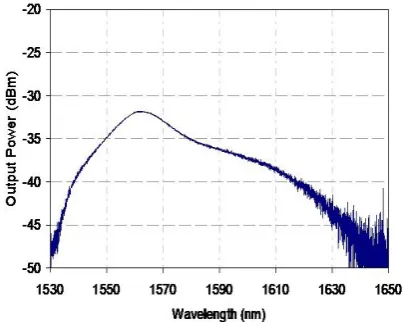
(7)Theoretically, the FWM conversion efficiency is optimum when the phase mismatch condition is fulfilled. Phase mismatch condition can only fulfilled when the pump and signal interact at zero-dispersion wavelength and the wavelength detuning between pump and signal wavelengths is approaching one another. However, this might not be the case in actual experiment due to the gain-dependence of pump and signal that originates from the amplified spontaneous emission (ASE) output profile which is higher at 1560nm that shown in Fig. 2. In this case, pump and signal wavelengths are situated closer to the higher ASE region will lead to higher FWM conversion efficiency compared to the one at the 1530nm zero-dispersion.
Fig. 2 The ASE spectrum of the 11m metrogain EDF.
3. Experimental Setup
Fig. 3 shows the proposed ring cavity experimental setup which uses 11m of Metrogainerbium doped fiber from Fibercore as an ASE source as well as the gain medium. The EDF with Erbium ion concentration of
900ppmwt has an absorption coefficient of 18.06dB/m and 11.3dB/m at 1530 nm and 980 nm respectively.
Fig. 3 Schematic diagram for generating FWM effect in a Highly Nonlinear Fiber using dual wavelengths fiber laser incorporating AWG as
a tuning element.
204
polarization state of pump and signal power. The dual-wavelengths fiber laser is generated at the output port of the variable optical coupler and travels in the clockwise direction and will be amplified again by the gain medium. The high output power from the dual wavelengths fiber laser will travel through the 100m highly nonlinear fiber from OFS which acts as the non-linear medium to generate the FWM output wavelength. This specification of highly nonlinear fiber is given in Table 1.
Finally, the output end of the HNLF is connected to a 90/10 coupler with the 10% port connected to an optical spectrum analyzer (Yokogawa aq6370B) via a 25dB fix attenuator and the 90% port completes the loop by connecting to the AWG.
Table. 1 Fiber Parameters and Properties of Highly Nonlinear Fiber
Length, L m 100 Dispersion @
1550nm, Dc
ps/nm.km 0.15
Dispersion slope @ 1550nm, dDc/dλ
ps/nm2.km 0.007
Zero dispersion wavelength, λo
nm 1531
Cut off wavelength nm 1240 Effective area @
1550nm, Aeff
μm 12.3
Nonlinear coefficient estimated from effective area, γ
(W.km)-1 10.8
Fiber attenuation @ 1550nm, α
dB/km 0.73
Total module loss @ 1550nm
dB 0.15
4. Result and Discussion
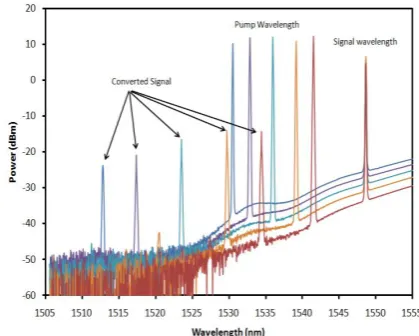
The dual-wavelengths fiber laser provides the required sources for generating the converted signal based on FWM in the highly nonlinear optical in the ring cavity as shown in Fig. 4. The generation of this converted signal is depends on the power of the pump and signal wavelengths where a strong pump transfers its energy to create this converted signal as shown in Fig. 4. To achieve the highest converted signal output power, the pump power should be higher than the signal power and this can be done by controlling the cavity loss using variable optical coupler.
Hence, the highest output power of the converted signal with -16.8dBm is obtained when the pump and signal powers are set to +13.3dBm and +5dBm respectively. From Fig. 4, it can be infer that the converted signal power increases when the pump power is nearing the signal power. In addition, an additional idler wavelength is generated when the pump power is almost the same with the signal power. This is due to the power of the first idler is enough to generate the additional idler wavelength.
Fig. 4 Spectra of the FWM at different pump wavelength for different AWG channel.
In Fig. 5, the FWM conversion efficiency of dual-wavelength fiber laser as a function of wavelength detuning is plotted based on calculation and measurement values. Measurement of the conversion efficiency from the spectrum obtained using OSA is shown in Fig. 6, where the FWM conversion efficiency η(dB) = Psignal(dBm) – PFWM(dBm).
205
zero-dispersion wavelength. Conversely, from the experiment carried out, the FWM conversion efficiency at zero-dispersion wavelength with the same wavelength detuning is lower compared to one at 1560nm region due to the higher ASE level in this region as shown in Fig. 2. This is due to the emission from the 11m EDF is shifted to a longer wavelength. In short, the use of the longer EDF contributes to a higher output power which will enhance the FWM effect. However, the maximum FWM conversion efficiency has shifted to a longer wavelength specifically the 1560nm region. In this experiment, the work to measure the FWM conversion efficiency curve in the 1560nm region is limited by the operating wavelength of AWG which covers the wavelength range from 1530.5nm to 1548.6nm.
Fig. 5 FWM conversion efficiency versus wavelength detuning in HNLF for the
dual-wavelength fiber laser.
Based on equation (6), the FWM output power obtained from calculation is presented in Fig. 7. It shows that the FWM output power is around -22dBm at wavelength detuning from 5nm to 15nm with the input pump and signal powers set at +13.3dBm and +5dBm, respectively.
Fig. 6 Measurement of conversion efficiency in the OSA.
However, the FWM output power obtained from measurement varies from -16dBm to -20dBm with wavelength detuning from 3nm to 18nm, respectively. The output power slowly decreased when the wavelength detuning increased and this can be verified from calculation.
Fig. 7 FWM output power versus wavelength detuning between pump and signal.
206
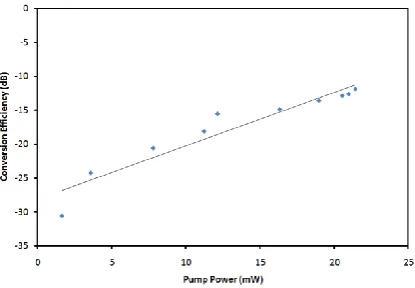
power less than 1mW, the conversion efficiency drops by about 19dB compared to the maximum value.
Fig. 8 FWM output power versus input pump power.
Fig. 9 shows the SNR of the converted signal against the wavelength detuning. Results show that the SNR varies between 30dB to 40dB with wavelength detuning up to 15nm. Fig. 9 also shows that closer wavelength detuning results in lower SNR because the peak of FWM product power overlaps with the ASE generated by the EDF. The characteristics of the FWM in dual-wavelength fiber laser of HNLF are important for wavelength converter application to avoid distortion of the output signal.
Fig. 9 Optical signal to noise ratio against wavelength detuning.
5. Conclusion
In this paper, we demonstrate the use of a self-constructed dual wavelength fiber laser tunable in the 1550 nm region as pump source and signal probe for FWM generation in a highly non-linear fiber. The tunability is achieved using an arrayed waveguide grating which provides different wavelength
combinations of the dual-wavelength fiber laser output and can be tuned from 1530.47nm to 1548.61nm with a spacing of 100GHz. The highly nonlinear fiber has a nonlinear coefficient, γ of 10.8 W-1km-1. To achieve
higher FWM output power the pump power of the dual wavelength fiber laser has to be higher than that of the signal probe. The optimum measured values of pump and signal power are +13.3dBm and +5dBm respectively, limited buy the current experimental setup. In our case, the FWM conversion efficiency is higher when the pump and signal wavelength are set at the highest ASE level instead of the zero-dispersion wavelength. This means that the FWM conversion efficiency is more dependent on the wavelength detuning between pump and signal wavelength than the zero-dispersion wavelength in a dual-wavelength fiber laser configuration.
References
[1] Danielsen, S.L., Hansen, P.B. & Stubkjaer, K.E. (1998). “Wavelength Conversion in Optical Packet Switching” in Journal of Lightwave Technology, Vol. 16. No. 12 pp. 2095.
[2] Kovacevic, M. & Acampora, A. (1996). “Benefits of Wavelength Translation in All-Optical Clear-Channel Networks” in Journal on Selected Areas in Communications, Vol. 14. No. 5 pp. 868-880.
[3] Yoo, S.B. (1996). “Wavelength Conversion Technologies for WDM Network Applications” in Journal of Lightwave Technology, Vol. 14. No. 6 pp. 955-966.
[4] Patrick, D.M. & Manning, R.J. (1994). “20 Gbit/S Wavelength Conversion using Semiconductor Nonlinearity,” in Electronics Letters, Vol. 30. No. 3 pp. 252-253.
[5] Durhuus, T., Joergensen, C., Mikkelsen, B., Pedersen, R.J.S. & Stubkjaer, K.E. (1994). “All Optical Wavelength Conversion by SOA's in a Mach-Zehnder Configuration,” in
Photonics Technology Letters, Vol. 6. No. 1 pp. 53-55.
207
Converter,” in Photonics Technology Letters, Vol. 7. No. 11 pp. 1276-1278. [7] Inoue, K. & Oda, K. (1995). “Noise
Suppression in Wavelength Conversion using a Light-Injected Laser Diode,” in Photonics Technology Letters, Vol. 7. No. 5 pp. 500-501.
[8] Kikuchi, N. & Sasaki, S. (1993). “Noise Analysis for Optical Frequency Conversion using Nearly Degenerate Four Wave Mixing in Semiconductor Optical Amplifier” in Journal of Lightwave Technology, Vol. 11. No. 56 pp. 819-828.
[9] Schunk, N., Groβkopt, G., Ludwig, R., Schnabel, R. & Weber, H.G. (1990). “Frequency Conversion by Nearly-Degenerate Four-Wave Mixing in Traveling-Wave Semiconductor Laser Amplifiers,” in Proceedings J (Optoelectronics), Vol. 137. No. 4 pp. 209-214.
[10] Kothari, N.C. & Blumenthal, D.J. (1996). “Influence of Gain Saturation, Gain Asymmetry, and Pump/Probe Depletion on Wavelength Conversion Efficiency of FWM in Semiconductor Optical Amplifiers” in Journal of Quantum Electronics, Vol. 32. No. 10 pp. 1810-1816.
[11] D'Ottavi, A., Iannone, A., Mecozzi, A., Scotti, S., Spano, P., Dall'Ara, R. & Guekos, G. (1995). “Efficiency and Noise Performance of Wavelength Converters Based on FWM in Semiconductor Optical Amplifiers” in
Photonics Technology Letters, Vol. 7. No. 4 pp. 357-359.
[12] Chow, K.K., Mak, M.W.K., Shu, C., & Tsang, H.K. (2002). “Widely Tunable All-Optical Wavelength Converter using a Fiber Ring Cavity Incorporating a Semiconductor Optical Amplifier” in Optics Communications, Vol. 203, No.1 pp. 101-106.
[13] Chow, K.K., Shu, C., Mak, M.W.K. & Tsang, H.K. (2002). “Widely Tunable Wavelength Converter using a Double-Ring Fiber Laser with a Semiconductor Optical Amplifier” in
Photonics Technology Letters, Vol. 14. No. 10 pp. 1445-1447.
[14] Agrawal, G.P. (1995). Nonlinear Fiber Optics. 2nd Edition, Academic
Press, pp. 322-324.
[15] Hill, K.O., Johnson, D.C., Kawasaki, B.S. & Macdonald, R. I. (1978). “CW Three‐Wave Mixing in Single‐Mode Optical Fibers,” in Journal of Applied Physics, Vol. 49. No. 10 pp. 5098-5106.
[16] Shibata, N., Braun, R. P. & Waarts, R. G. (1987). “Phase-Mismatch Dependence of Efficiency of Wave Generation Through Four-Wave Mixing in a Single-Mode Optical Fiber,” in Journal of Quantum Electronics, Vol. 23. No. 7 pp. 1205-1210.
[17] Deepa, R. & Vijaya, R. (2007). “Generalised Dispersive Phase and its Effect on Four Wave Mixing in Fibers,” in Optics Communications, Vol. 269. No. 1 pp. 206-214.
[18] Song, S., Allen, C. T., Demarest, K. R. & Hui, R. (1999). “Intensity-Dependent Phase-Matching Effects on Four-Wave Mixing in Optical Fibers,” in Journal of Lightwave Technology, Vol. 17. No. 11 pp. 2285-2290.
[19] Inoue, K. (1992). “Four-Wave Mixing in an Optical Fiber in the Zero-Dispersion Wavelength Region” in
Journal of Lightwave Technology, Vol. 10. No. 11 pp. 1553-1561.
[20] Hasegawa, T., Nagashima, T. & Sugimoto, N. (2008). “Determination of Nonlinear Coefficient and Group-Velocity-Dispersion of Bismuth-Based High Nonlinear Optical Fiber by Four-Wave-Mixing,” in Optics Communications, Vol. 281. No. 4 pp. 782-787.