Method for Detection of Nuclear-Plasma Interactions in a
134
Xe-Doped Exploding Pusher at the National Ignition Facility
∗
)
Darren L. BLEUEL
1), Lee A. BERNSTEIN
1), Christopher A. BRAND
1,2), William S. CASSATA
1),
Brian H. DAUB
1,2), Lucile S. DAUFFY
1), Bethany L. GOLDBLUM
2), James M. HALL
1),
Chris A. HAGMANN
1), Laura Berzak HOPKINS
1), Hesham Y. KHATER
1), Andrea L. KRITCHER
1),
Dieter H. G. SCHNEIDER
1), Sunniva SIEM
3), Carol A. VELSKO
1)and Mathis WIEDEKING
4)1)Lawrence Livermore National Laboratory, Livermore, CA 94550, USA 2)University of California, Berkeley, CA 94720, USA
3)University of Oslo, N-0316 Oslo, Norway 4)iThemba LABS, Somerset West 7129, South Africa
(Received 10 July 2015/Accepted 26 February 2016)
Angular momentum changes due to nuclear-plasma interactions on highly-excited nuclei in high energy density plasmas created at the National Ignition Facility can be measured through a change in isomer feeding following gamma emission. We propose an experiment to detect these effects in133Xe∗ in exploding pusher
capsules.
c
2016 The Japan Society of Plasma Science and Nuclear Fusion Research
Keywords: nuclear, plasma, laser, isomer, high energy density, activation, fusion DOI: 10.1585/pfr.11.3401075
1. Introduction
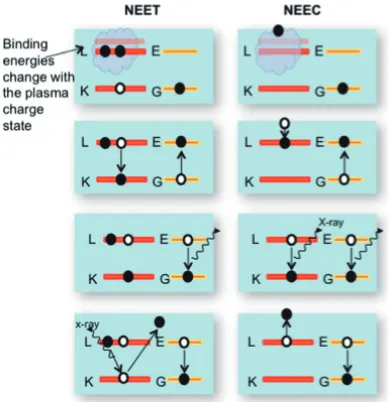
Electron-mediated nuclear-plasma interactions (NPIs) such as Nuclear Excitation by Electron Capture (NEEC) or Transition (NEET) are expected to cause significant changes in reaction cross sections in High Energy Den-sity Plasmas (HEDPs) such as nuclear weapons tests, Na-tional Ignition Facility (NIF) shots, and astrophysical set-tings. However, NPIs remain largely unobserved due to the extreme narrowness of nuclear transitions (Γ≤1µeV). A schematic of the NEEC and NEET processes are shown in Fig. 1. In both cases, the atomic binding energies are modified in the plasma environment due to charge state and screening effects. For NEEC, an electron is resonantly captured into an atomic orbital where the binding energy plus the electron kinetic energy is equal to the first excited nuclear state (for excitations offthe ground state). For the NEET process, atomic electrons transition with a binding energy difference equal to the nuclear excitation energy. Then, the binding energy (for NEET) or the free electron energy plus the binding energy (for NEEC) is resonantly transferred to the nucleus via a virtual photon and the nu-cleus becomes excited.
HEDP environments are expected to have a signifi-cant effect on cosmogenic nucleosynthesis, the formation of heavy elements from pre-existing nucleons in astrophys-ical plasmas [1]. Nuclei in stellar plasmas reach a thermal population of low-lying excited nuclear states from
photo-author’s e-mail: [email protected]
∗)This article is based on the presentation at the Conference on Laser
Energetics 2015 (CLE2015).
Fig. 1 Schematic of the NEET (left) and NEEC (right) pro-cesses. The red levels denote the atomic shells (L and M) and the yellow levels denote the nuclear excited and ground states (E and G). The top two boxes depict the ex-citation method while the bottom two show two different de-excitation schemes.
excitation, NEEC, NEET, and inelastic electron scattering in the dense plasma. Thermally-excited nuclei have dif-ferent spin, parity, and Q values leading to significantly modified neutron capture cross sections, and therefore dif-ferent isotopic and elemental abundances. The ratio of capture cross sections for thermally-excited nuclei
com-c
2016 The Japan Society of Plasma
pared to ground state nuclei is referred to as the stellar en-hancement factor (SEF). In addition to this well-known but experimentally-unobserved effect of NPIs on low-lying nu-clear states, NPIs may affect thermal neutron capture cross sections after the absorption of a neutron but before subse-quent emission of a gamma ray. In such a case, small in-creases in angular momentum near the neutron separation energy due to NPIs dramatically increase the probability of neutron re-emission. The relevance of these processes to post-capture nuclei is subject to a competition between the short lifetimes (∼fs) of highly-excited states versus the large number of nuclear transitions available and high elec-tron and photon fluxes. Modeling of these effects is un-wieldy due to the large number of both atomic and nuclear transitions possible, necessitating experimental measure-ments.
Although there have been extensive theoretical studies on this subject, previous attempts to measure NEEC have been unsuccessful [2], including our own attempts [3] to detect the NEEC process by resonantly exciting the ground state of181Ta and187Os in plasmas generated at the Omega Facility at the Laboratory for Laser Energetics at the Uni-versity of Rochester. The limited observations of the par-allel bound-state process NEET are controversial and have been restricted to non-plasma environments [4–6]. We will overcome this challenge by inducing NPIs on highly-excited (∼1 - 5 MeV) nuclear states produced by nuclear reactionspriorto their decay by spontaneous gamma-ray emission. The large density of nuclear states (≥ 10−1
-100 eV−1) at these excitation energies increases the
prob-ability that the energy from the atomic transition will res-onantly match an available nuclear transition. In addition, we will exploit a new experimental signature–the diff er-ential population of a high-spin isomer–to observe these effects.
2. The Double Isomer-to-Ground
State (DIGS) Ratio: a Signature of
NPIs
A major challenge in the search for NPIs is the ob-servation of a clear signature of the effect in a highly-chaotic HEDP environment. The energy transfer is usually small (keV) and the subsequently emitted radiation is over-whelmed by the background radiation in the HEDP. We propose a new signature for NPIs on highly-excited nuclei: the differential population of an isomeric state versus the ground state of the de-excited nucleus.
While (n, γ) reactions are of primary importance to astrophysical and other HEDP environments, we may ob-serve the same NPI effects following (n,2n) reactions at the NIF, which initially populate states several MeV below the neutron separation energy prior to gamma emission. Though energy transfer by NPIs is small, changes in angu-lar momentum can accompany this small energy transfer in highly-excited nuclei following (n,2n) reactions but prior
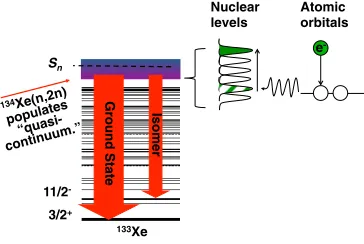
Fig. 2 Electron-mediated nuclear-plasma interactions change the angular momentum distribution, leading to a change in subsequent isomer population.
to gamma emission. An experimentally-accessible candi-date is133Xe∗, created in134Xe(n,2n) reactions, which has
a long-lived 11/2- isomer and a 3/2+ground state. The ca-pability of NPIs to produce differential isomer population for reactions in versus out of a plasma is shown schemati-cally in Fig. 2. The double isomer-to-ground-state (DIGS) ratio is defined as
RDIGS =
NcapsuleXe-133m/NcapsuleXe-133g NXe-133m
TOAD /N Xe-133g TOAD
, (1)
where N is the number of each state populated, determined from its characteristic-energy gamma ray emissions mea-sured in a high-purity germanium detector. A non-unity DIGS ratio for the133mXe/133gXe fraction formed in an
exploding pusher capsule plasma divided by same quan-tity for an externally-mounted, non-plasma “TOAD” (Tar-get Option Activation Device) sample will show NPIs took place on highly-excited states in133Xe.
3. Proposed Experiment
The National Ignition Facility (NIF) uses up to 2 MJ of laser energy to implode capsules of deuterium-tritium fusion fuel to pressures, densities, and temperatures sim-ilar to the core of the sun [7]. The combination of the large instantaneous neutron, photon and electron fluxes present in a NIF capsule is a unique environment for prob-ing the interaction between highly-excited nuclear states with a HEDP. We propose an experiment at the NIF to observe NPIs on highly-excited133Xe∗ using an existing
will be doped with 0.03 atm isotopically-pure (>99%)
134Xe. Indirect laser drive using 933 kJ of laser energy at
a peak power of 325 TW will produce>1014 DT fusion neutrons, inducing134Xe(n,2n) reactions in akT >5 keV plasma to produce133Xe∗ in a highly-excited state a few
MeV below the neutron separation energy.
Repeated NPIs in the high energy density plasma will transfer energy and angular momentum, altering the sub-sequent isomer population. The xenon originally loaded in the capsule will be collected in the existing RAGS (Radio-chemical Analysis of Gas Samples) collectors, with mea-sured collection efficiency greater than 50%, and trans-ported to a low-background counting facility. As a con-trol,134Xe will also be loaded into one or more “TOAD”
sealed containers located 50 cm from the implosion on up to three Diagnostic Instrument Manipulators (DIMs) irra-diated with the same neutron spectrum. The thin shell and low compression of the exploding pusher ensures mini-mal difference between the original fusion neutron spec-trum (overwhelmingly 14 MeV) in the plasma and that in-cident on the TOADs. The post-shot TOAD samples will be retrieved and also taken to a low-background facility for counting on the same detectors such that systematic un-certainties are the same between each sample and cancel in the DIGS ratio. The 133mXe isomer emits a 233 keV gamma ray with a half life of 2.19 days while the133gXe
ground state beta decays, emitting an 81 keV gamma ray with a 5.43 day half life. Thus sufficient time is available for sample retrieval and delivery without significant decay of the species to be measured.
A previous NIF direct-drive exploding pusher shot (N120228-001) with 0.057 atms of a 52/44/4 mix of124Xe, 126Xe and128Xe doping demonstrated the feasibility of
ir-radiating, collecting, and counting xenon activation prod-ucts [10]. The radioactive123,125,127Xe products were
col-lected using RAGS and counted ≈5 hours after the shot at the Building 151 nuclear counting facility at Lawrence Livermore National Laboratory.
The measured relative126Xe(n,2n)/124Xe(n,2n) ratio
was 1.22±0.05 (σstatistical = 4.1%). We anticipate bet-ter counting statistics in our experiment since the133mXe and133gXe are significantly longer-lived than the123,125Xe radionuclides (2.00 and 17.1 hr respectively) resulting in fewer lost decays during retrieval and transport. Further-more, the samples will be counted much closer to the de-tector (since only the ratio of the gamma-ray intensities and not their absolute magnitudes are important), and the yield will be higher. A statistical uncertainty of less than 1% is easily achievable based on these improvements.
The TOAD has an interior gas volume of 34.3 cm3.
For a NIF shot yield of 1014neutrons, the fluence at 50 cm
from the implosion where the TOAD is located will be 3× 10⁹n/cm2, inducing 6×10⁶(n,2n) reactions. This is more
than sufficient to detect more than 10,000γrays, achieving < 1% statistical uncertainty, in a high-purity germanium detector with∼1% photopeak efficiency over a several-day
measurement.
A potential background source of non-plasma xenon reaction products collected by RAGS is due to neutrons reacting with residual xenon in the capsule fill tube. An MCNP [11] simulation, conservatively assuming no atten-uation, constant temperature and pressure, and a capsule compression to 200µm (similar to the NIF shot designated N130503), has shown this contributes no more than 10−5
the number of reactions as in the capsule.
Another potential background source of 134Xe
pro-duction is from thermal neutrons, which may induce
132Xe(n, γ)133Xe reactions on small impurities in the xenon
gas. With an expected 0.3%132Xe impurity in a 99%
en-riched134Xe gas and a thermal neutron fraction of 3% of
the 14 MeV fluence, the fraction of133Xe produced from
these (n, γ) reactions only is 2.5x10⁻⁵.
While the thermal cross section for133Xe(n, γ)134Xe
is quite high (190 b), no significant depletion of the133Xe
product is expected due to the low number density of nuclei produced (∼10−12of the132Xe impurity).
The Hauser-Feshbach nuclear reactions code, TALYS [12] was used to predict isomer and ground state popu-lation from this reaction. By default, TALYS uses the first ten known discrete levels in 133Xe, above which a level density model is used. This number was increased to 28 to include known, prominent, low-lying, isomer-feeding states (such as the twelfth level at 1.1695 MeV withJ =13/2−). Changing this parameter, TALYS pre-dicts cross sections of the134Xe(n,2n) reaction leading to
the isomer and ground state of133Xe to be, respectively,
0.75 b and 0.93 b, consistent with the limited experimental data available for this reaction [13, 14]. Thus these TALYS level parameters were later used (see next Section) to pre-dict the cross sections at lower energies where measure-ments are unavailable. The ratio of this isomer cross sec-tion to the ground state cross secsec-tion is 0.8. This near-equal population of each state provides ideal detection statistics and sensitivity to perturbation.
The baseline population 133mXe/133gXe ratio from
14 MeV neutrons was measured using the DT generator lo-cated at iThemba LABS in South Africa. Results from that experiment are currently under analysis. Further quantifi-cation of background reactions and rate parameters could be obtained through thermal neutron capture experiments on 132Xe at a reactor or other thermal neutron source, and radiative strength function/level density measurements using the “Oslo method” [15] in inverse kinematics at iThemba using thed(132Xe,133Xe∗)preaction.
4. MCNP Modeling of the Neutron
Scatter E
ff
ect on the DIGS Ratio
ef-Fig. 3 Geometry of NIF chamber and internal components mod-eled with MCNP to determine neutron downscatter in
the TOAD xenon. The NIF chamber and target bay
(left) surround the DIMs and cryo-TARPOS (right). Each DIM holds a TOAD (bottom left) and the capsule is con-tained within a hohlraum in the thermomechanical pack-age (bottom right) at the end of the cryo-TARPOS.
1
10-1
10-2
10-3
10-4
Fig. 4 Normalized neutron spectra (n/cm2/MeV which inte-grates to unity over all energies) in the capsule (red) and the TOAD (blue) above the 8.6 MeV threshold, along with the isomer-to-ground state (m-g) cross section ra-tio (green, right axis) produced in134Xe(n,2n) reactions predicted by TALYS for both the default number of dis-crete levels used (DL=10) and increased values (DL= 20 and 28). Experimentally-measured ratios [13, 14] are noted by datapoints. Statistical uncertainties in the neu-tron spectra are smaller than the datapoints.
fect has been quantified with MCNP modeling of the NIF chamber and target bay, including the capsule, hohlraum, thermo-mechanical package, cryo-TARPOS, three DIMs, and a TOAD mounted to the side of each DIM, elements of which are depicted in Fig. 3. From the energy-dependent isomer-to-ground state ratio calculated with TALYS (see previous Section) shown in Fig. 4, it is apparent that neu-trons scattering off components in the NIF chamber to lower energies (down to the (n,2n) threshold of 8.6 MeV) will decrease the isomer-to-ground state population in the TOAD, increasing the DIGS ratio defined in Eq. 1. If un-corrected, this will mask NPI effects expected to decrease the DIGS ratio.
The neutron flux inside the imploding capsule and in-side the134Xe gas contained in the 1 mm thick aluminum
TOAD are also shown in Fig. 4. Convoluting these spectra with the calculated cross sections including all 28 known
discrete levels in the model, it is predicted that the diff er-ence in neutron spectra will produce only a 0.12% increase in the DIGS ratio, independent of NPI effects.
The small magnitude of this effect can be attributed to both the low amount of neutron scatter into the 8 - 14 MeV region and the relative invariance of the isomer-to-ground state ratio as a function of neutron energy. In a more conservative assumption, if the number of dis-crete levels included in TALYS is reduced to 20, the ef-fect of the scattered neutrons on the DIGS ratio is still only 0.21%. Major sources of scattered neutrons in this latter, more conservative, simulation include the hohlraum (in-creasing DIGS 0.02%), the tantalum blast plate in front of the TOAD (0.02%) the aluminum TOAD walls (0.05%), the aluminum mount behind the TOAD (0.03%), the DIM (0.05%), and the xenon gas itself (0.03%).
Replacing all the aluminum components of the TOAD and mount with a high-Z material like tantalum reduces this effect by about half. Such a redesign would improve the measurement, but is deemed unnecessary given the small and calculable effect.
The deployment of multiple TOADs of varying ma-terials and thicknesses on up to three DIMs with different lines-of-sight in test shots will provide confidence in this modeling. Any changes in the DIGS ratio from one posi-tion to another, will indicate scattering effects rather than NPIs.
5. Predicted Results
Predicting the exact impact of NPIs on the relative populations of 133mXe and 133gXe is a significant
chal-lenge, due in part to the extremely large number of possi-ble atomic transitions coupled to a similarly large number of nuclear transitions. The probability of an NPI is also ex-tremely uncertain due to its dependence on the low-energy (keV) photon transition strength, characteristic of the Xe M-, L-, and K-shell atomic binding energies.
Top to bottom, respectively, Fig. 5 shows the ini-tial excitation energy and angular momentum states popu-lated immediately after134Xe(n,2n)133Xe∗, the subsequent gamma decay path predicted (in the absence of NPIs), and the angular momentum distribution of the nucleus’ actual levels predicted by TALYS. Multiple NPIs will on average shift the angular momentum towards the actual available level distribution, overall lowering the angular momentum distribution as the nucleus decays by gamma-ray emission as indicated in the lower panel of Fig. 5. This lowering of angular momentum will increase the proportion of decays that populate the lower-spin ground state of133gXe versus
the higher-spin133mXe isomer.
Fig. 5 TALYS predictions of the energy (E) and angular dis-tribution (J) of states populated immediately following 134Xe(n,2n)133Xe∗ reactions (top), the predicted
unper-turbed gamma decay path (middle), versus theE/J dis-tribution of actual available states (bottom).
5.1
NPI rate
To determine the rate of NPIs on an excited state, we assume a local thermal equilibrium environment and use the principle of detailed balance, following the methodol-ogy of Gosselin and Morel [16] in which the rate of NEEC between an initial stateiand a final state f is given by
λNEEC
d =
2Jf +1 2Ji+1
α(Te) ln(2)
Tiγ→f fFD(Eb)(1−fFD(Er))
×1 2
erf
E
r ε√2
−erf
E
b ε√2
, (2)
where Ji and Jf are the spins of states i and f; α(Te) is the internal conversion coefficient for thei→ f transition;
Tiγ→f is the radiative lifetime of the transition; fFD is the Fermi-Dirac function; Er and Eb are the free and bound electron energies, which are assumed to resonantly match thei → f transition, andεis the dispersion of the elec-tronic transition energy around the average atom value.
Rather than using the average atom model, however, we use the calculated energies of specific states and con-figurations from the atomic physics code FLYCHK [17], which replaces the error functions with a sum over all bound statesb. Furthermore, we assume that our initial stateiis in the quasi-continuum, and so instead of a single state f, we consider all possible final nuclear states, which we represent with the level densityρ(Ei+(Er+|Eb|),Jf), and replaceTiγ→f with the average transition strength,
λNEEC
d =
all b 2Jf+1 2Ji+1
α(Te) ln(2)
Tiγ→f ρ(
Ei+(Er+|Eb|),Jf) ×fFD(Eb)1−fFD(Er)
. (3)
Now we substitute the expression for the photon strength function,S(Eγ),
S(Eγ)= 2
ρ(Ei+Eγ,Jf)
Tiγ→fEγ3 , (4)
where Eγ = Er +|Eb|, and finally, we integrate over all possible electron energies with a differential electron flux
dΦ(Er)
dEr , yielding λNEEC
d =
dEr dΦ(Er)
dEr
all b 2Jf+1 2Ji+1
α(Te) ln(2)E3γ
×S(Eγ)fFD(Eb)1−fFD(Er)
.
(5) Unfortunately, no measurements of the photon strength function,S(Eγ), in the quasi-continuum have been made below∼1 MeV, which is well above the transition energies whereα(Te) is substantial. To bound the possi-ble NEEC rate, we consider two possipossi-ble photon strength functions. The lower bound is based on the assumption that the photon strength function at low energies follows the generalized Lorentzian form seen at higher energies. With this photon strength function and a typical level den-sity in the quasi-continuum, even in very hot, dense plas-mas, the NEEC rate is on the order of 1/ns. To determine the upper bound, we assume that the photon strength func-tion is given by the single-particle estimate, in which case the NEEC rate can be as high as 0.1−10 fs−1.
5.2
Gamma-decay modification due to NPIs
To estimate the impact on high spin isomer produc-tion, we must include NPIs in a Hauser-Feshbach model. For some initial excited statei, the total decay width is the sum of all possible partial decay widths. The branching ratio to a specific final state f is given by the ratio of the partial decay width to this total decay width.until the population of the highest energy bin falls below 10−8 mb/MeV. The process is then begun again with the next highest energy bin. This is repeated until the decay is complete, and then the isomer to ground state ratio is com-puted. Based on these results, an NPI rate of∼0.4 fs−1is
required to reduce the isomer to ground state ratio by 5%. A rate of 1/fs will reduce this ratio by 10%. For the lower limit of the NPI rate, based on the generalized Lorentzian photon strength function, no visible impact will be seen in the DIGS ratio, but a 5 - 10% effect will be measurable for the single particle estimate of the PSF.
This analysis neglects the NEET process which may contribute significantly more to the NPI rate. Furthermore, this estimate is also sensitive to the low-energy portion (∼keV) of the photon strength function characteristic of the Xenon M-, L-, and K-shell atomic binding energies. The low-energy portion of the strength function in similar-mass nuclei has exhibited an unexpected and unexplained dipole enhancement at low energies [18, 19], deviating dramati-cally from the Lorentizian models. Only the tail of this enhancement above 1 MeV has been measured, however. Depending on the keV nature of the enhancement, which is not included in the generalized Lorentzian used in TALYS calculations, reaction rates could increase by many orders of magnitude. Even if no change in the DIGS ratio is ob-served, limits can be set on the low-energy photon transi-tion strength in the quasi-continuum, where no measure-ments are currently possible and theoretical estimates vary by many orders of magnitude.
6. Conclusions
The DIGS ratio is introduced as a signature for de-tecting angular momentum changes due to NPIs on highly-excited nuclei prior to gamma emission. We propose an ex-periment at the NIF to detect NPIs using the DIGS ratio in highly-excited133Xe∗, produced in134Xe(n,2n) reactions,
loaded into an indirect drive exploding pusher capsule. If the DIGS ratio does not deviate from unity, indicating NPI effects, limits can be set on the unknown low-energy pho-ton transition strength in the quasi-continuum. Deviation from unity will indicate, for the first time, the alteration of a nuclear reaction due to a plasma environment.
Acknowledgements
This work performed under the auspices of the UC Office of the President and the U.S. Department of En-ergy by Lawrence Livermore National Laboratory under Contract DE-AC52-07NA27344 and the University of Cal-ifornia Office of the President Laboratory Fees Research Program under Award 12-LR-238745. Dr. Wiedeking
ac-knowledges support from the National Research Founda-tion of South Africa.
[1] Z.Y. Bao, H. Beer, F. Kappeler, F. Voss and K. Wisshak, Atomic Data Nucl. Data Tables76, 70 (2000).
[2] Personal Communication with V. Meot, CEA (unpublished). [3] A. Kritcheret al.(in preparation).
[4] S. Kishimoto, Y. Yoda, M. Seto, Y. Kobayashi, S. Kitao, R. Haruki, T. Kawauchi, K. Fukutani and T. Okano, Phys. Rev. Lett.85, 1831 (2000).
[5] S. Kishimoto, Y. Yoda, Y. Kobayashi, S. Kitao, R. Haruki and M. Seto, Nucl. Phys. A748, 3 (2005).
[6] I. Ahmad, R.W. Dunford, H. Esbensen, D.S. Gemmell, E.P. Kanter, U. Rtt and S.H. Southworth, Phys. Rev. C61, 051304 (2000).
[7] M.J. Edwards, P.K. Patel, J.D. Lindl, L.J. Atherton, S.H. Glenzer, S.W. Haan, J.D. Kilkenny, O.L. Landen, E.I. Moses
et al., Phys. Plasmas20, 070501 (2013).
[8] S. Le Pape, L. Divol, L. Berzak Hopkins, A. Mackinnon, N. B. Meezan, D. Casey, J. Frenje, H. Herrmann, J. McNaney
et al., Phys. Rev. Lett.112, 225002 (2014).
[9] M.J. Rosenberg, A.B. Zylstra, F.H. Sguin, H.G.
Rinderknecht, J.A. Frenje, M. Gatu Johnson, H. Sio, C.J. Waugh, N. Sinenianet al., Phys. Plasmas21, 122712 (2014).
[10] D.A. Shaughnessy, C.A. Velsko, D.R. Jedlovec, C.B. Yea-mans, K.J. Moody, E. Tereshatov, W. Stoeffland A. Riddle, Rev. Sci. Instrum.83, 10D917 (2012).
[11] X-5 MONTE CARLO TEAM, “MCNP - A General Monte Carlo N-Particle Transport Code, Version 5 - Volume I: Overview and Theory”, LA-UR-03-1987, Los Alamos Na-tional Laboratory, revised 2/2008 (2008).
[12] A.J. Koning, S. Hilaire and M.C. Duijvestijn, “TALYS-1.0”, in Proceedings of the International Conference on Nuclear Data for Science and Technology, edited by O. Bersillon, F. Gunsing, E. Bauge, R. Jacqmin and S. Leray (Nice, France, 2007).
[13] R.A. Sigg and P.K. Kuroda, Nucl. Sci. Eng.60, 230 (1976). [14] A. Reggoug, G. Paic and M. Berrada, “Measurement of (n,2n) reaction cross sections by X-ray spectroscopy”, Prog. Univ. Mohammed V, Rabat, Annual Report No.5, p.14 (1982).
[15] A. Schiller, L. Bergholt, M. Guttormsen, E. Melby, J. Rek-stad and S. Siem, Nucl. Instrum. Methods Phys. Res. A447, 498 (2000).
[16] G. Gosselin and P. Morel, Phys. Rev. C70, 064603 (2004). [17] H.-K. Chung, M.H. Chen, W.L. Morgan, Yu. Ralchenko and
R.W. Lee, High Energy Density Physics1, 3 (2005). [18] M. Wiedeking, L.A. Bernstein, M. Krtiˇcka, D.L. Bleuel,
J.M. Allmond, M.S. Basunia, J.T. Burke, P. Fallon, R.B. Firestone, B.L. Goldblum, R. Hatarik, P.T. Lake, I-Y. Lee, S.R. Lesher, S. Paschalis, M. Petri, L. Phair and N.D. Sci-elzo, Phys. Rev. Lett.108, 162503 (2012).