R E S E A R C H
Open Access
Lung function in asbestos-exposed workers,
a systematic review and meta-analysis
Dennis Wilken, Marcial Velasco Garrido, Ulf Manuwald and Xaver Baur
*Abstract
Background:A continuing controversy exists about whether, asbestos exposure is associated with significant lung function impairments when major radiological abnormalities are lacking. We conducted a systematic review and meta-analysis in order to assess whether asbestos exposure is related to impairment of lung function parameters independently of the radiological findings.
Methods:MEDLINE was searched from its inception up to April 2010. We included studies that assessed lung function parameters in asbestos exposed workers and stratified subjects according to radiological findings. Estimates of VC, FEV1and FEV1/VC with their dispersion measures were extracted and pooled.
Results:Our meta-analysis with data from 9,921 workers exposed to asbestos demonstrates a statistically significant reduction in VC, FEV1and FEV1/VC, even in those workers without radiological changes. Less severe lung function
impairments are detected if the diagnoses are based on (high resolution) computed tomography rather than the less sensitive X-ray images. The degree of lung function impairment was partly related to the proportion of smokers included in the studies.
Conclusions:Asbestos exposure is related to restrictive and obstructive lung function impairment. Even in the absence of radiological evidence of parenchymal or pleural diseases there is a trend for functional impairment.
Keywords:Asbestos, lung function, chest X-ray, computed tomography, meta-analysis
Introduction
Asbestos fibres are one of the most pervasive environ-mental hazards because of their worldwide use in the last 100 years as a cheap and effective thermal, sound and electrical insulation material, especially in the con-struction, shipping and textile industries. The general public is also exposed to asbestos, mainly from dete-rioration and reconstruction or destruction of asbestos contaminated buildings, worn vehicle brake linings and from the deterioration of asbestos-containing products. In spite of outright bans or restrictions in nearly all industrialised countries nowadays, approximately 125 million workers are occupationally exposed to asbestos worldwide [1] and it is estimated that at least 100,000 die annually from complications of asbestos exposure [2]. In addition to mesothelioma, lung and laryngeal cancer, asbestos has long been known to cause
non-malignant pleural fibrosis, (i.e. circumscript pleural pla-ques (PP), or diffuse pleural thickening (DPT)), pleural effusions, rounded atelectasis and lung fibrosis (asbesto-sis). Since inhalation of high doses of asbestos fibres may lead to a variety of functional impairments, the monitoring of workers who have been exposed to asbes-tos, particularly of their lung function, has gained in importance over the years. The identification of func-tional abnormalities is also relevant for compensation issues. While compromised lung function in pronounced disease is widely accepted, controversies still remain about a possible relationship between earlier or milder non-malignant asbestos-induced pleural or parenchymal fibrosis and reduced lung function measurements [3-11]. The American Thoracic Society and the American Col-lege of Chest Physicians [12,13], in particular, have lamented the lack of definitive knowledge in the preva-lence and clinical relevance of asbestos-induced obstruc-tive airway diseases and have determined to make this a priority for investigation and elucidation.
* Correspondence: [email protected]
Institute for Occupational and Maritime Medicine, University Medical Center Hamburg-Eppendorf, Hamburg, Germany
Wilkenet al.Journal of Occupational Medicine and Toxicology2011,6:21 http://www.occup-med.com/content/6/1/21
We have conducted a systematic review and a meta-analysis of the literature with the aim of identifying and quantifying alterations of lung function parameters in subjects occupationally exposed to asbestos. The leading question was whether occupational exposure to asbestos leads to impairments of lung function independently from the non-malignant radiological findings (i.e. nor-mal chest radiograph (X-ray) or (high resolution) com-puted tomography (HR)CT, pleural plaques and diffuse pleural thickening or asbestosis).
Materials and methods Selection criteria
We included publications that assessed lung function parameters and radiological imaging (chest X-Ray or (HR)CT) in persons with occupational exposure to asbestos. Only studies that applied an internationally accepted quality standard for lung function testing (i.e. ATS standard, ERS standard) and that provided infor-mation about the corresponding reference values or used reference group were considered. We included only studies reporting lung function parameters expressed as percent-predicted with a corresponding dispersion measure (i.e. standard deviation, standard error or confidence interval) and assigned them to one of the following radiological categories:
A.“Normal imaging”, i.e. absence of pleural or lung parenchymal abnormalities.
B. “Pleural fibrosis”, i.e. presence of pleural plaques and/or diffuse pleural thickening.
C. “Asbestosis”, i.e. parenchymal fibrosis with or without pleural fibrosis.
To be included, studies had to provide data on the proportion of smokers among participants or on the dose (pack-years).
In a few potentially relevant studies the authors failed to report all information listed above (e.g. reference values, quality standards, dispersion measures), thus we tried to contact the authors in order to collect the missing data. Only three authors sent additional information that enabled us to include their publication in the meta-analysis.
Search strategy
MEDLINE was searched from its inception to April 2010 via PubMed with the following search strategy:
("Asbestosis"[Mesh] OR ("Pleural Diseases"[Mesh] AND “Asbestos"[Mesh]) OR ("occupational exposure" [Mesh] AND “Asbestos"[Mesh]) OR ("Lung diseases" [Mesh] AND “Asbestos"[Mesh])) AND “Respiratory Function Tests"[Mesh] AND ("occupational diseases" [Mesh] OR “occupational health"[Mesh] OR “ occupa-tional exposure"[Mesh])
We applied the following PubMed limits in order to increase the specificity of our search:
("humans"[MeSH Terms] AND (English[lang] OR
German[lang]) AND “adult"[MeSH Terms]) NOT
("Bronchoalveolar Lavage"[MeSH] OR “ Neoplasms"[-Mesh] OR“Case Reports“[Publication Type]).
Additionally, we scanned congress proceedings, refer-ence lists of relevant articles and searched our own archive for further potentially relevant publications not identified through the electronic search.
Data extraction
We extracted information on sample size, exposure to asbestos, proportion of non-smokers, radiological ima-ging method and lung function reference values together with the estimates for vital capacity (VC), forced expira-tory volume in the first second (FEV1) and FEV1/VC with their corresponding SD, SE or 95% CI. Most of the studies reported forced vital capacity (FVC), but in some papers it was not clear whether FVC or slow (relaxed) vital capacity (SVC) was measured. Data were extracted by at least two of the authors independently from each other and discrepancies were solved by consensus after discussion. (HR)CT-based diagnoses were favoured over those based on X-rays when both were available.
Data synthesis and statistical methods
We performed a meta-analysis to produce pooled esti-mates of VC, FEV1 and FEV1/VC for each of our desig-nated radiological categories (A, B or C). Within each radiological category, we conducted subgroup analysis according to the type of imaging method used for the diagnosis (X-ray or (HR)CT).
Some studies reported results for different degrees of radiological impairments within the same category (e.g. different ILO scores for asbestosis). In these cases, we pooled the subgroup estimates from the same study with a fixed effects model to obtain a single estimate for each study within each radiological category (A-C).
A random effects model was used to calculate overall estimates for each radiological category.
We calculated I2as an indicator for the degree of het-erogeneity across studies. Values of I2 under 25% indi-cate low, up to 60% medium and over 75% considerable heterogeneity, making it advisable to perform the analy-sis using the random effects model [14]. In order to assess whether any observed between-study heterogene-ity could be explained through study characteristics other than radiological imaging procedure, we also per-formed subgroup analysis for the proportion of never-smokers. For this purpose, we divided the study pool into two categories: studies with <25% of participants reporting to have never-smoked and studies with >= 25% of participants reporting to have never-smoked. Wilkenet al.Journal of Occupational Medicine and Toxicology2011,6:21
http://www.occup-med.com/content/6/1/21
A second subgroup analysis was done for mean dura-tion of asbestos exposure, dividing the study pool into two categories: studies reporting mean exposure dura-tion longer than the median duradura-tion of the whole sam-ple vs. studies with mean exposure duration shorter than median duration. In addition, we performed meta-regression analysis with the proportion of never-smokers and with the years of asbestos-exposed occupation.
All calculations were performed with the software Comprehensive Meta-Analysis 2.0. (Biostat™, Engle-wood, USA). Forest plot graphics were produced with Meta-Analyst Software [15]
Results
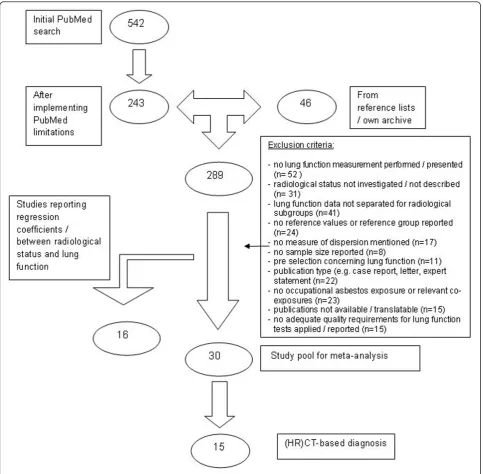
A total of 542 papers were identified by the electronic literature database search and a further 46 papers through manual searching in congress reports, reference scanning and from our own archive (Figure 1). After scanning titles and abstracts, 289 articles were selected for a detailed assessment of the full publication. From these 289 articles, 30 met the inclusion criteria for the meta-analysis. The most frequent reasons for exclusion were lack of information about lung function parameters and/or about radiological diagnoses and lack of report-ing statistical dispersion measures.
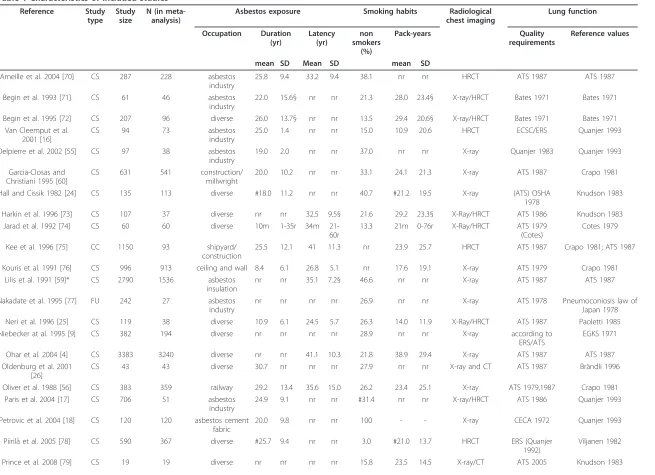
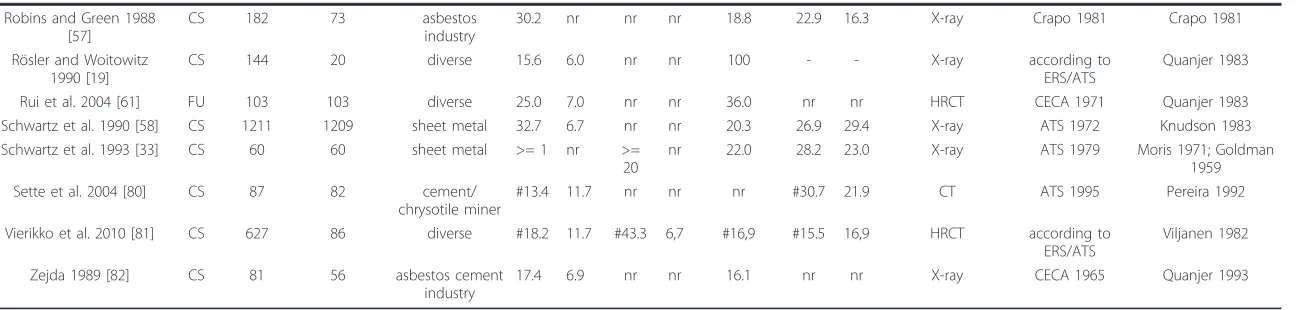
We included 27 cross-sectional studies, one case-control and two follow-up studies, comprising a total of 15,097 subjects of which the data for 9,921 were reported appropriately for inclusion in our meta-analy-sis. The characteristics of the included studies are shown in Table 1. Sample size ranged from 19 to 3,383. Some studies focussed on a specific occupation (e.g. asbestos manufacturing, insulation and cladding work, shipyard, asbestos industries, asbestos cement factory, ceiling tiles and wallboards, railway, ironwor-ker, sheet metal, construction carpenters and mill-wrights) while others included subjects from different occupational fields. The mean duration of occupational exposure to asbestos was reported in 22 studies (i.e. 73% of the study sample) and ranged from 8.4 ± 6.1 to 32.7 ± 6.7 years (mean ± SD). The latency time (i.e. the time since first exposure) was reported in only 9 studies (i.e. 30%) and ranged from 24.5 ± 5.7 to 43.3 ± 6.7 years (mean ± SD). Estimations of asbestos fibre concentration (i.e. fibre-years) were reported only rarely [16,17].
Except for two studies [18,19], all included current and/or former smokers. The proportion of participants reporting to be never-smokers ranged across the studies from only 3% to 100% (median 26.2%), with three stu-dies not reporting the proportion of never-smokers. Smoking severity was reported in 18 of the studies that included smokers and ranged from 14.0 ± 11.9 to 38.9 ± 29.4 pack-years (mean ± SD).
Radiological imaging was done relying exclusively on chest X-ray in 15 studies and relying exclusively on CT or HRCT in 7 studies. Eight studies considered both chest X-ray and CT/HRCT. Mainly VC, FEV1 or FEV1/ VC, or combinations of these parameters, were reported. Some studies provided additional parameters, but due to their scarcity and heterogeneity in assessment methods we did not include them in the meta-analysis. In all stu-dies, lung function test results were acquired according to a quality standard, with the majority (67%) following the American Thoracic Society (ATS) standard proce-dure available at the time. There was considerable het-erogeneity regarding the reference values used to calculate“percent of predicted”, with a total of 12 differ-ent reference values used across the included studies. The most frequently used reference values were those proposed by Quanjer 1983/1993 [20,21] (n = 5 studies), followed by those of the ATS [22] and Knudson 1983 [23] (both in 4 studies each).
Quantitative data synthesis
Figures 2, 3 and 4 provide an overview of the pooled estimates of lung function parameters according to radi-ological findings.
Vital capacity
Vital capacity (VC, FVC) was the parameter most com-monly reported in an adequate manner for inclusion in our meta-analysis. Overall, asbestos-exposed workers showed an impairment of vital capacity when compared with reference values (Figure 2). This impairment of vital capacity was already manifest in workers without radiological evidence of asbestos-related pleural or par-enchymal diseases (95.7%-predicted; 95%-CI 93.9, 97.3). The loss of vital capacity was most accentuated in sub-jects with radiological findings of asbestosis (86.5%-pre-dicted; 95%-CI 83.7, 89.4). The subgroup analysis based on the radiological procedure showed lower estimates of vital capacity in all three radiological categories among studies using conventional chest X-ray compared with those using (HR)CT (Table 2).
Heterogeneity was very high in all three radiological subgroups (I2 >90%) and remained after subgroup analy-sis according to radiological procedure.
FEV1
As for vital capacity, asbestos-exposed workers showed an impairment of FEV1 which was already present in workers with no radiological evidence of asbestos-related disease and was considerably more pronounced in subjects with radiological signs of asbestos-related pleural and/or parenchymal diseases (Figure 3). Again, the subgroup analysis showed differences between stu-dies using chest X-ray and stustu-dies using (HR)CT (Table Wilkenet al.Journal of Occupational Medicine and Toxicology2011,6:21
http://www.occup-med.com/content/6/1/21
2). The differences between both imaging procedures were particularly pronounced for subjects identified as having asbestos-related pleural disease. For this group of patients, the estimate of FEV1 obtained from the sub-group of studies using conventional X-ray was about 10 percent lower than estimate obtained from HR(CT) stu-dies (83.9%-predicted; 95% CI 77.2, 90.5 vs. 93.7%-pre-dicted; 95% CI 87.6, 99.9) (Table 2).
Heterogeneity was also very high for these analysis (I2 >90%), but decreased to some extent when grouping studies according to radiological technique.
FEV1/VC
FEV1/VC was less commonly reported in an adequate manner for inclusion in our analysis. Slight FEV1/VC reductions were already seen in workers even without radiological signs of disease, and were similar to those seen for workers with evidence of pleural disease and for those with signs of lung fibrosis related to asbestos (Figure 4). As for the other lung function parameters, there were differences between studies according to the radiological method used, with a tendency to lower FEV1/VC among the studies using chest X-ray.
Figure 1Flow chart - Study selection process.
Wilkenet al.Journal of Occupational Medicine and Toxicology2011,6:21 http://www.occup-med.com/content/6/1/21
Table 1 Characteristics of included studies
Reference Study type
Study size
N (in meta-analysis)
Asbestos exposure Smoking habits Radiological chest imaging
Lung function
Occupation Duration (yr)
Latency (yr)
non smokers
(%)
Pack-years Quality
requirements
Reference values
mean SD Mean SD mean SD
Ameille et al. 2004 [70] CS 287 228 asbestos
industry
25.8 9.4 33.2 9.4 38.1 nr nr HRCT ATS 1987 ATS 1987
Begin et al. 1993 [71] CS 61 46 asbestos
industry
22.0 15.6§ nr nr 21.3 28.0 23.4§ X-ray/HRCT Bates 1971 Bates 1971
Begin et al. 1995 [72] CS 207 96 diverse 26.0 13.7§ nr nr 13.5 29.4 20.6§ X-ray/HRCT Bates 1971 Bates 1971
Van Cleemput et al. 2001 [16]
CS 94 73 asbestos
industry
25.0 1.4 nr nr 15.0 10.9 20.6 HRCT ECSC/ERS Quanjer 1993
Delpierre et al. 2002 [55] CS 97 38 asbestos
industry
19.0 2.0 nr nr 37.0 nr nr X-ray Quanjer 1983 Quanjer 1993
Garcia-Closas and Christiani 1995 [60]
CS 631 541 construction/
millwright
20.0 10.2 nr nr 33.1 24.1 21.3 X-ray ATS 1987 Crapo 1981
Hall and Cissik 1982 [24] CS 135 113 diverse #18.0 11.2 nr nr 40.7 #21.2 19.5 X-ray (ATS) OSHA
1978
Knudson 1983
Harkin et al. 1996 [73] CS 107 37 diverse nr nr 32.5 9.5§ 21.6 29.2 23.3§ X-Ray/HRCT ATS 1986 Knudson 1983
Jarad et al. 1992 [74] CS 60 60 diverse 10m 1-35r 34m
21-60r
13.3 21m 0-76r X-Ray/HRCT ATS 1979
(Cotes)
Cotes 1979
Kee et al. 1996 [75] CC 1150 93 shipyard/
construction
25.5 12.1 41 11.3 nr 23.9 25.7 HRCT ATS 1987 Crapo 1981; ATS 1987
Kouris et al. 1991 [76] CS 996 913 ceiling and wall 8.4 6.1 26.8 5.1 nr 17.6 19.1 X-ray ATS 1979 Crapo 1981
Lilis et al. 1991 [59]* CS 2790 1536 asbestos
insulation
nr nr 35.1 7.2§ 46.6 nr nr X-ray ATS 1987 ATS 1987
Nakadate et al. 1995 [77] FU 242 27 asbestos
industry
nr nr nr nr 26.9 nr nr X-ray ATS 1978 Pneumoconiosis law of
Japan 1978
Neri et al. 1996 [25] CS 119 38 diverse 10.9 6.1 24.5 5.7 26.3 14.0 11.9 X-Ray/HRCT ATS 1987 Paoletti 1985
Niebecker at al. 1995 [9] CS 382 194 diverse nr nr nr nr 28.9 nr nr X-ray according to
ERS/ATS
EGKS 1971
Ohar et al. 2004 [4] CS 3383 3240 diverse nr nr 41.1 10.3 21.8 38.9 29.4 X-ray ATS 1987 ATS 1987
Oldenburg et al. 2001 [26]
CS 43 43 diverse 30.7 nr nr nr 27.9 nr nr X-ray and CT ATS 1987 Brändli 1996
Oliver et al. 1988 [56] CS 383 359 railway 29.2 13.4 35.6 15.0 26.2 23.4 25.1 X-ray ATS 1979,1987 Crapo 1981
Paris et al. 2004 [17] CS 706 51 asbestos
industry
24.9 9.1 nr nr #31.4 nr nr X-ray/HRCT ATS 1986 Quanjer 1993
Petrovic et al. 2004 [18] CS 120 120 asbestos cement fabric
20.0 9.8 nr nr 100 - - X-ray CECA 1972 Quanjer 1993
Piirilä et al. 2005 [78] CS 590 367 diverse #25.7 9.4 nr nr 3.0 #21.0 13.7 HRCT ERS (Quanjer
1992)
Viljanen 1982
Prince et al. 2008 [79] CS 19 19 diverse nr nr nr nr 15.8 23.5 14.5 X-ray/CT ATS 2005 Knudson 1983
Wilken
et
al
.
Journal
of
Occupation
al
Medicine
and
Toxicology
2011,
6
:21
http://ww
w.occup-med.
com/content/6
/1/21
Page
5
of
Table 1 Characteristics of included studies(Continued)
Robins and Green 1988 [57]
CS 182 73 asbestos
industry
30.2 nr nr nr 18.8 22.9 16.3 X-ray Crapo 1981 Crapo 1981
Rösler and Woitowitz 1990 [19]
CS 144 20 diverse 15.6 6.0 nr nr 100 - - X-ray according to
ERS/ATS
Quanjer 1983
Rui et al. 2004 [61] FU 103 103 diverse 25.0 7.0 nr nr 36.0 nr nr HRCT CECA 1971 Quanjer 1983
Schwartz et al. 1990 [58] CS 1211 1209 sheet metal 32.7 6.7 nr nr 20.3 26.9 29.4 X-ray ATS 1972 Knudson 1983
Schwartz et al. 1993 [33] CS 60 60 sheet metal >= 1 nr >=
20
nr 22.0 28.2 23.0 X-ray ATS 1979 Moris 1971; Goldman
1959
Sette et al. 2004 [80] CS 87 82 cement/
chrysotile miner
#13.4 11.7 nr nr nr #30.7 21.9 CT ATS 1995 Pereira 1992
Vierikko et al. 2010 [81] CS 627 86 diverse #18.2 11.7 #43.3 6,7 #16,9 #15.5 16,9 HRCT according to
ERS/ATS
Viljanen 1982
Zejda 1989 [82] CS 81 56 asbestos cement
industry
17.4 6.9 nr nr 16.1 nr nr X-ray CECA 1965 Quanjer 1993
Main characteristics of the Studies included in the meta-analysis. SD: standard deviation, CI: confidence interval CC: Case-control, CS: Cross-sectional; FU: follow-up; nr: not reported; m: median; r: range; X-Ray: chest X-ray; HRCT: high resolution computer tomography; CT: computer tomography; #:for the included subjects; §: calculated from SE. *Additional information obtained from [83]
Wilken
et
al
.
Journal
of
Occupation
al
Medicine
and
Toxicology
2011,
6
:21
http://ww
w.occup-med.
com/content/6
/1/21
Page
6
of
Figure 2Forest plot of FVC (expressed as percent predicted with 95%CI) in asbestos-exposed collectives grouped according to the radiological status. 2A shows the subgroups without asbestos-related diseases, 2B shows the subgroups with pleural fibrosis and 2C shows the subgroups with asbestosis.
Wilkenet al.Journal of Occupational Medicine and Toxicology2011,6:21 http://www.occup-med.com/content/6/1/21
Figure 3Forest plot of FEV1(expressed as percent predicted with 95%CI) in asbestos-exposed collectives grouped according to the
radiological status. 3A shows the subgroups without asbestos-related diseases, 3B shows the subgroups with pleural fibrosis and 3C shows the subgroups with asbestosis.
Wilkenet al.Journal of Occupational Medicine and Toxicology2011,6:21 http://www.occup-med.com/content/6/1/21
Figure 4Forest plot of FEV1/FVC (expressed as percent predicted with 95%CI) in asbestos-exposed collectives grouped according to
the radiological status. 4A shows the subgroups without asbestos-related diseases, 4B shows the subgroups with pleural fibrosis and 4C shows the subgroups with asbestosis.
Wilkenet al.Journal of Occupational Medicine and Toxicology2011,6:21 http://www.occup-med.com/content/6/1/21
Heterogeneity was considerable (I2 >60%) but not as pronounced as for the other lung function parameters.
Subgroup analysis and meta-regression Smoking
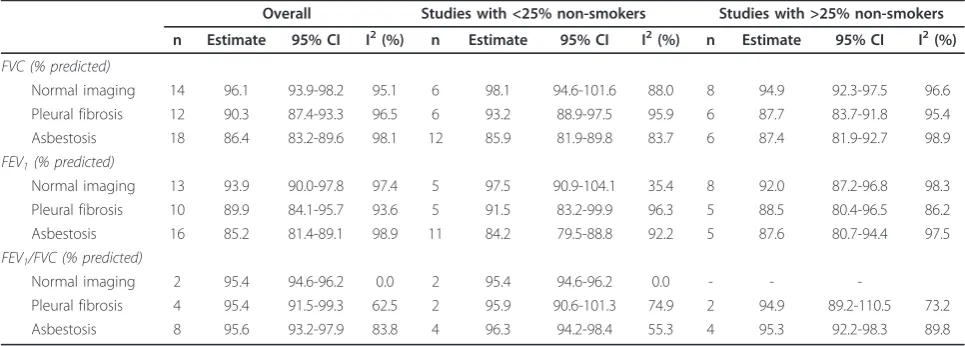
Few studies reported estimates stratified by smoking sta-tus and radiological category. The proportion of never-smokers was reported in 27 studies. The lung function estimates derived from the subgroup analysis showed greater impairment among studies with more than 25% of participants reporting to be never-smokers for sub-jects without radiological evidence of asbestos-related
disease and in those with pleural fibrosis (Table 3). In the group of workers showing radiological evidence of asbestosis lung function impairments were strongest and a bit more pronounced in the subgroup of studies with a lower proportion of never-smokers.
In the regression analysis of the effect of the propor-tion of non-smokers on estimates of FEV1, those studies with a higher proportion of never-smokers tended to show less impairment of this parameter (not statistically significant) for all three radiological categories.
Table 4 shows the results of three studies [24-26] reporting estimates for non-smokers and smokers
Table 2 Estimates of lung function according to radiological findings
Overall Studies with X-ray Studies with (HR)CT
n Estimate 95% CI I2(%) n Estimate 95% CI I2(%) n Estimate 95% CI I2(%)
FVC (% predicted)
Normal imaging 15 95.7 93.9-97.3 94.8 9 94.9 92.9-96.9 96.2 6 97.1 94.2-100.1 89.1
Pleural fibrosis 14 89.0 86.5-91.5 96.1 8 87.1 83.9-90.4 89.5 6 91.6 87.8-95.4 96.8
Asbestosis 20 86.5 83.7-89.4 98.2 10 84.8 80.8-88.8 98.9 10 88.5 84.3-92.7 95.8
FEV1(% predicted)
Normal imaging 14 93.6 90.6-96.5 97.3 8 91.4 87.7-95.1 98.0 6 97.4 92.5-102.2 64.7
Pleural fibrosis 11 89.2 84.7-93.7 93.7 5 83.9 77.2-90.5 42.0 6 93.7 87.6-99.9 95.8
Asbestosis 17 85.7 80.6-90.7 98.8 7 85.5 77.8-93.1 99.5 10 85.8 79.2-92.5 80.8
FEV1/FVC (% predicted)
Normal imaging 3 96.4 94.3-98.5 86.9 2 97.4 92.5-102.2 64.7 1 94.9 86.8-103.0
-Pleural fibrosis 5 95.4 92.7-98.1 68.7 2 93.7 87.6-99.9 95.8 3 96.3 92.6-100.1 68.1
Asbestosis 8 95.5 94.1-96.9 83.8 3 85.8 79.2-92.5 80.8 5 97.0 95.7-98.3 0.0
Comparison of imaging procedure.
Estimates for forced vital capacity (FVC), forced expiratory volume in the first second (FEV1) and the ratio of both parameters (FEV1/FVC) for each radiological subgroup. Results are shown for all included studies as well as separated according to the radiological method used for the diagnosis (conventional chest X-ray or (high resolution) computed tomography. Estimates are expressed as percent predicted together with confidence interval (CI) and I2 as a measure of heterogeneity, n = number of studies included in each subgroup.
Table 3 Estimates of lung function according to radiological findings
Overall Studies with <25% non-smokers Studies with >25% non-smokers
n Estimate 95% CI I2(%) n Estimate 95% CI I2(%) n Estimate 95% CI I2(%)
FVC (% predicted)
Normal imaging 14 96.1 93.9-98.2 95.1 6 98.1 94.6-101.6 88.0 8 94.9 92.3-97.5 96.6
Pleural fibrosis 12 90.3 87.4-93.3 96.5 6 93.2 88.9-97.5 95.9 6 87.7 83.7-91.8 95.4
Asbestosis 18 86.4 83.2-89.6 98.1 12 85.9 81.9-89.8 83.7 6 87.4 81.9-92.7 98.9
FEV1(% predicted)
Normal imaging 13 93.9 90.0-97.8 97.4 5 97.5 90.9-104.1 35.4 8 92.0 87.2-96.8 98.3
Pleural fibrosis 10 89.9 84.1-95.7 93.6 5 91.5 83.2-99.9 96.3 5 88.5 80.4-96.5 86.2
Asbestosis 16 85.2 81.4-89.1 98.9 11 84.2 79.5-88.8 92.2 5 87.6 80.7-94.4 97.5
FEV1/FVC (% predicted)
Normal imaging 2 95.4 94.6-96.2 0.0 2 95.4 94.6-96.2 0.0 - -
-Pleural fibrosis 4 95.4 91.5-99.3 62.5 2 95.9 90.6-101.3 74.9 2 94.9 89.2-110.5 73.2
Asbestosis 8 95.6 93.2-97.9 83.8 4 96.3 94.2-98.4 55.3 4 95.3 92.2-98.3 89.8
Subgroup analysis according to % of never-smokers.
Estimates for forced vital capacity (FVC), forced expiratory volume in the first second (FEV1) and the ratio of both parameters (FEV1/FVC) for each radiological subgroup. Results are shown for all included studies as well as separated according to the proportion of non-smokers included in each subgroup (less ore more than 25%). Estimates are expressed as percent predicted together with confidence interval (CI) and I2 as a measure of heterogeneity, n = number of studies included in each subgroup.
Wilkenet al.Journal of Occupational Medicine and Toxicology2011,6:21 http://www.occup-med.com/content/6/1/21
without radiological evidence of parenchymal disease. These papers suggest mainly a synergistic effect of smoking and asbestos exposure.
Duration of asbestos exposure
Mean exposure duration was reported in 23 studies. The data was heterogeneous (Table 5). FEV1 was consistently better across all radiological categories in the subgroup of studies with a mean exposure length of more than 22 years. In contrast, FEV1/VC was consistently better across all radiological subgroups for the studies with shorter mean exposure duration. The results for FVC were inconsistent. The regression analysis, however,
indicated that lower FVC and FEV1 could be expected with increasing mean exposure duration.
Discussion
Several population-based studies provide evidence of asbestos exposure contributing significantly to the bur-den of airway diseases, but a detailed assessment of exposure was generally neither presented nor performed in such studies [27-29]. The pleural plaque incidence in the general population is in the range of 0.02 to 12.8% [30] and is 80-90% attributable to asbestos exposure [31]. The initial concern about the potential adverse effects of asbestos on lung function was vindicated in clinical as well as epidemiologic studies over many years [12,13]. The present meta-analysis has considered the major lung function parameters VC, FEV1, FEV1/VC, for asbestos-exposed workers grouped, according to their radiological diagnosis, into three groups: “absence of pleural and lung parenchymal fibrosis”, diagnosed with “pleural fibrosis”(PP and/or DPT) or“asbestosis with or without pleural fibrosis”. Overall, our analysis shows a statistically significant reduction of VC, FEV1and FEV1/ VC among workers exposed to asbestos compared to the general population (i.e. reference values).
The severity of the observed impairments is related to the degree of radiological abnormalities indicative of pleural fibrosis and asbestosis. Overall, VC and FEV1 scores were lowest for those workers showing radiologi-cal findings of asbestosis, followed by those with signs of pleural fibrosis. Workers exposed to asbestos with normal radiological findings (either X-ray or (HR)CT) exhibited significantly better VC and FEV1 scores than those with radiological abnormalities, but their decreased values indicate some degree of lung function
Table 4 Asbestos-exposed workers without radiological evidence of parenchymal disease stratified by smoking status
Non-smokers Smokers
Studie n %
predicted
SD n %
predicted SD
Hall 1982 FEV1 46 101.0 13.6 67 92.5 14.9
FVC 102.2 11.6 99.2 13.4
Neri 1996 FEV1 34 90.9 15.6 47 92.0 14.0
FVC 89.7 14.9 90.9 14.3
FEV1/
FVC
100.3 10.9 100.2 6.8
Oldenburg 2001
FEV1 12 105.7 13.6 31 83.6 25.1
FVC 96.1 10.9 86.7 12.6
FEV1/
FVC
102.3 4.39 94.5 18.6
Differences in forced vital capacity (FVC), forced expiratory volume in the first second (FEV1) and the ratio of both parameters (FEV1/FVC) between asbestos exposed non-smokers and smokers without radiological evidence of asbestosis. Estimates expressed as percent predicted together with standard deviation (SD) and I2 as a measure of heterogeneity, n = number of subjects included in each subgroup.
Table 5 Estimates of lung function according to radiological findings
Overall Studies <22 yr. mean exposure Studies >22 yr. mean exposure
n Estimate 95% CI I2(%) n Estimate 95% CI I2(%) n Estimate 95% CI I2(%)
FVC (% predicted)
Normal imaging 11 96.2 94.4-98.0 95.9 4 97.0 94.2-99.8 96.5 7 95.7 93.4-98.0 90.8
Pleural fibrosis 11 89.2 85.6-92.8 96.9 2 81.8 73.2-90.3 92.8 9 90.8 86.8-94.8 98.0
Asbestosis 12 87.4 82.2-92.6 95.5 5 87.9 79.9-95.9 96.1 7 87.0 80.2-93.9 95.0
FEV1(% predicted)
Normal imaging 11 93.7 89.3-98.1 97.9 5 91.8 85.5-98.1 97.4 6 95.5 89.3-101.7 96.1
Pleural fibrosis 9 89.2 83.9-94.5 94.8 2 84.7 73.5-95.8 35.5 7 90.6 84.6-96.5 95.5
Asbestosis 10 86.8 82.3-91.2 84.2 5 86.4 80.3-92.5 90.4 5 87.1 80.6-93.6 66.7
FEV1/FVC (% predicted)
Normal imaging 3 96.4 94.3-98.5 86.9 2 96.5 94.3-98.7 93.4 1 94.9 86.2-103.6
-Pleural fibrosis 4 95.5 92.9-96.2 68.2 1 96.2 94.4-97.8 - 3 93.8 91.9-95.8 48.1
Asbestosis 7 95.8 93.8-97.9 86.1 3 97.7 95.9-99.5 0.0 4 94.6 92.0-97.2 83.2
Subgroup analysis by mean exposure duration.
Differences in forced vital capacity (FVC), forced expiratory volume in the first second (FEV1) and the ratio of both parameters (FEV1/FVC) between subgroups with a mean exposure duration of less (<22 yr.) and more for than 22 years (>22 yr.). Results are shown for each radiological subgroup. Estimates are expressed as percent predicted together with confidence interval (CI) and I2 as a measure of heterogeneity, n = number of studies included in each subgroup.
Wilkenet al.Journal of Occupational Medicine and Toxicology2011,6:21 http://www.occup-med.com/content/6/1/21
impairment. FEV1/VC was slightly reduced in all groups. This reduction was more evident in the subgroups with radiological abnormalities. These differences between groups persisted mostly when the studies were analysed separately, according to the radiological methods used (either X-ray or (HR)CT), although less pronounced for the (HR)CT-based studies of the three subgroups of patients. In general, studies with (HR)CT based diagno-sis report milder lung function impairments than those using conventional X-ray due to the higher sensitivity of the (HR)CT for mild grades of pleural disorders and asbestosis.
A positive relationship between the severity of func-tional impairment and the radiologically defined degree (score) of asbestos-related pleural and/or pulmonary fibrosis was already reported in a few studies [32-34]. As shown the absence of characteristic radiological findings does not exclude lung function abnormalities. Our meta-analysis revealed statistically significant deteriora-tion in the lung funcdeteriora-tion parameters for asbestos work-ers without any evidence of radiological abnormalities. These findings extend the meta-analysis by Filippelli, Martines et al [35] who found statistically significant reductions in all investigated lung function parameters in subjects exposed to asbestos, although the authors did not account for different radiological findings. Regression models reported in some of the included stu-dies indicate that the radiological findings can only explain a small part of the variability in these para-meters. Other authors have also reported a medium to low explanatory power of radiological findings for other lung function parameters [33,32].
There is evidence from clinical studies that discrepan-cies between lung function and radiological findings can be due to asbestos-induced pulmonary alterations not radiologically detectable. These studies describe multiple cellular lesions, apoptosis, inflammatory and profibro-genic responses, using histopathology and electron microscopy, as well as the synthesis of associated media-tors and oxygen radicals [36-40]. It has been estimated that exposure to an asbestos fibre dose [41] of 25 fibre-years represents the inhalation of about 55 billion asbes-tos fibres [42], of which a significant proportion is deposited in the lung.
Our findings indicate not only the presence of restric-tive but also of obstrucrestric-tive ventilation patterns in work-ers exposed to asbestos, either with or without asbestos-related radiological abnormalities: an issue of controver-sial discussion.
Recently, Dement et al. [43] found an overall COPD prevalence of 18.9% in asbestos workers/insulators. In their collective of older construction and trade workers, at the US Department of Energy with mixed exposure at nuclear sites, the prevalence of COPD was of 23%
among those only with pleural changes and 32.3% among those with both pleural and parenchymal changes [43]. Conversely, Ameille et al. [44] reported a lack of association between occupational exposure to asbestos and airway obstruction. They determined that FEV1/FVC and FEV25-75 did not differ through the cumulative exposure classes and there was no significant correlation between cumulative exposure to asbestos and pulmonary function parameters nor with the pro-portion of abnormal pulmonary function tests [44]. However, these authors did not include a non-exposed control group and report generally elevated values for FVC, FEV1, FEV1/FVC and residual volume (RV), which can be explained by the selected study population (volunteers for a screening programme without previous severe respiratory disease).
Bias and limitations
The degree of lung function impairment may have been underestimated due to bias in the included studies. Two main sources of not negligible underestimation of adverse health effects in actual occupational cohort stu-dies are the dilution effect and the comparison bias [45]. The dilution effect results from the inclusion of not or very low exposed workers in the study cohort. The comparison bias results from a healthy hire effects at the beginning of exposure history. The lung function of blue collar workers - like the ones included in our study - is typically better than the references taken from the general population (i.e. over 100% predicted) [46,47]. In those workers lung function values studied at a single time point may be still within the norm despite an underlying considerable absolute decrease since the start of exposure (e.g. a FEV1 fall from 115% to 95%). Comparison bias results also from the healthy worker effect in the course of the working life. Subjects with relevant health impairments may change their occupa-tion or have a shortened work life and thus may not be available for recruiting to later lung function assessment based on occupation or worksite. For example Fell et al. [48] hypothesized in their investigation on respiratory symptoms and ventilatory function of workers exposed to cement dust that individuals susceptible to adverse respiratory effects from cement dust may have quitted work and therefore dropped out of the exposed groups. The authors found a high prevalence (55%) of respira-tory symptoms and COPD in the group of former cement workers visited at home, underlying the impor-tance of included former workers. These biases are probably present in the studies included in our sys-tematic review, since most of them had a cross-sec-tional design not accounting for changes in lung function over time and in general did not consider for-mer workers.
Wilkenet al.Journal of Occupational Medicine and Toxicology2011,6:21 http://www.occup-med.com/content/6/1/21
In our meta-analysis, there is a high degree of hetero-geneity (high I2) across the studies, which we acknowl-edged by using a random effects model. Heterogeneity is caused by variations in the individual study populations as well as differences in study methods.
With respect to the study design, a major source of heterogeneity is the quality of lung function tests and the variety of references values used in the studies. We included predicted values, as given by the various authors with their considerable variation. For example, the reference values of Quanjer et al. [20,21] have been shown to be at least 10% too low for current normal populations [49-53], thus leading to an underestimation of the effects of asbestos exposure. The same is true for some other reference values based on inadequate refer-ence populations.
The issue of the study population as a source of het-erogeneity includes the following aspects: First, studies differed considerably in the duration of occupational exposure to asbestos, ranging from less than 1 year to over 30 years. The subgroup analysis indicated that the results for FEV1 and for FEV1/VC were negatively related to the duration of exposure. The meta-regres-sion analysis indicated an inverse relationship between exposure duration and FVC and FEV1 (i.e. lower esti-mates with increasing mean exposure duration). How-ever, this can only explain a small amount of heterogeneity. There are also major differences between studies regarding the intensity of exposure because of the wide variety of tasks and occupations studied. Since only two studies [41,54] reported an estimation of expo-sure intensity (i.e. fibre-years), we could not explore this source of heterogeneity in subgroup or regression analy-sis. Similarly, mean latency times were only reported in nine of the included studies, thus subgroup analysis or meta-regression to explore heterogeneity could not be performed.
An additional source of heterogeneity may be the dif-ferences in the distribution of confounders, such as smoking or co-exposure to other occupational noxae. Regarding co-exposures most of the studies provided lit-tle information and we could not explore this potential source of heterogeneity in detail.
An important question concerns the interaction between smoking and asbestos exposure. Only a few studies accounted for smoking in their analysis appro-priately. In one of the two studies that included only never-smokers [18], reduced VC was reported for both asbestos-exposed workers without and with pleural fibrosis, and an impairment of FEV1 was seen in those with pleural fibrosis. The other study considering only never-smokers examined patients with asbestosis. Here all lung function parameters were correspondingly impaired [19].
Niebecker and colleagues showed for patients with asbestosis that the degree of impairment was greater among smokers [9]. Some of the included studies [16,33,55-61] reported multivariate linear regression models including smoking as an explanatory variable (among others). The results of these analyses suggest an association of lung function impairments with pleural abnormalities independent of smoking, i.e. when pleural fibrosis is present then impairments in lung function can be observed in both smokers and non-smokers.
At the study level, the results of subgroup analysis according to the proportion of never-smokers were inconsistent and partly counterintuitive, since for some parameters, the higher the proportion of non-smokers in a study, the lower were the estimates. An additional analysis using the mean pack-years - as an indication of the dose - was not performed, because one third of the included studies did not report the information.
Therefore our approach does not allow a clear differ-entiation of smoking effects from those of asbestos, mainly due to the shortcomings or the failure to report findings of the included studies but provides evidence that the observed impairment in lung function in the absence of radiological signs of asbestos-related par-enchymal disease cannot be attributed solely to smoking and that asbestos exposure plays a causal role.
A recent meta-analysis [35], which did not consider radiological findings, demonstrated independent signifi-cant effects of smoking as well as of asbestos exposure (i.e. a synergistic effect), both for forced expiratory flow (FEF25-75, FEF50) as well as thoracic gas volume (TGV) and RV/TGV. In this analysis, the influence of asbestos exposure was stronger than that of smoking for FEV1/ VC and airway resistance, whereas smoking had a stron-ger effect on FEF25-75. Evidence for a synergistic detri-mental effect of smoking and asbestos exposure on airflow limitation has also been reported in several
addi-tional studies (FEV1 [62,41,61,63,64], FEV1/VC
[65,66,9,10,4,25,61,26], FEF25-75 [66,3,25,10,43] and FEF75-85[66,3]).
It has to be acknowledged that our study does not allow answering the question whether the observed sta-tistically significant lung function impairments at the population level are also of clinical relevance at the indi-vidual level. Indeed, in clinical practice the diagnosis of an obstructive defect requires a FEV1/FVC of less than 70% and a FEV1over 80% from predicted is considered to represent mild impairment in an individual [67]. Our pooled estimates are within the normal limits applied to individuals (even when considering the lower limits of the confidence interval). Small decreases in group mean values however do not preclude clinically important dis-ease. For example a group of workers exposed to asbes-tos with moderate dyspnoea had mean FVC of 96%, Wilkenet al.Journal of Occupational Medicine and Toxicology2011,6:21
http://www.occup-med.com/content/6/1/21
mean FEV1 of 94% and mean FEV1/FVC of 95% of pre-dicted [68], which are similar to our pooled estimates. In one study, lung function impairments, particularly airflow obstruction, have been associated with increased mortality in asbestos exposed workers [69].
Conclusions
We conclude that asbestos exposure causes restrictive as well as obstructive lung function impairment. Asbestos-exposed workers may present lung function impair-ments even in the absence of radiological evidence of asbestos-related pleural fibrosis or asbestosis.
Our systematic review demonstrates that despite the large number of studies about the health hazards from occupational exposure to asbestos, there is a need for further research, especially on the role of smoking, occupational co-exposure (e.g. other mineral dusts, welding fumes) and possible synergistic effects on the development of functional impairment, particularly chronic airway obstruction, in asbestos-exposed workers. Such studies should include measurement of CO diffu-sion capacity, airway resistance and flow volume curves in a consistent approach. Furthermore, our study under-lines the necessity for an international agreement on lung function reference values within the individual eth-nic groups, to facilitate comparison between different studies.
Abbreviations
CI: confidence interval; DL, CO: CO diffusion capacity; DPT: diffuse pleural
thickening; FEF: forced expiratory flow; FEV1: forced expiratory volume in the first second; FVC: forced vital capacity; HRCT: high resolution computed tomography; PP: pleural plaques; RV: residual volume; SD: standard deviation; SE: standard error; SVC: slow (relaxed) vital capacity; TGV: thoracic gas volume; TLC: total lung capacity; VC: vital capacity; X-ray: chest radiograph
Acknowledgements and Funding
We thank Kevan Wiley for proof-reading our manuscript. There has been no external financial support or funding of the study, any person who contributed to this study or the preparation of the manuscript.
Authors’contributions
All authors had full access to all data. XB had the original idea for the paper and vouches for the integrity of the analysis. DW, UM and MVG extracted and analysed the data. All authors collaborated in interpreting the data and writing the manuscript and read and approved the final manuscript.
Competing interests
The authors declare that they have no competing interests.
Received: 22 February 2011 Accepted: 26 July 2011 Published: 26 July 2011
References
1. LaDou J:The asbestos cancer epidemic.Environ Health Perspect2004, 112:285-290.
2. ILO resolution concerning asbestos.[http://www.ilo.org/wcmsp5/groups/ public/—ed_norm/—relconf/documents/meetingdocument/
wcms_gb_297_3_1_en.pdf].
3. Kilburn KH, Warshaw RH:Airways obstruction from asbestos exposure. Effects of asbestosis and smoking.Chest1994,106:1061-1070.
4. Ohar J, Sterling DA, Bleecker E, Donohue J:Changing patterns in asbestos-induced lung disease.Chest2004,125:744-753.
5. Enright P:Comment on spirometry.J Occup Med1987,29:842. 6. Edelman P:Asbestos and air flow limitation.J Occup Med1987,
29:264-265.
7. Jones RN, Glindmeyer HW, Weill H:Review of the Kilburn and Warshaw Chest article–airways obstruction from asbestos exposure.Chest1995, 107:1727-1729.
8. Smith DD:Failure to prove asbestos exposure produces obstructive lung disease.Chest2004,126:1000.
9. Niebecker M, Smidt U, Gasthaus L, Worth G:[The incidence of airway obstruction in asbestosis].Pneumologie1995,49:20-26.
10. Sue DY, Oren A, Hansen JE, Wasserman K:Lung function and exercise performance in smoking and nonsmoking asbestos-exposed workers.
The American review of respiratory disease1985,132:612-618. 11. Antonescu-Turcu AL, Schapira RM:Parenchymal and airway diseases
caused by asbestos.Curr Opin Pulm Med2010,16:155-161. 12. American Thoracic Society:Diagnosis and initial management of
nonmalignant diseases related to asbestos.Am J Respir Crit Care Med
2004,170:691-715.
13. Banks DE, Shi R, McLarty J, Cowl CT, Smith D, Tarlo SM, Daroowalla F, Balmes J, Baumann M:American College of Chest Physicians consensus statement on the respiratory health effects of asbestos. Results of a Delphi study.Chest2009,135:1619-1627.
14. Huedo-Medina TB, Sanchez-Meca J, Marin-Martinez F, Botella J:Assessing heterogeneity in meta-analysis: Q statistic or I2 index?Psychol Methods
2006,11:193-206.
15. Wallace BC, Schmid CH, Lau J, Trikalinos TA:Meta-Analyst: software for meta-analysis of binary, continuous and diagnostic data.BMC Med Res Methodol2009,9:80.
16. Van Cleemput J, De Raeve H, Verschakelen JA, Rombouts J, Lacquet LM, Nemery B:Surface of localized pleural plaques quantitated by computed tomography scanning: no relation with cumulative asbestos exposure and no effect on lung function.Am J Respir Crit Care Med2001, 163:705-710.
17. Paris C, Benichou J, Raffaelli C, Genevois A, Fournier L, Menard G, Broessel N, Ameille J, Brochard P, Gillon JC, Gislard A, Letourneux M: Factors associated with early-stage pulmonary fibrosis as determined by high-resolution computed tomography among persons occupationally exposed to asbestos.Scand J Work Environ Health2004,30:206-214. 18. Petrovic P, Ostojic L, Peric I, Mise K, Ostojic Z, Bradaric A, Bota B, Jankovic S,
Tocilj J:Lung function changes in pleural asbestosis.Coll Antropol2004, 28:711-715.
19. Rösler JA, Woitowitz HJ:Lungenfunktionsveränderungen bei
Nichtrauchern mit Asbeststaublungenerkrankungen.InBericht über die 30 Jahrestagung der Deutschen Gesellschaft für Arbeitsmedizin.Edited by: Schuckmann F, Schopper-Jochum J. Stuttgart: Gentner; 1990:113-118. 20. Quanjer PH:Standardized lung function testing.Bull Eur Physiopathol
Respir1983,19:1-96.
21. Quanjer PH, Tammeling GJ, Cotes JE, Pedersen OF, Peslin R, Yernault JC: Lung volumes and forced ventilatory flows. Report Working Party Standardization of Lung Function Tests, European Community for Steel and Coal. Official Statement of the European Respiratory Society.Eur Respir J Suppl1993,16:5-40.
22. American Thoracic Society:ATS/ERS Task Force: Standardisation of lung function testing.Eur Respir J2005,26:319-338.
23. Knudson RJ, Lebowitz MD, Holberg CJ, Burrows B:Changes in the normal maximal expiratory flow-volume curve with growth and aging.The American review of respiratory disease1983,127:725-734.
24. Hall SK, Cissik JH:Effects of cigarette smoking on pulmonary function in asymptomatic asbestos workers with normal chest radiograms.Am Ind Hyg Assoc J1982,43:381-386.
25. Neri S, Boraschi P, Antonelli A, Falaschi F, Baschieri L:Pulmonary function, smoking habits, and high resolution computed tomography (HRCT) early abnormalities of lung and pleural fibrosis in shipyard workers exposed to asbestos.Am J Ind Med1996,30:588-595.
26. Oldenburg M, Degens P, Baur X:Asbest-bedingte
Lungenfunktionseinschränkungen mit und ohne Pleuraplaques.
Atemwegs- und Lungenkrankheiten2001,27:422-423.
27. Balmes J, Becklake M, Blanc P, Henneberger P, Kreiss K, Mapp C, Milton D, Schwartz D, Toren K, Viegi G:American Thoracic Society Statement: Wilkenet al.Journal of Occupational Medicine and Toxicology2011,6:21
http://www.occup-med.com/content/6/1/21
Occupational contribution to the burden of airway disease.Am J Respir Crit Care Med2003,167:787-797.
28. Lebowitz MD:Occupational exposures in relation to symptomatology and lung function in a community population.Environ Res1977,14:59-67. 29. Viegi G, Prediletto R, Paoletti P, Carrozzi L, di Pede F, Vellutini M, di Pede C,
Giuntini C, Lebowitz MD:Respiratory effects of occupational exposure in a general population sample in north Italy.The American review of respiratory disease1991,143:510-515.
30. Clarke CC, Mowat FS, Kelsh MA, Roberts MA:Pleural plaques: a review of diagnostic issues and possible nonasbestos factors.Arch Environ Occup Health2006,61:183-192.
31. Henderson D, Rantanen J, Barnhart S, Dement JM, De Vuyst P, Hillerdal G, Huuskonen MS, Kivisaari L, Kusaka Y, Lahdensuo A, Langard S, Mowe G, Okubo T, Parker JE, Roggli VL, Rödelsperger K, Rösler J, Woitowitz HJ, Tossavainen A:Asbestos, asbestosis and cancer: the Helsinki criteria for diagnosis and attribution.Scand J Work Environ Health1997,23:311-316. 32. Copley SJ, Lee YC, Hansell DM, Sivakumaran P, Rubens MB, Newman
Taylor AJ, Rudd RM, Musk AW, Wells AU:Asbestos-induced and smoking-related disease: apportioning pulmonary function deficit by using thin-section CT.Radiology2007,242:258-266.
33. Schwartz DA, Galvin JR, Yagla SJ, Speakman SB, Merchant JA,
Hunninghake GW:Restrictive lung function and asbestos-induced pleural fibrosis. A quantitative approach.J Clin Invest1993,91:2685-2692. 34. Lebedova J, Dlouha B, Rychla L, Neuwirth J, Brabec M, Pelclova D,
Fenclova Z:Lung function impairment in relation to asbestos-induced pleural lesions with reference to the extent of the lesions and the initial parenchymal fibrosis.Scand J Work Environ Health2003,29:388-395. 35. Filippelli C, Martines V, Palitti T, Tomei F, Mascia E, Ferrante E, Tomei G,
Ciarrocca M, Fioravanti M:[Meta-analysis of respiratory function of workers exposed to asbestos].G Ital Med Lav Ergon2008,30:142-154. 36. Shukla A, Lounsbury KM, Barrett TF, Gell J, Rincon M, Butnor KJ, Taatjes DJ,
Davis GS, Vacek P, Nakayama KI, Nakayama K, Steele C, Mossman BT: Asbestos-induced peribronchiolar cell proliferation and cytokine production are attenuated in lungs of protein kinase C-delta knockout mice.Am J Pathol2007,170:140-151.
37. Murakami S, Nishimura Y, Maeda M, Kumagai N, Hayashi H, Chen Y, Kusaka M, Kishimoto T, Otsuki T:Cytokine alteration and speculated immunological pathophysiology in silicosis and asbestos-related diseases.Environ Health Prev Med2009,14:216-222.
38. Upadhyay D, Kamp DW:Asbestos-induced pulmonary toxicity: role of DNA damage and apoptosis.Exp Biol Med (Maywood)2003,228:650-659. 39. Miserocchi G, Sancini G, Mantegazza F, Chiappino G:Translocation
pathways for inhaled asbestos fibers.Environ Health2008,7:4.
40. Uhal BD:Apoptosis in lung fibrosis and repair.Chest2002,122:293S-298S. 41. Ohlson CG, Bodin L, Rydman T, Hogstedt C:Ventilatory decrements in
former asbestos cement workers: a four year follow up.Br J Ind Med
1985,42:612-616.
42. Woitowitz HJ:Die Situation asbestverursachender Berufskrankheiten.
Asbestos European Conference2003 [http://www.hvbg.de/e/asbest/konfrep/ konfrep/repbeitr/woitowitz_enpdf].
43. Dement JM, Welch L, Ringen K, Bingham E, Quinn P:Airways obstruction among older construction and trade workers at Department of Energy nuclear sites.Am J Ind Med2010,53:224-240.
44. Ameille J, Letourneux M, Paris C, Brochard P, Stoufflet A, Schorle E, Gislard A, Laurent F, Conso F, Pairon JC:Does Asbestos Exposure Cause Airway Obstruction, in the Absence of Confirmed Asbestosis?Am J Respir Crit Care Med2010,182:526-530.
45. Parodi S, Gennaro V, Ceppi M, Cocco P:Comparison bias and dilution effect in occupational cohort studies.Int J Occup Environ Health2007, 13:143-152.
46. Hernberg S:“Negative”results in cohort studies–how to recognize fallacies.Scand J Work Environ Health1981,7(Suppl 4):121-126. 47. Baillargeon J:Characteristics of the healthy worker effect.Occup Med
2001,16:359-366.
48. Fell AK, Thomassen TR, Kristensen P, Egeland T, Kongerud J:Respiratory symptoms and ventilatory function in workers exposed to portland cement dust.J Occup Environ Med2003,45:1008-1014.
49. Baur X, Isringhausen-Bley S, Degens P:Comparison of lung-function reference values.Int Arch Occup Environ Health1999,72:69-83. 50. Koch B, Schaper C, Ittermann T, Volzke H, Felix SB, Ewert R, Glaser S:
[Reference values for lung function testing in adults–results from the
study of health in Pomerania”(SHIP)].Dtsch Med Wochenschr2009, 134:2327-2332.
51. Roberts CM, MacRae KD, Winning AJ, Adams L, Seed WA:Reference values and prediction equations for normal lung function in a non-smoking white urban population.Thorax1991,46:643-650.
52. Hankinson JL, Odencrantz JR, Fedan KB:Spirometric reference values from a sample of the general U.S. population.Am J Respir Crit Care Med1999, 159:179-187.
53. Langhammer A, Johnsen R, Gulsvik A, Holmen TL, Bjermer L:Forced spirometry reference values for Norwegian adults: the Bronchial Obstruction in Nord-Trondelag Study.Eur Respir J2001,18:770-779. 54. Peric I, Arar D, Barisic I, Goic-Barisic I, Pavlov N, Tocilj J:Dynamics of the
lung function in asbestos pleural disease.Arh Hig Rada Toksikol2007, 58:407-412.
55. Delpierre S, Delvolgo-Gori MJ, Faucher M, Jammes Y:High prevalence of reversible airway obstruction in asbestos-exposed workers.Archives of environmental health2002,57:441-445.
56. Oliver LC, Eisen EA, Greene R, Sprince NL:Asbestos-related pleural plaques and lung function.Am J Ind Med1988,14:649-656.
57. Robins TG, Green MA:Respiratory morbidity in workers exposed to asbestos in the primary manufacture of building materials.Am J Ind Med
1988,14:433-448.
58. Schwartz DA, Fuortes LJ, Galvin JR, Burmeister LF, Schmidt LE, Leistikow BN, LaMarte FP, Merchant JA:Asbestos-induced pleural fibrosis and impaired lung function.The American review of respiratory disease1990,141:321-326. 59. Lilis R, Miller A, Godbold J, Chan E, Selikoff IJ:Pulmonary function and
pleural fibrosis: quantitative relationships with an integrative index of pleural abnormalities.Am J Ind Med1991,20:145-161.
60. Garcia-Closas M, Christiani DC:Asbestos-related diseases in construction carpenters.Am J Ind Med1995,27:115-125.
61. Rui F, De Zotti R, Negro C, Bovenzi M:[A follow-up study of lung function among ex-asbestos workers with and without pleural plaques].Med Lav
2004,95:171-179.
62. Chien JW, Au DH, Barnett MJ, Goodman GE:Spirometry, rapid FEV1 decline, and lung cancer among asbestos exposed heavy smokers.Copd
2007,4:339-346.
63. Zitting A, Huuskonen MS, Alanko K, Mattsson T:Radiographic and physiological findings in patients with asbestosis.Scand J Work Environ Health1978,4:275-283.
64. Yates DH, Browne K, Stidolph PN, Neville E:Asbestos-related bilateral diffuse pleural thickening: natural history of radiographic and lung function abnormalities.Am J Respir Crit Care Med1996,153:301-306. 65. Bagatin E, Neder JA, Nery LE, Terra-Filho M, Kavakama J, Castelo A,
Capelozzi V, Sette A, Kitamura S, Favero M, Moreira-Filho DC, Tavares R, Peres C, Becklake MR:Non-malignant consequences of decreasing asbestos exposure in the Brazil chrysotile mines and mills.Occup Environ Med2005,62:381-389.
66. Kilburn KH, Warshaw RH, Einstein K, Bernstein J:Airway disease in non-smoking asbestos workers.Archives of environmental health1985, 40:293-295.
67. Global strategy for the diagnosis, management and prevention of chronic obstructive pulmonary disease (updated 2010).[http://www. goldcopd.org/uploads/users/files/GOLDReport_April112011.pdf]. 68. Demers RY, Neale AV, Robins T, Herman SC:Asbestos-related pulmonary
disease in boilermakers.American journal of industrial medicine1990, 17:327-339.
69. Moshammer H, Neuberger M:Lung function predicts survival in a cohort of asbestos cement workers.Int Arch Occup Environ Health2009, 82:199-207.
70. Ameille J, Matrat M, Paris C, Joly N, Raffaelli C, Brochard P, Iwatsubo Y, Pairon JC, Letourneux M:Asbestos-related pleural diseases: dimensional criteria are not appropriate to differentiate diffuse pleural thickening from pleural plaques.Am J Ind Med2004,45:289-296.
71. Begin R, Ostiguy G, Filion R, Colman N, Bertrand P:Computed tomography in the early detection of asbestosis.Br J Ind Med1993,50:689-698. 72. Begin R, Filion R, Ostiguy G:Emphysema in silica- and asbestos-exposed
workers seeking compensation. A CT scan study.Chest1995,108:647-655. 73. Harkin TJ, McGuinness G, Goldring R, Cohen H, Parker JE, Crane M,
Naidich DP, Rom WN:Differentiation of the ILO boundary chest roentgenograph (0/1 to 1/0) in asbestosis by high-resolution computed Wilkenet al.Journal of Occupational Medicine and Toxicology2011,6:21
http://www.occup-med.com/content/6/1/21
tomography scan, alveolitis, and respiratory impairment.J Occup Environ Med1996,38:46-52.
74. Jarad NA, Strickland B, Pearson MC, Rubens MB, Rudd RM:High resolution computed tomographic assessment of asbestosis and cryptogenic fibrosing alveolitis: a comparative study.Thorax1992,47:645-650. 75. Kee ST, Gamsu G, Blanc P:Causes of pulmonary impairment in
asbestos-exposed individuals with diffuse pleural thickening.Am J Respir Crit Care Med1996,154:789-793.
76. Kouris SP, Parker DL, Bender AP, Williams AN:Effects of asbestos-related pleural disease on pulmonary function.Scand J Work Environ Health1991, 17:179-183.
77. Nakadate T:Decline in annual lung function in workers exposed to asbestos with and without pre-existing fibrotic changes on chest radiography.Occup Environ Med1995,52:368-373.
78. Piirila P, Lindqvist M, Huuskonen O, Kaleva S, Koskinen H, Lehtola H, Vehmas T, Kivisaari L, Sovijarvi AR:Impairment of lung function in asbestos-exposed workers in relation to high-resolution computed tomography.Scand J Work Environ Health2005,31:44-51.
79. Prince P, Boulay ME, Page N, Desmeules M, Boulet LP:Induced sputum markers of fibrosis and decline in pulmonary function in asbestosis and silicosis: a pilot study.Int J Tuberc Lung Dis2008,12:813-819.
80. Sette A, Neder JA, Nery LE, Kavakama J, Rodrigues RT, Terra-Filho M, Guimaraes S, Bagatin E, Muller N:Thin-section CT abnormalities and pulmonary gas exchange impairment in workers exposed to asbestos.
Radiology2004,232:66-74.
81. Vierikko T, Jarvenpaa R, Toivio P, Uitti J, Oksa P, Lindholm T, Vehmas T: Clinical and HRCT screening of heavily asbestos-exposed workers.Int Arch Occup Environ Health2010,83:47-54.
82. Zejda J:Diagnostic value of exercise testing in asbestosis.Am J Ind Med
1989,16:305-319.
83. Lilis R, Miller A, Godbold J, Chan E, Selikoff IJ:Radiographic abnormalities in asbestos insulators: effects of duration from onset of exposure and smoking. Relationships of dyspnea with parenchymal and pleural fibrosis.Am J Ind Med1991,20:1-15.
doi:10.1186/1745-6673-6-21
Cite this article as:Wilkenet al.:Lung function in asbestos-exposed workers, a systematic review and meta-analysis.Journal of Occupational Medicine and Toxicology20116:21.
Submit your next manuscript to BioMed Central and take full advantage of:
• Convenient online submission
• Thorough peer review
• No space constraints or color figure charges
• Immediate publication on acceptance
• Inclusion in PubMed, CAS, Scopus and Google Scholar
• Research which is freely available for redistribution
Submit your manuscript at www.biomedcentral.com/submit Wilkenet al.Journal of Occupational Medicine and Toxicology2011,6:21
http://www.occup-med.com/content/6/1/21