Open Access
Study protocol
Study protocol for a group randomized controlled trial of a
classroom-based intervention aimed at preventing early risk factors
for drug abuse: integrating effectiveness and implementation
research
Jeanne Poduska*
1, Sheppard Kellam
1, C Hendricks Brown
2, Carla Ford
1,
Amy Windham
1, Natalie Keegan
3and Wei Wang
4Address: 1American Institutes for Research, Baltimore, MD, USA, 2Department of Epidemiology and Public Health, University of Miami, Miller
School of Medicine, Miami, Florida, USA, 3Innovations Institute, Division of Child and Adolescent Psychiatry, University of Maryland, Baltimore,
MD, USA and 4Department of Epidemiology and Biostatistics, College of Public Health, University of South Florida, Tampa, FL, USA
Email: Jeanne Poduska* - [email protected]; Sheppard Kellam - [email protected]; C Hendricks Brown - [email protected]; Carla Ford - [email protected]; Amy Windham - [email protected]; Natalie Keegan - [email protected];
Wei Wang - [email protected] * Corresponding author
Abstract
Background: While a number of preventive interventions delivered within schools have shown both short-term and long-term impact in epidemiologically based randomized field trials, programs are not often sustained with high-quality implementation over time. This study was designed to support two purposes. The first purpose was to test the effectiveness of a universal classroom-based intervention, the Whole Day First Grade Program (WD), aimed at two early antecedents to drug abuse and other problem behaviors, namely, aggressive, disruptive behavior and poor academic achievement. The second purpose--the focus of this paper--was to examine the utility of a multilevel structure to support high levels of implementation during the effectiveness trial, to sustain WD practices across additional years, and to train additional teachers in WD practices.
Methods: The WD intervention integrated three components, each previously tested separately: classroom behavior management; instruction, specifically reading; and family-classroom partnerships around behavior and learning. Teachers and students in 12 schools were randomly assigned to receive either the WD intervention or the standard first-grade program of the school system (SC). Three consecutive cohorts of first graders were randomized within schools to WD or SC classrooms and followed through the end of third grade to test the effectiveness of the WD intervention. Teacher practices were assessed over three years to examine the utility of the multilevel structure to support sustainability and scaling-up.
Discussion: The design employed in this trial appears to have considerable utility to provide data on WD effectiveness and to inform the field with regard to structures required to move evidence-based programs into practice.
Trial Registration: Clinical Trials Registration Number: NCT00257088
Published: 2 September 2009
Implementation Science 2009, 4:56 doi:10.1186/1748-5908-4-56
Received: 12 March 2009 Accepted: 2 September 2009
This article is available from: http://www.implementationscience.com/content/4/1/56
© 2009 Poduska et al; licensee BioMed Central Ltd.
Background
The educational sector, as a normative setting for children, is an important delivery system for drug abuse prevention. A number of preventive interventions directed at aggres-sive, disruptive behavior and other antecedent risk factors such as poor achievement have shown both short-term and long-term impact in epidemiologically-based rand-omized field trials. However, prevention programs are often not implemented with high quality in schools [1-3]. Until recently, the primary concern of prevention researchers has been to test the impact of interventions through efficacy and effectiveness trials. The result is that many interventions have been tested without precise spec-ification of the model of support necessary to implement and sustain intervention practices with high quality over time.
In fall 2003, we began the third randomized field trial car-ried out by the senior members of this research team in collaboration with the Baltimore City Public School Sys-tem. This trial focused on testing interventions aimed at aggressive, disruptive behavior and poor achievement, separately and in combination. Results of the first two tri-als [4-15] provided support for undertaking this trial in which we combined three intervention components--classroom-behavior management; academic instruction, particularly in reading; and family-classroom partner-ships--into one integrated intervention called the Whole Day First Grade Program (WD). This trial was designed to bring together effectiveness and implementation research. The design supported an effectiveness trial of the WD compared with the standard school district program (SC). The design also supported an examination of the utility of a multilevel structure to support high levels of implemen-tation during the effectiveness trial, to sustain WD prac-tices across additional years, and to train additional teachers in WD practices. This paper presents the imple-mentation portion of the protocol in which we followed teachers with subsequent cohorts of children to study sus-tainability and scaling-up. Also see Additional File 1: 'Description of WD intervention, student sample, and measures of student outcomes' and Additional File 2: 'WD cohort two student sample figure'.
Specific aims and hypotheses
The specific aim and hypotheses regarding implementa-tion (aim three) follow logically from the aims of the effectiveness trial (aims one and two).
Aim one
Model the malleability of developmental paths by evalu-ating the effectiveness of the WD program, directed at reducing the antecedent risk factors for later substance abuse, comorbid mental and behavioral disorders, and school failure. We hypothesize that students in WD
class-rooms will exhibit less aggressive, disruptive behavior, more on-task behavior, and gains in student achievement, particularly in reading, compared with their counterparts in SC classrooms over the course of first grade and to the end of third grade.
Aim two
Measure the variation in the impact of WD by examining moderating factors at the level of the child and the social contexts of family, classroom and school, peers, and com-munity. In line with the results from our previous trials, we hypothesize that: the impact of WD will be stronger among children who begin first grade with lower readi-ness and poorer student behavior than their classmates; and the impact of WD will vary as a function of the quality of teacher practices, with improved teacher practices lead-ing to student improvements in behavior and achieve-ment, proximally and through third grade.
Aim three
Examine the utility of the support structure: during the effectiveness trial; as teachers implement WD in consecu-tive cohorts of first graders (sustainability); and as WD practices are taught by school system employees to teach-ers new to WD (scaling-up). We hypothesize that: the multilevel support structure will result in sustained high levels of WD practices with three consecutive cohorts of first graders; and the multilevel support structure will result in high levels of WD practices with additional teach-ers when they are trained in WD practices.
Methods
Overview of the design
Aware of the possibility of intervention leakage with this classroom-based, within-school design, we implemented procedures that had successfully limited such leakage in the prior trials, such as meeting with principals monthly [16]. In addition, the SC teachers received training and support in WD as part of the design in the third year of the trial. We found no evidence of contamination in the schools with internal controls in either of the first two tri-als [5,16] or in this trial.
Procedures for random assignment
We drew upon our prior experience as well as knowledge in the field to develop protocols for the random assign-ment of both students and teachers. Here, we describe the procedures for random assignment in this multilevel trial. For details regarding the effectiveness arm of the trial in which we followed students over first grade and into third grade, see Additional File 1: 'Description of WD interven-tion, student sample, and measures of student outcomes' and Additional File 2: 'WD cohort two student sample fig-ure'.
Schools
We began with a pool of 66 elementary schools in two adminstrative areas of the school district. Schools were excluded if all the students attending the school received special education or other special services; the school was operated by an entity other than the school system; the first-grade curriculum was not the standard district curric-ulum; or the school had fewer than two or more than five first-grade classrooms. We excluded large schools because they were less common and tended to have different organizational structures than smaller schools. Twenty-six of the 66 schools were excluded as a result of these criteria. Because academic achievement was a primary target of the WD intervention, we decided that the schools performing less well academically would be eligible to be part of the WD initiative. The 40 schools remaining after the first exclusion step were ranked by third-grade academic achievement on the standardized achievement test used by the school system, third grade being the lowest grade at which a standardized achievement test was used to rate student achievement. In October 2002, principals of the 20 lowest performing schools participated in a lottery draw to randomly assign schools to participate either as one of eight schools deemed development schools, where we piloted intervention components and conducted staff training on assessment procedures, or as one of 12 schools deemed trial schools, where the randomized field trial would take place (see Figure 1). The trial was con-ducted in these 12 schools for three consecutive school years beginning in 2003 to 2004.
Classrooms/teachers
In April 2003, all 37 first-grade classrooms/teachers in the 12 schools participating in the randomized field trial were randomly assigned to condition. In each school, one teacher was randomly assigned to be a WD classroom/ teacher, one was randomly assigned to be a wait-listed SC classroom/teacher, and all other first-grade teachers were randomly assigned to be nonparticipating classrooms/ teachers. Teachers in both WD and SC classrooms were followed as they taught three consecutive cohorts of first graders. In a type of wait-listed control, SC teachers who served as controls for cohorts one and two were trained in the third year to deliver WD to cohort three first-grade stu-dents. The effectiveness trial relied on efficient within-school comparisons of WD and SC for cohort one and cohort two students from first to third grade. The sustain-ability question centered on whether WD teachers' prac-tices remained high or fell off across the three cohorts. The scale-up question centered on whether the practices of the former SC teachers improved--as well as the consequent child outcomes--when they were trained to deliver WD.
While each of the 12 schools maintained the design by having one WD classroom and one SC classroom each year for three years, there were changes at the teacher level as teachers left the school. We anticipated that some teachers would change over the years, and we established a protocol for such changes. We stipulated that if a teacher left, the classroom would not change condition and the new teacher would be assigned the departing teacher's intervention status. If the replacement was a teacher already in the school, our protocol stipulated that this teacher could not have previously been assigned to a con-dition (WD or SC) within the trial. The patterns of teacher mobility are shown in Figure 1. There were no changes in either WD or SC teachers in schools one to five; the same teachers taught the WD and SC classrooms for all three years of the trial. Schools six to 12 experienced some degree of teacher mobility.
design. We randomly selected 10 students to come out of the original WD and SC classrooms before the interven-tion began, creating a new control classroom. The teacher of this newly formed classroom did not have experience teaching first grade and was not trained in the school sys-tem's first-grade curriculum, so the original SC class and the new control classroom were combined in a team-teaching model. By the end of the year, these two classes had separated back into two traditional, discrete classes. We decided to collect data in all three classrooms at each time point throughout the year. As a result, we have one WD classroom and two SC classrooms for school six in the second year of the trial. In the third year, school six had only two first-grade classrooms and they were taught by the initially assigned WD and SC teachers. In spite of this unexpected design modification, we were able to main-tain random assignment of children.
Although there were no instances of protocols being bro-ken--no teachers changed their design--it is important to note that SC teachers were replaced at twice the rate over the three years of the study (n = 8) compared with WD teachers (n = 4). We have hypothesized that as teachers gain mastery in their classroom with regard to their prac-tices in classroom behavior management and
instruc-tional content, they will be less likely to leave a school or the teaching profession. In keeping with this hypothesis, we would expect to see a lower rate of attrition in WD classrooms than in SC classrooms. As we move to an anal-ysis of the data, we will test for systematic bias at the level of the classroom and at the school/community level.
Structure to support sustainability and scale-up
In developing the support structure required for teachers to learn, implement, and sustain WD practices and for additional teachers to be trained, we focused on three areas: understanding the multilevel organizational struc-ture of the school system; delivering professional develop-ment to teachers; and systematically monitoring teacher practices and support to teachers.
Multilevel structure of the school system
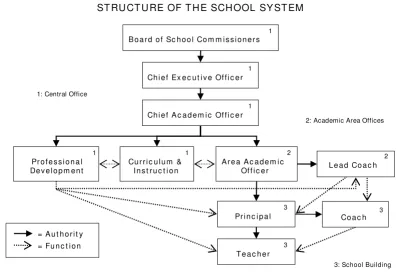
To understand the level and nature of the mandate, authority, accountability, and resources necessary to sus-tain and scale-up WD practices, we needed to understand the multilevel organizational structure of the school sys-tem. Figure 2 presents the organizational structure at the time of the WD trial. The Board of School Commissioners (the school board) had the legal authority to oversee all operations of the school district. The chief executive WD Teachers Over Three Years
Figure 1
WD Teachers Over Three Years. R = random assignment; WD = Whole Day First Grade Program classroom; SC = standard classroom (control); SY = school year.
Elementary schools in two administrative areas assessed for
eligibility n=66
Random assignment of 20 eligible elementary schools
Schools excluded n=46
Step 1: n=26 special ed school; curriculum not standard; operator other than school system Step 2: n=20 3rdgrade reading scores above median on CTBS (2001-02)
Development Schools n=8 Trial Schools n=12 August 2002 Determined eligibility of schools October 2002 Randomization of eligible schools
Cohort 1 SY 2003/04 Cohort 2 SY 2004/05 Cohort 3 SY 2005/06 April 2003: Initial random assignment of classrooms (teachers) 1 1 1 WD SC 1 1 1 #1 1 1 1 WD SC 1 1 1 #2 1 1 1 WD SC 1 1 1 #3 1 2 3 WD SC 1 1 1 #10 1 1 1 WD SC 1 2 3 #9 1 1 1 WD SC 1 3 3 2 #8 1 1 1 WD SC 1 1 1 #5 1 1 1 WD SC 1 1 1 #4 1 1 2 WD SC 1 2 2 #11 1 2 2 WD SC 1 1 1 2 #12 1 1 1 WD SC 1 1 1 2 #6 1 1 1 WD SC 1 3 3 2 #7
officer (CEO) of the school district (the superintendent) oversaw all aspects of school district administration. The chief academic officer (CAO) served under the CEO and was responsible for all K through 12 instruction, academic as well as behavior and social emotional learning. Under the direction of the CAO, the city schools were divided into four elementary areas, a middle school area, and a high school area, each overseen by an area academic officer (AAO). AAOs were responsible for providing sup-port to principals as well as to the schools more generally. Each area office had at least one coach who worked directly with schools to provide professional develop-ment. Within the school building, teachers were sup-ported by the principal, school-based instructional coaches, and support staff such as social workers and psy-chologists.
We worked with the school system to create two teams to support the effectiveness trial and the goal of sustaining and scaling-up practices in the school system--the Core Team and the Schools Committee. The Core Team com-prised individuals who held key positions of authority in the school system, along with senior members of the American Institutes for Research (AIR team). District members included the CAO, senior staff from the offices
of curriculum and instruction and professional develop-ment, and the area superintendents whose schools were participating in the trial. The Core Team was responsible for the implementation and continued monitoring of the randomized field trial within the school district, and met monthly to review progress against benchmarks and to anticipate and resolve problems. The Core Team's role was also to address the challenges that often impede the uptake of interventions into general practice, including the time to deliver the intervention, the ease of implemen-tation, the compatibility of the intervention with the mis-sion and vimis-sion of the institution, and the cost of the intervention [1-3,18-29].
Principals of the 12 participating schools, along with Core Team members and senior AIR staff, participated on the Schools Committee. The committee met monthly to address issues pertinent to the field trial, such as maintain-ing fidelity, developmaintain-ing procedures for randomization of teachers/classrooms and students, engaging with parents and garnering consent, determining ways to introduce the field trial to the school community, maintaining the morale of standard classroom (comparison) teachers, and making decisions at the school level regarding oversight, monitoring, and allocation of resources.
Multilevel Structure of a School System Figure 2
Multilevel Structure of a School System.
ST RU CT U RE OF T H E SCH OOL SY ST EM
1
B o a r d o f Sc h o o l Co m m i s s i o n e r s
1
Ch i e f Ex e c u t i v e Of f i c e r
1: Central Office
1
Pr o f e s s i o n a l De v e l o p m e n t
1
Cu r r i c u l u m & I n s t r u c t i o n
2
A r e a A c a d e m i c Of f i c e r
2
L e a d Co a c h
Co a c h
3
Pr i n c i p a l
3
T e a c h e r = A u t h o r i t y
= Fu n c t i o n
2: Academic Area Offices 1
Ch i e f A c a d e m i c Of f i c e r
3
Professional development to teachers
As part of the WD trial, we addressed the primary concern of school system leaders with regard to professional devel-opment for teachers, namely, that the role of the WD facil-itator be specified with precision so that practices would be observable and replicable. Because we were interested in building capacity within the school system, we decided that AIR staff would not train teachers directly but would train school district employees to be WD facilitators who would work directly with teachers. This model was decid-edly in contrast to the prior two field trials in which research staff worked directly with classroom teachers.
In developing the model of coaching and support to teachers, we were informed by the emerging literature on professional development for educators and on adult learning. This work highlights the importance of provid-ing opportunities for active learnprovid-ing through observation, meaningful discussion, practice, and reflection [30-32]. Research also suggests that professional development is best conceptualized as an ongoing process rather than a single event, and that professional development activities should be aligned with one's professional work [30,33-35] and incorporated into one's daily professional work [30,36-38].
Literature on adult learning and school reform empha-sizes the importance of collective participation of teachers within schools, grouped by grade level, or of principals across schools [39-42]. A concept that became critical to our coaching model and our work with the Schools Com-mittee and the Core Team is that supporting change at the organizational level requires linkages across levels in the system, not just within levels in the system [43,44]. Stated another way, while professional community matters at specific levels such as schools [45], it is critical to create communities of learners within and across the various lev-els of the organization [46,47]. As defined by Resnick and Glennan, nested learning communities are 'organizations in which all individuals and units are expected to upgrade their capacities continuously in accord with a shared set of instructional principles and strategies. In this design, instructional leadership, coupled with reciprocal account-ability between 'layers' of the organization, provide pro-fessional learning opportunities specifically geared to the district's vision of instruction' [46].
The support provided to the teacher was primarily techni-cal in that the WD facilitator was considered the expert in WD implementation practices and served as a mentor to the teacher. WD facilitators had expertise in the theory and practice of WD and classroom behavior management more broadly as well as the interpretation and use of data regarding teacher practices and student behavior. WD facilitators spent one day per week in the classroom with
each teacher and supported teachers in bringing together the new knowledge of WD learned in the pre-implemen-tation training with their craft knowledge of classroom teaching [48]. The WD facilitators spent most of their time working directly with teachers in classrooms, observing, planning, modeling and mentoring, and providing feed-back [48,49].
Observations of teacher practices in the classroom pro-vided the foundation of the WD facilitators' work. The facilitators used the WD implementation checklist each month throughout the entire school year to determine the type, amount, and focus of professional development. The checklist provided information regarding the occur-rence and quality of teacher practices on both general practices and specific core elements of each component of WD. Using these data, the WD facilitators prioritized coaching needs and worked with the teacher to create a professional development plan that specified goals, target areas for mentoring, and coaching strategies and activities to be undertaken. WD facilitators supported teachers in WD practices through modeling of practices, guided prac-tice, visits to other classrooms to observe WD implemen-tation, conferences, and joint planning. The ability to work through trust with the teacher was a critical skill for facilitators; not all teachers welcomed a facilitator into their classroom or were open to the support the facilitator offered [50,51].
The extant literature provided little guidance about the pace and focus of coaching over the course of a year. We decided on a predetermined amount of coaching support, with WD facilitators spending additional time with teach-ers who needed more support. Each facilitator supported four schools, devoting one day per week supporting the WD teacher in each school. WD facilitators were trained during the first year of the trial by intervention team mem-bers who were part of the research staff.
Systematic monitoring of intervention practices and support
In recent years, researchers have recognized that the deliv-ery of intervention practices is usually variable and that this variability affects outcomes [1,16,52-59]. To under-stand the occurrence and quality of WD practices and the support delivered directly to teachers, we measured teach-ers' practices with regard to WD implementation as dis-cussed above; facilitators' practices in supporting teachers; and the availability of resources such as materials, plan-ning time, and release time for professional development, particularly those provided by the principal.
Measures and data collection
base-line/autumn, mid-year/January, and spring/May. Each observation took four hours over two days, and did not disrupt the classroom activities. Teacher interviews about student behavior were conducted with first-grade teachers at the same three time points. When each cohort reached third grade, its current teacher was interviewed. In fall and spring of first grade and spring of third grade, students were assessed individually in a quiet area of the school on reading and reading-related skills; students were also asked about experiencing symptoms of depression and anxiety; see Additional File 1: 'Description of WD inter-vention, student sample, and measures of student out-comes'. School records were collected at the end of each school year.
Measures of teachers' practices
We conducted classroom observations using a variation of teacher observation/student engagement [60]. In this time-sampling schema, a teacher's instructional practice and students' behavior are recorded minute by minute. For a teacher's instructional practice, observers code the instructional format and content of teaching. Eight instruction categories range from whole class to small groups to students working on their own, and include a category for non-reading instruction. Twenty content codes cover four domains: reading comprehension, word work, oral language and writing, and non-reading-related activities. The content codes were extended to include feedback in response to behavior (corrective, praise, puni-tive, directive). Inter-rater reliabilities of >0.80 are main-tained. At the end of each timed observation, observers use the checklist of teacher's practices to rate the instruc-tional and behavior management strategies exhibited dur-ing the session. The form parallels the WD implementation checklist and provides an independent measure of program implementation in WD classrooms, as well as information on classroom behavior manage-ment and instructional strategies in SC classrooms. Items were added to the teacher interview to assess the strategies that teachers used to engage with families and the level of caregiver response to the strategies.
Measures of fidelity
The WD implementation checklist provided information about teacher practices along two dimensions, practices that were general to the classroom and practices that were intervention-specific. Thirty-six behavioral indicators pre-cisely defining the core elements of the three intervention components were rated on whether defined practices occurred (yes/no) and with what quality (scale of one to six). A global rating was also given for each of the three intervention components. Measures of family-classroom partnership included attendance sheets for activities to which parents were invited, such as classroom orienta-tion, class meetings, and the family read-alouds. The use
of the home-link telephone line, a messaging system for teachers and parents, was monitored. Checklists were developed to rate the degree to which principals and facil-itators fulfilled their clearly defined roles related to sup-porting the teacher and the implementation of the WD program.
Statistical analyses and power
The analyses for Aim three, sustainability and scaling-up of WD practices, proceed logically from the analyses sup-porting the effectiveness trial of WD.
Analyses for Aim one: Malleability of developmental paths We are carrying out formal growth analyses to evaluate how WD affects the course of reading skills and achieve-ment, aggressive behavior, and depressive symptoms. Intervention effects will be modeled as both mean ences in latent growth trajectories for the slope and differ-ences in the covariance between intercept and slope by intervention group, a type of intervention by baseline interaction [61]. These analyses will include school- and classroom-level clustering. Following this series of multi-level analyses for single repeated measures, we will con-duct multilevel growth analyses for first-grade through third-grade outcomes [62] to test for both main effects and interactions involving the intervention with baseline characteristics.
Analyses for Aim two: Variation in impact
We will also examine whether the intervention affects children differently by using baseline measures of reading skills and aggressive behavior, as well as parent involve-ment. We have found that additive models [11,15], because they include nonparametric models with smooth changes in impact as a function of baseline, are excellent tools to distinguish the degree of benefit that different children receive from this particular intervention. A sec-ond method for examining variation in impact is examin-ing how baseline interacts with intervention condition to affect growth trajectories [61,63-65]. These intervention-by-baseline models extend the univariate models into the growth curve framework, and allow changes in slope to be affected simultaneously by both intervention and base-line. Thus we will examine whether the best growth trajec-tory improvement from the intervention occurs more for higher- or lower-risk children.
general growth mixture models (GGMM) [15,64], param-eters of individual growth trajectories, including inter-cepts, slopes, and higher-order shape parameters, may be influenced by baseline characteristics, intervention status, and time-dependent covariates. GGMM also allows indi-viduals to follow a class of growth trajectories. An impor-tant part of this model is that class membership is an unobserved category variable. Nevertheless, like latent class analyses, GGMM permits both predictors and responses to be related to the unobserved class member-ship. Model selection for GGMM will be based on both the bootstrap likelihood ratio test and the Bayesian Infor-mation Criterion [67] with examination of model fit [64,68,69].
Analyses for Aim three: Sustainability and scaling-up of WD practices
We will examine the extent to which the impact of WD on children's learning and behavior is explained by the level of by the teacher implementation, as well as school-level support, over time. We have successfully examined such implementation measures in the past [16] when we deter-mined that poor implementation of the intervention fully explained the lack of improvement in some schools. Sus-tainability will be tested by comparing the practices and subsequent child outcomes for the WD teachers over two as well as three years with those of their SC counterparts for the first two years. Scaling-up will be tested by compar-ing the practices and child developmental outcomes for the original SC teachers in their last year with those in pre-vious years and with those of WD teachers. The difference in SC measures across cohorts assesses this extendibility, and the power is expected to be similar to that for testing the intervention in cohort one because here each teacher serves as his or her own control.
Statistical power
In cohort one, we expect to have power of 0.79 to test the WD main effect on end-of-first-grade reading when the true effect size is 0.25, compared against total variation in the sample. This calculation is based on specification of multivariate means, variances, and covariances from data from prior trials conducted in Baltimore. The prior studies provide estimates of each source of variation as well (chil-dren, classrooms within schools, and schools) [70]. It assumes that individual variation is twice as large as school variation, that classroom variation at the time of randomization was negligible, and that the variation in intervention impact by school is a third of the overall var-iation, with effect size. Because this earlier trial involved a smaller number of schools (nine instead of 12 schools) and a less comprehensive intervention compared with that in the present trial, we anticipate having higher statis-tical power than in the previous trial. In that trial, we were able to report significant main effects and interactions
[10,16]. The power is nearly identical for third-grade main effect analyses as it is for end-of-first-grade analyses, even when we allow for 20% attrition, primarily from mobility. This loss in power through attrition is generally more than offset by the increase in power from growth curve analysis [61].
For testing whether the intervention improved teacher practices, statistical power is slightly higher, for the same size effect, compared with analyses of child outcomes. This difference occurs because the teacher measures are not subject to the added statistical error arising from child variation. Thus, we expect to have sufficient power to detect moderate size effects in this trial on teacher prac-tices across cohorts. Our hypotheses state that the WD effects on the original WD teachers should increase from cohort one to cohorts two and three. We plan to test this with a two-level linear trend model across cohorts. A test for nonlinear trend (one DF) can also be carried out. The trend tests are expected to have higher power than our original tests of sustainability because there should be stronger improvements of these teachers over the cohorts.
Discussion
The WD trial was deliberately designed to bring together research on program effectiveness with research on pro-gram implementation. Although the model of support to teachers was not experimentally manipulated, we are learning a great deal about the multilevel structure that needs to be in place to ensure that teachers can learn, implement, and sustain evidence-based intervention tices with high quality over time and that support prac-tices being scaled-up. This information will inform the next generation of interventions focused on enhancing program implementation.
Ethical review
Ethical approval for this trial was obtained by the Institu-tional Review Board at the American Institutes for Research on July 17, 2002.
Competing interests
The authors declare that they have no competing interests.
Authors' contributions
analyst for the study. WW provided analytic models for mediation and moderation. All authors have read and approved the final manuscript.
Additional material
Acknowledgements
We thank our partners--the students, parents, teachers, and administrators of the Baltimore City Public School System (BCPSS)--who have contributed to this body of research for over 20 years. We are grateful to the preven-tion science methodology group, who offered thoughtful feedback on the design and analytic strategies employed in this study. We thank colleagues who contributed to the development of the study and the interventions, including John Reid, Patricia Chamberlain, Becky Fetrow, Nicholas Ialongo, and Kimberly Kendziora. We are grateful for the careful editing and thoughtful suggestions of Sarah Crowne.
The WD trial has been funded by the NIDA through R01DA15409 and R01DA19984. Additional support for the design of the trial is funded by NIMH and NIDA through R01MH040859. Initial planning for the WD trial took place under a NICHD grant to develop preventive interventions aimed at reducing violence (R21HD40051).
References
1. Dusenbury L, Brannigan R, Falco M, Hansen WB: A review of research on fidelity of implementation: implications for drug abuse prevention in school settings. Health Educ Res 2003, 18:237-256.
2. Elliott DS, Mihalic S: Issues in disseminating and replicating effective prevention programs. Prev Sci 2004, 5:47-53. 3. Ringwalt CL, Ennett S, Johnson R, Rohrbach LA, Simons-Rudolph A,
Vincus A, Thorne J: Factors associated with fidelity to sub-stance use prevention curriculum guides in the nation's mid-dle schools. Health Education and Behavior 2003, 30:375-391. 4. Brown CH: Statistical methods for preventive trials in mental
health. Statistics in Medicine 1993, 12:289-300.
5. Dolan LJ, Kellam SG, Brown CH, Werthamer-Larsson L, Rebok GW, Mayer LS, Laudolf J, Turkkan JS, Ford C, Wheeler L: The short-term impact of two classroom-based preventive interventions on aggressive and shy behaviors and poor achievement. Journal of Applied Developmental Psychology 1993, 14:345.
6. Kellam SG, Rebok GW, Ialongo N, Mayer LS: The course and mal-leability of aggressive behavior from early first grade into middle school: results of a developmental epidemiologically-based preventive trial. J Child Psychol Psychiatry 1994, 35:259-281. 7. Kellam SG, Rebok GW, Mayer LS, Ialongo N, Kalodner CR: Depres-sive symptoms over first grade and their response to a devel-opmental epidemiologically based preventive trial aimed at improving achievement. Development and Psychopathology 1994, 6:463-481.
8. Kellam SG, Anthony JC: Targeting early antecedents to prevent tobacco smoking: findings from an epidemiologically based randomized field trial. Am J Public Health 1998, 88:1490-1495. 9. Kellam SG, Ling X, Merisca R, Brown CH, Ialongo N: The effect of
the level of aggression in the first grade classroom on the course and malleability of aggressive behavior into middle school. Dev Psychopathol 1998, 10:165-185.
10. Ialongo NS, Poduska JM, Werthamer L, Kellam S: The distal impact of two first-grade preventive interventions on conduct prob-lems and disorder in early adolescence. Journal of Emotional and Behavioral Disorders 2001, 9:146-160.
11. Kellam SG, Brown CH, Poduska JM, Ialongo NS, Wang W, Toyinbo P, Petras H, Ford C, Windham A, Wilcox HC: Effects of a universal classroom behavior management program in first and sec-ond grades on young adult behavioral, psychiatric, and social outcomes. Drug Alcohol Depend 2008, 95(Suppl 1):S5-S28. 12. Poduska JM, Kellam SG, Wang W, Brown CH, Ialongo NS, Toyinbo P:
Impact of the Good Behavior Game, a universal classroom-based behavior intervention, on young adult service use for problems with emotions, behavior, or drugs or alcohol. Drug Alcohol Depend 2008, 95(Suppl 1):S29-S44.
13. Petras H, Kellam SG, Brown CH, Muthen BO, Ialongo NS, Poduska JM: Developmental epidemiological courses leading to anti-social personality disorder and violent and criminal behav-ior: effects by young adulthood of a universal preventive intervention in first- and second-grade classrooms. Drug Alco-hol Depend 2008, 95(Suppl 1):S45-S59.
14. Wilcox HC, Kellam SG, Brown CH, Poduska JM, Ialongo NS, Wang W, Anthony JC: The impact of two universal randomized first-and second-grade classroom interventions on young adult suicide ideation and attempts. Drug Alcohol Depend 2008, 95(Suppl 1):S60-S73.
15. Brown CH, Wang W, Kellam SG, Muthen BO, Petras H, Toyinbo P, Poduska J, Ialongo N, Wyman PA, Chamberlain P, Sloboda Z, MacKin-non DP, Windham A, Prevention Science and Methodology Group: Methods for testing theory and evaluating impact in rand-omized field trials: intent-to-treat analyses for integrating the perspectives of person, place, and time. Drug Alcohol Depend 2008, 95(Suppl 1):S74-S104.
16. Ialongo NS, Werthamer L, Kellam SG, Brown CH, Wang S, Lin Y: Proximal impact of two first-grade preventive interventions on the early risk behaviors for later substance abuse, depres-sion, and antisocial behavior. Am J Community Psychol 1999, 27:599-641.
17. Brown CH, Liao J: Principles for designing randomized preven-tive trials in mental health: an emerging developmental epi-demiology paradigm. Am J Community Psychol 1999, 27:673-710. 18. Adelman HS, Taylor L: On sustainability of project innovations
as systemic change. Journal of Educational and Psychological Consul-tation 2003, 14:1-25.
19. Coburn CE: Rethinking scale: Moving beyond numbers to deep and lasting change. Educational Researcher 2003, 32:3-12. 20. Datnow A, Castellano M: Teachers' responses to Success for
All: how beliefs, experiences, and adaptations shape imple-mentation. American Educational Research 2000, 37:775-799. 21. Elias MJ, Zins JE, Graczyk PA, Weissberg RP: Implementation,
sus-tainability, and scaling up of social-emotional and academic innovations in public schools. School Psychology Review 2003, 32:303-319.
22. Fagan AA, Mihalic S: Strategies for enhancing the adoption of school-based prevention programs: lessons learned from the Blueprints for Violence Prevention replications of The Life Skills Training Program. Journal of Community Psychology 2003, 31:235-253.
23. Gottfredson Associates Inc: National Study of Delinquency in Schools (Final Report, Grant No. 96-MU-MU-008), Ellicott City, MD 2000.
Additional file 1
Description of WD intervention, student sample, and measures of stu-dent outcomes. Description of WD intervention, student sample, and measures of student outcomes.
Click here for file
[http://www.biomedcentral.com/content/supplementary/1748-5908-4-56-S1.doc]
Additional file 2
WD cohort 2 student sample. This figure shows the random assignment and design status of a cohort of students from initial random assignment prior to the start of first grade to the end of the first grade year. WD = students randomized to Whole Day First Grade Program; SC = students randomized to standard classroom (control); Other = students rand-omized to first grade classrooms not participating in the trial; circles denote students who left a study condition and were reassigned to another study condition (denoted by a triangle).
Click here for file
24. Gottfredson DC: Schools and Delinquency New York: Cambridge Uni-versity Press; 2001.
25. Gottfredson DC: School-based crime prevention. In Preventing Crime: What Works, What Doesn't, What's Promising: A Report to the United States Congress Washington, DC: U.S. Department of Justice, Office of Justice Programs; 1997.
26. Payne AA, Gottfredson DC, Gottfredson GD: School predictors of the intensity of implementation of school-based prevention programs: results from a national study. Prev Sci 2006, 7:225-237.
27. Hallfors D, Godette D: Will the 'principles of effectiveness' improve prevention practice? early findings from a diffusion study. Health Educ Res 2002, 17:461-470.
28. McLaughlin MW: The Rand change agent study revisited: macro perspectives and micro realities. Educational Researcher
1990, 19:11-16 [http://edr.sagepub.com/cgi/content/abstract/19/9/ 11].
29. Mihalic S, Ballard D, Michalski A, Tororice J, Cunningham L, Argamaso S: Blueprints for Violence Prevention, Violence Initiative: Final Process Eval-uation Report Boulder, CO: Center for the Study and Prevention of Violence, Institute of Behavioral Science, University of Colorado; 2002.
30. Garet M, Porter A, Desimone L, Birman B, Yoon KS: What makes professional development effective? results from a national sample of teachers. American Educational Research 2001, 38:915-945.
31. Lieberman A: Practices that support teacher development: transforming conceptions of professional learning. In Teacher Learning: New Policies, New Practices Edited by: McLaughlin MW, Ober-man I. New York: Teachers College Press; 1996:185-201.
32. Loucks-Horsley S, Hewson PW, Love N, Stiles KE: Designing Profes-sional Development for Teachers of Science and Mathematics Thousand Oaks, CA: Corwin Press; 1998.
33. Cohen DK, Hill HC: Instructional policy and classroom per-formance: the mathematics reform in California. Teachers College Record 2000, 102:294-343.
34. Lieberman A, McLaughlin MW: Networks for educational change: powerful and problematic. Phi Delta Kappan 1992, 73:673-677.
35. Grant SG, Peterson PL, Shojgreen-Downer A: Learning to teach mathematics in the context of systemic reform. American Edu-cational Research 1996, 33:502-541.
36. Hargreaves A, Fullan MG: Understanding Teacher Development London: Cassell; 1992.
37. Little JW: Teachers' professional development in a climate of educational reform. Educational Revaluation and Policy Analysis
1993, 15:129-151.
38. Stiles KE, Loucks-Horsley S, Hewson PW: Principles of Effective Profes-sional Development for Mathematics and Science Education: A Synthesis of Standards (NISE Brief)Volume 1. Madison, WI: National Institutes for Science Education; 1996.
39. Ball DL: Teacher learning and the mathematics reforms: what we think we know and what we need to learn. Phi Delta Kappan
1996, 77:500-508.
40. Knapp MS: Between systemic reforms and the mathematics and science classroom: the dynamics of innovation, imple-mentation, and professional learning. Review of Educational Research 1997, 67:227-266 [http://rer.sagepub.com/cgi/content/ abstract/67/2/227].
41. Talbert JE, McLaughlin MW: Understanding teaching in context. In Teaching for Understanding: Challenges for Policy and Practice Edited by: Cohen DK, McLaughlin MW, Talbert JE. San Francisco: Jossey-Bass; 1993:167-206.
42. Elmore RF: Doing the Right Thing, Knowing the Right Thing to Do: Low-Performing Schools and Performance-Based Accountability National Gov-ernors Association Policy Education Advisors Institute. Los Angeles, CA; 2003.
43. Bowers DG: Systems of Organization: Management of the Human Resource Ann Arbor: University of Michigan Press; 1976.
44. Likert R: New Patterns of Management New York: McGraw-Hill Book Company; 1961.
45. Seashore LK, Marks H: Does professional community affect the classroom? teachers' work and student experiences in restructuring schools. American Journal of Education 1998, 106:532-575.
46. Resnick LB, Glennan TK Jr: Leadership for learning: a theory of action for urban school districts. In School Districts and Instruc-tional Renewal Edited by: Hightower AT, Knapp MS, Marsh JA, McLaughlin MW. New York: Teachers College Press; 2002:160-172. 47. Resnick LB, Hall MW: Learning organizations for sustainable education reform. Journal of the American Academy of Arts and Sci-ences 1998, 127:89-118.
48. Spouse J: Bridging theory and practice in the supervisory rela-tionship: a sociocultural perspective. J Adv Nurs 2001, 33:512-522.
49. Sweeney D: Learning the Way: Professional Development by and for Teachers Portland: Stenhouse; 2003.
50. Joyce B, Showers B: Student Achievement Through Staff Development
3rd edition. Alexandria, VA: Association for Supervision and Curric-ulum Development; 2002.
51. McCormick KM, Brennan S: Mentoring the new professional in interdisciplinary early childhood education: the Kentucky Internship Program. Topics in Early Childhood Special Education
2001:131-144 [http://tec.sagepub.com/cgi/content/abstract/21/3/ 131].
52. Botvin GJ, Baker E, Dusenbury L, Botvin EM, Diaz T: Long-term fol-low-up results of a randomized drug abuse prevention trial in a white middle-class population. JAMA 1995, 273:1106-1112. 53. Derzon JH, Sale E, Springer JF, Brounstein P: Estimating interven-tion effectiveness: synthetic projecinterven-tion of field evaluainterven-tion results. J Prim Prev 2005, 26:321-343.
54. Dane AV, Schneider BH: Program integrity in primary and early secondary prevention: are implementation effects out of control? Clin Psychol Rev 1998, 18:23-45.
55. Pentz MA, Trebow EA, Hansen WB, McKinnon DP: Effects of pro-gram implementation on adolescent drug use behavior. Eval-uation Review 1990, 14:264-289.
56. Rohrbach LA, Graham JW, Hansen WB: Diffusion of a school-based substance abuse prevention program: predictors of program implementation. Prev Med 1993, 22:237-260. 57. Tobler NS: Meta-analysis of 143 adolescent drug prevention
programs: quantitative outcome results of program partici-pants compared to a control or comparison group. Journal of Drug Issues 1986, 16:537-567.
58. Tortu S, Botvin GJ: School-based smoking prevention: the teacher training process. Prev Med 1989, 18:280-289.
59. Durlak JA: Why program implementation is important. Journal of Prevention and Intervention in the Community 1998, 17:5-18. 60. Foorman BR, Schatschneider C: Measuring teaching practice
during reading/language arts instruction and its relation to student achievement. In Systems for Observing Teaching and Learn-ing Edited by: Vaughn S, Briggs KL. Baltimore: Brooks Publishing; 2003:1-30.
61. Muthen B, Curran P: General longitudinal modeling of individ-ual differences in experimental designs: a latent variable framework for analysis and power estimation. Psychological Methods 1997, 2:371-402.
62. Muthen LK, Muthen BO: Mplus User's Guide. Fifth edition 1998-2007
Los Angeles, CA: Muthen & Muthen; 2007.
63. Curran PJ, Muthen BO: The application of latent curve analysis to testing developmental theories in intervention research.
Am J Community Psychol 1999, 27:567-595.
64. Muthen B, Brown CH, Masyn K, Jo B, Khoo ST, Yang CC, Wang CP, Kellam SG, Carlin JB, Liao J: General growth mixture modeling for randomized preventive interventions. Biostatistics 2002, 3:459-475.
65. Muthen B, Shedden K: Finite mixture modeling with mixture outcomes using the EM algorithm. Biometrics 1999, 55:463-469. 66. Muthen B, Masyn K: Discrete-time survival mixture analysis.
Journal of Educational and Behavioral Statistics 2005, 30:27-58. 67. Nylund KL, Asparouhov T, Muthen BO: Deciding on the number
of classes in latent class analysis and growth mixture mode-ling: a Monte Carlo simulation study. Structural Equation Mode-ling 2007, 14:535-569 [http://www.informaworld.com/smpp/ content~db=all?content=10.1080/10705510701575396].
Publish with BioMed Central and every scientist can read your work free of charge "BioMed Central will be the most significant development for disseminating the results of biomedical researc h in our lifetime."
Sir Paul Nurse, Cancer Research UK
Your research papers will be:
available free of charge to the entire biomedical community
peer reviewed and published immediately upon acceptance
cited in PubMed and archived on PubMed Central
yours — you keep the copyright
Submit your manuscript here:
http://www.biomedcentral.com/info/publishing_adv.asp
BioMedcentral
69. Carlin JB, Wolfe R, Brown CH, Gelman A: A case study on the choice, interpretation and checking of multilevel models for longitudinal binary outcomes. Biostatistics 2001, 2:397-416. 70. Brown CH, Indurkhya A, Kellam SG: Power calculations for data