Original Research Article
Acceptability of low-priced, socially-marketed sanitary napkins
amongst non-users of sanitary napkins in a slum population of Delhi
Zakirhusain Shaikh, Meely Panda*, Diksha Gaur
INTRODUCTION
Menstruation is a physiological phenomenon, in which on an average a woman spends around six-seven years of her life. A monthly event which should have been a norm in any girl‟s or woman‟s life unfortunately can become a risky period if it is not managed hygienically. Lack of or improper menstrual management is known to expose women to medical conditions like vaginitis or urinary tract infections. In the case-control study by das et al amongst women from Odisha, it was found that women who used reusable cloths were twice more likely to be a case (symptomatic for urinary tract infection and bacterial vaginosis) than women using disposable absorbents.1
Due to lack of hygienic methods, a significant proportion of girls are likely to miss out on school during their menstrual days or even completely drop out of the school post-menarche. In the systematic review and meta-analysis of 138 studies, conducted by van Ejik et al, it was found that a quarter of the Indian adolescents reported missing school during their menstrual periods.2 Inadequate menstrual protection made adolescent girls (age group 12-18 years) miss 5 days of school in a month (i.e. 50 days a year) according to the study by Goyal. Around 23% of these girls actually dropped out of school after they started menstruating.3 In the study by Vashisht et al, it was discovered that 40% of Delhi school girls were absent from schools during their menstrual days. It
ABSTRACT
Background: Access to menstrual hygiene resources is a basic human and healthcare right. A substantial number of women in rural areas and urban slums do not use sanitary napkins due to its prohibitive cost and difficult access, leading to consequences like infections and the subsequent morbidity, school absenteeism and decreased social participation. The study explored the reasons for non-usage of sanitary napkins in an urban slum of Delhi. It was further studied if there would be a high acceptance if low-cost product was made available at health-centre.
Methods: A cross-sectional study was done to assess the magnitude and reasons for not using sanitary napkins and acceptability of low-priced sanitary napkins provided through RHTC.
Results: Most women (47%) do not use sanitary napkins because its price was perceived as high as against the benefit that can be accrued. Difficult in access to product purchase was the second important reason for non-usage. A low-priced sanitary napkin provided through RHTC was an acceptable solution to them.
Conclusions: Increasing the accessibility of affordable sanitary napkins through health centers can increase in usage of sanitary napkins.
Keywords: Menstruation, Menstrual hygiene, Sanitary napkin, Reproductive health, Adolescent health, Social marketing
Department of Community Medicine, Hamdard Institute of Medical Sciences and Research, Jamia Hamdard, New Delhi, India
Received: 09 February 2019
Accepted: 12 March 2019
*Correspondence:
Dr. Meely Panda,
E-mail: [email protected]
Copyright: © the author(s), publisher and licensee Medip Academy. This is an open-access article distributed under the terms of the Creative Commons Attribution Non-Commercial License, which permits unrestricted non-commercial use, distribution, and reproduction in any medium, provided the original work is properly cited.
is interesting to note that the girls using cloth as absorbent during menstruation were 3 times more likely to remain absent as compared to those using a sanitary napkin.4
While a substantial number of women in urban areas are using sanitary napkins, the situation becomes grave in urban slums and rural areas where women are still clinging to traditional methods like used cloth rags. Stories abound of use of unimaginable substances like ash, plastic, cow dung and what not! The study by Garg et al in an urban slum of Delhi revealed that cloth was the preferred and cheapest material used during menstruation. All kinds of old, ragged and rejected clothes are kept by women for this. The use of sanitary napkins was observed in only 11.5% of respondents.5 While lack of awareness regarding the use of hygienic products is a missing link, even in those women who are aware, the use is prohibited by lack of availability in places they feel comfortable to access, exorbitant pricing, lack of disposal facilities and generalized embarrassment towards anything to do with menstruation.6
According to National Family Health Survey-Round 4 (2015-16), only 57.6% of Indian women in the age group of 15-24 years used any hygienic method (locally prepared napkins, sanitary napkins and tampons) during menstruation, with 42% of them using sanitary napkins. The same survey showed that 62% of women in this age-group use cloth for menstrual protection. The usage of sanitary napkins was higher in urban areas (59.2%) as compared to rural areas (33.6%). Factors like education played a vital role, as expected, with only 13% women with no schooling using sanitary napkins as against 60% usage in those who have 12 or more years of schooling. There was a distinct correlation between wealth index and usage of sanitary napkins, with only 13.3% women in the lowest category using sanitary napkins as against 70.8% in the highest category.7 It is no surprise that cost is a major barrier to access to the sanitary napkins. Around 70% of women in India said that their family can't afford to buy sanitary napkins, according to the survey by AC Nielson. In comparison, 100% women in Singapore and Japan, 88% in Indonesia and 64% in China use sanitary napkins.8 In the study by Hakim and others, it was found that 42% of schoolgirls in Jodhpur didn‟t use a sanitary napkin because the cost was perceived as high.9 Many women in India, especially from urban slums, cannot afford the expenses of sanitary napkins. As a result, they tend to ignore the health consequences and run the risk of infections and diseases. This adversely affects the health of these poor women and pushes them further into the vicious cycle of poverty and disease.
Taking into consideration the high prevalence of STI/RTI in the center‟s clientele along with abysmal use of sanitary napkins amongst the women, the present study was conducted with the following objectives.
Aim and objectives of study
To find out the awareness and perception regarding sanitary napkins amongst women from a slum population in Delhi.
To find the prevalence of use of sanitary napkins amongst study participants.
To explore the reasons for non-use of sanitary napkins
To find the acceptability of low-priced socially-marketed sanitary napkins amongst non-users of sanitary napkins.
METHODS
It was a community-based cross-sectional study conducted in the field-practice area of rural health training center at Madanpur Khadar, a slum in the outskirts of South-East Delhi, with a substantial migrant and floating population, belonging to lower socio-economic strata. The data collection was conducted between March-August 2017. Simple random sampling was conducted using the list of all the eligible participants from family survey records as the sampling frame.
Sample size calculation
Based on the prevalence of use of sanitary napkins in urban areas as 60% in NFHS survey, the sample size was calculated using the formula:7
N=Z2 P (1-P)/e2
Where, the prevalence was taken as 60%, Z as 1.96 and e as 5%
The calculated sample size was 369. Taking a non-response rate of 5-10%, the practical sample size was calculated as 400.
Individual interviews were conducted with the women in their homes by trained female medico-social workers and female MBBS intern, using a pre-validated, structured questionnaire. Informed written consent was taken from all the participants at the start of the interview. For those participants who were below 18 years of age, the consent was taken from both the participant and her mother.
The data was entered in Microsoft excel worksheet 2010 and then analyzed using SPSS version 20. Statistical significance was set at the 5% level (p<0.05).
Inclusion criteria
Exclusion criteria
Those not willing to consent for interview were excluded from the study.
RESULTS
The study was conducted with 400 participants from the field-practice area of RHTC between March-August 2017.
For the purpose of convenience in analyzing and comparing values across the various stages, Age was categorized into <18, 19–44 and ≥45 years. Family size
breakup was <5 and ≥5. Similarly, socio-economic status was taken according to the modified B G Prasad scale (2017) and educational status was divided into illiterate, primary, middle school, high school and above.10 The average age of the participants was 25 years. Adolescents (10-19 years) constituted 24% of the total participants. The average family size was 6 members, with more than 60% having 5 or more members. When classified according to the modified B G Prasad classification, almost half of the participants belonged to the middle class. The proportions of the people in the lower class and upper class were small. One-third of the participants were illiterate, while 42% were educated up to high school and above.
Table 1: Socio-demographic details of the participants.
S. no Variables Categories Frequencies (n=400) Percentage (%) Mean/mode
1 Age (years)
≤18 77 19.2
25
19-44 316 78.8
≥45 7 1.7
2 Family size <5 ≥5 154 38.5 6
246 61.5
3 Socio-economic
classification
Upper class 7 1.75
Middle class
Upper middle class 26 6.5
Middle class 199 49.75
Lower middle class 150 37.5
Lower class 18 4.5
4 Education
Illiterate 132 33
Illiterate
Primary/middle 100 25
High school and above 168 42
5 Occupation Housewife 317 79.25 Housewife
Student 83 20.75
Table 2: Comparison of demographic details and the awareness about sanitary napkins.
Question Socio-demographic detail Categorization Yes No P value
Are you aware of sanitary napkins?
Age (years)
≤18 76 1
0.6
19–45 310 6
≥45 6 1
Family size <5 150 4 0.2
≥5 242 4
Socio-economic class
Middle class and above 227 5
0.7
Lower middle 148 2
Lower class 17 1
Education
Illiterate 127 5
0.2
Primary/middle 98 2
Higher secondary and above 167 1
Occupation
Housewife 151 4
0.0001
Student 85 2
Unemployed 156 2
Around 80% of the women were housewives with the rest being students. No employed women could be interviewed as the interviews were conducted during the day-time, making the employed women unavailable for the interview.
socio-economic status and more educated were found to be more aware about the sanitary napkins, however, there was no significant association between the two. Students were less aware about sanitary napkins as compared to
housewives or unemployed and this association was found to be statistically significant. Cells with value less than 5 were evaluated by Fischer exact test, whereas the rest had Chi-square values.
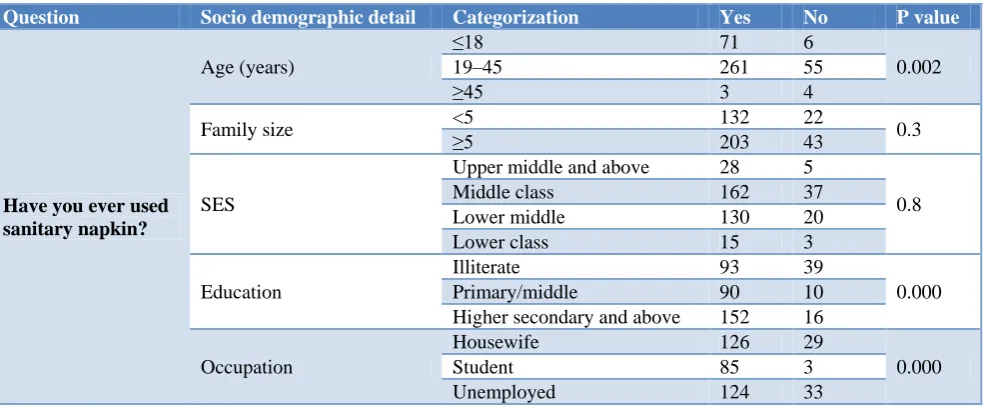
Table 3: Comparison of demographic details and the usage of sanitary napkins.
Question Socio demographic detail Categorization Yes No P value
Have you ever used sanitary napkin?
Age (years)
≤18 71 6
0.002
19–45 261 55
≥45 3 4
Family size <5 ≥5 132 22 0.3
203 43
SES
Upper middle and above 28 5
0.8
Middle class 162 37
Lower middle 130 20
Lower class 15 3
Education
Illiterate 93 39
0.000
Primary/middle 90 10
Higher secondary and above 152 16
Occupation
Housewife 126 29
0.000
Student 85 3
Unemployed 124 33
83.75% of the study participants had ever used sanitary napkin. The prevalence of ever use of sanitary napkin was highest in those who were younger than 18 years of age, with 92% having used sanitary napkin ever. The prevalence decreased in higher age groups with only 43% of women in the age of more than 45 years having ever used sanitary napkin. The factor of family size did not bear much relevance. Other than the upper class, almost all the socio-economic classes showed nearly equal prevalence of ever-use of sanitary napkin. The ever use of sanitary napkin was lower amongst the illiterate females as compared to those with any level of education. Similarly, it was found that the ever use was significantly higher amongst the students as compared to the housewives or unemployed participants.
Table 4: Reasons for not using sanitary napkin currently.
Reason for not using
sanitary napkin Frequency* %
High cost 191 47.6
Difficult access 117 29.2
Misconception 5 1.2
Traditionally using clothes 6 1.5
Any other 81 20.5
*Multiple responses.
As can be seen, high cost of sanitary napkin versus other materials like old cloth was the reason for nearly half of the participants not using sanitary napkin currently, though most of them have every used sanitary napkin. Another important factor was difficulty in accessing and using (purchasing and wearing) sanitary napkins.
Traditional use of clothes was not a major reason for current non-usage of sanitary napkin.
Table 5: Experience of using sanitary napkins versus cloth(n=335).
Experience Frequency %
Both are same 38 9.5
Sanitary napkin is better
than cloth 281 70.1
Sanitary napkin is worse
than cloth 16 4
Of all the participants who had ever used sanitary napkin, 70% preferred sanitary napkin over the cloth, whereas only 4% preferred cloth. In spite of this, none of them were currently using sanitary napkin, mostly due to high cost.
When asked if they would like to use sanitary napkins if they are provided a low-cost product, 347 said that they are likely, while 53 said that they are unlikely.
Table 5: Likelihood of using low-cost sanitary napkins.
Likelihood Frequency %
Likely 347 86.75
Unlikely 53 13.25
convert under-used cotton cloth into reusable sanitary pads.12 The second product was a winged sanitary napkin, which is socially marketed under the brand name of „Sakhi‟ by Hindustan Latex Family Planning Promotion Trust (HLFPPT). HLFPPT is promoted by HLL Lifecare Ltd (a Mini Ratna PSU under the Ministry of Health and Family Welfare). Sakhi has a smooth, soft, cottony cover, 18 leak-lock channel, anti-stain sheet, super absorbency,
and wide adhesive strips to hold the pad firmly.13 Free samples of these products were distributed to a few of our clinic attendees and feedback obtained from them. Sakhi sanitary napkin was preferred by most respondents.11 All the non-users of sanitary napkins were asked about the likelihood of using sanitary napkins if they were provided the low-cost, subsidized, winged sanitary napkin, Sakhi through social marketing.
Table 6: Logistic regression analysis of the females with the likelihood scale of use of low-cost sanitary napkins.
Variables Categories Odds ratio P value Degree of freedom (95% CI)
Age (years)
<18 Ref
19–45 0.2 0.2 1 (0.02–2.7)
>45 1.1 0.04 1 (0.1–9.6)
Family size >5 Ref
<5 1.3 0.3 1 (0.7-2.4)
Education level
Illiterate Ref
Primary 1.03 0.9 1 (0.5-2.1)
Higher secondary and above 0.8 0.7 1 (0.4-1.9)
Ever use of sanitary napkin?
Yes Ref
No 0.3 0.1 1 (0.1-1.7)
The likeliness of using the low-cost sanitary napkin was categorized as unlikely (point 0-4) and likely (point 5-10) and this was taken as the dependent variable. After doing a correlation analysis and finding out the correlation between the factors and likelihood scale, all those values which were significant i.e. p<0.05, were taken forward and a binary logistic regression analysis was done. The odds ratio and confidence intervals were calculated for each factor and likelihood was assessed. For all the variables, the first category was taken as the reference value and appropriate comparisons were done.
Females >45 years were 1.1 times more likely to use the improvised low-cost napkin as compared to those <18 years with statistical significance. Similarly, those with a smaller family (<5) had 1.3 times more likelihood to use sanitary napkin as compared to those with larger families (>5); however, this had no statistical significance. Lack of previous experience of sanitary napkin translated in lesser likelihood of use of sanitary napkins in future (OR 0.3).
DISCUSSION
The present study found that the average age of the participants was 25 years and adolescents (10-19 years) constituted 24% of the total participants. More than 60% had 5 or more members in their family and almost half of the participants belonged to the middle socio-economic class as per the modified Kuppuswamy scale. While 42% were educated up to high school and above, there were nearly 33% who were illiterate. Around 80% of the women were housewives and the rest were students. Similar demographic details were also found in the case-control study by Das et al on menstrual hygiene practices, WASH access in Odisha, 2015. Das et al reported the
average age of participant to be 32 (range 18–45). Most of the participants in their study were married (73%) and primarily engaged in housework.1
Awareness about sanitary napkins revealed that more than 95% knew about it. Age did not seem to play a role in affecting the awareness levels as evidenced by no significant difference between awareness levels among the adolescents and older women. The systematic review and meta-analytical study by van-Ejik et al on menstrual hygiene management among adolescent girls in India had similar findings.2
Our study revealed that better socio-economic status and higher levels of education translated in increased awareness about sanitary napkins, however the difference was not statistically significant. This was like the findings by Narayan et al and Chothe et al.12,13
It was found that the students were less aware about sanitary napkins as compared to housewives bearing a significant statistical association. This was similar to Chothe et al study where half of the adolescent girls did not know about the and how of the menstrual process prior to menarche.13
housewives or unemployed participants. Anand et al reported similar associations in their study among married women in India which explored the determinants of menstrual hygienic practices and its effect on reproductive tract infections (RTI).14
As regards to the reason for not using sanitary napkins, nearly 50% found it to be too costly, followed by 30% who found it less accessible and about 3% who were bound by societal pressures or were used to the traditional method of using cloth. Anand et al highlighted how the married women in their study were bound by cost constraints and were veiled by social pressures and taboos.14 Thakur et al and Garg et al had similar reasons quoted in their studies respectively.15,5
CONCLUSION
Women who are illiterate and belonging to lower socio-economic strata have no/less experience of ever use of sanitary napkins. High cost and difficulty in accessing are the two most important reasons for not using sanitary napkins. Even a single experience of use of sanitary napkin can increase the preference of sanitary napkins over the cloth. Adolescents and women are highly likely to start using sanitary napkins if they are provided low-cost products through health centers.
Limitations
Since the survey was conducted in day time, working women could not be enrolled in this survey. The study asked respondents about the likelihood of use low-cost sanitary napkins provided through health centers. The women were not provided with samples of sanitary napkins and interviewed after use to collect their experience.
ACKNOWLEDGEMENTS
The authors would like to acknowledge the help provided by Ms. Vinitha Babu, Medico-social worker of Rural Health Training Centre, Madanpur Khadar who helped in field-mapping, sampling and data collection.
Funding: No funding sources Conflict of interest: None declared
Ethical approval: The study was approved by the Institutional Ethics Committee
REFERENCES
1. Das P, Baker KK, Dutta A, Swain T, Sahoo S, Das BS, et al. Menstrual hygiene practices, WASH access and the risk of urogenital infection in women from Odisha, India. PloS one. 2015;10(6):0130 . 2. Van-Eijk AM, Sivakami M, Thakkar MB, Bauman
A, Laserson KF, Coates S, et al. Menstrual hygiene management among adolescent girls in India: a
systematic review and meta-analysis. BMJ open. 2016;6(3):e010290.
3. Goyal V. “Scope and Opportunities for Menstrual Health and Hygiene Products in India”. Int Res J Social Sci. 2016;5(7):18-21.
4. Vashisht A, Pathak R, Agarwalla R, Patavegar BN, Panda M. School absenteeism during menstruation amongst adolescent girls in Delhi, India. J family community med. 2018;25(3):163.
5. Garg S, Sharma N, Sahay R. Socio-cultural aspects of menstruation in an urban slum in Delhi, India. Reproductive health matters. 2001;9(17):16-25. 6. Feasibility study with Traditional outlets,
Non-traditional outlets and individuals to establish sanitary napkins supply chain management for adolescent girls and women. Available at: http://vatsalya.org.in/wpcontent/uploads/2013/04/Fe asibility-study-MHM.pdf. Accessed on 27 December 2018.
7. NFHS-4 (National Family Health Survey-4). International Institute for Population Studies. Deonar, Mumbai: IIPS; 2017.
8. Nielsen AC. Sanitary Protection: Every Woman's Health Right. Community development organization Plan India, 2011.
9. Hakim A, Shaheen R, Tak H. A cross-sectional study on the knowledge, attitudes and practices towards menstrual cycle and its problems: a comparative study of government and non-government adolescent school girls. Int J Community Med Public Health. 2017;4(4):973-81. 10. Shaikh Z, Pathak R. Revised Kuppuswamy and BG
Prasad socio-economic scales for 2016. Int J Community Medicine Public Health. 2017;4(4):997-9.
11. Sakhi Sanitary Napkins. Available at: https://hlfppt .org/sakhi-sanitary-napkins/. Accessed on 27 December 2018.
12. Narayan KA, Srinivasa DK, Pelto PJ, Veeramal S. Puberty rituals reproductive knowledge and health of adolescent schoolgirls in south India. Asia Pac Popul J. 2001;16:225–38.
13. Chothe V, Khubchandani J, Seabert D, Asalkar M, Rakshe S, Firke A, et al. Students' perceptions and doubts about menstruation in developing countries: a case study from India. Health Promot Pract. 2014;15(3):319-26.
14. Anand E, Singh J, Unisa S. Menstrual hygiene practices and its association with reproductive tract infections and abnormal vaginal discharge among women in India. Sex Reprod Health. 2015;6:249– 54.
15. Thakur H, Aronsson A, Bansode S. Knowledge, practices, and restrictions related to menstruation among young women from low socioeconomic community in Mumbai, India. Front Public Health. 2014;2:72.
Cite this article as: Shaikh Z, Panda M, Gaur D.