K K Goyal
Faculty of Management & Computer Application R.B.S.College, Khandari, Agra-282002 (U.P), India.
E-Mail:[email protected] Kuldeep Bharadwaj Institute of Basic Science
Dr.B.R.Ambedkar University, Khandari, Agra-282002 (U.P) Email:[email protected]
Pankaj Saxena
Faculty of Management & Computer Application R.B.S.College, Khandari, Agra-282002 (U.P), India
E-Mail:[email protected]
---ABSTRACT--- In 2003, Novikov and Kiselev [6] proposed an authentication of the user from the remote autonomous object. In 2005 Yang et al [10] pointed out that Novikov and Kiselev scheme is insecure against the man-in-middle attack. In 2009, Goyal and Bhardwaj[12], proposed that Novikov-Kiselev scheme is insecure against a reflection attack and also proposed an improvement in this scheme. In this paper, we propose the implementation of the improved NK protocol using MATLAB.
Keywords: Authentication, Remote User, RSA, Security, MATLAB.
--- Date of Submission: December 03, 2009, Accepted: December 15, 2009
---
1. Introduction
T
he authentication scheme is commonly used for verifying a user’s identity. Only the authenticated users can access the remote systems. The scatter of remote systems in different places allows more efficient and convenient access for geographically dispersed users. Remote access is one of the applications which ascertain whether the user is legal and whether it can access [1, 2, 3, 4, 5, 8, 9]. In Novikov-Kiselev scheme [6], the authentication of the user is done from the remote autonomous object with public key cryptosystem. The scheme has applications in the telecommunications systems. But Yang et al [10] pointed out that Novikov and Kiselev scheme is insecure against the man-in-middle attack. Goyal and Bhardwaj[12], proposed that Novikov-Kiselev scheme is insecure against a reflection attack and also proposed an improvement in this scheme. In this paper, we propose the implementation of the improved NK protocol using MATLAB.2. Notations
• Ui , O, and I denote the User, the remote
autonomous Object, and the Intruder.
• IDi and K denote the user’s identifier and the
control command.
• (PKU,SKU) and (PKO,SKO) denote a pair of session
keys of Ui and O, generated by RSA algorithm.
• (PKI,SKI) are the keys of Intruder generated by the
RSA algorithm.
• Ti denotes the time parameter.
• E(.) and D(.) are the encryption and decryption functions.
3. Review of the Novikov-Kiselev Scheme
The Novikov-Kiselev scheme consists of two stages. In the first stage a user negotiates the identity with remote autonomous object before functioning as an object. In the second stage the user’s identity is verified, when the user communicates with the object.
3.1 The First Stage : -
The user negotiates the identity ID and the time parameter T0 with the remote object beforehand. This step is executed
just once. The ID and T0 are stored in the operative
memory of the object by the user.
3.2 The Second Stage: -
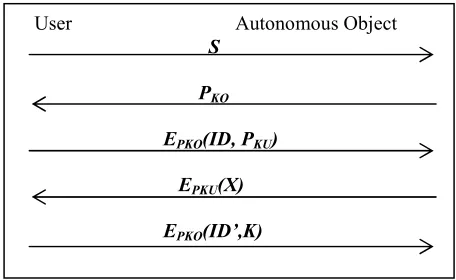
Step 1: The user sends start communication request S to the object through the public communication channel.
Step 2: The object generates a pair of keys PKO andSKO
by the RSA algorithm [7] and sends the public key PKO
to the user. Note that SKO is kept securely by the
object. Simultaneously, the object turns on the timer and records the start transmission time T1.
Step 3: The user sends the encrypted message EPKO(ID,
PKU ) to the object, where EA(M) is that message M is
encrypted by the public key A using the encryption function E(·) of the RSA algorithm. The identity ID and
public key PKU are encrypted with PKO using the
encryption function of the RSA algorithm. Note that the user also has a pair of keys PKU and SKU are
generated by the RSA algorithm and SKU is kept
securely by the user.
Step 4: The object decrypts the message DSKO(EPKO(ID,
PKU))= (ID, PKU ) with secure key SKO using the
decryption function of the RSA algorithm, where DB(M) is that message M is decrypted by the secret key
B using the decryption function D(·) of the RSA
algorithm. T2 is recorded simultaneously. If the
difference in time ∆T between T1and T2 is smaller than
T0 compared with the user’s ID. Supposing ID discord
with user’s ID saved in memory of the object, then the object terminate the session. Otherwise, the object encrypts the message X with the user’s public key PKU
using the RSA algorithm, and then sends it to the user.
Step 5: When the user receive the message from the object, the user decrypts X with secure key SKU using
the RSA algorithm. The user can derive the command K from the message X and encrypt the command K and new identity ID’with pubic key PKO of object using
the RSA algorithm. And then, the encrypted message is sent to the object.
The object decrypts the message with the secure key SKO after receiving the message from the user. The
object executes the command K, if the difference in time ∆T between T1 and T2 is smaller than T0. The
object terminate the session, or else. The procedures of this stage are shown in Figure 1.
Figure 1: The procedures of the second stage
4. Reflection Attack
4.1 The First Stage : -
The first stage is the pre-tuning of the parameters Ui and
O. Ui produces IDi and synchronizes Ti with the remote
object. This processing is executed just once. IDi and T0
are produces and stored in the operative memory of O by Ui.
4.2 The Second Stage : -
1) The user sends start request S to the object. He uses public channel for this purpose but intruder intercepts S and does not send S to object.
2) The Intruder uses RSA key generation algorithm. He computes (SKI,PKI) as private and public key respectively. Intruder sends PKI to the user and starts timer to note the time T1.
3) The user computes the encrypted message using public key PKI of Intruder EPKI(ID,PKU)
Where PKU is RSA public key of user and corresponding private key of user is SKU. User sends this encrypted
message to the object.
4) The Intruder decrypts the message using SKI.
5) The Intruder encrypts his own message M with the public key of user PKU and sends to the user: EPKU(M)
6) When the user received the message from the Intruder he decrypts it with his secret key SKU. The user derives the command K from M. User sends the following information : EPKI(ID’,K)
7) Now intruder decrypts this message with SKI. Intruder can get the ID’ and K. After that, Intruder can make whatever modification he wants.
User Autonomous Object S
PKO
EPKO(ID, PKU)
EPKU(X)
Here we observe that whole communication is open in front of Intruder and Intruder intercept in between the user and object and create illusion of object.
5 Our Improved Scheme with Matlab Code
We have improvement the Novikov-Kiselev scheme by taking into account the reflection attack. In our protocol we have two stages. In first stage user sends his IDi and Ti
via secure channel at that time object computes a pair of session keys (PKO,SKO) and sends his public key PKO via
secure channel to Ui. In second stage object identify the
user Ui. We have used the concept of random number in
this stage.
5.1 The First Stage : -
The first stage is the pre-tuning of the parameters Ui and
O. Ui produces IDi and T0 and sends to object O via secure
channel. This processing is executed just once. IDi and T0
are produces and stored in the operative memory of O by Ui. Object computes a pair of session keys (PKO,SKO) and
sends his public key PKO via secure channel to Ui.
Pre-tuning of parameters Ui and O
Let the Ui is ‘kkg’ and T0 is any time stamp. Convert the
text ‘kkg’ into integer using the function text2int(‘kkg’) = 111107 and send it to object O using secure channel. Ui
and T0 are stored in the operative memory of O.
Generation of session key by object Select p,q Let p = 659 and q = 1249 Calculate n=p*q n=659*1249=823091 Calculate Φ(n) = (p-1)*(q-1)
Φ(n) = 658*1248=821184
Select integer e gcd(Φ(n),e)=1;1<e<Φ(n) e=17
Calculate d ≡ e-1modΦ(n) d=48305
Public key PKO={17,823091} Private key SKO={48305,823091}
5.2 The Second Stage : -
1. User also computes a pair of session keys (PKU,SKU) and
encrypts his public key PKU and start request S with public
key of object. The user sends EPKO(S,PKU) to the object via public channel.
Generation of session key by user Select p,q Let p = 59 and q = 61 Calculate n=p*q n=59*61=3599 Calculate Φ(n) = (p-1)*(q-1)
Φ(n) = 58*60=3480
Select integer e gcd(Φ(n),e)=1;1<e<Φ(n) e=31
Calculate d ≡ e-1modΦ(n) d=3031
Public key PKU={31,3599} Private key SKU={3031,3599}
Encryption of start request by user
Now encrypt S,31,3599 using public key of object PKO={17,823091} using powermod(message,17,823091)
encryption function. text2int1(‘s’) = 19
powermod(19,17,823091) = 433258 powermod(31,17,823091) = 75578 powermod(3599,17,823091) = 251923
User send cipher text 433258,75578,251923 to object O using public channel.
2. The object decrypt the message by using his private key
SKO and sends the following message to the user
EPKU(r)
Simultaneously, the object turns on the timer and record the start transmission time T1.
Decryption of message by object
Object decrypts the encrypted message using his private key SKO={48305,823091}and powermod(,,) function.
Cipher text 433258,75578,251923
powermod(433258,48305,823091) = 19 int2text1(19) = ‘S’ powermod(75578,48305,823091) = 31
powermod(251923,48305,823091) = 3599
and gets the start request ‘S’ and public key of user PKU={31,3599}. Now object encrypts a random no r=3221
using public key of user and send it to user. powermod(3221,31,3599) = 3526
3. The user decrypt the encrypted message using his private key and get the random number send by object
r’=DSKU(EPKU(r))
powermod(3526,3031,3599) = 3221
Where SKU={3031,3599} is RSA secret key of user. User
sends the following encrypted message to the object.
EPKO(IDi,r’)
IDi=text2int(‘kkg’) = 111107 powermod(111107,17,823091) = 627494 powermod(3221,17,823091) = 508532
4. The object decrypts the message using SKO and finds the
IDi and r’. T2 is recorded simultaneously. If the difference in time ∆T between T1and T2is smaller than T0and r’ is same as r then compared with the user’s ID. Supposing ID
discord with user’s ID saved in memory of the object, then the object terminate the session. Otherwise, the object encrypts the message M with the user’s public key PKU using the RSA algorithm, and then sends it to the user:
EPKU(M)
powermod(627494,48305,823091) = 111107 int2text1(111107) = kkg
powermod(508532,48305,823091) = 3221
successfully done in between user and the remote autonomous object.
5. When the user received the message from the object he decrypts it with his secret key SKU. The user derives the command K from M. User sends the following information:
EPKO(ID’,K)
Now we see that in our protocol the intruder can’t intercept in any stage. Because the public key of object send to user via private channel and the start request message and other conversation is done with encrypted form. User identification is done with the help of random number.
6 MATLAB code for used functions
1.powermode function [used for encryption and decryption]
function y = powermod(a,z,n) [ax,ay]=size(a);
a=mod(a,n);
if (z<0), z=-z; for j=1:ax,
for k=1:ay,
a(j,k)=invmodn(a(j,k),n); end;
end;
end;
for j=1:ax,
for k=1:ay, x=1; a1=a(j,k); z1=z;
while (z1 ~= 0),
while (mod(z1,2) ==0), z1=(z1/2);
a1=mod((a1*a1), n); end; %end while
z1=z1-1; x=x*a1; x=mod(x,n); end;
y(j,k)=x;
end;
end;
2. text2int1 function [Used to convert a text into integer]
function y = text2int1 (x) [s1,s2]=size(x);
yvec=x - 'a'+1;
inds=find(yvec<1);
yvec(inds)=zeros(size(inds)); y=zeros(s1,1);
for k=1:s1,
for j=0:s2-1, ind=s2-j;
y(k)=y(k)+yvec(k,ind)*100^(j);
end;
end;
3.int2text1 function [used to convert an integer into text]
function y = int2text1 (x) j=1;
flag=1; xv=x;
while flag,
xrem=rem(xv,100); xv=floor(xv/100); xstore(j)=xrem; j=j+1;
if xv<1, flag=0; end;
end;
xstore=xstore(:); yvec=flipud(xstore)'; y=char(yvec+'a'-1); ind=find(y=='`'); y(ind)=' '; 7 Conclusion
In this paper we have reviewed the the Novikov and Kislev’s scheme. We discussed reflection attack and proposed authentication scheme of the user from the Remote Autonomous Object. we also proposed the implementation of the improved NK protocol using MATLAB.
Acknowledgement
The authors thank Prof. Sunder Lal [ Pro.V.C., Dr.B.R.Ambedkar University, Khandari, Agra - 282002 (U.P) ] for his kind supervision of the work.
References
[1] M. S. Hwang, “A remote password authentication scheme based on the digital signature method,” International Journal of Computer Mathematics, vol. 70, pp. 657–666, 1999.
attack,” International Journal of Informatica, vol. 12, no. 2, pp. 297–302, 2001.
[3] M. S. Hwang and L. H. Li, “A new remote user authentication scheme using smart cards,” IEEE Transactions on Consumer Electronics, vol. 46, no. 1 pp. 28–30, 2000.
[4] C. C. Lee, M. S. Hwang, and W. P. Yang, “A flexible remote user authentication scheme using smart cards.” ACM Operating Systems Review, vol. 36, no. 3, pp.46-52, 2002.
[5] C. C. Lee, L. H. Li, and M. S. Hwang, “A remote user authentication scheme using hash functions,” ACM Operating Systems Review, vol. 36, no. 4, pp. 23–29, 2002.
[6] Sergei N. Novikov and Anton A. Kiselev. “The authentication of the user from the remote autonomous object,”. in 4th Siberian Russian Workshop and Tutorial on Electron Devices and Materials EDM,Section II, NSTU, Altai, Erlagol, July 2003.
[7] R. L. Rivest, A. Shamir, and L. Adleman, “A method for obtaining digital signatures and public key cryptosystems,” Communications of the ACM, vol. 21, pp. 120–126, Feb. 1978.
[8] Y. L. Tang, M. S. Hwang, and C. C. Lee, “A simple remote user authentication scheme,” Mathematical and Computer Modelling, vol. 36, pp. 103–107, 2002.
[9] Lal Sunder, K.K.Goyal,”An improved remote user authentication scheme using bilinear pairing”,
http://eprint.iacr.org/2007/440.pdf.
[10] C. Y. Yang, C. C. Lee, and S. Y. Hsiao, “Man-in-the-middle attack on the authentication of the user from the remote autonomous object,” International Journal of Network Security, vol. 1, no. 2, pp. 81-83,Sep. 2005.
[11] A. K. Awasthi, “On the authentication of the user from the remote autonomous object,” International Journal of Network Security, vol. 1, no. 3, pp. 166-167, Nov. 2005.
[12] K.K.Goyal and Kuldeep Bharadwaj, “User Authentication From the Remote Autonomous Object” in 3rd National Conference on Computing For Nation
Development held at BVICAM, New Delhi on February 26-27, 2009 (INDIACom-2009) ISSN:0973-7529.
Authors Biography
Mr. K. K. Goyal is presently working as a faculty member in the Department of Computer Application, Faculty of Management and Computer Application, R.B.S.College, Agra. and having eight years experience of teaching to U.G. and P.G. classes. He obtained B.Sc.(maths), M.C.A., M.A.(maths), M.Tech. (Computer Science) degrees and pursuing Ph.D. in Cryptography from Dr. B. R. A. University, Agra. He is a life member of IACSIT, Singapore, CRSI, India and RMS, India. He has published his research works at national and international level. His current research interests include Network Security, Cryptography and Applied Mathematics.
Kuldeep Bhardwaj received his M. Sc. in Mathematics & Computer Science from Department of Mathematics, Institute of Basic Science, Dr. B. R. Ambedkar (Agra) University, Agra, INDIA in 2004. His current research interests include Elliptic Curve Cryptography and Implementation of Cryptographic Protocols in which he is working for Ph. D. Degree.