Iris Feature Extraction for Personal Identification using
Fast Wavelet Transform (FWT)
1
Abikoye Oluwakemi C.,
1Sadiku, J. S., Adewole Kayode S., and
1Jimoh Rasheed G.
1Department of Computer Science, University of Ilorin, Ilorin, Nigeria.
ABSTRACT
Iris is the annular region of the eye bounded by the pupil and the sclera(white of the eye) on either side. The iris has many interlacing features such as stripes, freckles, coronas, radial furrow, crypts, zigzag collarette, rings etc collectively referred to as texture of the iris. This texture is well known to provide a signature that is unique to each subject. All these features are extracted using different algorithms i.e features extraction is the process of extracting information from the iris image. Iris feature extraction is the crucial stage of the whole iris recognition process for personal identification. This is a key process where the two dimensional image is converted to a set of mathematical parameters. The significant features of the iris must be encoded so that comparisons between templates can be made. In this study the feature of the iris is extracted using Fast Wavelet Transform (FWT). The algorithm is fast and has a low complexity rate. The system encodes the features to generate its iris feature codes.
General Terms
Biometric, Information System and Algorithm.
Keywords
Iris identification, Feature extraction, Algorithm, FWT.
1.
INTRODUCTION
Establishing the identity of an individual is of paramount importance in our highly networked society [3]. The overarching task of any identity management system is the ability to determine or validate the identity of its users prior to granting them access to the resources protected by the system. Traditionally, passwords (knowledge-based scheme) and ID cards (token-based schemes) have been used to validate the identity of an individual intending to access the services offered by an application (e.g., online banking) or a facility (e.g theme parks). However, such mechanisms for user authentication have several limitations [3]. For example, passwords can be divulged to unauthorized users resulting in a breach of security;
moreover, simple passwords can be easily guessed by an intruder while complex passwords can be difficult to recollect for a legitimate user. ID cards, on the other hand, can be misplaced, forged or stolen thereby undermining the security afforded by the system. Thus, it is necessary to utilize alternate methods of authentication that are not merely based on what you know or what you have but, rather, on who you are.
Biometric techniques [5][6], is one of the methods which use uniquely identifiable physical or behavioral characteristics to identify individuals. Commonly used biometric features are the face, fingerprints, voice, deoxyribonucleic acid (DNA), retina, and the iris. Iris recognition is thought to be one of the most reliable methods of biometric identification, its use for
identification and verification is crucial because it is considered as a reliable solution in establishing a person’s identity. The probability of finding two people with identical iris pattern is almost zero [1]. That’s why iris recognition technology is becoming an important biometric solution for people identification in access control as networked access to computer application [2].
The iris contains unique features, such as stripes, freckles, coronas, etc. [7], collectively referred to as the texture of the iris. All these features can be extracted using different algorithms i.e features extraction is the process of extracting information from the iris image.
Iris feature extraction is the crucial stage of the whole iris recognition process for personal identification. This is a key process where the two dimensional image is converted to a set of mathematical parameters. The significant features of the iris must be encoded so that comparisons between templates can be made.
In this study a novel feature extraction technique is proposed using Fast Wavelet Transform (FWT), the system encodes the features to generate its iris feature codes.
2.
SYSTEM OVERVIEW
The proposed framework consists of three basic modules: which include image acquisition, Iris Localization & pre-processing, Iris texture extraction & signature encoding and lastly Iris signature matching for recognition or verification.
The system is tested on the CASIA iris image database [4], this work takes no account of the iris image acquisition module. The entire system flow is briefly described as follows.
First, the iris image pre-processing module employs some image processing algorithms to detect the exact location and contour of the iris in an image. (i.e it defines the inner and outer boundaries of iris region) It performs major tasks including iris localization and normalization.
Next, the iris texture extraction & signature encoding module performs a 2-D wavelet transform, computes the gradient direction features, and applies appropriate coding methods on these features to generate the iris feature code.
Finally, the iris signature for matching & recognition module employs Hamming distance to recognize the iris pattern by comparing the iris code with the enrolled iris codes in the iris code database.
3.
RELATED WORK
structure information of the iris to generate 2,048-bit (256 bytes) iris code and used Hamming distance for matching. Boles and Boashash [12] used a zero-crossing representation of 1D wavelet transform at various resolution levels of a concentric circle on an iris image to characterize the texture of the iris, with dissimilarity functions for matching. Wildes et al. [13] used a Laplacian pyramid for analysis of the iris image, with application of normalized correlation & fisher’s linear discriminant for matching. Lim et al. [14] used a 2D Haar transform to extract iris data while LVQ, competitive learning neural network for iris matching. Ma et al. [15] used multichannel Gabor filtering to extract important data. Tisse et al. [16] used a Hilbert transform for extraction and retain Hamming distance for the matching. In later research, Ma et al.[7] used a different spatial filter to extract features.
Sanchez-Reillo and Sanchez-Avila [17] also provided a partial implementation of the algorithm by Daugman. Noh et al. [18] performs a comparison of different feature extraction techniques including Gabor wavelets, Haar Wavelets, DAUB4 wavelets, independent Component Analysis (ICA), and Multiresolution ICA (M-ICA). ICA and M-ICA, a new method of feature extraction is introduced by these authors. The Fisher Discriminant Ration is used for the iris comparison. Tan et al. [19] proposed a variant of Gabor filter for feature extraction. The dimension of the signature is reduced using fisher linear discriminant and Euclidean distance and Cosine similarity measure is used for matching. Du et al. [20] used a Gray scale invariant called Local Texture Patterns (LTP) to extract the features of the iris which is simple to implement while the matching algorithm uses Du measure, a product of two measures, otherwise known as Kullback-Leibler distance. Log-Gabor also can be used in iris feature extraction [21].
Yuan and Shi [22] used 2D phase congruency to extract the iris feature with Euclidean distance for matching. Wen-Shiung et al [23] adopted the gradient direction (i.e., angle) on wavelet transform as the discriminating texture features for its iris feature extraction. The system encodes the features to generate its iris feature codes using two efficient coding techniques: binary Gray encoding and delta modulation and normalized Hamming Distance is used for matching purpose. Sulochana and Selvan [24] extracted the feature of the iris based on Directional Image representation, this reduces processing time and increase the classification accuracy when compared with the Gabor filter bank method. Two types of measures such as weighted hamming distance and Euclidian distance are used for the iris matching. Birgale and Kokare [25] developed a technique that uses all the frequency resoulution planes of Discrete Wavelet Transform (DWT) for the feature extraction, in this technique accuracy are improved and error rates reduced. Euclidean Distance is used for its matching. Harjoko et al [26] applied the four levels Coiflet wavelet transform to the extracted iris image then the modified Hamming distance is employed to measure the similarity between two irises. In Patil and Patilkulkarni [27] proposed to extract the features of an iris using wavelet approximations. Patil and Patilkulkarni [28] developed a Lifting (integer) wavelet-based algorithm that enhances iris images, reduces noise to the maximum extent possible, and extracts the important features from the image. Then the similarity between two iris images is estimated using Euclidean distance and comparison of threshold. The proposed technique is simple and computationally effective.
The iris is not believed to change drastically over time, and so a database of images should be reliable for a long time [7]. The
demodulation of the iris image to extract two-dimensional modulations which are turned into what is referred to as an IrisCode. The extracted IrisCode is compared to an IrisCode in a database, and if it is similar enough, it is considered a match. Most iris recognition used today is based on this method [7].
4.
METHODOLOGY
In the proposed methodology, Images are acquired from pre-collected images, then the iris is localized in the eye image, which is related to the detection of the exact location and contour of the iris in an image. It defines the inner and outer boundaries of iris region. The inner and outer boundaries of the iris region is modeled as either a circle or an ellipse and defined by developing an algorithm that uses the concept of Cartesian co-ordinate system while the iris is pre-processed (that is, the localized iris is converted from a Cartesian coordinate system to a polar coordinate system) using the existing Daugman Rubber Sheet Model.
Next, a novel feature extraction technique is proposed using Fast Wavelet Transform (FWT) to extract the features of the iris and encodes the features to generate its 2048bits iris feature codes.
4.1
Iris Pre-processing
Before the features of the iris is extracted and encoded, the input image must be pre-processed to localize/segment the iris region. The system normalizes the iris region to overcome the problem of a change in camera-to-eye distance and pupil’s size variation derived from illumination. Hence, the Iris Pre-processing module consists of Image acquisition, iris localization and Normalization.
4.1.1 Image Acquisition
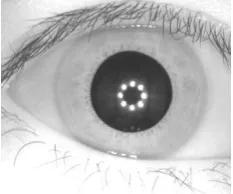
Images are acquired from pre-collected images. The first phase of our method is to collect a large database consisting of several iris images from various individuals, and CASIA iris image database is selected for the implementation which has specular reflections. The CASIA iris image databases are used to evaluate the iris recognition algorithms. Currently this is one of the largest iris databases available in the public domain.
Figure 1: Iris Image
4.1.2 Iris Localization
used to localize the iris by drawing a perfect geometry that fits the boundaries. The center points and the computed radii serve as the parameters which are stored as objects- one for the inner boundary and another for the outer boundary. The steps involved in the iris localization process are summarized as follows:
Step 1: Create Object1, Object2 (Objects are composite data types that stores the parameters representing the geometry for the boundaries of the iris, the parameters include x,y, r1,r2 where x, y are co-ordinates of the center of the eye image and radius1, radius2 respectively)
Step 2: Capture the co-ordinate of the centre of the image of the eye.
Step 3: Capture the co-ordinates of 2 points on the inner boundaries of the iris ( one of the 2 points is vertically above the centre of the eye and the other is horizontally eastward of the centre of the eye that is pX, pY respectively)
Step 4: Compute: radius1 (r1) as distance between the centre of the eye image and the vertical points co-ordinates.
1.1
Where
radius2 (r2) as distance between the center of the eye image and the
horizontal eastward co-ordinates.
1.2
Where
Step 5: Draw an Eclipse using the co-ordinates of the centre of the eye, radius1 and radius2 (r1 and r2).
Step6: Repeat step 3 to 5 for the outer boundary
Step 7: Store the co-ordinates of the centre of the eye image and the 2 computed radius for the inner boundary into Object1
Store the co-ordinates of the centre of the eye image and the 2 computed radius for the outer boundary into Object2.
Step 8: Stop.
4.1.3 Iris Normalization
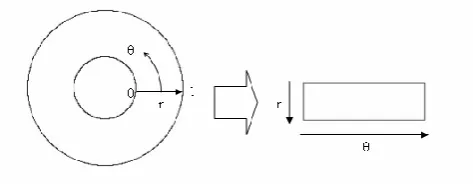
After successfully segmenting iris region from an eye image, next step is to transform the iris region to the fixed dimensions. To facilitate the feature extraction and compensation for rotation, the localized iris is converted from a Cartesian coordinate system to a polar coordinate system. Daugman’s ‘rubber sheet model’ [17] is used to normalize the iris annular region to a rectanglar region. This model remaps each point within the iris region to polar coordinates (r,θ) where r is on the interval [0,1] and θ is angle [0,2π] from the Cartesian coordinates.
Figure 2: Daugman’s rubber sheet model
The remapping of the iris region from (x,y) Cartesian coordinates to the normalised non-concentric polar representation is modelled as
4.3
with
where I(x,y) is the iris region image, (x,y) are the original Cartesian coordinates, (r,θ) are the corresponding normalised polar coordinates, and and are the coordinates
of the pupil and iris boundaries along the θ direction. The rubber sheet model takes into account pupil dilation and size inconsistencies in order to produce a normalised representation with constant dimensions. In this way the iris region is modelled as a flexible rubber sheet anchored at the iris boundary with the pupil centre as the reference point. The normalized iris image is used for iris signature extraction.
4.2
Iris Feature Extraction
Feature extraction is a key process where the two dimensional image is converted to a set of mathematical parameters. The iris contains important unique features, such as stripes, freckles, coronas crypts radial furrow, rings and zigzag collarette. These features are collectively referred to as the texture of the iris. The significant features of the iris must be encoded so that comparisons between templates can be made.
Gabor filter and wavelet transform are well-known techniques in texture analysis [15][7]. In this research work, Wavelet transform is adopted for the feature extraction.
A novel feature extraction technique is proposed using Fast Wavelet Transform (FWT).
4.2.1 Fast Wavelet Transform
It is derived from a finitely generated, orthogonal multiresolution analysis (MRA). In the terms given there, one selects a sampling scale J with sampling rate of 2J per unit interval, and projects the given signal f onto the space VJ; in
theory by computing the scalar products.
4.2.2 Algorithm
for
FWT
Feature
Extraction
Step 1: Read normalised greyscale image of dimension 480 × 160 pixels.
Step 2: Store pixel value into a linear array
where =
Step 3: Perform FWT encoding
a) Take each pixel row in the linear array and store as vector Vec1d
b) Transform each vector Vec1d using FWT algorithm
c) Store transformed vector(s) back in the linear array
d) Take each pixel column in the linear array and store as vector vec1d
e) Transform each vector using FWT algorithm
f) Store transform vector back into the linear array
g) Extract 2048bit FWT values from the array and store in new array as template
Step 4: Repeat steps 1-3 for second normalized grayscale image
Encoding Process
Immediately the transformation is initiated, the program copies the pixels data of the normalized image into a memory location (say) X, to ensure that the image is in gray scale that is, 8bpp, it converts the pixel data in the memory to grey-scale image. The converted image is stored back into the memory. It is then transformed using the daub filter/fwt. In the formular , the filter is a parameter.
After the transformation, the 2048 bits data is extracted in the following format;
For pixel value greater than 0.5 we take 11
For pixel value greater than 0 but less than 0.5 we take 10
For pixel value greater than -0.5 but less than 0 we take 01
For pixel value less than -0.5 we take 00.
5.
RESULTS AND DISCUSSIONS
5.1
Iris Localization
The iris localization algorithm proved to be successful.
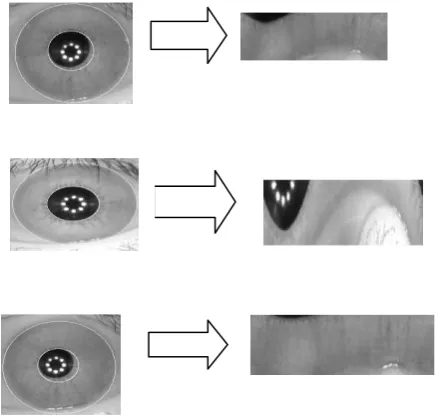
Eye image7 Eye image9 Eye image19
Figure 3: Iris Localization of various images from the CASIA database.
5.2
Iris Normalization
The normalization process also proved successful and some results are shown in Figure 4. The normalized iris is converted to 480 by 160 pixels in order to be able to generate 2048 bit iris codes.
Figure 4: Illustration of normalization process for Iris images 7, 9 and 19 respectively
5.3 Iris Feature Extractions
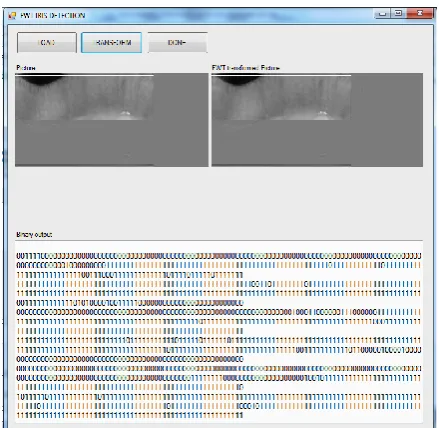
After successful normalization process, the features of the iris are encoded. For pixel value greater than 0.5, 11 bits is extracted, for pixel value greater that 0 but less than 0.5, 10 is extracted, for pixel value greater than -0.5 but less than 0, 01 is extracted and when pixel value is less than - 0.5, 00 is extracted to generate the 2048 bit iris codes.
Figure 5(a): FWT feature encoding for Normalized iris 7.
Figure 5(b): FWT feature encoding for Normalized iris 9.
6.
CONCLUSION
The researchers have proposed a new algorithm for iris feature extraction. To facilitate the feature extraction, the localized iris is converted from a Cartesian coordinate system to a polar coordinate system. This algorithm uses Fast Wavelet Transform to extract features of iris. This algorithm is fast and has lower complexity rate.
7.
REFERENCES
[1] Belganoui Y., Guézel J. C. and Mahé T., "La biométrie, sésame absolu", Industries et Techniques, France, n°817, July 2000.
[2] Gifford, M. M., McCartney, D. J. and Seal, C.H.”Networked biometrics systems: requirements based on iris recognition,” BT Technol. Journal, vol. 17, no 2, Apr 1999.
[3] Ross, A. and Jain, A.K. “Human Recognition Using Biometrics: An overview”, Annals of Telecommunications, vol. 62, No.1/2, pp. 11-35, Jan/Feb 2007.
[4] Institute of Automation, Chinese Academy of Sciences, CASIA Iris Image Database, Retrieved 20th June, 2013 from http://www.sinobiometrics.com/.
[5] Jain, A., Bolle, R. and Pankanti, S. eds, “Biometrics: Personal Identification in a Networked Society,”
Kluwer, pp 276-284, 1999.
[6] Daugman, J “Biometric Personal Identification system based on iris analysis,” U S Patent No 5291,560 1994.
[7] Ma. L, Yunhong Wang, T. and Zhang, D. “Personal identification based on iris texture analysis,” IEEE
Transactions on Pattern Analysis and Machine
Intelligence, vol.25, no.12, 2003.
[8] Daugman John. Recognizing persons by their iris patterns. Cambridge University, Cambridge, UK pp 103-123.
[9] Iris Recognition and Identification, Retrieved 27th July, 2013 from http://www.iris-recognition.org/, 2002.
[10] Daugman, J. “High Confidence Visual Recognition of Persons by a Test of Statistical Independence,” IEEE
Trans. Pattern Analysis and Machine Intelligence,
vol. 15, no. 11, pp. 1148- 1161, Nov. 1993.
[11] Daugman, J. “Demodulation by Complex-Valued Wavelets for Stochastic Pattern Recognition,” Int’l J. Wavelets, Multiresolution and Information Processing, vol. 1, no. 1, pp. 1-17, 2003.
[12] Boles, W and Boashash, B. “A Human Identification Technique Using Images of the Iris and Wavelet Transform,” IEEE Trans. Signal Processing, vol. 46, no. 4, pp. 1185-1188, 1998.
[13] Wildes, R., Asmuth, J., Green, G., Hsu, S., Kolczynski, R., Matey, J. and McBride, S. “A Machine-Vision System for Iris Recognition,” Machine Vision and Applications, vol. 9, pp. 1-8, 1996.
[14] Lim, S., Lee, K., Byeon, O. and Kim, T. “Efficient Iris Recognition through Improvement of Feature
Vector and Classifier,” ETRI J., vol. 23, no. 2, pp. 61-70, 2001.
[15] Ma, L., Wang, Y. and Tan, T. “Iris Recognition Based on Multichannel Gabor Filtering,” Proc. Fifth Asian Conf.Computer Vision, vol. 1, pp. 279-283, 2002.
[16] Tisse, C., Martin, L., Torres, L. and Robert, M “Person Identification Technique Using Human Iris Recognition” Proc.Vision Interface, pp.
294-299, 2002
[17] Sanchez-Reillo, R. and Sanchez – Avila, C. “Iris Recognition with Low Template Size” In Proc. Int.
Conf. Audio and Video-Based Biometrics Person
[18] Noh, S. I., Pae, K., Lee, C. and Kim, J. “Multiresolution independent component analysis for iris identification,” Proc. International Conf. on
circuits/Systems Computers and Communication, 2002.
[19] Zhu, Y., Tan, T. and Wang, Y. “Biometric personal identification based on iris pattern,” ICPR2000:
the 15th International Conference on Pattern
Recognition, pp.805-808, 2002.
[20] Du,Y., Ives, R., Chang, C-I., Etter, D. and Welch, T. “Information divergence-based iris pattern recohnition for automatic human identification,” Proc.SPIE
5404, 2004.
[21] Ramy Zewail, Ahmed Seil, Nadder Hamdy, Magdy Saeb,“Iris Identification Based on Log-Gabor Filtering”, Proceedings of the IEEE Midwest Symposium on Circuits,Systems, and Computers, 2003.
[22] Xiaoyan Yuan and Pengfei Shi, “Iris Feature Extraction Using 2D Phase Congruency,”
Proceedings of the Third International Conference on Information Technology and Applications (ICITA’05). 2005.
[23] Wen-Shiung , C., Kun-Huei, C., Sheng-Wen, S. and Chih-Ming Hsieh, H. “ Personal Identification Technique based on Human Iris Recognition with Wavelet Transform,” ICASSP, pp. 949-952, 2005.
[24] Sulochana, Helen. C. and Selvan, S. “Iris Feature Extraction Based on Directional Image
Representation,” GVIP Journal, vol 6, no. 4, pp. 55-62, 2006.
[25] Birgale, L.V. and Kokare, M. “Iris Recognition Using Discrete Wavelet Transform,” IEEE Computer Society International Conference on Digital Image Processing, pp.147-151, 2009.
[26] Harjoko, A., Hartati, S. and Dwiyasa, H. “A Method for Iris Recognition Based on 1D Coiflet Wavelet,” World Academy of Science, Engineering and Technology 56, pp.126-129, 2009.
[27] Patil, C.M. and Patilkulkarni Sudarshan . “Iris recognition for personal identification using wavelet Approximations,” Proc. Second International Conf. on Advances in computer Vision and Information Technology., Accepted
[28] Patil, C.M. and Patilkulkarni Sudarshan ,”Iris Feature Extraction for Personal Identification using Lifting Wavelet Transform,” International
Journal of Computer
Applications,vol.1,no.14,pp.68-72, 2010.
[29] Daugman, J. How iris recognition works. Proceedings
of 2002 International Conference on Image
Processing, vol. 1, 2002.
[30] Proenca H and Alexandre Luis A., “ Iris Recognition: An Analysis of the Aliasing Problem in the Iris Normalization Stage”, IEEE Proceedings on the
International Conference on Computational
Intelligence and Security – CIS, vol. 2,pp 1771-1774, 2006.