Original Research Article
Job satisfaction among nurse‘s in public and private sector in Dhaka
City of Bangladesh: a comparative study
Ratna Khatun
1, Nahida Akter
1, Faisal Muhammad
2*,
A. B. M. Alauddin Chowdhury
2INTRODUCTION
Nurses need enthusiasm and feeling love, caring attitude and alarming concern to fulfill the needs of their patients.1 Nursing is an identified noble profession that has relations with the healing ability and a sense of reflection to serve humanity. Disparity in health care sectors including reorganization, redesigning, escalate the roles of health care professionals are the cause of nurses to enlarge their responsibilities. They have to face many awkwardness in providing care to the patients with their quick changing roles and separate environment.2 Moreover, worldwide nursing is dealing with the shortage
of work force that creates a significant threat which is society‟s most vulnerable populations and has adverse implications for the quality of health care.3 Dealing with these situations, nurses‟ job satisfaction has become a major concern in the health care sector globally.4 Quality assurance in health includes all the movements taken to encourage and intensify health care.5
Job satisfaction among nurses is a crucial concern in Bangladesh; limited research in this area has been found in Bangladesh. Some surveys reported that job satisfaction among nurses in Bangladesh was near to the ground.6,7 Humans accomplish optimally when satisfied
ABSTRACT
Background: Nursing is a recognized noble profession that has relations with the healing ability and a sense of reflection to serve humanity. Variations in health care sectors including reorganization, redesigning, intensifying the roles of health care professionals are the cause of nurses to extend their responsibilities. The study was aimed to analyze the level of job satisfaction among nurses in public and private sector in Dhaka city of Bangladesh.
Methods: A descriptive cross-sectional type of study was carried out among the nurses of the selected hospitals, data
was collected using self-administered semi-structured questionnaire and it was analysed using SPSS.
Results: In this study the mean age of the respondents from public hospital was 34.61±7.79 years. On the other hand
from private hospital the mean age was 29.33±5.91 years more than half (56%) of the respondents from public hospital had diploma in nursing, while most (45%) of the respondents from private hospital had B.Sc. in nursing. Slightly above six-tenths (61%) of the respondents were satisfied with their present job and the rest of the respondents were not satisfied.
Conclusions: The finding of this study revealed that the respondents who are working in the public hospital were more satisfied than their counterpart.
Keywords: Satisfaction, Nurses, Job, Health, Bangladesh
1
Grameen Caledonian College of Nursing, Mirpur-2, Dhaka, Bangladesh
2
Department of Public Health, Faculty of Allied Health Sciences, Daffodil International University, Dhaka, Bangladesh
Received: 08 February 2018
Revised: 04 May 2018
Accepted: 05 May 2018
*Correspondence:
Dr. Faisal Muhammad, E-mail: [email protected]
Copyright: © the author(s), publisher and licensee Medip Academy. This is an open-access article distributed under
the terms of the Creative Commons Attribution Non-Commercial License, which permits unrestricted non-commercial use, distribution, and reproduction in any medium, provided the original work is properly cited.
with their work. Job satisfaction is regulate by the degree to which the characteristics of a job fulfill a person‟s needs. The higher the balance of satisfaction over dissatisfaction, the more likely it is that an individual will play an active role in the fulfillment of organizational goals.5The nursing shortage results in a “brain drain” of this essential source from low income countries. A range of factors has been shown to contribute to the shortage of nurses, including poor job satisfaction.8,9 According to WHO in Bangladesh, about 90% of the nurses were not satisfied with their job.7 This study was aimed to analyze and compare the level of job satisfaction among nurses in public and private sector in Dhaka city of Bangladesh.
METHODS
A cross-sectional type of study was conducted for a period of five months (June to November 2017), among the nurses in Dhaka medical college hospital (DMCH) and Labaid hospital Dhaka Bangladesh. The targeted population was all the registered nurses in the selected hospitals who were available and willing to participate.
A sample of 200 nurses was selected purposively. All the respondents were given the necessary information regarding this study and the data was collected from the respondents using self-administered, pre-tested, semi-structured questionnaire, after taking verbal consent form the participants. All the collected data, was checked for
completeness, correctness and internal consistency to exclude missing or inconsistent data and those were discarded. Corrected data was entered into Statistical Package for Social Sciences (SPSS) statistical software version 20 for the analysis.
RESULTS
Socio-demographic distribution of the respondents
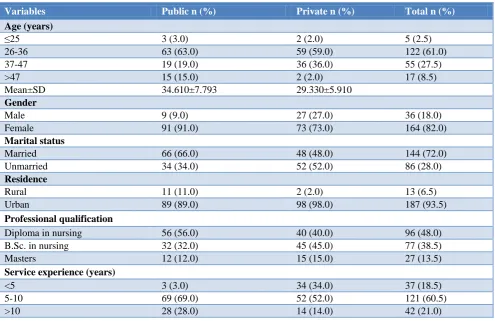
In the present study the majority (61.0%) of the respondents were between 26-36 years old. The mean age of the respondents from public hospital was 34.610±7.793 years. On the other hand the mean age of them was 29.330±5.910 years. Most of the respondents (82%) were female and the rest were male, above nine-tenths (91%) of the respondents from public hospital were female, while from the counterpart more than seven-tenths (73%) of the respondents were female. The majority (72%) of the respondents was married and the rest were unmarried. According to residence distribution of the respondents about 91% of the respondents were residing in urban areas. Close to half (48%) of the respondents had diploma level of education, followed by B.Sc. in nursing (38.5%) and the rest had masters level of education. More than half (56%) of the respondents in the public hospital had diploma in nursing and from the private hospital above two-fifths (45%) had B.Sc. in nursing (Table 1).
Table 1: Socio-demographic distribution of the respondents (n=200).
Variables Public n (%) Private n (%) Total n (%)
Age (years)
≤25 3 (3.0) 2 (2.0) 5 (2.5)
26-36 63 (63.0) 59 (59.0) 122 (61.0)
37-47 19 (19.0) 36 (36.0) 55 (27.5)
>47 15 (15.0) 2 (2.0) 17 (8.5)
Mean±SD 34.610±7.793 29.330±5.910
Gender
Male 9 (9.0) 27 (27.0) 36 (18.0)
Female 91 (91.0) 73 (73.0) 164 (82.0)
Marital status
Married 66 (66.0) 48 (48.0) 144 (72.0)
Unmarried 34 (34.0) 52 (52.0) 86 (28.0)
Residence
Rural 11 (11.0) 2 (2.0) 13 (6.5)
Urban 89 (89.0) 98 (98.0) 187 (93.5)
Professional qualification
Diploma in nursing 56 (56.0) 40 (40.0) 96 (48.0)
B.Sc. in nursing 32 (32.0) 45 (45.0) 77 (38.5)
Masters 12 (12.0) 15 (15.0) 27 (13.5)
Service experience (years)
<5 3 (3.0) 34 (34.0) 37 (18.5)
5-10 69 (69.0) 52 (52.0) 121 (60.5)
>10 28 (28.0) 14 (14.0) 42 (21.0)
Variables Public n (%) Private n (%) Total n (%)
Income (taka)
≤28000 38 (38.0) 1 (1.0) 39 (19.5)
29000-39000 29 (29.0) 39 (39.0) 68 (34.0)
40000-50000 30 (30.0) 45 (45.0) 75 (37.5)
>50000 3 (3.0) 15 (15.0) 18 (9.0)
Mean±SD 34640.0±8454.9 28150.0±7435.0
**80 taka=1USD.
Table 2: Distribution of the respondents based on job satisfaction (n=200).
Hospital
Satisfaction
Df
Chi-square P value
Yes n (%) No n (%) Total n (%)
Public 91(91.0) 9(9.0) 100(50.0)
1 75.662 <0.001
Private 31(31.0) 69(69.0) 100(50.0)
Total 122(61.0) 78(39.0) 200(100.0)
Table 3: Relationship between job satisfaction and some socio-demographic factors (n=200).
Variables Satisfaction Df
Chi-square P-value
Yes No Total
Age group
≤25 4 1 5 3
46.722 <0.001
26-36 52 70 122
37-47 50 5 55
>47 16 1 17
Monthly income (taka)
≤28000 2 37 39 3
78.208 <0.001
29000-39000 39 29 68
40000-50000 65 10 75
>50000 16 2 18
Residence
Rural 10 3 13 1
1.482 0.223
Urban 112 75 187
Professional qualification
Diploma 33 63 96 2
55.269 <0.001
B.Sc. in nursing 67 10 77
Masters 22 5 27
Year of service experience
<5 years 2 35 37 2
67.783 <0.001
5-10 years 81 40 121
>10 years 39 3 42
Total 122 78 200
It also demonstrated that little above three-fifths (60.5%) of the respondents had 5-10 years of service experience. The majority (37.5%) of the respondents was earning 40000-50000 taka per month, the mean monthly income was 34640.0±8454.9 taka. On the other hand the mean monthly income was 28150.0±7435.0 taka.
Distribution of the respondents according to job satisfaction
Table 2 demonstrated that slightly above six-tenths (61%) of the respondents were satisfied with their present job and the rest of the respondents were not satisfied. Most of
the respondents from public hospital (91.0%) were satisfied with their job while in the other way round only about 31% of the respondents from private hospital were satisfied and the rest (69%) of them were not satisfied. It has also been found that there was significant association (p<0.001) between job satisfaction and hospital type of the respondents.
Relationship between job satisfaction and some socio-demographic factors
(p<0.001), monthly income (p<0.001), professional qualification (p<0.001) and years of service experience (p<0.001). However it was not associated with residence of the respondents (p=0.223).
DISCUSSION
Nurses hold a greater part of positions in the most health care organizations and are considered to be essential for ensuring the quality of patient care and cost minimization. A study reported that organizational factors and substandard working conditions have also been strongly associated with job dissatisfaction, while the social aspects of a job have been found to be a strong predictor of job satisfaction.10
Nurses‟ job satisfaction is define as the scope to which the contrast between the amount of rewards received by nurses and the amount they believed that they should receive.11 In present study above six-tenths (61%) of the respondents were satisfied with their present job and the rest of the respondents were not satisfied. Our finding was little bit lower than the finding of another study which reported that about 76% of healthcare professionals were satisfied with their current jobs in overall job satisfaction at Tilganga eye centre.12 Our finding was not similar to the findings of another study which reported that the majority of the participants were not satisfied with their job.13
In our study most of the respondents from public hospital (91.0%) were satisfied with their job while on the other hand only about 31% of the respondents from private hospital were satisfied. Our finding is inconsistent with the findings of a similar study done by Pillay, who reported that public sector nurses were highly dissatisfied with salaries, workload and resources, while private sector nurses were moderately dissatisfied with pay, workload and opportunities to develop.14 It has also been found that there was significant association between job satisfaction and hospital type of the respondents. Many studies about job satisfaction reported that the quality of the healthcare was found to be associated with job satisfaction.15,16 Consequently, the job satisfaction among nurses should be a great concern for any health care organizations. Our study demonstrated that job satisfaction was found to be significantly associated with age of the respondents, monthly income, professional qualification and years of service experience. A study in Nigeria also reported that there is significant positive relationship between age, work experience and job satisfaction.17 Another study also reported that employees with longer experience were also more satisfied than those with short experience.18 In a study done by Hardigan et al, they reported that the most significant finding from this study is that age, income, and practice site can predict job satisfaction among practicing pharmacists.19
CONCLUSION
The findings of this study reveals that more than three-fifths of the respondents were satisfied with their present job and the respondents who are working in the public hospital were more satisfied than their counterpart. It further revealed that there was significant association between job satisfaction and hospital type of the respondents.
It also reported that job satisfaction was found to be significantly associated with some socio-demographic factors such as age of the respondents, monthly income, professional qualification and years of service experience.
Recommendations
Generally the nurses should be allowed to make some decision on their own and should be properly evaluated and promoted based on one‟s performance.
Nurses should be compliant for organizational structure and policy that can give a better environment.
Every hospitals should infuse in nurses through giving orientation, staff development and upgrade work environment as such measures are more cost-effective in the long term.
ACKNOWLEDGEMENTS
The authors would like to thank Department Public Health, Daffodil International University, Dhaka Bangladesh and Grameen Caledonian College of Nursing, Mirpur-2, Dhaka, Bangladesh.
Funding: No funding sources Conflict of interest: None declared
Ethical approval: The study was approved by FAHS Research Ethics Committee, DIU” Daffodil International University, Dhaka Bangladesh
REFERENCES
1. Henry J, Henry L. Caring from the inside out strategies to enhance nurse retention and patient satisfaction. Nurse Leader. 2004;2(1):28-32. 2. Mok E, Au-Yeung B. The relationship between the
organizational climates and empowerment of nurses in Hong Kong. J Nursing Manag. 2002;10(3):129-37.
3. Buchan J, Aiken L. Solving nursing shortages: A common priority. J Clin Nurs. 2008;17(24):3262-8. 4. Bradley JR, Cartwright S. Social support, job stress,
health, and job satisfaction among nurses in the
United Kingdom. Int J Stress Manag.
2004;9(3):163-82.
6. Hossain D. Nurses‟ satisfaction on job performance provided in public & private hospitals. Unpublished master‟s thesis, Northern University, Dhaka, Bangladesh, 2008.
7. World Health Organization. Nursing and midwifery workforce management: Guidelines. Regional Office for South East Asia. New Delhi, WHO 2003. 8. Aiken LH, Clarke SP, Sloane DM, Sochalski JA,
Busse R, et al. Nurses‟ reports on hospital care in
five countries. Health Aff (Millwood).
2001;20(3):43–53.
9. Miller JF. Burnout and its impact on good work in nursing. J Radiol Nurs. 2011;30(4):146–9.
10. Kekana HP, du Rand EA, van Wyk NC. Job satisfaction of registered nurses in a community hospital in the Limpopo Province in South Africa. Curationis. 2007;30(2):24-35.
11. Molinari DL, Monserud MA. Rural nurse job satisfaction. Rural Remote Health. 2008;8(4):1055. 12. Nawaraj C, Deepak KK. Factors Influencing Job
Satisfaction among Healthcare Professionals at Tilganga Eye Centre. Int J Sci Tech Res. 2012;1(11):32-6.
13. Ramesh K, Jamil A, Babar TS, Rehan H, Assad H. Job satisfaction among public health professionals working in public sector: a cross sectional study from Pakistan. Human Resources for Health. 2013;11:2.
14. Pillay R. Work Satisfaction of Professional Nurses in South Africa: A Comparative Analysis of the Public and Private Sectors. Human Resources for Health. 2008;7:5.
15. Mrayyan MT. Jordanian nurses‟ job satisfaction, patients‟ satisfaction and quality of nursing care. International Nursing Rev. 2006;53(3):224-30. 16. Adams A, Bond S. Hospital nurses‟ job satisfaction,
individual and organizational characteristics. J Adv Nurs. 2000;32(3):536–43.
17. Abiodun MG, Gbadebo OA. Effects of Age and Work Experience on Job Satisfaction of Primary School Teachers: Impactions for Career Counseling. Int J Asian Social Sci. 2012;2(3):302-9.
18. Shah MA, Al-Enezi N, Chowdhury RI, Shah NM. Correlates of Job Satisfaction among Healthcare Professionals in Kuwait. Med Principles Pract. 2001;10(3):156-62.
19. Hardigan P, Carvajal M. Job Satisfaction among Practicing Pharmacists: A Rasch Analysis. Int J Allied Health Sci Pract. 2007;5(4):1-9.
Cite this article as: Khatun R, Akter N, Muhammad