Content-Based Color Image Retrieval Using
Adaptive Lifting
P.Manimegalai1, Dr.K.Thanushkodi2
1 Asst. Professor, Department of Electronics and Instrumentation Engineering
Karunya University, Coimbatore, Tamilnadu, INDIA Email: [email protected]
2 The Principal, Akshaya College Of Engineering and technology, Coimbatore, Tamilnadu, INDIA
---ABSTRACT--- An image retrieval system is a computer system for browsing, searching and retrieving images from a large database of digital images. CBIR aims at avoiding the use of textual descriptions and instead retrieves images based on their visual similarity to a user-supplied query image or user-specified image features. Although classical wavelet transform is effective in representing image feature and thus is suitable in CBIR, it still encounters problems especially in implementation, e.g. floating-point operation and decomposition speed, which may nicely be solved by lifting scheme, a novel spatial approach for constructing biorthogonal wavelet filters. Lifting scheme has such intriguing properties as convenient construction, simple structure, integer-to-integer transform, low computational complexity as well as flexible adaptivity, revealing its potentialsin CBIR. In this paper, by using general lifting and its adaptive version, we decompose HSI color images into multi-level scale and wavelet coefficients, with which, we can perform image feature extraction.
Keywords
:
Content based image retrieval, Lifting Scheme , Adaptive Lifting.--- Date of Submission: 25, November 2009 Revised: April 09, 2010 Date of Acceptance: May 15, 2010 ---
1. INTRODUCTION:
C
ontent-based image retrieval (CBIR)[1]–[2] ,allows to automatically extract targets according to objective visual contents of image itself (e.g. color, texture and shape), has become increasingly attractive in multimedia information service system (MISS). With appealing time-frequency localization and multi-scale properties, wavelet transform proved to be effective in feature extraction and representation, and thus has been successfully applied especially in image coding and denoising. In CBIR, wavelet approaches mainly include direct wavelet coefficients, wavelet histogram and wavelet moment of image, etc. However, classical wavelet encounters some inherent limitations in image processing. First, classical construction relying heavily on frequency domainis basically unfit for spatial realization, inevitably losing desirable properties exclusively owned in spatial domain. Second, its floating-point operation makes it not only inefficient but also inaccurate when processing integer image coefficients[6]. Third, finding an ideal preprocessing method from classical viewpoint is somewhat difficult, e.g. hard to seek a boundary extension method ensuring perfect reconstruction, while simultaneously maintaining boundary continuity. Hence,
traditional wavelet approaches, though effective in general case, may still result in reduced performance in CBIR. Lifting scheme [3]-[6] ,a novel approach for constructing the so-called second-generation wavelet, provides feasible alternative for problems facing the classical first-generation wavelet in image applications. Constructed entirely in spatial domain and based on the theory of biorthogonal wavelet filter banks with perfect reconstruction, lifting scheme can easily build up a gradually improved multi-resolution analysis through iterative primal lifting and dual lifting. It turns out that lifting scheme outperforms the classical especially in effective implementation, such as convenient construction, in-place calculation, lower computational complexity and simple inverse transform, etc. With lifting, we can also build wavelets with more vanishing moments and/or more smoothness, contributing to its flexible adaptivity and non-linearity.
diversity of prediction and update operators as linear, non-linear or spatially variable, we thus design corresponding adaptive filters via lifting to make them data-dependent, as a result, optimal image representation and accordingly, improved retrieval performance may be achieved. The rest of this paper is organized as follows. In Section 2, we introduce image decomposition approaches via general lifting and its adaptive version as well as classical wavelets. Section 3 provides image feature extraction and similarity criteria based on F-norm theory. Section 4 describes a progressive CBIR strategy. Section 5 presents the implementation and experimental results of above wavelet approaches applied in CBIR. Finally, conclusions and future research are provided
in chapter 6.
2. Image decomposition with wavelet approaches
We intend to use three wavelet approaches for image decomposition, namely classical wavelet, general lifting and its adaptive version. With resulting decomposition coefficients, we can take measures to extract image feature and perform similarity match.
2.1 CLASSICAL WAVELET TRANSFORM
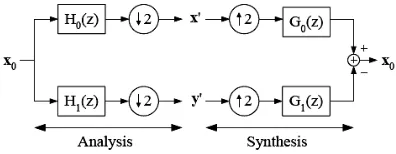
A main goal of wavelet research is to create a set of expansion functions and transforms that give informative, efficient, and useful description of a function or signal. In applications working on discrete signals, one never has to directly deal with expansion functions. Discrete wavelet transform (DWT) is obtained simply by passing a discrete signal through a filter bank. Wavelet theory can be understood and developed only by using such digital filters. This is the meeting point between wavelets and sub band coding and the origin of two different nomenclatures for the same concepts. In fact, wavelet transform and sub band coding are so closely connected that both terms are often used interchangeably. Filter banks are structures that allow a signal to be decomposed into sub signals through digital filters, typically at a lower sampling rate. Figure 1 shows a two-band filter bank.
Figure 1.one level 2 band perfect reconstructions.
It is formed by the analysis filters (Hi(z), i = 0, 1) and the
synthesis filters (Gi(z), for i = 0, 1).Filters H0(z) and G0(z)
are low-pass filters. In an M-band filter bank, Hi(z) and
Gi(z) for 0 < i < M − 1 are band-pass filters, and HM−1(z)
and GM−1(z) are high-pass filters. For a two-band filter
bank, M = 2 and H1(z) and G1(z) are high-pass filters. If
the input signal can be recovered without errors from the sub signals, the filter bank is said to be a perfect reconstruction (PR) or a reversible filter bank. To enable PR, the analysis and synthesis filters have to satisfy a set of bilinear constraints.
Every finite impulse response (FIR) filter bank with an additional linear constraint on the low-pass filter is associated with a wavelet basis. The low-pass synthesis filter G0(z) is associated with the scaling function, and the
remaining band-pass synthesis filters (G1(z) in the 2-band
case) are each associated with the wavelet functions. Analysis low-pass filter H0(z) is associated with the
so-called dual scaling function and analysis band-pass filters with the dual wavelet functions.
The notion of channel refers to each of the filter bank branches. A channel is the branch of the 1-D scaling coefficients (or approximation signal) and also each branch of the wavelet coefficients (or detail signals). The concept of band involves the concept of frequency representation, but it is commonly used in image processing to refer to each set of samples which are the output of the same 2-D filter. In 1-D linear processing both concepts are interchangeable.
2.2 LIFTING SCHEME
The discrete wavelet transform applies several filters separately to the same signal. In contrast to that, for the lifting scheme the signal is divided like a zipper. Then a series of prediction-update operations across the divided signals is applied. It starts with a set of well known filters, thereafter lifting steps are used in an attempt to improve (lift) the properties of corresponding wavelet decomposition. A number of such lifting steps can be used in order to obtain desired properties of a wavelet transform.
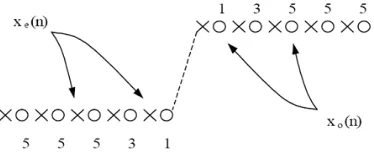
The basic lifting scheme for DWT consists of three steps: Split, Predict and Update. The lifting analysis stage is as shown in Figure 2.
A. Split:
The signal s is split into even and odd sub arrays so and s1. }
l ] l [ S {
B. Predict:
The filtered even array is used to predict the odd array. Then the odd array is redefined as the difference between the existing array and the predicted one. This gives detail coefficients w1.
w1[l1]=gH(S[l1]−Pl1(s0)),∀l1∈Π1 (3) C. Update:
To eliminate aliasing, which appears while down sampling the original signal and to obtain the low-frequency component of the signal, the even array is updated using the filtered new odd array to get coarser coefficients w0.
= + − ∀ ∈Π
0 0 1 1 0 0
0[l] g (S[l] g .Ul0(w)), l
w L H (4)
2.3ADAPTIVE LIFTING USED IN CBIR
In CBIR, since feature extraction requires accurate expression of image contents, thus more precise image decomposition, the basis of effective feature extraction, may be obtained by introducing adaptive lifting. In this work, adaptivity is acquired by using a suite of predictors for smooth and unsmooth parts of the image. In this adaptive lifting scheme Cohen-Daubechies-Feauveau (CDF) wavelet family is employed.
For fast decomposition, we perform a N1=1 point update
and then for each N, chooses the N
∈
{1, 3, 5} point prediction below.P1 = [0, 0, 1, 0, 0]
P2 = [0, -1, 8, 1, 0]/8
P3 = [-3, 22, 128, -22, 3]/128
U = [1, 1]/2
The RLV yields a decision map indicating which prediction filters should be used at which positions. The moderate order predictor is applied first, namely P2 for
high-pass filtering, RLV for all subsequent pixels (i, j) to be predicted is computed,
Higher order predictors are used where the image is locally smooth, resulting in many negligible detail coefficients for better image representation. Whether an image I is locally smooth, namely, the smoothness is determined by measuring the relative local variance (RLV) .
2.3.1 RELATIVE LOCAL VARIANCE (RLV)
A measure is proposed, on which the decision operator in the 2D adaptive lifting scheme can be based on, namely the relative local variance (RLV) of an image. This RLV of an image ‘I’ is given by
= ∑ ∑+ −µ
− = +
− =
T j
T j l
2 j ,i T
i
T i k
) I var( ) ) l , k ( I ( )
j ,i ]( I [
rlv (5)
with
∑ +
∑ =
µ +
− = +
− =
T j
T j l
2 T
i
T i k j
,i I(k,l) (2T 1) (6)
Where, T is the size of sliding window, σ (I) is the standard variance of the image I.
For all pixels (i, j) to be predicted, we first compute rlv[I] (i, j). Then thresholding the values of the RLV yields a decision map indicating which prediction filters should be used at which positions. The moderate order predictor is applied first, namely P2 for high-pass filtering, RLV for all
subsequent pixels (i, j) to be predicted is computed, and suitable predictors are chosen. Two thresholds are chosen preliminarily according to practical situations . Threshold values can be taken as multiples of the mean of the RLV. Test results have shown that [µ(rlv) 1.5µ(rlv) 2µ(rlv) ] are the threshold levels that yield a good performance. RLV value above the bigger threshold indicates that a lower order predictor namely P1 should be selected. When RLV
value is below the smaller threshold suggests that a higher order predictor, namely P3 should be activated. Otherwise
P2 remains unchanged
.
Figure 3.Adaptive prediction using CDF wavelets
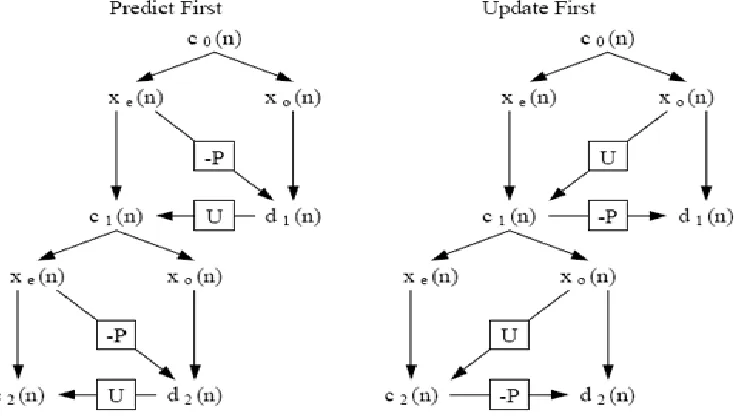
2.3.2 TWO LEVEL LIFTING FRAME WITH UPDATE-FIRST
In non-linear wavelet transform for image coding via lifting, under the “predict-first” frame, adaptive multi-predictors strategy aims at better image decomposition which in turn, introduce stability and synchronization
problems to reconstruction part and results in serious reconstruction errors.So, an update-first structure is proposed to make the prediction outside of the lifting loop.Therefore, the resulting coarse coefficients can be directly iterated to the lowest scale [8] .
In CBIR, dealing with no reconstruction, we just borrow this idea in the proposed adaptive scheme. With update
first, coarse coefficients representing the main part of image can be calculated fast, which are used to perform fast retrieval, simultaneously, to compensate the retrieval precision. Because of update first scheme, the order of the high pass filters can be increased to obtain more accurate detail coefficients without any affecting the calculation of coarse coefficient
Figure 4 Two-level lifting frames with predict-First (Left) and Update-First (right) 3. F-NORM THEORY
Our CBIR algorithm is based on direct wavelet decomposition of image in HSI colour space and utilizes the “query by example” method. With approaches mentioned in previous chapters, database images are decomposed offline into multi-level coefficients from -1 to -J levels, with which, we can generate colour feature database and perform similarity match between images. After decomposition, each resulting sub image is in fact a coefficient matrix, where, by special processing, large coefficients with more energy can be distributed in the up-left area, therefore, with F-norm theory , we can well decrease the dimension of image feature and perform highly efficient image matching.
3.1 QUERY BY EXAMPLE METHOD
‘Query by Example method’ is a query technique that involves providing the CBIR system with an example image that it will then base its search upon. The underlying search algorithms may vary depending on the application, but result images should all share common elements with the provided example.
Options for providing example images to the system include:
• A preexisting image may be supplied by the user or chosen from a random set.
• The user draws a rough approximation of the image they are looking for, for example with blobs of color or general shapes.
This query technique removes the difficulties that can arise when trying to describe images with words.
3.2 FEATURE VECTOR EXTRACTION USING F-NORM THEORY
Suppose A is a square matrix and Ai is its ith order sub matrix:
=
nn 1 n n 1 11a
...
a
...
...
...
a
...
a
A
,
=
ii 1 i i 1 11 ia
...
a
...
...
...
a
...
a
A
(i=1~ n)The F-norm of Ai is given as: 2 1 i 1 k 2 i 1 l kl F i
a
A
∑ ∑
=
= = (7) Let F 1 i F ii A A
A = − −
∆ and A 0
F 0 = , We can define the feature vector of A as:
{
1, 2 n}
AF A A ,..., A
V = ∆ ∆ ∆ (8) 3.3 SIMILARITY CRITERIA
Consider two images A and B. Let the feature vectors of the two images be VAF and VBF. Vector elements in the
feature vector are represented by ∆Ai and ∆Bi. The
similarity between the two images is given by the following similarity criteria . Let αi be the similarity of ∆Ai
and ∆Bi.
= ∆ = ∆ ≠ ∆ ≠ ∆ ∆ ∆ ∆ ∆ = α 0 B A , 1 0 B or 0 A , ) B , A max( ) B , A min( i i i i i i i i i (9)
And we can give the similarity α of the two images A and B as:
∑
α
=
α
= n 1i i i
c
(10) Where,)
n
....,
,
2
,
1
i
(
n
1
i
2
c
2 i=
−
=
and n
c
1
1
i i
=
∑
=
Similarity between the two images lies in between 1
0≤α≤ .
4. PROGRESSIVE RETRIEVAL STRATEGY
When a user submits a query, we must compute the feature vector for the querying image and match it to the pre-computed feature vectors of the images in the database. This is done in two phases. In the first phase, we compare the standard deviations stored for the querying image with
the standard deviations stored for each image in the database. The following criteria is used for rough filtering of the database. Denote the standard deviation information computed for the querying image as e
H σ , e
S
σ and e I
σ . Denote the standard deviation of target image as t
H
σ , t S
σ and t
I
σ . If this acceptance criterion is satisfied the target image is kept for further retrieval or else it is discarded.
)) &( & ) (( ) ( β σ σ βσ β σ σ βσ β σ σ βσ e I t I e I e s t S e S e H t H e H F < < < < < <
= (11)
Where, β is a filtering constant. The value of β = 1- percent\100 and percent is a threshold variable set to control the number of images passing the first matching phase. It is usually set to 50.In second phase, with the obtained LL coefficients, which best reflect the general feature of image; we use the similarity criteria to determine more precise targets. We use all the three colour components(HSI) for feature extraction to get better retrieval accuracy If α exceeds a given threshold, it means that mismatch occurs and It should be discarded; else, It be
kept for further match.
5.EXPERIMENTAL RESULTS
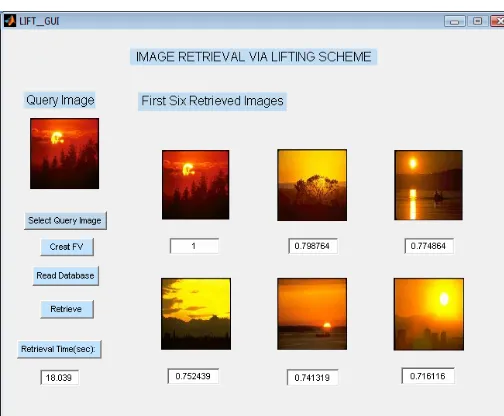
Figure 5.CBIR Results Using Classical Wavelet Transform
Figure 6.CBIR Results Via Lifting Scheme Using 9/7 Wavelet
Figure 7.CBIR Results Via Adaptive Lifting Scheme Using CDF Wavelets
5.1RETRIEVALCOMPARISON PAPAMETERS
The two important retrieval comparison parameters are
• Retrieval accuracy
• Retrieval time 5.1.2 Retrieval accuracy
The retrieval accuracy is defined as the ratio between the number of relevant (belongs to the same category) retrieved images and the total number of retrieved images (known as a single precision).
ages trieved of
No Total
ages trieved velent
No Accuracy trieval
Im Re
.
Im Re
Re .
Re =
Wavelet Transform Method
Six Retr ieval s
Five Retrie vals
Four Retrieva
ls
Three Retrie vals
Two Retri evals
One Retr ieva ls
Classical Wavelet Transform
5.33
33 4.6945 3.9722 3 2 1
General Lifting Scheme
5.61
11 4.8888 4 3 2 1
Adaptive Lifting Scheme
5.86
11 5 4 3 2 1
TABLE-1: COMPARISON OF RETRIEVAL ACCURACY
COMARSION OF THREE WAVELET METHODS
0 20 40 60 80 100 120
Classical Wavelet Transform General Lifting Scheme Adaptive Lifting Scheme
WAVELET METHOD
R
E
T
R
IE
V
A
L
A
C
C
U
R
A
C
Y
Figure-8: Comparison of retrieval accuracy From Figure-8 it is obvious that retrieval rates were improved by using adaptive lifting filters instead of general non-adaptive wavelet filters
5.1.3 Retrieval time
It is the average time taken for the retrieval of target images after query image has been given.
TABLE 2.COMPARISON OF RETRIEVAL TIMES FOR THE
THREE WAVELET METHOD
From the table.2 it is obvious that classical wavelet method takes much time than lifting scheme. Adaptive lifting scheme takes a little more time. It is because the time
taken for deciding proper predictor filter according to the image content. But adaptive lifting scheme takes less time than classical wavelet transform and it has high retrieval accuracy. Hence, with adaptive version of lifting scheme we can build a precise image retrieval system.
6. CONCLUSION AND FUTURE ENHANCEMENT
In this paper, a novel approach to CBIR via adaptive lifting scheme is introduced. A database of images is formed, and then all the images are decomposed by three wavelet transform methods. It is followed by feature extraction and similarity match under F-norm theory. Retrieval performance of adaptive lifting scheme, general lifting scheme and classical wavelet transform are compared in terms of accuracy and time.
In CBIR, factoring classical wavelet filters into lifting steps can greatly accelerate the retrieval. Meanwhile, still maintain enough retrieval accuracy comparable with that of classical ones. This is alsothe most apparent advantage of the lifting in real-time image applications. It turns out that lifting has great speed retrieval as well as ensure enough retrieval accuracy comparable with its classical counterpart. Adaptive lifting may further enhance the retrieval accuracy. Despite the time-consuming decision of whether a higher or lower order lifting filter should be chosen, it is still faster than its classical counterpart; Moreover, the flexible adaptive lifting with multi-predictors and “update first” methods may further enhance retrieval performance. In addition, the progressive retrieval strategy helps to achieve flexible compromise among retrieval indices.
Since the applications of lifting scheme in CBIR are just germinating, further researches, including involving more predictors as well as U operators and their coordination, non-separable cases including directional filters, and construction of more effective lifting filters, e.g. the so-called second-generation wavelet not relying on existing classical filters, have to be carried out for better modelling of image decomposition and thereby, better retrieval performance.
References
[1]. V.N. Gudivada and V.V. Raghavan, “Content based image retrieval systems”, IEEE Computer, 28 (9), 18-22, 1995.
[2]. A. Yoshitaka and T. Ichikawa, “A survey on content-based retrieval for multi-media databases”, IEEE Transactions on Knowledge and Data Engineering, 11(1),81-93, 1999
[3]. I. Daubechies and W. Sweldens, “Factoring wavelet transforms into lifting steps”, J. Fourier. Anal. Appl., 4(3),245-267, 1998
[4]. W. Sweldens, “The lifting scheme: a custom-design construction of biorthogonal wavelets”, Wavelet
Method
Classical Wavelet Transform
General Lifting Scheme
Adaptive Lifting Scheme Retrieval
Journal of Appl. And Comput. Harmonic Analysis,3(2), 186-200, 1995
[5].G. Uytterhoeven, D. Roose and A. Bultheel, “Wavelet transform using the lifting scheme”, Report ITA-Wavelet-WP1.1 , Department of Computer Science, Katholieke Universiteri Leuven, 1997
[6].R. Calderbank, I. Daubechies, W. Sweldens and Y.Boon-Lock, “Wavelet transform that map integers to integers”, Appl. Comut. Harmon. Anal., 5(3), 332-369, 1998
[7].R. Claypoole, R. Baraniuk and R. Novak, “Adaptive wavelet transform via lifting”, in International Conference on Acoustics, Speech and Signal Processing, 3, 1513-1516,1998 [8].R. Claypoole, G. Davis, W. Sweldens and R.
Baraniuk,“Nonlinear wavelet transforms for image coding via lifting”,IEEE Trans. Image Processing, 12(12), 1449-1459, 2003
[9].P.J. Onnincx and P.M. de Zeeuw, “An image retrieval system based on adaptive wavelet lifting”, CWI Report PNA-R0208, 2002
[10]. J. Hafner, H.S. Sawhney and W. Equitz, “Efficient color histogram indexing for quadratic form distance functions”,IEEE Trans. Pattern Anal. Machine Intell, 7, 1995.
Authors Biography
P. Manimegalai is serving as a Assistant professor in the Department of Electronics and Instrumentation Engineering, Karunya University, Coimbatore. She received her M.E .applied electronics from Govt College Of technology, Coimbatore. She is doing her research work in the area of Lifting wavelets under the guidance of Dr.K.Thanushkodi. Her areas of interest are Wavelets, Biomedical instrumentation and VLSI Signal processing.