Infogain Publication (Infogainpublication.com) ISSN: 2454-1311
Lane Departure Warning through Message and
Alarm & Vehicle Position Tracking using Video
Camera based Driver Assist System
Tangina Sultana*
1, Md. Delowar Hossain
2, Asfia Nuzat
3, Nadira Islam Ruku
41,3,4Department of Electronics and Communication Engineering, Hajee Mohammad Danesh Science and Technology
University, Bangladesh 2
Department of Computer Science and Engineering, Hajee Mohammad Danesh Science and Technology University, Bangladesh
*
[email protected]
Abstract— In modern competitive era, people are so much desperate to reach their goal in a short time. They are not even concerned much about their lives. When these people are driving on road, they have more attention about the time to reach the destination. As a result, they are risking their and others lives on road due to driver’s inattention or incompetence or drowsiness. If driver have an assist system in their vehicle which alert him when he drives car out of lane, then he can save himself and others from accident. This paper proposes a video based driver assist system which alerts the driver with audio alarm and visual message about lane departure as well as can track the specific vehicle using license plate extraction. The proposed system uses camera sensor to get the real time input data of road environment which is then passes through the 2D FIR filter and thresholding process. After that Hough transform and Hough line is used to detect lane marker and line. Kalman filter is employed for lane tracking. Furthermore, the system searches a specific region to detect vehicle based on license plate extraction. Geometrical translator is used to reduce the unwanted motion of the video. The algorithm of our proposed system is implemented by using MATLAB. The driver assist system which is proposed in this paper is very efficient, low cost and robust against noise. Through this system, the accuracy of lane detection is almost 96% in different environment.
Keywords— Geometric Translation, Haugh Transform, Kalman Filter, Lane detparture, Tracking
I. INTRODUCTION
After analyzing the information from 180 countries, it can be seen that there are more than 1.25 million people die due to road traffic accident over a year with the highest road traffic fatality rates in low-income countries [1]. Furthermore the progress to improve road safety
Infogain Publication (Infogainpublication.com) ISSN: 2454-1311
The rest of this paper is organized as follows. The proposed system model along with a brief description of the working procedure of both lane departure and vehicle tracking is included in section 2. Section 3 elucidates the simulation results of the proposed system for different period of time, various weather environments, left and right departure and so on. Conclusions and ideas for future work regarding this system will be represented in section 4.
II. PROPOSEDSYSTEM
Lane departure warning system is one kind of collision avoidance system in which the driver is warned when the vehicle move out of its lane [6]. This system is used to reduce the number of accidents on the road due to the drowsiness or distraction of the driver. Different types of sensors are used in this purpose which is mounted on the ego-vehicle. Camera based lane detection system is commonly used. For an efficient lane detection system, it is necessary to detect only the lane markers avoiding the other markers such as road barrier, writing on the road etc. The proposed system can fulfill these requirements. The basic principle of this system is to record the front view of the road from the vehicle and then process the recorded video with image processing techniques. It includes the following steps which are noise reduction, edge detection, line detection and lane detection technique for detecting lane departure. This system takes the lower section of the video frame and image conversion is done to get intensity image. Various filters are used to remove noise. Then it is fed to a 2D FIR filter which generates edge map of the binary image and auto thresholding process is applied on the image. All possible potential edge candidates are detected and the true candidates are selected to comprise an edge. Hough Transform is used for line detection which transforms the Cartesian space to a parameter space. The Hough Lines object determines the Cartesian coordinates of lines from the rho and theta pairs. Lane tracking is done by matching the distance between lanes of current frame and the previous frame stored in the respiratory and by using Kalman filter. This system produces a warning alarm depending on the lane marks and the vehicle position. When the vehicle runs out of lane then it gives visual messages of departure and when vehicle changes the lane, it gives audio alarm to aware the driver.
This system also proposes a tracking process in addition to lane detection system. This tracking system is based on number plate extraction of vehicles or matching back side view of a specific vehicle. Its result is followed by some steps like location finding, geometrical translation, template matching. At first, the system defines the target
whose position is determined by the last known target location and determines how much the target has moved relative to the previous frame in each subsequent video frame. Template matcher System is used to compute the location of the best match of the target in the video frame. The search for the target only within this search region reduces the number of computations required to find the target. The movement of video frame is compensated by using geometric translation. The flow diagram of our proposed algorithm is given in Fig. 1.
Fig.1: System model of lane departure and vehicle position tracking
III. SIMULATIONRESULTS
In the proposed system, the algorithm was implemented in a Dell Intel ® Core TM (i3) 2.10GHz computer using MATLAB. The .avi format video is used as input and the frame size is 320 by 240. The average running time of the algorithm is 10 milliseconds which are faster than former lane detection systems.
3.1 LANE DEPARTURE
Our proposed system describes a lane detection system based on image processing and computer vision techniques. Input to the system is video streams recorded by the video camera mounted on the vehicle. The input image is divided horizontally into two sub-frames. Dividing the frame is intended to reduce the processing time as only the lower part of the frame is needed to detect various types of lane marks such as solid line, dashed line, etc. Difficulty of determining lane marks on
Yes No
2 D FIR Filter
Auto Thresholding Hough Transform Hough Line Kalman Filter Lane Change No Warning Output(Warning and Alert sound) Video Frame
Lower Part of Video Upper Part of Video
Location Finding
Geometric Translation
Infogain Publication (Infogainpublication.com) ISSN: 2454-1311
vehicles, etc. can be equalized by applying filtering techniques. Depending on the classified lane marks and the vehicle position, the system produces a warning alarm if the vehicle moves across either of the lane markers. The efficiency of the system was tested on different situation such as day, night, cloudy weather, road with different marking, road with shadow etc.
Fig.2: Lane detection in day light
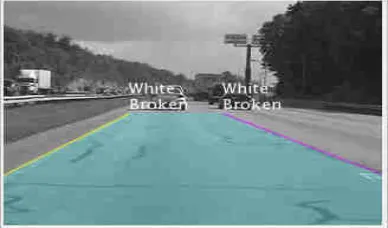
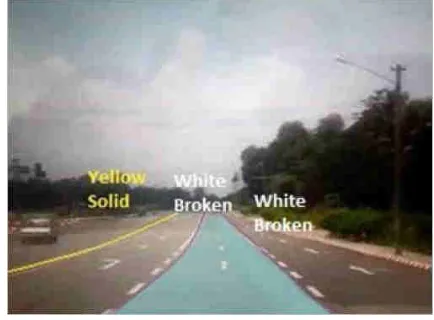
Fig. 2 shows the normal day light views of the lane departure system. It can specify the different types of lane marker. It detects the yellow solid and white broken lane marker and gives 98.7% efficient result.
Fig.3: Lane detection in cloudy weather
The system performs good in cloudy weather. Fig. 3 indicates white broken lines on road in cloudy weather.The system can 96.5% efficient result in dull weather condition.
Fig 4: Left departure
Fig. 4 demonestrates the left departure of vehicle.The sytem shows left departure message when the vehicle moves towards the left lane from its present lane. It also warns the driver with an audio alarm during lane change.
Fig.5: Right departure
Fig. 5 shows the right departure of the vehicle. The system shows right departure message during the change of lane to right direction and gives sound message when it is settled to the lane in right direction.
Fig.6: Lane detection in night
The system is tested in night time road condition. The night time lane detection is displayed in Fig. 6.Because of having low light in night, the system can’t work as good as day light. It gives efficient result but it can’t specify which kinds of lines are drawn in road.
Fig.7: Lane detection in fog
Infogain Publication (Infogainpublication.com) ISSN: 2454-1311
Fig.8: Lane detection in occluded road
Fig. 8 shows lane detection in occluded road. This picture specifies the white solid and yellow broken line of lane. It also shows right departure message as the car is turning to the right direction.
Fig.9: Lane detection with shadow
The system can detect the lanes of road although there is shadow on the road. Fig. 9 represents the detection of road with shadow. System returns 97.5% efficient performance in this case and 97.70% with different lane marker.
Fig.10: Lane detection in straight road
Lane detection in straight road gives 96.5% correct result with other warning messages. Fig. 10 describes lane detection in straight road. In this figure, yellow solid and white broken lane markers are also shown.
Fig.11: Lane detection in curved road
This system gives 94.3% efficient result in curved road including the message of lane type. Fig. 11 represents lane detection in curved road with yellow solid and yellow broken lane marker. The overall efficiency is around 95%. Fig. 12 shows the bar chart to analyze the efficiency of the proposed system in different lane types and various weather conditions.
Fig.12: Efficiency of our proposed system at different circumstances
3.2 VEHICLE POSITION TRACKING
This system also proposes a tracking process in addition to lane detection system. This tracking system is based on number plate extraction of vehicles or matching back side view of a specific vehicle. Fig. 13 shows the tracking of a vehicle in pre-specified region. It shows the traced vehicle with white rectangular box. The tracking is based on the back side view of the vehicle including the license plate.
Infogain Publication (Infogainpublication.com) ISSN: 2454-1311
IV. CONCLUSIONS
The proposed system tracks the different lane markers and informs the driver with visual messages. It warns the driver with sound alarm when the vehicle begins to move out of its’ lane on freeways and arterial roads. The system also can track a specific vehicle using a high resolution camera mounted on the vehicle. It takes the lower part information of the image and passes through the 2D FIR filter and thresholding process. Then the line and the lane markers are detected by using Hough transform and Hough line. Kalman filter is used for lane tracking. At the same time, it finds the location of the vehicle in a specific region which is to be tracked. Reduction of search area minimizes the number of computations. Then geometric translator is used to minimize the camera motion to get a stabilized video. This system is robust against noise and high speed algorithm. In future, we will use high resolution camera for efficient detection.
ACKNOWLEDGEMENTS
The authors would like to thank the anonymous reviewers for their valuable comments which helped to improve the presentation of the paper.
REFERENCES
[1] International Transport Forum,“Road Safty Annual Report 2015”.
[2] S.Stephan, K. Sarath, A. Alen, D. Gamini, “Robust lane detection in urban environments”, Proceedings of the IEEE/RSJ International Conference on Intelligent Robots and Systems, pp.123-128, 2007. [3] T. Aung, and M. H. Zaw, “Video Based Lane
Departure Warning System using Hough Transform”, International Conference on Advances in Engineering and Technology (ICAET'2014), pp. 85-88, March 2014.
[4] J. Liu, J. Han, H. Lv and B. Li , “An Ultrasonic Sensor System Based on a Two-Dimensional State Method for Highway Vehicle Violation Detection Applications”, Sensors, pp. 9000-9021, 2015, [5] K. Y. Chiu and S. F. Lin, “Lane detection using
color-based segmentation”, in Proc. IEEE conference in Intell. Veh. Symp., pp.706–711, 2005.