Original Research Article
Magnitude and determinants of diarrhea among 0-6 year’s children:
a cohort study from central India
Rakesh Kumar* Rajnish Borkar
INTRODUCTION
Diarrheal disease is the second leading cause of death next to pneumonia in children under five years old, and is responsible for killing around 5,25,000 children every year. In low-income countries, children under three years old experience on average three episodes of diarrhea every year. Each episode deprives the child of the nutrition necessary for growth. As a result, diarrhea is a major cause of malnutrition, and malnourished children are more likely to fall ill from diarrhea.1
In India, according to NFHS 4 report prevalence of diarrhea among under- 5 year children is 9.2 percent and there hasn’t been any significant reduction in prevalence compared to NFHS 3 report of 9% prevalence. Only half of children suffering from diarrhea received oral rehydration solution (ORS) fluid.2
At the global level, deaths due to diarrheal diseases have decreased substantially in the past 25 years, although progress has been faster in some countries than others. Diarrhea remains a largely preventable disease and cause of death, and continued efforts to improve access to safe
ABSTRACT
Background: Inspite of efforts of all the stakeholders, diarrhea still remains a cause of significant morbidity and mortality in developing country like India.
Methods: A follow up study was done among 305 children of 0-6 year’s age to estimate the incidence and risk factors of diarrhea. Diarrhea was defined as more than 3 stools in one day that were more liquid than usual. At each monthly follow up enquiry was made about the occurrence of diarrhea, health seeking, infant feeding practices and dietary history etc. Cumulative incidence, attack rates and risk ratio was used to estimate the burden and risk factors of diarrhea.
Results: The number of diarrhea episodes per child per year was 0.65 (95% CI=0.62-0.67). The cumulative incidence of diarrhea among 0-6 years children was 485.7 per 1000 children per year (95% CI=430.8–540.9). In terms of attack rate, the diarrhea among 0-6 years children was 63.5 percent (95% CI=58.1–68.7). Age of child, birth weight, total duration of breastfeeding, anaemia and season were found to be significant risk factors of diarrhea.
Conclusions: Further substantial changes in diarrhea incidence will require action on multiple factors like improvement of birth weight of child by better maternal and child health (MCH) care, continued breastfeeding of child till two year of age, correction of anaemia and provision of safe water supply and sanitation during summer and raining season.
Keywords: Diarrhea, Incidence, Risk factors, Cohort study
Department ofCommunity Medicine, ACS Medical College and Hospital, Chennai, Tamil Nadu, India
Received: 12 September 2018
Revised: 09 October 2018
Accepted: 27 October 2018
*Correspondence:
Dr. Rakesh Kumar,
E-mail: [email protected]
Copyright: © the author(s), publisher and licensee Medip Academy. This is an open-access article distributed under the terms of the Creative Commons Attribution Non-Commercial License, which permits unrestricted non-commercial use, distribution, and reproduction in any medium, provided the original work is properly cited.
water, sanitation, and childhood nutrition is important in reducing the global burden of diarrhea.3
Despite substantial reductions in diarrhea mortality in many countries, the burden of this preventable disease remains concentrated in the poorest children. Understanding the contribution of each cause to the burden of diarrhea and how this varies geographically will enable interventions to be targeted.3
Identification of burden and epidemiological correlates of diarrhea may help in planning an appropriate intervention to prevent and control diarrhea. Hence, the present study was carried out to study the magnitude of diarrhea and its epidemiological correlates in children (0-6 years).
METHODS
Study setting and study population
The study was conducted during 2010-2011 in four adopted villages of Mahatma Gandhi Institute of Medical Sciences (MGIMS), Sevagram in Wardha district. These villages were adopted every year for the training of medical students.4 All the children residing in these four selected villages were recruited in the study. A cohort of 305 children below the age of six years was followed for a period of one year.
Data collection
Before conducting the study, ethical clearance was obtained from Institutional Ethical Committee. Children were enrolled in the study after obtaining written informed consent from mother/ caretaker. The baseline data was collected from mother or caretaker on socio-demographic profile, birth history, immunization, morbidity profile, dietary history, child feeding practices and utilization of anganwadi services. Data was collected by using a pre-designed and pre-tested interview schedule.
The enrolled children were followed up for a period of twelve months. At each month enquiry was made about the occurrence of any morbidity including diarrhea, health seeking, infant feeding practices and dietary history during the previous month in addition to the anthropometric measurements like weight, height, mid upper arm circumference (MUAC) of child in a separate schedule.
Definitions and tools used
Diarrhea was defined as more than 3 stools in one day that were more liquid than usual. Episodes were defined as a period of sickness separated at least three days apart.5 Colour coded ration cards was used to assess socio-economic status. Yellow card signified families below
poverty line (BPL), and ration card of orange colour signified family above poverty line.
Delivery during the 8th month or less was considered preterm delivery while delivery at 9th month or above was considered full term. Low birth weight was defined as birth weight less than 2500 grams.6 Date of birth, Immunization status and vitamin A supplementation were asked and verified by the immunization card if available.
Information on dietary intake of children was obtained from mother. Calorie intake and protein intake was calculated using the 24-hours recall method. Calorie deficit was calculated by subtracting actual calorie intake from the recommended calorie intake. Similarly protein deficit was also calculated.7 Hemoglobin of the children was estimated using ―WHO color scale‖. Anemia was defined as hemoglobin less than 11 grams%.8
Anthropometric measurements were done following the WHO guidelines.9 Nutritional assessment of children was done by calculating Z- scores for weight for age (W/A), height for age (H/A), weight for height (W/H) using WHO Anthro v 3.0.1 software and WHO AnthroPlus v 1.0.3 software.10,11
Information was also collected on source of drinking water, method of water purification, use of sanitary latrine by family members and availability of kitchen garden in house. We had also studied the effect of season on diarrhea. The seasons broadly classified into four categories based on climaticallyand also ICDS quarterly survey, they are winter (January to March), summer (April to June) rainy (July to September) and autumn (Octoberto December).12
Statistical analysis
Data thus collected was entered in epi_info 6.04 and analysis was donse by using SPSS version 16.0. Magnitude was expressed in terms of cumulative incidence, attack rates and average number of episodes.
Incidence rate was calculated using the formula
Incidence rate of diarrhea= (Number of children who had at least one episode of diarrhea)*1000/Total number of children at risk of diarrhea
Attack rate was calculated using formula
Attack rate= (Total number of episodes of
diarrhea)*100/Total number of children at risk of diarrhea
RESULTS
Study subjects
In the present study, 19.7%, 14.6% and 65.7% percent children were in the age-group of 0-12 months, 13-24 months, 25-60 months respectively. Out of total 305 study population 160 (52.7%) were male and 140 (47.3%) were female. Most of the children 140 (45.7%) belonged to other backward caste (OBC). More than fifty percent 161 (53.7%) were from schedule caste (SC)/ schedule tribes (ST)/ nomadic tribes (NT).
Magnitude of diarrhea
The number of diarrhea episodes per child per year was 0.65 (95% CI=0.62-0.67). The cumulative incidence of diarrhea among 0-6 years children was 485.7 per 1000 children per year (95% CI=430.8–540.9). In terms of attack rate, the diarrhea among 0-6 years children was 63.5 percent (95% CI=58.1–68.7) (Table 1 and 2).
Table 1: Magnitude of diarrhea.
S No.
Magnitude of
diarrhea Magnitude 95% CI
1
Number of episodes per child per year*
0.65 0.62-0.67
2 Attack rate (in
percent) 63.5 58.01–68.7
3
Cumulative incidence (per 1000 children per year)
485.7 430.8–540.9
*Total numbers of episodes of diarrhea among 315 children during the study period were 200.
Table 2: Distribution of children according to the number of episodes of diarrhea in a year.
Number of episodes of diarrhea per year
No. of children suffered (N=315)
Percentage (%)
1 117 37.1
2 27 8.6
3 7 2.2
4 2 0.6
Risk factors of diarrhea
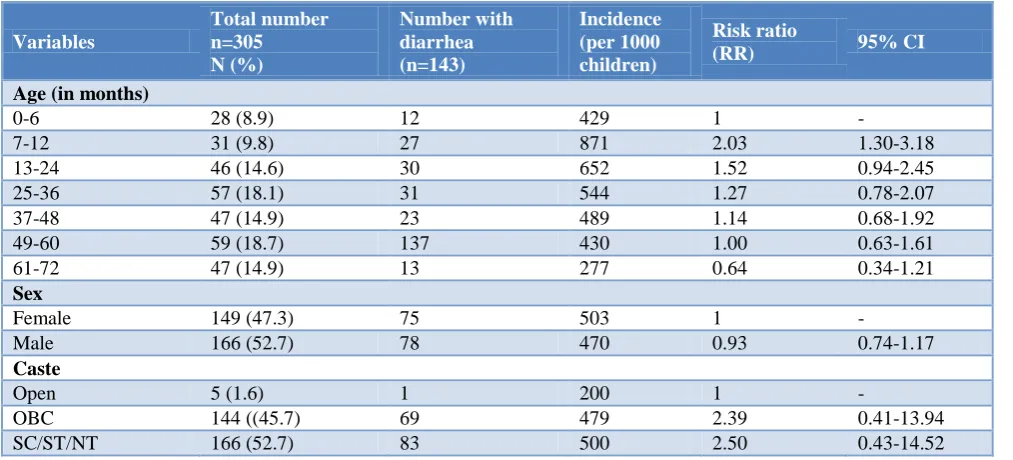
Age of child was significantly associated with diarrhea with the highest risk among 7-12 month age groups (RR, 2.03; 95% CI, 1.30 -3.18) (Table 3).
Birth weight was also found to be significantly associated with diarrhea with low birth weight child at higher risk of diarrhea (RR, 1.38; 95% CI, 1.10-1.73) (Table 4).
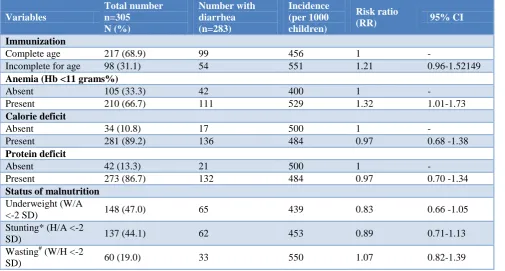
Among other children characteristics significant determinants of diarrhea were total duration of breastfeeding (RR, 1.21; 95% CI, 1.10-1.33); presence of anemia (RR, 1.11; 95% CI, 1.02-1.20) (Table 4 and 5).
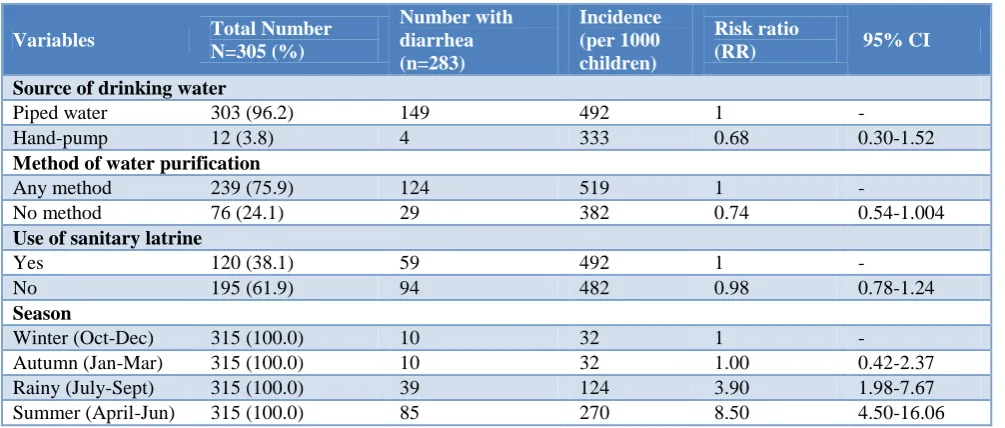
In our study highest incidence of the diarrhea among children was during summer season (528 per 1000 children) followed by rainy season (423 per 1000 children) and autumn season (302 per 1000 children). Least diarrhea occurred during winter season (134 per 1000 children). The risk of diarrhea was significantly higher being 3.39 (95% CI, 2.90-5.32) during summer followed by 3.15 (95% CI, 2.30-4.30) during rainy and 2.24 (95% CI, 1.61-3.13) during autumn season as compared to winter season (Table 6).
Table 3: Association of socio-demographic characteristics with diarrhea.
Variables
Total number n=305 N (%)
Number with diarrhea (n=143)
Incidence (per 1000 children)
Risk ratio
(RR) 95% CI
Age (in months)
0-6 28 (8.9) 12 429 1 -
7-12 31 (9.8) 27 871 2.03 1.30-3.18
13-24 46 (14.6) 30 652 1.52 0.94-2.45
25-36 57 (18.1) 31 544 1.27 0.78-2.07
37-48 47 (14.9) 23 489 1.14 0.68-1.92
49-60 59 (18.7) 137 430 1.00 0.63-1.61
61-72 47 (14.9) 13 277 0.64 0.34-1.21
Sex
Female 149 (47.3) 75 503 1 -
Male 166 (52.7) 78 470 0.93 0.74-1.17
Caste
Open 5 (1.6) 1 200 1 -
OBC 144 ((45.7) 69 479 2.39 0.41-13.94
Variables
Total number n=305 N (%)
Number with diarrhea n=143
Incidence (per 1000 children)
Risk ratio
(RR) 95% CI
Socio-economic status
BPL 75 (23.8) 38 507 1 -
APL 240 (76.2) 115 479 0.95 0.73-1.23
Table 4: Association of birth history and infant feeding practices with diarrhea.
Variables
Total Number n=305 N (%)
Number with Diarrhea n=283
Incidence (per 1000 children)
Risk ratio
(RR) 95% CI
Gestational age (months)
<9 36 (11.4) 17 472 1 -
≥9 279 (88.6) 136 487 1.03 0.72-1.49
Birth weight (in grams)*
≥2500 206 (71.5) 93 451 1 -
<2500 82 (28.5) 51 622 1.38 1.10-1.73
Duration of exclusive breastfeeding (months)*
≥6 207 (71.4) 101 488 1 -
<6 83 (28.6) 42 506 0.96 0.75 - 1.24
Duration of breastfeeding (months)#
>24 169 (58.5) 64 379 1 -
≤24 120 (41.5) 78 650 1.72 1.36–2.17
Bottle feeding
No 294 (93.3) 141 480 1 -
Yes 21 (6.7) 12 571 1.19 0.81-1.76
*Remaining (315-290)= 25 children were still on exclusive breast feeding at baseline; #A total of 24 children were still breastfeeding at the time of diarrhea.
Table 5: Association of nutritional and immunization status on diarrhea.
Variables
Total number n=305 N (%)
Number with diarrhea (n=283)
Incidence (per 1000 children)
Risk ratio
(RR) 95% CI
Immunization
Complete age 217 (68.9) 99 456 1 -
Incomplete for age 98 (31.1) 54 551 1.21 0.96-1.52149
Anemia (Hb <11 grams%)
Absent 105 (33.3) 42 400 1 -
Present 210 (66.7) 111 529 1.32 1.01-1.73
Calorie deficit
Absent 34 (10.8) 17 500 1 -
Present 281 (89.2) 136 484 0.97 0.68 -1.38
Protein deficit
Absent 42 (13.3) 21 500 1 -
Present 273 (86.7) 132 484 0.97 0.70 -1.34
Status of malnutrition
Underweight (W/A
<-2 SD) 148 (47.0) 65 439 0.83 0.66 -1.05
Stunting* (H/A <-2
SD) 137 (44.1) 62 453 0.89 0.71-1.13
Wasting# (W/H <-2
SD) 60 (19.0) 33 550 1.07 0.82-1.39
Table 6: Association of environmental characteristics with diarrhea.
Variables Total Number
N=305 (%)
Number with diarrhea (n=283)
Incidence (per 1000 children)
Risk ratio
(RR) 95% CI
Source of drinking water
Piped water 303 (96.2) 149 492 1 -
Hand-pump 12 (3.8) 4 333 0.68 0.30-1.52
Method of water purification
Any method 239 (75.9) 124 519 1 -
No method 76 (24.1) 29 382 0.74 0.54-1.004
Use of sanitary latrine
Yes 120 (38.1) 59 492 1 -
No 195 (61.9) 94 482 0.98 0.78-1.24
Season
Winter (Oct-Dec) 315 (100.0) 10 32 1 -
Autumn (Jan-Mar) 315 (100.0) 10 32 1.00 0.42-2.37
Rainy (July-Sept) 315 (100.0) 39 124 3.90 1.98-7.67
Summer (April-Jun) 315 (100.0) 85 270 8.50 4.50-16.06
DISCUSSION
Diarrhea still remains a public health problem in developing country like India. The present study was conducted to estimate the burden of diarrhea in terms of incidence rate and also to determine the risk factors of diarrhea.
Frequent diarrhea episodes have been proven to affect the growth and health of the child in several studies.13,14 In the present study the number of diarrhea episodes per child per year was 0.65. The study conducted in Pondicherry found the slightly higher average of 0.86 episodes per child per year.13 The cumulative incidence of diarrhea among 0-6 years children was 485.7 per 1000 children per year. A higher incidence was found in study conducted in Pondicherry and Jammu.13,14 One of the possible reason could be due to calculation of incidence density in contrast to cumulative incidence in our study. Several other studies during 1990 to 2000 reported higher incidences of over 2 episodes per child per year.15,16 This may be due to improved access and availability of safe water supply and sanitation.
In present study the incidence of diarrhea was significantly higher among infants of 6–11 and 12–23 months of age. This can be due to protective effect of exclusive breast feeding for very young children of 0–6 months of age and less exposure of children to environmental contaminated agents. On the other hand, the frequency of diarrhea peaks at the age 6- 12 months when the child is exposed to different types of infections due to eating foods that are prepared un-hygienically, in unclean water and unhealthy environment. Similar results were found in several other studies.13-19
Low birth weight (LBW) is an important determinant of several infectious diseases including diarrhea.20 In this study low birth weight children have 1.38 times high risk
of occurrence of diarrhea as compared to normal weight children. Similar finding was there in a study from Pondicherry where LBW children were 1.75 times high risk of diarrhea as compared to child with normal birth weight.13
Exclusive breastfeeding practices for the first 6 months of life and continued breastfeeding until 24 months of age continue to need improvement in nearly all low- and middle-income countries. A systemic review found that not breastfeeding resulted in an excess risk of diarrhea mortality in comparison to exclusive breastfeeding among infants 0-5 months of age (RR: 10.52) and to any breastfeeding among children aged 6-23 months (RR: 2.18).21 In present study we also found that children who were breastfed for less than two years were at significantly higher risk of having diarrhea as compared to those who were breastfed for more than two years. Another study from Pondicherry also found a beneficial effect of breastfeeding in preventing diarrheal episodes.13 Any nutrient deficiency, if sufficiently severe, will impair resistance to infection. Iron deficiency and protein-energy malnutrition which are both highly prevalent, have the greatest public health importance in this regard.22 In this study, we found that anaemia is significantly associated with diarrhea. Anemia reduces the immunity of children and makes them prone to infectious diseases like diarrhea and respiratory infections.23
incidence of diarrhea during summer and rainy season.13,24
Strength and limitations of the study
Strength
Being a cohort study it is among the few study from central India which assessed the true risk of diarrheal disease. Such study is free from of many biases which are inherent in case control and cross-sectional studies. Findings from this study thus may be of relevance for health intervention programs in the region.
Limitations
Loss to follow up bias is one main concern in many cohort studies. But we minimized this bias in our study by making multiple visits. A maximum of three visits was done before declaring a child as loss to follow up. Only 10 children in the present study who were initially recruited lost to follow up. We didn’t account these children in the final analysis.
Diarrheal morbidity was measured by asking mothers about their children’s health in the past two weeks preceding the survey. This may lead to some recall bias.
CONCLUSION
Although there has been reduction in incidence of diarrheal due to better access to safe water supply and improved sanitation. Further substantial changes in diarrhea incidence will require action on multiple factors like improvement of birth weight of child by better maternal and child health (MCH) care, continued breastfeeding of child till two year of age, correction of anemia and provision of safe water supply and sanitation during summer and raining season. All these will require action simultaneously at the household and community level.
ACKNOWLEDGEMENTS
I would like to thank my guide and mentor Dr. P.R Deshmukh and Dr. B.S Garg for their support and guidance in conducting this study. I also thank the parent of children for their full cooperation and participation.
Funding: No funding sources Conflict of interest: None declared
Ethical approval: The study was approved by the Institutional Ethics Committee
REFERENCES
1. World Health Organization. (2018). Diarrheal disease. Available at: http://www.who.int/news-room/fact-sheets/detail/diarrheal-disease. Accessed 11 September 2018.
2. National Family Health Survey (NFHS 4), (2015-16). Available at: http://rchiips.org/NFHS/factsheet _NFHS-4.shtml Accessed on 11 September 2018. 3. GBD Diarrheal Diseases Collaborators. Estimates of
global, regional, and national morbidity, mortality, and aetiologies of diarrheal diseases: a systematic analysis for the Global Burden of Disease Study 2015. Lancet Infect Dis. 2017;17:909–48.
4. Garg BS, Nayar S. Doctors for the rural poor. World Health Forum. 1996;17:268-70.
5. Schmidt MK, Muslimatun S, West CE, Schultink W, Gross R, Hautvast JG. Nutritional status and linear growth of Indonesian infants in west java are determined more by prenatal environment than by postnatal factors. J Nutr. 2002;132(8):2202-7. 6. Park K. Park’s textbook of preventive and social
medicine.24th ed. Jabalpur (India): Banarasidas bahnot; 2017.
7. Indian council of medical research. Nutrient requirement and recommended dietary allowances for Indians- A report of the expert group of the Indian Council Med Res: 2009.
8. World Health Organisation. Iron deficiency anaemia: Assessment, prevention and control A
guide for programme managers. Geneva
(Switzerland): World Health Organisation; 2001. 9. Jelliffe DB. The assessment of the nutritional status
of the community. Geneva: World Health Organisation Monograph series, 1966.
10. WHO Anthro [computer program]. Version 3.01. Geneva (Switzerland): World Health Organization. 11. WHO AnthroPlus [computer program]. Version
1.0.3. Geneva (Switzerland): World Health
Organization.
12. Venkateswarlu C, Reddy KK, Rao AP. Assessment of diarrhea among pre-school children. Anthropol 2004;6(2):97-100.
13. Jayalakshmy R, Roy G, Premarajan KC. Incidence and risk factors of acute diarrheal disease among under-five children in urban slums in Pondicherry z— One year follow-up study. Indian J Matern Child Health. 2011;13:1–11.
14. Gupta S, Gupta SK, Jamwal DS, Kumar D. Incidence of diarrhea among under-five children in a rural area of Jammu– A longitudinal study, Indian J Matern Child Health. 2011;13(2):1–6.
15. Reddaiah VP, Kapoor SK. Epidemiology of
Diarrhea and its Implication for Providing Services. Indian J Pediatr. 1991;58:205-8.
16. Sengupta PG, Sircar BK, Mondal S, Gupta DN, Ghose S, De SP. Epidemiological profile of acute Diarrheal diseases of a cohort of rural under five children: A three years longitudiual observation. Indian J Public Health. 1997;41(3):79-81.
18. Mihrete TM, Alemie GA, Teferra AS. Determinants of childhood diarrhea among underfive children in Benishangul Gumuz Regional State, North West Ethiopia. BMC Pediatr. 2014;14:102.
19. Walker F. Diarrhea incidence in low- and middle-income countries in 1990 and 2010: a systematic review. BMC Public Health. 2012;12:220.
20. Causes and Consequences of Intrauterine Growth Retardation, Proceedings of an IDECG Workshop, November 1996, Baton Rouge, USA, Supplement of the Eur J Clin Nutr. 1996: 100.
21. Lamberti L M, Walker C L F, Moiman A, Victora C and Black R E. Breastfeeding and the risk for diarrhea morbidity and mortality. BMC Public Health. 2011;11(3):15.
22. Scrimshaw NS, SanGiovanni JP. Synergism of nutrition, infection, and immunity: an overview. Am J Clin Nutr. 1997;66:464–77.
23. Macintosh N, Helm PJ, Smyth RL. Forfar & Arneil’s Textbook of Pediatrics. 6th ed. Edinburgh: Churchill Livingstone; 2003.
24. Isenbarger DW, Hien BT, Ha HT, Ha TT,
Bodhidatta L, Pang LW, et al. Prospective study of the incidence of diarrhea and prevalence of bacterial pathogens in a cohort of Vietnamese children along the Red River. Epidemiol Infect. 2001;127:229-36.