
ISSN: 2231-5381
http://www.ijettjournal.org
Page 212
ECG Signal Analysis: Different Approaches
S. Thulasi Prasad#1, S. Varadarajan*2 #
Associate Professor, Dept. of ECE, CVSE, Tirupati, India
*
Professor, Dept. of ECE, SVUCE, Tirupati, India
Abstract – In recent years scientists and engineers are facing several challenges in solving biomedical problems and making Digital Signal Processing as an essential and effective pedagogical approach to solve a problem of detecting selected arrhythmia conditions from a patient’s electrocardiograph (ECG) signals. The detection of QRS complex has many clinical applications as it marks the beginning of the left ventricular contraction. A lot of possible heart malfunctions such as cardiac arrhythmias, transient ischemic episodes and silent myocardial ischemia or failures will be slow while monitoring of ECG signal in real-time during normal activity. Introducing an efficient method for arrhythmia detection can be very useful for better conceptual understanding of signal processing. In this paper, we discussed two methods to clean ECG signal corrupted by noise and to extract required parameters for detecting arrhythmia condition. One method is Hilbert Transform method and another method is Filter Bank method. These methods involve using filter techniques, algorithms of finding peaks & valleys, local maxima & minima etc, for determining R peaks, R-R intervals and QRS complexes.
Keywords - ECG, QRS, Arrhythmia, SA node, AV node, Filter Bank,Adaptive LMS filter, Downsampling, MATLAB.
I. INTRODUCTION
The Electro-Cardio-Gram (ECG) is a useful tool to study functional and structural status of the heart. ECG is a recording of the bioelectrical potentials generated on the surface of the body by the heart. In 1901, Willem Einthoven used a string galvanometer to measure ECG and assigned letters P, Q, R, S and T to the various deflections. In recent years an automated method of analysis of ECG signals using real-time processing is very much required for the diagnosis of cardiac diseases accurately. According to Einthoven the complete ECG wave is a trace as shown in the Fig. 1
Fig. 1 ECG Signal
In a typical ECG tracing of the cardiac cycle (heartbeat) most of the energy is concentrated in QRS complex and very
little energy in T wave and U wave, which is normally invisible in 50 to 75 % of ECGs because it is hidden by the T wave and upcoming new P wave [1]
.
The type of wave and the action which causes them are summarized in Table-I The flat horizontal segments, PR segment and the segment between TP segments constitute the baseline of the electrocardiogram. In a normal healthy heart, the baseline is equivalent to the isoelectric line (0mV). However, in a diseased heart the baseline may be elevated (e.g. cardiac ischaemia) or depressed (e.g. myocardial infarction) relative to the isoelectric line due to flow of injury currents during the conduction periods of the TP and PR intervals when the ventricles are at rest. Normally the baseline drift caused by patient breathing, 50/60 Hz power line interference, bad electrodes and improper positioning of electrodes will corrupt ECG signal severely and makes the detection of QRS complexes very difficult or may even lead to give false detection. Different procedures and algorithms were developed by many researchers to detect QRS complexes accurately and precisely. Trahanias used the mathematical morphology, Dr. Li, proposed the wavelet transforms method, Mehta and Lingayat used the support vector machine (SVM) method to detect the QRS complexes [2].TABLE I Types of waves and Action
Wave Action
P-wave Depolarization of the atria
Q-wave Activation of the anterioseptal region of the ventricular myocardium
R-wave Depolarization of the ventricular myocardium S-wave Activation of the posteriobasal portion of the
ventricles
T-wave Rapid ventricular repolarization
ISSN: 2231-5381
http://www.ijettjournal.org
Page 213
In this paper we discussed two approaches to analyse ECGsignals. One approach is Hilbert Transform approach and another approach is Filter Bank approach to analyse the ECG to identify QRS complexes.
II. PHYSIOLOGY
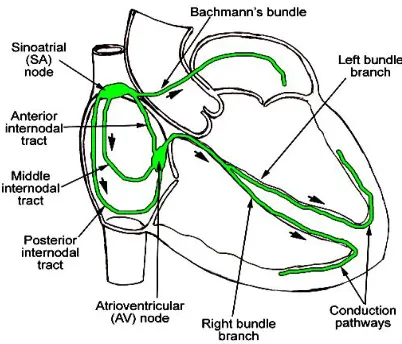
In human beings the heart is roughly the size of a large fist and weighs around 250 to 300 grams. It is located within the chest cavity between lungs, behind the sternum and above the diaphragm with its base (the widest part) upward and leaning toward the right shoulder, and its apex pointing down and to the left [3]. The heart acts a biological pump and pumps the blood to the body tissues through the action of muscles of the chamber walls rhythmically. Most of the great vessels (pulmonary trunk, aorta, and superior vena cava) emerge upward from the base of the heart. The chambers of the heart alternately contract and relax in a rhythmic cycle. During the period of contraction (systole), the heart pumps blood out through the arteries; during the period of relaxation (diastole), the heart fills with blood. One complete sequence of filling and pumping blood is called a cardiac cycle, or heartbeat. The rhythm of heart's contraction is controlled by the SA node (sinoatrial node), which is made up of specialized myocardial cells called nodal cells and is a part of the heart's intrinsic conduction system. The cross section of human heart is shown in the Fig. 2
Fig. 2 Physiological features of human heart
The SA node generates electrical impulses. These electrical impulses spread through the heart via a nodal tissue pathway that coordinates the events of the cardiac cycle. The heart acts a synchronized pump as the conduction system, muscles, and valves of the heart function in a synchronized manner. The conduction system initiates and coordinates the muscular activity of the heart. Pressure differentials that result from muscle activity actuate the opening and closing of valves. The
flow of blood through the heart is controlled by the opening and closing of valves and as directed by each electrical signal which begins in a group of cells called the (SA) node [4] located in the upper right chamber of the heart called right atrium. In a healthy adult SA node sends an electrical impulses up to 60 to 80 times a minute. From the SA node, the signal travels through the right and left atria. This causes the atria to contract, which helps move blood into the heart's lower chambers, the ventricles [5]. The electrical signal moving through the atria is recorded as the P wave on the ECG. The electrical signal passes between the atria and ventricles through a group of cells called the atrioventricular (AV) node. The signal slows down as it passes through the AV node and allows the ventricles to have enough time to finish filling with blood. On the ECG, this part of the process is the flat line between the end of the P wave and the beginning of the Q wave. The electrical signal then leaves the AV node and travels along a pathway called the bundle of His to reach right and left bundle branches. The heart's ventricles contract and pump blood to the lungs and the rest of your body as soon as the electrical signal spreads quickly across the heart's ventricles. The ventricles then recover their normal electrical state (shown as the T wave on the ECG) and allow the heart to refill with blood. This entire process continues over and over with each new heartbeat. This process is recorded as the QRS waves on the ECG.
III. METHODS
A. Hilbert Transform Approach
The ECE signal is pre-processed to remove baseline wanders and power line interference using band pass filter. The analysis of low frequency ST - segment becomes easy to diagnose ischemia with the removal of baseline wander. The band-pass filter is implemented from high-pass filter and low-pass filters. The high-low-pass filter is designed choosing cut-off frequency of 0.5 Hz, considering the slowest heart rate, since the heart beat during bradycardia may be around 40 beats/ minute (approximately 0.6 Hz).
The simple and effective form of low-pass filter designed by Lynn is represented in with the following transfer function [6].
1 2
2
1
) 1 (
) 1 ( ) (
z z z H
(1)
Amplitude response of low-pass filter is obtained as follows
) 2
ω
( sin
) 2
ω
( sin H
2 2
1( )
(2)
ISSN: 2231-5381
http://www.ijettjournal.org
Page 214
y(n)=2y(n-1)-y(n-2)+x(n)-2x(n-)+x(n-2) (3)When α is chosen as 4 depending upon 3 dB cut off frequency of 35 Hz and sampling frequency is 430 Hz, then the corresponding difference equation is as follows
) 8 -x(n + ) 4 -2x(n -x(n) + 2) -y(n -1) -2y(n =
y(n) (4)
Lynn’s high-pass [6] is designed by subtracting a low pass filter from an all pass filter with delay. The transfer function of the low pass filter is
) 1 ( ) 1 ( ) ( 1 2 z z z H (5)
Amplitude response of high-pass filter is obtained as follows
) 2 ω sin( ) 2 ω sin( H ) (
2
(6)
Now the high-pass filter transfer function is obtained as follows ) 1 ( ) 1 ( ) ( 1 2 ) 1 ( 3 z z z z H (7)
And corresponding difference equation is
) ( 1 2 ) 1 ( 2 ) 1 ( ) ( ) 1 ( ) ( n x n x n x n x n y n y (8)
For sampling frequency of 430 Hz and cut off frequency of
0.5 Hz the value of α is found to be 33
(n-15) +x(n-16)-x )+x(n-33)
y(n-1)-x(n 03
y(n)= 0.03 [ ] (9)
The QRS complex is enhanced to enlarge the QRS complex compared to the other ECG features (P, T, and noise) [7]. The R-Peak is detected by determining the maximum amplitude value within the identified QRS complex. Since R-wave is positive waveform and highest peak in ECG signal, the time interval between two successive R-wave peaks is used to calculate HR (beats/minute) as follows [8].
te beats/minu 60 INTERVAL RR HR
(10)
Hilbert transform of a real signal is defined as
t d
x t
xh() 1 ( )
t x
) 1
(
(11)
And the envelop xe(n) of ECG signal, x(n), is as
) ( ) ( )
(n x2 n x2 n
xe h
) ( ) (n x n
x h
(12)
Here the polarity problem of ECG signal caused by wrong placement of electrodes is also solved by Hilbert Transform [9]. Using MATLAB R-Peaks can be identified from the Hilbert Transformed ECG signal easily and separation between consecutive R-Peaks is calculated.
B. Filter Bank Approach
In this approach the ECG signal is analysed based on frequency content. Depending upon the sharpness of the morphology of Q, R and S waves the frequency content may extend even beyond 50 Hz. Hence the best way is to detect heartbeats is to analyze ECG signal based on different sub-bands of the ECG using FIR filters in the form of a filter bank [10], instead of considering just the output of one filter which maximizes SNR of the QRS [11].
The adaptive filter using LMS filter [12][13] is used to remove 50 Hz (60 Hz) powerline interference. In adaptive technique, generally rejection range for a filter is less, which increases the quality and accuracy of medical diagnoses. Fig. 3 shows the block diagram of an adapted LMS filter.
Fig. 3 Block diagram of adaptive LMS filter
The adaptive filter is FIR structure [14] defined with filter coefficients as
T
n n
n
n W W W p
W [ (0), (1),... ( )]
(13)
The error signal is as follows Variable Filter Update Algorithm x(n)
Wn
ISSN: 2231-5381
http://www.ijettjournal.org
Page 215
e(n) d(n) d(n)
(14)
The desired signal is estimated by convolving the input signal with the impulse response.
d(n)WnX(n)
(15) Where X(n) and Wn are given respectively by eq(4) and eq(5)
X(n)[x(n),x(n1),...x(np)]T
(16)
Wn1WnWn
(17)
where Wn is a correction factor for the filter coefficients.
The adaptive algorithm generates this correction factor based on the input and error signals. We implemented this adaptive LMS filter using MATLAB. The low-pass filter is used to filter unwanted noise is defined as
2 1
2 6 1
) 1 (
) 1 ( )
(
z z z
H
(18)
The corresponding difference equation is as follows:
-4)+x(n-8) +x(n)-2x(n
-1)-y(n-2)
y(n)= 2y(n (19)
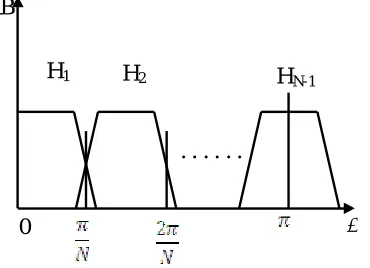
After lowpass filtering the ECG signal is decomposed into different frequency bands using Filter Bank [15] consisting of 4 sub-bands; each one has bandwidth 6 Hz. Thus the processing of ECG signal is carried out by using analysis and synthesis filters, each of length L. The analysis filters are bandpass filters whose ideal magnitude response Hn(w), n
=0,1,2,…,(N-1) is shown in the Fig. 4.
Fig. 4 Ideal Magnitude response of a Filter Bank
The filter bank decompose the input signal X(f) into sub-band signals as follows
1 N ...., 0,1,2,3, n
z X z H z
Yn( ) n( ) ( )
(20)
The downsampled signal is given as follows
1 N ..., 0,1,2, n e
z Y N z Z
N
n
N j N n
n
1
0
2 1
) (
1 ) (
(21)
Since the downsampled signal has lower rate than subbands of input ECG signal the filtering process can be efficiently done at the input rate by taking advantage of the downsampling.
Interesting features QRS complex can be extracted by combining these subbands in different ways. For example by using subbands 1, 2, 3 and 4 we can calculate the feature sum-of-absolute values, P1, as follows
4
1
1 ( )
k k z
Z
P
(22)
P1 gives the energy in the frequency band (4-28) Hz. Similarly,
P2 and P3 can be computed using sub-bands {1, 2, 3}, and {2,
3, 4}, respectively as
3 , 2 , 1 )
(
2
Z z k Pk
k
(23)
4 , 3 , 2 )
(
3
Z z k Pk
k
(24)
And these values are proportional to the energy in their respective sub-bands.
An heuristic beat detection logic can be developed to maximize the number of true positives (TP's), while keeping the number of false negatives (FN's) and false positives (FP's) to a minimum by computing the detection strength (D) of an incoming feature (e.g., P1, P2, P3) with the help of signal and
noise levels as:
N S
N P D
(25)
Where
S = Signal Level N= Noise Level
The value of D is limited at 0 if a feature's value is less than N and limited to 1when a feature's value is above S. The signal history is updated with the feature's value if the value of D is greater than the threshold and noise history is updated with the feature's value if the value of D is less than the threshold. After extracting the ECG signal with isolated QRS energies, the R-peaks are detected by simple algorithm where a dynamic threshold is used.
IV.RESULTS
In Hilbert Transform approach we tested our procedure on the ECG signal that is obtained from MIT/BIH database. The noise due to baseline wanders, other physiological signals are removed first from the ECG signal by using low-pass and high-pass filters. Later to attenuate the low frequencies characteristics of P and T waves, to isolate and also enhance the predominant QRS energy centred at 10 Hz, the filtered ECG signal is processed with Hilbert Transform. Finally simple decision logic is used to determine the temporal location of the R-wave with a combined maximum/minimum search. After R-Peaks located the Heart Rate signal is determined from the separation between consecutive R-Peaks and plotted. Fig-4 shows the Original ECG signal, ECG signal with R-peaks and the corresponding Heart Rate signal as function of time. Fig. 5 shows the original ECG signal and analysed ECG signal with identified R-peaks.
0
dB
H
1H
2. . .
. .
H
N-1ISSN: 2231-5381
http://www.ijettjournal.org
Page 216
Fig. 5 Original ECG signal and analysed ECG signal withidentified R-peaks
In Filter Bank approach we used MATLAB built-in function, adaptive.lms, to implement an adaptive filter. The input noisy ECG signal is processed with this filter to reduce noises that resulted from 50 Hz power lines and baseline drift and then filtered in a lowpass filter to remove high frequency noise above 60 Hz. Finally a filter bank is used to separate QRS complexes and then a simple threshold algorithm is used to detect the R-peak positions from the ECG signal. The Fig. 6 shows the noisy ECG signal and processed signal with detected R-Peaks.
Fig.6 Lowpass filtered ECG and Cleaned ECG with detected R-peaks
V. CONCLUSIONS
We demonstrated two possible approaches to analyse ECG signal in the field of biotechnology. The noisy elements have to be removed before the signal is used for next data processing like heart rate frequency detection. Digital filters and signal processing should be designed very effective for next real-time applications in embedded device. It is possible to develop more advanced methods to control to quality of analysis and accuracy. Our work in biomedical signal processing show the validity of the affirmation in academic and professional aspects in medical field
ACKNOWLEDGMENT
We gratefully acknowledge the support of National Instruments (NI) Innovation Center, CREC (Tiruapti). We also extend our sincere thanks to SVRR hospital (Tirupati) personal for providing basic clinical information regarding ECG
.
REFERENCES
[1] N.Goldschlager (June 1989), Principles of Clinical Electrocardiography, Appleton & Lange, 13th edition, ISBN 978-083-8579-510, Connecticut, USA
[2] T.B. Garcia and N.E. Holtz, 12-lead ECG: The Art of Interpretation, (Jones & Bartlett Publ. Sudbury, MA.236 pp. ISBN 0-7637-1284-1).
[3] Ruch TC, Patton HD (eds.) (1982): Physiology and Biophysics, 20th ed., 1242 pp. W. B. Saunders, Philadelphia.
[4] Williams PL, Warwick R (eds.) (1989): Gray's Anatomy, 37th ed., 1598 pp. Churchill Livingstone, Edinburgh.
[5] A. Camm, T. L. uscher, and P. Serruys, The ESC Textbook of cardiovascular Medicin,. OUP Oxford, 2009.
[6] P. S. Hamilton, W. J. Tompkins, (1986). Quantitative Investigation of QRS Detection Rules Using MIT/BIH Arrhythmia Database, IEEE Transactions on Biomedical Engineering, Vol.31, No.3, (March 2007), pp. 1157-1165, ISSN 0018-9294.
[7] Y. H. Hu, W. J. Tompkins, J. L. Urrusti, and V. X. Afonso, Applications of artificial neural networks for ECG signal detection and classification. Electrocardiology, 1993; 26 (Suppl.): 66-73.
[8] J. Parák, and J. Havlík, ECG Signal Processing and Heart Rate Frequency Detection Methods, In Proceedings of Technical Computing Prague, 2011; 8.11.2011.
[9] J. Pucik, J. Cocherova, Elena: Bio-signal analysis, STU Publishing House Bratislava, 2008, 121, pp-ISBN 978-80-227-2833-1.
[10] H. S. Malvar, Signal Processing with Lapped Transforms ( Norwood, MA: Artech House, 1992).
[11] P. S. Hamilton and W. J. Tompkins, Quantitative investigation of QRS detection rules using the MIT/BIH arrhythmia database, IEEE Trans. Biomed. Eng., vol. BME-33, pp. 1157–1165, 1986.
[12] J. R. Glover. Adaptive noise canceling applied to sinusoidal interferences, IEEE Trans. Acoustical., Speech, Signal Processing, and ASSP-25 (12):484–491, Dec. 1977.
[13] D.R Morgan, An analysis of multiple correlation cancellation loops with a filter in the auxiliary path, IEEE Transactions on Acoustics, Speech and Signal Processing, ASSP-28(4):454–467, August 1980. [14] C.C. Boucher, S.J. Elliott, and P.A. Nelson, Effect of errors in the plant
model on the performance of algorithms for adaptive feedforward control. Proceedings of Institution of Electrical Engineers, volume 138, pages 313–319, 1991.



![catena Poly[[diaquabis(μ3 5 carboxylato 1H pyrazole 3 carboxylic acid κ3O3:O3;O5)dilithium(I)] monohydrate]](data:image/gif;base64,R0lGODlhAQABAIAAAP///wAAACH5BAEAAAAALAAAAAABAAEAAAICRAEAOw==)