1535-9778/07/$08.00
⫹
0
doi:10.1128/EC.00010-07
Copyright © 2007, American Society for Microbiology. All Rights Reserved.
Expression and Interstrain Variability of the
YPS3
Gene of
Histoplasma capsulatum
䌤
Megan L. Bohse and Jon P. Woods*
Department of Medical Microbiology and Immunology, University of Wisconsin Medical School, Madison, Wisconsin 53706
Received 8 January 2007/Accepted 20 February 2007
The
YPS3
locus of the dimorphic fungus
Histoplasma capsulatum
encodes a secreted and surface-localized
protein specific to the pathogenic yeast phase. In this study we examined this locus in 32
H. capsulatum
strains
and variants. Although protein production is limited to a select group of strains, the North American
restriction fragment length polymorphism class 2/NAm 2 isolates, the locus was present in all the strains we
examined. The
YPS3
gene is well conserved in its 5
ⴕ
and 3
ⴕ
regions but displays an intragenic hypervariable
region of tandem repeats that fluctuates in size between strains. This feature is similar to that seen with genes
encoding several cell surface proteins in other fungi.
Histoplasma capsulatum
is a dimorphic fungal pathogen
that is the causative agent of histoplasmosis, a respiratory
and systemic disease of particular danger to the
immuno-compromised. Essential to the pathogenicity of
H.
capsula-tum
is the ability to transition from the mycelial to the
pathogenic yeast phase of growth, a transformation that
happens after the shift from ambient to human body
tem-perature (19, 20). Associated with this conversion is
alter-ation in the expression of many genes; nearly 500
phase-regulated genes have been identified to date (4, 7–9, 11, 12,
17, 18, 22, 25). Genes that are upregulated during the
patho-genic yeast phase of growth have been of particular interest
to researchers. Two yeast phase-upregulated genes,
CBP1
and
AGS1
, have been implicated in pathogenesis, while the
functions of others remain unknown (11, 17, 24).
The
YPS3
gene of
Histoplasma capsulatum
was first
identi-fied in 1989 by Keath et al. in a differential hybridization
screening as one of five identified transcripts unique to the
yeast phase of growth (17). It encodes a 20 kDa yeast
phase-specific protein that is both secreted and surface localized.
Yps3p localizes to the cell surface via a mechanism of secretion
from the cell and binding back to the exposed cell wall
poly-saccharide chitin (1). It was initially described as having
vari-able expression in different strains of
H. capsulatum
.
Specifi-cally, a survey of three strains typed by restriction fragment
length polymorphism (RFLP) suggested that protein
produc-tion during the yeast phase was restricted to the North
Amer-ican class 2 strains, the most thermotolerant and virulent
strains of
H. capsulatum
identified so far (17). In this report we
sought to more thoroughly examine
H. capsulatum
isolates in
light of the recent classification schemes that have been
devel-oped (13, 14, 16) and to better understand interstrain diversity.
MATERIALS AND METHODS
Fungal strains and culture conditions.Table 1 lists the isolates and variants used in this study. Strain G184ASura5-11, a uracil auxotroph derived by UV mutagenesis, has been described previously (28).H. capsulatumwas grown in
Histoplasma-macrophage medium broth, a rich defined medium (29), in a 5% CO2–95% air atmosphere. All experiments were done withH. capsulatumgrown as yeast cells at 37°C.
Bacterial strain.Plasmids were cloned and propagated in theEscherichia coli
strain JM109 (F⬘ traD36 proAB lacIq ⌬
(lacZ)M15/⌬(lac-proAB) glnV44 e14⫺ gyrA96 recA1 relA1 endA1 thi hsdR17).
N-terminal sequencing.We collected Yps3p by the use of a previously de-scribed polysaccharide binding assay (1). Briefly, we washed 50 mg of crab shell chitin (Sigma Aldrich, Saint Louis, MO) once with phosphate-buffered saline (PBS) and incubated it for 1 h with filtered, concentrated supernatant from mid-logarithmic-phase G217B cultures. Following incubation, we removed the supernatant and boiled the chitin in 2⫻sodium dodecyl sulfate (SDS)-poly-acrylamide gel electrophoresis loading buffer (50 mM Tris-Cl containing 2% SDS, 100 mM dithiothreitol, 10% glycerol, and 0.1% bromophenol blue) for 5 min at 95°C, electrophoresed the mixture in an SDS–12% polyacrylamide gel, and electroblotted the gel onto a polyvinylidene difluoride membrane. After transfer, the polyvinylidene difluoride membrane was stained with Coomassie blue, and the band corresponding to Yps3p was excised and submitted to the Protein Facility of the Iowa State University Office of Biotechnology for N-terminal sequencing on an Applied Biosystems Model 494 Procise protein-peptide sequencing system (Applied Biosystems, Foster City, CA).
Amplification, cloning, and sequencing of theYPS3locus.Primers were de-signed to amplify the open reading frame (ORF) by the use of MacVector sequence analysis software (Accelrys, San Diego, CA). We designed ORF-specific primers utiliz-ing available sequences of theYPS3locus from two sources. Our laboratory has previ-ously sequenced the locus from several strains, including G217B, Downs, G184AS, G184AR, and RV26821. TheHistoplasma capsulatumgenome project pages (http: //www.genome.wustl.edu/genome.cgi?GENOME⫽Histoplasma%20capsulatum; http: //www.broad.mit.edu/annotation/genome/histoplasma_capsulatum/Home.html) present sequences of strains of RFLP classes 1, 2, and 3. The primers used to amplify class 2 strains were ORF upstream (5⬘-ATGCTGAACATCAAATCGATCTC-3⬘) and ORF downstream (5⬘-TTATGCCTCGCAGTGTTTATAAAGC-3⬘). The primers used to amplify class 1 and 3 strains were ORF upstream and C1/C3 downstream (5⬘-TTATG CCTCGCATTGTTGATAAAGC-3⬘). All genes were amplified using Triplemaster high-fidelity polymerase (Eppendorf, Westbury, NY). After amplification, we cloned these ORFs into the vector pGEM-T Easy (Promega, Madison, WI) and sequenced two to three clones by the use of BigDye Terminator v. 3.1 mix and an Applied Biosystems 3730xl automated DNA sequencing instrument. Because of the nature of cloning a repetitive element intoE. coli, all sequenced ORF sizes were verified by comparison to genomic DNA PCR amplifications.
Protein expression in G184ASura5-11.To test the coding capacity ofYPS3
from representative class 1 and class 3 strains, we cloned the ORFs from strains G186B and Downs into an expression vector based on the previously described telomeric shuttle plasmid pWU45 (23). This vector contains thePodospora anserina URA5gene and a telomeric cassette for selection and maintenance inHistoplasma
* Corresponding author. Mailing address: Department of Medical
Microbiology and Immunology, 420 SMI, University of Wisconsin
Medical School, 1300 University Avenue, Madison, WI 53706. Phone:
(608) 265-6292. Fax: (608) 265-6132. E-mail: [email protected].
䌤
Published ahead of print on 2 March 2007.
609
on September 8, 2020 by guest
http://ec.asm.org/
capsulatumand the ampicillin resistance gene for selection inEscherichia coli. Ex-pression in this vector is achieved via a fusion of theYPS3ORF with the promoter from theH2Bgene, which encodes the constitutively expressed histone H2B.
Protein detection. For Western blot analysis, samples were denatured by incubation in 50 mM Tris-Cl containing 2% SDS, 100 mM dithiothreitol, 10% glycerol, and 0.1% bromophenol blue for 5 min at 95°C, electrophoresed in an SDS–12% polyacrylamide gel, and electroblotted onto a nitrocellulose mem-brane. This membrane was blocked for 1 h with Tris-buffered saline (25 mM Tris, 123 mM NaCl, 2.7 mM KCl) containing 0.01% SDS, 0.05% Tween 20, and 5% dried milk. The blot was then incubated with a 1:10,000 dilution of Yps3p-specific antiserum (1). NonYps3p-specific antibody was removed by three washings for 20 min per washing in 0.01% SDS–0.05% Tween 20–Tris-buffered saline. The washed nitrocellulose membrane was incubated in a 1:6,000 dilution of horse-radish peroxidase-labeled goat anti-rabbit antibody (Bio-Rad, Hercules, CA).
Immunofluorescence microscopy.H. capsulatumyeast cells from late-log-phase
Histoplasma-macrophage medium broth cultures were washed in PBS and stained indirectly using a 1:10,000 dilution of Yps3p-specific rabbit antiserum followed by a 1:100 dilution of goat anti-rabbit immunoglobulin G Alexa Fluor 488 (Invitrogen, Carlsbad, CA) for 20 min at 4°C. Stained cells were washed with PBS, and a 20-l aliquot was spread on a prewashed glass slide, air dried, and mounted under a glass coverslip using Prolong Gold antifade reagent (Invitrogen). Images were collected on a Zeiss AxioPlan Iii microscope at⫻63 magnification, captured with a Zeiss AxioCam black-and-white charge-coupled device camera, and analyzed using Open-Labs 5.0.2 software (Improvision, Lexington, MA).
RESULTS
Analysis of the
YPS3
locus in 32 strains.
Early analyses
re-vealed that the RFLP class 1 strain Downs, a strain with relatively low
virulence that does not produce the Yps3p protein, has a
YPS3
gene
that appears larger than the expressed gene in the class 2 strain
G217B (15). Similarly, when we used BLAST tools to examine
the sequenced class 3 strain G186AR (http://www.genome.wustl
.edu/genome.cgi?GENOME
⫽
Histoplasma%20capsulatum), we
ob-served that it has a larger predicted gene size also. To determine the
conservation and size of the gene on a broader scale, we examined
the ORF and tested for Yps3p protein expression in 32 strains and
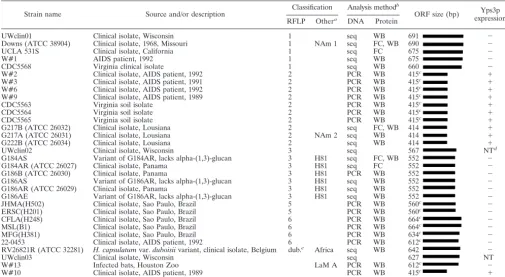
variants by use of a variety of techniques (Table 1). These strains
were isolated from clinical samples or the environment, and some
strains have previously been classified based on RFLP class or DNA
sequencing of individual genes (13, 14, 16). All 32 strains we
exam-ined had the
YPS3
gene. We noted well-conserved differences in
gene size between phylogenic groups. Additionally, we observed a
strong correlation between a gene size of approximately 414 bp and
production of the Yps3p protein (Table 1).
Individual isolate sequencing.
We designed ORF-specific
primers based on available sequence data from the
Histoplasma
capsulatum
genome and amplified the locus from isolates selected
from Table 1. The selected strains were representative of three
described RFLP classes as well as unclassified clinical isolates and
strains from the variant
Histoplasma capsulatum
var.
duboisii
,
typically associated with African histoplasmosis. After
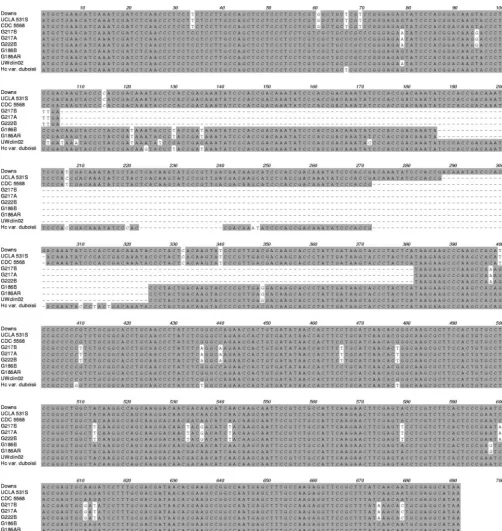
amplifica-tion, we cloned and sequenced the ORF. The ORF appears well
conserved in the 5
⬘
and 3
⬘
regions. This conservation includes
100% predicted amino acid identity in the first 24 amino acids, a
region that, according to our N-terminal sequencing results,
en-codes a secretion signal sequence that is cleaved from the mature
protein after the first proline (
MLNIKSISTLLLLASSSLLVAAR
P
/GEYPTD. . ., where the italicized residues correspond to the
TABLE 1. Analysis of the
YPS3
gene in 32 isolates
Strain name Source and/or description
Classification Analysis methodb
ORF size (bp) Yps3p expression RFLP Othera
DNA Protein
UWclin01 Clinical isolate, Wisconsin 1 seq WB 691 ⫺
Downs (ATCC 38904) Clinical isolate, 1968, Missouri 1 NAm 1 seq FC, WB 690 ⫺
UCLA 531S Clinical isolate, California 1 seq FC 675 ⫺
W#1 AIDS patient, 1992 1 seq WB 675 ⫺
CDC5568 Virginia clinical isolate 1 seq WB 660 ⫺
W#2 Clinical isolate, AIDS patient, 1992 2 PCR WB 415c ⫹
W#3 Clinical isolate, AIDS patient, 1991 2 PCR WB 415c ⫹
W#6 Clinical isolate, AIDS patient, 1992 2 PCR WB 415c ⫹
W#9 Clinical isolate, AIDS patient, 1989 2 PCR WB 415c ⫹
CDC5563 Virginia soil isolate 2 PCR WB 415c ⫹
CDC5564 Virginia soil isolate 2 PCR WB 415c ⫹
CDC5565 Virginia soil isolate 2 PCR WB 415c ⫹
G217B (ATCC 26032) Clinical isolate, Lousiana 2 seq FC, WB 414 ⫹ G217A (ATCC 26031) Clinical isolate, Lousiana 2 NAm 2 seq WB 414 ⫹
G222B (ATCC 26034) Clinical isolate, Lousiana 2 seq WB 414 ⫹
UWclin02 Clinical isolate, Wisconsin 3 seq 567 NTd
G184AS Variant of G184AR, lacks alpha-(1,3)-glucan 3 H81 seq FC, WB 552 ⫺ G184AR (ATCC 26027) Clinical isolate, Panama 3 H81 seq FC 552 ⫺ G186B (ATCC 26030) Clinical isolate, Panama 3 H81 PCR WB 552 ⫺
G186AS Variant of G186AR, lacks alpha-(1,3)-glucan 3 H81 seq WB 552 ⫺
G186AR (ATCC 26029) Clinical isolate, Panama 3 H81 seq WB 552 ⫺ G186AE Variant of G186AR, lacks alpha-(1,3)-glucan 3 H81 seq WB 552 ⫺ JHMA(H502) Clinical isolate, Sao Paulo, Brazil 5 PCR WB 560c ⫺
ERSC(H201) Clinical isolate, Sao Paulo, Brazil 5 PCR WB 560c ⫺
CFLA(H248) Clinical isolate, Sao Paulo, Brazil 6 PCR WB 664c ⫺
MSL(B1) Clinical isolate, Sao Paulo, Brazil 6 PCR WB 664c ⫺
MFG(H381) Clinical isolate, Sao Paulo, Brazil 6 PCR WB 634c ⫺
22-0453 Clinical isolate, AIDS patient, 1992 6 PCR WB 612c ⫺
RV26821R (ATCC 32281) H. capsulatumvar.duboisiivariant, clinical isolate, Belgium dub.e
Africa seq WB 642 ⫺
UWclin03 Clinical isolate, Wisconsin seq 627 NT
W#13 Infected bats, Houston Zoo LaM A PCR WB 612c ⫺
W#10 Clinical isolate, AIDS patient, 1989 PCR WB 415c ⫹
a
Classifications are from references 6 and 7.
b
seq, DNA sequencing; PCR, PCR with ORF-specific primers; WB, Western blotting; FC, flow cytometry.
c
Estimated by comparison to size standard ladder after gel electrophoresis.
d
NT, not tested.
e
dub.,H. capsulatumvar.duboisiiRFLP pattern distinct from 1 to 6.
on September 8, 2020 by guest
http://ec.asm.org/
signal sequence). In all strains examined, the gene size differences
among strains are due to a region of intragenic variability that
starts approximately 100 bp after the ATG start codon (Fig. 1)
and accounts for 7% to 43% of the gene’s length.
Analysis of the intragenic variable region.
Using sequence
analysis software, we analyzed the DNA and predicted amino
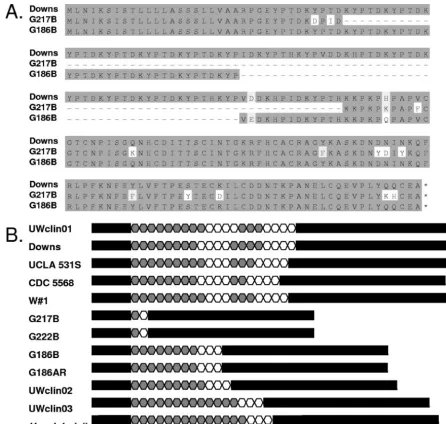
acid sequences of the sequenced strains. The insertions in all of
the strains sequenced resulted in an in-frame predicted
pro-tein, three examples of which are shown in Fig. 2A. The
intra-genic variability is composed of a series of between 2 and 20
well-conserved amino acid repeats with the consensus
se-quence YPTDK. In strains with multiple copies of the repeat,
FIG. 1. Alignment of the
YPS3
genes from selected strains of
Histoplasma capsulatum
. Sequence homology is observed in the 5
⬘
and 3
⬘
regions
of the gene, with a region of intragenic variability that is predicted to encode a series of tandem amino acid repeats. The lengths of the intragenic
variable regions differ between strains and show evidence of plasticity. Hc var. duboisii,
Histoplasma capsulatum
var.
duboisii
.
on September 8, 2020 by guest
http://ec.asm.org/
18% to 40% of the repeats showed some variability at the first,
third, or fourth position in the form (Y,H)P(I,T)(D,H),K (Fig.
2). Two copies of the repeat in the sequenced class 1 strains
also have the alternate form YPVDDK. The observed
intra-genic variability occurs at the same point where Yps3p diverges
from its homolog Bad1, the well-described
Blastomyces
derma-titidis
adhesin, immunomodulatory agent, and virulence factor
(1–3). The heterologous region of
BAD1
also involves a
repet-itive element of a longer 24-amino-acid length but comprised
of similar amino acids (10). The RFLP class 2 strains, which
express the Yps3 protein, show the smallest number of repeats,
averaging two. The analyzed RFLP class 3 strains have 11 or 12
copies of the repeat. The RFLP class 1 strains have 18 to 20
copies of the repeat, while strains of the African subtype
H.
capsulatum
var.
duboisii
have 16 to 17 copies. The differing
numbers of tandem repeats between strains of the same and
different RFLP classes suggest plasticity in the locus (Fig. 2B).
Heterologous expression of the
YPS3
ORF.
Whereas
centrated culture supernatants of all class 2 strains tested
con-tained Yps3p, we could not detect Yps3p produced by a panel
of class 1 or 3 strains tested on the cell surface (Table 1) or
released extracellularly (reference 1 and data not shown). It
was previously hypothesized that this intragenic variability
could possibly result in protein instability, a potential
explana-tion for why class 1 and class 3 strains do not produce Yps3p
(15). To address this, we expressed the cloned ORFs from the
class 1 strain Downs, the class 2 strain G217B, and the class 3
strain G186B in the class 3 uracil auxotroph G184AS
ura5-11
under the control of the heterologous promoter from the
Histoplasma capsulatum
histone
H2B
gene. Western blotting
FIG. 2. The top panel (A) shows three predicted amino acid sequences with variable-length repeats. Figure 2B shows a scaled diagram
of the Yps3p protein from several strains of various classifications. The black bars indicate the well-conserved N and C termini of the gene.
Each hexagon represents a tandem repeat element. Gray-shaded hexagons are repeats of the consensus YPTDK sequence. White hexagons
indicate a tandem repeat with one or two substitutions or an insertion, as described in the text.
H.c. duboisii
,
Histoplasma capsulatum
var.
duboisii
.
on September 8, 2020 by guest
http://ec.asm.org/
revealed that under heterologous control the Yps3p protein
from class 1 or class 3 strains can be produced in a class 3
strain, is reactive with our class 2 Yps3p antibody, and is
predictably larger (Fig. 3A). The heterologously expressed
class 1 (Fig. 3B) or class 3 (data not shown) protein is also
surface localized, which is also a characteristic of natively
ex-pressed Yps3p in class 2 strains (1), although expression in
general in these strains occurs at very low levels.
DISCUSSION
These findings demonstrate marked interstrain diversity in
the selectively expressed
YPS3
locus of the thermally
dimor-phic fungal pathogen
Histoplasma capsulatum
. They reveal a
hypervariable region that encodes a 5- to 6-amino-acid tandem
repeat element. There is evidence of plasticity in this repetitive
element, with strains containing between 2 and 20 copies. The
presence of a larger-sized insert does not prevent production
of protein when it is expressed during yeast-phase growth
un-der the control of a heterologous promoter. While this study
used yeast-phase thermal growth conditions, it was an in vitro
study, and future directions of research include a detailed
analysis of protein production during infection in all classes of
growth. Although patients infected with class 1 strains do not
generate antibody to Yps3p, suggesting that it is also not
pro-duced in vivo (27), it is important to better understand the
FIG. 3. A. Western blotting of
Histoplasma capsulatum
G184AS
ura5-11
yeast cells expressing the
YPS3
ORF of Downs, G217B, or
G186B strains by use of a heterologous
H2B
promoter reveals Yps3p
proteins of variable sizes. The increased size of the class 1 and class 3
proteins is consistent with the larger-sized ORF due to the region of
intragenic variability. B. Yps3p produced from the heterologously
ex-pressed Downs strain ORF is detectable on the surface of G184AS
ura5-11
yeast cells. Left panel, immunofluorescence; right panel,
dif-ferential interference contrast.
FIG. 4. Predicted protein alignment of several putative
Aspergillus
species homologs. These proteins share a predicted N-terminal signal
sequence and a C-terminal EGF-like domain, including the conserved spacing of six cysteines (boxed) predicted to be important for disulfide
bonding. The
Aspergillus
species are the most minimal homologs identified and lack an intragenic tandem repeat domain. The
H. capsulatum
strain
G217B Yps3p and
B. dermatitidis
Bad1p homologs are shown for comparison. The large tandem repeat region of Bad1p is indicated.
on September 8, 2020 by guest
http://ec.asm.org/
regulation of this protein and whether host signals, in addition
to temperature, play a role.
Intragenic repeats have recently been analyzed for several
cell wall or surface proteins and have been shown to play a role
in adhesive properties of these proteins. A study by Verstrepen
et al. analyzed
Saccharomyces cerevisiae
open reading frames
and identified 44 ORFs with intragenic repeats, 23 of which
encode proteins with predicted cell surface localizations (26).
In vitro analysis of one of these genes,
FLO1
, which encodes a
predicted adhesin, revealed that altering the number of repeats
led to differences in flocculation and adherence to polystyrene
whereas longer regions of repeats increased both phenotypes
(26). In addition to the Verstrepen study, intragenic repeats
have been analyzed in the
Candida albicans ALS3
gene, where
adhesive function is also linked to more copies of a tandem
repeat sequence, this one 108 bp long (21). While the results
regarding tandem repeats could suggest a role for Yps3p as an
adhesin, the class 2 strains that routinely produce the protein
have the most minimal tandem repeat subunit (only two
cop-ies). Additionally, Far Western blotting, yeast two-hybrid, and
immunofluorescence analysis of host cells probed with Yps3p
have not yielded evidence for an adhesive function (data not
shown).
The intragenic tandem repeat region also marks the main
area of divergence from
Blastomyces dermatitidis BAD1
. While
the Bad1 protein shares a conserved N-terminal secretion
sig-nal sequence and C-termisig-nal epidermal growth factor
(EGF)-like domain with Yps3p, the intragenic repeat region is
com-prised of 30 copies of a longer, 24-amino-acid repeat. The
Klein group has extensively characterized Bad1p and
deter-mined that it is an essential virulence factor of
Blastomyces
dermatitidis
(3). The immunomodulatory action contributing to
this virulence effect has been localized to the repeat region (5,
6). Analysis of interstrain variability in Bad1 has not yet been
performed. We are currently using RNA interference to
ana-lyze the role of Yps3p during infection and to determine how
the divergent intragenic regions in these two homologs might
differently affect fungal virulence.
Beyond Bad1, we have recently analyzed the genomes of
several
Aspergillus
species and found homologs of
YPS3
(Fig.
4). Interestingly, these homologs entirely lack an intragenic
tandem repeat element. It has not yet been determined
whether these homologs direct protein production; however,
reverse transcription-PCR analysis revealed that transcript is
detectable in
Aspergillus fumigatus
(data not shown). The
As-pergillus
homologs present the most minimal EGF-like locus,
while Bad1 has a large intragenic tandem repeat element.
Yps3p falls in between these two extremes, and it will be
interesting to determine what effect this variable tandem
re-peat region has on pathogenesis or other phenotypes.
ACKNOWLEDGMENTS
We gratefully acknowledge Joseph Wheat and Patricia Connolly for
the provision of several strains utilized in this study. Robert Zarnowski
provided assistance in strain propagation and culturing as well as
helpful discussions and critical reading of the manuscript. We thank
Parul A. Trivedi and Thanh T. Hoang for unpublished results and
James Bangs for the use of a fluorescence microscope.
This work was supported by National Institutes of Health (NIH)
R01 (Research Project Grant Program) grants HL55949 and AI52303
(to J.P.W.), NIH R37 (Method to Extend Research in Time) award
AI42747 (to George Deepe), and a traineeship on NIH T32 (Infectious
Diseases Training Fellowship) AI055397 (M.L.B.).
REFERENCES
1.Bohse, M. L., and J. P. Woods.2005. Surface localization of the Yps3p protein ofHistoplasma capsulatum. Eukaryot. Cell.4:685–693.
2.Brandhorst, T., M. Wuthrich, B. Finkel-Jimenez, and B. Klein.2003. A C-terminal EGF-like domain governsBAD1localization to the yeast surface and fungal adherence to phagocytes, but is dispensable in immune modula-tion and pathogenicity ofBlastomyces dermatitidis. Mol. Microbiol.48:53–65. 3.Brandhorst, T. T., M. Wuthrich, T. Warner, and B. Klein.1999. Targeted gene disruption reveals an adhesin indispensable for pathogenicity of
Blastomyces dermatitidis. J. Exp. Med.189:1207–1216.
4.Di Lallo, G., S. Gargano, and B. Maresca.1994. TheHistoplasma capsulatum cdc2gene is transcriptionally regulated during the morphologic transition. Gene140:51–57.
5.Finkel-Jimenez, B., M. Wuthrich, T. Brandhorst, and B. S. Klein.2001. The WI-1 adhesin blocks phagocyte TNF-alpha production, imparting pathoge-nicity onBlastomyces dermatitidis. J. Immunol.166:2665–2673.
6.Finkel-Jimenez, B., M. Wuthrich, and B. S. Klein.2002. BAD1, an essential virulence factor ofBlastomyces dermatitidis, suppresses host TNF-alpha pro-duction through TGF-beta-dependent and -independent mechanisms. J. Im-munol.168:5746–5755.
7.Gargano, S., G. Di Lallo, G. S. Kobayashi, and B. Maresca.1995. A tem-perature-sensitive strain of Histoplasma capsulatumhas an altered delta 9-fatty acid desaturase gene. Lipids30:899–906.
8.Harris, G. S., E. J. Keath, and J. Medoff.1989. Characterization of alpha and beta tubulin genes in the dimorphic fungusHistoplasma capsulatum. J. Gen. Microbiol.135:1817–1832.
9.Harris, G. S., E. J. Keath, and J. Medoff. 1989. Expression of ␣- and
-tubulin genes during dimorphic-phase transitions ofHistoplasma cap-sulatum. Mol. Cell. Biol.9:2042–2049.
10.Hogan, L. H., S. Josvai, and B. S. Klein.1995. Genomic cloning, character-ization, and functional analysis of the major surface adhesin WI-1 on
Blastomyces dermatitidisyeasts. J. Biol. Chem.270:30725–30732.
11.Hwang, L., D. Hocking-Murray, A. K. Bahrami, M. Andersson, J. Rine, and A. Sil.2003. Identifying phase-specific genes in the fungal pathogen His-toplasma capsulatumusing a genomic shotgun microarray. Mol. Biol. Cell 14:2314–2326.
12.Johnson, C. H., M. G. Klotz, J. L. York, V. Kruft, and J. E. McEwen.2002. Redundancy, phylogeny and differential expression of Histoplasma cap-sulatumcatalases. Microbiology148:1129–1142.
13.Kasuga, T., J. W. Taylor, and T. J. White.1999. Phylogenetic relationships of varieties and geographical groups of the human pathogenic fungus His-toplasma capsulatumDarling. J. Clin. Microbiol.37:653–663.
14.Kasuga, T., T. J. White, G. Koenig, J. McEwen, A. Restrepo, E. Castaneda, C. Da Silva Lacaz, E. M. Heins-Vaccari, R. S. De Freitas, R. M. Zancope-Oliveira, Z. Qin, R. Negroni, D. A. Carter, Y. Mikami, M. Tamura, M. L. Taylor, G. F. Miller, N. Poonwan, and J. W. Taylor.2003. Phylogeography of the fungal pathogenHistoplasma capsulatum. Mol. Ecol.12:3383–3401. 15.Keath, E. J., and F. E. Abidi.1994. Molecular cloning and sequence analysis
of yps-3, a yeast-phase-specific gene in the dimorphic fungal pathogen His-toplasma capsulatum. Microbiology140:759–767.
16.Keath, E. J., G. S. Kobayashi, and G. Medoff.1992. Typing ofHistoplasma capsulatumby restriction fragment length polymorphisms in a nuclear gene. J. Clin. Microbiol.30:2104–2107.
17.Keath, E. J., A. A. Painter, G. S. Kobayashi, and G. Medoff.1989. Variable expression of a yeast-phase-specific gene inHistoplasma capsulatumstrains differing in thermotolerance and virulence. Infect. Immun.57:1384–1390. 18.Ku¨gler, S., T. Schurtz Sebghati, L. Groppe Eissenberg, and W. E. Goldman.
2000. Phenotypic variation and intracellular parasitism byHistoplasma cap-sulatum. Proc. Natl. Acad. Sci. USA97:8794–8798.
19.Medoff, G., M. Sacco, B. Maresca, D. Schlessinger, A. Painter, G. S. Kobayashi, and L. Carratu.1986. Irreversible block of the mycelial-to-yeast phase transition ofHistoplasma capsulatum. Science231:476–479.
20.Nemecek, J. C., M. Wuthrich, and B. S. Klein.2006. Global control of dimorphism and virulence in fungi. Science312:583–588.
21.Oh, S. H., G. Cheng, J. A. Nuessen, R. Jajko, K. M. Yeater, X. Zhao, C. Pujol, D. R. Soll, and L. L. Hoyer.2005. Functional specificity ofCandida albicans
Als3p proteins and clade specificity ofALS3alleles discriminated by the number of copies of the tandem repeat sequence in the central domain. Microbiology151:673–681.
22.Patel, J. B., J. W. Batanghari, and W. E. Goldman.1998. Probing the yeast phase-specific expression of theCBP1gene inHistoplasma capsulatum. J. Bacteriol.180:1786–1792.
23.Retallack, D. M., E. L. Heinecke, R. Gibbons, G. S. Deepe, Jr., and J. P. Woods. 1999. TheURA5gene is necessary forHistoplasma capsulatumgrowth during infection of mouse and human cells. Infect. Immun.67:624–629.
24.Sebghati, T. S., J. T. Engle, and W. E. Goldman.2000. Intracellular para-sitism byHistoplasma capsulatum: fungal virulence and calcium dependence. Science290:1368–1372.
on September 8, 2020 by guest
http://ec.asm.org/
25.Tian, X., and G. Shearer, Jr.2001. Cloning and analysis of mold-specific genes in the dimorphic fungusHistoplasma capsulatum. Gene275:107–114. 26.Verstrepen, K. J., A. Jansen, F. Lewitter, and G. R. Fink.2005. Intragenic
tandem repeats generate functional variability. Nat. Genet.37:986–990. 27.Weaver, C. H., K. C. Sheehan, and E. J. Keath.1996. Localization of a
yeast-phase-specific gene product to the cell wall inHistoplasma capsulatum. Infect. Immun.64:3048–3054.
28.Woods, J. P., and W. E. Goldman.1992. In vivo generation of linear plasmids with addition of telomeric sequences byHistoplasma capsulatum. Mol. Mi-crobiol.6:3603–3610.
29.Woods, J. P., E. L. Heinecke, and W. E. Goldman.1998. Electrotransforma-tion and expression of bacterial genes encoding hygromycin phosphotrans-ferase and-galactosidase in the pathogenic fungusHistoplasma capsulatum. Infect. Immun.66:1697–1707.