INTRODUCTION
Total joint arthroplasty such as total knee arthroplasty or total hip arthroplasty (TKA or THA) is one of the most suc-cessful surgical treatments for patients with end-stage osteo-arthritis. It is estimated that over 700,000 joint replacements are performed in the United States each year [1]. Pain control and comfort level are linked to earlier mobilization and ini-tiation of physiotherapy, better range of motion, decreased length of hospital stay and risk of postoperative complications, and improved patient satisfaction [2].
Epidural analgesia consisting of a local anesthetic agent and an opioid has been a regular regimen used for postopera-tive analgesia after total joint arthroplasty [3]. However, some studies have indicated that the benefit of epidural analgesia
must be weighed against the frequency of its adverse effects such as urinary retention, hypotension, pruritus, and motor block that delays mobilization [4,5]. In recent years, there is a growing interest in the use of local infiltration analgesia (LIA) containing various constituents as a modality of postoperative pain control. The LIA technique was originally performed by Bianconi et al. [6] and Kerr and Kohan [7] with promis-ing results. The advantage of LIA is the ability to provide pain control without interfering with lower extremity motor strength, thereby allowing early mobilization of patients [7]. Studies have shown that LIA is consistently more effective in the treatment of postoperative pain after TKA or THA when compared with placebo [8,9]. Comparison between LIA and epidural analgesia was conducted by several authors, which was more convincing to illustrate its superiority [10-18]. Tsukada et al. [16] have shown that local infiltration was asso-ciated with a lower visual analog scale (VAS) score and bet-ter flexion motion than epidural analgesia, while Jules-Elysee et al. [14] reported that epidural analgesia provided less opioid and a lower VAS score. Regarding different studies, analgesic
*Corresponding author: Hao Wang, Department of Anesthesiology, Zhongshan Hospital, Shanghai Medical College of Fudan University, NO. 180 Fenglin Road, Shanghai 200032, People’s Republic of China. E-mail: [email protected]
Submitted: 01 February 2016/Accepted: 08 March 2016
Comparison of local infiltration and epidural analgesia
for postoperative pain control in total knee arthroplasty
and total hip arthroplasty: A systematic review and
meta-analysis
Huan Yan1, Jing Cang1, Zhanggang Xue1, Jianfeng Lu2, Hao Wang1*
1Department of Anesthesiology, Zhongshan Hospital, Shanghai Medical College of Fudan University, Shanghai, People’s Republic of
China, 2Waisman Center, University of Wisconsin, Madison, Wisconsin, USA
ABSTRACT
Pain management after total knee arthroplasty (TKA) and total hip arthroplasty should permit early mobilization with minimal pain. Local infiltration analgesia (LIA) is a new popular method for decreasing postoperative pain. The goal of this meta-analysis is to evaluate the efficacy of LIA in comparison with epidural analgesia. A literature search was performed in PubMed, EMBASE, the OVID database, Web of Science, and the Cochrane Library databases. The risk of bias was assessed using the Cochrane collaboration tool. Outcomes of interest included visual analog scale score, range of flexion, length of stay, and complications. Nine trials involving 537 patients met the inclusion criteria. LIA provides better pain relief and larger range of motion in TKA patients compared to epidural analgesia at the late postoperative period. No significant dif-ference was observed in regard to the length of stay and complications. The current evidence shows that the use of local infiltration is effective for postoperative pain management in TKA patients. More high-quality randomized controlled trials with long-term follow-up are required for examining the long-term efficacy and safety of local infiltration.
KEY WORDS: Total knee arthroplasty; total hip arthroplasty; local infiltration; epidural analgesia; meta-analysis
advantage and functional benefits of LIA versus epidural analgesia remain a debate. Therefore, this meta-analysis was designed to quantitatively assess the clinical efficacy and safety of LIA compared with epidural analgesia in TKA or THA.
MATERIALS AND METHODS
PubMed, Cochrane Library, Web of Science, OVID, and EMBASE were searched up to October 2015. The search terms included “local infiltration”, “periarticular injection”, “intra-articu-lar injection”, “knee arthroplasty”, “knee replacement”, “hip arthro-plasty”, and “hip replacement”. No restrictions were imposed on language. Reference lists of all the eligible studies and relevant reviews were hand searched for any additional trials.
Inclusion criteria and study selection
We identified randomized controlled trials (RCTs) compar-ing LIA with epidural analgesia group followcompar-ing THA/TKA. Any type of local infiltration (both periarticular infiltration and intra-articular infiltration) and any type of medication (both single infiltration and continuous infiltration) were included. The primary outcomes included pain score at rest or on move-ment. Secondary outcomes included a range of flexion, length of hospital stay, and complications. Articles that reported at least one outcome were included. Letters, comments, editori-als, practice guidelines, and trials published without the out-come measures of interest were excluded. Two authors inde-pendently assessed potentially relevant citations for inclusion; disagreements were resolved with a third author.
Data abstraction and quality assessment
Data were extracted independently by two reviewers. Full texts of any potentially useful studies were reviewed, disagree-ments regarding which studies to include were resolved by dis-cussion. Data regarding the patient characteristics, interven-tion, and outcomes were extracted in duplicate by two authors using a standardized form. The postoperative pain intensity was measured by a 10 points VAS. When a numerical rating scale score was used, it was converted to a VAS score. Data in other forms (i.e., median, interquartile range, and mean ± 95% confidence interval [CI]) were converted to mean ± standard deviation (SD) according to Cochrane Handbook. If the data were not reported numerically, we extracted them by manual measurements from the published figures.
Two authors assessed the risk of bias of the included stud-ies independently. Possible biases were recorded in a Cochrane risk of bias table. Random sequence generation, allocation concealment, blinding of participants and personnel, blind outcome assessment, incomplete outcome data, selective reporting, and other sources of bias were measured with care.
Statistical analysis
Review Manager Software (Revman 5.3, Cochrane Collaboration, Oxford, United Kingdom) was used for the meta-analysis. The heterogeneity of the studies was tested using the I2 statistic and Chi-squared tests. A fixed-effects model was used when the heterogeneity test did not reveal statistical significance (I2 < 50%). Otherwise, the random effects model was used. Mean difference (MD) with 95% CI was calculated for the continuous data and relative risk (RR) with 95% CI for the dichotomous data.
RESULTS
Search results
After comprehensive searches, 1354 citations were found. We excluded 549 duplicates and 789 citations after screening the titles and abstracts. After reading full texts, 7 citations which did not fulfill the inclusion criteria were excluded. Finally, 9 RCTs were identified in our study (Figure 1) [10-18].
The characteristics of the included studies are presented in Table 1. Six hundred and seven TKAs (local infiltration/ epidural analgesia: n = 302/305) in 537 patients (bilateral/uni-lateral: n = 70/467) were performed in 9 RCTs. The baseline characteristics between the two groups were well matched in each trial. One study investigated the effect of LIA by place-ment of a bilateral TKA.
Study quality
Of the nine included studies, eight were randomized by computer generated numbers or random table using sealed envelopes, while one study did not mention its design. Only two trials were double-blind to patients and outcome asses-sors while four were not able to be blinded for the trial designs and three did not mention it. The methodological quality of included studies is seen in Figure 2.
Results of the meta-analysis
VAS score at restFive studies with 272 patients showed a VAS score at 12 hours postoperatively [12,13,15,16,18]. No significant differ-ence was found between local infiltration and epidural analge-sia (Figure 3A) (MD = −0.42; 95% CI = −1.03-0.20).
Nine studies, which included RCTs with 537 patients, showed a VAS score at 24 hours postoperatively [10-18]. The meta-analysis showed no significant difference (Figure 3B) (MD = −0.08; 95% CI = −0.49-0.33). The subgroup analysis showed the same result.
meta-analysis reported that local infiltration had a lower VAS score than epidural analgesia (Figure 3C and D) (MD = −1.08; 95% CI = −1.86 to −0.29 and MD = −0.82; 95% CI = −1.24 to −0.4). In the subgroup analysis of THA [14,17], the meta-analysis of two studies showed no significant dif-ference between local infiltration and epidural analgesia at 48 and 72 hours postoperatively. However, the results com-bined from four studies [10,11,13,16] showed that in TKA local infiltration significantly reduced the VAS score at 48 and 72 hours.
VAS score on movement
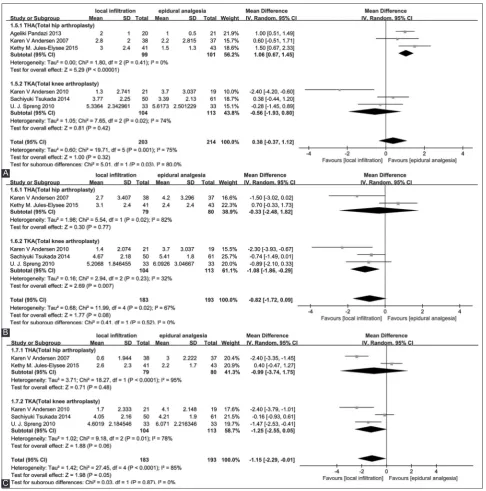
The VAS score showed no significant differences between the two groups at 24 hours (MD = 0.38; 95% CI = −0.37-1.12) (Figure 4A) [10,11,14-17]. However, in THA [14,15,17], epidural analgesia showed a reduced VAS score, while in TKA [10,11,16], there was no statistical difference. In THA [14,17], no signifi-cant difference was observed between the two groups on movement at 48 and 72 hours postoperatively (Figure 4B and C) (at 48 hours: MD = −0.33; 95% CI = −2.48-1.82; at 72 hours: MD = −0.99; 95% CI = −3.74-1.75). On the contrary, in TKA [10,11,16], local infiltration had lowered VAS score
on movement at 48 hours postoperatively (MD = −1.08; 95% CI = −1.86 to −0.29).
Range of knee flexion
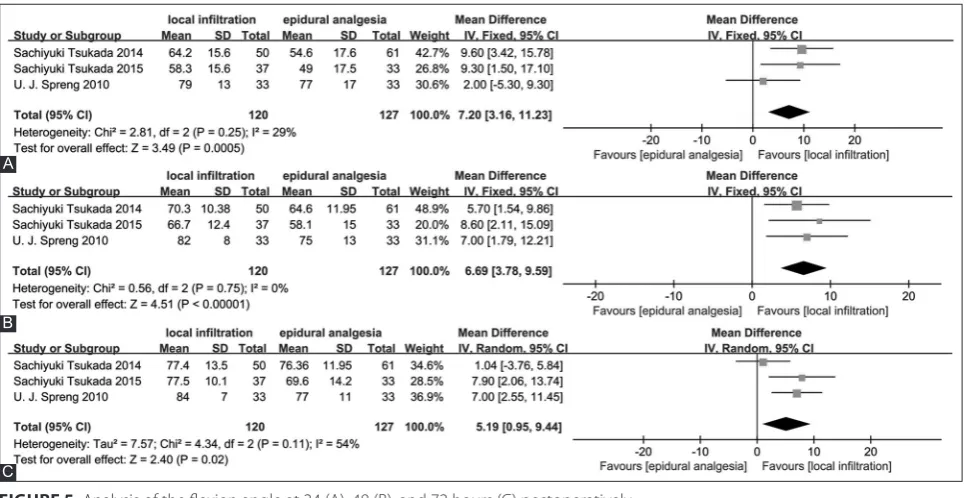
Three studies [11,13,16] reporting a range of knee flex-ion were included in the meta-analysis. Local infiltratflex-ion had better flexion at 24, 48, and 72 hours (MD = 7.2; 95% CI = 3.16-11.23; MD = 6.69; 95% CI = 3.78-9.59 and MD = 5.19; 95% CI = 0.95-9.44) (Figure 5A-C).
TABLE 1. Characteristics of included studies
Author Year Operation Anesthesia Number of patients(LIA/epidural) Local infiltration Epidural analgesia
Klasen et al. 1999 TKA Spinal 10/10 Single infiltration Boluses of epidural infusion
Andersen et al. 2007 THA Spinal 38/37 Combination of wound infiltration and a single-shot intra-articular injection postoperatively Continuous epidural infusion
Spreng et al. 2010 TKA Spinal 33/33 Combination of wound infiltration and a single-shot intra-articular injection postoperatively Continuous epidural infusion
Andersen et al. 2010 TKA Spinal 21/19 Combination of wound infiltration and continuous intra-articular injection postoperatively Continuous epidural infusion Pandazi et al. 2013 THA Spinal 20/21 Single-shot intraoperative periarticular infiltration Continuous epidural infusion Tsukada et al. 2014 TKA Spinal 50/61 Single-shot intraoperative periarticular infiltration Continuous epidural infusion Binici Bedir et al. 2014 TKA Spinal 15/15 Continuous periarticular injection postoperatively Continuous epidural infusion Tsukada et al. 2015 TKA Spinal 37/33 Single-shot intraoperative periarticular infiltration Continuous epidural infusion Jules-Elysee et al. 2015 THA Combined 41/43 Single-shot intraoperative periarticular infiltration Continuous epidural infusion
THA: Total hip arthroplasty; TKA: Total knee arthroplasty; LIA: Local infiltration analgesia
FIGURE 1. The flow chart of literature screening.
Length of hospital stay
Pooling four trials [10,11,14,17] with 265 patients, the results showed that local infiltration failed to reduce the length of
Complications
The meta-analysis of five studies [11-13,16,17] revealed no significant difference in the incidence of nausea between the
FIGURE 3. Analysis of the visual analog scale score at rest at 12 (A), 24 (B), 48 (C), and 72 hours (D) postoperatively.
A
B
C
meta-analysis of four studies [11,13,16,17] showed there was no statistical difference between local infiltration and epidural analgesia (RR = 2.02; 95% CI = 0.51-7.99) (Figure 7B).
DISCUSSION
To our knowledge, this is the first meta-analysis of RCTs comparing the efficacy and safety of local infiltration with epi-dural analgesia in the management of postoperative pain in THA and TKA. The most important finding of this study was that in TKA local infiltration may have better pain relief in the late postoperative period compared with epidural analgesia, and in the early postoperative period, local infiltration pro-vided postoperative analgesia comparable to that of epidural
analgesia. Moreover, there was no significant difference in pain relief between local infiltration and epidural analgesia both in the early postoperative period and in the late postop-erative period in THA.
Pain intensity was measured as VAS score at 12, 24, 48, and 72 hours after THA and TKA. In THA, local infiltra-tion showed no superiority in analgesic effects over epi-dural analgesia both at rest and on movement, while in TKA local infiltration showed better pain relief in the late postoperative period both at rest and on movement com-pared to epidural analgesia. The different outcome between THA and TKA may be due to the different pain intensities between THA and TKA. The different outcome between early and late postoperative periods may be due to short
FIGURE 4. Analysis of the visual analog scale score on movement at 24 (A), 48 (B), and 72 hours (C) postoperatively.
A
B
time pain relief of epidural analgesia. Choi et al. [4] dis-cussed epidural analgesia or systemic analgesia in patients undergoing hip or knee replacement in a Cochrane review and concluded that the beneficial effect of epidural anal-gesia on pain relief was limited to the early postoperative period.
With respect to functional recovery, local infiltration had a wider range of flexion at 24, 48, and 72 hours postopera-tively. This may be explained by the fact that the pain scores were consistently lower in the local infiltration group when compared with the epidural analgesia. Mullaji et al. [19] sus-pected that the duration of the effect of methylprednisolone
FIGURE 6. Analysis of the length of hospital stay.
FIGURE 5. Analysis of the flexion angle at 24 (A), 48 (B), and 72 hours (C) postoperatively.
A
B
C
FIGURE 7. Analysis of the complications such as nausea (A) and wound infection (B).
A
acetate led to extended pain control, thereby aiding flexion. Additionally, because local infiltration affects only the surgical area with moderate analgesia, there is limited interference to muscle strength of the lower limb. The application of contin-uous epidural analgesia has been reported to lengthen motor block compared to LIA [20]. Thus, improved mobilization was observed in the local infiltration group [7].
Regarding the length of hospital stay, our study failed to demonstrate any significant difference in the length of hospi-tal stay between the two groups. The length of hospihospi-tal stay following TKA and THA depends on many factors includ-ing factors unrelated to the patient’s medical or rehabilitation status.
Although we observed some differences when comparing the incidence of nausea between the two groups, there were no significant differences showing the method of local infil-tration being better or worse. Also, there was no difference in wound infection between the two groups. In a meta-analysis of studies involving the continuous infusion of local anesthetic into the surgical wound after various surgical procedures, Liu et al. [21] found that there was no statistically significant differ-ence in wound infection rates between patients who received active treatment (0.7%) and those who received placebo treat-ment (1.2%).
Considerable heterogeneity across the trials exists in our meta-analysis which might have a bias impact on our results. This could be the result of non-standardized local infiltra-tion and different administrainfiltra-tion methods and study designs. First, the cocktail content differed from each other. Six stud-ies [10,11,13,15-17] used ropivacaine, two studstud-ies [14,18] used bupivacaine, six studies [11-16] used morphine, five stud-ies [10,11,13,16,17] used ketorolac, and four studies [13-16] used corticosteroid. Ropivacaine has the similar efficiency to bupi-vacaine but is associated with a longer acting and fewer com-plications in the nervous and cardiovascular systems [22,23]. Second, different administration methods were used in nine trials. Five studies [12-16] had a single-shot infiltration, and two studies [11,17] had a combination of intraoperative and postoperative infiltration, whereas another two studies [10,18] used continuous infiltration. Zhang et al. [24] found that con-tinuous local infiltration provided prolonged superior anal-gesia and were associated with more favorable functional recovery and patient satisfaction compared with single local infiltration. Moreover, most trials were not sufficiently blinded due to the design, which may also arise a bias. Therefore, the standardization of the multimodal drugs and administration methods should be dealt with carefully.
In addition, the optimal site of administration of local infiltration should be of concern. Five studies [13-16,18] used periarticular infiltration and four studies [10-12,17] used intra-articular infiltration. There were several trials comparing
intra-articular infiltration with periarticular infiltration. Andersen et al. [25] and Perret et al. [26] concluded no clear statistically significant benefit with either technique. On the contrary, Tsuyoshi Nakai et al. [27] showed the level of pain control was higher in periarticular infiltration than in intra-ar-ticular infiltration. Therefore, further studies are needed com-paring the pain-relief efficacy between intra-articular infiltra-tion and periarticular infiltrainfiltra-tion to confirm the optimal site of administration.
Furthermore, in this meta-analysis, we focused on the pain score, range of flexion, length of hospital stay, and complica-tions shortly after THA and TKA. However, longer follow-up would be preferable to evaluate the results, especially in terms of long-term knee motion and complications. A study about the long-term outcome of local infiltration is needed to soli-date the advantage of local infiltration.
Another limitation of the meta-analysis are the small sam-ple sizes in each study. The overestimation of the treatment effect is more likely in smaller trials compared with larger sam-ples. Furthermore, variable reporting of outcomes and incon-sistent definitions mean that some data were provided insuf-ficiently. Ultimately, some outcomes could not be included in the meta-analysis, which might lower the level of evidence.
CONCLUSION
Local infiltration appeared to be an efficient and safe alter-native for postoperative pain management in TKA. There is a high level of heterogeneity between the studies, and more homogenous research is necessary to validate our conclusion.
ACKNOWLEDGMENTS
This work was supported by grants from the National Natural Scientific Foundation of China (81301615 to H.W.) and the Natural Scientific Foundation of Shanghai (14ZR1406900 to Z.X.).
DECLARATION OF INTERESTS
The authors declare no conflict of interests.
REFERENCES
[1] Kurtz S, Ong K, Lau E, Mowat F, Halpern M. Projections of primary and revision hip and knee arthroplasty in the United States from 2005 to 2030. J Bone Joint Surg Am. 2007;89(4):780-5.
http://dx.doi.org/10.2106/JBJS.F.00222.
[2] Nussenzveig TC. Pain management after total joint replacement and its impact on patient outcomes. AORN J. 1999;70(6):1060-2. http://dx.doi.org/10.1016/s0001-2092(06)62213-8.
Anesthesiology. 1999;91(1):8-15.
http://dx.doi.org/10.1097/00000542-199907000-00006. [4] Choi PT, Bhandari M, Scott J, Douketis J. Epidural analgesia for pain
relief following hip or knee replacement. Cochrane Database Syst Rev. 2003;3:CD003071.
http://dx.doi.org/10.1002/14651858.cd003071.
[5] Tang R, Evans H, Chaput A, Kim C. Multimodal analgesia for hip arthroplasty. Orthop Clin North Am. 2009;40(3):377-87.
http://dx.doi.org/10.1016/j.ocl.2009.04.001.
[6] Bianconi M, Ferraro L, Traina GC, Zanoli G, Antonelli T, Guberti A, et al. Pharmacokinetics and efficacy of ropivacaine continuous wound instillation after joint replacement surgery. Br J Anaesth 2003;91(6):830-5.
http://dx.doi.org/10.1093/bja/aeg277.
[7] Kerr DR, Kohan L. Local infiltration analgesia: A technique for the control of acute postoperative pain following knee and hip surgery: A case study of 325 patients. Acta Orthop. 2008;79(2):174-83. http://dx.doi.org/10.1080/17453670710014950.
[8] Teng Y, Jiang J, Chen S, Zhao L, Cui Z, Khan MS, et al. Periarticular multimodal drug injection in total knee arthroplasty. Knee Surg Sports Traumatol Arthrosc. 2014;22(8):1949-57.
http://dx.doi.org/10.1007/s00167-013-2566-0.
[9] Jiang J, Teng Y, Fan Z, Khan MS, Cui Z, Xia Y. The efficacy of periarticular multimodal drug injection for postoperative pain management in total knee or hip arthroplasty. J Arthroplasty. 2013;28(10):1882-7.
http://dx.doi.org/10.1016/j.arth.2013.06.031.
[10] Andersen KV, Bak M, Christensen BV, Harazuk J, Pedersen NA, Søballe K. A randomized, controlled trial comparing local infil-tration analgesia with epidural infusion for total knee arthroplasty. Acta Orthop. 2010;81(5):606-10.
http://dx.doi.org/10.3109/17453674.2010.519165.
[11] Spreng UJ, Dahl V, Hjall A, Fagerland MW, Ræder J. High-volume local infiltration analgesia combined with intravenous or local ketorolac morphine compared with epidural analgesia after total knee arthroplasty. Br J Anaesth. 2010;105(5):675-82.
http://dx.doi.org/10.1093/bja/aeq232.
[12] Klasen JA, Opitz SA, Melzer C, Thiel A, Hempelmann G. Intraarticular, epidural, and intravenous analgesia after total knee arthroplasty. Acta Anaesthesiol Scand. 1999;43(10):1021-6. http://dx.doi.org/10.1034/j.1399-6576.1999.431009.x.
[13] Tsukada S, Wakui M, Hoshino A. Pain control after simultaneous bilateral total knee arthroplasty: A randomized controlled trial comparing periarticular injection and epidural analgesia. J Bone Joint Surg Am. 2015;97(5):367-73.
http://dx.doi.org/10.2106/JBJS.N.00373.
[14] Jules-Elysee KM, Goon AK, Westrich GH, Padgett DE, Mayman DJ, Ranawat AS, et al. Patient-controlled epidural analgesia or mul-timodal pain regimen with periarticular injection after total hip arthroplasty: A randomized, double-blind, placebo-controlled study. J Bone Joint Surg Am. 2015;97(10):789-98.
http://dx.doi.org/10.2106/JBJS.N.00698.
[15] Pandazi A, Kanellopoulos I, Kalimeris K, Batistaki C, Nikolakopoulos N, Matsota P, et al. Periarticular infiltration for pain relief after total hip arthroplasty: A comparison with epidural and PCA analgesia. Arch Orthop Trauma Surg. 2013;133(11):1607-12. http://dx.doi.org/10.1007/s00402-013-1849-8.
[16] Tsukada S, Wakui M, Hoshino A. Postoperative epidural analgesia compared with intraoperative periarticular injection for pain con-trol following total knee arthroplasty under spinal anesthesia: A ran-domized controlled trial. J Bone Joint Surg Am. 2014;96(17):1433-8. http://dx.doi.org/10.2106/JBJS.M.01098.
[17] Andersen KV, Pfeiffer-Jensen M, Haraldsted V, Søballe K. Reduced hospital stay and narcotic consumption, and improved mobiliza-tion with local and intraarticular infiltramobiliza-tion after hip arthroplasty: A randomized clinical trial of an intraarticular technique versus epidural infusion in 80 patients. Acta Orthop. 2007;78(2):180-6. http://dx.doi.org/10.1080/17453670710013654.
[18] Binici Bedir E, Kurtulmus T, Basyigit S, Bakir U, Saglam N, Saka G. A comparison of epidural analgesia and local infiltration analgesia methods in pain control following total knee arthroplasty. Acta Orthop Traumatol Turc. 2014;48(1):73-9.
http://dx.doi.org/10.3944/AOTT.2014.3256.
[19] Mullaji A, Kanna R, Shetty GM, Chavda V, Singh DP. Efficacy of periarticular injection of bupivacaine, fentanyl, and methylprednis-olone in total knee arthroplasty: A prospective, randomized trial. J Arthroplasty. 2010;25(6):851-7.
http://dx.doi.org/10.1016/j.arth.2009.09.007.
[20] Starks I, Frost A, Wall P, Lim J. Is a fracture of the transverse process of L5 a predictor of pelvic fracture instability? J Bone Joint Surg Br. 2011;93(7):967-9.
http://dx.doi.org/10.1302/0301-620X.93B7.26772.
[21] Liu SS, Richman JM, Thirlby RC, Wu CL. Efficacy of continuous wound catheters delivering local anesthetic for postoperative anal-gesia: A quantitative and qualitative systematic review of random-ized controlled trials. J Am Coll Surg. 2006;203(6):914-32. http://dx.doi.org/10.1016/j.jamcollsurg.2006.08.007.
[22] Vendittoli PA, Makinen P, Drolet P, Lavigne M, Fallaha M, Guertin MC, et al. A multimodal analgesia protocol for total knee arthroplasty. A randomized, controlled study. J Bone Joint Surg Am. 2006;88(2):282-9.
http://dx.doi.org/10.2106/JBJS.E.00173.
[23] Mather LE. The acute toxicity of local anesthetics. Expert Opin Drug Metab Toxicol. 2010;6(11):1313-32.
http://dx.doi.org/10.1517/17425255.2010.514265.
[24] Zhang S, Wang F, Lu ZD, Li YP, Zhang L, Jin QH. Effect of single-in-jection versus continuous local infiltration analgesia after total knee arthroplasty: A randomized, double-blind, placebo-controlled study. J Int Med Res. 2011;39(4):1369-80.
http://dx.doi.org/10.1177/147323001103900423.
[25] Andersen LØ, Kristensen BB, Husted H, Otte KS, Kehlet H. Local anesthetics after total knee arthroplasty: Intraarticular or extraar-ticular administration? A randomized, double-blind, placebo-con-trolled study. Acta Orthop. 2008;79(6):800-5.
http://dx.doi.org/10.1080/17453670810016885.
[26] Perret M, Fletcher P, Firth L, Yates P. Comparison of patient out-comes in periarticular and intraarticular local anaesthetic infil-tration techniques in total knee arthroplasty. J Orthop Surg Res. 2015;10:119.
http://dx.doi.org/10.1186/s13018-015-0249-x.