R E S E A R C H
Open Access
Effect of mixotrophic growth on the ultrastructure
and fatty acid composition of the diatom
Synedra
acus
from Lake Baikal
Sergey M Shishlyannikov
*, Igor V Klimenkov, Yekaterina D Bedoshvili, Ivan S Mikhailov and Alexander G Gorshkov
Abstract
Background:Interest in studies concerning the effect of organic carbon sources on the growth of diatoms is largely aimed at subsequent physiological changes occurring in their cells. There are no data on structural changes in the cytoplasm and their relationship with changes in the composition of fatty acids in the course of mixotrophic culturing of freshwater diatoms. To elucidate the role of lipids in the growth of diatom cells in autotrophic and mixotrophic cultures, it is necessary to obtain information on the distribution of fatty acids among intracellular compartments and on possible ultrastructural changes in the cells.
Results:In this study, the results demonstrated thatSynedra acuscells cultured in the presence of 80 mM glycerol contained lipid bodies of increased size, while cells from cultures supplemented with 40 mM glucose accumulated polysaccharide (chrysolaminarin) granules. An increase in the relative amounts of palmitic and stearic acids was revealed at the exponential growth phase ofS. acusin the medium with 80 mM glycerol, which was indicative of the accumulation of fatty acids contained in triacylglycerols.
Conclusions:Synedra acussubsp.radianshave an ability to proliferate in the presence of high concentrations of organic substances and their transport into cells is evidence for its high adaptation potential, which, along with other factors, accounts for the dominance of this diatom in the spring-summer plankton of the oligotrophic Lake Baikal.
Keywords:Synedra acus, Lake Baikal, Ultrastructure, Lipid bodies, GC-MS, Fatty acids
Background
Diatoms are autotrophic microalgae that, under certain conditions, can utilize organic carbon sources as nutrients [1-4]. As a rule, these substances are used to store energy as well as to satisfy metabolic needs for cell growth. For example, some species of microalgae assimilate up to 85% of available glucose in the form of reserve polysaccharides [5] whereas other species (e.g. Prymnesium parvum and
Dunaliella tertiolecta) cannot assimilate glucose even though they have the enzyme systems necessary for their metabolism [6]. Glycerol contained in the medium can also be utilized by some microalgae, which provides for an increase in their growth rate [3] and induces certain bio-chemical [7] and structural changes in the cell, particularly in the morphology of chloroplasts [8].
When nutrient supply is sufficient and environmental conditions are favorable, phytoplankton develops at a high rate, and the greater part of intracellular carbon is in the form of proteins. Under stressful conditions, such as nutri-ent deficiency (silicon, phosphorus, nitrogen, etc.) [9-11] or insufficient amount of sunlight [12], diatoms begin to store lipids and polysaccharides (in particular, chrysolami-narin) as energy reserve molecules. In the norm, fatty acids in microalgae are utilized mainly for the synthesis of membrane lipids. Under stress, lipid metabolism shifts to-ward the production of triacylglycerols and enrichment of lipid bodies in the cytoplasm [13].
As shown in previous experiments with diatom cultures, their cells accumulate triacylglycerols as the composition of the medium changes and the age of the culture increases [14,15], with the resulting increase in the amount of lipids in the cell being accompanied by changes in the compos-ition (ratio) of fatty acids [16-18]. Data on changes in the composition of fatty acids depending on environmental
* Correspondence:[email protected]
Limnological Institute, Siberian Branch, Russian Academy of Sciences, 3, Ulan-Batorskaya, St, P.O. Box 278, Irkutsk 664033, Russia
factors provide a basis for the search of new biological in-dicators characterizing the state of aquatic ecosystems under conditions of climate-dependent changes in the temperature of water bodies and their increasing tro-phicity resulting from the impact of human activities. Moreover, analysis of the effect of stress factors on the de-velopment of diatoms may provide the possibility of optimizing biotechnology of their culturing in order to ob-tain cell biomass with the desirable composition of low-molecular-weight compounds, fatty acids in particular.
Diatoms, green and red algae are natural producers of value-added bioactive compounds, such as PolyUnsatur-ated Fatty Acids (PUFAs). Some essential PUFAs including EPA (eicosapentaenoic acid,ω-3, C20:5), DHA (docosahex-aenoic acid, DHA,ω-3, C22:6), and AA (arachidonic acid, ω-3, C20:4) have critical physiological functions, e.g., pre-venting high cholesterol, myocardial infarction and im-proving high blood pressure, etc. Therefore, PUFAs have attracted a great attention due to their beneficial effects on human health [19]. Microalgae have potential for numer-ous commercial applications, among them the production of PUFAs [20]. Diatoms normally contain significant amount of EPA and lower levels of DHA [21-23]. Red algae also synthesize large amounts of EPA accompanied with AA [24]. EPA and DHA are typically absent in green algae [25] but these algae contain, in generally, primarily C16 and C18 PUFAs [26,27].
Interest in studies on the effect of organic carbon sources on the growth of diatoms is largely aimed at sub-sequent physiological changes occurring in their cells. A fairly detailed analysis has been made of various factors
having an effect on the ultrastructure of marine and fresh-water diatoms cultured under autotrophic, mixotrophic, and heterotrophic conditions [8,28-32]. On the other hand, there are no data on structural changes in the cyto-plasm and their relationship with changes in the compos-ition of fatty acids in the course of mixotrophic culturing of freshwater diatoms. To elucidate the role of lipids in the growth of diatom cells in autotrophic and mixotrophic cultures (supplemented with organic carbon sources), it is necessary to obtain information on the distribution of fatty acids among intracellular compartments and on possible ultrastructural changes in the cells.
Synedra acus subsp. radians (Kütz.) Skabitsch, one of dominant species in the phytoplankton of oligotrophic Lake Baikal, has been the object of intensive research on morphogenesis of frustules [33] as well as of molecular [34-36], cytological [37], and genomic studies [38]. As shown previously, this diatom is a potential source of PUFSa, mainly of EPA [39].
The purpose of this study was to analyze changes in the morphology and fatty acid composition of S. acus
cells cultured in the presence of glucose and glycerol as organic carbon sources.
Results
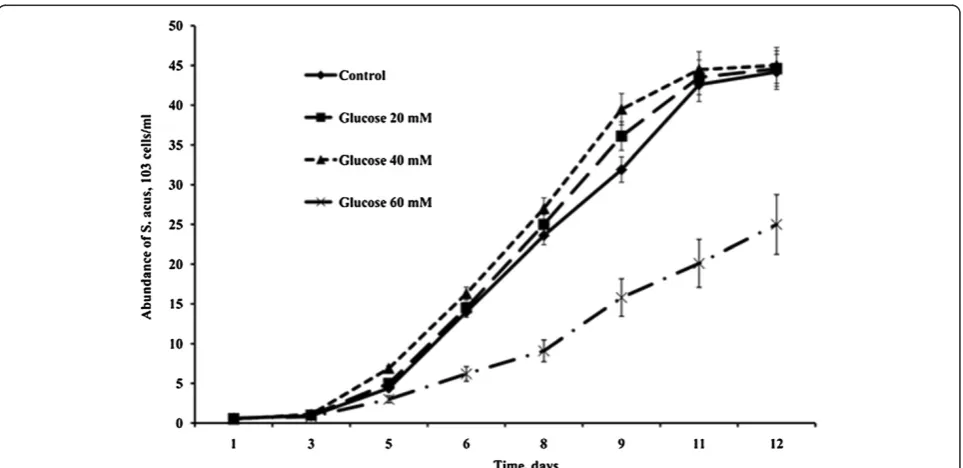
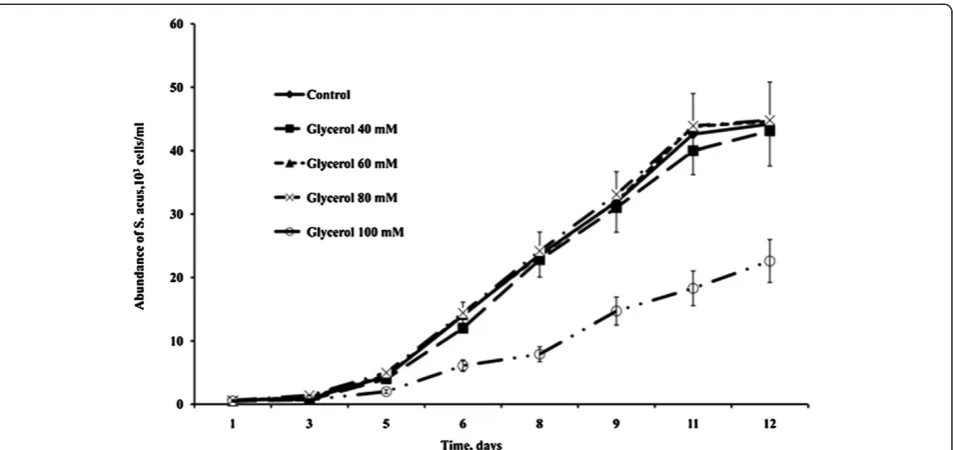
In preliminary experiments, the maximum concentra-tions of organic carbon sources in the medium that did not result in a reduced rate of cell divisions or gradual cell death in S. acus culture were estimated at 40 mM for glucose and 80 mM for glycerol (Figures 1 and 2).
Therefore, it is these concentrations that were used in subsequent mixotrophic cultures.
According to the results of TEM,S. acus cells in auto-trophic culture (Figure 3B) formed vacuoles (up to 1.0μm) with homogeneous electron-dense contents, which could be located either at the periphery or in the center of the cell (Figure 3E). These vacuoles in preparations stained with Nile red were bright orange (Figure 3A), which was evidence for the lipid nature of their contents [40]. Such intracellular lipid bodies were also found in cells cultured under mixotrophic conditions (with glycerol or glu-cose). It should be noted, however, that the size of lipid bodies in cells from cultures with glycerol was greater than in cells from either autotrophic (control) or glucose-containing cultures, reaching 2.5 μm (Figure 3C and 3F). Such glycerol-dependent accumulation of lipids in the cytoplasm of diatoms was observed already at the phase of their exponential growth. Further enlargement of lipid inclusions at the stationary growth phase resulted in a increase in the overall cell volume, which was usually ac-companied by deformation of the cell wall in the girdle zone (Figure 3F). At the stage of frustule formation, cells cultured in the presence of glucose contained a different kind of vacuoles (0.5-0.7 μm), which had heterogeneous granular and small-grained contents (10–20 nm, Figure 3D), and also included more electron-dense granules of a larger size (20–40 nm, Figure 3D). Such structures were not re-vealed in the cells cultured in autotrophic conditions and with glycerol. The characteristic structure of these organ-elles [41] could be regarded as evidence for the accumula-tion of polysaccharides (in particular, chrysolaminarin) in the cells.
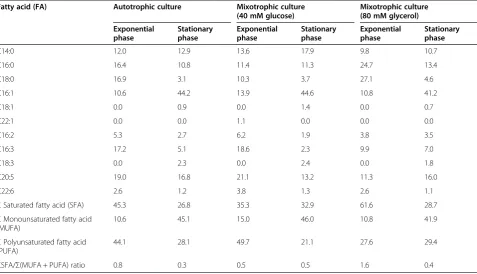
Analysis ofS. acuscell lipids was performed by means of their acid hydrolysis followed by gas chromatography of the extracted fraction of fatty acid methyl esters. It was found that the qualitative composition of fatty acids remained ba-sically unchanged in the course of culture growth (Table 1). Thus, the group of dominant fatty acids at the exponential growth phase included myristic (C14:0), palmitic (C16:0), palmitoleic (C16:1), hexadecatrienic (C16:3) stearic (C18:0), and eicosapentaenoic (C20:5) acids, and that at the sta-tionary growth phase, myristic, palmitic, palmitoleic, and eicosapentaenoic acids. Such composition of fatty acids is typical for hydrolysates of diatom lipids [21,22].
As follows from Table 1,ΣSFA/Σ(MUFA + PUFA) ra-tios in cell lipids markedly differed between cells cultured under photoautotrophic and mixotrophic conditions at the exponential phase. For example, palmitic and stearic acids dominated in the fatty acid spectrum ofS. acuscells cultured with 80 mM glycerol, indicating that these acids, contained in triacylglycerols, were accumulated in the lipid bodies.
Judging from theΣSFA/Σ(MUFA + PUFA) ratios of fatty acids in lipid hydrolysates, the relative amount of saturated fatty acids in S. acus cells decreased at the stationary growth phase in autotrophic cultures and mixotrophic cultures with 80 mM glycerol but remained unchanged in cultures with 40 mM glucose (Table 1). The contents of monounsaturated fatty acids increased threefold at the sta-tionary growth phase in both autotrophic and mixotrophic cultures with glucose or glycerol. The amount of PUFAs decreased in autotrophic cultures and mixotrophic cul-tures with 40 mM glucose but changed only slightly in cultures with 80 mM glycerol.
Table 1 Fatty acid composition (% of total fatty acid) inS. acusbiomass from different types of cultures (n = 3)
Fatty acid (FA) Autotrophic culture Mixotrophic culture
(40 mM glucose)
Mixotrophic culture (80 mM glycerol)
Exponential phase
Stationary phase
Exponential phase
Stationary phase
Exponential phase
Stationary phase
С14:0 12.0 12.9 13.6 17.9 9.8 10.7
С16:0 16.4 10.8 11.4 11.3 24.7 13.4
С18:0 16.9 3.1 10.3 3.7 27.1 4.6
С16:1 10.6 44.2 13.9 44.6 10.8 41.2
С18:1 0.0 0.9 0.0 1.4 0.0 0.7
С22:1 0.0 0.0 1.1 0.0 0.0 0.0
С16:2 5.3 2.7 6.2 1.9 3.8 3.5
С16:3 17.2 5.1 18.6 2.3 9.9 7.0
С18:3 0.0 2.3 0.0 2.4 0.0 1.8
С20:5 19.0 16.8 21.1 13.2 11.3 16.0
С22:6 2.6 1.2 3.8 1.3 2.6 1.1
ΣSaturated fatty acid (SFA) 45.3 26.8 35.3 32.9 61.6 28.7
ΣMonounsaturated fatty acid (MUFA)
10.6 45.1 15.0 46.0 10.8 41.9
ΣPolyunsaturated fatty acid (PUFA)
44.1 28.1 49.7 21.1 27.6 29.4
ΣSFA/Σ(MUFA + PUFA) ratio 0.8 0.3 0.5 0.5 1.6 0.4
Discussion
The data presented above show that the fatty acid profile of lipids from diatom cells is subjected to changes, which apparently result from exposure to stress factors. One of such factors may be the addition of organic carbon sources (glucose or glycerol) to the culture medium.
At the stationary growth phase, the content of palmito-leic acid inS. acusculture has proved to increase, by more than 40% relative to the total amount of fatty acids (Table 1). This fatty acid is most prevalent in the com-position of diatom lipids [21,42,43]. Fatty acid biosynthesis in all plastid-containing organisms is catalyzed by type II fatty acyl synthase [44]. Armbrust et al. described complete cycles of the biosynthesis of polyunsaturated fatty acids in the marine diatomThalassiosira pseudonana
[45]. Fatty acids synthesized in plastids are exported to the cytoplasm to be incorporated into intracellular lipids. It is known that diatom cells in cultures at the stationary growth phase experience a deficit of nutrients and begin to accumulate storage compounds such as lipids, inor-ganic ions and polysaccharides [11,46]. When the medium is supplemented with a certain source of carbon, diatoms can build up more biomass due to intensification of lipid biosynthesis [3,47]. Thus, the increase in the relative con-tent of palmitoleic acid inS. acuscells may be regarded as evidence for its accumulation as a component of reserve triacylglycerols stored in lipid bodies. Palmitic, palmitoleic and stearic acids are known to prevail in reserve triacyl-glycerols accumulated by photosynthesizing cells [18,48]. In our experiments, the relative contents of stearic, pal-mitic, acids in the biomass ofS. acusdiatoms at the expo-nential growth phase were found to be higher in cultures with glycerol than in cultures with glucose or in the con-trol (Table 1), which could be indicative of an increasing accumulation of lipids inS. acuscells.
In our experiments, the dominant PUFA was EPA at ex-ponential growth phase (Table 1). The dietary uptake of EPA and DHA is very important in human health. High EPA productivity is typical for many diatoms, for example,
Phaeodactylum tricornutum[23]Navicula saprophilaand
Nitzschia sp. [2]. Therefore, S. acus can be a preferable diatom that can be used as producer for“ω-3 polyunsatur-ated fatty acids” (PUFAs) and the putative candidate for genetic engineering.
These biochemical data are supported by the results of microscopic analysis. TEM preparations of S. acus cells from cultures with glycerol at the exponential growth phase, when the cells experience increasing deficit in silica, clearly show that the size of lipid bodies in the cytoplasm increases, compared to the control, and that this increase continues at the stationary growth phase, resulting in the expansion of cell volume in the girdle zone (Figure 3F). This is evidence for the existence of a mechanism for transmembrane transport of glycerol intoS. acuscells and
its involvement in cell metabolism. It is known that gly-cerol not only has a structural function as a component of cell membrane lipids but also plays a role in energy metabolism (in the form of glycerol-3-phosphate) and regulation of glycerol transport and lipid metabolism, and transmembrane transport of small charged molecules [49].
Synedra acus cells cultured in the presence of glucose proved to form polysaccharide granules in the cytoplasm (Figure 3D), which were absent in cells from cultures with glycerol and control cultures. In previous microscopic and biochemical studies, the main polysaccharide stored in the vacuoles of marine and freshwater diatoms was identified as β-1,3-glucan, or chrysolaminarin [41,50,51]. This poly-saccharide is metabolized during the dark period and thereby serves as an energy substrate for cell metabolism. As shown recently, the genome of the marine diatom
Thalassiosira pseudonanacontains genes coding forе ndo-and exo-active β-1,3-glucanases involved in intracellular chrysolaminarin hydrolysis [45]. These data and the results of our experiments indicate that glucose molecules enter-ing the cytoplasm ofS. acuscells become involved in cell metabolism.
Conclusions
The results of this study do not provide unequivocal an-swers to the questions as to whether or how the processes of transport of silica and organic molecules through the diatom cell wall are coupled and to what extent they de-pend on each other. However, it is clear thatS. acuscells under conditions of deficit in silica show the intake of mol-ecules providing a source of energy (glucose or glycerol) from the ambient medium. The ability of this freshwater diatom to proliferate in the presence of high concentra-tions of organic substances and their transport into cells is evidence for its high adaptation potential, which, along with other factors, accounts for the dominance ofSynedra acussubsp. radiansin the spring-summer phytoplankton of oligotrophic Lake Baikal.
Methods
Diatom culture
Light microscopy
Samples from the cultures were examined under an Axiostar Plus microscope (Carl Zeiss, Germany) at 1000× magnification. Microscopic images were made using an AxioCam I Cc1 digital camera with the AxioVision 4.7 program (Carl Zeiss, Germany).
Fluorescence microscopy
Samples for fluorescence microscopy were taken at the exponential and stationary phases of culture growth (1.5-2.0 × 10⁴ and 3.5-4.0 × 10⁴ cells ml−1, respectively). They were supplemented with 10μl of a 2 mg ml−1stock solu-tion of Nile red stain (Sigma, USA) in acetone, incubated for 5 min, transferred onto a glass slide under a cover slip, and examined under an Axiovert 200 inverted microscope (Carl Zeiss, Germany) with an Osram HBO 50 W/AC mer-cury lamp. Microscopic images were made using a Penguin 600CL digital camera (Pixera Corp., USA) with the AxioSet program (Carl Zeiss, Germany).
Transmission electron microscopy (TEM)
Samples for TEM were taken at the exponential and stationary phases of culture growth (1.5-2.0 × 10⁴ and 3.5-4.0 × 10⁴cells ml−1, respectively). They were concen-trated on a polycarbonate membrane filter with a pore size of 5 μm (Millipore, Ireland) placed in a Sartorius glass-vacuum holder, 25 mm, 30 ml (Germany) and fixed with glutaraldehyde (Sigma-Aldrich, USA) for 30 min and then with OsO4(Merck, Germany) for 10 min (final
concentra-tions 2.5% and 1%, respectively). Thereafter, the cells were washed in three portions of DM medium, embedded in 1% agar (Helicon, Russia), and dehydrated in an ascending al-cohol series (10, 30, 50, 70, 80, and 96%) followed by abso-lute alcohol and acetone dehydrated with calcined copper sulfate (3 min each). Dehydrated samples were impreg-nated with mixtures of Araldite 502 epoxy resin (SPI, USA) and acetone (1:2, 1:1, and 2:1, 6 hrs each) and with pure Araldite (12 hrs), transferred to a new portion of Ara-ldite supplemented with DMP-30 accelerator (SPI; 250μl per 20 ml of the resin), and polymerized in a thermostat at 60°C for 3 days. Ultrathin sections were made in an Ultra-cut R (Leica, Austria) with an ULTRA 35 diamond knife (Diatom, Switzerland), placed onto palladium grids, and contrasted with lead nitrate as described [54]. TEM ana-lysis was performed using a Leo 906 E microscope (Carl Zeiss, Germany) at an acceleration voltage of 80 kV. Microscopic images were made with a MegaView II cam-era (Carl Zeiss, Germany) and processed using the Mega-Vision program.
Isolation of lipids
Synedra acus cells from the culture were collected on a polycarbonate filter as described above, washed with ster-ile DM medium, transferred to 5-ml plastic tubes with
screw caps, and treated with a 2:1 methanol-chloroform mixture (2 ml per 50 mg of cells) at 5°C for 12 hrs. For phase separation, the mixture was additionally supple-mented with 1 ml of chloroform and 1 ml of water and in-cubated overnight at 5°С. The chloroform phase was then collected, dried over anhydrous sodium sulfate, and the solvent was evaporated under argon.
Preparation of fatty acid methyl esters
Total lipids extracted from diatom cells (10 mg) were suspended in 0.2 ml of 2% H2SO4solution in methanol
and incubated at 75°C for 1 hr in a sealed tube. The mixture was then cooled, supplemented with several drops of water, and treated with three 0.2-ml portions of n-hexane to extract fatty acid methyl esters. The extracts were pooled and evaporated under argon. Samples for subsequent analysis by means of Gas Chromatography-Mass Spectrometry (GC-MS) were dissolved in 300μl of n-hexane.
GC-MS analysis of fatty acid methyl esters
Analysis was performed in an Agilent GC 6890 gas chromatography system with a DB-5MS capillary col-umn (30 m × 0.25 mm, 250μm film thickness) coupled to an MSD 5973 mass spectrometer (Agilent Technologies, USA), under the following conditions: column heating from 160 to 300°C at 2°C/min, with the temperature main-tained at 300°C for 20 min; injector temperature 290°C, quadruple temperature 150°C; injected sample volume 2μl. Peak detection was performed in the full scan mode in a mass range of 50 to 500 atomic mass units, at a scan-ning rate of 0.1 s and an ionization energy of 70 eV.
Competing interests
The authors declare that they have no competing interests.
Authors’contributions
SMS supervised the study, conceived the research, designed and performed data analyses, and drafted the manuscript. IVK performed the experiments and drafted the manuscript. AGG, EDB, ISM performed the experiments and analyzed the data. All authors read and approved the final manuscript.
Acknowledgments
The authors are thankful to Dr. E. Michaloudi from the editorial board of the journal and the anonymous reviewers for their useful comments. This work was financially supported by the Program of the Presidium of the Russian Academy of Sciences“Molecular and Cell Biology”(project no. 6.9).
Received: 26 September 2013 Accepted: 26 June 2014 Published: 4 August 2014
References
1. Lewin JC:Heterotrophy in Diatoms.J Gen Microbiol1953,9:305–313. 2. Kitano M, Matsukawa R, Karube I:Changes in eicosapentaenoic acid content ofNavicula saprophila,Rhodomonas salinaandNitzschiasp. under mixotrophic conditions.J Appl Phycol1997,9:559–563. 3. García MC, Fernández Sevilla JM, Acién Fernandez FG, Molina Grima E, García
4. Liu X, Duan S, Li A, Xu N, Cai Z, Hu Z:Effects of organic carbon sources on growth, photosynthesis, and respiration ofPhaeodactylum tricornutum. J Appl Phycol2009,21:239–246.
5. Tanner W:TheChlorellahexose/H(+)-symporters.Int Rev Cytol2000,
200:101–141.
6. Neilson AH, Lewin RA:The uptake and utilization of organic carbon by algae: an essay in comparative biochemistry.Phycologia1974,13:227–264. 7. Lewitus AJ, Caron DA, Miller KR:Effects of light and glycerol on the
organization of the photosynthetic apparatus in the facultative heterotroph
Pyrenomonas salina(Cryptophyceae).J Phycol1991,27:578–587. 8. Liu XJ, Duan SS, Li AF, Sun KF:Effects of glycerol on the fluorescence
spectra and chloroplast ultrastructure ofPhaeodactylum tricornutum
(Bacillariophyta).J Integr Plant Biol2009,51:272–278.
9. Roessler PG:Effects of silicon deficiency on lipid composition and metabolism in the diatomCyclotella cryptica.J Phycol1988,24:394–400. 10. Reitan KI, Rainuzzo JR, Olsen Y:Effect of nutrient limitation on fatty acid
and lipid content of marine microalgae.J Phycol1994,30:972–979. 11. Granum E, Kirkvold S, Myklestad SM:Cellular and extracellular production
of carbohydrates and amino acids by the marine diatomSkeletonema costatum: diel variations and effects of N depletion.Mar Ecol Prog Ser
2002,242:83–94.
12. Terry KL, Hirata J, Laws EA:Light-limited growth of two strains of the marine diatomPhaeodactylum tricornutum: chemical composition, carbon partitioning and the diel periodicity of physiological processes. J Exp Mar Biol Ecol1983,68:209–227.
13. Cooksey KE, Guckert JB, Williams SA, Callis PR:Fluorometric determination of the neutral lipid content of microalgal cells using Nile Red.J Microbiol Methods1987,6:333–345.
14. Hu Q, Sommerfeld M, Jarvis E, Ghirardi M, Posewitz M, Seibert M, Darzins A:
Microalgal triacylglycerols as feedstocks for biofuel production: perspectives and advances.Plant J2008,54:621–639. 15. Yu ET, Zendejas FJ, Lane PD, Gaucher S, Simmons BA, Lane TW:
Triacylglycerol accumulation and profiling in the model diatoms
Thalassiosira pseudonanaandPhaeodactylum tricornutum
(Baccilariophyceae) during starvation.J Appl Phycol2009,21:669–681. 16. Ackman RG, Jangaard PM, Hoyle RJ, Brockerhoff H:Origin of marine fatty
acids. I. Analyses of fatty acids produced by the diatomSkeletonema costatum.J Fish Res Board Can1964,21:747–756.
17. Opute FI:Studies on fat accumulation inNitzschia paleaKutz.Ann Bot
1974,38:889–902.
18. Fisher NS, Schwarzenbach RP:Fatty acid dynamics inThalassiosira pseudonana(Bacillariophyceae): implications for physiological ecology. J Phycol1978,14:143–150.
19. Nagao K, Yanagita T:Conjugated fatty acids in food and their health benefits.J Biosci Bioeng2005,100:152–157.
20. Khozin-Goldberg I, Iskandarov U, Cohen Z:LC-PUFA from photosynthetic microalgae: occurrence, biosynthesis, and prospects in biotechnology. Appl Microbiol Biotechnol2011,91:905–915.
21. Kates M, Volcani BE:Lipid components of diatoms.Biochim Biophys Acta
1966,116:264–278.
22. Arao T, Kawaguchi A, Yamada M:Positional distribution of fatty acids in lipids of the marine diatomPhaeodactylum trikornutum.Phytochemistry
1987,26:2573–2576.
23. Hamilton ML, Haslam RP, Napier JA, Sayanova O:Metabolic engineering of
Phaeodactylum tricornutumfor the enhanced accumulation of omega-3 long chain polyunsaturated fatty acids.Metab Eng2014,22:3–9. 24. Shiran D, Khozin I, Heimer YM, Cohen Z:Biosynthesis of eicosapentaenoic
acid in the microalgaPorphyridium cruentum. I: The use of externally supplied fatty acids.Lipids1996,31:1277–1282.
25. Pohl P, Zurheide F:Fat production in freshwater and marine algae.In
Marine Algae in Pharmaceutical Science, Volume 2. 2nd edition. Edited by Hoppe HA, Levring T. New York & Berlin: W. de Gruyter; 1982:65–80. 26. Watanabe T, Kitajima C, Fujita S:Nutritional values of live organisms used
in Japan for mass propagation of fish: a review.Aquaculture1983,
34:115–143.
27. Mikhailova MV, Bemis DL, Wise ML, Gerwick WH, Norris JN, Jacobs RS:
Structure and biosynthesis of novel conjugated polyene fatty acids from the marine green algaAnadyomene stellata.Lipids1995,30:583–589. 28. Sicko-Goad L, Ladewski BG, Lazinsky D:Synergistic effects of nutrients and
lead on the quantitative ultrastructure ofCyclotella(Bacillariophyceae). Arch Environ Contam Toxicol1986,15:291–300.
29. Sicko-Goad L, Simmons MS, Lazinsky D, Hall J:Effect of light cycle on diatom fatty acid composition and quantitative morphology.J Phycol
1988,24:1–7.
30. Ribier J, Patillon M, Falxa M-J, Godineau J-C:The antarctic diatom:Stellarima microtrias(Ehrenberg) Hasle & Sims cell structure and vegetative cell enlargement in culture.Polar Biol1988,8:447–455.
31. Bayraktaroğlu E, Legovic T, Velasquez ZR, Cruzado A:DiatomThalassiosira weissflogiiin oligotrophic versus eutrophic culture: models and ultrastructure.Ecol Model2003,170:237–243.
32. Chiovitti A, Molino P, Crawford SA, Teng R, Spurck T, Wetherbee R:The glucans extracted with warm water from diatoms are mainly derived from intracellular chrysolaminaran and not extracellular polysaccharides. Eur J Phycol2004,39:117–128.
33. Kaluzhnaya OV, Likhoshway YV:Valve morphogenesis in an araphid diatomSynedra acussubsp.radians.Diatom Res2007,22:81–87. 34. GrachevМА, Denikina NN, Belikov SI, LikhoshvaĭEV, Usol’tseva MV,
Tikhonova IV, Adel’shin RV, Kler SA, Shcherbakova TA:Elements of the active center of silicic acid transport proteins in diatoms.Mol Biol (Moscow)2000,236:534–536.
35. Sherbakova TA, Masyukova YA, Safonova TA, Petrova DP, Vereshagin AL, Minaeva TV, Adelshin RV, Triboy TI, Stonik IV, Aizdaitcher NA, Kozlov MV, Likhoshway YV, Grachev MA:Conserved motif CMLD in silicic acid transport proteins of diatoms.Mol Biol2005,39:269–280. 36. Petrova DP, Bedoshvili YD, Shelukhina IV, Samukov VV, Korneva ES,
Vereshagin AL, Popkova TP, Karpyshev NN, Lebedeva DV, Klimenkov IV, Likhoshway YV, Grachev MA:Detection of the silicic acid transport protein in the freshwater diatomSynedra acusby immunoblotting and immunoelectron microscopy.Dokl Biochem Biophys2007,417:295–298. 37. Bedoshvili YD, Popkova TP, LikhoshvaĭYV:Chloroplast ultrastructure in
some diatoms from different classes.Tsitologiia2009,51:346–357. 38. Ravin N, Galachyants YP, Mardanov AV, Beletsky AV, Petrova DP, Sherbakova
TA, Zakharova YR, Likhoshway YV, Skryabin KG, Grachev MA:Complete sequence of the mitochondrial genome of a diatom algaSynedra acus
and comparative analysis of diatom mitochondrial genomes.Curr Genet
2010,56:215–223.
39. Vereshchagin AL, Glyzina OY, Basharina TN, Safonova TA, Latyshev NA, Liubochko SA, Korneva ES, Petrova DP, Annenkov VV, Danilovtseva EN, Chebykin EP, Volokitina NA, Grachev MA:Culturing of a fresh-water diatom algaSynedra acusin a 100 L photobioreactor and analysis of the biomass composition.Biotekhnologia2008,4:55–63.
40. Greenspan P, Mayer EP, Fowler SD:Nile red: a selective fluorescent stain for intracellular lipid droplets.J Cell Biol1985,100:965–973.
41. Takahashi E, Ledauphin J, Goux D, Orvain F:Optimizing extraction of extracellular polymeric substances (EPS) from benthic diatoms: comparison of the efficiency of six EPS extraction methods.Mar Fresh Res2009,60:1201–1210. 42. Dunstan GA, Volkman JK, Barrett SM, Leroi J-M, Jeffrey SW:Essential
polyunsaturated fatty acids from 14 species of diatom (Bacillariophyceae). Phytochemistry1994,35:155–161.
43. Pahl SL, Lewis DM, Chen F, King KD:Heterotrophic growth and nutritional aspects of the diatomCyclotella cryptica(Bacillariophyceae): effect of some environmental factors.J Biosci Bioeng2010,109:235–239. 44. Waller RF, Keeling PJ, Donald RGK, Striepen B, Handman E, Lang-Unnasch N,
Cowman AF, Besra GS, Roos DS, McFadden GI:Nuclear-encoded proteins target to the plastid inToxoplasma gondiiandPlasmodium falciparum. Proc Natl Acad Sci U S A1998,95:12352–12357.
45. Armbrust EV, Berges JA, Bowler C, Green BR, Martinez D, Putnam NH, Zhou S, Allen AE, Apt KE, Bechner M, Brzezinski MA, Chaal BK, Chiovitti A, Davis AK, Demarest MS, Detter CJ, Glavina T, Goodstein D, Hadi MZ, Hellsten U, Hildebrand M, Jenkins BD, Jurka J, Kapitonov VV, Kröger N, Lau WWY, Lane TW, Larimer FW, Lippmeier JC, Lucas S,et al:The genome of the diatom
Thalassiosira pseudonana: Ecology, evolution, and metabolism.Science
2004,306:79–86.
46. Taguchi S, Hirata JA, Laws EA:Silicate deficiency and lipid synthesis of marine diatoms.J Phycol1987,23:260–267.
47. Wang H, Fu R, Pei G:A study on lipid production of the mixotrophic microalgaePhaeodactylum tricornutumon various carbon sources. Afr J Microbiol Res2012,6:1041–1047.
49. Rojek A, Praetorius J, Frøkjaer J, Nielsen S, Fenton RA:A current view of the mammalian aquaglyceroporins.Annu Rev Physiol2008,70:301–327. 50. Meeuse BJD:Storage products.InPhysiology and biochemistry of algae.
Edited by Lewin RA. New York and London: Academic; 1962:293–299. 51. Alekseeva SA, Shevchenko NM, Kusaĭkin MI, Ponomorenko LP, Isakov VV,
Zviagintseva TN, LikhoshvaĭEV:Polysaccharides of diatoms occurring in Lake Baikal.Prikl Biokhim Mikrobiol2005,41:213–219.
52. Shishlyannikov SM, Zakharova YR, Volokitina NA, Mikhailov IS, Petrova DP, Likhoshway YV:A procedure for establishing an axenic culture of the diatomSynedra acussubsp.radians(Kütz.) Skabitsch. from Lake Baikal. Limnol Oceanogr: Methods2011,9:478–484.
53. Thompson AS, Rhodes JC, Pettman I:Culture collection of algae and protozoa, catalogue of strains.Ambleside, Cumbria: Freshwater Biological Association; 1988.
54. Reynolds ES:The use of lead citrate at high pH as an electron-opaque stain in electron microscopy.J Cell Biol1963,17:208–212.
doi:10.1186/2241-5793-21-15
Cite this article as:Shishlyannikovet al.:Effect of mixotrophic growth on the ultrastructure and fatty acid composition of the diatomSynedra acusfrom Lake Baikal.Journal of Biological Research-Thessaloniki
201421:15.
Submit your next manuscript to BioMed Central and take full advantage of:
• Convenient online submission
• Thorough peer review
• No space constraints or color figure charges
• Immediate publication on acceptance
• Inclusion in PubMed, CAS, Scopus and Google Scholar
• Research which is freely available for redistribution