R E S E A R C H
Open Access
Effects of exogenous enzymes and dietary energy
on performance and digestive physiology of
broilers
Jialing Zou, Ping Zheng, Keying Zhang
*, Xuemei Ding and Shiping Bai
Abstract
The study was conducted to compare the effects of XG with AG and BM at different metabolizable energy diets on growth performance, digestive physiology and energy utilization of broilers fed with corn-SBM diet. A 2 × 4 factorial design was used with two basal diets (the positive control group, PC; negative control with ME reduction 100 kcal/ kg, NC) and with or without the addition of three exogenous enzymes (0.02% BM; 0.01% AG; 0.05% XG)
respectively. 1,200 one-day-old broilers were randomly allocated to 8 treatments with 10 pens of 15 broilers. There was no significant difference on BW, BWG, and FI at 0-21d, 21-42d or 0-42d for diet, enzymes or their interactions, but FI at 22-42d and 0-42d were tend to be decreased with the addition of enzymes. The F/G was significantly improved by the addition of enzymes especially in NC diet. The dietary AME and TME in PC or NC diet were significantly increased by XG or AG in NC diet. The villus length and V/C of ileum were significantly increased by the addition of BM or XG. XG improved the activities of trypsin, chymotrypsin and amylase, BM improved the activity of trypsin at 21d, and AG improved the activity of chymotrypsin at 21d. Comparing to PC diet, the addition of enzymes in PC or NC diet decreased feed cost per kg body weight gain especially in NC diet (except AG in PC diet) with the highest profits for XG in NC diet. In conclusion, supplementation of 0.02% BM or 0.01% AG or 0.05% XG could improve feed conversion of broilers in corn-soybean meal diet by improving energy utilization and digestive physiology, and also supplementation of 0.05% XG had a preferable efficacy in low energy diet.
Keywords:Broilers, Digestive physiology, Exogenous enzymes, Growth performance
Introduction
The identification and alleviation of factors that inhibit nutrient utilization are necessary for poultry production. The nonstarch polysaccharides (NSP) in ingredients such as soybean meal and sesame meal are the main factors which reduce nutrient bioavailability [1]. The NSPs include various fiber types such as lignin, arabinoxylan,β-glucans, galactose and mannose in poultry feedstuffs [2]. Corn-SBM diet mainly used in poultry was assumed to cause no digestive problem in poultry, so the exogenous en-zymes were not required. But researchers have proved that corn-SBM diet contains numerous antinutritional factors, such as β-glucans, β-mannose, protease inhibi-tors and lectins, and it has been proved that the addition
of exogenous enzymes in corn and soybean meal is jus-tified and feasible [3].
In our study, BM is a commercialβ-mannanase product, AG is a commercial galactosidase product and XG is a new commercial enzyme product containing
endo-xylanases and β-Glucanase. Studies have demonstrated
thatβ-mannanase in corn-SBM diet improved growth
per-formance and energy utilization in broilers [4]. AG is used in poultry diet containing soybean meal with improved growth performance of broilers and nutrient availability of soybean meal [5,6]. Owusu-Asiedu reported that the
addition of mixed xylanase and β-Glucanase improved
performance in weaned pigs [7]. And Cowieson reported that Xylanase andβ-Glucanase improved feed conversion ratio and ileal nutrient digestibility in broilers [8].
So far, little research has been conducted to investigate the effect of XG on growth performance of broilers. A study was conducted to compare the effects of XG, AG * Correspondence:[email protected]
Institute of Animal Nutrition, Engineering Research Center for Animal Disease-Resistance Nutrition of China Ministry of Education, Sichuan Agricultural University, Ya'an, Sichuan, People’s Republic of China
and BM at two metabolizable energy diets on growth performance, digestive physiology and energy utilization of broilers fed with corn-SBM diet.
Materials and methods Experimental design and broilers
All experimental procedures were approved by the Ani-mal Care and Use Committee of Sichuan Agricultural University. The feeding experiment was conducted in the cage pen house of the Animal Nutrition Research Centre in Sichuan Agricultural University.
A 2 × 4 factorial treatment arrangement was used in this study with two basal diets (the positive control group with normal ME for broilers, PC; negative control with ME reduction 100 kcal/kg, NC) and with or with-out the addition of three different exogenous enzymes (BM, β-mannanase 140 × 106 U/kg; AG, α-galactosidase
750,000 U/kg; XG, xylanase 3,000 U/kg andβ-Glucanase
400 U/kg) respectively. Dietary treatments were shown in Table 1. The three exogenous enzymes were provided by Nutreco Nederland B.V.
A total of 1,200 one-day-old male Cobb broiler chicks were randomly distributed by body weight to the 8 treat-ments with 10 replicate pens of 15 broilers. Room
temperature was kept at 33°C −35°C during the first
week and gradually decreased to 24°C by the end of the third week. The chicks were given free access to feed and water with 24 h light.
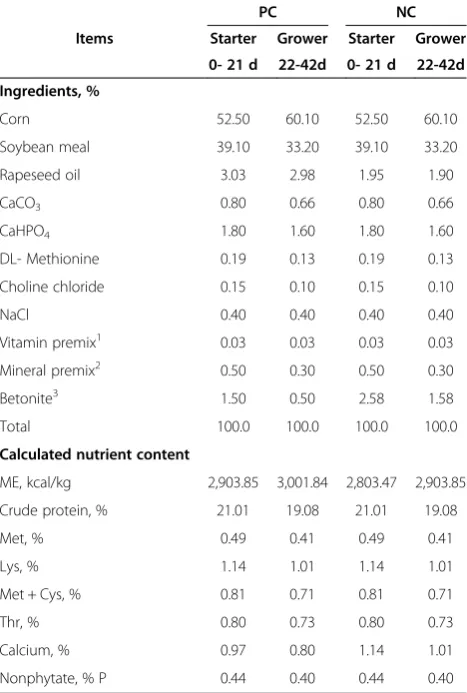
The PC basal diet was corn and SBM type and formu-lated to meet the nutrient recommendation according to Feeding Standard of Chicken of the People’s Republic of
China (NY/T 33–2004), and the compositions were
showed in Table 2. The doses of the three exogenous
en-zymes followed the enzyme provider’s recommendation.
The NC diet dietary energy was reduced by decreasing rapeseed oil level. All diets were steam pelleted with a conditioning temperature below 75°C with pellet sizes of 1.3 mm and 2.3 mm respectively for starter and grower.
Observations
Growth performance
The broilers were weighed by pens at 0, 21, and 42 d of age, feed consumption for each pen was recorded by starter (0-21d) or grower (22-42d) phase. The average body weight (BW), body weight gain (BWG), feed intake (FI) and feed to gain ratio (F/G) were recorded at starter, grower and the whole phases (0-42d).
AME and TME measurements
At the end of 42d, 72 healthy broilers (average body weight 2.8 kg) were selected from treatment 1 and di-vided into 9 groups. The broilers were fed individually in metabolism cages with 24-h light and surgically fitted with modified plastic retainer lids for the collection of Table 1 Experimental design and treatments
Treatments Diets
1 NC, negative control with ME reduction 100 kcal/kg
2 NC + 0.02% BM,β-mannanase 140 × 106U/kg
3 NC + 0.01% AG,α-galactosidase 750,000 U/kg
4 NC + 0.05% XG, xylanase 3,000 U/kg andβ-Glucanase 400 U/kg
5 PC, the positive control group with normal ME for broilers
6 PC + 0.02% BM,β-mannanase 140 × 106U/kg 7 PC + 0.01% AG,α-galactosidase 750,000 U/kg
8 PC + 0.05% XG,α-galactosidase 750,000 U/kg
Table 2 Composition and nutrients levels of basal diets
Items
PC NC
Starter Grower Starter Grower
0- 21 d 22-42d 0- 21 d 22-42d
Ingredients, %
Corn 52.50 60.10 52.50 60.10
Soybean meal 39.10 33.20 39.10 33.20
Rapeseed oil 3.03 2.98 1.95 1.90
CaCO3 0.80 0.66 0.80 0.66
CaHPO4 1.80 1.60 1.80 1.60
DL- Methionine 0.19 0.13 0.19 0.13
Choline chloride 0.15 0.10 0.15 0.10
NaCl 0.40 0.40 0.40 0.40
Vitamin premix1 0.03 0.03 0.03 0.03
Mineral premix2 0.50 0.30 0.50 0.30
Betonite3 1.50 0.50 2.58 1.58
Total 100.0 100.0 100.0 100.0
Calculated nutrient content
ME, kcal/kg 2,903.85 3,001.84 2,803.47 2,903.85
Crude protein, % 21.01 19.08 21.01 19.08
Met, % 0.49 0.41 0.49 0.41
Lys, % 1.14 1.01 1.14 1.01
Met + Cys, % 0.81 0.71 0.81 0.71
Thr, % 0.80 0.73 0.80 0.73
Calcium, % 0.97 0.80 1.14 1.01
Nonphytate, % P 0.44 0.40 0.44 0.40
1
Provided per kg of diet: vitamin A, 4 × 10⁷
IU; vitamin D3, 1 × 10⁷IU; vitamin
E, 25,000 IU; vitamin K3, 5,000 mg; thiamin, 2,000 mg; riboflavin,16,000 mg;
vitamin B6, 6,000 mg; vitamin B12, 30 mg; folic acid, 500 mg; niacin, 35,000 mg;
Ca-D-panthothenate, 25,000 mg.
2
Provided per kg of diet: Fe(FeSO4.H2O),100 mg; Cu(CuSO4.5H2O);8 mg; Mn
(MnSO4.H2O),120 mg; Zn (ZnSO4.H2O),100 mg; Se (Na2SeO3), 0.3 mg;
I (KI), 0.7 mg.
3
feces. After a 48-h fasting, the broilers of 8 groups were force-fed by 50 g respective diets. Total excreta were collected for the following 48 h. The other group broilers were continue to fast for 48 h to collect the ex-creta as the endogenous nutrient loss. During the collec-tion period, broilers were given free access to water. Excreta were weighed and frozen at−20°C until analysis. The samples of feed and excreta were analyzed for dry matter (DM) and gross energy (GE). The gross energy was measures with bomb calorimeter. The apparent and true metabolizable energy values (AME and TME) of the diets were calculated by the method described by Sibbald [9].
AME¼ðEIEOÞ=FI TME¼AMEþðEEL=FIÞ
where EI is the gross energy intake. EO is the gross en-ergy in excreta. EEL is the endogenous enen-ergy loss.
Digestive physiology
At 21 and 42 day of age, one broiler with an average weight per replicate was selected and killed by cervical dislocation. The anterior intestine (duodenum, the U-shaped bending from gizzard to jejunum) and ileum (from Meckel’s diver-ticulum to the cecal junction) of each broiler were col-lected. Then 2.0 cm-long samples from duodenum and ileum were taken to measure the villus length and crypt depth, and the villus length to crypt depth ratio (V/C) was calculated by the method of Lei [10]. Villus length and crypt depth were measured using software for image ana-lysis (Image-Pro Plus 6.0).
One broiler per replicate was chosen and fed for 2 h. After 4 h feeding, the intestinal contents of the
duode-num plus jejuduode-num were collected and stored at −20°C
for analysis of trypsin, chymotrypsin, lipase, and amylase activities according to the method of detection kit instructions from Nanjing Jiancheng Bioengineering Institute [10].
Statistical analyses
Data were analyzed by multivariate ANOVA of SPSS 16.0 for Windows (SPSS Inc., Chicago, IL). The model included diet (PC and NC), different enzymes as the main effects. Variable means for treatments showing significant differ-ences in the ANOVA were separated by Duncan test. In all analyses, significance was declared atP≤0.05.
Results
Growth performance
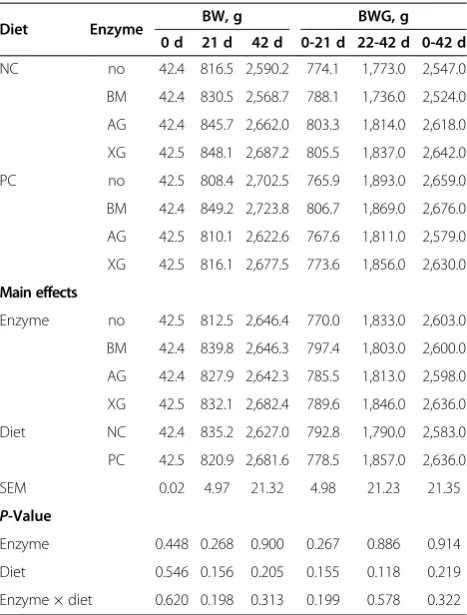
Results of growth performance were presented in Tables 3 and 4. There was no significant difference on BW, BWG, and FI at 0-21d, 22-42d or 0-42d for diet, enzymes or their interaction, but the FI at 22-42d and
0-42d were tended to be decreased with the addition of enzymes. The F/G was significantly influenced by the addition of enzymes, diet (except at 0-21d), or their interaction (except at 0-21d) (P< 0.05). Compared to PC diet, the NC diet significantly increased the F/G at 22-42d and 0-22-42d (P< 0.05). The addition of BM (except at 22-42d), or AG, or XG significantly decreased the F/G at
0-21d, 22-42d and 0-42d (P< 0.05). Compared to the
NC diet, addition of BM, AG or XG in NC diet signifi-cantly improved F/G by 6.1%, 5.4%, and 6.7%
respect-ively (P <0.05) at 0-21d and by 6.3%, 8.1% and 8.5%
respectively (P <0.05) at 22-42d. Compared to the PC diet, addition of BM in PC diet significantly improved F/G by 4.9% at 0-21d (P<0.05).
TME results
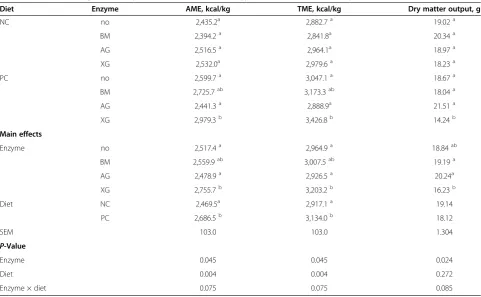
Result for AME, TME, and dry matter output were presented in Table 5. The dietary AME and TME were influenced significantly by the diet or the addition of en-zymes (P <0.05). NC diet had significantly lower AME
(−8.1%) or TME (−6.9%) than PC diet (P <0.05). The
addition of XG significantly increased the AME (+3.9% in Table 3 Effects of exogenous enzymes and diet on the BW and BWG of broilers
Diet Enzyme BW, g BWG, g
0 d 21 d 42 d 0-21 d 22-42 d 0-42 d
NC no 42.4 816.5 2,590.2 774.1 1,773.0 2,547.0
BM 42.4 830.5 2,568.7 788.1 1,736.0 2,524.0
AG 42.4 845.7 2,662.0 803.3 1,814.0 2,618.0
XG 42.5 848.1 2,687.2 805.5 1,837.0 2,642.0
PC no 42.5 808.4 2,702.5 765.9 1,893.0 2,659.0
BM 42.4 849.2 2,723.8 806.7 1,869.0 2,676.0
AG 42.5 810.1 2,622.6 767.6 1,811.0 2,579.0
XG 42.5 816.1 2,677.5 773.6 1,856.0 2,630.0
Main effects
Enzyme no 42.5 812.5 2,646.4 770.0 1,833.0 2,603.0
BM 42.4 839.8 2,646.3 797.4 1,803.0 2,600.0
AG 42.4 827.9 2,642.3 785.5 1,813.0 2,598.0
XG 42.5 832.1 2,682.4 789.6 1,846.0 2,636.0
Diet NC 42.4 835.2 2,627.0 792.8 1,790.0 2,583.0
PC 42.5 820.9 2,681.6 778.5 1,857.0 2,636.0
SEM 0.02 4.97 21.32 4.98 21.23 21.35
P-Value
Enzyme 0.448 0.268 0.900 0.267 0.886 0.914
Diet 0.546 0.156 0.205 0.155 0.118 0.219
Enzyme × diet 0.620 0.198 0.313 0.199 0.578 0.322
Table 4 Effects of exogenous enzymes and diet on the FI and F/G of broilers
Diet Enzyme FI, g F/G
0-21d 22-42d 0-42d 0-21d 22-42d 0-42d
NC no 1,258.9b 3,975.0b 5,431.0b 1.632c 2.239c 2.013c
BM 1,206.0a 3,596.0a 4,750.0a 1.532ab 2.081b 1.886b
AG 1,238.6ab 3,651.0ab 4,838.0ab 1.543ab 2.014ab 1.849ab
XG 1,223.8ab 3,685.0ab 4,858.0ab 1.520a 2.016ab 1.842ab
PC no 1,220.3ab 3,756.0ab 4,926.0ab 1.597bc 1.990ab 1.856ab
BM 1,221.9ab 3,709.0ab 4,875.0ab 1.518a 1.990ab 1.821ab
AG 1,218.8ab 3,625.0ab 4,790.0a 1.590abc 2.013ab 1.862ab
XG 1,223.5ab 3,531.0a 4,717.0a 1.586abc 1.904a 1.796a
Main effects
Enzyme no 1,239.6 3,866.0b 5,028.0b 1.615b 2.115b 1.934B
BM 1,213.9 3,652.0ab 4,813.0ab 1.525a 2.035ab 1.853A
AG 1,228.7 3,638.0ab 4,814.0ab 1.566a 2.014a 1.856A
XG 1,223.7 3,608.0a 4,788.0a 1.553a 1.960a 1.819A
Diet NC 1,231.8 3,727.0 4,894.0 1.557 2.088A 1.897A
PC 1,221.1 3,655.0 4,827.0 1.573 1.975B 1.833B
SEM 5.14 38.84 37.59 0.008 0.014 0.009
P-Value
Enzyme 0.365 0.084 0.091 0.002 0.003 <0.001
Diet 0.302 0.357 0.372 0.331 <0.001 0.001
Enzyme × diet 0.275 0.451 0.440 0.097 0.027 0.013
Table 5 Effects of exogenous enzymes and diet on the energy utilization of diet (air dry basis)
Diet Enzyme AME, kcal/kg TME, kcal/kg Dry matter output, g
NC no 2,435.2a 2,882.7a 19.02a
BM 2,394.2a 2,841.8a 20.34a
AG 2,516.5a 2,964.1a 18.97a
XG 2,532.0a 2,979.6a 18.23a
PC no 2,599.7a 3,047.1a 18.67a
BM 2,725.7ab 3,173.3ab 18.04a
AG 2,441.3a 2,888.9a 21.51a
XG 2,979.3b 3,426.8b 14.24b
Main effects
Enzyme no 2,517.4a 2,964.9a 18.84ab
BM 2,559.9ab 3,007.5ab 19.19a
AG 2,478.9a 2,926.5a 20.24a
XG 2,755.7b 3,203.2b 16.23b
Diet NC 2,469.5a 2,917.1a 19.14
PC 2,686.5b 3,134.0b 18.12
SEM 103.0 103.0 1.304
P-Value
Enzyme 0.045 0.045 0.024
Diet 0.004 0.004 0.272
NC diet, +14.6% in PC diet,P<0.05), and TME (+3.3% in NC diet, +12.5% in PC diet, P<0.05), while the addition of AG significantly increased AME and TME in NC diet but significantly decreased the AME and TME in PC diet (P <0.05). The addition of XG in PC diet significantly decreased the dry matter output (P<0.05).
Intestine morphology
Results for duodenum morphology were shown in Table 6. The crypt depth was significantly decreased by the addition of enzymes in the PC diet (−7.9%) at 21d, and decreased with the addition of AG in the PC diet at 21 d (−16.6%) (P <0.05). The V/C was significantly in-creased by PC diet (+9.7%) at 21 d, and the addition of AG increased V/C (+19.3%) (P<0.05) at 21d.
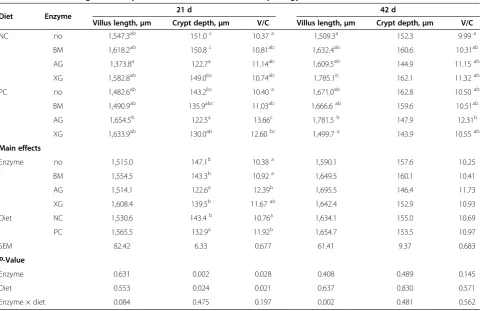
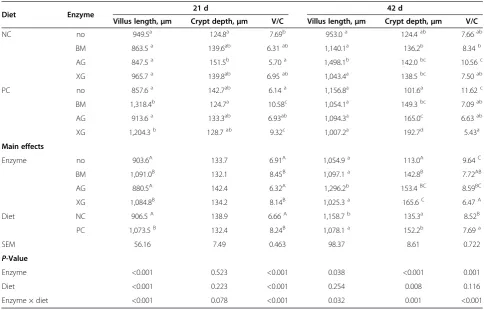
The data of effect of the dietary treatments on ileum morphology were shown in Table 7. The villus length, crypt depth (except at 21d) and V/C were significantly influenced by the addition of enzymes, diets (except the villus length at 42d) or their interactions (P <0.05). At 21d, the villus length was significantly increased by 53.7% and 40.4% with the addition of BM and XG in PC diet and the V/C was significantly increased by 72.3% and 51.8% with the addition of BM and XG. NC diet significantly de-creased the villus length by 15.5% at 21d, but inde-creased the V/C by 22.4% at 42d (P <0.05). The crypt depth was
significantly increased by the addition of enzymes in PC diet and by PC diet at 42d. The addition of BM and XG significantly decreased the V/C in PC diet, while signifi-cantly increased by AG at 42d (P<0.05).
Digestive enzyme activities
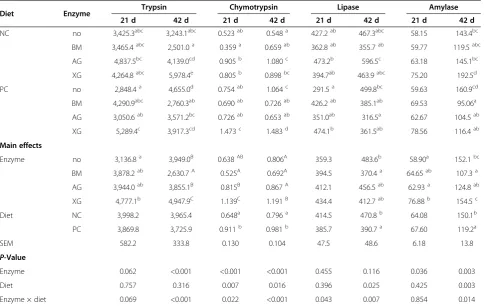
The data of effect of the dietary treatments on digestive enzyme activities in small intestine were shown in Table 8. At 42d, the trypsin activity was significantly increased by AG or XG in NC diet, and decreased by BM in NC and PC diet (P<0.05). The addition of XG in PC diet signifi-cantly increased the trypsin activity at 21d (P<0.05). The chymotrypsin activity was significantly decreased by NC
diet, and increased by XG in PC diet (P <0.05). And
addition with AG in NC diet increased the chymotrypsin activity at 42d (P<0.05). At 42d, the lipase activity was sig-nificantly increased by NC diet (P<0.05). The addition of enzymes in PC diet tended to increase lipase activity at 21d, significantly for XG in PC diet (P<0.05). At 42d, the amylase activity was significantly decreased by PC diet and increased by XG in NC diet (P <0.05). The amylase activity at 21d was significantly increased by XG (P<0.05).
Economic profit
Results for economic profit were presented in Table 9. Comparing with PC group (as 100%), the addition of
Table 6 Effects of exogenous enzymes and diet on duodenum morphology in broilers
Diet Enzyme 21 d 42 d
Villus length,μm Crypt depth,μm V/C Villus length,μm Crypt depth,μm V/C
NC no 1,547.3ab 151.0c 10.37a 1,509.3a 152.3 9.99a
BM 1,618.2ab 150.8c 10.81ab 1,632.4ab 160.6 10.31ab
AG 1,373.8a 122.7a 11.14ab 1,609.5ab 144.9 11.15ab
XG 1,582.8ab 149.0bc 10.74ab 1,785.1b 162.1 11.32ab
PC no 1,482.6ab 143.2bc 10.40a 1,671.0ab 162.8 10.50ab
BM 1,490.9ab 135.9abc 11.03ab 1,666.6ab 159.6 10.51ab
AG 1,654.5b 122.5a 13.66c 1,781.5b 147.9 12.31b
XG 1,633.9ab 130.0ab 12.60bc 1,499.7a 143.9 10.55ab
Main effects
Enzyme no 1,515.0 147.1b 10.38a 1,590.1 157.6 10.25
BM 1,554.5 143.3b 10.92a 1,649.5 160.1 10.41
AG 1,514.1 122.6a 12.39b 1,695.5 146.4 11.73
XG 1,608.4 139.5b 11.67ab 1,642.4 152.9 10.93
Diet NC 1,530.6 143.4b 10.76a 1,634.1 155.0 10.69
PC 1,565.5 132.9a 11.92b 1,654.7 153.5 10.97
SEM 82.42 6.33 0.677 61.41 9.37 0.683
P-Value
Enzyme 0.631 0.002 0.028 0.408 0.489 0.145
Diet 0.553 0.024 0.021 0.637 0.830 0.571
BM, AG and XG in NC or PC diet decreased the feed cost per kg BWG by 6.1%, 6.5%, 6.8% or 3.1%, 2.7%, 7.5%, while increased the profits (except AG in PC diets) by 0.4%, 7.8%, 9.8% or 3.8%, 3.7%, 5.9%, with the highest profits for XG especially in NC diet.
Discussion
Studies have well documented that the addition of exogenous enzymes in corn-SBM diet improved broil-ers performance and nutrient utilization [11,12]. Daskiran demonstrated that the addition of 0.05%, 0.10% and 0.15%
Hemicell, whose active ingredient was β-mannanase, in
corn-SBM diet improved F/G by 2.8% and 5.7% at 0-2wk [13]. Zou reported that the supplementation with 0.025%, 0.05% and 0.075% Hemicell in a corn-SBM diet improved (P <0.05) weight gain respectively by 3.52%, 5.06% and 5.39% at 22-42d and by 2.86%, 4.64% and 3.18% at 0-42d, F/G for the 0.025% and 0.05% groups was significantly better than the control group at 22-42d (3.72% and 4.96%) and 0-42d (2.14% and 5.07%)[14]. Kidd reported that the addition of 112 g/t enzyme preparation, the active ingredi-ent wasα-galactosidase, in corn-SBM diet decreased F/G by 8.4% at 0–7 wk [15], while the addition of 115 g/t de-creased F/G by 2.2% at 0–7 wk [16]. In present study, the addition of BM or AG improved F/G at 0-21d (by 6.1% and 5.4%), 22-42d (by 7.1% and 10.0%) and 0-42d (by 6.3%
and 8.1%) in NC diet but not in PC diet (except for BM at 0-21d). It was not consistent with the previous study in BW or BWG.
Additionally, F/G of broilers fed NC diet with the addition of enzymes was similar to the PC diet with no significant difference. This was consistent with the study of Wu [17], who demonstrated that feed conversion of hens fed the low-energy diet based on corn-SBM diet
supplemented with β-mannanase was similar to that of
hens fed the high-energy diet. In our study, the effect of XG on F/G was lower than that of BM and AG, especially in NC diet or at 22-42d, which was related to the different composition of enzymes. It has been proved
that the effect of xylanase and β-glucanase (the main
ingredient of XG) in corn-SBM diet was additive [18]. Corn-SBM diet contains high level of starch (in corn) and nonstarch polysaccharides (in soybean meal), which are po-tentially antagonistic to nutrient utilization and negatively affect the growth performance. Therefore, supplementing
in corn-SBM diet with xylanase and β-glucanase can
hydrolyze the ploysaccharides and unlock the encapsulated starch molecules, and potentially improve the utilization of corn-SBM diet, while simultaneously improving the digest-ibility of nutrients, resulting in the conservation of en-dogenous utilizable nutrients and energy that cannot be otherwise used for protein accretion of broilers. And Table 7 Effects of exogenous enzymes and diet on ileum morphology in broilers
Diet Enzyme 21 d 42 d
Villus length,μm Crypt depth,μm V/C Villus length,μm Crypt depth,μm V/C
NC no 949.5a 124.8a 7.69b 953.0a 124.4ab 7.66ab
BM 863.5a 139.6ab 6.31ab 1,140.1a 136.2b 8.34b
AG 847.5a 151.5b 5.70a 1,498.1b 142.0bc 10.56c
XG 965.7a 139.8ab 6.95ab 1,043.4a 138.5bc 7.50ab
PC no 857.6a 142.7ab 6.14a 1,156.8a 101.6a 11.62c
BM 1,318.4b 124.7a 10.58c 1,054.1a 149.3bc 7.09ab
AG 913.6a 133.3ab 6.93ab 1,094.3a 165.0c 6.63ab
XG 1,204.3b 128.7ab 9.32c 1,007.2a 192.7d 5.43a
Main effects
Enzyme no 903.6A 133.7 6.91A 1,054.9a 113.0A 9.64C
BM 1,091.0B 132.1 8.45B 1,097.1a 142.8B 7.72AB
AG 880.5A 142.4 6.32A 1,296.2b 153.4BC 8.59BC
XG 1,084.8B 134.2 8.14B 1,025.3a 165.6C 6.47A
Diet NC 906.5A 138.9 6.66A 1,158.7b 135.3a 8.52B
PC 1,073.5B 132.4 8.24B 1,078.1a 152.2b 7.69a
SEM 56.16 7.49 0.463 98.37 8.61 0.722
P-Value
Enzyme <0.001 0.523 <0.001 0.038 <0.001 0.001
Diet <0.001 0.223 <0.001 0.254 0.008 0.116
researchers have demonstrated that the broiler diets based on corn-SBM supplemented with xylanase and
β-glucanase was able to compensate for some reduction
in dietary ME content without compromising feed conver-sions [19-21].
Similar to F/G, the addition of XG in NC and PC diet significantly (P <0.05) increased the dietary AME, TME, and decreased dry matter output. Our study demonstrated that XG improved the energy utilization, and resulted in
more energy available for broilers’ growth. The results were also similar to other studies, which showed that the addition of xylanase and β-glucanase improved nutrient digestibility and growth performance in ducks and chick-ens fed corn-SBM diet [22,23]. The addition of AG in NC diet significantly increased AME, TME, and improved F/G, but AME, TME were decreased in PC diet. AME and TME determinations were made of soybeans varying in oligosaccharide content due to ethanol extraction or from
Table 9 Economic efficiency of the broilers (1,000 broilers)
Diet Enzyme
0—42 d broilers profits
FI, kg F/G Feed cost 1U. S.dollar
Feed cost/BWG U.S. dollar/kg
Compered with PC,%
BWG, kg
Income2U.S. dollar
Profits3U.S. dollar
Compared with PC,%
NC
no 5,431.0 2.01 2,504.0 0.50 108.7 2,547.0 3,540.9 1,036.9 85.9
BM 4,750.0 1.89 2,297.3 0.43 93.7 2,524.0 3,508.9 1,211.6 100.4
AG 4,838.0 1.85 2,339.1 0.43 93.4 2,618.0 3,639.6 1,300.5 107.8
XG 4,858.0 1.84 2,347.8 0.43 93.3 2,642.0 3,672.9 1,325.2 109.8
PC
no 4,926.0 1.86 2,490.1 0.46 100.0 2,659.0 3,696.6 1,206.4 100.0
BM 4,875.0 1.82 2,467.4 0.45 97.0 2,676.0 3,720.2 1,252.8 103.8
AG 4,790.0 1.86 2,423.7 0.45 97.3 2,579.0 3,585.3 1,161.6 96.3
XG 4,717.0 1.80 2,379.0 0.43 92.5 2,630.0 3,656.2 1,277.2 105.9
1
Cost of enzymes was not included.
2
Price of broilers was 1.39U.S. dollars/kg in the market.
3
Profits = income- cost of feed consumption.
Table 8 Effects of exogenous enzymes and diet on digestive enzyme activities in small intestinum of broilers,U/mg
Diet Enzyme Trypsin Chymotrypsin Lipase Amylase
21 d 42 d 21 d 42 d 21 d 42 d 21 d 42 d
NC no 3,425.3abc 3,243.1abc 0.523ab 0.548a 427.2ab 467.3abc 58.15 143.4bc
BM 3,465.4abc 2,501.0a 0.359a 0.659ab 362.8ab 355.7ab 59.77 119.5abc
AG 4,837.5bc 4,139.0cd 0.905b 1.080c 473.2b 596.5c 63.18 145.1bc
XG 4,264.8abc 5,978.4e 0.805b 0.898bc 394.7ab 463.9abc 75.20 192.5d
PC no 2,848.4a 4,655.0d 0.754ab 1.064c 291.5a 499.8bc 59.63 160.9cd
BM 4,290.9abc 2,760.3ab 0.690ab 0.726ab 426.2ab 385.1ab 69.53 95.06a
AG 3,050.6ab 3,571.2bc 0.726ab 0.653ab 351.0ab 316.5a 62.67 104.5ab
XG 5,289.4c 3,917.3cd 1.473c 1.483d 474.1b 361.5ab 78.56 116.4ab
Main effects
Enzyme no 3,136.8a 3,949.0B 0.638AB 0.806A 359.3 483.6b 58.90a 152.1bc
BM 3,878.2ab 2,630.7A 0.525A 0.692A 394.5 370.4a 64.65ab 107.3a
AG 3,944.0ab 3,855.1B 0.815B 0.867A 412.1 456.5ab 62.93a 124.8ab
XG 4,777.1b 4,947.9C 1.139C 1.191B 434.4 412.7ab 76.88b 154.5c
Diet NC 3,998.2 3,965.4 0.648a 0.796a 414.5 470.8b 64.08 150.1b
PC 3,869.8 3,725.9 0.911b 0.981b 385.7 390.7a 67.60 119.2a
SEM 582.2 333.8 0.130 0.104 47.5 48.6 6.18 13.8
P-Value
Enzyme 0.062 <0.001 <0.001 <0.001 0.455 0.116 0.036 0.003
Diet 0.757 0.316 0.007 0.016 0.396 0.025 0.425 0.003
genetic selection generally, indicating that the chicks in PC group added with AG do not use these fractions well. The addition of BM decreased F/G, but showed no influ-ence on AME and TME, which indicated that the growth performance of broilers was affected not only by nutrient utilization, but also by the immunization or health of di-gestive tract [24].
Mehri added 0.09% β-mannase in corn-SBM diet and
found that β-mannase improved villus length, V/C, and
broilers growth performance [25]. The results of present study showed that the addition of XG improved villus length, V/C (at 21d) and crypt depth (at 42d) of ileum, while BM improved villus length and V/C of ileum at 21 d, and AG improved V/C of duodenum at 21d, villus length, crypt depth and V/C of ileum at 42d. This find-ing was consistent with the previous studies [26]. These results provided the evidence for the improvement of diet energy utilization and F/G.
The other effect of exogenous enzymes on broiler per-formance may be explained by increasing the output of pancreatic juice and endogenous digestive enzyme
activ-ities. The NSP, such as β-glucanase and cellulase in
corn-SBM diet increased the intestinal viscosity and negatively influences the digestion and absorption of nu-trients. Wang added NSP degrading enzymes (including xylanase,β-glucanase and cellulase) in rough rice-based pig diets and showed that the activities of protease, tryp-sin and amylase in duodenal content were significantly increased, and the average daily gain and F/G were (P <0.05) significantly improved [27]. Engberg reported that with the addition of xylanase in broiler barely-based diet the chymotrypsin and lipase activities in pancreas were increased and feed conversion was also improved (P <0.001) [28]. In our study, the addition of XG im-proved the activities of trypsin, chymotrypsin and amyl-ase at 21d and 42d, while BM improved the activity of trypsin at 21d, but decreased at 42d, and AG improved the activity of chymotrypsin at 21d. The improvement of trypsin and chymotrypsin implied that the amount of protein available for digestion was increased by exogen-ous enzymes supplementation, and the digestibility of carbohydrate and amylum in the diet was also improved by XG, but lipase activity was not improved (except for AG in NC diet and XG in PC diet at 21d) in our study, which demonstrated that the addition BM showed few effect on the utilization of lipid in the diet, which was consistent with the result of AME and TME. Addition-ally, our study suggested that the exogenous enzymes showed more effects on the activities of endogenous di-gestible enzyme at 21d than that at 42d, which implied that the exogenous enzymes probably made up some de-ficiency of endogenous enzyme in the starter period. The present study demonstrated that XG decreased the feed cost per kg body weight gain, increased the profits
in PC or NC diet. Furthermore, the addition of XG de-creased the output of excrement, which plays an import-ant role in the environmental protection.
In conclusion, supplementation of 0.02% BM or 0.01% AG or 0.05% XG could improve broiler diet feed conver-sion in corn-soybean meal diet by improving energy utilization and digestive physiology, and also supplemen-tation of 0.05% XG had a preferable efficacy in low energy diet.
Competing interests
The authors declared that they have no competing interests.
Authors’contributions
ZZ and Z conceived the study; ZZ, Z, D and B designed the study; Z raise the animals and carried out the lab analysis; Z, Z, Z, D and B contributed to data analysis; Z and Z wrote the manuscript. All authors read and approved the manuscript.
Acknowledgments
We are grateful for financial support and enzymes provision from Nutreco Nederland B.V., and financial support by the specific research support program for the Academic Sustentation Research Team at Sichuan Agricultural University (Sichuan, P. R. China).
Received: 7 December 2012 Accepted: 25 March 2013 Published: 4 April 2013
References
1. Malathi V, Devegowda G:In vitro evaluation of nonstarch polysaccharide digestibility of feed ingredients by enzymes.Poult Sci2001,80(3):302–305. 2. Aman P, Graham H:Chemical evaluation of polysaccharides in nimal feeds.
Feedstuff Evaluation.Cambridge, UK: University Press; 1990:161–177. 3. Yang Z, Yang W, Jiang S:Effects of a thermotolerant multi-enzyme
product on nutrient and energy utilization of broilers fed mash or crumbled corn-soybean meal diets.J Appl Poultry Res2010,19(1):38–45. 4. Kong C, Lee J, Adeola O:Supplementation ofβ-mannanase to starter and
grower diets for broilers.Can J Anim Sci2011,91(3):389–397. 5. Irish GG, Barbour GW, Bedford MR:Removal of theα-galactosidase of
sucrose from soybean meal using either ethanol extraction or exogenousα-galactosidase and broiler performance.Poult Sci1995, 74:1484–1494.
6. Knap I, Ohmann A, Dale N:Improved bioavailability of energy and growth performance from addingalpha-galactosidase (from Aspergillus sp.) to soybean meal-based diets. InProc. Aust. Poultry. Sci.Sydney. Australia:; 1996:153–156.
7. Owusu-Asiedu A, Simmins P, Brufau J:Effect of xylanase andbeta -glucanase on growth performance and nutrient digestibility in piglets fed wheat-barley-based diets.Livest Sci2010,134(1–3):76–78. 8. Cowieson A, Bedford M, Ravindran V:Interactions between xylanase and
glucanase in maize-soy-based diets for broilers.Br Poultry Sci2010,51(2): 246–257.
9. Sibbald I:The true metabolizable energy values of several feedingstuffs measured with roosters, laying hens, turkeys and broiler hens.Poult Sci 1976,55(4):1459–1463.
10. Lei Y:Effects of Probiotics on Performance, Intestinal Physiology and the Microflora in the Intestine of Broilers. MHA Diss.Ya'an, Sichuan, China: Sichuan Agricultural University; 2009.
11. Wang C, Li W:Effect ofα-galactosidase on nutrient utilization, growth performance, serum parameters and weight of organs in broilers fed with corn-soybean meal.The Ninth International Conference Proceedings in Animal Nutrition Clubs of Animal in China Husbandry and Veterinary Association; 2004.
13. Daskiran M, Teeter R, Fodge D:An evaluation ofendo-β-mannanase(BM) effects on broiler performance and energy use in diets varying in β-mannan content.Poult Sci2004,83:662–668.
14. Zou XT, Qiao XJ, Xu ZR:Effect ofβ-Mannanase (BM) on Growth Performance and Immunity of Broilers.Poult Sci2006,85:2176–2179. 15. Kidd M, Morgan G, Fontana E:Enzyme supplementation to corn and
soybean meal diets for broilers.J Appl Poultry Res2001,10(1):65. 16. Kidd M, Morgan JG, Fontana E:Alpha-Galactosidase enzyme
supplementation to corn and soybean meal broiler diets.J Appl Poultry Res2001,2(10):186.
17. Wu G, Bryant M, Roland D Sr:Effects ofbeta-mannanase in corn-soy diets on commercial leghorns in second-cycle hens.Poult Sci2005,84(6):894. 18. Novus web:. http://www.chinafeed.org.cn/want/nuoweisi/09-CSM.html.
Accessed on October 11, 2011.
19. Bi Y, Chung T:Effects of multiple-enzyme mixtures on growth performance of broilers fed corn-soybean meal diets.J Appl Poultry Res 2004,13(2):178.
20. Lázaro R, Latorre M, Medel P, Gracia M:Feeding regimen and enzyme supplementation to rye-based diets for broilers.Poult Sci2004,83(2): 152–160.
21. Meng X, Slominski B, Nyachoti C:Degradation of cell wall polysaccharides by combinations of carbohydrase enzymes and their effect on nutrient utilization and broiler chicken performance.Poult Sci2005,84(1):37. 22. Hong D, Burrows H, Adeola O:Addition of enzyme to starter and grower
diets for ducks.Poult Sci2002,81(12):1842.
23. Zhang L:Effect of xylanase on performance and blood parameters of broilers based on a corn-soybean meal diet. MHA Diss.Yangling, Shanxi, China: Northwest A&F University; 2010.
24. Gao F, Jiang Y, Zhou G:The effects of xylanase supplementation on performance, characteristics of the gastrointestinal tract, blood parameters and gut microflora in broilers fed on wheat-based diets. Anim Feed Sci Technol2008,142(1):173–184.
25. Mehri M, Adibmoradi M, Samie A:Effects ofβ-Mannanase on broiler performance, gut morphology and immune system.Afr J Biotechnol2010, 9(37):6221–6228.
26. Wang Z, Qiao S, Li D:Effects of enzyme supplementation on performance, nutrient digestibility, gastrointestinal morphology, and volatile fatty acid profiles in the hindgut of broilers fed wheat-based diets.Poult Sci2005,84(6):875–881.
27. Wang M, Xu Z, Sun J:Effects of enzyme supplementation on growth, intestinal content viscosity, and digestive enzyme activities in growing pigs fed rough rice-based diet.Asian Austral J Anim2008,21(2):270. 28. Engberg RM, Hedemann MS, Steenfeldt S:Influence of whole wheat and
xylanase on broiler performance and microbial composition and activity in the digestive tract.Poult Sci2004,83(6):925–938.
doi:10.1186/2049-1891-4-14
Cite this article as:Zouet al.:Effects of exogenous enzymes and dietary energy on performance and digestive physiology of broilers.Journal of Animal Science and Biotechnology20134:14.
Submit your next manuscript to BioMed Central and take full advantage of:
• Convenient online submission
• Thorough peer review
• No space constraints or color figure charges
• Immediate publication on acceptance
• Inclusion in PubMed, CAS, Scopus and Google Scholar
• Research which is freely available for redistribution