THE IMAGE LEVEL TAINTING: A NEW
APPROACH FOR PREVENTING SQL
INJECTION ATTACKS
AUTHORS UNDER THE GUIDANCE OF:
MR. P. NARESH KUMAR1 MR .YUGANDHAR .G3
Reg no: 09C61D2508, M.TECH (S.E) Asst. Professor, MIST,
Mother Teresa Institute of Science & Technology, Research Scholar, Department of CSE, Sathupally, Khammam DT, GITAM University, Vishakhapatnam,
Andhra Pradesh. Email id: [email protected] Email id: [email protected] Mobile no: 9866688563
Mobile no: 9440575412
MS. N. SOUJANYA2 MR. K.NAGESWARA RAO4
Reg no: 09C61D2512, M.TECH (S.E) Assoc. professor & H.O.D, Mother Teresa Institute of Science & Technology, Department of CSE, MIST, Sathupally, Khammam DT, Sathupally, Khammam DT
Andhra Pradesh. Email id: [email protected] Email id: [email protected] Mobile no: 9866186158.
Mobile no: 9666037429
Abstract:A new approach for protecting Web applications-An Image level Tainting, involves comparing
the SQL statements that includes the images viewed as characters in the user input with the Meta strings library, to prevent them if found any and protecting the web applications against SQL injection is discussed in this paper. This paper includes the strange idea of combining the Indication based method and the Inspection Method. The main problem that occurs with web application security is the SQL Injection, which gives the attackers unauthorized access to the database that contains the Web applications. This leads to the cause of calamities in the Web applications and this is very serious. In Indication based method point of view, it exhibits detection mode for SQL injection using coupled way routing arrangement of amino acid code formulated from web application form parameter sent via the web server. On the other hand from the Inspection based method point of view, it analyzes the transaction to find out the malicious access. In Indication based method it uses an approach called Beschermen algorithm, not only to prevent the SQL Injection attacks, but also reduces the time and space complexity. This system was able to stop all of the successful attacks.
1. INTRODUCTION
The modern web world always expects the organization to concentrate more on providing the security on web application. The Dangerous situation faced by all the organizations is to protect their most valuable data against malicious access, Interrupts and corruptions, i.e. the Attacks. The developers of the programs will have to show their keen interest in developing the applications with usability than combining the security policy rules. The major security issue is an Input validation issue, if an attacker finds that an application makes unfounded assumptions about the type, length, format, or range of input data. Then the attacker can furnish a malicious input which compromises an application. The public interfaces exposed by an application become the only source of attack, when a network and host level entry points are fully secured. The SQL Injections attacks, Buffer Overflow attacks and cross site scripting attacks, are the major threat in the web application security through this input validation security issues [11]. The SQL Injection attacks breach the database mechanism such as Integration, Authentication, Availability and authorization [8]. There are many number of total cyber vulnerabilities in the Web world which are input validation vulnerabilities.
Since 2002, nearly 20% of the input validation issues are SQL Injection vulnerabilities (SQLIV’s) and therefore, 10% of total cyber vulnerabilities. SQL injection attacks involve placing SQL statements in the user input for corrupting or accessing the Database [11]. Even the SQL Injection attacks can bypass the security mechanism such as Firewall, cryptography and traditional Intrusion detection systems. If the trend of providing web-based services continues, the prevalence of SQLIV’s is likely to increase. The most worrying aspect of SQL Injection attacks is-Easy to perform, even if the developers of the application are well known about this type of attacks. The basic idea behind in this attack is that the attacker will copy the data that a web application sends to the database aiming at the modification of SQL Query that will be executed by DBMS software. Input validation issues can allow the attackers to gain complete access to such databases.
The Technologies vulnerable to SQL Injection attacks are Dynamic Scripting Languages like ASP, ASP.net, PHP, JSP, CGI etc. In addition, all types of database have been severely vulnerable in such type of SQL Injection Attacks. Researchers have proposed a different techniques to provide a solution for SQLIAs (SQL Injection attacks), but many of these solutions have limitations that affect their effectiveness and practicality. Researchers have indicated that solution to these types of attacks may be based on defense coding practices. But it's not efficient because of three reasons. First, it is very hard to bring out a rigorous defensive coding discipline. Second, many solutions based on defensive coding address only a subset of the possible attacks. Third, legacy software poses a particularly difficult problem because of the cost and complexity of retrofitting existing code so that it is compliant with defensive coding practices. In this work, an attempt has been made to increase the efficiency of the above techniques by a combinatorial approach for protecting web application against SQL Injection attacks.
The remainder of the paper is organized as follows: Section 2 contains background and related work; Section 3 describes our proposed approach. Section 4 describes the conclusion and future work.
II. BACKGROUND AND RELATED WORK
SQL injection is one of the main issues in database security. It easily affects the database without the knowledge of the database administrator and the user. It is a technique that may corrupt the information in the database i.e. deletes or changes the full database or records or tables. To exploit the database system, some vulnerable web applications [9] are used by the attackers.
These attacks not only make the attacker to breach the security and steal the entire content of the database but also, to make arbitrary changes to both the database schema and the contents. SQL injection attack could not be realized about information compromization until long after the attack has passed in many scenarios, the victims are unaware that their confidential data has been stolen or compromised. SQL Injection attacks can be performed by attackers [12] just with the help of simple web browser. The following section describes the attacks with an example.
Generally the Authenticated users have username and password such as, Username: rahul
Password: 123
The SQL Query format will be as follows,
The above query then retrieves the needed records from the database where username and pwd is available in the database or it shows some error messages to the browsers. The unauthorized users or the attackers inject the following SQL Injection in this field:
Username: r hul Password: 123
Then the dynamic SQL query constructed from the above information is, Select * from table where username=' r hul ' and pwd=123;
In this SQL statement, the actual username is ‘rahul’ which is modified as ' r hul’ by the attackers while generating the Query. This includes the image of ‘a’ in place of the character ‘a’. The attacker will now have the capability of attacking the database by writing the injection code at the inside location of the image (just as-image processing). Here the username is visible as the set of characters so that even by using the character level tainting, it will consider this query as the character and performs the operation. When the image is taken to compare with the string in the Meta Strings library, due to the unavailability of information about the images, the Meta strings library doesn’t consider it as a malicious code and accepts the string. Hence the Query was sent to the database. The result of this query performs SQL Injection attacks.
A. Authorization diversions (SQL manipulation)
This attack allows the attacker access the total information in the database [15]. The example of this attack is discussed in the above section.
B. Exploiting Insert
The Web Sites like Banking, when registration, it allows the user to feed inputs and store it. INSERT statement allows the user input to store in the back end. The misuse of INSERT statements by the attacker results in many rows in the database with corrupt data.
C. Exploiting SELECT
SQL injection is not only a straight forward attack but also it has some background tricky attack is present. Most of the time attackers would see some error message and will have to reverse engineer their queries.
Direct Vs Informative (SQL manipulation) – Both Direct and informative are the types of SQL Injection attacks in SQL manipulation. In direct attack, the input data become part of the SQL statement formed by the application. Attacker has to add image in place of a character in a way that image is also visible as character which manipulates the SQL statement. The error message has been returned if the injection was successful.
In Informative injection, the injected string has a code at the inside appended to image similar to the statement. In order to manipulate the SQL statement successfully input string must contain an image that is visible as a character and also should contain the malicious code at the inside of the image that attacks the database whenever this image is considered by the database.
D. Exploiting System Stored Procedures (Function call)
Database uses stored procedures to perform database Administrative operations. Attacker uses stored procedures to corrupt the database system and it’s a most harmful attacks. If attacker is able to inject SQL string successfully then attacker can make use of these stored procedures. Access to these procedures depends on the privileges of the user on the database.
SELECT usrid, details, username from user where username like ‘r hul’; to execmaster.dbo.xp_cmdshell "dir. The above injected SQL query will return all the rows from the table containing the details of the username starting with the character ‘r’ as well as execute the operating system command DIR.
The following subsection describes in details about the related works based on SQL Injection Attacks. A number of researches had been taken to provide solutions for SQL Injection Attacks.
which can decide whether it can send the statement to database for execution. 2. Analysis module uses Hirschberg algorithm to compare the statement from the specifications. 3. Specifications comprise the predefined keywords and send it to analyze module for comparisons. It performs well for finding the malicious code if any, by checking the given statement in terms of characters. If it founds any wrong character other than the specified, it just blocks the query and gives the information of the type of the attack.
Wassermann and Su [6], proposed a static framework to analyze and filter the user inputs. According to them, their approach has restricted to discover only logic-based attacks. i.e. Attacks that always result in true or false SQL statements.
Konstantinos et al [3], proposed a mechanism to detect SQL injection with novel-specification based methodology. This approach utilizes specifications that define the intended syntactic structure of SQL queries that are produced and executed by the web application. The main disadvantage of this paper is, to compare the SQL statement with the predefined structure at run time, the computational time is overhead.
Xiang Fu et al [1], propose the design of a static analysis framework (called SAFELI) for identifying SIA (SQL Injection attacks) vulnerabilities at compile time which statically monitors the MSIL (Microsoft Symbolic intermediate language) byte code of an ASP.NET Web application, using symbolic execution. SAFELI can analyze the source code information and will be able to identify very delicate vulnerabilities that can’t be discovered by black-box vulnerability scanners. The disadvantage of this work is that this approach can discover the SQL injection attacks only on Microsoft based product.
Marco Cova et al 19], propose a mechanism to the anomaly-based detection of attacks against web applications. Swaddler analyzes the internal state of a web application and finds the relationships between the application’s critical execution points and the application's internal state. By doing this, he is able to identify attacks that attempt to bring an application in an inconsistent, anomalous state, such as violations of the intended workflow of a web application. The main disadvantage is, as the number of executed basic blocks increases, the overhead grows linearly due to instrumentation and detection overhead associated with each basic block in the program. Buehrer et al[12], proposed a static mechanism that filters the SQL Injection. By comparing the parse tree of a SQL statement before and after input, the SQL statements allow the SQL statements to execute only when the parse trees match. Their study on using one real world web application and their application of SQLGUARD solution to each application has stopped all of the SQLIAs without generating any false positive results, and their solution required the developer to rewrite all of their SQL code to use their custom libraries
Livshits and Lam [21], proposed another static analysis approach for finding the SQL injection using vulnerability pattern approach. Vulnerability patterns are described here in this approach. The main issues of this method, is that it can’t detect the SQL injection attacks patterns that are not known beforehand.
William G.J. Halfond and Alessandro Orso [2], proposed a mechanism to prevent SQL injection at run time. AMNESIA uses a model based approach to detect illegal queries before it sends for execution to database. In its dynamic method, the technique uses run time monitoring method to inspect each and every query which is passed to its techniques. Here the AMNESIA requires the modification of the web application's source code. They also describes the mechanism to keep track of the positive taints and negative taints which had outlined a new automated technique for preventing SQLIAs based on the novel concept of positive tainting and on flexible syntax-aware evaluation. It can check the SQL statement with these taints and will generate the alarm, if it finds any problems. The advantage of this mechanism is it imposes a low execution overhead, and it doesn’t require any modification of the run time system even at application level.
Along with them, many authors have discussed much number of various techniques to prevent SQL Injection attacks through many ways in static and dynamic analysis and also in DBMS auditing methods. But all these methods reported to have a various pros and cons of its own proposal. In this paper, a new attempt has been proposed and worked out against SQL Injection attacks.
III. OUR APPROACH
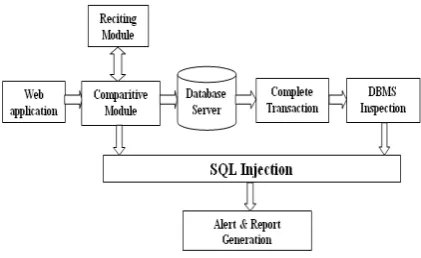
respect to the Reciting module. After the each character in the statement is scrutinized, if it finds any suspicious activity like finding the images in place of characters, it acts as an active agent to stop the transaction and audit the attacks.
Reciting module includes the Meta strings library which comprises the predefined keywords and is updated with new type of information in terms of coordinates of the images, their pixels information, color resolution and the details on type of images (extension files like .jpg etc). If both comparitive module and inspection module has satisfied, it provides the complete transaction. The following figure 1 clearly portrays the architecture of the system to prevent the SQL Injection attacks using this new approach. The following section outlines each module's work in detail.
Figure 1: Image Level tainting approach for Preventing SALIAs
A. Reciting Module
Reciting module includes the Meta strings library which comprises the predefined keywords and is updated with new type of information in terms of coordinates of the images, their pixels information, color resolution and the details on type of images (extension files like .jpg etc).
B. Comparitive Module
In Comparitive module, it gets an input from the web application and it compares the statement with the Meta strings library included in the Reciting Module, if founds any error message it attempts to block the query. It uses the Hirschberg algorithm to analyze the statement into set of characters. It uses Beschermen algorithm for comparison of each character with Meta Strings library and prevent SQL Injection attacks if found. The time complexity of this algorithm is O(nm) and space complexity is O(min(nm)).
Beschermen Algorithm
Beschermen algorithm is generally applicable algorithm for finding an optimal sequence alignment. Let,
The Statement generated from the Web application is =Q
The Character of the Statement is =C, The Meta String Library = M
ThePixel Size of the statement= X
The Original Statement included in the Meta String library= S.
Hence,
The Pixel size of the generated Statement = Q(X),
SQL Injection code
Select * from table where username=' r hul ' and pwd=123;
The algorithm describes the way how we follow the procedure for preventing the SQL Injection Attacks. Here, we had considered the generated query as Q, The Meta Strings Library is M, The Character of the Statement is C, The Pixel size of the statement as X and the Original statement to which the generated statement of web application is to be compared is represented as S. Let i & j be the position values of both the generated and actual statement.
First, we consider the Statement Q from the Web application, and we choose Ci of Q. now the first character of the generated statement is compared with that of the actual statement included in the Meta Strings Library, in terms of their pixel information. If they are matched, i.e. Q(C(X)) = M(S(C(X))), then the character is considered and sent to the database server for the further transactions. This process repeats till the total statement is accepted.
If at any position, when Q(C(X))! = M(S(C(X))), then the character is considered as an image and the total statement should be blocked. Further the Details of the Prevention is to be reported. Comparing to Hirschberg algorithm, this approach is very advanced as it considers the images along with the strings for checking; where as Hirschberg principle is unable to check the images.
D. DBMS INSPECTION
DBMS Inspection enables DBA’s to position the usage of database resources and authority [11]. When inspection is enabled, the DBMS will produce a trail checking of database operations, which in turn the each checked database operation produces a trail of checking the information. It includes the details on what database object was impacted, who & when performed the operation.
Depending on the level of inspections supported by the DBMS, the data that was actually changed was recorded. But it has some limited functionality to predict the attacks. It is very useful to find that what type of operation has been made on prevention of attacks. For example End user is a customer that he can log on to the bank and he can see his personal or his academic record of Transactions and money details. Only option given to the users is to check their information. i.e. (Select operation) Instead of select operation, any deletion or update operation is made; attackers could login in to the system and to do some malicious actions, like transforming the money to their accounts.
So this Inspection method try to block not only SQL Injection attacks and also some other attacks [18]. The restriction of this DBMS Inspection method is to prevent the attackers view some other records, that select operation has been made. It never generates any alarms. Signature based method itself work effectively against SQL Injection attacks well and also this DBMS Inspection also provides an support to this method to work effectively against SQL Injection attacks.
IV. CONCLUSION
This paper presented a highly automated approach for protecting Web applications from SQLIAs. Our approach consists of 1) Updating of Meta Strings library,2)using Beschermen algorithm to compare the given statement with updated meta strings library, find out the SQL Injection attacks. 3) Using DBMS Inspection methods to find out the transactions and reports the generation in case of SQL injection attacks. Beschermen algorithm is used to detect the SQL Injection attacks in order to reduce the time and space complexity and it provides the complete execution after analyzing the DBMS Inspection. Our approach also provides advantages over the many existing techniques environments, reduces the Time and Space complexities. Moreover, it requires no modification of the runtime system as it is defined at the application level, and hence imposes a low execution overhead.
REFERENCES
[1] R. Ezumalai, G.Aghila’s “Combinatorial approach for preventing SQL Injection attacks”, 2009 IEEE International Advance Computing
Conference (IACC 2009) Patiala, India, 6-7, March 2009.
[2] William G.J. Halfond, Alessandro Orso,PanagiotisManolios, "WASP: Protecting Web Applications Using Positive Tainting and
Syntax-Aware Evaluation", IEEE Transaction of Software Engineering Vol 34, Nol, January/February 2008.
[3] KonstantinosKemalis and TheodorosTzouramanis, "Specification based approach on SQL Injection detection", ACM, 2008.
[4] Stephen Thomas and Laurie Williams "Using Automated Fix Generation to Secure SQL Statements", International workshop on Software
Engineering and secure system ", IEEE, 2006.
[5] V. Benjamin Livshits and Monica S. Lam, "Finding Security Vulnerabilities in Java Applications with Static Analysis", ACM, 2005.
[6] Z. Su and G. Wassermann, "The Essence of Command Injection Attacks in Web Applications", 33rd ACM SIGPLAN, SIGACT Symposium
on Principles of Programming Languages, Charleston, South Carolina, USA, 2006, pp. 372-382.
[7] SruthiBandhakavi, "CANDID: Preventing SQL Injection Attacks using Dynamic Candidate Evaluations", ACM, 2007.
[8] Ashishkamra, Elisa Bertino, Guy Lebanon, "Mechanisms for database intrusion detection and response", Data security & privacy, Pages 31-36, ACM, 2008.
[9] Christina Yip Chung, “DEMIDS: A Misuse Detection System for Database Systems", Integrity and internal control information systems,
Pages: 159 - 178, ACM, 2008.
[10] Huang, F. Yu, C. Hang, C. H. Tsai, D. T. Lee, and S. Y. Kuo. "Securing Web Application Code by Static Analysis and Runtime
Protection", In Proc. of the 13th Intl. World Wide Web Conference (WWW 04), pages 40-52, May 2004. [11] David Geer, "Malicious Bots Threaten Network Security", IEEE, Oct 8, 2008.
[12] G.T. Buehrer, B.W.Weide and P.A..G.Sivilotti, "Using Parse tree validation to prevent SQL Injection attacks", In proc. Of the
5thInternational Workshop on Software Engineering and Middleware (SEM'056), Pages 106-113, Sep. 2005.
[13] W.G. J. Halfond and A. Orso, “Combining Static Analysis and Run time monitoringto counter SQL Injection attacks", 3rd International
workshop on Dynamic Analysis, St. Louis, Missouri, 2005, pp.1.
[14] N. Jovanovic, C. Kruegel, and E. Kirda, "Pixy: A Static Analysis tool for detecting web application vulnerability", In 2006 IEEE
Symposium on Security and Privacy, May 2006.
[15] O. Maor and A. Shulman, "SQL Injection Signature Evasion", White paper, Imperva, Apr 2004.
[16] R. McClure and I. Kruger, "SQL DOM: Compile Time Checking of Dynamic SQL Statements", Inproc of the 27th Int. Conference on
Software engineering (ICSE 05), pages 88-96, May 2005.
[17] Nguyen-tuong, S. Guarnieri, D. Greene, J.Shirley, and D. Evans, "Automatically hardening web applications use Precise Tainting", In Twentieth IFIP Intl, Information security conference (SEC 2005), May 2005.
[18] Xin Jin, Sylvia Losborn, "Architecture for data collection in database intrusion detection system", Secure data management, Springer
link, 2007.
[19] Marco Cova, Davide Balzarotti, Viktoria Felmetsger, and Giovanni vigna, “Swaddler: An approach for the anamoly based character
distribution models in the detection of SQL Injection attacks", Recent Advances in Intrusion Detection System, Pages 63-86, Springerlink, 2007.
[20] Mehdi Kiani, Andrew Clark, George Mohay, "Evaluation of Anomaly Based Character Distribution Models in the Detection of SQL
Injection Attacks", Third International Conference on Availability, Reliability and Security - Volume 00, , Issue, 4-7 Page(s):47-55, IEEE, March 2008. [21] V.B. Livshits and M.S. Lam, "Finding Security vulnerability in java Applications with static analysis", In proceedings of the 14th Use nixSecurity Symposium, Aug 2005.
[21] Xiang Fu, Xin Lu, Boris Peltsverger, Shijun Chen, "A Static Analysis Framework for Detecting SQL Injection Vulnerabilities", IEEE