_____________________________________________________________________________________________________
Effect of Cooking and Solar Drying on the ‘
In vitro
’
and ‘
In vivo
’ Digestibility of Okra According to the
Different Stages of Maturity
N’guessan Yao Firmin
1, Konan Brou Roger
1*and Assemand Emma Fernande
11Laboratory of Food Biochemistry and Technology of Tropical Products, Department of Food
Sciences and Technologies, University Nangui Abrogoua, Côte d’Ivoire.
Authors’ contributions
This work was carried out in collaboration between all authors. Authors NYF and KBR designed the study, collected samples from the field and performed the laboratory tests and produced a draft of the manuscript. Author AEF managed the literature searches. All authors read and approved the final manuscript.
Article Information
DOI: 10.9734/ACRI/2018/44575 Editor(s): (1)Dr. Fernando José Cebola Lidon, Faculdade de Ciencias e Tecnologia, Universidade Nova de Lisboa, Campus da Caparica, Portugal. Reviewers: (1) Zarouk Imoro Abubakari, University for Development Studies, Ghana. (2)Rober Ndjouenkeu, University of Ngaoundere, Cameroon. (3)Rosendo Balois Morales, Universidad Autonoma de Nayarit, México. Complete Peer review History:http://www.sciencedomain.org/review-history/27820
Received 19 September 2018 Accepted 26 November 2018 Published 18 December 2018
ABSTRACT
Aims: The study aimed to assess the nutritional profile and the ‘in vitro’ and ‘in vivo’ digestibility of two varieties of okra (Abelmoschus caillei and Abelmoschus esculentus), sun-dried and water-cooked, to determine the best harvest stage showing the best nutritional and digestibility profiles.
Place and Duration of Study: University of Felix Houphouet Boigny, Abidjan, Côte d’Ivoire, between January and February, 2018.
Methodology: Plant material was harvested at four different stages of maturity (at 5, 10, 15 and 20 days after flowering) on an experimental field. Some macroscopic parameters, ‘in vitro’ and ‘in vivo’ digestibility of the both okra’s varieties were determined.
Results: There was a significant increase in digestibility (in vitro) until the 15th day of provide maturity before falling at the 20th day for both varieties. The two treatments thus find their best nutritional and digestibility levels at 15 days after maturity. The highest fresh okra digestibility rates are 0. 120 mg / 100 g DM and 0.70 mg / 100 g DM respectively for the Koto’s and Tomi’s variety at
15 days of maturity. In terms, the ‘in vivo’ digestibility results indicate that okra promotes the digestion of food and minerals. This digestibility of food is better with Tomi’s variety (1.35 mg / 100 g) in the dried form than Koto (0.44 mg / 100 g).
Conclusion: Okra dried under the sun with its high fibre level, could be considered as a dietetic food intended to prevent or to treat constipation, obesity, hyperlipemia, diabetes, some chronic diarrhoea and cancer. Also, cooking and drying processes could be recommended in accordance with the variety of okra used after 15 days of maturity. Seeing its nutritional potential, okra could be very useful to fight against malnutrition.
Keywords: Okra; digestibility; stage of maturity; water-cooked; sun-dried.
1. INTRODUCTION
Okra is a vegetable plant grown in most tropical, subtropical and Mediterranean countries of Africa, America and Asia. In Côte d'Ivoire, market gardening of okra is a lot more developed in pre-forest and pre-forest areas [1]. Two varieties are identified: (Abelmoschus esculentus) Koto variety and (Abelmoschus caillei) Tomi variety [2]. These species show a great resistance to the heavy rains and can produce fruits even during the dry season [3]. Côte d'Ivoire is the second-largest African producer of okra after Nigeria and is ranked 4th in the world with 115867 tonnes [4]. Okra is an original and exceptional plant especially as all its parts (roots, stems, leaves, fruits, and seeds) were used as food, medicinal, artisanal and even industrial purposes [5]. The fruits are mainly used to cook sauces. These sauces are prepared with okra, either fresh or dried, cut into slices or reduced to flour [6].
On a nutritional level, okra is high in calcium (90 mg / 100 g) and ascorbic acid (18 mg / 100 g). It also contains phosphorus (56 mg / 100 g), magnesium (43 mg / 100 g) and potassium [7]. Carbohydrates are present mainly in the form of mucilage. Okra seeds contain about 20% protein and 20% lipid [8,9]. The plant is very useful for the digestive system because of its high content of polysaccharides and micronutrients [10,11]. In addition, the fruit contains flavonoids, polyphenolic compounds, vitamins E, C and antioxidants [12]. Several scientific studies have shown the biochemical and nutritional potential of okra and their effects on human health. In developing countries, malnutrition, particularly micronutrient deficiencies, are among the leading causes of child mortality and morbidity [13]. As the purchasing power of these countries is relatively low, the medical approach seems very expensive for the most vulnerable populations.
Thus, an alternative or complementary approach to the medical one would be to promote the
consumption of local food resources rich in micronutrients like okra.
Okra is a vegetable that is eaten fresh, fried, grilled, cooked and can be dried or frozen for preservation. Vegetable its fruits are usually harvested at the juvenile stage of growth between the 3rd and 5th day after flowering. They undergo several heat treatments before their consumption. These treatments could influence the bioavailability of micronutrients and cause the loss of minerals by dissolution in the cooking water or the destruction of vitamins at too high temperature [14]. In addition, okra is often taxed to be the origin of digestive complications. But, there is no study to corroborate these allegations.
The aim of this study is to master the effect of technological treatments on the "in vitro" and “in vitro" digestibility of the two varieties of okra at different stages of maturity
2. MATERIALS AND METHODS
2.1 Experimental Site, Plant Material and Cropping Practice
The two varieties of Okra (Abelmoschus esculentus (Koto) and Abelmoschus caillei (Tomi), used for this research work, were brought from Malbaie, Abobo, Ivory Coast. The experimental device using Fisher’s model, was set up with three repetitions in two blocks covering a surface area of11.25 m2 (1.50 m × 7.5 m).
emergence of way to keep only the strongest plant.
The fruits were harvested at four stages of maturity (5, 10, 15 and 20 days after flowering for each variety).
2.2 Collection and Sampling
The okras were harvested from a farm near Malbaie (Abobo), a village located at about 30 km north of Felix Houphouet Boigny Airport, Abidjan, Cote d’Ivoire. The fruit were transported directly to the Biocatalysis and Bioprocessing laboratory of Nangui Abrogoua University (Côte d’Ivoire). At each stage of maturity and for each species, (5) kg of fresh okra were collected and dried at the ambient temperature. After drying, the samples were crushed and stored in airtight containers for analysis. Snails kept on an empty stomach for three days are cautiously broken; the brown digestive tract was isolated from the visceral mass using forceps. It is placed above a funnel containing gas to obtain a digestive juice devoid of mucus. The extracted digestive juice was then centrifuged at 6000 rpm for 30 min using a refrigerated centrifuge (HERMLEZ 300K) at 4 ° C. The clear digestive juice obtained would constitute the raw enzymatic extract.
2.3 Procedure of Enzymatic Digestibility
This study was carried out with the enzymatic fresh extract diluted to the 50th concentration.
An amount (0.5 g) of each type of okra was added to 30 mL of distilled water. The mixture was heated in a bain-marie at 90°C for 15 minutes to gelatinise the sample. After cooling, 500 μL of the gelatinised solution was picked into two test tubes (control and test). Then 10 mL of acetate buffer (100 mM, pH 5.0) was added to each tube. 200 μL of the fresh enzyme extract was added to the test tube and 200 μL of acetate buffer (100 mM, pH 5.0) in the control tube. The reaction mixtures thus obtained were incubated at 37°C in a bain-marie. The reducing sugars released were assayed according to the [15] Bernfeld’s method (1955). The optical density was converted to mg of reducing sugars by a standardising curve obtained with a standard glucose solution (1 mg / ml).
2.4 Animal’s Material
Adult male rats (Rattus norvegicus, Muridae, L. 1753) of Wistar origin, age between 90 and
100 days and from the Laboratory of Nutrition and Pharmacology of the Biosciences faculty of University Félix HOUPHOUET- BOIGNY.
2.5 Experimental Conditions
All experiments were carried out in the breeding farm of the Biosciences faculty at Felix Houphouet Boigny University. The temperature of the animal house was between 25°C and 27°C, the room humidity was between 70 and 80% with 12 hours of daylight and 12 hours of darkness. After weaning, the rats are fed with rabbit pellets made by "IVOGRAIN" (Abidjan). At the beginning of each experiment, the rats were 90 to 100 days old. They are distributed single by cage. They received ad libitum, mixed semi-synthetic diets [16]. 10% protein [17] and tap water. Five days before each experiment, the rats were all fed a unique fish-based diet to accustom them to semi-synthetic experimental diets.
2.6 Composition of Diets
The isoproteic and isocaloric diets were prepared according to [16]. A total of nine diets have been formulated for animal testing:
- A control diet (P) based on fish powder has been also formulated.
- Four diets K1, K2, K3 and K4 blended with Koto’s powder at the four stages of maturity at 6% in comparison with the control diet.
- Four diets T1, T2, T3 and T4 blended with Tomi’s powder at the four stages of maturity at 6% in comparison with the control diet.
2.7 Animal Experimentation
The animals were housed individually in metabolism cages for the first experiment. For the second experiment, they were housed in groups of six in plexiglass cages covered with a grid. Food was placed on the grid lids. The duration of each growth experiment is 8 days. Every morning, between seven and eight o'clock, the rats were fed and water was renewed. The food allocated to each treatment was weighed and placed on the screen serving as a lid for the cages. The next day, food remains were also weighed to determine the amount of food ingested [18]. Every other day, the animals are weighed to assess the change in body weight. A total of 54 male rats were used for this work.
2.8 Ingested Food (IF)
The quantity of ingested food is equal to the difference between the quantity of served food and the quantity of the leftover [16].
Ingested food (g) = served Food (g) - refused Food (g)
2.9 Ingested Dry Matter (IDM)
Ingested dry matter (IDM) is the product of the total amount of ingested food by the dry matter content [16].
IDM (g) = Ingested food (g) x Percent dry matter
2.10 Ingested Protein (IP)
The ingested proteins are the total amount of protein found in the ingested food during the experimentation period [16].
IP (g) = MSI (g) x Percentage of diet protein
2.11 Body Weight Gain (BWG)
The body weight gain is determined by the difference between the final weight and the initial weight of the rats [16].
BWG (g) = Final weight (g) - Initial weight (g)
2.12 Feeding Efficiency Coefficient (FEC)
Feeding Efficiency Coefficient reflects food assimilation yield. In other words, it’s the weight
gain favoured by the ingestion of a food gram of [16].
FEC = BWG (g) / IDM (g)
2.13 Protein Efficacy Coefficient (PEC)
The protein Efficacy coefficient is obtained by comparing the weight gain (g) and the ingested protein (g). It translates to yield of protein utilisation [16].
PEC = BWG (g) / IP (g)
2.14 Mineral Balance
The measurement of the mineral balance was carried out during the last five days of experimentation according to [16] . During the mineral balance experiment, all allocated nutrients, leftovers, and excreted feces are weighed for each rat. These faeces and urines samples were collected individually for each rat. After five days, the feces were dehydrated in an oven at 70 ° C. Their mineral content were determined using the atomic absorption spectrometric method at the National Laboratory for Agro-Industrial Development Support (LANADA) in Treichville (Abidjan, Côte d'Ivoire).1. 1. 2 Mineral digestibility rate [16].
2.15 Mineral Digestibility Rate
Mineral digestibility rate is the proportion of absorbed minerals provided by the diet. It is expressed by the coefficient of apparent digestive use (CUPap) or digestibility (Dap). The CUPap represents the difference between the amounts of the faecal minerals and the dietary minerals reported to dietary minerals multiplied by 100 [16].
CUDap ou Dap = x 100
2.16 Statistical Treatments
Table 1. Composition of diets containing ‘Koto’ variety
Ingredients Diet (1 kg dried food)
Stage of maturity
P 5 10 15 20
Fish meal (g) 68.2 68.2 68.2 68.2 68.2
Okra powder (g) 5 days 13.53 - - -
Okra powder (g) 10 days - - 10.79 - -
Okra powder (g) 15 days - - - 9.11 -
Okra powder (g) 20 days - - - - 8.25
Rice flour (g) 699 699 699 699 699
Maize starch 164.3 164.3 164.3 164.3 164.3
Sugar (g) 100 100 100 100 100
Premix (g) 1 1 1 1 1
Sunflower oil (ml) 67.1 67.1 67.1 67.1 67.1
Protein from diets: 10.00%; Energy P: 4000 kcal / k
P: Control diet based on fish meal; K1, K2, K3 and K4: Fish meal blended with Koto’s powder at different stages of maturity (5, 10 15 et 20); Source: [16]
Table 2. Composition of diets containing ‘Tomi’ variety
Ingredients Diet (1 kg dried food)
Stage of maturity
P T1 T2 T3 T4
Fish meal (g) 68.2 68.2 68.2 68.2 68.2
Okra powder (g) 5 days - 19.35 - - -
Okra powder (g) 10 days - - 14.51 - -
Okra powder (g) 15 days - - - 11.92 -
Okra powder (g) 20 days - - - - 10.59
Rice flour (g) 699 699 699 699 699
Maize starch 164.3 164.3 164.3 164.3 164.3
Sugar (g) 100 100 100 100 100
Premix (g) 1 1 1 1 1
Sunflower oil (ml) 67.1 67.1 67.1 67.1 67.1
Protein from diets: 10.00%; Energy P: 4000 kcal / kg
P: Control diet based on fish meal; T1, T2, T3 and T4: Fish meal blended with Tomi’s powder at different stages of maturity (5, 10 15 et 20); Source: [16]
3. RESULTS
3.1 Evolution of ‘In vitro’ Digestibility of
the ‘Koto’ Variety According to Stage of Maturity and Technological
Treatments
Statistical analysis showed a significant difference in digestibility between both treatments. Generally, there was a significant increase in digestibility up to the 15th day of maturity before falling to the 20th day of maturity (Fig. 1).
Thus, for fresh okra the digestibility increases significantly from the 5th day of maturity (0.054 mg / 100 g) to the 15th day of maturity (0.120 mg / 100 g) before falling to the 20th day of maturity (0.045 mg / 100 g).
For sun-dried okra, the digestibility increases significantly from 0.075 mg / 100 g (the 5th day of
maturity) to 0.130mg / 100 g (the 15th day of maturity) before decreasing to the 20th day of maturity (0.087 mg / 100 g). As for the cooked okra, the digestibility increases significantly from 0.075 mg / 100 g (5th day of maturity) to 0.166 mg / 100 g (15th day of maturity) before falling the 20th day of maturity (0.049 mg / 100 g). Finally, it must be said that cooked Koto gives a better digestibility compared to dried Koto at 15 days of maturity.
3.2 Evolution of ‘in vitro’ Digestibility of
the ‘Tomi’ Variety According to Stage
of Maturity and Technological
Treatments
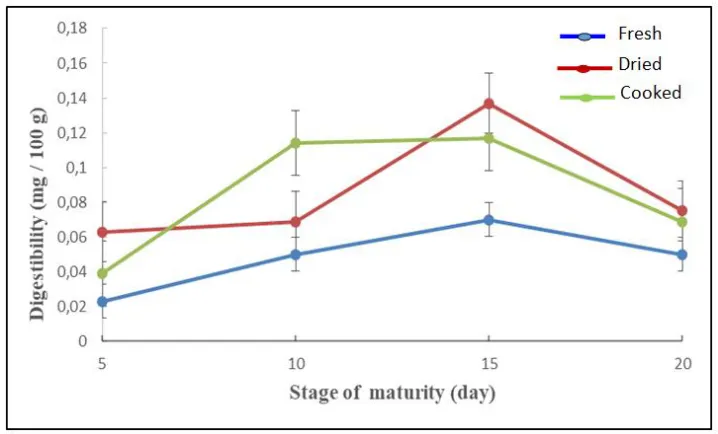
Thus, for fresh okra, the digestibility increases significantly from 0.023 mg / 100 g the 5th day of maturity to 0.070 mg / 100 g the
15th day of maturity before decreasing up to 0.050 mg / 100 g the 20th day of
maturity.
For dried okra’s digestibility, it increases significantly from 0.063 mg / 100 g (5th day of maturity) to 0.137 mg / 100 g (15th day of
maturity) before decreasing up to 0.075 mg / 100 g the 20th day of maturity.
Finally, for cooked okra, the digestibility increases from 0.039 mg / 100 g (5th day of maturity) to 0.114 mg / 100 g (15th day of maturity) before falling up to 20th day of maturity (0.069 mg / 100 g).
Fig. 1. Evolution of ‘in vitro’ digestibility of the ‘Koto’ variety according to stage of maturity and technological treatments
3.3 Effects of Okra’s Maturity Stages on the Rat’s Growth Characteristics
The nutritional values of the Koto variety, at the different stages of maturity showed that the body weight of the rats, fed with 0.6% of koto’s powder, is lower than those fed with the control diet (Table 3). Final weight, Ingested Dry Matter (IDM), and ingested protein (IP) of the animals fed with koto-containing diets were significantly lower (p ≤ 0.05) than those fed with the control one. For the same rats, Body Weight Gain (BWG), the Feeding Efficacy Coefficient (FEC) and the Protein Efficacy Ratio (PEC) were significantly lower (p ≤ 0.05) than those consuming the control diets. The nutritional values of the Tomi variety, at the different stages of maturity showed that the body weight of the rats, fed with 0.6% of Tomi’s powder, is lower than those fed with the control diet. Final weight, Ingested Dry Matter (IDM), Ingested Protein (IP) of the animals fed with Tomi-containing diet were significantly lower (p ≤ 0.05) than those fed with the control one. For the same rats, Body Weight Gain (BWG), the Feeding Efficacy Coefficient (FEC) and the Protein efficacy ratio (PER) were significantly lower (p ≤ 0.05) than those of rats consuming the control diet.
3.4 Eliminated Faeces
Table 4 indicates that, at the end of the experiment, the average faecal weight (g / rat / day) of rats fed with K1, K2 and K3 diets are
significantly lower (p ≤ 0.05) than those of rats fed with the control diet. However, the rats
fed with the three Koto’ diet excreted more faeces (p ≤ 0.05) than those fed with the control diet.
3.5 Coefficient of Apparent Digestive Use of the Different Stages of Maturity of Okra on the Evolution Characteristics of Rats
Table 5 shows the average value of the Apparent Digestive Utilisation Coefficient (CUDap) of minerals from okra powder diets at different maturity stages.
Thus, the apparent digestive utilisation coefficient (CUDap) of the rats in the diets with inclusion of "Koto" increased significantly (p ≤ 0.05) compared to rats consuming fish-based diet. Sodium is statistically higher (p ≤ 0.05) for the rats subject to the diets incorporating K1 and K2 formulas compared to the ones consuming the
control diet. The diets containing K1 and K4 formulas caused a significant (p ≤ 0.05) increase in apparent digestibility (CUDap) of potassium compared to the control diet. However, consumption of the diet with K3 and K4 formulas lead to a significant (p ≤ 0.05) decrease in iron apparent digestibility (CUDap) in comparison with the consumption of the control diet. The consumption of all the Koto-based formulations has not impact (p> 0.05) on the digestibility of phosphorus. The apparent digestive utilisation coefficient (CUDap) of calcium and sodium increased significantly (p ≤ 0.05) in the case of all the diet including Tomi variety. Then, phosphorus levels were statistically lower (p ≤ 0.05) when the sane diets were performed and the CUDap decrease significantly (p ≤ 0.05) compared to the control diet.
4. DISCUSSION
The biochemical and nutritional composition and digestibility of vegetables depend on the conditions of food technologies application. Indeed, these treatments can influence the bioavailability of micronutrients and cause the loss of minerals by dissolution in the cooking water or the destruction of vitamins at too high temperatures [14].
The study revealed that, after sun drying, the
digestibility of okra evolves according to the stage of maturity. Generally, the two
varieties, dried or cooked, showed increasing
levels of biochemical compounds until the 15th day before falling the 20th day, except the
fibres.
Sun-drying and water-cooking are two
gradual decrease in the levels of antinutrients and moisture during ripening. Drying improves digestibility of okra because it can reduce fruit moisture to increase nutrient concentration [21]. In addition, the crushing applied to the dried okras led to reduce the particle size which would favour substrates accessible to the enzymes [22]. However, the highest digestibility value (0.137 mg / 100 g) obtained at the 15th day of maturity, after drying in this study, was much lower than that (4.8 mg / 100 g) found by [23]. In this case, drying is not free from blame because many researchers have pointed out that sun-drying can cause significant degradation in food’s quality. Indeed, nutrients, organoleptic and functional properties and sensory characteristics could be deteriorated after a long drying period [24,25]. Our results are also in line with the work of [26]. Who had found that ash, fresh protein, fresh fibre, fat, carbohydrate and protein digestibility increased while moisture decreased after drying the okra pods. Like drying, cooking increases the digestibility of okra since it also reduces antinutritional factors. Indeed, oxalate and phytate levels, contained in all the vegetable, were reduced after cooking treatment. The phytates were wiped out at high temperatures [26]. This is beneficial for the consumer because oxalates and phytates chelate calcium, magnesium, zinc and iron and thus reduce their uptake. The reduction of oxalate content could be explained by the cell wall’s breaking. The decrease in digestibility from the 20th day of maturity for all technological treatments, would be due to an increase in the amount of insoluble (indigestible) fibre during ripening. So, the fruit becomes ligneous, more and more rigid because it contains more cellulose, lignin, hemicellulose which significantly affects its digestibility. Finally, the difference in digestibility observed between the two varieties is due to the cultural requirements. Depending on farming conditions, the amount of nutrients absorption varies from one variety to another, resulting in a significant difference in composition. Indeed, Abelmoschus caillei is later and photosensitive and more resistant to water stress than Abelmoschus esculentus [27]. Regarding the in vivo digestibility, the experiment showed that animals consuming the control diet had a higher increase in body weight (p ≤ 0.05) compared to animals fed with diets enriched by both varieties of okra. In this experiment, growth characteristics such as final weight, ingested dry matter, ingested protein, body weight gain of diets containing the two species of okra, at all stages of maturity, are statistically lower than those fed with the control
9
Table 3. Average value of growth characteristics with inclusion of "Koto" and tomi variety at different stages of maturity
Parameters measured
Diet at different stages of maturity Control
(n = 6)
5 10 15 20
Koto (n = 6) Tomi (n=6) Koto (n=6) Tomi (n=6) Koto (n=6) Tomi (n =6) Koto (n =6) Tomi (n = 6)
Original weight (g) 156.75±4.1a 157.75 ± 2.3a 153.25 ± 2.01a 158.5 ± 1.7a 159.2 ± 1.5a 155.12±0.88a 158.42 ± 3a 155.12 ± 0.88a 158.5 ± 3.2a Final weight (g) 176 ±3.1a 167.25 ± 0.9b 158.75 ± 1.25b 169.25 ± 7.84b 169.7 ± 2.2ab 171.75±0.82b 174.75 ± 2.8a 171.75 ± 0.82b 169.17 ± 2.5ab MDI (g) 12.59 ± 1.01b 7.27 ± 0.23a 15.41 ± 0.59b 7.20 ± 0.58a 11.6 ± 0.91a 8.65 ± 0.76a 13.21 ± 1.2a 8.65 ± 0.76a 11.55 ± 1.08a PI (g) 1.08 ± 0.07a 0.74 ± 0.06b 1.65 ± 0.04b 0.73 ± 0.06b 1.20 ± 0.03b 0.84 ± 0.06b 1.31 ± 0.06b 0.84 ± 0.06b 1.03 ± 0.07b BWG (g) 3.85 ± 0.08a 2.15 ± 0.08b 3.1 ± 0.02a 2.3 ± 0.05b 2.1 ± 0.09b 3.35 ± 0.03a 3.25 ± 0.04a 3.35 ± 0.03a 2.15 ± 0.07b DCE 1.52 ± 0.02a 1.47 ± 0.02a 1 ± 0.02b 1.59 ± 0.03a 0.9± 0.01b 1.93± 0.03b 1.22 ± 0.01a 1.93± 0,03b 0.96 ± 0,02b PCE 3.55 ± 0.19a 3.62 ± 0.33a 1.87 ± 0.13b 3.88 ± 0.33a 1.74 ± 0.01b 3.90 ± 0.33b 2.46 ± 0.11ab 4.93 ± 0.33ab 2.07 ± 0.09b
n: Number of rats per treatment. On the same line, the averages followed by the same letter are not significantly different.. MDI : matter dried ingested ; PI : Protein ingested ; BWG : body weight gain ; DCE : diet coefficient efficacy ; PCE : protein coefficient efficacy.
Table 4. Faeces Average values of different batches of rats
Faecal weight (g)
Control (n = 6)
Varieties
Koto Tomi
Stage of maturity
0,49 ± 0,03a 5 10 15 20 5 10 15 20
0.23 ± 0.02b 0.33 ± 0.02c 0.44 ± 0.02d 0.27 ± 0.02e 1.04 ± 0.01f 1.35 ± 0.04g 1.09 ± 0.06h 1.07 ± 0.04h
n : Number of rats per treatment. On the same line, the averages followed by the same letter are not significantly different
Table 5. Apparent digestibility of mineral content of ‘Koto’ and ‘Tomi ‘varieties at different stages of maturity
Parameters Control
(n = 6)
Stages of maturity
5 10 15 20
Koto (n=6) Tomi (n=6) Koto (n=6) Tomi (n=6) Koto (n=6) Tomi (n=6) Koto (n=6) Tomi (n=6)
Dap Ca 0.56±0.01a 0.91±0.02b 0.81±0.04b 0.84±0.03ab 0.95±0.03ab 0.78±0.07c 0.90±0.07bc 0.74±0.06c 0.67 ± 0.08c Dap P 0.94±0.02a 0.92±0.05a 0.82±0.02b 0.95± 0.01a 0.75±0.08ab 0.94±0.04a 0.61 ± 0.04a 0.91±0.05a 0.50 ± 0.05c Dap Na 0.86±0.09a 0.93±0.05b 0.97±0.07a 0.90± 0.23b 0.98 ± 0.04b 0.89±0.07a 0.98 ± 0.07a 0.88±0.01a 0.96± 0.08a Dap K 0.91±0.08a 0.96±0.02b -3.86± 0.02b 0.90 ± 0.23a -3.61± 0.03b 0.95±0.09a -1.97 ±0.08c 0.91±0.05b -5.98±0.05ab Dap Fe 0.99±0.06a 0.99± 0.01a -5.06± 0.05b 0.99 ± 0.03a -21.49±0.08ab -7.65±0.01b -12.90±0.06c -82.3±0.01ab -15.89±0.05c
(n): Number of rats per treatment. On the same line, the averages followed by the same letter are not significantly different
cations such as magnesium (Mg), potassium (K), calcium (Ca), iron (Fe), manganese (Mn)) and / or zinc substituted hydrogen [43]. Also, the effect of the fibres is often associate to the ones of phytates and tannins.
Cation fixation is a physical property also recognised for dietary fibre. Indeed, decreasing in mineral’s bioavailability and the absorption of electrolytes in fibre-rich foods are attributed to the ability of fibres to create bond with these minerals and electrolytes, leading their excretion [44].
5. CONCLUSION
Sun drying and water cooking treatments had a positive impact on 'in vitro' digestibility. For a better valuation of consumption of okra it would be better to dry or cook okra according to the variety before consumption. In addition, okra fruits must be harvested on the 15th day of maturity regardless the variety chosen and the treatment to apply (drying or cooking) or even if it would be eaten fresh. However, it is important to note that the digestibility results obtained in this study may vary depending on the composition of the added ingredients during cooking. In terms of in vivo digestibility, the results indicate that okra promotes the digestion of food and minerals. This digestibility was better with the Tomi’s variety in the dried form compare the Koto’s variety. Finally, okra permits us to avoid nutrition-related diseases by allowing better functioning of organs.
COMPETING INTERESTS
Authors have declared that no competing interests exist.
REFERENCES
1. Akassey RP, Daubrey A. Le guide de l’agriculteur en Côte d’Ivoire. Edition Prat/Europa. 1992;3:282.
2. Fondio L, Kouamé C, N’zi JC, Mahyao A, Agbo E, Djidji AH. Survey of indigenous leafy vegetable in the urban and peri-urban areas of Côte d’Ivoire. Acta Horticulturae. 2007;752:287-289.
Available:https://doi.org/10.17660/ActaHort ic.2007.752.47
3. Siemonsma JS. West-African okra-
morphological and cytogenetical indica-tions for, the existence of a natural amphidiploid of Abelmoschus esculentus L. Medikus. Euphytica. 1982;1(24):1-252.
4. Varmudy V. Marking survey needs to boost okra exports. Department of Economics, Vivekananda College, Puttur, Karnataka, India; 2011.
5. Marius C, Gerard V, Antoine G. Le gombo, Abelmoschus esculentus L. Moench, une source possible de phospholipides. Agronomie et Biotechnologies, Oleag-ineux, Corps Gras lipides. 1997;4:389-392. 6. Grubben GJH, Denton OA. Ressources végétales de l’Afrique tropicale 2 Légumes. In: PROTA (Eds.). 2004;737.
7. Nzikou JM, Mvoula T, Matouba E, Ouamba JM, Kapseu C, Parmentier M, Desobry S. A study on gumbo seed grown in Congo Brazzaville for its food and industrial
applications. African Journal of
Biotechnology. 2005;2469-2475.
8. Charrier A. Etude des ressources
génétiques du genre Abelmoschus Med. (Gombo). CIRPG. Rome. 1983;61.
9. Siemonsma JS, Hamon S. Abelmoschus esculentus L. Moench. In: Ressources vegetales de l’Afrique Tropicale 2. Fondation PROTZ. Wageningen Pays-Bas. 2004 ;25-30.
10. Adelakun OE, Oyelade OJ, Ade-Omowaye BI, Adeyemi IA. Van de venter, m. chemical composition and the anti oxidative properties of Nigerian Okra seed (Abelmoschus esculentus Moench) flour. Food Chemistry Toxicology. 2009;47:1123-1126.
Available:https://doi.org/10.1016/j.fct.2009. 01.036
11. Rio LC, MMR. Effect of electro-magnetic field on the growth characteristics of okra
(Abelmoschus Esculentus), tomato
(Solanum lycopersicum) and eggplant (Solanum melongena). International Journal of Scientific and Research Publications. 2013;35:19.
12. Atawodi SE, Atawodi JC, Idakwo P, Pfundstein B, Haubner R Wurtele G, Spiegelhalder B, Bartsch H, Owen RW. Evaluation of the polyphenol composition and antioxidant activity of African variety of Dacryodes edulis (G. Don) HJ Lam fruit. Journal of Medicinal Food. 2009;12:1321-1325.
Available:https://doi.org/10.1089/jmf. 2008.0215.
13. Lartey A. Maternal and child nutrition in Sub-Saharan Africa: Challenges and interventions. Proceedings of the Nutrition Society. 2008 ;67:105–108.
14. Pineau H, Avallone S, Treche S. Etat nutritionnel et qualité de l’alimentation des enfants de moins de deux ans dans le village de Damé (Côte d’Ivoire) Identifi-cation et estimation de la valeur et de l’apport nutritionnels des aliments de complément. Université de Montpellier II, 2004 ;43-44.
15. Bernfeld P. Alpha and beta-amylases. In: Methods in enzymology. Colowick SP, Kaplan N eds. Academic Press, New York. 1955;1:149-158.
16. Garcin H, Higueret P, Amoikon K. Effect of large dose of retinol or retinoid acid on thyroid hormones in the rats. Ann. Nutr. Metab. 1984;28:92-100.
DOI: 10.1159/000176788
17. Bouafou KGM, Kouamé KG, Offoumou AM. Bilan azoté chez le rat en croissance de la farine d’asticots séchés. Tropicultura. 2007;25(2):70-74.
18. Pellet PL, Young VR. Nutritional evaluation of protein foods. Edited by Peter L. Pellet and Vermon L. Young. The United Nation University. 1980;323.
19. Ngoh Neewilah G, Brat P, Tchango JT, Tomekpe K, Alter P, Fokou E, Etoa F. Effet de la cuisson sur la teneur en polyphénols totaux de quelques cultivars de bananiers (Musa sp.) au Cameroun. 2005;19.
20. Souci WS, Fachman W, Kraut H.
Composition de la nourriture et tableaux nutritionnels, 5ème édition, révisée et complétée. 1994;915.
21. Morris A, Barnett A, Burrows O. Effect of processing on nutrient content of foods: A handbook of vegetables and vegetable processing. Asian Journal of Biochemistry. 2004;37:160-164.
22. Lebas. Granulométrie des aliments composés et fonctionnement digestif du lapin. INRA Prod. Anim. 2000;13:109- 116.
23. Osunde ZD, Musa Makama AL. Assess-ment of changes in nutritional. Values of locally sun-dried vegetables. Journal Technology. 2007;10:248-253.
24. Bouraout M, Richard Durance P. Micro-wave and convective drying of potato slices. Journal Food Products Engineering. 1994;17:353-363.
25. Maskan M. Kinetics of colour change of kiwifruits during hot air and microwave drying. Journal of Food Engineering. 2001; 48:169–175.
26. Plaami S, Kumpulainen J. Inositol phosphate content of some cereal based
foods. Journal of Food Composition and Analysis. 1995;8:324–335.
27. Sandberg AS. Bioavailability of minerals in legumes. British Journal of Nutrition. 2002; 88:281-285.
28. Udengwu OS. Photoperiodic response of early and late okra types Abelmoschus esculentus and application to accelerated Gene Transfer. Nigeria Journal Botanic. 1998;11:151-160.
29. Fahey GC, Merchen NR, Corbin JE, Hamilton AK, Serbe KAM, Lewis S, Hirakawa DA. Dietary fiber for dogs: I. Effects of graded levels of dietary beet pulp on nutrient intake, digestibility, metabolizable energy and digesta mean retention time. J. Anim. Sci. 1990;68:4221-4228.
30. Sunvold GD, Fahey GC, Merchen NR, Reinhart GA. Fermentability of selected fibrous substrates by dog fecal microflora as influenced by diet. J. Nutr. 1994;124: 2719S-2720S.
31. Hallman JE, Moxley RA, Reinhart GA, Wallace EA, Clemens ET. Cellulose, beet pulp and pectin/gum arabic effects on canine caloric microstructure and histo-pathology. Vet. Clin. Nutr. 1995;2:137- 142.
32. Dimski DS, Buffington CA. Dietary fibre in small animal therapeutics. J. Am. Vet. Med. Assoc. 1991;199:1142-1146.
33. Leib MS, Monroe WE, Codner EC.
Management of chronic large bowel diarrhea in dogs. Vet. Med. 1991;922- 929.
34. Debraekeleer J, Henroteaux M. Dietary management of colitis. Proceedings of the 4th ESVIM Annual Congress, Brussels; 1994.
35. Gatti E, Catenazzo G, Camisasca E, Torri A, Denegri E, Sirtori CR. Effects of guar-enriched pasta in the treatment of diabetes and hyperlipidemia. Ann. Nutr. Metab. 1984;28:1-10.
36. Di Lorenzo C, Williams CM, Hajnal F, Valenzuela JE. Pectin delays gastric emptying and increases satiety in obese subjects. Gastroenterology. 1988;95:1211-1215.
38. Cheung PCK. Plasma and hepatic cholesterol levels and feacal neutral sterol excretion are altered in hamsters fed straw mushroom diets. J. Nutrition. 1998;128: 1512-1516.
39. Benito P, Miller D. Iron absorption and bioavailability. Nutrition Research. 1998; 18:581-603.
40. Hallberg L, Hulthen L. Perspectives on iron absorption. Blood Cells Molecules and Diseases. 2002;29:562-573.
41. Gillooly M, Bothwell TH, Torrance JD. The effects of organic acids, phytates and polyphenols on the absorption of iron from vegetables. British Journal of Nutrition. 1983;49:331-335.
42. Hurrell RF, Reddy MB, Juillerat MA, Cook JD. Degradation of phytic acid in cereal porridges improves iron absorption by human subjects. Am. J. Clin. Nutr. 2003; 77:1213-1219.
43. Raboy V. Accumulation and storage of phosphate and minerals In Cellular and
molecular biology of plant seed
development. (eds Larkins BA, Vasil IK). Kluwer Academic Publishers, Dordrecht, The Netherlands.1997;441–477.
44. Scheeman BO. Dietary fiber: Physical and chemical properties, methods of analysis and physiological effects. Food Techno-logy. 1986;40:104-110.
© 2018 Firmin et al.; This is an Open Access article distributed under the terms of the Creative Commons Attribution License (http://creativecommons.org/licenses/by/4.0), which permits unrestricted use, distribution, and reproduction in any medium, provided the original work is properly cited.
Peer-review history: