International Journal of Research (IJR)
e-ISSN: 2348-6848, p- ISSN: 2348-795X Volume 2, Issue 08, August 2015Available at http://internationaljournalofresearch.org
Available online:http://internationaljournalofresearch.org/ P a g e | 628
Learning of Standard Electronic and Electrical Devices Using
Augmented Reality
1
Neha &
2Dr.Rajneesh Talwar
1M.tech student,Deptt of ECE;Chandigarh Group of Colleges Technical Campus, Jhanjeri
2Principal,Chandigarh Group of Colleges Technical Campus, Jhanjeri
1email:[email protected]
2 email:[email protected]
Abstract-
Augmented Reality includes computer visualization, image processing and computer graphics techniques in it so as combine digital data into the real environment.. This proposal describes augmented Reality (AR), that is applies to education that clear the ideas of scholars still as lecturers in learning and also the possible impact on the long run of education. This research describes marker based Augmented Reality (AR) which combines the real image and virtual image together to show the 3D view of electronic devices while popping up the matched image like transistor, resistors, capacitor, transformer, motors and many more devices. The Mat lab simulink 2014a is used for the purpose to implement augmented reality application on electronic and electrical devices for innovative study. This can be designed by installing OS generic video interface and using SURF features to locate and recognize objects and pops up the virtual image. The video related to the particular reference image being
started just after the matching of virtual image with the real image.
International Journal of Research (IJR)
e-ISSN: 2348-6848, p- ISSN: 2348-795X Volume 2, Issue 08, August 2015Available at http://internationaljournalofresearch.org
Available online:http://internationaljournalofresearch.org/ P a g e | 629
1 INTRODUCTION
Learning with technology involves learning situations in which the instructional experience is created with the aid of a physical device, such as a computer. At some level almost all learning involves technology.[1][2] For example, in a traditional lecture, an instructor may use chalk and a chalkboard, thereby employing an old but reliable technology. Similarly, a textbook constitutes a form of technology albeit one with a 500-year old history [3].
Over last decade the leisure and entertainment world have developed very attractive devices for the younger population reaching the point of becoming essential for study. It’s a fact that when most students reach college they are used to new technologies and computer use.[1] Teachers notice that new generations of students in graphic engineering subjects show far more interest and pay more attention when they use CAD tools, multimedia material, web resources, virtual platforms and social networks but show apathy and less motivation while go for technical study.[3]
This paper focuses mainly on learning with augmented reality technology. An important feature of computer-based technology, and possible advantage if used appropriately is that, it
allows the presentation of multimedia
instructional messages [4] that is, instructional messages consisting of words (spoken or printed) and pictures (such as animation, video or 3D illustrations). Computer-based technology also allows levels of interactivity and graphic rendering [3]. One of main advantages of using this technology is the student’s adhesion which allows the establishment of contact while studying tasks. Learning processes used to be long, involving a lot of boring didactic material leading to students dropping out of subjects. AR technology allows interaction, motivation and it can even be used at home. It’s true that adhesion to any technology disappears overtime if used frequently.
This kind of technology will focus on the specific content of the subject avoiding the study
becoming a routine when students are no longer interested in it.[1] In this paper the benefits of teaching and learning are analyzed as well as the use of didactic material with additional information supplied by augmented reality against the use of traditional class notes. This AR based application help them to learn the electronic and electrical devices with interest. These markers
used are common in electronics and
communication engineering.[1] Students should master these fundamental subjects for successful professional performance.
2 AUGMENTED REALITY
ENVIRONMENTS
Virtual reality (VR) is the use of computer graphics system combined with various displays and interface devices for providing the effect of immersion in the interactive 3D computer-generated environment. From VR technology onwards arise augmented reality (AR) where technology merges virtual images with real ones, maintaining contact with the real world while interacting with virtual objects. Azuma [5] defines AR as a variation of virtual environments (VR). VR technology completely immerses the user in a synthetic environment which can be interacted with obtaining answers while not seeing the outer real world.
However, an augmented reality environment allows the user to see the real world with virtual computer-generated objects superimposed or merged with real surrounding. A basic scheme of an augmented reality system consists of a camera which captures snapshots of the real world connecting to a computer that makes necessary calculations for merging virtual objects into the real scene. The result is an image shown to the user through a graphic interface (figure-1.)[5]
International Journal of Research (IJR)
e-ISSN: 2348-6848, p- ISSN: 2348-795X Volume 2, Issue 08, August 2015Available at http://internationaljournalofresearch.org
Available online:http://internationaljournalofresearch.org/ P a g e | 630
Short characteristics of an AR environment: • Combines real and virtual environments • Is real-time interactive
• Is registered in four dimensions (three dimensional space and time)
• Virtual objects can be stationary or animated • There is interactivity between the object and the real world
•Abstract concepts can be made visible,enhancing understanding[5]
3. FLOW CHART OF ALGORITHM USED TO DESIGN AR APPLICATION
Figure 2: Flow chart of Algorithm used to design the
application 3 IMAGE MARKERS
We are using image markers in this application as they have variety of advantages.
Image markers can use ordinary (color)
images as markers.
To help detection and pose calculation
Image markers usually have a border or other landmarks, but these are optional.
Image markers are mostly recognized by
using feature matching which is
resourceful process[6]
Detecting images without frames
comprise an advantage of operating AR applications in an existing environment without changing to the environment itself. For example, an AR application may convey supplementary value to a book by not changing the book itself. The images on hand book could be use in AR application to explode out extra 3D visualization, animation, etc.
In this , AR application markers can be detected by their natural features and calculates the comparative pose of the camera by matching features to the original reference image.[6]
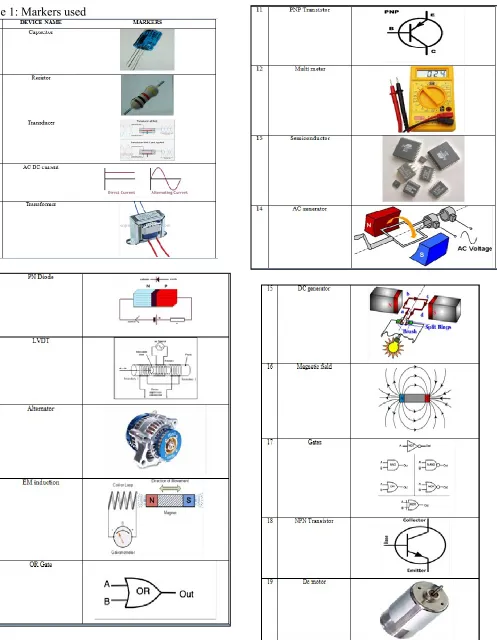
3.1 Markers used in Application
International Journal of Research (IJR)
e-ISSN: 2348-6848, p- ISSN: 2348-795X Volume 2, Issue 08, August 2015Available at http://internationaljournalofresearch.org
Available online:http://internationaljournalofresearch.org/ P a g e | 631
International Journal of Research (IJR)
e-ISSN: 2348-6848, p- ISSN: 2348-795X Volume 2, Issue 08, August 2015Available at http://internationaljournalofresearch.org
Available online:http://internationaljournalofresearch.org/ P a g e | 632
4 SURF FEATURES
In laptop vision, Speeded Up Robust Features (SURF) could be a native feature detector and descriptor which will be used for tasks like seeing or 3D reconstruction. It's partially impressed by the scale-invariant feature transform (SIFT) descriptor. The quality version of SURF is many times quicker than SIFT and claimed by its authors to be a lot of strong against totally different image transformations than SIFT.[8]
To perceive interest points, SURF uses associate number approximation of the determinant of hessian blob detector, which may be computed with three number operations employing a pre computed integral image. Its feature descriptor is predicated on the total of the Haar ripple response round the purpose of interest. These may also be computed with the help of the integral image.
SURF descriptors will be used to find and acknowledge objects, individuals or faces, to form 3D scenes, to trace objects and to extract points of interest.[8]
Syntax
points = detectSURFFeatures(I)
points = detectSURFFeatures(I,Name,Value)
4.1 Algorithm
The SURF algorithmic program is predicated on identical principles and steps as SIFT however details in every step are totally different. The algorithmic program has 3 main parts: interest
purpose detection, native neighborhood
description and matching.[8]
The SIFT approach uses cascaded filters to sight scale-invariant characteristic points, wherever the distinction of Gaussians (DoG) is calculated on rescaled pictures more and more. In SURF, square-shaped filters are used as associate approximation of mathematician smoothing. Filtering the image with a square is far quicker if the integral image is employed, that is outlined as:
The total of the first image at intervals a parallelogram will be evaluated quickly exploitation the integral image, requiring four evaluations at the corners of the parallelogram.[8]
SURF uses a blob detector supported the hessian matrix to search out points of interest. The determinant of the hessian matrix is employed as a live of native modification round the purpose and points are chosen wherever this determinant is outside. In distinction to the Hessian-Laplacian detector by Mikolajczyk and Schmid, SURF conjointly uses the determinant of the boot for choosing the dimensions, because it is finished by Lindeberg. Given some extent p=(x, y) in a picture I, the boot matrix H(p, σ) at purpose and scale σ, is outlined as follows:
where
etc. are the second-order derivatives of the grayscale image.
The box filter of size 9×9 is associate approximation of a Gaussian with σ=1.2 and represents rock bottom level (highest spatial resolution) for blob-response maps.[7][8]
5 MATCHING
By comparing the descriptors obtained from different images, matching pairs can be found.[9]
International Journal of Research (IJR)
e-ISSN: 2348-6848, p- ISSN: 2348-795X Volume 2, Issue 08, August 2015Available at http://internationaljournalofresearch.org
Available online:http://internationaljournalofresearch.org/ P a g e | 633
6 PRACTICAL RESULTS
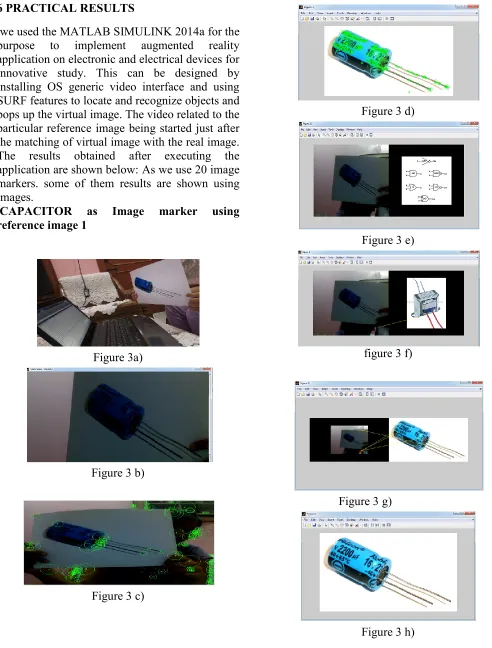
we used the MATLAB SIMULINK 2014a for the purpose to implement augmented reality application on electronic and electrical devices for innovative study. This can be designed by installing OS generic video interface and using SURF features to locate and recognize objects and pops up the virtual image. The video related to the particular reference image being started just after the matching of virtual image with the real image. The results obtained after executing the application are shown below: As we use 20 image markers. some of them results are shown using images.
CAPACITOR as Image marker using reference image 1
Figure 3a)
Figure 3 b)
Figure 3 c)
Figure 3 d)
Figure 3 e)
figure 3 f)
Figure 3 g)
International Journal of Research (IJR)
e-ISSN: 2348-6848, p- ISSN: 2348-795X Volume 2, Issue 08, August 2015Available at http://internationaljournalofresearch.org
Available online:http://internationaljournalofresearch.org/ P a g e | 634
Figure 3 i)
Figure 3 j)
Description of images - Figure 3: 3a) -Showing
capacitor marker in front of Web cam. 3b) - win video preview captures the frame 3c) -Detecting SURF features of real image. 3d) - Detecting SURF features of virtual or reference image . 3e), 3f) ,3g)- Shows the matching of real image with reference image. Real image is matched with all the reference images , some of them are shown above(53 e), 3f) . The matched with the image contains highest index pairs as in 3 g). 3h) Matched reference image pops up. 3 i) video started related d to matched image. 3j) Highest index matching pair and reference features whose value is
after matching ( Min 3; Max 740)
7 MATCHING RESULTS OF CAPACITOR MARKER HAVING HIGHEST INDEX
PAIRS
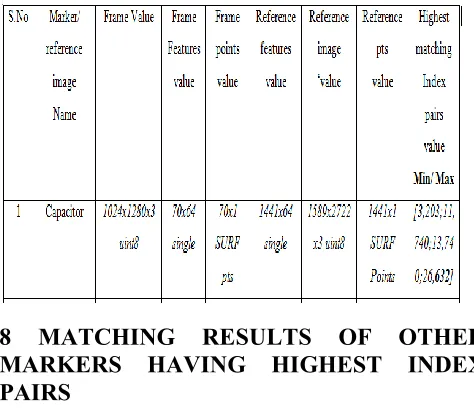
Table 2: Different feature values of capacitor markers resulting highest index pairs while displaying in front
of camera ie ( Min 3; Max 740)
8 MATCHING RESULTS OF OTHER MARKERS HAVING HIGHEST INDEX PAIRS
Table 3: Different values of markers with highest index pairs while displaying in front of camera
Above are the values of Frame Features , Frame points, Reference features, Reference image , Reference pts , Highest matching Index pairs. When index pairs are high while matching , then video corresponding to the particular image starts
International Journal of Research (IJR)
e-ISSN: 2348-6848, p- ISSN: 2348-795X Volume 2, Issue 08, August 2015Available at http://internationaljournalofresearch.org
Available online:http://internationaljournalofresearch.org/ P a g e | 635
and1x1 COM.WMPlayer_OCX_7 is the window
media player value.
9 CONCLUSION
The results of the application of Learning of Standard Electronic and Electrical Devices Using Augmented Reality are obtained. This provides the ability to learn concepts and ideas through interacting with a scene (constructivism learning theory) facilitates with generation of knowledge and skills that otherwise would take too long to accumulate. Earlier ,AR tool kit was used to design the mechanical elements which has limitations but we design a application of AR using MAT LAB 2014a which uses a image acquisition toolbox which uses a hardware and support packages that includes OS generic video interface. Furthermore, we uses SURF features which used an integer approximation of the determinant of Hessian blob detector .When index pairs are high while matching , then video corresponding to the particular image started playing in 3D using matlab.
Thus, research describes marker based
Augmented Reality (AR) using image markers, which applies to education to help the students in both technical and non technical fields . This work depicted the 3D view of electronic and electrical devices video like transistor, resistors, capacitor, transformer, motors and many more devices which students often cannot understand. It shows the complete knowledge of devices in a better way.
10 REFRENCES
[1] Jorge Martín-Gutiérrez “Proposal of
Methodology for Learning of Standard
Mechanical Elements Using Augmented Reality”
978-1-61284-469-5/11/$26.00 ©2011 IEEE
October 12 - 15, 2011, Rapid City, SD
41stASEE/IEEE Frontiers in Education
Conference T1J-1
[2] Matt Dunleavy, Chris Dede “Augmented
Reality Teaching and Learning” In J.M. Spector, M.D Merrill, J. Elen, & M.J. Bishop (Eds.), The
Handbook of Research for Educational
Communications and Technology (4th ed.). New York: Springer.
[3] Mayer, R.E. (2010) Learning with Technology. In Hanna Dumont, David Istance and Francisco Benavides (Eds). The nature of learning. Using research to inspire practice. Centre for educational research and innovation, pp. 179-198, OECD Publishing.
[4] Mayer, R.E. (2009). Multimedia Learning. Cambridge University Press-2ndedition, New York.
[5] Azuma, R. (1997). A Survey of Augmented Reality, Presence: Teleoperators and Virtual Environments. 6 (4), 355-385.
[6] Sanni Siltanen “Theory and applications of marker-based augmented reality” ISBN 978-951-38-745
6(URL:http://www.vtt.fi/publications/index.jsp)
ISSN 2242-1203 (URL:
http://www.vtt.fi/publications/index.jsp) Copyright © VTT 2012
[7] P M Panchal, S R Panchal, S K Shah (2013) “A Comparison of SIFT and SURF” International Journal of Innovative Research in Computer and Communication Engineering Vol. 1, Issue 2, April 2013
[8] Herbert Bay,Tinne Tuytelaarsand Luc Van Gool “SURF: Speeded Up Robust Features Katholieke Universiteit Leuven.