How Does It Feel Like?
An Exploratory Study of a Prototype System to
Convey Emotion through Haptic Wearable Devices
Antonella Mazzoni
Media and Arts TechnologyCentre for Digital Music
School of Electronic Engineering and Computer Science Queen Mary University of London
Mile End, London, E1 4NS, UK [email protected]
Nick Bryan-Kinns
Interactional Sound and MusicCentre for Digital Music
School of Electronic Engineering and Computer Science Queen Mary University of London
Mile End, London, E1 4NS, UK [email protected]
Abstract— This paper reports on the design and implementation of a portable, hands-free, wearable haptic device that maps the emotions evoked by the music in a movie into vibrations, with the aim that hearing-impaired audience can get a sense of the emotional content carried by the music in specific movie scenes, and therefore feel (hear) the music through the sense of touch. A study of the use of the technology is reported which found that high arousal and high valence were reliably conveyed through haptic patterns with high intensity and high frequency, whereas haptic patterns with low intensity and low frequency conveyed low arousal and low valence.
Keywords-wearable technology; haptics; film art; film music; music and emotions
I. INTRODUCTION
This study focuses on exploring new ways of communicating emotions usually conveyed through music to those who cannot hear it, and it considers the possibility of communicating the emotional content of sound through vibrations as well as exploring the role of film music in motion pictures. The aim is to enrich the emotional experience of hearing-impaired as well as normal-hearing people while watching a movie, providing the audience to encounter the emotions evoked by the music through haptic feedback delivered by a piece of wearable technology.
This work explores whether haptic communication via vibrotactile stimuli is able to induce emotions, and whether specific aspects of a vibrotactile feedback, such as frequency and intensity are able to evoke specific kinds of emotions. Rather than directly map some music characteristics (e.g. pitch, timbre, rhythm, etc.) into vibrations, this work investigates people’s emotional responses to carefully designed haptic patterns, and presents the finding of a study conducted to assess this emotional response when wearing a haptic glove designed as a tool to deliver those meaningful vibration patterns.
II. BACKGROUND
Entertainment often relies on combinations of senses to convey emotions. Film is a multimodal form of entertainment that blends together audio and visual stimuli to tell a story and create an emotional experience for those watching it. Both the audio and the visual elements are essential in creating this experience, and some argued that these should be accessible to everyone enjoying this form of entertainment, but how for deaf movie lovers even though captioning or sign language can make speech more accessible, music and background noises are not included in subtitles [7]. Also, in silent movies (with all music and no words) music is the main element for communicating emotions, so those not able to hear are left out. We therefore believe that sensing the music is very important as music transmits emotions that cannot be communicated by other stimuli such as the visual, and particularly in the context of watching a movie if the music element is missing the outcome experience for the viewer could be different from the one intended by the film director.
From a study conducted to assess the impact of music on perceived emotions in film [15] it was observed that changing the music in a movie clip could alter audience’s emotions, which lead our study to deduce that music in a movie acts on the way people feel.
Simon Boswell [1], a film music composer proposes that there are two ways of using music in a movie:
1. Using the music to transmit the same emotions transmitted by the movie scene (e.g. sad scene with sad music), to intensify a certain emotion;
2. Using the music to draw the opposite emotions drawn by the movie scene (e.g. sad scene with happy music), to attenuate an emotion, e.g. playing an uplifting music in a vivid horror scene to make the scene bearable to watch for the audience.
Considering this, we researched how deaf people experience music, and reflected on how different is the experience of
EPSRC
INTETAIN 2015, June 10-12, Torino, Italy Copyright © 2015 ICST
watching a movie for a hearing-impaired person, and we believe that for those unable to hear the music, the emotions experienced while watching a movie are purely based on the movie scenes, therefore the outcome experience is missing something and may differ from the one intended by the movie director. One of the aims of this research is to overcome this problem and provide the hearing-impaired with a full experience by giving them a sensation of the emotions conveyed in the music through meaningful vibration patterns.
Work has been done to provide awareness of ambient sounds for deaf people at home or in an office environment [12], but there is little research on how to enhance musical experiences for hearing-impaired people, and some deaf musicians say to experience music as vibrations they feel on their body while playing an instrument [5]. Two previous studies in this field [7]–[14] presented the design of a vibrating haptic chair as a solution to the enhancement of musical experience for the deaf, but this study proposes instead the design of an affordable wearable haptic device that will give the user freedom of movement and enhance their musical experience while watching a movie. This study used the review on measures, capabilities and limitations of tactile sensitivity for the human body in [13] as guidance for developing a wearable tactile interface suitable for this experiment. The tactile modality review [13] reported the hands and soles of feet to be the body regions most sensitive to vibration due to the high density of receptors in those areas; hence our decision in developing a wearable prototype for the hand, as the most sensitive body area [13] and more versatile than for the foot. However, we do not exclude trialing different body regions in future studies.
Work on vibrotactile systems has also been done over the past years, for virtual contact and information display [11]; and to enhance non-verbal communication over the internet by adding a haptic channel to a foot device [16]; as well as in affective haptics in emotional communication [17]–[18]. However, none of these studies used haptic feedback to enhance the movie-watching experience or attempted to use touch as alternative sense to convey emotions.
A vibrotactile display for movie viewing enhancement was proposed in form of a wearable jacket [9] containing 64 coin motors distributed on the torso, which allowed viewers to experience what the main character in the movie was experiencing. The study was based on the premise that distinct emotions are accompanied by distinct bodily reactions, and presumed that triggering a similar bodily reaction could produce the desired emotion. The resulting tactile jacket worked by adding haptic stimulation specifically targeted to influence viewers’ emotions, by trying recreating specific bodily reactions (e.g. shivers down the spine) to stimulate the wearer in feeling a certain emotion (e.g. fear). Also a different version of the tactile jacket [9] was proposed, attempting to intensify movie experiences through a personalized tactile actuation blanket [4].
Although both these methods could provide some sort of emotional immersion, this would be as a result of the trigger of physical events in a movie (purely video or audio feature extracted), whereas this paper attempts to address a different
aspect: communicating the emotional content of the music in a movie through meaningful haptic feedback, with the aim of improving this musical experience and provide a new form of entertainment.
A recent study attempted to enrich storytelling with haptic sensations [6], and recognized haptic feedback to be a new addition to the toolbox of special effects, which are used by artists to enrich user experience in various forms of entertainment (e.g. movies, games, shows, etc.) [6]. The study defined a ‘feel effect’ as a synthetically created haptic pattern that enriches media content through vibrations on users’ skin, and proposed a library of those feel effects for artists to create meaningful haptic content for their media. The study used the back as surface for stimulation (although acknowledged by the authors to be an area with low density of receptors), and the method used is similar to the one employed for the tactile jacket [9] in terms of the association between haptic representations and the mental interpretation of physical events, therefore different from the one applied in this study. However, the work in [6] emphasizes the interest and possibly the need for creating expressive haptic sensations for media enhancement.
The study reported in this paper examines the possibility of communicating emotions using meaningful haptic feedback through the design of a piece of wearable technology.
III. TECHNOLOGY
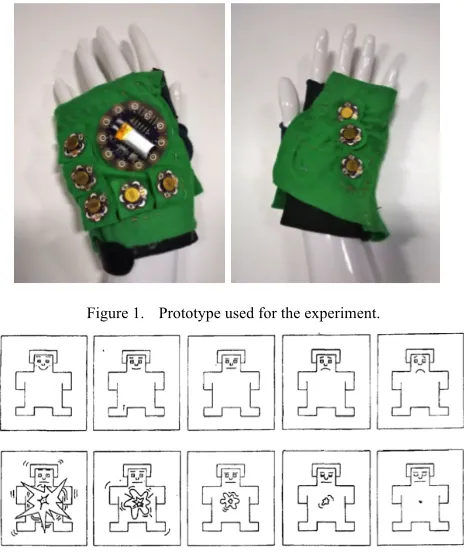
This study proposes the design of a haptic glove prototype as from findings in [13], the hand was identified as the most sensitive body region for touch. The prototype version used in the pilot study presented in this paper used the LilyPad Arduino and had 8 LilyPad Vibe Boards [10] mounted on it, 5 at the back of the hand, and 3 on the palm (Fig. 1). Each vibe board has a 20mm outer diameter and it is 0.8mm PCB (printed circuit board) thin. The vibration motors present on the vibe board are 310-101 10mm Shaftless Vibration Motor 3.4mm button type, with a voltage range of 2.5~3.8V, a rated speed of 12000 rpm, vibration amplitude 0.8G, and weight as little as 1.2g. [10].
A set of 8 vibration patterns were designed which varied between 10 and 15 seconds duration, with varying intensity and frequency of coin motor vibration, as outlined in Table 1 and Table 2. Motors would not vibrate all simultaneously, but would go on and off depending on the directional order the pattern would follow (left to right, and right to left). Patterns 5 to 8 have respectively the same intensity and frequency values as patterns 1 to 4 (as described in Table 1), but were presented in a different order.
IV. STUDY
A. Participants
normal-Figure 1. Prototype used for the experiment.
Figure 2. Modified version of SAM [2] used in this study, with top panel representing valence, and bottom panel representing arousal; and with a coding scale (not shown to participant) from left to right for each
panel: -2, -1, 0, +1, -1
hearing people, all post-graduate students, 9 males and 7 females; aged from: 22 to 38; mean age: 27.5.
B. Procedure
The study took place in our research laboratory, with one participant at a time. Participants were given a consent form to sign, which had some brief information on the study, and a demographic questionnaire. Following this, each participant was asked to wear a glove fitted with small vibration motors, sense 8 distinguished vibration patterns and rate each of them in terms of pleasure and activity (i.e. how active or energetic the vibrations felt). Participants rated the vibration patterns through the use of a modified version (Fig. 2) of the Self-Assessment Mannequin (SAM) [2]–[8], a non-verbal picture-oriented assessment technique to assess the valence (pleasure), arousal (activity), and dominance associated with a person’s affective reaction to an object or event. This study used only two dimensions of SAM, the valence and arousal, opposed to the original three that included dominance, as the dominance factor was not present in this experiment. The top panel of SAM, the valence dimension, ranges from happy (left side) to sad (right side); whereas the bottom panel, representing the arousal dimension, ranges from excited (left side) to calm (right side).
The first 8 participants felt the vibration patterns in order 1 to 8, whereas the remaining 8 participants were presented the patterns in the reverse sequence (8 to 1) in order to reduce ordering effects. Each pattern was played in a loop twice, then the participant was given 30 seconds to mark the experience on the modified SAM in terms of pleasure and activity.
TABLE I. VIBRATION MOTOR RATES
Patterns Intensity Frequency
1 & 5 LOW LOW 2 & 6 LOW HIGH 3 & 7 HIGH LOW 4 & 8 HIGH HIGH
TABLE II. INTENSITY RANGE AND FREQUENCY OF THE VIBRATIONS
Intensity in Pulse Width Modulation (PWM)
Frequency in ms
ON OFF
LOW 64 (25%) – 127 (50%) 400 ms 500 ms HIGH 191 (75%) – 255 (100%) 400 ms 200 ms
V. RESULTS
All 16 participants completed the full session, which lasted approximately 15 minutes. This section presents the results from the pilot run. Table 4 and Fig. 3 illustrate the average ratings for the arousal and valence dimensions.
TABLE III. AROUSAL AND VALENCE AVERAGE RATINGS
Average Ratingsa
Pattern Arousal Avg ratings Valence Avg ratings
1 1 0
2 0.5 -0.25 3 0.125 0.1875 4 -0.625 -0.625 5 1.375 0.625 6 0.375 -0.4375 7 -0.0625 0.625 8 -0.1875 -0.625
a. Average ratings scored in the study for the arousal and valence dimensions
Figure 3. Graph representing the arousal and valence average ratings. Figure 1.
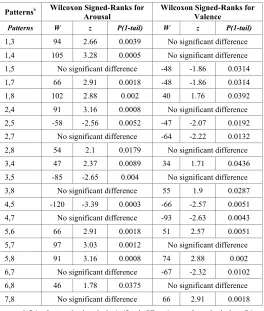
TABLE IV. ORDINAL DATA TEST RESULTS FOR AROUSAL AND VALENCE
Patternsb Wilcoxon Signed-Ranks for
Arousal Wilcoxon Signed-Ranks for Valence
Patterns W z P(1-tail) W z P(1-tail)
1,3 94 2.66 0.0039 No significant difference 1,4 105 3.28 0.0005 No significant difference 1,5 No significant difference -48 -1.86 0.0314 1,7 66 2.91 0.0018 -48 -1.86 0.0314 1,8 102 2.88 0.002 40 1.76 0.0392 2,4 91 3.16 0.0008 No significant difference 2,5 -58 -2.56 0.0052 -47 -2.07 0.0192 2,7 No significant difference -64 -2.22 0.0132 2,8 54 2.1 0.0179 No significant difference 3,4 47 2.37 0.0089 34 1.71 0.0436 3,5 -85 -2.65 0.004 No significant difference 3,8 No significant difference 55 1.9 0.0287 4,5 -120 -3.39 0.0003 -66 -2.57 0.0051 4,7 No significant difference -93 -2.63 0.0043 5,6 66 2.91 0.0018 51 2.57 0.0051 5,7 97 3.03 0.0012 No significant difference 5,8 91 3.16 0.0008 74 2.88 0.002 6,7 No significant difference -67 -2.32 0.0102 6,8 46 1.78 0.0375 No significant difference 7,8 No significant difference 66 2.91 0.0018
b. Pairs of patterns that showed to be significantly different in terms of arousal and valence. Pairs of patterns that did not show a significance difference appear in the above table as such.
VI. DISCUSSION
Vibration patterns 1, 4, 5, 7, and 8 were the most reliably different in this study. As outlined in Table 1, patterns 1 and 5, and patterns 4 and 8, were set to the same level of vibration intensity and frequency, but the motors vibrated in a different sequence. These data lead us to believe that the sequential order of the vibration patterns does not contribute to identifying a certain arousal and valence state, but instead suggest that the key elements which define those states are the intensity and frequency at which each vibration motor plays. Pattern 7 had high intensity and low frequency values, with participants associating it with low valence. Results show that participants reliably associated high level of valence and arousal (coding scale < 0) to vibration patterns with high intensity and high frequency, and low valence and arousal (coding scale > 0) to those patterns with low intensity and low frequency. Some of the participants reported that they associated the vibrations to rhythm, and consequently to associate this last one to music or other ambient sounds, e.g. ambulance or police sirens and therefore evoke a sense of alarm. This kind of association (as the one in [9] between haptic sensations and the mental interpretation of physical events) could serve as a direction in designing intuitive vibration patterns, but also needs more exploration, as this interrelation could be limited to hearing and not the hearing-impaired people. A further study involving both normal-hearing and hearing-impaired people could help determine if the vibration-to-rhythm, rhythm-to-music and ambient sound, and sound-to-emotional state associations span across the different hearing abilities.
In this study, conducted with normal-hearing participants, patterns 1, 4, 5, and 8 resulted to be the most reliably conveyed emotions, with most participants associating patterns 1 and 5 to low levels of valence and arousal, and patterns 5 and 8 to high levels of valence and arousal. Whereas pattern 6, as visible form Fig. 4, appeared to be the pattern with the least significant differences, scoring very similar averages to pattern 2, which had same frequency and intensity (see Table 3 and Fig. 3), and resulting significantly differently to pattern 5 in terms of both valence and arousal, and pattern 7 in terms of valence, exactly as scored from paired patterns 2,5 and 2,7. This reinforces our belief that the sequential order in which vibrations are
!
presented does not influence participants’ arousal and valence states. For this reason, together with space limitation, we chose not to include the representation of the haptic patterns in this paper.
The results from this study suggest that vibrations at low intensity and frequency can induce an emotional state equal to low valence and low arousal, whereas vibrations applied at high intensity and frequency can induce in people a high state of valence and arousal.
These findings provide an indication that vibrotactile stimuli can be used to induce emotions, and could therefore work as a substitute for the emotional content conveyed in the music and enhance this way the musical experience for the hearing-impaired. In particular, the movie-watching experience of a hearing-impaired person could be improved, as the vibrotactile stimuli could provide them with additional emotional information that is usually carried by the music they are not able to hear.
VII. CONCLUSION AND FUTURE WORK
This paper provides some reliable results indicating that people are able to associate emotional states to vibrotactile stimuli played at different frequencies and intensities. This study found that the combination of low intensity and low frequency would induce in participants a low sense of arousal and a low sense of valence, whereas vibrations at high intensity combined with high frequency communicated to people a high sense of valence and a high sense of arousal.
Future goals of this research are developing another wearable prototype for testing different vibration patterns together with movie clips and other media, to assess if those forms of entertainment could be enriched by vibrotactile stimuli played through haptic wearable devices. Also, in our next user study we aim to include hearing-impaired participants as well as normal-hearing.
ACKNOWLEDGMENT
This work is supported by the EPSRC Doctoral Training Centre in Digital Music and Media for the Creative Economy (EP/G03723X/1).
REFERENCES
[1] S. Boswell, “Music in cinema: how soundtrack composers act on the way people feel,” unpublished, keynote speech on “Music and emotions: composition perspectives,” presented at the 9th Int. Symp. CMMR 2012
on Music & Emotions, London, UK, June 19-22, 2012.
[2] M. M. Bradley, and P. J. Lang, “Meausuring emotion: The self-assessment manikin and the semantic differential,” J. of Behavioral Theory and Experimental Psychiatry, vol. 25, pp. 49-59, 1994. [3] N. Bryan-Kinns, and F. Hamilton, “Identifying mutual engagement,” J.
of Behaviour & Information Technology, pp. 1-25, December 2009. [4] E.O. Dijk, A. Weffers-Albu, and T. De Zeeuw, “A tactile actuation
blanket to intensify movie experiences with personalised tactile effects,” Demonstration papers Proc. 3rd Int. Conf. on Intelligent Technologies for Interactive Entertainment (INTETAIN), Amsterdam, 2009.
[5] D. E. Glennie, (1993). “Hearing essay,” [Online]. Available: www.evelyn.co.uk/hearing-essay/. [Last Accessed: Mar. 3, 2015]. [6] A. Israr, S. Zhao, K. Schwalje, R. Klatzky, and J. Lehman, “Feel effects:
enriching storytelling with haptic feedback,” ACM Trans. on Applied Perception (TAP), vol. 11, issue 3, no. 11, Oct. 2014.
[7] M. Karam, G. Nespoli, F. Russo, and D. Fels, “Modelling perceptual elements of music in a vibrotactile display for deaf users: a field study,” in Proc. 2009 2nd Int. Conf. on Advances in Computer-Human Interactions (ACHI 2009), pp. 249-254.
[8] P. J. Lang, “Behavioural treatment and bio-behavioral assessment: computer applications,” in Technology in mental health care delivery systems, J. B. Sidowski, J. H. Johnson, and T. A. Williams, Ed. Norwood, NJ: Ablex, 1980, pp. 119-137.
[9] P. Lemmens, F. Crompvoets, D. Brokken, J. Van den Eerenbeemd, and G. de Vries, “A body-comforming tactile jacket to enrich movie viewing,” in Proc. 2009World Haptics – 3rd Joint EuroHaptics Conf. and Symp. on Haptic Interfaces for Virtual Environment and Teleoperator Systems, pp. 7-12.
[10] “LilyPad Vibe Board,” [Online]. Available: www.sparkfun.com/products/11008. [Last Accessed: Mar. 3, 2015]. [11] R. W. Lindeman, Y. Yanagida, H. Noma, and K. Hosaka, “Wearable
vibrotactile systems for virtual contact and information display,” Virtual Reality, vol. 9, issue 2-3, pp. 203-213, March 2006.
[12] T. Matthews, J. Fong, and J. Mankoff, “Visualizing non-speech sounds for the deaf,” in Proc. 2005 7th Int. ACM SIGACCESS Conf. on Computers and accessibility (ASSETS’05), pp. 52-59.
[13] K. Myles, and M. S. Binseel, “The tactile modality: a review of tactile sensitivity and human tactile interfaces,” U.S. Army Research Laboratory, Aberdeen Proving Ground, MD, Tech. Rep. ARL-TR-4115, May 2007.
[14] S. Nanayakkara, E. Taylor, L. Wyse, and S. H. Ong, “An enhanced musical experience for the def: design and evaluation of a music display and a haptic chair,” in Proc. 200927thInt. Conf. on Human Factors in Computing Systems (CHI’09), pp. 337-346.
[15] R. Parke, E. Chew, and C. Kyriakakis, “Quantitative and visual analysis of the impact of music on perceived emotion of film,” Computers in Entertainment (CIE), vol. 5, issue 3, article 5, July/September 2007. [16] A. F. Rovers, and H. A. van Essen, “Guidelines for haptic interpersonal
communication applications: an exploration of foot interaction styles,”
Virtual Reality, vol. 9, issue 2-3, pp. 177-191, March 2006.
[17] D. Tsetserukou, A. Neviarouskaya, H. Prendinger, N. Kawakami, and S. Tachi, “Affective haptics in emotional communication,” in Proc. 2009 3rd Int. Conf. on Affective Computing and Intelligent Interaction and Workshops (ACII 2009), pp. 1-6.
[18] S. Yohanan, M. Chan, J. Hopkins, H. Sun, and K. MacLean, “Hapticat: exploration of affective touch,” in Proc. 2005 7th Int. Conf. on