28
© Global Society of Scientific Research and Researchers http://ijcjournal.org/
An Agent-based Performance Evaluation System
Gbadebo A. O.
a*, Adebayo A. O.
ba,bDepartment of Computer Science, School of Computing and Engineering Sciences, Babcock University
aEmail: [email protected]
Abstract
Performance evaluation is one of the major factors that determine the growth and development of any
organization. Competent and hardworking employees are identified proper appraisal, and promotion and
gratuity are justly applied. Lack of clarity of performance metrics and bias create improper appraisal in
organizations, with evaluation process mostly inconclusive, incomplete, and unfair, affecting the effectiveness
of the result. This study, therefore, focused on developing a modeland application towards achieving a staff-centric, task-centric and environment-centric computer-based appraisal system. In developing the proposed
system, the spiral model of the Software Development Life Cycle was adopted. The software development
environment consists of Netbeans Integrated Development Environment, Hypertext Mark-up language, MySQL,
MySQL DB connector, Apache and PHPmyAdmin. The metrics that were used by the system to evaluate
performance include attendance, employee responsiveness, punctuality and projects. The model was created and
an agent-based performance evaluation application was developed as an instantiation of the model. The system
revealed employee strengths and weaknesses regarding execution of a particular project.
Keywords: Performance Evaluation; Agent; Appraisal; Performance Metrics; Auto-Scoring.
1.Introduction
Largely, the need for evaluation is to reward high performing employees, recognize areas for improvement of staff as well as organizations, and provide recommendation in case of un-reconcilable negligence of staff [1].
Though these reasons should make any organization want to adopt evaluation system, most organizations that
perform evaluations disrupts the system with too many human interpretations or bias. Performance evaluations
are usually not as effective as they should be because some organization’s performance process lack credibility;
no clarity in the aspect of Job being evaluated, no standards against which performance is measured [13].
---
29
A recent investigation of major U.S organizations revealed that 40% of managers admitted to forging or
controlling performance data because it was clear to them that the evaluation served no valuable purpose in the
way it was managed in their Organization [9]. Performance Evaluation is bias, manual, vague and incomplete in
most Organizations [8]. Most Organizations do not have intelligent systems to appraise their staff thereby
adopting manual process, which injects subjectivity into staff appraisal [7]. Appraisal system should track targets, accomplishments and projects of each employee, otherwise, a staff is appraised based on human
judgments and traits. Employee is then evaluated by finding a score that best characterizes his or her level of
performance for every quality rather than the competence and accomplishment of tasks.
Organizations ceaselessly look for solutions to manage and maximize the performance of their workforce. They
perceive that there has been a shift in the business environment from a tangible asset economy to an intangible
asset economy [12]. However, the challenge of recognizing every employee's abilities, capacities, and arears for
development to encourage positive commitment and managing poor performance can be overwhelming.
The problem of performance evaluation is a hydra-headed monster which includes non-existence of the process
in many organizations. Organizations that put checks and balances into their operations are few. Those who do,
spend hours of valuable man-power trying to manually arrive at the staff performance evaluation. When these
are done, various data are exposed to personal bias. At other times the performance evaluation are inconclusive
and incomplete as there is no clarity of performance metrics; thus, affecting the effectiveness of the result.
Hence, in order to achieve the goal of objectivity, credibility and trust in staff appraisal, a system that achieves
comprehensive and self-information gathering must be considered, which the study focused upon.
The objectives of this study were to develop an agent-based Intelligent Perfomance evaluation model for
managing staff-work information and auto-Scoring based on organization’s predefined uniform company-wide
appraisal score-weights, create a prototype of the proposed model, and evaluate the prototype.
An extensive literature review provided the basis for developing an appreciation of the relevant issues in the
study. The knowledge gained from the literature survey was used to construct a theoretical background of the
research. The organization’s predefined uniform company-wide appraisal score-weights served as the basis for
proposing the model of the agent-based performance evaluation system to be used in managing staff-work
information and auto-Scoring. The prototype of the proposed model was developed using the Netbeans IDE,
Hypertext Markup language (HTML), MySQL, MySQL DB connector, Apache and PHPmyAdmin. The
prototype of the proposed system was simulated and implemented to demonstrate the degree of exactness of the
system and the extent to which bias had been eradicated through automatic and intelligent information gathering
about staff. The evaluation of the model was carried using an organization as a Case-Study.
The proposed approach will enable an auto-determinant appraisal scores for every staff. A manager or project
team head can provide weight values to agreed appraisal metrics. Management can detect staff’s attitude to work
automatically through intelligent approaches such as Staff-Computer Inactivity Time, Staff-Email response
time. An appraisal administrator can view non-editable appraisal scores at will and it also allows management
30
enhancing the work-experiences, staff outputs and overall company achievement as they can share and learn
from genuine and unbiased appraisal reportage.
2. Outcomes and discussions
2.1 The Model
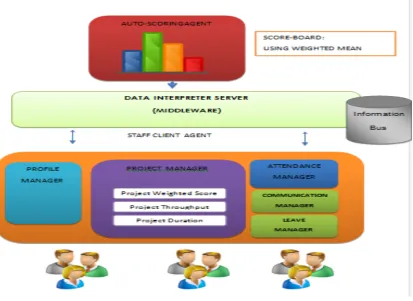
The architecture of the agent-based Intelligent Perfomance evaluation model is presented in Figure 1. The model
consists of three tiers, namely the Staff Client Agent or Staff-Agent tier, the Data Interpreter Server tier, and the
Score tier. These are further discussed subsequently.
Figure 1: Architecture of the Model
1st Tier: The Staff Client Agent or Staff-Agent Tier
This is the major component where data about staff and the context or computing environment of staff,
otherwise called staff service-delivery environment, is provided to the data interpreter middleware. The followings are the sub components of the Staff Client Agent: Profile Manager, Project Manager, Attendance
Manager, Communication Manager, and Leave Manager.
The Profile Manager is a reader component, for retrieving useful staff information needed for the appraisal
computation. The required staff profile information is categorized as Micro and Macro. Staff-Micro information
31
and other information such as Staff Position.Macro information includes the Staff Internet Protocol Address and Staff Date of Birth. The profile information
serves as input required at the middleware component.
The Project Manager Component, which focuses on the tasks and projects delivered by a staff, is an important
component of the staff-agent. The project manager has three major functions, namely Project Weighted Score
Computation, Project Throughput Scoring Manager, and Project Duration Store.
a.Project Weighted Score Computation
In a service-delivery environment, the role of the Project Manager (PM) component is to extract project title and
its weighted score value. The PM component achieves this through direct request from line-manager or a project
scoring document.
b.Project Throughput Scoring
This function is carried out after a successful project sign-off. This PM function computes the rate at which
project are delivered efficiently
c.Project Duration
This function gives the time frame of a project. Managers must estimate the calendar time required for executing
a project successfully.
The Attendance Manager Component is a primary component for retrieving punctuality information of each
staff. This component informs the appraisal system of the attendance rate of every staff. The Communication
Manager Component retrieves useful information about the staff-response rate per email. This component
interacts with the mailing system and retrieves useful mail information. The communication manager
component helps to determine staff effectiveness, collaborations and contributions in organizational tasks,
projects and duties.
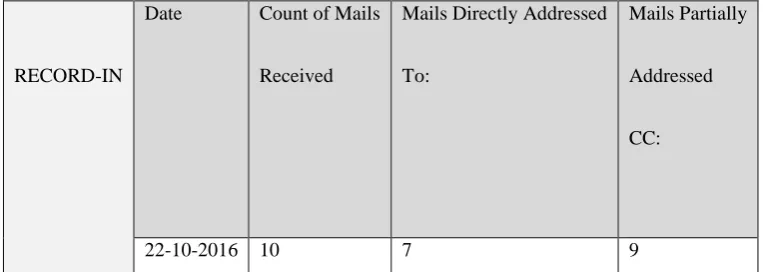
Table 1 shows the rate of staff response per email for an organization. The Leave Manager Component captures Leave information per staff, Leave Frequency, and Current staff pending projects on the Leave
Handover document.
2nd Tier: The Data Interpreter Server
This is the middle tier component. This component interprets information retrieved from the 1st Tier of the
architecture. The 2nd Tier manages all information received from the components of the 1st-Tier. Other roles
played by these components include representation of information in format acceptable by the 3rd tier. The
32
Table 1: Staff-Response Rate per Email
RECORD-IN
Date Count of Mails
Received
Mails Directly Addressed
To:
Mails Partially
Addressed
CC:
22-10-2016 10 7 9
RECORD-OUT Date Count of Mails
(Initiated)
Directly Addressed To:
(Reply)
Partially
Addressed To:
Reply to CC.
22-10-2016 9 6 4
The Weighted Mean
The proposed architecture adopts a weighted mean approach such that a weight is attached to each significant
component of the appraisal, and staff is scored based on a weighted mean value.
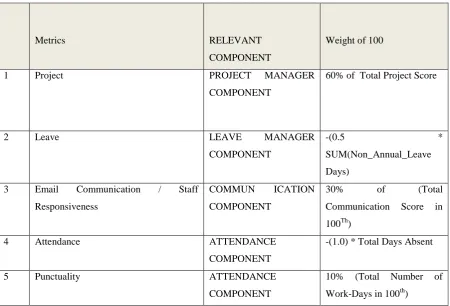
Table 2 defines the metrics and weight for the proposed architecture.
Table 2: Metrics and Weight definition
Metrics Weight of 100
1 Project 60% of Total Project Score
2 Leave -(0.5* SUM ( Non_Annual_Leave Days)
3 Email Communication / Staff Responsiveness 30% of (Total Communication Score in 100Th)
4 Attendance -(1.0) * Total Days Absent
33
The 3rd Tier: The Score TierA staff-friendly metrics were selected and infused flexibly by allowing organization appraisal human resource
manager input weight worth/value per metric. Staff weighted means computations are managed by the
Score-Manager component. The second tier provides the weighted values per metrics. These weighted values of the
metrics are retrieved by the various component of the 1st Tier.
Table 3 defines the metrics and weight of the proposed architecture with relevant components
Table 3: Metrics and Weight definition with the relevant components
Metrics RELEVANT
COMPONENT
Weight of 100
1 Project PROJECT MANAGER
COMPONENT
60% of Total Project Score
2 Leave LEAVE MANAGER
COMPONENT
-(0.5 *
SUM(Non_Annual_Leave
Days)
3 Email Communication / Staff
Responsiveness
COMMUN ICATION
COMPONENT
30% of (Total
Communication Score in
100Th)
4 Attendance ATTENDANCE
COMPONENT
-(1.0) * Total Days Absent
5 Punctuality ATTENDANCE
COMPONENT
10% (Total Number of
Work-Days in 100th)
2.2 The Application
Figure 2 shows the work details page of the web application. This is where the employee work details are
captured and who the supervisor is also assigned. The system captures some details about the work schedule of
an employee as well as the supervisor for that project.
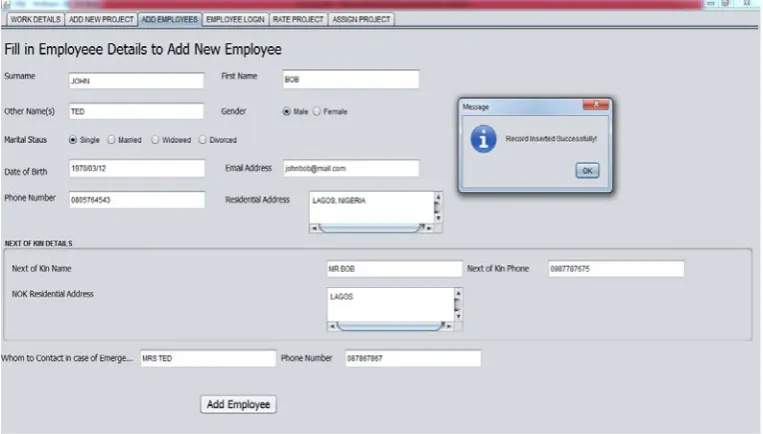
Figure 3 shows the page of the web application where new employees are added. This section allows new
project to be included stating explicitly, the duration of the project, the project description, name of the project
and who will be the supervisor of the project. As many projects as desired can be added in this section. This
34
to be added to the system. It accepts valid information about the employee such as the name, contact details,
date of birth, residential address, emergency contact details, and so on. As many employee as desired can be
added to the system via this platform.
Figure 2: Work Details Page
Figure 3: Add Employees Page
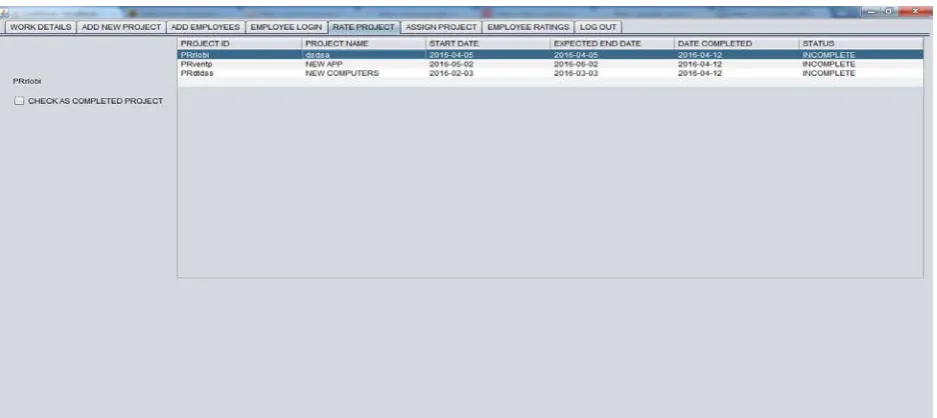
Figure 4 shows the page of the web application where projects are rated. This page allows supervisor check the status of projects if it has been completed or not. It also provided reevant information as regards a project.
Information that can be gotten include project description, project strart date, expected date of project
35
Figure 4: Rate Project Page
2.3 Evaluation Results
The system developed was evluated in a social context so as to examine its social benefits in addition to the
various benefits it provides. It was tested at a printing company.
The company specializes in all kinds of media printing (posters, handbills, magazines, books, and journals,
among others). The system was tested with just one project and the project had four (4) employees assigned to
it. The Human Resource (HR) manager decided to use punctuality, responsiveness, project completion and
attendance as the metrics for the evaluation. The system performed the evaluation for the staffs after the
completion of the assigned project which lasted for twoweeks. The system gave the employees rating in regards
to how they performed and the employee were satisfied with the results.
The evaluation of the system was majorly based on two of its requirements which are; the system’s eficiency
(how efficient did the system rid biasness during the performance evaluation of the staffs), and its usability (how
easy was it to navigate through the system). The system HR manager had little to do with the appraisal of the staff because all he did was to assign projects and set the factors to be used for the performance. This allows
little/no room for manipulation of data during the appraisal process. The system does all the computing by
assessing the employees’ responsiveness and punctuality.
Sequel to the hands on deployment of the system, a follow up questions were administered via oral interview as
a result of time constraints and its effectiveness for the evalaution purpose. The responses show that there was a
positive learning in terms of acceptance of the system.
Related Work
36
[2]. The management of performance in an organization determines to a high level, the achievements and
failures of the organization [6]. Researchers have contended that, to have a successful human resource system
for an organization, the utilization of an appraisal system which is dependable and accurate is required [10]; [3].
Performance appraisal is required for a more responsive method for assessing the quality of employees. An automated performance evaluation system is needed for an accurate and undisputable result.
A fuzzy evaluation technique was proposed to interprete and measure imprecise appraisal data for performance
measurements [11]. A fuzzy reference was proposed using IF and Else contruct as similar to expert systems.
The method uses fuzzy to capture imprecise data without a practical or technical prototypical representation of
the proposed methods. Fuzzy deals with imprecise data and are probabilistic. The proposed fuzzy evaluation
technique makes all appraisal staff data precise by assigning exact values to appraisal metrics. These values or
scores are assigned real-time to predefined metrics from a staff work context or environment. Advantageously,
the proposed solution is custom-based, customizable to each organization. This is achieved through custom
metrics defined uniformly for all staff. The data-values asigned to these metrics are automatic thereby
eradicating bias.
Similarly, to tackle the issue that weighs on every attribute of staff performance, managements are often decided
subjectively in multi-attribute assessment. Anentire staff performance management evaluation model based on fuzzy partial ordering and rough set theory was proposed [14]. Test values having been standardized, each
sample is ranked by a fuzzy partial rank model. A decision making information list of continuous value is built
in order to solve the problem that there must be decision making information list in general rough sets. Then, the
weight coefficient of each attribute value is calculated based on generalized significance of the attribute. This is
done so as to avoid the terrible eventual outcome worked by dispersing attribute values sensitized to noise.
Then, the practicality and feasibility of post-evaluation of entire staff performance management is verified by
fuzzy partial ordering and rough sets strategy. The fuzzy methods are based on estimated scores as against
actual and automated scoring proposed in this study. Actual scoring is precise, values are not vague or
arbitrarily.
The behavioural anchored rating appraisal technique was also employed to implement a quantitative and
hierarchical assessment index system and an interactive e-appraisal system in a power enterprise organization
[5]. It was argued that the proposed solution can guide human resource management effectively and promote the
enterprises rapid development. It is worth noting that the metrics and scoring was based on human judgment as
against an automated scoring proposed in this study.
Process Algebra, Model Checking and Markov chains were utilized in proposing a model for performance
evaluation [4]. Markov chains are generally used as a practice to decide system performance and reliability
characteristics. It was indicated how effective model specification and analysis techniques from concurrency
theory can be applied to performance evaluation. The specification of Continuous Time Markov Chains
(CTMCs) is bolstered by stochastic process algebra, while the quantitative analysis of these models is handled
by methods for model checking. Process algebra provides: (i) a high-level specification formalism for describing
37
aggregation of CTMCs. Temporal logic model checking provides: (i) a formalism to determine complex
measures-of-interest in a clear, conservative and flexible way, (ii) automated means to quantify these measures
over CTMCs, and (iii) automated measure-driven aggregation (lumping) of CTMCs. Combining process algebra
and model checking constitutes a coherent structure for performance assessment based on CTMCs.
3.Conclusion
Performance evaluation is a continuous and systematic process that helps the organization assess its candidate to
give appropriate appraisal to theindividual. Proper evaluation of performance for employees will help determine
the productivity of every employee in the organization. Thus, there is need for a proper evaluation and avoidance of biasness to get the adequate productivity level of employees in the organization. This work has
developed a model that will eradicate biasness in performance evaluation because some previous performance
appraisal models allow/give room to biasness which has made productive employees in a firm to be laid off due
to favouritism towards some other employees. This model will help those that are worthy of keeping their jobs
keep it and help improve employees that need to work on some specific areas to develop themselves as plainly
revealed.
4.Recommendations
It is recommended that the automation of staff performance using unbiased and complete model should be
adopted because such performance approach will allow organizations achieve transparent performance rating for
members of staff. The approach will go a long way in enhancing the work-experiences, staff outputs and overall
company achievement as they can share and learn from genuine and unbiased appraisal reportage.
5.Suggestion for future works
The proposed model can be worked upon to totally reduce/eradicate human intervention thereby making the
software completely autonomous. Features like biometrics can be incorporated and used to monitor attendance
and punctuality of employees in the organization. A platform where employees could communicate and share
ideas can also be incorporated into the system so as enable employees help, build and improve one another’s
skills. The application could also be mobile-based.
References
[1] A.H.M. Shamsuzzoha,., and M.R.H. Shumon. "Employee Turnover- a Study of its Causes and Effects to
Different Industries in Bangladesh." Manufacturing Engineering/ Vyrobne Inzinierstvo, 6.3, pp 64-68,
2007.
[2] D. R. Ilgen, and J. M. Feldman, Performance appraisal: A process focus. Research in Organizational
Behavior, 5(1), 141-197, 1983
38
439-442, 2004.[4] H. Holgers, and K. Joost-Pieter “Model-checking algorithms for continuous-time Markov
chains.” Software Engineering, IEEE Transactions on, 29(6), 524-541, 2014.
[5] J. Qu, F. Dang, Y. Xu, and F. Fan. “Design and implementation of power enterprise staff performance
appraisal system based on Flex and J2EE.” In Computational and Information Sciences (ICCIS), 2012
Fourth International Conference on, (2012) 702-705.
[6] J.P. Muczyk, and G. Myron "Managing Sales Performance through a Comprehensive Performance
Appraisal System," Journal of Personal Selling & Sales Management, 7, 41-52, 1987
[7] K. Venclová, S. Andrea and K. Gabriela. “Identification of employee performance appraisal methods in
agricultural organizations.” Journal of Competitiveness 5(2), 20-36, June 2013
[8] L. E. Daoanis “Performance Appraisal System: It’s Implication to Employee Performance.”
International Journal of Economics and Management Sciences, 2(3), 55-62, 2012.
[9] L.S. Gordon (2016) “Performance Appraisal - An important managerial Responsibility. Internet:
http://www.managerwise.com/article.phtonl?id=161 [February 23, 2016].
[10] M. Armstrong, and A. Baron. Managing performance: performance management in action. London:
CIPD, 2005.
[11] N. Arbaiy, and Z. Suradi. “Staff performance appraisal using fuzzy evaluation.” International
Conference on Artificial Intelligence Applications and Innovations, 195-203. Springer, Boston, MA.
2007.
[12] N. J. Adler and S. Bartholomew. “Managing globally competent people.” The Executive, 6(3), 52-65,
1992.
[13] R. Cintron. “Performance Appraisal: A Supervision or Leadership Tool?” International Journal of
Business and Social Science, 2(17), 29-37, 2011.
[14] S. Yu, Z. Lisha and L.Chen . "A method on post-evaluation of whole staff performance management
based on fuzzy partial ordering and rough sets." Emergency Management and Management Sciences