7
Maryanne Fisher
Saint Mary’s University, Canada E-mail: mlfi [email protected]
Anthony Cox
Dalhousie University, Canada E-mail: [email protected]
Abstract
Contemporary students and instructors have differing views about communication technologies that can impact their learning relationship. We have found that although e-mail is students’ primary method for contacting instructors, some students view it as too slow for their academic needs. At the same time, many students do not want to use more immediate, and consequently, more personal communications technologies such as instant messaging. Meanwhile, instructors are relying more than ever on electronic communication, such as e-mail, ‘blogs,’ instant messaging, and newsgroups to create virtual online environments that replace or supplement traditional classrooms. Thus, instructors must fi nd appropriate technologies that satisfy both educational and student requirements. Unfortunately, instructional needs, such as the ability to create transcripts of commu-nication, can confl ict with those of students, such as a desire for anonymity. As a consequence, technologies designed to enhance communication can inadvertently be disruptive and create barriers to effective education. We conducted a survey on student’s use of e-mail, instant messaging, and other text-based communication technologies to accurately ascertain contemporary attitudes towards these tools and determine their impact on the educational environment. Our results identify currently existing problems, such as differing attitudes about ‘spam,’ for which further study is needed.
Keywords: e-mail, instant messaging, post-secondary education, text-based communication.
Introduction
In response to student desires, universities have increased Internet accessibility in locations such as dormitories, cafeterias, and student lounges. Increased accessibility, both on and off campus, along with greater student familiarity with technology, has led to more courses that require Internet use. In fact, with the advent of online learning, students are no longer required to have a physical presence on campus. Thus, for the vast majority of students in post-secondary education, the Inter-net is a highly important aspect of academic life that is considered to be extremely helpful to their university learning experiences (Elmer, 2007; Lanthier & Windham, 2004).
Furthermore, as the average North American undergraduate student is approximately 21 years old, today’s university students represent the fi rst generation to have had widely available Internet access for the majority of their lives. For example, students in Nova Scotia, Canada, where our studies were performed, have lived in a province with dial-up (i.e., telephony) Internet access since 1992 (CA*Net Institute, 2001), when they were about 6 years of age. Consequently, they can be considered as more representative of future students than were previous students that grew up without consistent Internet access.
While previous research has attempted to document the Internet activities of adults within the general population, only a few (e.g., Odell, Korgen, Schumacher, & Delucchi, 2000) have examined
EDUCATIONAL CHALLENGES
8 college or university students. For the purposes of informing university instructors of students’ be-haviour, it is critical that students be examined because their behaviours are not necessarily identi-cal to those of the general population. This difference is well documented; for example, a study by Birdsell, Muzzio, Krane, and Cottreau (1998) showed that 53% of those with a baccalaureate degree, or higher, performed online activities, versus only 19% of those with a high school education, or less. Other studies have indicated that college students are online more than the general population. Taylor (1999) reports 85% of college students, versus 56% of American adults, use the Internet. The Canadian Internet Usage Survey (Statistics Canada, 2005) reports that 67.9% of Canadian adults (i.e., individuals aged 18 or older) access the Internet and that 26.1% of Canadians do so for educational purposes, thus indicating that 38.4% of Internet use is education related. University education is a clear predictor of Internet use, as 89.4% of Canadians with an undergraduate degree will use the Internet, as opposed to 31.2% of adults who did not complete high school.
When thinking about the impact of communication technology on education, it is important to note that students fi nd some technologies more useful than others. For example, previous research suggests that university students fi nd e-mailing their professors extremely valuable. Frey, Yankelov, and Faul (2003) asked students to rank the usefulness and perceived value of a variety of Internet related tasks in relation to a course they were completing. These tasks included: e-mailing the instruc-tor, checking online posted grades, determining the availability of e-mail addresses for other students, submitting assignments, retrieving the syllabus, accessing lectures notes, and participating in online discussion groups. The most valuable and most performed task was e-mailing the instructor (100% of participants) and the least often performed task was participating in online discussion groups (17% of participants). This fi nding clearly indicates that students rely upon e-mail for communicating with their course instructors. Statistics Canada (2005) reports that 21.5% of Internet use for educational purposes is to communicate with instructors or peers, and 24.4% of use is for communicating with administration, registering for courses, or obtaining marks. Research (e.g., to support course assign-ments) is the most common (non-communicative) activity, performed by 66.2% of adults who use the Internet for educational purposes.
Interpersonal communication, whether it be by e-mail, computer-based instant messaging (IM), or other applications (e.g., online forums) is the dominant use of the Internet (Boneva, Kraut, & Frolich, 2001), with e-mail being one of the most frequently used techniques. In Lanthier and Windham’s (2004) research, students self-report spending an average of about three hours per week on e-mail, or about 43% of an average of seven hours per week online. Joiner et al. (2005) showed that students self-report using e-mail about once a day.
People’s use of e-mail has evolved over time. Initially it was used primarily as a means for brief communications, then for more elaborate communications with attached documents that were fi rst opened with confi dence but now with suspicion (Licari, 2005). Recently, other communication technologies, namely IM, have grown in popularity for communication, particularly among students. Gross, Juvonen and Gable (2002) suggest that IM has become the primary online activity of middle school students. However, as Frey and colleagues (2003) state, it has become exceedingly diffi cult to locate a university instructor who does not use e-mail to communicate with students, and that instructors are turning to the Internet to facilitate their strategies for delivering content and promot-ing instructor-student, as well as student-student, interactions outside of the classroom. Thus, there is evidence of a developing difference in the preferred communication technology of students (i.e., IM) and of instructors (i.e., e-mail).
differ-9 ence in perceived value when communicating with a professor versus peers by e-mail. Thus, Frey and associates concluded that e-mail is an effective method of online interaction between professors and students, from the student’s perspective. This fi nding casts doubt on the usefulness of other communication technologies that instructors are adopting, such as IM (e.g., Mock, 2001; Wymer, 2006), WebCT (e.g., Morss, 1999), ‘podcasts’ (e.g., Ractham & Zhang, 2006) and Facebook (e.g., Kapur, 2007).
To put it simply, while instructors are often aware that students’ use of technology is continually changing as they adopt more recently developed products, trying to “keep up” with students may not be effective. Although students often express an interest in being technologically up-to-date, they may not want nor expect that educational environments will also be on the cutting edge. In the words of Mock (2001, p. 14) regarding the use of online teaching tools, “student participation was generally low unless the students were either motivated or were given an explicit assignment using the tool.” Conversely, using outdated technology may also be ineffective, and thus there is a perplexing quandary that instructors must address. This situation is even more complex because it is diffi cult to examine these issues while technology continuously changes and evolves; at no time does technological progress stop long enough for its impact to be fully and carefully investigated. Thus, in this article, we document the current state of affairs so that long-term solutions can be developed using the historical data we are providing.
Using a measure that included quantitative and qualitative questions, we investigated the be-haviours of current university students with the belief that students have a perspective on electronic communication that is considerably different to that of their instructors. That is, now that Internet use is common-place and familiar to both students and instructors, there is a strong likelihood that their differing priorities and needs will create differences in their perceptions and usage of elec-tronic, Internet-based communication. These disparate views lead to interesting issues that warrant investigation. We now describe some of the potential areas where students and instructors may have confl icting views, and then provide information about our methodology, followed by a simultaneous presentation of the survey items and the results for each item.
Firstly, there is a potential for different attitudes towards e-mail access. A university instructor may believe that all students will have effective access to e-mail, and will respond appropriately. This belief may be caused by the fact that in Canadian universities, and presumably in many other countries, every student is provided with a computer account that they can use until graduation. This situation can be problematic, as instructors might send e-mail to a student using her or his university account and not receive a response because the student does not use this account.
Past research (Utz, 2004) shows that the majority of people have more than one e-mail address, particularly if they are concerned with privacy or expect to receive spam. Utz reported an average of 6 accounts (SD = 10). Thus, students may be relying on accounts that are not affi liated with their universities, particularly if they are concerned with privacy. People also tend to keep distinct addresses in order to separate their life roles; for example, using a professional e-mail address for work-related activities and maintaining a personal address for family and friends (Gross, 2004). Furthermore, as Gross (2004) suggests, multiple e-mail accounts allow an individual to focus on the tasks associated with each account without being interrupted. As well, there may be technical restrictions with some accounts, causing individuals to require more than one account (Gross, 2004). In any case, regardless of how many addresses a person maintains, they tend to regularly check no more than three distinct addresses (Gross, 2004).
10 accounts, and historically indicated status resulting from exclusivity (Donath, 1999). As Utz (2004) discusses, addresses from the later arriving commercial providers were considered lower in status than institutional addresses, and freemail potentially even lower in status. These observations lead us to our fi rst issue to explore:
Issue 1: Students will have multiple accounts, and will not always use or value their university provided account.
Another interesting situation involves lost (i.e., unreceived) e-mail. Instructors who are used to receiving telephone calls or traditional paper communications may view e-mail as something that should be carefully attended to, dealt with in a professional tone, and fi led for later reference. Hence, a misplaced or unreceived e-mail may be a cause for concern, particularly given that the e-mail may come from a colleague, high level administrator, grant agency, or other potentially important source. However, when viewed as a more social medium where messages have lower economic, career, or academic impact, students might be more casual about lost e-mail.
As identifi ed by Boneva, Kraut, and Frohlich (2001), the use of e-mail for maintaining personal relationships is growing faster than its use for work-related activities. Furthermore, even when used in an academic setting, the predominant use of IM is for socialization (Nicholson, 2002). Given that students now tend to have e-mail access before attending university, and their pre-university use of e-mail is predominantly social and recreational, we believe that they view the Internet as a social tool. Thus, while from an instructor’s point of view, ‘lost’ e-mail is an unacceptable occurrence that must be avoided, from a student’s view it may only be a mild inconvenience. When differing levels of concern are assigned to the issue of lost e-mail, it is likely that different actions will result for avoiding and responding to the issue. There may also be induced differences regarding user’s trust in e-mail, their belief in its reliability, and their frequency of use.
Issue 2: Students will be minimally concerned with, and put little effort into locating or preventing, lost e-mail.
Spam is widely held to be a growing concern for the continuance of e-mail as a tool for com-munication. Depending on the source, spam is thought to account for approximately 73% (Metz, 2005) to 80% (Townley & Parsell, 2005) of all e-mail sent. This percentage has increased over time, and is much higher than when e-mail was fi rst introduced. As fi ltering technology can lead to e-mail being incorrectly classifi ed and potentially going unread, we believe that instructors will be more concerned with this possibility. However, students, who we believe have distinct views towards misplaced e-mail, may not be overly concerned with spam. As well, since students have experienced spam for the majority of their time using e-mail, we propose that they will express a moderate level of tolerance toward spam. When dealing with spam, it is known that e-mail users will tend to use the simplest and most obvious solutions, with only the most technically capable employing sophisticated approaches (Fallows, 2004). Unfortunately, with simplicity there is less user control for preventing valid e-mail messages from being treated as spam.
Issue 3: Students techniques for dealing with spam will refl ect their concern with lost e-mail. Students will prefer better fi ltering at the cost of lost e-mail.
Furthermore, an instructor may have several hundred students in her or his classes each term, while students tend to have perhaps a half dozen instructors with whom they interact during the term. These differences in numbers will lead to differences in e-mail response times, and for students used to the faster-pace of IM, may not provide an acceptable response time.
11 replying quickly, and believe that they should respond within a shorter time frame. A secondary issue is that students might perceive an instructor’s e-mail to be of lower value or quality if they have had to wait too long for a reply. Thus, we wish to identify appropriate and satisfactory response times.
Issue 4: Students desire timely responses to e-mail, and when replies are not quick enough, they will send a follow-up e-mail within a short time frame. Instructor response times may consequently impact how students value the reply.
The widespread use of IM software suggests that users enjoy the immediate response that IM generates; IM is the best medium when time is a critical factor (Quan-Haase, Cothrel, & Wellman, 2005). It is not as interruptive as a telephone call, which demands a reply, as a “pop-up” window appears when a message requiring a response has been received so that the respondent can reply at their convenience. While IM may be viewed as potentially invasive, people seem to resist sending “just anyone” an instant message. However, as Quan-Haase and colleagues (2005) report, IM is re-served for those with whom one has a personal relationship, unless there is a critical need to disturb the recipient. They also point out that one of the most salient reasons to use IM instead of e-mail is because people can see if their communication partners are actually online. Although this knowl-edge can be useful, it may also hinder communication when students do not want their instructors to know their status.
Wymer (2006), after learning that students seemed to prefer IM when communicating with friends, decided to attempt this transition and found that the students were very reluctant to fol-low suit. Over the course of the semester, during which time she was available for two hours on IM, as well as during her regular offi ce hours, only 7 of the 72 students contacted her by IM, and only four did so more than once. One should compare these values to her report of approximately two-thirds visiting in person during her offi ce hours, and e-mails that were simply too numerous to count. She speculates, and we agree, that students want to “keep their personal and professional modes of communication separate” (p. C2). From an instructor’s view, the move to IM was plagued with issues, such as the constant possibility of distraction, and the feeling of needing to reply to a message because the other person was waiting (Wymer, 2006). Furthermore, research on deception in communication reveals that people are the least likely to attempt to lie or deceive someone by e-mail, the most on a telephone, with no differences between face-to-face communication and IM, suggesting recordabilty and nonverbal behaviour may infl uence one’s decision regarding deception (Hancock, Thom-Santelli, & Ritchie, 2004). Thus, students are likely to be more honest and less deceptive when communicating by e-mail, as opposed to when they use IM.
While desiring faster and more immediate communication, we do not believe that students will desire to share their personal lives with their instructors. While there is evidence of multiple e-mail accounts to manage their communication, there is no corresponding evidence of users having multiple IM addresses. Thus, IM does not readily permit the separation of personal and academic concerns that is possible with e-mail.
Issue 5: Students will desire IM-like response times from instructors, but will not be willing to share IM contact information to achieve these times. Given the personal nature of IM, students will gener-ally resist communicating with their instructors using IM.
12
Methodology of Research
Participants
For study one, our sample consisted 62 students, 30 of whom were men (age, in years M = 21.73,
SD = 4.49) and 32 women (M = 20.94, SD = 4.47). All participants were undergraduate students and had 15 different majors of study (5 were undeclared) with a mean of 2.40 years of university education. In return for their assistance, they received credit towards an undergraduate course in psychology at St. Mary’s University, which is a publicly funded institution (see Odell et al., 2000, for a discussion of the differences between private and public universities).
In study two, our sample consisted of 102 students, 54 of whom were men (age, in years M = 21.96, SD = 2.30) and 48 women (M = 22.13, SD = 0.97). All participants were undergraduate students, enrolled in a wide variety of programs, and represented all possible years of study. Students came from the same university (as study 1) and also received a small course credit.
Stimuli
In order to obtain a full background on students’ e-mail habits, we opted to rely upon both qualitative and quantitative analysis. Thus, we created two open-ended surveys, such that students completed one that focused on e-mail or one that focused on other communication technologies. Students therefore responded to a variety of questions regarding their online, text-based, communi-cation behaviours both within and external to the university environment. The focus on text omits voice-oriented software (e.g., Skype) from the study.
In study one, we examined the use of e-mail and asked questions regarding students’ e-mail accounts, how they fi lter their e-mail to avoid spam, and their thoughts about lost e-mail. The quan-titative aspect of the survey dealt with students’ frequency in checking e-mail, where they use a computer, and how often they send and receive e-mail.
For study two, students were given a paper-based survey that questioned other text-based communication behaviours, and in particular their academic use of IM. The exact wording of the questions is provided below and integrated with the results to improve clarity. Participants completed both surveys in a private laboratory on an individual basis. Note that for both studies, when the ac-tual question is not provided, the descriptions of the results contain suffi cient context to permit the question to be easily reproduced by future researchers.
Results of Research
For clarity, we categorise our results and present each category separately. Results regarding e-mail come from study one, while other results come from study two. For more general results (e.g., computer use) we report and identify the results from both studies.
Description of Students’ Computer Use
13 For study two, participants reported that on days they used a computer, they used it for 4.05 hours on average (SD = 3.10). Most students (93%) used a computer daily, but a few used one less frequently (3% report 5 or 6 days a week, 3% report 3 or 4 days a week, and 1% did not answer the question). Almost all students used a computer at their home (96%), most used one on the university campus (86%), and some (26%) used one at their place of employment.
Almost all students owned a cellular (mobile) telephone (86%), many owned a laptop com-puter (60%), and almost half owned an iPod or other form of MP3 player (42%). The high level of cellular telephone ownership has caused pagers to become uncommon (2% of students had one). A few students used other portable communication devices (7% owned a portable digital assistant (PDA) and 1% owned a ‘Blackberry’ wireless e-mail client). Just over a third of students (36%) have accessed the Internet using their cellular telephone or PDA.
We asked about ownership of MP3 players as we wanted to explore students’ habits regard-ing ‘podcasts.’ We found that 12% of students had downloaded a podcast and, on average, they download 2.16 podcasts per week (SD = 4.07).
When asked to describe their use of text-based online communication tools, 53% (SD = 26.66) of this communication was via IM or some other online ‘chat’ mechanism. About a third (36%, SD
= 26.84) of text-based communication was via e-mail, and a small percentage (16%, SD = 19.70) was via ‘text-messaging’ on their cellular telephone. One quarter (25%) read ‘blogs’ (i.e., web logs or online journals) posted by others, and just under one-sixth (14%) reported that they maintain a blog for others to read. All students indicated that they have used MSN Messenger to perform IM, but a few have used alternative software (Yahoo, 12%; ICQ, 10%; & AOL, 5%). Almost all students (95%) consider IM as a concurrent activity and do other things while using IM. While the most common concurrent activity was “homework,” students listed other activities such as sending/reading e-mail, reading, listening to music, watching television, and “surfi ng the net.”
Description of Students’ E-mail Activity
To determine how often e-mail was accessed, we asked, “How often do you check or use e-mail?” with the anchor points 1 (less than once a week) and 7 (many times a day), resulting
in a mean of 5.85 (SD = 1.29). Participants were then asked, “Compared to people you know
that are close to your age, how do you rate your frequency of using e-mail” and with the same group, “how do you rate your ability to use e-mail?” with the anchors 1 (extremely poor) and 7 (extremely good). The results showed a mean of 5.56 (SD = 1.33) for the former, and 6.08 (SD = 1.23) for the latter.
When asked, “How much time, on average, do you spend e-mailing per day?” students indi-cated an average of 34.95 minutes per day (SD = 33.07). Presented with the question, “How many e-mails (excluding spam) do you (approximately) receive and send per day,” students revealed a considerable variance in their behaviour, with the vast majority sending far less e-mail than they receive. Participants reported sending from 0 to 10 e-mail messages per day (M = 2.10, SD = 1.88) and receiving between 1 and 50 e-mail messages (M = 6.03, SD = 7.51). All participants accessed e-mail from their home, with 81% checking their e-mail at work/school, 8% on a cellular/mobile telephone (“cell phone”) and 2% on a Blackberry. As well 63% used cellular telephone-based text messaging and 86% used computer-based IM.
We asked students whom they had sent e-mail to within the last 24 hours. The most common recipients were friends (84 of 274 total messages for all participants), followed by mother (34), siblings (30), classmates (30), all other relatives (23), professors (22), co-workers (14), romantic partners (12), applications for positions (7), boss (4), and other recipients such as coaches and customer service representatives (14).
Participants’ E-mail Accounts
14 you have multiple e-mail accounts; if so, how many, with what service providers, and why?” 49 of the students documented using more than one account (meaning that 13 reported only using one account), with the range being 1 to 8 (M = 2.77, SD = 1.66) e-mail accounts. Not counting the declared, primary address, these accounts were with St. Mary’s University (48%), hotmail. com (31%), yahoo.com (27%), gmail.com (19%), and other (18%; e.g., lycos.com, Canada. com, teenmag.com). Of those who have multiple accounts, the qualitative fi ndings indicate that 70% students use them the way that tool designers intend mail folders to be used. For example, family is given one address, work-place friends a different address and school friends yet an-other address. In fact, 64% of students replied that they use multiple accounts to separate their university careers from their personal life, and an additional 6% replied that they use a specifi c account to interact with specifi c people. Some participants (15%) stated that they have multiple accounts simply because another account was given to them; in all cases these were students who identifi ed their university account as their secondary account. Furthermore, one student replied that she or he liked having a specifi c alias, one reported wanting to have a “backup” e-mail in case of accessibility issues, and three needed a second account for space issues. One student did not provide any explanation.
When asked, 47% of students indicated that they have a separate address that they used only for academic communication and 32% indicated that they use a different e-mail address to communicate with the instructor than they do to communicate with other students. Student’s choice of address does impact their perceptions of their professionalism. When asked how profes-sional they appeared when using the provided university account, 26% believed they were very professional, 43% somewhat professional, 20% neither professional or casual, 10% somewhat casual, and a single percent believed they appeared casual. However, when using an account not provided by the university, the values shift towards the casual end of the spectrum, as only 12% believed they appear very professional, 34% somewhat professional, 25% neither professional or casual, 19% somewhat casual, and 10% now believe they appeared very casual.
E-Mail and Instructors
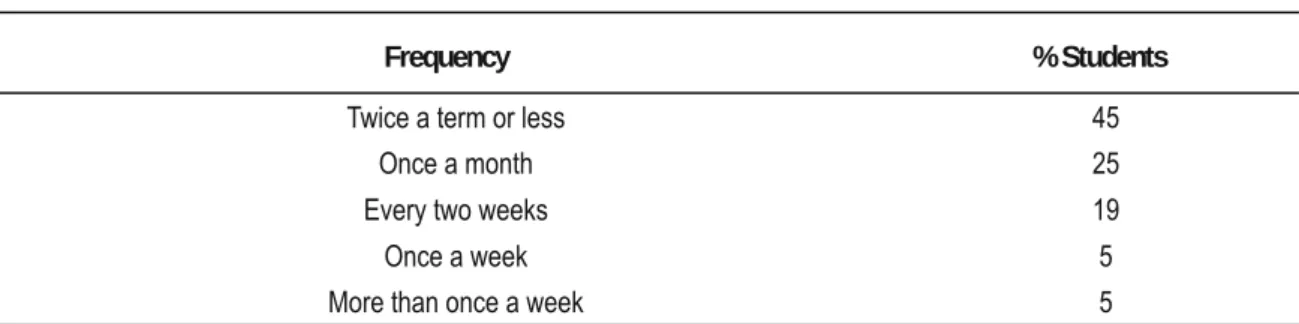
In general, it seems that while students will contact an instructor, they tend to avoid doing so with great frequency. As can be seen in Table 1, almost all students (95%) have contacted an instructor by e-mail, with 45% doing so twice per term or less, 25% about once a month, 19% every two weeks, 5% once a week, and 5% more than once a week. Only 30% use their provided university e-mail account to contact an instructor. When asked why they would contact the instructor, 78% indicated that they would do so to discuss marks or grades, 58% to get infor-mation about an upcoming examination, 55% to arrange a meeting, 47% to discuss a project or assignment, and 32% to discuss a missed class (see Table 2). When appealing a mark or grade 32% of students have done so using e-mail, with 60% of the students obtaining a changed mark or grade as a result. About a quarter of students (24%) have contacted an instructor for a course they are not taking, often to inquire about the status of a future course or for other academic information and advice.
Table 1. Frequency of Student-Instructor E-mail Contact.
Frequency % Students
Twice a term or less 45
Once a month 25
Every two weeks 19
Once a week 5
15
Table 2. Reason for Student-Instructor E-mail Contact.
Reason % Students
Discuss marks or grades 78
Information about examination 58
Arrange a meeting 55
Discuss a project or assignment 47
Discuss a missed class 32
Instructors tend to answer student e-mail 94% of the time, according to student reports. The majority of students (68%) received a reply within three days and 60% within two days. However, it is reported that response times are highly variable with some instructors responding “fast” and oth-ers taking “a week or more.” To gauge student expectations of response times, we asked them how long they think they should wait for a reply. The most common response (by 38%) was that students should only wait one day for a reply. One quarter (25%) thought they should wait at most two days, with the remainder of responses showing great variability (from 3 hours to two weeks). When asked how long they would wait before sending another e-mail if they did not receive a response to their initial request, a similar variability in responses existed. The predominant response (35%) was to wait two or three days, with the remainder indicating they would wait some length of time up to a week, or would try to arrange a “face-to-face” meeting with the instructor. However, only 56% of students indicated that they would send a second message.
We then asked students to think about the length of instructors’ e-mails. Instructors’ replies tend to be shorter (52%) or the same length (43%) as the initial student message and are rarely longer (5%). However, regardless of their brevity, most students said these replies tend to be of high (37%) or very high (13%) quality, as compared to 46% reporting the quality to be average, low (3%) or very low (1%). Students reported that the replies are typically satisfying (45% somewhat and 24% very) with a small set (22%) considered as neutral and only a few (9%) considered as somewhat unsatisfying. No student was “very unsatisfi ed” with instructors’ replies. Students suggested that instructors are “doing their best,” are “very busy,” and that for the most part, instructors are provid-ing students with satisfactory solutions to issues by e-mail.
Most students (72%) have received e-mail that an instructor has sent to the entire class, thus suggesting that use of class e-mail lists is common-place. However, a quarter of students have had an instructor that refused to use e-mail and in 86% of these cases, the instructor did not use any form of electronic communication.
Other Academic Uses of E-Mail
In addition to using e-mail to communicate with the instructor, 50% of students use e-mail to contact teaching assistants (TAs). The TA was indicated as having responded 68% of the time, with 51% of the responses being somewhat or very satisfying. Similar to the results from e-mailing an instructor, the rest of the responses tended to be neutral (37%) with only a minority (11%) being somewhat or very unsatisfying. About one tenth (11%) of students indicated that they had sent an e-mail message to an instructor because they were unsatisfi ed with a TA’s response.
16 Table 3. Reason for Student-Student Contact by E-mail.
Reason % Students
Discuss marks or grades 17
Information about examination 67
Arrange a meeting 46
Discuss a project or assignment 64
Discuss a missed class 77
Students have also contacted other university services using e-mail, such as the technology support department (21% of students), student associations (21%), department chairpersons (20%) and, quite unexpectedly, Deans, Vice-Presidents, the Provost, or the President (18%). The most commonly e-mailed department, however, is the offi ce of the Registrar, which has received e-mail from 46% of students.
Students’ Views on Spam
In general, the majority of our participants could not provide an accurate technical defi nition when asked, “What is spam?” As popular as the term has become, it is still not the term of choice among university students, and instead, the majority (82%) defi ned it as “junk e-mail.” When presented with the defi nition: “spam is unsolicited, unwanted e-mail that was sent indiscriminately, directly or indirectly, by a sender having no current relationship with the recipient,” (Cormack & Lynam, 2005) 94% agreed with this defi nition and 6% disagreed. Of those who disagreed, 2 individuals considered it inaccurate, as spam may come from someone they know and 2 indicated they did not understand the defi nition.
When asked, “Do you think that there should be some sort of legislation to stop spam?” 31% replied yes, 65% replied no, and 4% were undecided. The arguments of those who did not agree that there should be legislation centered on the idea that it is easy to delete, impossible to stop, and one just has to expect it to happen. As one participant aptly put it, “Junk e-mail is just something that exists like junk mail or ads on TV. You just have to live with it.” Interestingly, 20% of students indicated that they have received e-mail from other students that they consider to be spam and 19% of students believe that their instructors have accidentally mistaken their e-mail for spam.
Even though these attitudes demonstrate a moderate acceptance of spam, the students’ also re-vealed that they were quite adept at dealing with it by reducing its impact. When asked, “Do you fi lter your own e-mail to cut back on spam? If so, how?” 71% replied in the affi rmative; of this total, 66% replied they use a “white-list” to specify from whom the account can receive e-mail and/or train their fi lter by individually specifying which of their received e-mail messages are to be considered spam, placed in a junk folder, and deleted.
It is also possible that students are apathetic towards spam because they do not manually sort it on a daily basis. The majority of students (69%) use the spam fi ltering of their freemail service provider (an increase over the 37% reported by Fallows, 2004), but some (27%) were unaware of whether any fi ltering took place. Most (80%) believe that fi lters are easy to use, and merely involve the “click of a button” when creating an account. Three students believe that their freemail accounts allow them to decide the level of the fi ltering. Whether they understand that the level of the fi ltering is inversely related to the potential for lost e-mail is unknown, but two students did reply that they do not allow for any fi ltering of their e-mail because they are concerned with missing e-mail.
Students’ Views on Lost E-mail
When asked, “Have you misplaced or lost e-mail because of spam fi ltering? If yes, how often does it happen?” we found that students lose an estimated 1 to 116 messages per year (M = 28.38,
par-17 ticipants lose 2 messages a month on average and are ambivalent to the fact. Only 9 students responded “yes” when asked, “Would you stop fi ltering your e-mail to avoid this problem?” When asked if they had ever “lost e-mail from an instructor,” 8% indicated that they had, and 5% indicated that “they had used lost e-mail as an excuse in an academic situation.” Over a quarter of students (28%) have had an instructor claim to have lost a message that the student has sent.
Students’ Views of Instant Messaging
Students were almost evenly split in their desire to have an instructor communicate with them using IM. One half (50%) responded that they would permit an instructor to contact them by IM, and 49% would not (1% did not answer the question). The reasons underlying this decision are highly varied, but in general, those students that would permit IM contact would do so because it is “quicker and easier,” “they receive the message right away,” and “its great for quick answers.” Other reasons for permitting contact were that it allows “the development of a more comfortable relationship with the instructor,” and it “allows for extra help.” If it was necessary to contact an instructor by IM, about a half would create a new account to do so (47% would, 52% would not, 1% did not respond).
When an instructor has given students the option of using IM (reported by 9% of students), 23% of students did so. However, we view these numbers with some doubt as it appears that some of the students were quite liberal in their interpretation of an instructor’s intent. That is, we believe that some students obtained their instructor’s IM contact information and, when the instructor did not object, assumed that consent was given.
Those that did not desire to communicate with instructors using IM had a larger set of reasons, with the most dominate being that it would be “hard for instructors,” in that “its full of slang that most instructors wouldn’t understand.” Another common belief is that “IM is only used for friends,” because “it’s friendly and personal” and that its “too informal” and “not professional” for contact with instructors. It was stated that contact with an instructor via IM would “violate your personal space.” Some students were just dissatisfi ed with IM regardless of whom they were communicating with because they “hate chatting online” or “don’t use it that much.” It was often stated that e-mail is “better for explaining things,” and “communicating important messages” but several students suggested that the telephone or face-to-face meetings are needed for longer interactions. One student did not use IM because they had been “hassled when using IM” and felt that it created a threat to their privacy and personal safety.
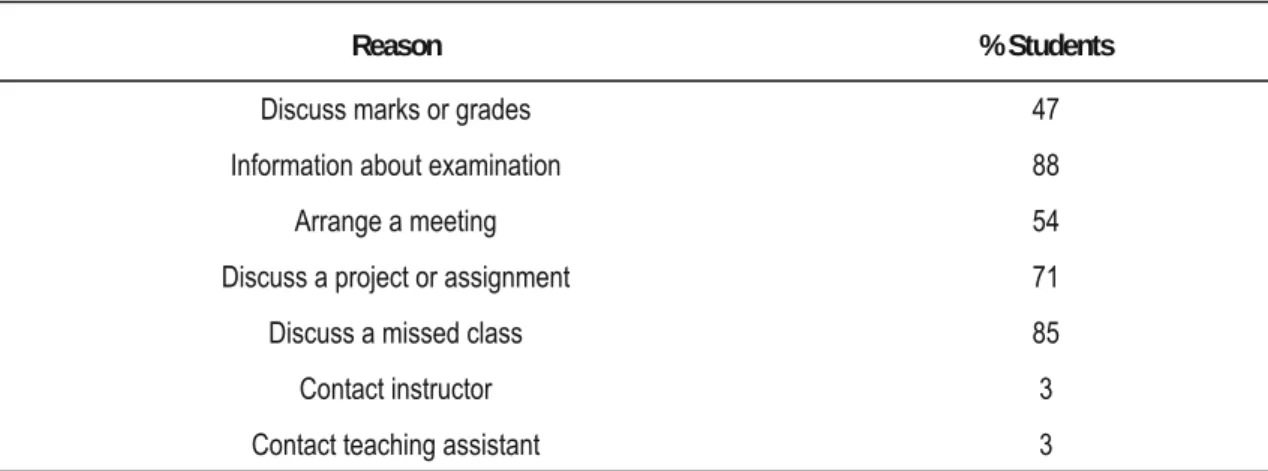
Although students are split as to whether IM should be used with instructors, IM does have an academic role in that many individuals reported contacting other students. As can be seen in Table 4, most students have used IM for an academic purpose such as discussing an upcoming exam (88%), discussing a missed class (85%), discussing a project or assignment (71%), arranging a meeting for an academic purpose (54%) or discussing their marks or grades (47%). In general, IM is used predomi-nately with other students, as its use to contact TAs (3%) or instructors (3%) has been performed by a comparatively small numbers of students.
Table 4. Reasons for Students’ Academic Use of Instant Messaging.
Reason % Students
Discuss marks or grades 47
Information about examination 88
Arrange a meeting 54
Discuss a project or assignment 71
Discuss a missed class 85
Contact instructor 3
18 Acceptable Abbreviations
When using IM, it is very common to use abbreviations and acronyms such as ASAP (as soon as possible) or LOL (laughing out loud). Many of these abbreviations are common-place (e.g., ASAP), while others have been more recently developed and may be less familiar. We asked stu-dents to identify the abbreviations that they felt would be permissible to use during electronic (e.g., IM, e-mail) conversations with instructors. About one fi fth (18%) could not suggest any appropriate abbreviations. For the remaining 82%, most of the responses (all but 10) were very restrained and thought only a few, usually conventional, abbreviations were acceptable. Examples of these conven-tional abbreviations include: Dr., Mr., Mrs., prof (professor), GPA (grade point average), and SMU (Saint Mary’s University). One student claimed not to use abbreviations, one student suggested that any abbreviation used in the course material would be acceptable, and one suggested that the use of abbreviations “didn’t matter as long as they sound professional.” Five students suggested more contemporary abbreviations such as: bc or b/c (because), c (see), u (you), and LOL.
IM and Group Projects
IM is used by the majority of students (71%) to correspond with group members for a group project. It is chosen because its “easy,” “fast,” and permits one to “talk to all group members simul-taneously.” However, its role is not always to discuss the project (although 51% of students have used it for this purpose), as 50% of students see IM as a means to arrange a face-to-face meeting.
WebCT
We found that 64% of students reported taking a course that used WebCT (now merged with the Blackboard Learning System), with 2% taking one course using it, 10% taking two courses, 12% taking three courses, 15% reporting 4 courses, and the rest more than 4 courses, up to a reported maximum of 14 courses. Of those that reported taking at least one course where WebCT was used, 45% reported talking in a chat room with other students, the TA and the professor, 96% reported downloading or viewing fi les, 76% viewed or posted to a bulletin board, 46% viewed a presentation, 68% completed practice quizzes, 93% looked at marks, 90% checked important dates, 67% sent e-mail to the professor, and 58% submitted course work. Of those with at least one course involving WebCT, 82% of students reported that they have directly interacted via this tool with instructors, 15% directly interacted with the TA, 37% with group members for a group project, and 67% with other students. In general, students were satisfi ed with their use of WebCT, as 34% indicated that they were very satisfi ed, 48% were somewhat satisfi ed, 13% were neutral, and 5% were somewhat unsatisfi ed. No student was very unsatisfi ed with their experience in using WebCT.
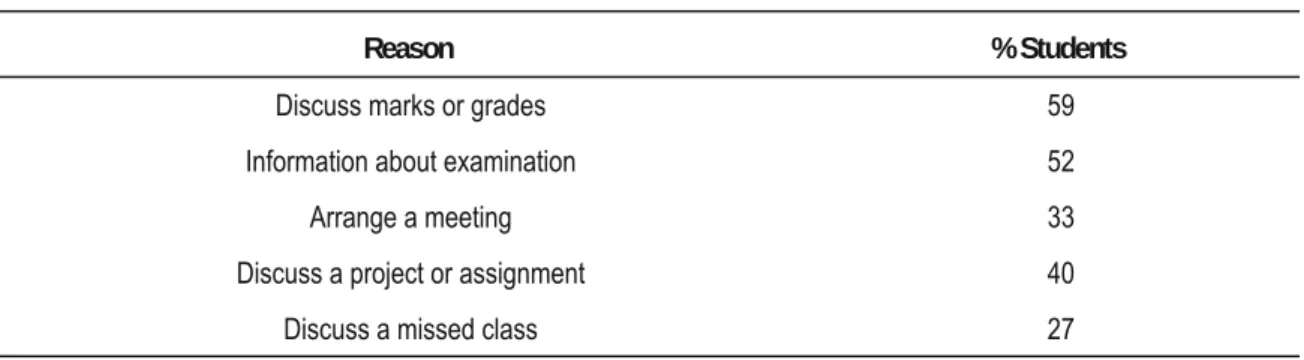
We asked students the reasons why they contact their instructors on WebCT. As shown in Table 5, more than half (52%) were attempting to gain information about an upcoming examination, while 27% wanted information about a missed class, 40% wanted to discuss a project or assignment, 33% wanted to arrange a meeting, and 59% wanted to discuss marks or grades.
Table 5. Reasons for Student-Instructor Contact on WebCT.
Reason % Students
Discuss marks or grades 59
Information about examination 52
Arrange a meeting 33
Discuss a project or assignment 40
19 WebCT provides students with the capability, when it is enabled, to examine some descrip-tive statistics for an evaluadescrip-tive instrument (e.g., test, assignment). Less than half (43%) of students reported using this feature. We then asked students, who indicated that they had used WebCT, how often during a term they logged into a WebCT server; 2% replied once or twice a term, 3% replied once a month, 8% replied a few times a month, 25% replied once a week, 42% replied a few times a week, and 20% replied daily.
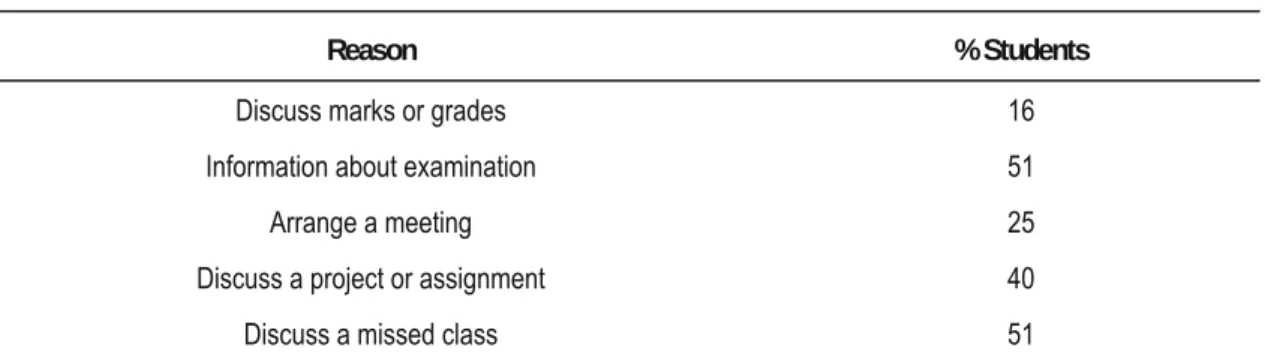
The reasons students provided for contacting other students on WebCT were very similar to the data for IM or e-mail (see Table 6). Slightly over one half (51%) reported that they were seeking information about an upcoming examination, 51% were seeking information about a missed class, 40% were discussing a project or assignment 25% were arranging a meeting to discuss an academic issue, and 16% were discussing marks or grades.
Students were asked if they had taken a course where they were given access to WebCT, but they decided to not use it; 21% reported affi rmative. For those that did not use WebCT, we asked them why. Student responses identifi ed a variety of reasons, such as “all materials I needed were provided in class,” “it’s hard to access,” “not worth the effort,” “I’m just lazy,” or “the professor never provided anything new there during the course.”
Table 6. Reasons for Student-Student Contact on WebCT.
Reason % Students
Discuss marks or grades 16
Information about examination 51
Arrange a meeting 25
Discuss a project or assignment 40
Discuss a missed class 51
We also asked students to indicate the features of WebCT that they found the most useful for successfully completing a course. The two most frequent responses were that students enjoyed and learned from “talking” online with other students (35%) and that they gained access to course materials (40%). Other features that students found useful included the posting of grades and practice quizzes; interestingly, no student replied that interacting with the professor was the most useful feature.
Cellular (Mobile) Telephone Text Messaging
20 Table 7. Reasons for Students’ Academic Use of Text Messaging.
Reason % Students
Discuss marks or grades 16
Information about examination 39
Arrange a meeting 33
Discuss a project or assignment 30
Discuss a missed class 38
Discussion
Although our universities provide students with e-mail accounts, our results show that many students do not always use these accounts. Although this issue does not directly address the commu-nication between an instructor and a student, it is informative to discuss some explanations for this phenomenon. First, many students had an e-mail account prior to enrolling in university and were unwilling to expend the effort of switching to the university address for a brief four year period (a typical Canadian undergraduate student takes four years to complete a degree). We posit that students fully expect to continue using e-mail after graduation and do not wish to establish a temporary e-mail identity. They appear to be satisfi ed with their freemail accounts, but would likely switch providers if their service was limited or restricted.
Second, many students are potentially unhappy with imposed university quotas for non-volatile storage (i.e., disk space). Students are often highly adept at using e-mail to share photographs, music, and other multimedia assets. Informal conversations during the debriefi ng revealed that many students consider the university quota (49 Mbytes at SMU) as insuffi cient to reliably perform these activities. This issue also indicates a need for improved integration of e-mail clients with other media manage-ment tools. As well, students believe that Saint Mary’s University, the location of this research, has a poor “web presence” and fi nd the WWW-based e-mail interface to be unappealing, unattractive, slow, and diffi cult to use, when compared to their freemail accounts.
Furthermore, students appear to not like to have their alias (i.e., user ID) assigned to them and prefer to select their own, which some universities, such as Saint Mary’s, do not permit. In contrast, freemail accounts allow users to select their own aliases and thus, to create an identity that is visible to the world. That is, as Gross (2004) states, people can create identities where the alias has little in common with their real name. Comments during debriefi ng indicated very clearly that students are aware of the anonymity that is available and sometimes desire this anonymity. Furthermore, self-selection permits the creation of an identity that matches the purpose of the account. Related to this, students might be avoiding their university accounts, which are linked to their name, in order to remain anonymous, and hence, use a freemail account for this purpose (Utz, 2004). Wymer (2006) suggests that students develop identities related to technologies and they may not wish to bring these identities into the classroom for personal or professional reasons.
Alternatively, when aliases are randomly generated, as they are at Dalhousie University, the institution of the second author, students anecdotally mention that they avoid using these accounts because the recipients of their e-mail cannot easily identify them. In general, it is likely that students wish to select their own alias because many providers permit them to, and because they have personal criteria that assigned aliases do not satisfy.
21 concerned with how professional they appear, and hence, there is little to encourage students to use an account associated with an academic institution.
While providing a potential replacement to e-mail, IM should be viewed as a supplementary communication technology and should only be used with those students with whom an instructor has forged some form of personal relationship. As our data show, many students consider IM as a means for communicating with friends and peers, and are not necessarily willing to let instructors fall into this category. In support of this view, Wymer (2006) notes that when given the chance to use IM, only 7 of her 72 students availed themselves of the opportunity. Quan-Haase, Cothrel, and Wellman (2005) examined the use of IM in an industrial setting and found that although IM increases employee “connectivity,” it was also used as a shield by employees to distance themselves from their superiors. That is, they saw it as a means to communicate with co-workers with whom they have a close relationship, but not as a tool to increase their communication with those in higher positions. Our fi ndings show that an equivalent attitude exists with students and thus, we suggest that instructors use IM sparingly, and with students that they have formed an appropriate social relationship.
Nicholson (2002) found that when given access to IM, students decreased their use of WebCT and of the telephone, but not of e-mail. Thus, e-mail must be seen as serving a valued and crucial role than cannot be replaced by alternative technologies. His students identifi ed IM as a “valuable social tool” that was not often used for communication of academic material. However, it was noted that even though the students did not often communicate with the instructor, his presence helped to build a better sense of “community.” Given these fi ndings, as well as those of Frey, Yankelov, and Faul (2003) who showed that e-mail was the most effective and valued communication technology by students, we propose that instructors should not turn to alternative technologies at the expense of e-mail.
Although we are recommending that instructors opt to not use IM unless they personally know the student, we are not suggesting that students should be encouraged to stop their IM activity. As the results of our study demonstrated, students are interacting with their peers about academic material using IM, and use this medium to discuss missed class material, upcoming examinations, assign-ments or projects, and evaluation. This result highlights the complexity of social interactions, power and status. Students obviously want to communicate and discuss academic issues over IM, but they want to do so with those at the same level with equivalent power and status (other students), and not necessarily do so with those of higher power and status (instructors).
We should also mention that students listed personal safety and privacy as a reason for not wanting to use IM in an educational context, which is an important issue when thinking about the implementation of any tool. Student concerns about their personal safety in online environments and about misuse of technology are well founded. As Licari (2005) indicates, information technol-ogy workers are unfamiliar with the threats associated with IM and other new technologies. IM is used to circumvent established e-mail security procedures, creating avenues for malicious users to obtain personal and other sensitive data. As IM is rarely recorded, it is perceived as more anonymous, and thus is more likely to be used in an abusive manner than is e-mail (Hancock, Thom-Santelli, & Ritchie, 2004). IM is also vulnerable to ‘spim,’ the IM equivalent of spam. As reported by Farmer (2005), it is expected that spim will increase by over 1300% between 2004 and 2008.
A cursory search for university podcasts on the Internet reveals that there are several universities that advertise that they are using this method for communicating with the public, and presumably, are encouraging instructors to use it as a tool to interact with students. A quick search in October 2007 revealed over 30 universities in the United States alone offered courses, with many of these offering many courses by podcast (see also http://www.oculture.com/2006/10/university_podc.html). While podcasts are a potential communication tool, they are not interactive in nature and, as our data indicate, are not being regularly accessed by the majority of students. Thus, they may provide an alternative delivery technique for academic material, but are not likely to have any signifi cant future impact on interactive communication.
22 create and use a blog throughout a course as a way to update students about course material, but this would result in essentially creating a website to which students refer for more information. As has been previously stated, if it is not mandatory for students to perform an online task, or if suffi cient motivation is not provided, students will usually not comply (Mock, 2001).
Another competitor to e-mail and IM is cellular (i.e., mobile) telephony, whether used for text messaging, or simply for placing a call. Cell phones have become increasingly affordable and are carried by the majority of students. We found that students overwhelmingly do not desire the ability to communicate by cell phone with their instructors. Thus, while cell phones are highly convenient and provide a faster response time than IM or e-mail, they also are considered as less useful in aca-demic settings because of this fact. We suggest that the more immediately accessible that technol-ogy makes a person, the more they limit its use by providing their contact information to fewer and more intimate acquaintances. E-mail thus seems to provide the average student with the appropriate amount of accessibility for the relationship that they have with an instructor. However, as student perceptions change with respect to acceptable response times, future instructors may fi nd that IM is a better communication tool, but presumably, cell phones will remain relatively useless for student-instructor communication for a long time to come.
We also investigated students’ views and behaviours involving WebCT. Students were generally satisfi ed with their experience in using this environment, and many have used it within their classes, thus showing that many instructors use it with some regularity. Interestingly, students in our study showed that when they interact with the instructor directly, they are primarily addressing the same issues as they would by e-mail. We do not fi nd this surprising as communication within WebCT is based on standard e-mail protocols. However, WebCT does offer additional tools to students, such as the ability for instructors to post practice quizzes and other materials for students to download. In future research, it would be informative to ask students to compare their views on their interactions with instructors for courses in which they used, and did not use, WebCT. Although our results show that the content of the interaction seems to be the same between the two tools, students might prefer to communicate with instructors who put the effort into creating a virtual environment to support student learning and engagement.
One last topic that deserves discussion involves spam. In conversation with colleagues at uni-versities, we fi nd that students’ attitudes towards spam is unexpected. Perhaps students’ tolerance of spam stems from the fact that they have not known a time without spam and thus believe that it is to be expected – it is just the way the world is. Given that spam is thought to fi rst exist starting in the early 1990’s (Bleicher, 2005), when the majority of today’s undergraduates were at best in primary school, their view that it simply accompanies e-mail is sensible. An informal survey of fac-ulty members at our institutions suggests that the attitude of students differs from instructors’ more strongly expressed fear of losing messages. Our students do not want to fi lter spam, they want to fully “block” it and are content with losing some e-mail as a consequence. In future, spam fi ltering may be replaced with “ham” (i.e., the opposite of spam; the e-mail that one wants to receive) fi lter-ing to identify blocked but potentially valuable e-mail.
E-mail triage (i.e., the sorting of unhandled e-mail) can be a time-consuming activity. While approaches to provide support for triage have been examined (e.g., Neustaedter, Bernheim Brush, Smith, & Fisher, 2005) the use of white-lists and multiple accounts demonstrates that students have found effective techniques, albeit simple ones, for dealing with this issue. Students are minimally concerned about lost e-mail, and while accepting of spam’s existence, are more than tolerant of some lost e-mail when it occurs as a result of spam elimination techniques. This situation creates a paradox: students view e-mail as a highly effective tool for communicating with their instructors, yet express little concern over the possibility of losing or not-receiving e-mail. Given that they hold e-mail in high esteem, one would expect that they would be extremely careful to ensure that they receive all their messages.
23 IM further increases, the habits they develop in IM will further infl uence their communication with instructors. Our fi ndings suggest that informality in communication is the result of familiarity with the technology and most likely not due to familiarity with the instructor. As noted by Nachbaur (2003), students increase their use of ‘smileys,’ ‘emoticons,’ and abbreviations when they learn to use these techniques to replace body language and other visual cues not available in online communication. Future research is needed to explore how these devices impact instructor-student communication. For example, do instructors who receive an e-mail laden with emoticons and abbreviations respond far differently than if the e-mail did not contain these devices? What are the long-term implications for students who use these devices within an educational environment?
There are many other issues that need to be examined in the future. We primarily encourage others in this research domain to begin exploring instructor’s perceptions in a formal manner so as to fully examine the differences in instructor’s and student’s beliefs and expectations. In addition to the questions already posed in this chapter, one could investigate how instructors view students’ use of their non-university based e-mail accounts. Is there agreement that the status of freemail accounts is lower than an institutional account? How do they perceive students’ whose user names are, in their opinion, unprofessional? That is, for example, we have received e-mail from students whose user names are: “ghetto_meadow,” “stepha_hottie_69,” “pigtails5,” “Buddha_baby80,” “iluv_jesus,” “black_beauty_1982,” “dream_queen_17,” “hotstuf69,” and “sexykitten1985,” all of which advertise personal traits and may actually decrease the instructor’s perception of the student’s professionalism or academic ability. Additionally, how can instructors adjust to student tolerance of unreceived e-mail? While instructors may simply demand that students use e-mail in a more professional manner, such an approach will inevitably fail when it clashes with students’ values, expectations, and experiences. Thus, there is a need to explore techniques that can be used to mediate differences in attitudes and perceptions regarding electronic communication.
Finally, it is important to acknowledge the limitations of this research, particularly as they per-tain to our sample. Our sample size was suffi cient for the purposes of this study, however, in order to have more representative results, future researchers might wish to include a larger sample. More importantly, our fi ndings rest on students from the east coast of Canada. Although Halifax is a capital city, it is still relatively small and ethnically homogenous compared to other metropolitan cities in Canada, and elsewhere in the world. One might opt to include a more diverse sample in the future.
Conclusion
24
References
Birdsell, D., Muzzio, D., Krane, D., & Cottreau, A. (1998). Web users are looking more like America. The Per-spective, 9, 33-35.
Bleicher, P. (2005). From spam to adverse events. Applied Clinical Trails, 14, 38-44.
Boneva, B., Kraut, R., & Frohlich, D. (2001). Using e-mail for personal relationships: The difference gender
makes. American Behavioral Scientist, 45, 530-549.
CA*Net Institute. (2001). A nation goes online: Canada’s Internet history. Ottawa: CANARIE, Inc. Retrieved May 8, 2007, from http://www.canarie.ca/press/publications/pdf/ango.pdf
Cormack, G. V., & Lynam, T. R. (2005). Spam track overview. Proceedings Fourteenth Text Retrieval
Confer-ence, Gaithersburg, MA, USA, 1-17.
Donath, J. S. (1999). Identity and deception in the virtual community. In M.A. Smith & P. Kollock (Eds.), Com-munities in cyberspace (pp. 29-59). London: Routledge.
Elmer, D. (2007). Something different from the same-oh, same-oh: A survey of community college students’ competence in and use of technology in public speaking classes. Journal of Literacy and Technology, 8, 21-39. Fallows, D. (2004). Internet users and spam: What attitudes and behavior of Internet users can tell us about fight-ing spam. Proceedings of the First Conference on E-mail and Anti-Spam, Mountain View, CA, USA.
Farmer, R. (2005). Instant messaging: IM online RU? Educause Review, 40, 49-62.
Frey, A., Yankelov, P., & Faul, A. (2003). Student perceptions of web-assisted teaching strategies. Journal of Social Work and Education, 39, 443-457.
Gross, E. F., Juvonen, J., & Gable, S. L. (2002). Internet use and well being in adolescence. Journal of Social Issues, 58, 75-90.
Gross, M. (2004). Multiple e-mail addresses: A socio-technical investigation. Proceedings of the Conference on E-mail and Anti-Spam, Mountain View, CA, USA.
Hancock, J. T., Thom-Santelli, J., & Ritchie, T. (2004). Deception and design: The impact of communication technology on lying behavior. Proceedings of the ACM Conference on Computer-Human Interaction, 6,Vienna, Austria, 129-134.
Joiner, R., Gavin, J., Duffield, J., Brosnan, M., Crook, C., Durndell, A., Maras, P., Miller, J., Scott, A. J., & Lovatt, P. (2005). Gender, internet identification, and internet anxiety: Correlates of internet use. Cyberpsychology and Behavior, 8, 371-378.
Kapur, S. (2007, September 25). Facebook moves into the classroom. The Stanford Daily.
Retrieved October 17, 2007, from http://daily.stanford.edu/article/2007/9/25/facebookMovesIntoTheClass-room
Lanthier, R. P., & Windham, R. C. (2004). Internet use and college adjustment: the moderating role of gender. Computers in Human Behavior, 20, 591-606.
Licari, J. (2005). Securing the information workplace: Managing threats to enterprise e-mail, IM and document sharing environments. Information Systems Security, 14, 45-50.
Metz, C. (2005). The spam stoppers. PC Magazine, 24, 82.
Mock, K. (2001). The use of Internet tools to supplement communication in the classroom. Journal of Computing Sciences in Colleges, 17, 14-21.
Morss, D. (1999). A study of student perspectives on web-based learning: WebCT in the classroom. Internet Research, 9, 393-408.
Nachbaur, A. (2003). College students and instant messaging: An analysis of chatting, flirting, and using away messages. Retrieved July 7, 2007, from Stanford University Web site: http://www.stanford.edu/class/pwr3-25/group2/pdfs/IM_Flirting.pdf
Neustaedter, C., Bernheim Brush, A., Smith, M., & Fisher, D. (2005). The social network and relationship finder: Social sorting for e-mail triage. Proceedings of the Second Conference on E-mail and Anti-Spam, Stanford, CA, USA.
25 Odell, P. M., Korgen, K. O., Schumacher, P., & Delucchi, M. (2000). Internet use among female and male college students. Cyberpsychology and Behavior, 3, 855-862.
Quan-Haase, A., Cothrel, J., & Wellman, B. (2005). Instant messaging for collaboration: A case study of a high-tech firm. Journal of Computer-Mediated Communication, 10. Retrieved May 9, 2007, from http://jcmc.indiana. edu.vol10/issue4/quan-haase.html.
Ractham, P., & Zhang, X. (2006). Podcasting in academia: a new knowledge management paradigm within
aca-demic settings. Proceedings of the 2006 ACM SIGMIS Conference on Computer Personnel Research:
Achieve-ments, Challenges, and the Future, New York, NY, USA, 314-317.
Statistics Canada (2005; data released 2006, August 15). Canadian Internet use survey (Rep. No. 4432). Retrieved September 12, 2007, from http://www.statcan.ca/
Taylor, H. (1999, December 22). The Harris poll #76: Online population growth surges to 56% of all adults. Retrieved May 8, 2007, from http://www.harrisinteractive.com/harris_poll/
Townley, C., & Parsell, M. (2005). The cost of a common good: Putting a price on spam. Philosophy in the Contemporary World, 12, 68-75.
Utz, S. (2004). Enter your e-mail address: How German Internet users manage their e-mail addresses. Cyberpsy-chology and Behavior, 7, 241-246.
Wymer, K. (2006, February 10). The professor as instant messenger. The Chronicle of Higher Education (online edition). Retrieved May 8, 2007 from http://chronicle.com/weekly/v52/i23/
Adviced byMartin Voracek, University of Vienna, Austria.
Maryanne Fisher Assistant Professor at Saint Mary’s University, Canada. 923 Robie Street, Halifax, Nova Scotia, Canada. Phone: +1 902 491 6275
E-mail: mlfi [email protected]
Website: http://www.smu.ca/ ; http://dagobah.cs.dal.ca/~mlfi sher/
Anthony Cox Assistant Professor at Dalhousie University, Canada.
6050 University Avenue, Halifax, Nova Scotia, Canada, B3H 1W5 Phone: +1 902 494 8046
E-mail: [email protected]