Probabilistic Graphical Models for
Credibility Analysis in
Evolving Online Communities
Subhabrata Mukherjee
Dissertation zur Erlangung des Grades
des Doktors der Ingenieurwissenschaften (Dr.-Ing.) der Fakultät für Mathematik und Informatik
der Universität des Saarlandes
Saarbrücken March 2017
Dean Prof. Dr. Frank-Olaf Schreyer
Faculty of Mathematics and Computer Sciences Saarland University
Saarbrücken, Germany Colloquium July 6, 2017
Saarbrücken, Germany
Examination Board
Advisor and Prof. Dr. Gerhard Weikum
First Reviewer Department of Databases and Information Systems Max Planck Institute for Informatics
Saarbrücken, Germany Second Reviewer Prof. Dr. Jiawei Han
Department of Computer Science
University of Illinois at Urbana-Champaign Urbana, USA
Third Reviewer Prof. Dr. Stephan Günnemann Department of Informatics Technical University of Munich Munich, Germany
Chairman Prof. Dr. Dietrich Klakow
Department of Computer Science Saarland University
Saarbrücken, Germany Research Dr. Rishiraj Saha Roy
Assistant Department of Databases and Information Systems Max Planck Institute for Informatics
“Note to self: every time you were convinced you couldn’t go on, you did.” — Unknown
To my (latent) support system — my loving parents and brother, and my beautiful wife Sarah . . .
Acknowledgements
First and foremost, I would like to express my deepest gratitude to my supervisor and mentor Gerhard Weikum for giving me the opportunity to pursue research under his guidance. His constant motivation, excellent scientific advice, wisdom, and vision have been of quintessen-tial importance to make this work possible. I will always cherish our interactions that have helped me mature not only as a researcher, but also as a person.
I would like to thank the additional reviewers and examiners of my dissertation, Jiawei Han, and Dietrich Klakow for their valuable feedback. I am extremely grateful to all my collaborators and co-authors — Cristian Danescu-Niculescu-Mizil, Stephan Günnemann, Hemank Lamba, Kashyap Popat, Sourav Dutta, and Jannik Strötgen — for actively contributing to, and shaping my dissertation. I am thankful to all my colleagues at the Max Planck Institute for Informatics for participating in discussions, and providing insightful ideas and valuable feedback during the course of my doctoral studies. I am thankful to all my friends here to have made my jour-ney an enjoyable one, especially Arunav Mishra, Sarvesh Nikumbh, Tomasz Tylenda, Dilafruz Amanova, Sourav Dutta and Nikita Dutta. I would also like to thank all the administrative staff at the Max Planck Institute for being supportive and providing assistance whenever necessary, so I could freely indulge in my research. I owe many thanks to the International Max Planck Research School and the Max Planck Society for the financial support that allowed me to pursue my research, and present my work at conferences around the world.
Last but not least, I would like to thank my parents Sushama and Subrata Mukherjee, and my brother Subhojyoti Mukherjee for their continued support and encouragement. Most importantly, I thank my wife Sarah John for being by my side since the beginning of time.
Abstract
One of the major hurdles preventing the full exploitation of information from online com-munities is the widespread concern regarding the quality and credibility of user-contributed content. Prior works in this domain operate on a static snapshot of the community, making strong assumptions about the structure of the data (e.g., relational tables), or consider only shallow features for text classification.
To address the above limitations, we propose probabilistic graphical models that can lever-age the joint interplay between multiple factors in online communities — like user interac-tions, community dynamics, and textual content — to automatically assess the credibility of user-contributed online content, and the expertise of users and their evolution with user-interpretable explanation. To this end, we devise new models based on Conditional Random Fields for different settings like incorporating partial expert knowledge for semi-supervised learning, and handling discrete labels as well as numeric ratings for fine-grained analysis. This enables applications such as extracting reliable side-effects of drugs from user-contributed posts in healthforums, and identifying credible content in news communities.
Online communities are dynamic, as users join and leave, adapt to evolving trends, and mature over time. To capture this dynamics, we propose generative models based on Hidden Markov Model, Latent Dirichlet Allocation, and Brownian Motion to trace the continuous evolution of user expertise and their language model over time. This allows us to identify expert users and credible content jointly over time, improving state-of-the-art recommender systems by explicitly considering the maturity of users. This also enables applications such as identifying helpful product reviews, and detecting fake and anomalous reviews with limited information.
Kurzfassung
Eine der größten Hürden, die die vollständige Nutzung von Informationen aus sogenannten Online-Communities verhindert, sind weitverbreitete Bedenken bezüglich der Qualität und Glaubwürdigkeit von Nutzer-generierten Inhalten. Frühere Arbeiten in diesem Bereich gehen von einer statischen Version einer Community aus, machen starke Annahmen bezüglich der Struktur der Daten (z.B. relationale Tabellen) oder berücksichtigen nur oberflächliche Merk-male zur Klassifikation von Texten.
Um die oben genannten Einschränkungen zu adressieren, schlagen wir eine Reihe von proba-bilistischen graphischen Modellen vor, die das Zusammenspiel mehrerer Faktoren in Online-Communities berücksichtigen: Interaktionen zwischen Nutzern, die Dynamik in Online-Communities und der textuell Inhalt. Dadurch können die Glaubwürdigkeit von Nutzer-generierten On-line Inhalten sowie die Expertise von Nutzern und ihrer Entwicklung mitinterpretierbaren Erklärungenbewertet werden. Hierfür konstruieren wir neue, auf Conditional Random Fields basierende Modelle für verschiedene Szenarien, um beispielsweise partielles Expertenwissen mittels semi-überwachtem Lernen zu berücksichtigen. Genauso können diskrete Labels so-wie numerische Ratings für präzise Analysen genutzt werden. Somit werden Anwendungen ermöglicht wie etwa das automatische Extrahieren von Nebenwirkungen von Medikamenten aus Nutzer-erstellten Inhalten in Gesundheitsforen und das Identifizieren von vertrauenswür-digen Inhalten aus Nachrichten-Communities.
Online-Communities sind dynamisch, da Nutzer zu Communities hinzustoßen oder diese verlassen. Sie passen sich entstehenden Trends an und entwickeln sich über die Zeit. Um diese Dynamik abzudecken, schlagen wir generative Modelle vor, die auf Hidden Markov Modellen, Latent Dirichlet Allocation und Brownian Motion basieren. Diese können die kontinuierliche Entwicklung von Nutzer-Erfahrung sowie ihrer Sprachentwicklung über die Zeit nachzeichnen. Dies ermöglicht uns, Expertennutzer und glaubwürdigen Inhalt über die Zeit gemeinsam zu identifizieren, sodass die aktuell besten Recommender- Systeme durch das explizite Berücksichtigen der Entwicklung und der Expertise von Nutzern verbessert werden können. Dadurch wiederum können Anwendungen entwickelt werden, die nützliche Produktbewertungen erkennen sowie fingierte und anomale Bewertungen mit geringem Informationsgehalt identifizieren.
Contents
Acknowledgements i
Abstract (English/Deutsch) iii
List of figures xi
List of tables xiii
I Introduction 1
I.1 Motivation . . . 1
I.2 Challenges . . . 3
I.3 Prior Work and its Limitations . . . 3
I.4 Contributions . . . 5
I.5 Organization. . . 7
II Related Work 9 II.1 Probabilistic Graphical Models . . . 9
II.2 Truth Discovery . . . 11
II.3 Trust and Reputation Management . . . 13
II.4 Information Extraction (IE) . . . 13
II.5 Language Analysis for Social Media . . . 14
II.6 Information Credibility in Social Media . . . 15
II.7 Collaborative Filtering for Online Communities . . . 17
III Credibility Analysis Framework 19 III.1 Introduction and Motivation . . . 19
III.1.1 Use-case Study: Health Communities . . . 20
III.1.2 Use-case Study: News Communities. . . 21
III.1.3 Contributions . . . 23
III.2 Problem Statement . . . 24
III.3 Overview of the Model . . . 24
III.3.1 Credibility Classification. . . 24
III.3.2 Credibility Regression . . . 25
III.4 Model Components. . . 28
Stylistic . . . 28
Affective . . . 29
Bias and Subjectivity . . . 30
III.4.2 User Expertise . . . 32
III.4.3 Postings and their Topics . . . 33
III.4.4 Sources . . . 33
III.5 Probabilistic Inference . . . 34
III.5.1 Semi-supervised Conditional Random Fields for Credibility Classification 34 III.5.2 Continuous Conditional Random Fields for Credibility Regression. . . . 38
Topic Model . . . 39
Support Vector Regression. . . 40
Continuous Conditional Random Field . . . 40
III.6 Experimental Evaluation: Health Communities . . . 45
III.6.1 Data. . . 45
III.6.2 Baselines . . . 46
III.6.3 Experiments and Quality Measures . . . 47
III.6.4 Results and Discussions . . . 48
III.6.5 Discovering Rare Side Effects . . . 50
III.6.6 Following Trustworthy Users . . . 51
III.7 Experimental Evaluation: News Communities . . . 52
III.7.1 Data. . . 52
III.7.2 Predicting User Credibility Ratings of News Articles. . . 55
III.7.3 Finding Credible News Articles . . . 56
III.7.4 Finding Trustworthy Sources . . . 57
III.7.5 Finding Expert Users . . . 58
III.7.6 Discussion . . . 58
III.8 Conclusions . . . 61
IV Temporal Evolution of Online Communities 63 IV.1 Introduction . . . 63
IV.2 Motivation and Approach . . . 64
IV.2.1 Discete Experience Evolution . . . 65
IV.2.2 Continuous Experience Evolution . . . 66
IV.3 Discrete Experience Evolution . . . 68
IV.3.1 Model Dimensions . . . 68
IV.3.2 Hypotheses and Initial Studies . . . 70
IV.3.3 Building Blocks of our Model . . . 72
Latent Factor Recommendation . . . 72
Experience-based Latent Factor Recommendation . . . 72
User-Facet Model . . . 73
Supervised User-Facet Model . . . 73
Contents
Generative Process for a Review . . . 75
Supervision for Rating Prediction . . . 76
Inference . . . 77
IV.3.5 Experiments . . . 80
Setup: Data and Baselines . . . 80
Quantitative Comparison . . . 82
Qualitative Analysis . . . 83
IV.4 Continuous Experience Evolution . . . 86
IV.4.1 Model Components . . . 86
Importance of Time . . . 86
Continuous Experience Evolution . . . 86
Experience-aware Language Evolution . . . 88
IV.4.2 Joint Model for Experience-Language Evolution . . . 91
Generative Process . . . 91
Inference . . . 93
IV.4.3 Experiments . . . 97
Data Likelihood, Smoothness and Convergence . . . 98
Experience-aware Item Rating Prediction. . . 98
Quantitative Results . . . 100
Qualitative Results . . . 100
IV.5 Use-Case Study . . . 103
IV.5.1 Recommending News Articles . . . 104
IV.5.2 Identifying Experienced Users . . . 104
IV.6 Conclusion. . . 105
V Credibility Analysis of Product Reviews 107 V.1 Introduction . . . 107
V.2 Motivation and Approach . . . 108
V.2.1 Finding Useful Product Reviews . . . 108
V.2.2 Finding Credible Reviews with Limited Information . . . 110
V.3 Exploring Latent Semantic Factors to Find Useful Product Reviews. . . 112
V.3.1 Review Helpfulness Factors . . . 112
Item Facets. . . 112
Review Writing Style . . . 112
Reviewer Expertise . . . 113
Distributional Hypotheses . . . 114
Consistency . . . 114
Timeliness or “Early-bird” bias . . . 115
Preliminary Study of Feature Significance . . . 115
V.3.2 Joint Model for Review Helpfulness . . . 116
Incorporating Consistency Factors. . . 116
Incorporating Latent Expertise . . . 117
Difference with Prior Works for Modeling Expertise . . . 118
Generative Process . . . 118
Inference . . . 119
V.3.3 Experiments . . . 123
Setup: Data . . . 123
Tasks and Evaluation Measures. . . 124
Baselines . . . 125
Quantitative Comparison . . . 125
Qualitative Comparison . . . 126
V.4 Finding Credible Reviews with Limited Information using Consistency Features 129 V.4.1 Review Credibility Analysis . . . 129
Facet Model . . . 129
Consistency Features. . . 130
Additional Language and Behavioral Features . . . 132
V.4.2 Tasks . . . 133
Credible Review Classification . . . 133
Item Ranking and Evaluation Measures . . . 134
Domain Transfer from Yelp to Amazon . . . 134
Ranking SVM . . . 136
V.4.3 Experiments . . . 137
Setup and Data . . . 137
Baselines . . . 139 Quantitative Analysis. . . 139 Qualitative Analysis . . . 141 V.5 Conclusions . . . 144 VI Conclusions 145 VI.1 Contributions . . . 145 VI.2 Outlook . . . 146 Bibliography 166
List of Figures
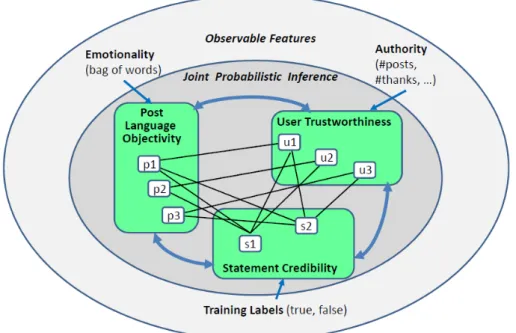
III.1 Overview of the proposed model, which captures the interactions between
statement credibility, posting objectivity, and user trustworthiness. . . 24
III.2 Graphical model representation. . . 26
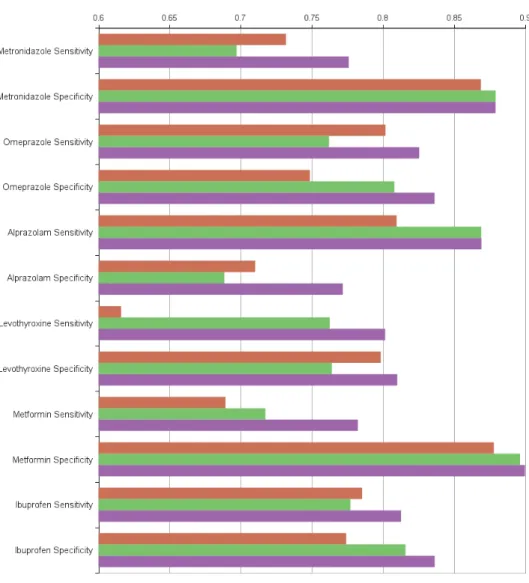
III.3 Specificity and sensitivity comparison of models. . . 49
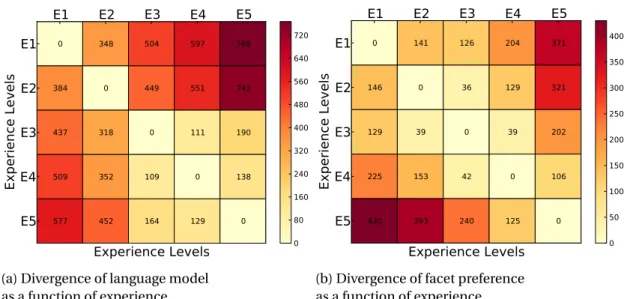
IV.1 K LDivergence as a function of experience.. . . 71
IV.2 Supervised model for user facets and ratings. . . 74
IV.3 Supervised model for user experience, facets, and ratings. . . 75
IV.4 MSE improvement (%) of our model over baselines. . . 82
IV.5 Proportion of reviews at each experience level of users. . . 84
IV.6 Facet preference and language modelK Ldivergence with experience. . . 85
IV.7 Discrete state and continuous state experience evolution of some typical users from the BeerAdvocate community. . . 87
IV.8 Continuous experience-aware language model. Words (shaded in blue), and timestamps (not shown for brevity) are observed. . . 92
IV.9 Log-likelihood per iteration of discrete model (refer to Section IV.3) vs. continu-ous experience model (this work). . . 99
IV.10 Variation ofexperience(e) withyearsandreviewsof each user. Each bar in the above stacked chart corresponds to a user with her most recent experience, number of years spent, and number of reviews posted in the community.. . . . 101
IV.11 Variation ofexperience(e) withmean(µu) andvariance(σu) of the GBM trajec-tory of each user (u). Each bar in the above stacked chart corresponds to a user with her most recent experience, mean and variance of her experience evolution.101 IV.12 Variation ofword frequencywithword experience. Each point in the above scatter plot corresponds to a word (w) in “2011” with corresponding frequency and experience value (lt=2011,w). . . 101
IV.13Language modelscore (βt,z,w·lt,w) variation for sample words withtime. Figure a) shows the count of some sample words over time in BeerAdvocate community, whose evolution is traced in Figure b). Figures c) and d) show the evolution in Yelp and Amazon Movies. . . 102
V.2 Increase in log-likelihood (scaled by 10e+07) of the dataper-iterationin the five domains. . . 126 V.3 Facet preference and language model KL divergence with expertise. . . 127 V.4 Variation of Kendall-Tau-M (τm) on different Amazon domains with parameter
List of Tables
III.1 Stylistic features. . . 29
III.2 Examples of affective features. . . 30
III.3 Subjectivity and bias features.. . . 31
III.4 Latent topics (with illustrative labels) and their words. . . 34
III.5 Features for source trustworthiness. . . 34
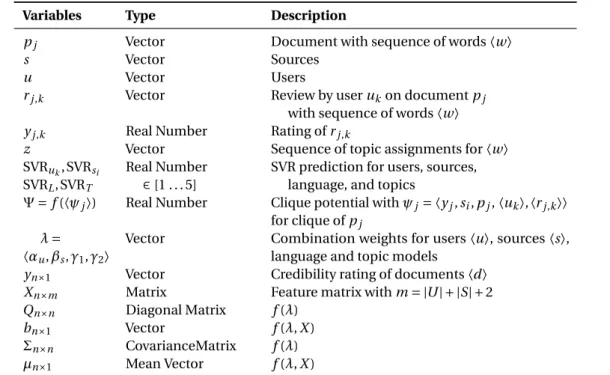
III.6 Symbol table. . . 38
III.7 User statistics. . . 45
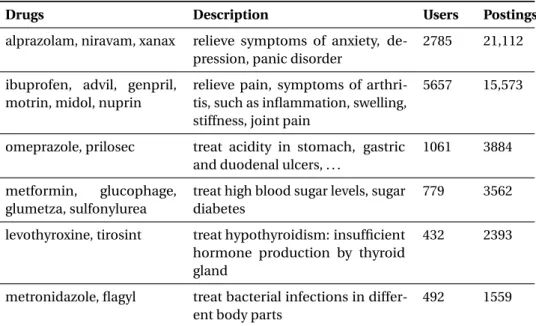
III.8 Information on sample drug families: number of postings and number of users reporting at least one side effect. . . 46
III.9 Number of common, less common, and rare side-effects listed by experts on Mayo Clinic. . . 46
III.10 Accuracy comparison in setting I. . . 48
III.11 CRF performance in setting II. . . 49
III.12 Experiment on finding rare drug side-effects. . . 52
III.13 Experiment on following trustworthy users. . . 52
III.14 Dataset statistics.. . . 53
III.15 Graph statistics. . . 54
III.16 MSE comparison of models for predicting users’ credibility rating behavior with 10-fold cross-validation. Improvements are statistically significant withP-value < 0.0001. . . 55
III.17 MSE comparison of models for predicting aggregated article credibility rating with 10-fold cross-validation. Improvements are statistically significant with P-value< 0.0001. . . 56
III.18 NDCG scores for ranking trustworthy sources. . . 57
III.19 NDCG scores for ranking expert users. . . 57
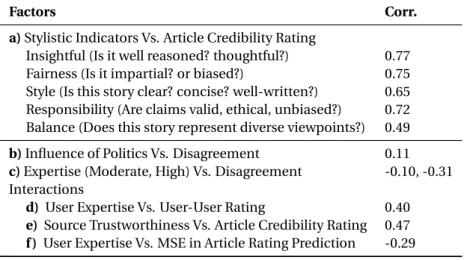
III.20 Pearson’s product-moment correlation between various factors (withP-value <0.0001 for each test). . . 58
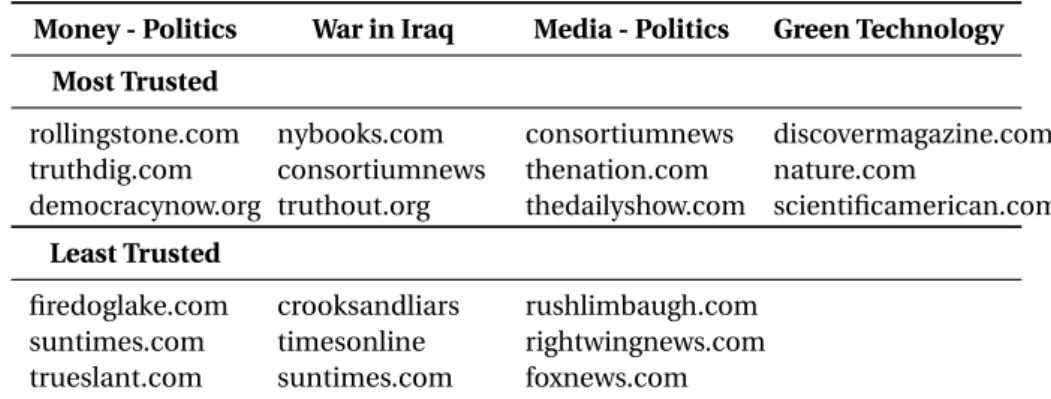
III.21 Most and least trusted sources on sample topics. . . 59
III.22 Most and least trusted sources with different viewpoints. . . 60
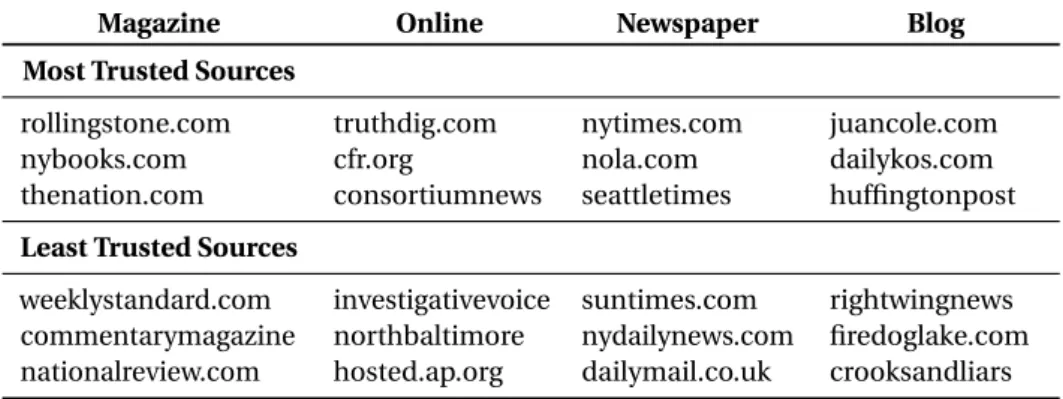
III.23 Most and least trusted sources on different types of media. . . 60
IV.1 Vocabulary at different experience levels. . . 66
IV.3 Dataset statistics. . . 81
IV.4 MSE comparison of our model versus baselines.. . . 82
IV.5 Experience-based facet words for theillustrativebeer facettaste.. . . 83
IV.6 Distribution of users at different experience levels. . . 84
IV.7 Dataset statistics. . . 97
IV.8 Mean squared error (MSE) for rating prediction. Our model performs better than competing methods. . . 99
IV.9 Top words used by experienced and amateur users. . . 103
IV.10 Salient words for theillustrativeNewsTrust topicUS Electionused by users at different levels of experience. . . 104
IV.11 Performance on identifying experienced users. . . 105
V.1 Pearson correlation between different features and helpfulness scores of reviews in the domainselectronics, foods, music, movies,andbooks. All factors (except the one marked with∗) are statistically significant withp-value<2e−16. . . . 115
V.2 Dataset statistics. Votes indicate the total number of helpfulness votes (both, for and against) cast for a review. Total number of users=5, 679, 944, items =1, 895, 462, and reviews=29, 004, 754. . . 124
V.3 Prediction Task:Performance comparison of our model versus baselines. Our improvements over the baselines are statistically significant atp-value<2.2e−16 usingpaired sample t-test. . . 125
V.4 Ranking Task:Correlation comparison between the ranking of reviews and gold rank list — our model versus baselines. Ourimprovementsover the baselines are statistically significant atp-value<2.2e−16 usingpaired sample t-test. . . 126
V.5 Snapshot of latent word clusters as used by experts and amateurs for most and least helpful reviews in different domains. . . 128
V.6 List of variables and notations used with corresponding description. . . 137
V.7 Dataset statistics for review classification (Yelp∗denotes balanced dataset using random sampling). . . 138
V.8 Amazon dataset statistics for item ranking, with cumulative #items and varying #reviews. . . 138
V.9 Credible review classification accuracy with 10-fold cross validation. TripAdvisor dataset contains only review texts and no user/activity information. . . 140
V.10 Kendall-Tau correlation of different models across domains. . . 141
V.11 Variation of Kendall-Tau-M (τm) correlation with #reviews withMAmazon (SVM-Rank). . . 141
V.12 Top n-grams (by feature weights) for credibility classification. . . 142 V.13 Snapshot of non-credible reviews (reproduced verbatim) with inconsistencies. 143
I
Introduction
I.1 Motivation
In recent years, the explosion of social networking sites (e.g., Facebook, Twitter), blogs (e.g., Mashable, Techcrunch), and online review portals (e.g., Amazon, TripAdvisor, IMDB, Health-boards) provide overwhelming amount of information on various topics like health, politics, movies, music, travel, and more. However, the usability of such massive data is largely re-stricted due to concerns about the quality and credibility of user-contributed content. Online communities are massive repositories of knowledge that are accessed by regular every-day users as well as expert professionals. For instance, 59% of the adult U.S. population and nearly half of U.S. physicians consult online resources (e.g., Youtube and Wikipedia) [Fox 2013,
IMS Institute 2014] for health-related information. In the product domain, 40% of online
consumers would not buy electronics without consulting online reviews first [Nielsen]. How-ever, this user-contributed content is highly noisy, unreliable, and subjective with rampant amount of spams, rumors, and misinformation injected by users in their postings. This has greatly eroded public trust and confidence on social media information. Some statistics show that 66% of web-using U.S. adults do not trust social media information [Mitchell 2016]. To counter these, stakeholders in the industry (e.g.,Yelp) have been developing their own de-fense mechanism1. In certain domains like healthforums, misinformation can have hazardous consequences — as these are frequently accessed by users to find potential side-effects of drugs, symptoms of diseases, or getting advice from health professionals. To give an example, consider the following user-post from the online healthforumHealthboards.
Example I.1.1 I took a cocktail of meds. Xanax gave me hallucinations and a demonic feel. I can feel my skin peeling off.
The above post suggests that “peeling-of-skin” is a probable side-effect of the drug Xanax, although thestylein which it is written renders its credibility doubtful.
1https://www.yelpblog.com/2013/09/fake-reviews-on-yelp-dont-worry-weve-got-your-back Yelp filter rejects 25% of user-contributed reviews as non-reliable.
In this case, the user seems to be suffering from hallucinations; and the side-effect can also be attributed to the “cocktail of meds”, and not Xanax alone.
Prior works in Natural Language Processing dealing with fake reviews and opinion spam
[Mihalcea 2009,Ott 2011,Recasens 2013,Li 2014b] would only analyze the linguistic cues and
writing style of this post (e.g., distribution of unigrams and bigrams, affective emotions, part-of-speech tags, etc.) to find if it is subjective, biased, or fake. However, it is difficult to arrive at a conclusion by analyzing the post in isolation. In general, online communities provide many other signals that can help us in this task. For instance, the above post may be refuted (or downvoted) by anexperiencedhealth professional in the community. Similarly, credible postings or statements may becorroborated(or upvoted) by other experienced users in the community. A significant challenge is thata prioriwe do not know which users are experienced or trustworthy — that need to be inferred as a part of the task.These kinds of implicit or explicit feedback from other users, and their identities, prove to be helpful for credibility analysis in a community-specific setting.
Prior works in Data Fusion and Truth Discovery (cf. [Li 2015b] for a survey) leverage such interactions between sources and queries in a general setting. Some typical queries are “the height of Mount Everest” that fetch different answers (e.g., “29,035 feet”, “29,002 feet”, “29,029 feet”) from various sources, or “the birthplace of Obama” that includes answers as “Hawaii”, “USA”, and “Africa”. These methods aim to resolve conflicts among these
multi-source data by obtaining reliability estimates of the multi-sources providing the information (e.g., Wikipedia being a trustworthy source provides an accurate answer to the above queries), and aggregating their responses to obtain the truth. However, these approaches operate over structured data (e.g., relational tables, structured query templates like “Obama_BornIn_Kenya” represented as a subject-predicate-object triple), and factual claims — whereby they ignore the content and context of information. These approaches are not geared for online communities with more fine-grained interactions, subjective, and unstructured data. Context helps us in understanding the attitude and emotional state of the user writing the posts, the topics of the postings and users’ topic-specific expertise, objectivity and rationality of the postings, etc. Similar principles hold true for any online community like music, travel, politics, and news. The above discussion demonstrates the complex interplay between several factors in online communities — like writing style, cross-talk between users and interactions, user experi-ence, and topics — that influences the credibility of statements therein. A natural way to represent these interactions and dependencies between various factors is provided by Proba-bilistic Graphical Models (PGM) (like, Markov Random Fields, Bayesian Networks, and Factor Graphs) [Koller 2009], where each of the above aspects can be envisioned as random variables with edges depicting interactions between them.
PGMs provide a natural framework to compactly represent high-dimensional distributions over many random variables as a product of local factors over subsets of the variables, i.e., by factoring the joint probability distribution into marginal distributions over subsets of the
I.2. Challenges
variables. The conditional independence assumptions, and factorization help us to make the problem tractable. It is also effective in practice as any random variable interacts with only a subset of all the variables. During inference and learning, we estimate the joint probability distribution, the marginals, and other queries of interest. In terms ofinterpretability, output of probabilistic models (labels, probabilities of queries and factors) can be better explained to the end-user. For instance, a PGM may label two sources as “trustworthy” with corresponding probabilities as 0.9 and 0.7 — which is easier to envision than obtaining corresponding raw estimates as 12.7 and 9.6.
The key contribution of this work is in bringing all of these different aspects together in a computational model, namely, a probabilistic graphical model, for credibility analysis in online communities, and providing efficient inference techniques for the same.
I.2 Challenges
Analyzing the credibility of user-contributed content in online communities is a difficult task with the following challenges:
• User-contributed postings in online forums areunstructured, biased, and subjectivein nature. This is in contrast to the classical setting in prior works in Truth Discovery and Data Fusion that deal with structured and factual data.
• Although reliable sources and users contribute credible information,a prioriwe do not know which of these sources and users are trustworthy (or experts).
• Online communities arecomplexin nature with rich user-user and user-item interactions (like, upvote, downvote, share, comment, etc.) that are difficult to model computationally. • Online communities aredynamicin nature as users’ interactions, maturity, and content
evolve over time.
• Scarcity of labeled training data and rich statistics (e.g., activity history, meta-data) about users and items lead to data sparsity and difficulty in learning.
• It is difficult to generate user-interpretable explanations of the models’ verdict.
I.3 Prior Work and its Limitations
Information extraction methods [Sarawagi 2008,Koller 2009] previously used for extracting information from user-contributed content do not account for the inherent bias, subjectivity, and noise in the data. Additionally, they also do not consider the role of language (e.g., stylistic features, emotional state and attitude of the writer, etc.) in assessing the reliability of the extracted statements.
Prior works in Natural Language Processing [Mihalcea 2009,Ott 2011,Recasens 2013,Li 2014b], dealing with opinion spam and fake reviews in online communities, consider postings in
iso-lation, and analyze their writing style to capture bias and subjectivity. They typicallyignore the identity of the users writing the postings, and interactions between them. Typically these works use bag-of-words features, and resources like WordNet [Miller 1995], and SentiWord-Net [Esuli 2006] to create feature vectors that are fed into supervised machine learning models (e.g., Support Vector Machines) to classify the postings as credible, or otherwise.
On the other hand, works in Data Fusion and Truth Discovery (cf. [Li 2015b] for a survey) make strong assumptions about the nature and structure of the data (e.g., relational tables, factual claims, static data, subject-predicate-object triples, etc.) whereby they model the interactions between sources and queries as edges in a network, butignorethe textual content and context altogether. Typically, these works use approaches like belief propagation and label propagation (e.g., Markov random walks) to propagate reliability estimates in the network. Availability of ground-truth data is a typical problem faced by the works in this domain. Therefore, most of these prior works operate in an unsupervised fashion. However, some prior works show that the performance of these methods can be improved by using a small set of labeled data for training.
In the absence of proper ground-truth data, prior works [Jindal 2007,Jindal 2008,Lim 2010,
Liu 2012,Mukherjee 2013a,Li 2014a,Rahman 2015] make strong assumptions, e.g.,
dupli-cates and near-duplidupli-cates are fake, and harness rich information about users and items in the form of activity, posting history, and meta-data. Such profile history may not be readily available in several domains, especially for “long-tail” users and items in the community (e.g., newcomers and recently launched products). Also, such a policy tends to over emphasize long-term contributors and suppress outlier opinions off the mainstream.
Prior works in collaborative filtering [Koren 2008,Koren 2015,Jindal 2008,Tang 2013,Ma 2015] consider a static snapshot of the data whereby theyignorethe temporal evolution of users and their interactions. These use activity history (e.g., frequency of postings, number of upvotes / downvotes, rating history) as a proxy to find experienced members in the community. Online communities are dynamic in nature as users join and leave, adopt new vocabulary, and adapt to evolving trends. Therefore, a user who was not experienced a decade before could have evolved into a matured user now with refined preferences, writing style, and trustworthiness. This dimension of user evolution is ignored in the static analysis.
Most of the works involving classifiers and machine learning models generate discrete (e.g., binary) decision labels as output. These models have limited interpretability as they rarely explain why the model arrived at a particular verdict. Most of these are not geared for fine-grained analysis involving continuous data types. Additionally, most of the prior works output only raw scores, as estimates of reliability, that are difficult to explain to the end-user.
I.4. Contributions
I.4 Contributions
This work addresses the challenges outlined above developing principles and models to advance the state-of-the-art. In summary, it addresses the following research questions.
RQ: 1 How can we develop models that jointly leverage the context and interactions in online communities for analyzing the credibility of user-contributed content? How can we complement expert knowledge with large-scale non-expert data from online communities?
We develop novel forms of probabilistic graphical models that capture the complex inter-play between several factors: the writing style, user-user and user-item interactions, latent semantic factors like the topics of the postings and experience of the users, etc. Specifically, we develop Conditional Random Field (CRF) based models, where these factors (e.g., users, postings, statements) are modeled as random variables with edges between them depicting interactions. Furthermore, these variables have observable features that capture the context (e.g., stylistic features, subjectivity, topics, etc.) of the postings and relevant background infor-mation (e.g., user demographics and activity history). We develop efficient joint probabilistic inference techniques for these models for classification and regression settings. Specifically, we develop:
• Asemi-supervisedversion of the CRF for credibility classification (presented at SIGKDD 2014 [Mukherjee 2014b]) that learns frompartialexpert supervision using Expectation -Maximization principle. We use this model in a healthforumHealthboardsto identify rare or uncommon side-effects of drugs from user-contributed posts. This is one of the prob-lems where large-scale non-expert data has the potential to complement expert medical knowledge. Our model leverages partial expert knowledge of drugs and their side-effects to jointly identify credible statements (or, drug side-effects), reliable postings, and trustworthy users in the community.
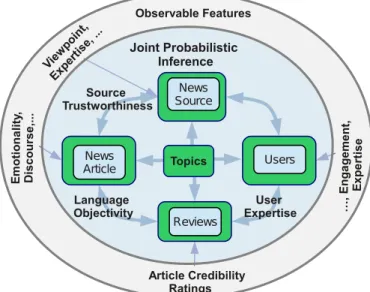
• Acontinuousversion of the CRF for more fine-grained credibility regression (presented at CIKM 2015 [Mukherjee 2015b]) to deal with user-assignednumeric ratingsin online communities. As an application use-case, we consider news communities (e.g.,NewsTrust) that are plagued by misinformation, bias, and polarization induced by the style of reporting and political viewpoint of media sources and users. We show that the joint probability distribution function for the continuous CRF is Multivariate Gaussian, and propose a constrained Gradient Ascent based algorithm for scalable inference.
We released two large-scale datasets used in these works:
• The healthforum dataset2contains 2.8 million posts from 15, 000anonymizedusers in the communityHealthboards, along with their demographic information. Additionally, we also provide side-effects of 2, 172 drugs from 837 drug families contributed by expert health 2http://resources.mpi-inf.mpg.de/impact/peopleondrugs/data.tar.gz
professionals inMayoClinic. The drug side-effects — categorized as most common, less common, rare, and unobserved — are used as ground-truth in our evaluation.
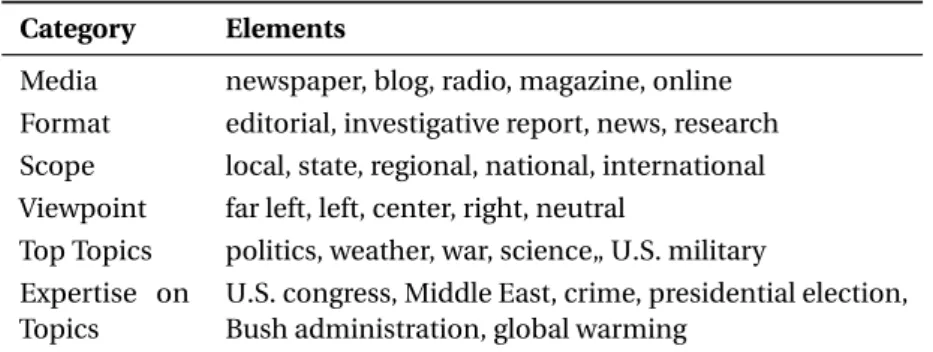
• The news community dataset3consists of 84, 704 stories fromNewsTruston 47, 565 news articles crawled from 5, 658 media sources (like BBC, WashingtonPost, New York Times). The dataset contains 134, 407 NewsTrust-member reviews on the articles, corresponding ratings on various qualitative aspects like objectivity, correctness of information, bias and credibility; as well as interactions (e.g., comments, upvotes/downvotes) between members, and their demographic information.
RQ: 2 How can we quantify changes in users’ maturity and experience in online communities? How can we model users’ evolution or progression in maturity? How can we improve recom-mendation by considering a user’s evolved maturity or experience at the (current) timepoint of consuming items?
Online communities are dynamic as users mature over time with evolved preferences, writing style, experience, and interactions. We study the temporal evolution of users’ experience with respect to item recommendation in a collaborative filtering framework in review communities (like, movies, beer, and electronics). We propose two approaches to model this evolving user experience, and her writing style:
• The first approach (presented at ICDM 2015 [Mukherjee 2015a]) considers a user’s experi-ence to progress in adiscretemanner employing a Hidden Markov Model (HMM) – Latent Dirichlet Allocation (LDA) model: where HMM traces her (latent) experience progression, and LDA models her facets of interest at any timepoint as a function of her (latent) experi-ence. This framework (presented at SDM 2017 [Mukherjee 2017]) is used to identify useful product reviews — in terms of beinghelpfulto the end-consumers — in communities like Amazon, where useful reviews are buried deep within a heap of non-informative ones. • The second approach (presented at SIGKDD 2016 [Mukherjee 2016b]) addresses several
drawbacks of this discrete evolution, and develops a natural andcontinuousmode of temporal evolution of a user’s experience, and her language model (LM) using Geometric Brownian Motion (GBM), and Brownian Motion (BM), respectively. We develop efficient inference techniques to combine discrete multinomial distributions for LDA (generating words per review) with the continuous Brownian Motion processes (GBM and BM) for experience and LM evolution. To this end, we use a combination of Metropolis Hastings, Kalman Filter, and Gibbs sampling that are shown to work coherently to increase the data log-likelihood smoothly and continuously over time.
RQ: 3 How can we perform credibility analysis with limited information and ground-truth? We utilize latent topic models leveraging review texts, item ratings, and timestamps to derive consistency featureswithout relying on extensive item/user histories, typically unavailable for
I.5. Organization
“long-tail” items/users. These are used to learn inconsistencies such as discrepancy between the contents of a review and its rating, temporal “bursts”, facet descriptions etc. We also propose an approach to transfer a model learned on the ground-truth data in one domain (e.g., Yelp) to another domain (e.g., Amazon) with missing ground-truth information. These results were presented at ECML-PKDD 2016 [Mukherjee 2016a].
All the above models for product review communities use only the information ofa user reviewing an item at an explicit timepoint. This makes our approach fairly generalizable across all communities and domains with limited meta-data requirements.
RQ: 4 How can we generate user-interpretable explanations for the models’ credibility verdict? For each of the above tasks, we provideuser-interpretable explanationsin the form of in-terpretable word clusters, representative snippets, evolution traces, etc. This way we can explain to the end-user why the model arrived at a particular verdict. Our model shows user-interpretable word clusters depicting user maturity that give interesting insights. For example, experienced users in Beer communities use more “fruity” words to depict beer taste and smell; in News Communities experienced users talk about policies and regulations in contrast to amateurs who are more interested in polarizing topics. Similarly, evolution traces show that experienced users progress faster than amateurs in acquiring maturity, and also exhibit a higher variance.
I.5 Organization
This dissertation is organized as follows. ChapterIIdiscusses the state-of-the-art in this domain and related prior work. ChapterIIIlays the foundation of our credibility analysis framework. It develops probabilistic graphical models and methods for joint inference in online communities for credibility classification, and credibility regression. It also presents large-scale experimental studies on one of the largest health community and a sophisticated news community. ChapterIVdevelops approaches for modeling temporal evolution of users in online communities. It presents stochastic models for discrete and continuous modes of experience evolution of users in a collaborative filtering framework. It also presents large-scale experimental studies on five real world datasets like movies, beer, food, and news. ChapterV uses the principles and methods developed in earlier chapters for credibility analysis in product review communities for two tasks, namely: (i) finding useful product reviews that are helpful to the end-consumers in communities like Amazon, and (ii) detecting non-credible reviews with limited information about users and items in communities like Yelp, TripAdvisor, and Amazon. ChapterVIpresents conclusions and future research directions.
II
Related Work
This chapter presents an overview of the related work in several overlapping domains like truth discovery, sentiment analysis and opinion mining, information extraction, and collaborative filtering in online communities. It discusses the state-of-the-art in these domains, and their limitations.
II.1 Probabilistic Graphical Models
In each of the following sections, we give a brief overview of the usage of Probabilistic Graphical Models (PGM) for related tasks. Since a full primer on PGMs is beyond the scope of this work, we refer the readers to [Koller 2009] for a general overview on PGMs.
Probabilistic graphical models use a graph-based representation to encode complex high-dimensional distributions involving many random variables. It provides a natural framework to modelprobabilisticinteractions between them, represented as edges in the graph with random variables as the nodes. The objective is to probabilistically reason about the values of subsets of random variables, possibly given observations about some others. In order to do so, we need to construct a joint probability distribution function over the space of all possible value assignments to the random variables. This is often intractable. In practice, any random variable interacts with only a subset of the others. This allows us to represent the joint distribution as a product offactorscomposed of a smaller set of random variables, representing the marginals. This has several advantages. The factorization or decomposition can lead to a tractable solution, even though the complete specification over all possible value assignments can be asymptotically large. Secondly, it is easy to interpret the semantics of the model and output to users; highlight interactions between factors, and answer queries of interest with probabilistic interpretations. Thirdly, it also is easy to encode expert knowledge in the framework for specifying the structure of the graph in terms of (in)dependencies, and priors for the parameters.
Markov Random Fields
There are typically two families of PGMs:Bayesiannetworks that use adirectedrepresentation, andMarkovnetworks (or, Markov Random Fields (MRFs)) that use anundirected representa-tion. MRFs model the joint probability distribution overXandY asP(X,Y):Xrepresenting multi-dimensional input (or, features), andY representing multi-dimensional output (or, labels/values). Since they are fully generative, they can be used to model arbitrary prediction problems. In our work, we mostly use Conditional Random Fields (CRFs), which are a spe-cific type of MRF. They are discriminative in nature, and model the conditional distribution P(Y|X=x). Since they directly model the conditional distribution that are of primary interest for standard prediction problems, they are more accurate for these settings. They can also be viewed as a structured extension over logistic regression, where the output (labels) can have dependencies between them. Please refer to [Sutton 2012] for an introduction to CRFs. Topic Models
Probabilistic topic models extend the principles of PGMs to discoverthematicinformation in unstructured collection of documents. Latent Dirichlet Allocation (LDA) is the simplest type of topic model. These assume that documents have a distribution over topics (or, themes), and topics have a distribution over words. For example, a news article can talk about sports and politics, and use specific words to describe these topics. The topics are not knowna priori, and are treated as hidden random variables, that need to be inferred from data. It uses a generative process to model these principles and assumptions. Refer to [Blei 2012] for an overview on probabilistic topic models.
Inference
A crucial component of PGMs involveinferencealgorithms for computing marginals, con-ditionals, and maximum a posteriori (MAP) probabilities efficiently for answering queries of interest. There are several variants of message passing or belief propagation algorithms (e.g., junction tree) forexact inference. However, the computational complexity is often ex-ponential due to large size of cliques (subsets of nodes that are completely connected), and long loops for arbitrary graph structures. Therefore, we have to often resort toapproximate probabilistic inference. There are two large classes of such inference techniques: Monte Carlo and Variational algorithms.
Monte Carlo methods: These algorithms are based on the fact that although computing expectation of the original distributionP(X) may be difficult, we can obtainsamplesfrom it or some closely related distribution to compute sample-based averages. In our work, we mostly use Gibbs sampling, and Metropolis Hastings. Gibbs sampling is a type of Markov Chain Monte Carlo (MCMC) algorithm, where samples are obtained from a Markov chain whose stationary distribution is the desiredP(X). We use Collapsed Gibbs Sampling [Griffiths 2002] for inference in probabilistic topic models. Metropolis Hastings is also a type of MCMC algorithm. Instead of sampling from the true distribution — that can be often quite complex
II.2. Truth Discovery
— it uses a proposal distribution that is proportional in density to the true distribution for sampling the random variables. This is followed by an acceptance or rejection of the newly sampled value. That is, at each iteration, the algorithm samples a value of a random variable — where the current estimate depends only on the previous estimate, thereby, forming a Markov chain. The principle advantage of Monte Carlo algorithms is that they are easy to implement, and quite general. However, it is difficult to guarantee their convergence, and the time taken to converge can be quite long. In our work, we empirically demonstrate fast convergence, under certain settings.
Variational mthods:The other class of approximate inference involving Variational methods use a family of approximate distributions with their own variational parameters. The objective is to find a setting of these parameters to make the approximate distribution to be as close to the posterior of interest. Thereafter, these approximate distributions with the fitted parameters are used as a proxy for the true posterior.
Refer to [Jordan 2002] for an overview of the probabilistic inference methods for graphical models.
II.2 Truth Discovery
In approaches to truth discovery, the goal is to resolve conflicts in multi-source data [Yin 2008,
Dong 2009,Galland 2010,Pasternack 2010,Zhao 2012b,Li 2012,Pasternack 2013,Dong 2013,
Li 2014c,Li 2015c,Ma 2015,Zhi 2015]. Input data is assumed to have a structured
representa-tion: an entity of interest (e.g., a person) along with its potential values provided by different sources (e.g., the person’s birthplace).
Truth discovery methods of this kind (see [Li 2015b] for a survey), starting with the seminal work of [Yin 2008], assume that claims follow a structured template with clear identification of the questionable values [Li 2012,Li 2011] or correspond to subject-predicate-object triples obtained by information extraction [Nakashole 2014]. A classic example is“Obama is born in Kenya” viewed as a triple〈Obama, born in, Kenya〉where“Kenya” is the critical value. The assumption of such a structure is crucial in order to identify alternative values for the questionable slot (e.g.,“Hawaii”,“USA”,“Africa”), and is appropriate when checking facts for tasks like knowledge-base curation. Such alternative values are provided by many other sources. The objective is to resolve the conflict between these multi-source data for a given query to obtain the truth. It is assumed that the conflicting values are already available. To resolve conflicts for a particular entity, these approaches exploit that reliable or trustworthy sources often provide correct information. To exploit this principle, these works propagate and aggregate scores (or, reliability estimates) over networks of objects, and sources that provide information about the objects. A significant challenge is thata prioriwe do not know which sources are reliable or trustworthy that need to be inferred during the task.
[Li 2011] uses information-retrieval techniques to systematically generate alternative hypothe-ses for the given statement, and ashypothe-sess the evidence for each alternative. However, it relies on theuserproviding thedoubtfulportion of the input statement (e.g., the birthplace of “Obama” in the above example). Making use of the doubtful unit, alternative statements (e.g., alterna-tive birthplaces) are generated via web search and ranked to identify the correct statement. Work in [Nakashole 2014] goes a step further by proposing a method to generate conflicting valuesorfact candidatesfrom Web contents. They make use of linguistic features to detect the objectivity of the source reporting the fact. Note that both of these approaches can handle only input statements for which alternative facts or values are given or can be retrieved a priori.
[Yin 2008,Pasternack 2010,Pasternack 2011] develop methods for statistical reasoning on the
cues for the statement being true vs. false. [Li 2012] has developed approaches for structured data such as flight times or stock quotes, where different Web sources often yield contradictory values. [Vydiswaran 2011b] addressed truth assessment for medical claims about diseases and their treatments (including drugs and general phrases such as “surgery”), by an IR-style evidence-aggregation and ranking method overcuratedhealth portals.
Probabilistic graphical models: Recently, [Pasternack 2013] presented an LDA-style latent-topic model for discriminating true from false claims, with various ways of generating incorrect statements (guesses, mistakes, lies). [Ma 2015] proposed an LDA-style model to capture expertise of users for different topics. They use it to model question content, and answer quality to find the best candidate answer. [Zhao 2012c] proposed a Latent Truth Model based on a generative process of two types of errors (false positive and false negative) by modeling two different aspects of source quality. They also propose a sampling based algorithm for scalable inference. [Zhao 2012a] proposed a Gaussian Truth Model to deal with numerical data based on a generative process.
Most of the above approaches are limited to resolving conflicts amongst multi-source data — where, input data is in a structured format and conflicting facts are always available. Although these are elaborate models, they do not take into account the language in which statements are reported in user postings, and trustworthiness of the users making the statements. None of these prior works have considered online discussion forums where credibility of statements is intertwined with all of the above factors. Moreover, due to limited availability of ground-truth data in this problem setting, most of these models work in an unsupervised fashion.
In our work, we propose general approaches that do not require any alternative claims. Our approaches are geared for online communities with rich interactions between users, (language of ) postings, and statements. Also, our models can be partially or weakly supervised, as well as fully supervised depending on the availability of labeled data. Moreover, we provide user-interpretable explanations for our models’ verdict, unlike many of the previous works.
II.3. Trust and Reputation Management
II.3 Trust and Reputation Management
This area has received much attention, mostly motivated by analyzing customer reviews for product recommendations, but also in the context of social networks. [Kamvar 2003,
Guha 2004a] are seminal works that modeled the propagation of trust within a network of
users. TrustRank [Kamvar 2003] has become a popular measure of trustworthiness, based on random walks on (or spectral decomposition of ) the user graph. Reputation management has also been studied in the context of peer-to-peer systems, the blogosphere, and online interactions [Adler 2007,Agarwal 2009,Despotovic 2009,de Alfaro 2011,Hang 2013].
All these works focused on explicit relationships between users to infer authority and trust levels. The only content-aware model for trust propagation is [Vydiswaran 2011a]. This work develops a HITS-style algorithm for propagating trust scores in a heterogeneous network of claims, sources, and documents. Evidence for a claim is collected from related documents using generic IR-style word-level measures. It also requires weak supervision at the evidence level in the form of human judgment on the trustworthiness of articles. However, it ignores the fine-grained interaction between users making the statements, their postings, and how these evolve over time. We show that all of these factors can be jointly captured using sophisticated probabilistic graphical models.
II.4 Information Extraction (IE)
There is ample work on extracting Subject-Predicate-Object (SPO) like statements from natural-language text. The survey [Sarawagi 2008] gives an overview; [Krishnamurthy 2009,
Bohannon 2012,Suchanek 2013] provide additional references. State-of-the-art methods
combine pattern matching with extraction rules and consistency reasoning. This can be done either in a shallow manner, over sequences of text tokens, or in combination with deep parsing and other linguistic analysis. The resulting SPO triples often have highly varying confidence, as to whether they are really expressed in the text or picked up spuriously. Judging the credibility of statements is out-of-scope for IE itself. [Sarawagi 2008,Koller 2009] give an overview of probabilistic graphical models used for Information Extraction.
IE on Biomedical Text
For extracting facts about diseases, symptoms, and drugs, customized IE techniques have been developed to tap biomedical publications like PubMed articles. Emphasis has been on the molecular level, i.e. proteins, genes, and regulatory pathways (e.g., [Bundschus 2008,
Krallinger 2008,Björne 2010]), and to a lesser extent on biological or medical events from
sci-entific articles and from clinical narratives [Jindal 2013,Xu 2012b]. [Paul 2013] has used LDA-style models for summarization of drug-experience reports. [Ernst 2014] has employed such techniques to build a large knowledge base for life science and health. Recently, [White 2014a] demonstrated how to derive insight on drug effects from query logs of search engines. Social media has played a minor role in this prior IE work.
II.5 Language Analysis for Social Media
Sentiment AnalysisWork on sentiment analysis [Pang 2002,Turney 2002,Dave 2003,Yu 2003,Pan 2004,Pang 2007,
Liu 2012,Mukherjee 2012] has looked into language features — based on phrasal and
depen-dency relations, narratives, perspectives, modalities, discourse relations, lexical resources etc. — in customer reviews to classify their sentiment as positive, negative, or objective. Going
beyond this special class of texts, [Greene 2009,Recasens 2013] have studied the use of biased language in Wikipedia and similar collaborative communities. Even more broadly, the task of characterizing subjective language has been addressed, among others, in [Wiebe 2005,
Lin 2011]. The work by [Wiebe 2011] has explored benefits between subjectivity analysis and
information extraction.
Opinion mining methods for recognizing a speaker’s stance in online debates are proposed
in [Somasundaran 2009,Walker 2012]. Structural and linguistic features of users’ posts are
harnessed to infer their stance towards discussion topics in [Sridhar]. Temporal and textual information are exploited for stance classification over sequence of tweets in [Lukasik 2016]. Opinion Spam
Several existing works [Mihalcea 2009,Ott 2011,Ott 2013] consider the textual content of user reviews for tackling fake reviews (or, opinion spam) by using word-level unigrams or bigrams as features, along with specific lexicons (e.g., LIWC [Pennebaker 2001] psycholinguistic lexicon, WordNet Affect [Strapparava 2004]), to learn latent topic models and classifiers (e.g., [Li 2013]). Some of these works learn linguistic features from artificially created fake review dataset, leading to biased features that are not dominant in real-world data. This was confirmed by a study on Yelp filtered reviews [Mukherjee 2013b], where then-gram features used in prior works performed poorly despite their outstanding performance on the artificial datasets. Addi-tionally, linguistic features such astext sentiment[Yoo 2009],readability score(e.g., Automated readability index (ARI), Flesch reading ease, etc.) [Hu 2012],textual coherence[Mihalcea 2009], and rules based onProbabilistic Context Free Grammar(PCFG) [Feng 2012] have been studied. Aspect Rating Prediction from Review Text
Aspect rating prediction has received vigorous interest in recent times. A shallow depen-dency parser is used to learn product aspects and aspect-specific opinions in [Yu 2011] by jointly considering the aspect frequency and the consumers’ opinions about each aspect.
[Mukherjee 2013c] presents an approach to capture user-specific aspect preferences, but
re-quires manual specification of a fixed set of aspects to learn from. [Snyder 2007] jointly learns ranking models for individual aspects by modeling dependencies between assigned ranks by analyzing meta-relations between opinions, such as agreement and contrast.
Probabilistic graphical models:Latent Aspect Rating Analysis Model (LARAM) [Wang 2010,
II.6. Information Credibility in Social Media
in a review. However, the model ignores user identity and writing style, and learns parameters per review. A rated aspect summary of short comments is done in [Lu 2009]. Similar to LARAM, the statistics are aggregated at the comment-level. A topic model is used in [Titov 2008] to assign words to a set of induced topics. The model is extended through a set of maximum entropy classifiers, one per each rated aspect, that are used to predict aspect specific ratings. A joint sentiment topic model (JST) is described in [Lin 2009] which detects sentiment and topic simultaneously from text. In JST, each document has a sentiment label distribution. Top-ics are associated to sentiment labels, and words are associated to both topTop-ics and sentiment labels. In contrast to [Titov 2008] and some other similar works [Wang 2010,Wang 2011b,
Lu 2009] which require some kind of supervised setting like ratings for the aspects or
over-all rating [Mukherjee 2013c], JST is fully unsupervised. The CFACTS model [Lakkaraju 2011] extends the JST model to capture facet coherence in a review using Hidden Markov Model. This is further extended by [Mukherjee 2014a] to capture author preferences, and writing style, while being completely unsupervised.
All these generative models have their root in Latent Dirichlet Allocation Model [Blei 2001]. LDA assumes a document to have a probability distribution over a mixture of topics and topics to have a probability distribution over words. In the Topic-Syntax Model [Griffiths 2002], each document has a distribution over topics; and each topic has a distribution over words being drawn from classes, whose transition follows a distribution having a Markov dependency. In the Author-Topic Model [Rosen-Zvi 2004a], each author is associated with a multinomial distribution over topics. Each topic is assumed to have a multinomial distribution over words. However, these models — with the exception of [Rosen-Zvi 2004a,Mukherjee 2014a] that are not geared for credibility analysis — do not consider the users writing the reviews, their prefer-ences for different topics, experience, or writing style. Our models capture all of these user-centric factors, as well interactions between them to capture credibility of user-contributed content in online communities.
II.6 Information Credibility in Social Media
Prior research for credibility assessment of social media posts exploitscommunity-specific features for detecting rumors, fake, and deceptive content [Castillo 2011a,Lavergne 2008,
Qazvinian 2011,Xu 2012a,Yang 2012]. Temporal, structural, and linguistic features were used
to detect rumors on Twitter in [Kwon 2013]. [Gupta 2013] addresses the problem of detecting fake images in Twitter based on influence patterns and social reputation. A study on Wikipedia hoaxes is done in [Kumar 2016]. They propose a model which can determine whether a Wikipedia article is a hoax or not — by measuring how long they survive before being debunked, how many page-views they receive, and how heavily they are referred to by documents on the web compared to legitimate articles. [Castillo 2011b] analyzes micro-blog postings in Twitter related to trending topics, and classifies them as credible or not, based on features from user posting and re-posting behavior. [Kang 2012] focuses on credibility of users, harnessing the
dynamics of information flow in the underlying social graph and tweet content. [Canini 2011] analyzes both topical content of information sources and social network structure to find credible information sources in social networks. Information credibility in tweets has been studied in [Gupta 2012]. [Vydiswaran 2012] conducts auser studyto analyze various factors like contrasting viewpoints and expertise affecting the truthfulness of controversial claims. All these approaches are geared for specific forums, making use of several community-specific characteristics (e.g., Wikipedia edit history, Twitter follow graph, etc.) that cannot be general-ized across domains, or other communities. Moreover, none of these prior works analyze the joint interplay betweensources, language, topics,andusersthat influence the credibility of information in online communities.
Rating and Activity Analysis for Spam Detection
The influence of different kinds of bias in online user ratings has been studied in [Fang 2014,
Sloanreview.mit.edu]. [Fang 2014] proposes an approach to handle users who might be
sub-jectively different or strategically dishonest.
In the absence of proper ground-truth data, prior works make strong assumptions, e.g., duplicates and near-duplicates are fake, and make use ofextensivebackground information like brand name, item description, user history, IP addresses and location, etc. [Jindal 2007,
Jindal 2008, Lim 2010,Wang 2011a,Liu 2012, Mukherjee 2013a, Mukherjee 2013b,Li 2014a,
Rahman 2015]. Thereafter, regression models trained on all these features are used to classify
reviews as credible or deceptive. Some of these works also use crude or ad-hoc language features like content similarity, presence of literals, numerals, and capitalization.
In contrast to these works, our approach uses limited information about users and items — that may not be available for “long-tail” users and items in the community — catering to a wide range of applications. We harvest several semantic and consistency features — only from the information of a user reviewing an item at an explicit timepoint — that also give user-interpretable explanation as to why a user posting should be deemed non-credible. Citizen journalism
[Shayne 2003] defines citizen journalism as “the act of a citizen or group of citizens playing an
active role in the process of collecting, reporting, analyzing and dissemination of news and information to provide independent, reliable, accurate, wide-ranging and relevant information that a democracy requires.” [Stuart 2007] focuses on user activities like blogging in community news websites. Although the potential of citizen journalism is greatly highlighted in the recent Arab Spring [Howard 2011], misinformation can be quite dangerous when relying on users as news sources (e.g., the reporting of the Boston Bombings in 2013 [Nytimes.com]).
Our proposed approaches automatically identify the trustworthy and experts users in the community, and extract credible statements from their postings.
II.7. Collaborative Filtering for Online Communities
II.7 Collaborative Filtering for Online Communities
State-of-the-art recommenders based on collaborative filtering [Koren 2008,Koren 2015] ex-ploit user-user and item-item similarities by latent factors. The temporal aspects leading to bursts in item popularity, bias in ratings, or the evolution of the entire community as a whole is studied in [Koren 2010,Xiong 2010,Xiang 2010]. Other papers have studied temporal issues for anomaly detection [Günnemann 2014], detecting changes in the social neighbor-hood [Ma 2011] and linguistic norms [Danescu-Niculescu-Mizil 2013]. However, none of this prior work has considered the evolving experience and behavior of individual users.
[McAuley 2013b] modeled and studied the influence of evolving user experience on rating
behavior and for targeted recommendations. However, it disregards the vocabulary and writing style of users in their reviews. In contrast, our work considers the review texts for additional insight into facet preferences and experience progression. We address the limitations by means of language models that are specific to the experience level of an individual user, and by modeling transitions between experience levels of users with a Hidden Markov Model. Even then these models are limited todiscreteexperience levels leading to abrupt changes in both experience and language model of users. To address this, and other related drawbacks, we further propose continuous-time models for the smooth evolution of both user experience, and their corresponding language models.
Probabilistic graphical models:Sentiment analysis over reviews aimed to learn latent topics
[Lin 2009], latent aspects and their ratings [Lakkaraju 2011,Wang 2011b] using topic models,
and user-user interactions [West 2014] using Markov Random Fields. [McAuley 2013a] unified various approaches to generate user-specific ratings of reviews. [Mukherjee 2014a] further leveraged the author writing style. However, all of these approaches operate in a static, snapshot-oriented manner, without considering time at all.
From the modeling perspective, some approaches learn a document-specific discrete rat-ing [Lin 2009,Ramage 2011], whereas others learn the facet weights outside the topic model
[Lakkaraju 2011,McAuley 2013a,Mukherjee 2014a]. In order to incorporate continuous
rat-ings, [Blei 2007] proposed a complex and computationally expensive Variational Inference algorithm, and [Mimno 2008] developed a simpler approach using Multinomial-Dirichlet Regression. The latter inspired our technique for incorporating supervision in our discrete-version of the experience model.
[Wang 2006] modeled topics over time. However, the topics themselves were constant, and
time was only used to better discover them. Dynamic topic models have been introduced
in [Blei 2006,Wang 2012]. This prior work developed generic models based on Brownian
Motion, and applied them to news corpora. [Wang 2012] argues that the continuous model avoids making choices for discretization and is also more tractable compared to fine-grained discretization. Our language model is motivated by the latter. We substantially extend it to capture evolving user behavior and experience in review communities using Geometric Brownian Motion.
Our models therefore unify several dimensions to jointly study the role of language, users, and topics over time for collaborative filtering in online communities.
Detecting Helpful Reviews
Prior works on predicting review helpfulness [Kim 2006,Lu 2010] exploit shallow syntactic fea-tures to classify extremely opinionated reviews as not helpful. Similar feafea-tures are also used in finding review spams [Jindal 2008,Mukherjee 2013a]. Similarly, few other approaches utilize features like frequency of user posts, average ratings of users and items to distinguish between helpful and unhelpful reviews. Community-specific features with explicit user network are used in [Tang 2013,Lu 2010]. However, these shallow features do not analyze what the review isabout, and, therefore, cannotexplainwhy it should be helpful for a given product.
Approaches proposed in [Liu 2008,Kim 2006] also utilize item-specific meta-data likeexplicit item facets and product brands to decide the helpfulness of a review. However, these ap-proaches heavily rely on a large number of meta-features which make them less generalizable. Some of the related approaches [O’Mahony 2009,Liu 2008] also identifyexpertiseof a review’s author as an important feature. However, they do not explicitly model the user expertise. We use our own approach for finding expert users in a community using experience-aware collaborative filtering models, and leverage the distributional similarity in the semantics (e.g, writing style, facet descriptions) and consistency of expert-contributed reviews to identify useful product reviews.
III
Credibility Analysis Framework
III.1 Introduction and Motivation
Online social media includes a wealth of topic-specific communities and discussion forums about politics, music, health, and many other domains. User-contributed contents in such communities offer a great potential for distilling and analyzing facts and opinions. For instance, online health communities constitute an important source of information for patients and doctors alike, with 59% of the adult U. S. population consulting online health resources
[Fox 2013], and nearly half of U. S. physicians relying on online resources for professional use
[IMS Institute 2014].
One of the major hurdles preventing the full exploitation of information from online com-munities is the widespread concern regarding the quality and credibility of user-contributed content [Peterson 2003,White 2014b,Nber.org,Gallup.com]; as the information obtainable in the raw form is very noisy and subjective due to the personal bias and perspectives injected by the users in their postings.
State-of-the-Art and Its Limitations:Although information extraction methods using prob-abilistic graphical models [Sarawagi 2008,Koller 2009] have been previously employed to extract statements from user generated content, they do not account for the the inherent bias, subjectivity and misinformation prevalent in online communities. Unlike standard in-formation extraction techniques [Krishnamurthy 2009,Bohannon 2012,Suchanek 2013], our method considers the role language can have in assessing the credibility of the extracted state-ments. For instance, stylistic features — such as the use of modals and inferential conjunctions — help identify accurate statements, while affective features help determine the emotional
state of the user making those statements (e.g., anxiety, confidence).
Prior works in truth discovery and fact finding (see [Li 2015b] for a survey) make strong assumptions about the nature and structure of the data — e.g.,factual claims and structured inputin the form of subject-predicate-object triples likeObama_BornIn_Kenya, or relational tables [Dong 2015,Li 2012,Li 2011,Li 2015c]). These approaches, also, do not consider the