
A Population Based ACO Algorithm for the Combined
Tours TSP Problem
Martin Clauß
Fraunhofer FKIE Fraunhoferstraße 20D-53343
Wachtberg-Werthhoven, Germany
[email protected]
Lydia Lotzmann
University of Leipzig Dept. of Computer ScienceAugustusplatz 10 D-04109 Leipzig, Germany
[email protected]
Martin Middendorf
University of Leipzig Dept. of Computer ScienceAugustusplatz 10 D-04109 Leipzig, Germany
[email protected]
ABSTRACT
In this paper we apply a Population based Ant Colony Op-timization (PACO) algorithm for solving the following new version of the Traveling Salesperson problem that is called the Combined Tours TSP (CT-TSP). Given are a set of cities, for each pair of cities a cost function and an integer
k. The aim is to find a set ofk(cyclic) tours, i.e., each city
is contained exactly once in each tour and each tour returns to its origin city, which have minimum total costs. In this paper the case of finding two tours is studied where the costs of one tour depends on the other tour. Each pair of cities has a distance and a weight which influence the costs of the tours. The weight is used to define if it is advantageous or disadvantageous when the corresponding pair of cities is con-tained, i.e., neighbouring, in both tours. Different heuristics that the ants of the PACO use for the construction of the tours are compared experimentally. One result is that it is (often) advantageous when the heuristic for the second tour is different from the heuristic for the first tour such that the former heuristic uses knowledge about the first tour.
Categories and Subject Descriptors
I.2.8 [Artificial Intelligence]: Problem Solving, Control
Methods, and Search—Heuristic methods
Keywords
Ant colony optimization, population based ACO, traveling salesperson problem, metaheuristic
1.
INTRODUCTION
A variant of the Traveling Salesperson problem is intro-duced in this paper where the aim is to find for a given set of cities several (cyclic) tours such that each of them connects all given cities, i.e., each tour contains each city exactly once and returns to its origin city. The difficulty is that the costs
.
of each tour depend on the other tours and the total costs of all tours should be minimized. In the classical Travel-ing Salesperson problem (TSP) the aim is to find a sTravel-ingle shortest, i.e., cheapest, (cyclic) tour. The TSP is one of the most investigated combinatorial optimization problems. It is an NP-hard problem and one of the standard benchmark problems that are used for testing metaheuristics. Many variants of the TSP have been studied in the literature (for an overview see Section 2).
In this paper we use the Population based Ant Colony Optimization metaheuristic (PACO) that was proposed in [7] to solve the new variant of the TSP. This variant is called Combined Tours TSP (TSP). An instance of the CT-TSP consists of a set of cities, for each pair of cities a cost
function (distance function), and an integer k ≥ 1. The
aim of the CT-TSP is to find k (cyclic) tours which have
minimum total costs. The cost function for a pair of cities
(i, j) assigns for each tour that includes a drive from i to
j a corresponding cost. We are interested in particular in
cost functions where the costs that a tour has for driving
fromitojdepend on how many other tours include a drive
from i to j. The notation k-TSP is used for the
CT-TSP with fixedk. In this initial study on the CT-TSP we
restrict us to the 2-CT-TSP, i.e., to the case of findingk= 2
tours. Note, that 1-CT-TSP is the standard TSP problem. Observe, that the special case where it holds for every pair
of cities (i, j) that the cost for driving fromitojis always
the same fixed value dij can be reduced to the standard
TSP problem. Simply, choosingk times the cheapest TSP
tour is the optimal solution. It follows thatk-CT-TSP is an
NP-hard problem for everyk≥1.
As an application of the CT-TSP consider a scenario where companies have to pay fees for using the roads between a given set of cities. The administration that defines the road fees uses them to regulate the traffic on the different roads. If the administration wants to keep the traffic on the road
from a cityito a cityjlow it might define increasing costs
for each use of this road during a day by a company. The
first use of the road might cost a company dij, the second
use might cost wijdij where wij >1, the third use might
cost 2wijdij, and so on. If in this applicationdij is the
dis-tance between cityiand cityjthen the costs for the first use
are equal to the distance betweeniandj. If, on the other
hand,wij<1 then the average costs for using the road from
itojby the company decrease with an increasing number of
tours that use the road. Now consider a company that has
BICT 2015, December 03-05, New York City, United States Copyright © 2016 ICST
to planktours for one day such that the total costs for all
ktours are minimal. Then the corresponding tour planning
problem is an instance of thek-CT-TSP.
As another application of the CT-TSP consider a scenario with set of robots in a fabrication site. Each robot has to drive a tour that connects all machines in the fabrication site. The fabrication site is setup in the morning so that all lanes that the robots can use are clean and safe. When more
thanr robots have used a lane between two machines it is
necessary to make a security check and to clean the lane.
Each such check of a lane might lead to fixed costsc > 0.
Then the costs for each of the first r−1 robots that uses
a lane might bedij. For example,dij could be the length
of the lane or the time it takes a robot to drive along the
lane. The costs for therth robot that uses the lane might
then bedij+c, i.e., the additional costs for the check of the
lane have to be paid. Analogously, the costs for the mrth
use of the lane aredij+c and for all other uses the costs
aredij,m≥2. The problem to plank tours for the robots
such that the total costs are minimum is an instance of the
k-CT-TSP.
In Section 2 we present background information on the TSP and its variants, on the Population based ACO meta-heuristic (PACO), and on related literature. The CT-TSP problem is defined formally in Section 3. How the PACO is applied to the 2-CT-TSP is described in Section 4. The experimental setup is described in Section 5. The exper-imental results are presented in Section 6 and conclusions are given in Section 7.
2.
BACKGROUND AND RELATED
LITER-ATURE
Formally, the TSP can be defined in graph theoretic terms
as follows. Given are a set of verticesV ={1, . . . , n}, a set of
edgesE=V2, and for each edge (i, j)∈Ea lengthdij≥0.
The elements ofV are also called cities and valuedijis called
the distance between cityiand cityj. A (cyclic) tour such
that each city is contained exactly once in the tour is de-scribed as a permutationπ= (π1, π2, . . . , πn) of{1, . . . , n}
such thatπi+1 is the successor of πi fori∈ {1, . . . , n−1}
and π1 is the successor of πn. For a permutation π =
(π1, π2, . . . , πn) of {1, . . . , n} we define (i, j) ∈ π iff there
exists anh∈1, . . . , n−1 such thati=πhandj=πh+1or
i=πnandj=π1, i.e.,iandjare neighbouring in the
cor-responding tour. The problem is to find a shortest (cyclic) tour, i.e., a permutationπ= (π1, π2, . . . , πn) of{1, . . . , n},
such that the total lengthl(π) :=(i,j)∈πdij is minimum.
Several variants of the TSP have been studied in the liter-ature. A short overview is given in the following (for more information see, e.g., [8, 12]).
Some TSP variants exists where not all given cities have to be visited. One example is the generalized TSP (GTSP), also known as the set TSP, where the set of cities is par-titioned into clusters [5]. Then the problem is to find a shortest tour that contains exactly one city from every clus-ter. In a variant of this problem the tour should contain at least one city from each cluster. Note, that this variant is different from the GTSP when the triangle equation does not hold. Another example is the Prize Collecting Traveling Salesman Problem where a salesperson receives a reward or a penalty in every city [6]. The aim is that the salesper-son visits a subset of the cities such that the tour length is
minimum under the restriction that a given minimum total reward has to be earned.
Other TSP variants consider scenarios where tours have to be planned for several days. In the period TSP one tour
must be planned for each ofm≥2 days such that cityiis
visited onri≥1 tours for given numbersri,i∈ {1,2, . . . , n}
(e.g., [21]). The aim is to minimize the total length of
the tours. A specific variant is the Single-Double Travel-ing Salesman Problem where some cities have to be visited every day and some cities have to be visited only every sec-ond day. Hence, the aim is to find two tours — one for each of two successive days.
Other variants of the TSP have different objective func-tions. One example is the minimax version (bottleneck TSP, BTSP) where the aim is to find a tour where the largest dis-tance between two neighbouring cities in the tour is minimal (e.g., [9]). Another example is the maximin version (maxi-mum scatter TSP, MSTSP) where the aim is to find a tour where the smallest distance between two neighbouring cities in the tour is maximal (e.g., [9]).
Several variants of the TSP exist with several salesper-sons. It is typical for these variants that the cities have to be partitioned such that each salesperson visits exactly the cities in one set of the partition. In the multiple TSP
(mTSP) there existm≥2 salespersons that start from the
same city v0 ∈ V which is called depot ([1]). The goal is
to find for each salesperson a tour that starts at the depot and ends there such that each city is contained in one of the tours and such that the sum of all tours is minimal. There exist several variants of the mTSP. For example, it could be required that the number of cities in the different tours is as equal as possible or that each tour contains at least one city that is different from the depot. Another variant has several depots and each salesperson starts from a different depot.
It should be noted, that a large class of TSP variants is motivated by applications in tour planning and vehicle routing. The double TSP (DTSP) is an example that is somewhat related to the TSP variant considered in this pa-per. A salesman has to find two tours for a set of cities: one pick up tour and one delivery tour. The aim is to min-imize the total lengths of both tours. However, there exist restrictions for packing and unloading the items to the car (e.g., the car has a certain number of stacks) such that the sequence of pick-ups leads to restrictions for the possible sequences for delivering the items (see, e.g., [14]). For the area of planning and vehicle routing it is typical that several tours are sought which are done by several vehicles, each of them might only visit a subset of the cities. Typically, there exist additional information and restrictions that have to be considered. An example is that time windows for the differ-ent cities are given which define the time intervals when the corresponding city can be visited. Another example is that capacities for the edges are given which restrict the maxi-mum load that can be transported along the corresponding edges.
Clearly, as for many combinatorial optimization problems, also for the TSP and its variants there exist also dynamic versions, probabilistic versions, noisy versions, online ver-sions, and multi-criteria versions.
the GTSP [20, 17], the Prize Collecting TSP [18], the pe-riod TSP [21], the bottleneck TSP [10], the multiple TSP [2, 3, 22], and for many vehicle routing problems (see, e.g., [15] for an overview).
The PACO metaheuristic was proposed in [7]. It is a vari-ant of ACO [4]. Different from ACO, PACO keeps a small
population of solutionsP which is used to generate them
new solutions of the next iteration. Each new solution is gen-erated by an artificial ant which uses artificial pheromone information. The pheromone information in the standard PACO algorithm for the TSP is given as a pheromone ma-trix [τij],i, j∈[1, n] withτij=τinit+nij×τsolutionwhere
nij is the number of solutions in population P that have
(i, j) in their tour and where τinit > 0 and τsolution > 0
are parameters. In some PACO algorithms the best solu-tion that has been found so far - the so called elitist solusolu-tion - influences the pheromone information. If that is the case
and (i, j) is included in the elitist solution, thenτij is
de-fined asτij=τinit+τelite+nij×τsolutionwhereτelite >0
is a parameter. For symmetric TSP instances, i.e., where dij=dji for all citiesi,j, we setτij=τji.
To find a new solution an ant in PACO for the TSP starts
at a randomly chosen city. An ant that is located at cityi
uses the following probabilistic rule — as in classic ACO [4] — to decide which city should be chosen as next city:
pij= τ
α ijηijβ
h∈Sτihαηβih
(1)
whereηij is heuristic information,S is the set of cities that
are still selectable, andα >0,β≥0 are parameters.
When allm solutions of the current iteration have been
generated populationP is updated as follows. The best of
the solutions — which is called iteration best solution —
is added toP and the oldest solution in the population is
removed fromP (see [7] for alternative population update
strategies).
Several studies have shown that PACO is a competitive metaheuristics that is suitable for solving the TSP. For ex-ample, it was shown in [7] that PACO is competitive to stan-dard ACO. In [13] it was shown that PACO is competitive to the state-of-the-art ACO algorithms for TSP and PACO has the advantage that it can find good solutions in a shorter computation time. In that study a variant of PACO was considered that uses local search and a restart mechanism since both principles are also used by the other state-of-the-art algorithms for the TSP. An open source framework for evaluating and comparing TSP solvers was developed recently in [19]. In this study several evolutionary computa-tion methods have been benchmarked and it was concluded that PACO is the method of choice. Several variants of PACO for the TSP have been investigated recently in [11].
3.
THE CT-TSP PROBLEM
In the TSP variant that is studied in this paper the aim is to find several tours. However, the cost (or length) of a tour is not independent from the other tours. We call this TSP
variant theCombined Tour TSP (CT-TSP). To the best of
our knowledge this variant of the TSP has not been studied before in the literature.
Formally, the CT-TSP is defined as follows. An instance
of the CT-TSP consists of a set of citiesV ={1, . . . , n}, for
each pair of cities (i, j)∈V,i=ja cost function (distance
function) cij, and an integer k ≥ 1. Let π(1), . . . , π(k) be
k (cyclic) tours, i.e., permutations ofV. Thencij(π(1), . . . ,
π(k))(m) are the costs assigned toπm for driving fromito
j, m ∈ [1, k]. For the cost function it is assumed in this
paper thatcij(π(1), . . . , π(k))(m) = 0 when (i, j)∈πm, i.e.,
wheniandjare not neighbours in the tourπm. Otherwise,
cij(π(1), . . . , π(k))(m)≥0. The total costs of tourπmare
de-fined as(i,j)∈πmcij(π(1), . . . , π(k))(m) and are denoted by
c(π(1), . . . , π(k))(m). The total costs ofktoursπ(1), . . . , π(k) are defined asm∈[1:k]c(π(1), π(2), . . . , π(k))(m) and are
de-noted byc(π(1), . . . , π(k)). The CT-TSP problem is to findk
tours, i.e., kpermutationsπ(1), . . . , π(k) of {1, . . . , n}, such
that that the total costsc(π(1), . . . , π(k)) are minimal. Ifk
is fixed we call the problem thek-CT-TSP.
In the following we consider the CT-TSP only for the case
of k = 2, i.e., the 2-CT-TSP. The particular cost function
that we study is defined in the following. To define the cost
function, for each pair of cities (i, j) are given a distance
dij≥0 and a weightwij≥0. The cost for two permutations
π1,π2 and each pair of cities (i, j),i=jis defined by
cij(π1, π2)(1) :=dij (2)
and
cij(π1, π2)(2) :=
dij∗wij if (i, j)∈π1
dij else (3)
Observe, that weightwij<1 indicates that it is an
advan-tage for the second tourπ2 when the edge (i, j) is used by
the first tourπ1 (in the sense thatwij<1 reduces the cost
of driving fromitojfor the second tour). Correspondingly,
ifwij>1 it is a disadvantage for the second tour when (i, j)
is included also in the first tour.
For comparison with the standard TSP problem we define for a tour πthat l(π) :=(i,j)∈πdij, i.e.,l(π) is the total
length of the tour π. Note, that if wij = 1 for all pairs
of cities (i, j) that are part of both tours, i.e., for which
(i, j) ∈ π1 and (i, j) ∈ π2, then c(π1, π2) = l(π1) +l(π1). This equation holds also if there does not exist a pair of cities that is included in both tours. Note also, that it is
possible that there exist tours π1 and π2 withc(π1, π2) <
2×l(π) whereπis a shortest tour, i.e.,πis the optimal
TSP solution. Clearly, this is possible only if at least one
pair of cities (i, j) exists that is part of both tours and for
whichwij<1 holds.
4.
THE PACO FOR THE 2-CT-TSP
In this paper we apply the Population based Ant Colony Optimization (PACO) metaheuristic for solving the
2-CT-TSP. The proposed PACO uses two pheromone matricesτ=
[τij] andτ= [τij] withi, j∈[1, n] andn is the number of
cities in the 2-CT-TSP instance that has to be solved. For the construction of the first tour (second tour) pheromone
matrix [τij] (respectively [τij]) is used as in the PACO for
the standard TSP. Pheromone value τij := τinit +xij×
τelite+nij×τsolution if nij solutions in the populationP
have the pair of cities (i, j) in their first tour and wherexij
is an indicator variable that is 1 if (i, j) is in first tour of
the elitist solution and 0 otherwise. Here, τinit > 0 and
xij×τelite+nij ×τsolutionifnijsolutions in the population
Phave the pair of cities (i, j) in their second tour and where
xijis an indicator variable that is 1 if (i, j) is in second tour
of the elitist solution and 0 otherwise.
To find a new solution an ant starts at a randomly chosen city and constructs the first tour iteratively as follows. When
the ant is at cityiit uses the probabilistic rule in Formula
1. When the first tourπ1 is finished the ant constructs the
second tourπ2. Again it starts at some randomly chosen city
and proceeds analogously as for the first tour. The difference to the construction of the first tour is that pheromone matrix
τ and heuristicη are used.
As heuristicsηandηone of the three heuristicsη(1),η(2),
and η(3) that are defined in the following are used in this
paper. Heuristicη(3) can only be used for the construction
of the second tourπ2 since it assumes that the first tourπ1
of an ant is already known. For a pair of cities (i, j) define
ηij(1):= 1/dij (4)
ηij(2):= 1/(dij∗wij) (5)
ηij(3):=
⎧ ⎪ ⎨ ⎪ ⎩
1/(dij∗wij) if (i, j)∈π1
1/dij else
(6)
where π1 denotes the first tour that has been constructed
by the ant.
Note, thatη(1)is the standard TSP heuristic which is
typ-ically used in ACO for the TSP ([4]). Heuristicη(2) prefers
a city j that has a small distance to the city i where the
ant is located and where the corresponding weight is small.
Heuristicη(3)is only used for the construction of tour 2 since
it assumes that the first tour is already known. Heuristicη(3)
considers the weightwijof a pair of cities (i, j) only if (i, j)
is already contained in the first tour of the ant.
5.
EXPERIMENTAL SETUP
Pairs of cities (i, j) which have a weightwij >1 are
in-teresting when solving the 2-CT-TSP because ideally only
one of the solutions includes such an edge (unlesswij∗dijis
relatively small compared the alternative pairs of cities dur-ing the construction of the second tour). The case of pairs
of cities (i, j) with weightwij<1 is mainly only interesting
when there exist other pairs of cities that are similarly close and attractive for constructing the tours. In that case, ide-ally both tours should include the same pair of cities. How-ever, in most (real world metric) TSP instances the shortest tour is unique. In that case the ants can basically simply try to find a shortest tour for both solutions and then profit
automatically from edges withw <1. Therefore, in the
ex-periments the main focus is on problem instances where all edges have a weight of at least one.
For the experiments symmetric 2-CT-TSP instances have been used, i.e.,dij=djiandwij=wjifor alli, j∈1, . . . , n,
i= j. For the first experiment 2-CT-TSP instances were
created where some pairs of cities have weight 5 and all other pairs of cities have weight 1. Which pairs of cities have weight 5 was chosen randomly with uniform probabil-ity. Test instances with different number of pairs of cities with weight 5 have been created. The second experiment is a variant of the first experiment. The difference is that each
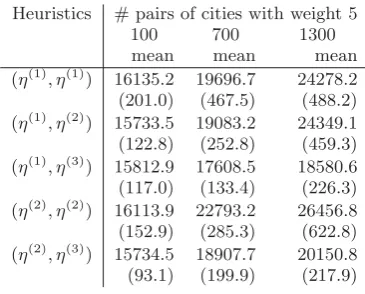
Table 1: Experiment 1: Average solution quality and standard deviation (in brackets) of PACO with different heuristics for berlin52 instance with differ-ent number of pairs of cities with weight 5
Heuristics # pairs of cities with weight 5
100 700 1300
mean mean mean
(η(1), η(1)) 16135.2 19696.7 24278.2
(201.0) (467.5) (488.2)
(η(1), η(2)) 15733.5 19083.2 24349.1
(122.8) (252.8) (459.3)
(η(1), η(3)) 15812.9 17608.5 18580.6
(117.0) (133.4) (226.3)
(η(2), η(2)) 16113.9 22793.2 26456.8
(152.9) (285.3) (622.8)
(η(2), η(3)) 15734.5 18907.7 20150.8
(93.1) (199.9) (217.9)
pair of cities has weight 0.2 or weight 5. For the third
experi-ment 2-CT-TSP instances were created where the weight for each pair of cities was chosen randomly with uniform
prob-ability from the interval [1,5].
For defining the distances dij we used the TSP test
in-stances berlin52 and eil101 from the standard benchmark library TSPLIB [16]. Note, that the total number of cities (pairs of cities) is 52 (respectively 1326) for berlin52 and 101 (respectively 5050) for eil101. The test parameter val-ues that were used are (if not stated otherwise): 10 ants
per iteration, population size |P| = 5, α = 1, β = 5,
τinit = 1/(n−1), τsolution = 0.3, andτelite = 0.2. Note,
that parameter values α= 1 andβ = 5 are typically used
in ACO algorithms for the TSP (e.g., [4]) and it has been shown that a small population size works well for PACO and the TSP ([7]). Each test run was done over 1000 iterations and has been repeated 50 times. The results given in Section 6 are averages over these 50 runs.
The influence of the different heuristics was tested. In particular, it was tested how important it is to use a heuristic for the construction of the second tour that takes the first
tour into account. Therefore, heuristics η(1) and η(2) have
been tested for the construction of the first tour of an ant
and all three heuristicsη(1),η(2), andη(3)have been tested
for the construction of the second tour. We use notation (η(i), η(j)) for a test run where heuristicη(i)is used for the
construction of the first tourπ1and heuristicη(j)is used for
the construction of the second tourπ2,i, j∈ {1,2,3}.
6.
RESULTS AND DISCUSSION
Table 1 shows the results of the PACO for the 2-CT-TSP instances of Experiment 1 when using the different heuristics and for different number of pairs of cities with weight 5. The relative quality of PACO with the different pairs of heuristics
can also be seen in Figure 1. The pair of heuristics (η(1), η(3))
is best for nearly all different number of pairs of cities with weight 5 that have been tested. An exception is the case with a small number of only 100 pairs of cities with weight 5. In
this case the pairs of heuristics (η(1), η(1)) and (η(1), η(2))
perform best. Thus, most often it is best when the first
0% 10% 20% 30% 40%
0 500 1000
number of pairs of cities with weight 5
relativ
e solution quality
(η(2),η(3)) (η(2),η(2))
(η(1),η(3)) (η(1),η(2))
(η(1),η(1))
0% 20% 40% 60%
0 300 600 900
number of pairs of cities with weight 5
relativ
e solution quality
(η(2),η(3)) (η(2),η(2))
(η(1),η(3))
(η(1),η(2)) (η(1),η(1))
Figure 1: Experiment 1: relative average solution quality for different number of pairs of cities with weight 5, top: berlin52, bottom: eil101
17609 18609 19609 20609 21609 22609 23609 24609 25609 26609 27609
0 250 500 750 1000
iteration
solution quality
(η(2),η(3))
(η(2),η(2))
(η(1),η(3))
(η(1),η(2))
(η(1),η(1))
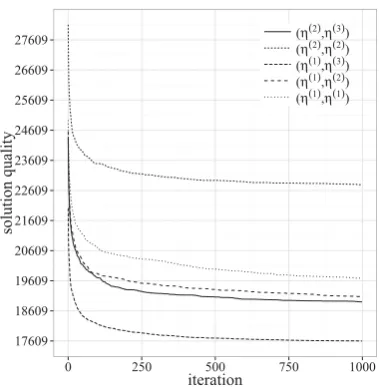
Figure 2: Experiment 1: convergence behaviour of PACO for berlin52 instance with 700 pairs of cities with weight 5
for the second tourπ2the heuristicη(3)which considers the
weights and considers also which pairs of cities are already
included in tour π1. Clearly, in the extreme cases when all
edges have the same weight heuristicsη(1)andη(2) become
equal. In the experiments usingη(1) instead ofη(2) for the
first tourπ1is always better. The solution quality difference
between using the two heuristics forπ1 is particularly large
when only few pairs of cities with weight 1 exist. When using
η(1)for tourπ1 it is nearly always better to useη(3) forπ2
instead of using η(2). The results for the eil101 instances
are very similar to the corresponding results for berlin52 instances (see Figure 1).
Figure 2 gives an example that shows the convergence be-haviour of PACO for the case of 700 pairs of cities with weight 5. It can be seen that the quality differences between the different PACO versions occur already after a few iter-ations and that the algorithms have mostly converged after 1000 iterations.
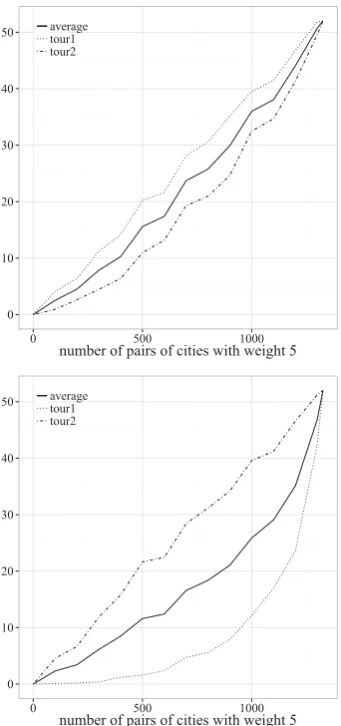
The number of pairs of cities of weight 5 that are included in the solutions of Experiment 1 are shown in Figure 3 for
PACO with heuristics (η(1), η(3)) and (η(2), η(3)). Note, that
in the extreme cases of instances with only pairs of cities with weight 1 and with only pairs of cities with weight 5 each tour includes zero, respectively 52, pairs of cities with
weight 5. Since heuristicη(1)does not consider the weights,
the number of pairs of cities with weight 5 in the first tour
π1 increases linearly with the total number of pairs of cities
with weight 5 in the problem instance. The effect of using
heuristicη(3)for the second tourπ2is that the second tour
contains less pairs of cities with weight 5. When heuristic
η(2)is used for tourπ1 there are clearly fewer pairs of cities
with weight 5 in tour π1. This holds in particular for
in-stances with a medium total number of pairs of cities with weight 5. In these cases it is relatively easy to avoid using pairs of cities with weight 5 for the second tour.
Table 2 shows the quality of the following variants of
re-0 10 20 30 40 50
0 500 1000
number of pairs of cities with weight 5
average tour1 tour2
0 10 20 30 40 50
0 500 1000
number of pairs of cities with weight 5
average tour1 tour2
Figure 3: Experiment 1: average number of pairs of cities with length 5 in the first tour π1 and the
second tourπ2, for PACO with (η(1), η(3)) (top) and
(η(2), η(3))(bottom)
Table 2: Experiment 1: average solution quality of PACO for berlin52 instance with different num-ber pairs of cities with weight 5, for each version of PACO also the best combination of heuristics is shown
Algorithm # pairs of cities with weight 5
version 100 700 1300
τelite= 0.2 16620 18771 19843
β= 2 (η(1), η(3)) (η(1), η(3)) (η(1), η(3)) τelite= 0.2 16054 18201 19408
β1= 5,β2= 2 (η(2), η(3)) (η(1), η(3)) (η(1), η(3)) τelite1= 0.2 15824 17658 18644
τelite2= 0 (η(1), η(2)) (η(1), η(3)) (η(1), η(3))
0% 20% 40% 60%
0 500 1000
number of pairs of cities with weight 5
relativ
e solution quality
(η(2),η(3))
(η(2),η(2)) (η(1),η(3))
(η(1),η(2)) (η(1),η(1))
Figure 4: Experiment 2 (each pair of cities has weight w = 0.2 or w= 5): relative average solution quality for different number of pairs of cities with weight 5
duced, 2)β= 5 is used for the construction of tourπ1 and
β= 2 is used for the construction of tourπ2, i.e., the
influ-ence of the heuristic is smaller for the second tour, and 3) the elitist solution is only used for the construction of the first
tourπ1but not for the second tourπ2(i.e., a different value
for parameterτelite was used for π1 (τelite1 = 0.2) and π2
(τelite2 = 0)). One hypothesis why PACO variants (2) and
(3) might be good is that the construction of the second tour should depend on the first tour that has already been con-structed by the ant. The reason is that some pairs of cities should be avoided for the second tour that are included al-ready in the first tour. In these cases a strong influence of a heuristic or of the elitist solution might lead the ants in the wrong direction. However, the results show that this hypothesis does not hold. None of the three PACO variants (1) - (3) results in a better solution quality.
The results of Experiment 2 where each pair of cities has
either weight 0.2 or 5 are shown in Figure 4. For small
and medium numbers of pairs of cities with weight 5 the relative solution quality of the PACO versions shows differ-ences to the results of Experiment 1. For less than 800 pairs
of cities with weight 5 heuristics (η(2), η(3)) are better than
(η(1), η(3)). Heuristics (η(2), η(2)) is the worst combination
for each problem instance in Experiment 1. However, in
Experiment 2 (η(2), η(2)) is the second best combination for
small and medium numbers (200 - 600) of pairs of cities with weight 5. This shows, that the existence of a large enough
number of pairs of cities with a small weight (<1) is useful
for a heuristic that prefers pairs of cities with small weight
for tourπ2 when they are already included in the first tour
π1.
For the evaluation of Experiment 3 all pairs of cities where
classified with respect to their weight. Four classes are
considered with weights in one of the following intervals: [1.0,2.0), [2.0,3.0), [3.0,4.0), and [4.0,5.0]. Figure 5 shows the fraction of pairs of cities in the different classes that are
included in the first tourπ1and in the second tourπ2. It can
tourπ1is nearly the same in all weight classes when heuristic
η(1)is used for the construction ofπ1. This is different when
heuristicη(2)is used for the construction ofπ1. In that case,
pairs of cities with small distance are preferred and a higher
percentage of pairs of cities in class [1.0,2.0) is contained in
π1 than for pairs of cities in class [4.0,5.0] (the percentage
for the former class is approximately 15 times higher). This
holds also for tourπ2when heuristicη(2)is used and this
re-sult is relatively independent from the heuristic that is used for the first tour.
The results are very different whenη(3)is used for the
con-struction of the second tourπ2. If in that caseη(2)is used for
tourπ1, the percentage of pairs of cities in tourπ2 is much
higher for class [4.0,5.0] than for class [1.0,2.0). The reason
is that heuristicη(3)can differentiate if a pair of cities with
large weight is included inπ1 or not. If not, such a pair of
cities can be chosen for tourπ2 without the disadvantage of
increased costs. When heuristicη(3) is used for the second
tourπ2 together with heuristicη(1)for tourπ1 the
percent-age of pairs of cities inπ2 is smaller for class [4.0,5.0] than
for class [1.0,2.0). Here, tourπ1includes already many pairs
of cities with small distance and large weight. These pairs
of cities should not be chosen for tourπ2.
7.
CONCLUSIONS
A new version of the Traveling Salesperson problem (TSP) which is called the Combined Tours TSP (CT-TSP) was defined in this paper. The aim of the CT-TSP is to find several (cyclic) tours that connect given cities such that each city is contained exactly once in each tour. The total costs of all tours should be minimum. The problem is that the costs of one tour may depend on the other tours. In this paper the particular version of CT-TSP where two tours are sought was studied (2-CT-TSP). For the studied cost function each pair of cities has a length and a weight. The quality of a solution of the corresponding 2-CT-TSP depends on the total lengths of both tours but also on the weights of the included pairs of cities. The weights are used to indicate if it is advantageous or disadvantageous when a pair of cities is contained in both tours. A Population based Ant Colony Optimization (PACO) algorithm was applied for solving the 2-CT-TSP. It was investigated how different heuristics that the ants use for the construction of the tours influence the solution quality. It was shown that it can be important that an ant uses a different heuristic for the construction of the first tour and the second tour. In particular, the heuristic for the construction of the second tour should use the knowledge about which pairs of cities are included in the first tour.
8.
ACKNOWLEDGMENTS
This work has been supported by the European Social Fund (ESF) and the Free State of Saxony within the Nach-wuchsforschergruppe ”Schwarm-inspirierte Verfahren zur Op-timierung, Selbstorganisation und Ressourceneffizienz”.
9.
REFERENCES
[1] T. Bektas: The multiple traveling salesman problem: an overview of formulations and solution procedures. OMEGA: The International Journal of Management Science 34(3): 209-219, 2006.
[2] Y.J. Costa Salas, R.A. Led´on, N.I. Coello Machado, A.
Now´e: Multi-type ant colony system for solving the
1.9 5.26
1.96 1.82 2.07
0.69 2.06
0.25
0 2 4 6
[1.0,2.0) [2.0,3.0) [3.0,4.0) [4.0,5.0]
percentage used pairs of cities
(η(1),η(2))−tour1 (η(1),η(2))−tour2
2.01 2.6
2.03 1.95 2.02 1.8 1.95
1.65
0 1 2 3
[1.0,2.0) [2.0,3.0) [3.0,4.0) [4.0,5.0]
percentage used pairs of cities
(η(1),η(3))−tour1 (η(1),η(3))−tour2
5.08 5.07
1.79 1.78
0.81 0.81 0.36 0.36
0 2 4 6
[1.0,2.0) [2.0,3.0) [3.0,4.0) [4.0,5.0]
percentage used pairs of cities
(η(2),η(2))−tour1 (η(2),η(2))−tour2
5.08
1.44 1.83 1.76
0.81 2.28
0.32 2.51
0 2 4 6
[1.0,2.0) [2.0,3.0) [3.0,4.0) [4.0,5.0]
percentage used pairs of cities
(η(2),η(3))−tour1 (η(2),η(3))−tour2
Figure 5: Experiment 3 (each pair of cities has a weight in[1,5]): average percentage of pairs of cities used in the different weight classes by the first tour
multiple traveling salesman problem. Rev. T´ec. Ing. Univ. Zulia., 35(3): 311 - 320, 2012.
[3] Y.J. Costa Salas, W.A. Sarache Castro: An alternative solution for the repair of electrical breakdowns after natural disasters based on ant colony optimization. DYNA, 81(186): 304-310, 2014.
[4] M. Dorigo, L.M. Gambardella: Ant Colony System: A Cooperative Learning Approach to the Traveling Salesman Problem. IEEE Transactions on Evolutionary Computation, 1:53-66, 1997.
[5] M. Fischetti, J.J. Salazar-Gonzalez, P. Toth: A Branch and Cut Algorithm for the Symmetric Generalized Traveling Salesman Problem. Operations Research, 45(3):378-394, 1997.
[6] M. Fischetti, P. Toth: An Additive Approach for the Optimal Solution of the Prize-Collecting Traveling Salesman Problem. In Vehicle Routing: Methods and Studies. B.L. Golden, A.A. Assad (eds.).
North-Holland, Amsterdam, 319-343, 1988. [7] M. Guntsch, M. Middendorf: A Population Based
Approach for ACO. Proc. 2nd European Workshop on Evolutionary Computation in Combinatorial
Optimization (EvoCOP-2002), LNCS 2279, 72-81, 2002. [8] G. Gutin, A.P. Punnen (Eds): The Traveling Salesman
Problem and Its Variations. Springer, Combinatorial Optimization Series, Vol. 12, 2007.
[9] J. LaRusic: The bottleneck traveling salesman problem
and some variations.M.Sc. thesis, Department of
Mathematics, Simon Fraser University , 2010.
[10] M.A. Liang: Ant Colony Optimization for Bottleneck TSP. Computer Engineering, 9: 24-25, 2001.
[11] Y.-C. Lin, M. Clauß, M. Middendorf: Simple Probabilistic Population Based Optimization. IEEE Transactions on Evolutionary Computation, early access article, DOI 10.1109/TEVC.2015.2451701, 2015. [12] R. Matai, S.P. Singh, M.L. Mittal:Traveling Salesman Problem: An Overview of Applications, Formulations, and Solution Approaches. In: D. Davendra (ed.), Traveling Salesman Problem, Theory and Applications, 2010.
[13] S. Oliveira, M. S. Hussin, T. St¨utzle, A. Roli, M.
Dorigo: A detailed analysis of the population-based ant colony optimization algorithm for the TSP and the QAP. Proc. Genetic and Evolutionary Computation Conference (GECCO-2011), 13-14, 2011.
[14] A. Plebe, A.M. Anile: A Neural-Network-Based Approach to the Double Traveling Salesman Problem. Neural Computation, 14(2): 437-471, 2002.
[15] J.-Y. Potvin: A Review of Bio-Inspired Algorithms for Vehicle Routing. In: F.B. Pereira, J. Tavares (eds.), Bio-inspired Algorithms for the Vehicle Routing Problem, Studies in Computational Intelligence, Vol. 161, 1-34, 2009.
[16] G. Reinelt: TSPLIB. http://comopt.ifi.uni-heidelberg.de/software/TSPLIB95.
[17] M. Reihaneh, D. Karapetyan: An Efficient Hybrid Ant Colony System for the Generalized Traveling Salesman Problem. Algorithmic Operations Research, 7: 21-28, 2012.
[18] X. Shi, L. Wang, Y. Zhou, Y. Liang: An Ant Colony Optimization Method for Prize-collecting Traveling
Salesman Problem with Time Windows. Proc. Fourth International Conference on Natural Computation (ICNC ’08), 480 - 484, 2008.
[19] T. Weise, R. Chiong, J- L¨assig, K. Tang, S. Tsutsui,
W. Chen, Z. Michalewicz, X. Yao: Benchmarking Optimization Algorithms: An Open Source Framework for the Traveling Salesman Problem. IEEE
Computational Intelligence Magazin, 9(3):40-52, 2014. [20] J. Yang, X. Shi, M. Marchese, Y. Liang: An ant colony
optimization method for generalized TSP problem. Progress in Natural Science, 18:1417-1422, 2008. [21] B. Yu , Z.Z. Yang: An ant colony optimization model:
The period vehicle routing problem with time windows. Transportation Research Part E: Logistics and
Transportation Review, 47(12):166-181, 2011. [22] W. Zhou, P. Yao: An Improved Ant Colony
![Figure 5:Experiment 3 (each pair of cities has aused in the different weight classes by the first tourπPACO withweight in [1, 5]): average percentage of pairs of cities1 and the second tour π2 (from top to bottom): (η(1), η(2)), PACO with (η(1), η(3)), PACOwith (η(2), η(2)), PACO with (η(2), η(3))](https://thumb-us.123doks.com/thumbv2/123dok_us/8408319.1690011/7.595.365.507.57.639/figure-experiment-dierent-classes-tourppaco-withweight-percentage-pacowith.webp)
