PRODUCT DEVELOPMENT THROUGH
QUANTITATIVE EVALUATION OF
ENVIRONMENTAL ASPECTS USING
LCA – A CASE STUDY
Ms. SUMAN SHARMAa† a
Professor, Department of Mechanical Engineering, TRUBA College of Engineering and Technology,
Indore-452009, Madhya Pradesh, India,
Dr. SMITA MANEPATILb b
Professor, Department of Mechanical Engineering , SGS Institute of Technology and Science,
Indore-452001, Madhya Pradesh, India,
Abstract
Significant environmental improvement can be achieved by investigation of environmental aspects as an optimization parameter in product development. Environmental oriented product design has already had a significant amount of attention in literature, in the form of Eco Design, DFE, and sustainable Design etc. The quantitative evaluation is required to learn about environmental impacts at various stages of the life of the product. LCA (Life Cycle Assessment) can be used in any phase of product development, but the major potential exists in the analysis phase or the conceptual development phase. LCA is used for effective quantitative evaluations of individual products in terms of their environmental issues and the effectiveness of improvements.
The Objective of this work is to develop the design of a product through the investigation of environmental aspects through quantitative evaluation of their impacts. The methods EDIP (Environmental Design of Industrial Products), FRED- ISO14040 and Eco Indicator 99 have been used as Life Cycle Assessment methods and comparative studies have been presented in this work. Three main stages of life cycle of product had selected for this investigation. The two important parts, namely mudguards and chain cover of a bicycle have been selected for case studies and material selection have been suggested based on the comparative statement of LCA methods. The results can support the designers to develop the products with improved environmental properties.
Keywords: Product development; Eco Design; Design for Environment (DFE); Life Cycle Assessments; Environmental Impact; Life Cycle Inventory; Bicycle.
1.Introduction
Investigation of environmental aspects for achievement of environmental improvement is the optimizing parameter in product development. Environmental oriented product design has already had a significant amount of attention in literature, i.e. Eco Design, DFE, sustainable Design etc. The quantitative evaluation of environmental impacts is required to learn at various stages of the life of the product.
an important quality criterion. The product quality can be evaluated by applying the concept of Ecodesign. Ecodesign is an approach to design of a product with special consideration for the environmental impacts of the product during its whole lifecycle. Ecodesign assumes that the contribution of the product to the environment should be considered through all of its life cycle phases.
1.1 Product development
Environmental considerations during product development imply a large potential for reducing society's environmental impact. Implementing environmentally adapted product development has been considered difficult and was uncommon.
In the seventies, with the emergence of life-cycle engineering and concurrent engineering, companies became more aware of the need to include serviceability and maintenance issues in their design processes. One of the most striking areas where companies now have to be concerned is with the environment. The concern regarding environmental impact stems from the fact that, whether we want it or not, all our products affect in some way our environment during their life-span. The general goal of environmentally conscious approaches to product design is the reduction of the negative environmental impact of a product throughout its life cycle. (Coulter, et al., 1995).
The introduction of appropriate design guidelines is one of the easiest ways in introducing environmental issues in design. A number of design guidelines ranging from a focus on specific aspects of a product’s life cycle (e.g., “reduce the number of materials used to facilitate more efficient recycling”) to sustainable development (e.g., “reduce the use of non-renewable energy sources”) have been developed in recent years. Quantitative metrics are needed to assess the progress and provide means for continuous improvement and feedback when integrating environmental issues in design. (Berkhout, 1995).
The potential for environmental improvements is large in the beginning of product development when ideas and conceptual solutions are open. It decreases gradually as the general product features are established and more and more details are determined. The environmental aspects are limited to production processes, logistics, recycling etc. when the production has been setup and the product is ready for the market. LCA can be used in any phase of product development, but the major potential exists in the analysis phase, the conceptual development phase.
(i) Analysis Phase: For the initial investigation, first a defined product is required and the details of materials and processes are also required for quantitative LCA of that defined product. So first we have to define reference product for new product development at initial phase of analysis. An existing product can serve as a reference product. The environmental performance of a product or a service is determined as a sum of all impacts throughout the life cycle of product.
(ii) Concept Development Phase: When all the environmental aspects of the selected product has been evaluated, now we have to determine some area sub-assemblies/parts of product /processes ,where the environmental impacts can be moderated or removed by modifying or removing / replacing some solution in the reference product. During this all the aspects such as design, functionality, aesthetics, environmental etc. must be taken into account.
(iii) Implementation Phase: In this phase all alternative suggested in concept development phase must be analyzed through quantitative evaluation by LCA methods. The LCA computer model can be used for this quantitative evaluation and also can be used for determining the environmentally optimal solution.
Figure 1: Framework of Product Life Cycle
1.2 Eco design
An international concept, developed by the World Business Council for Sustainable Development (WBCSD) at the Rio summit, eco-design is the culmination of a holistic, conscious and proactive approach. It consists in designing a product -or service- so as to minimize its impacts on the environment. Eco-design applies at every stage in a product’s life: raw material extraction, production, packaging, distribution, use, recovery, recycling, incineration, etc. Ecodesign can be defined as” It is an approach to design of a product with special consideration for the environmental impacts of the product during its whole lifecycle. The life cycle of a product usually includes the stages extraction of raw material, manufacture, use and disposal “.
Life Cycle Assessment (LCA) examines inputs (e.g. materials, resources, energy) and outputs (e.g. emissions to air and water, waste) at every stage in a product’s lifecycle in terms of its environmental impacts. This framework has been standardized within the series ISO 14040.The concept also can be used to optimize the environmental performance of a single product (Ecodesign) or to optimize the environmental performance of a company. Common categories of assessed damages are global warming (greenhouse gases), acidification, smog, ozone layer depletion, Eutrophication, eco-toxicological and human-toxicological pollutants, desertification, land use as well as depletion of minerals and fossil fuels.
2. Literature Review
The Eco friendly design is evaluated by investigating the product for environmental impact. This is generally studied by three methods i.e. FRED, Eco-Indicator 99 and EDIP. So a brief literature review on Ecodesign, LCA, LCI, product development etc. is presented here.
The production of electrical and electronic equipment (EEE) is one of the fastest growing domains of manufacturing industry in the Western world. The EEE sector makes a significant environmental impact on all stages of the product life cycle: extraction and use of raw materials, consumption of energy and other resources in production and product use, and eventually waste from EEE. Eco-design as one of the most effective environmental protection tool is analyzed in the paper. An integrated model for systematic use of different environmental improvement methods for development of new products has been developed taking into account main drivers for Eco-design in EEE industry. The results of the electricity meter Eco-design project are presented to demonstrate the effectiveness of the developed methodology. The other environmental issues for EEE include the impact of materials used in manufacturing and product waste at the end of the item’s useful life. A number of materials in these products are banned, such as polychlorinated biphenyl in fridges. [1]. In 1988, the amount of electronic equipment reaching end-of-life was 6 million tons and is expected to double in 2010 [2]. This means that about 20% of the municipal waste stream will be related to WEEE (Waste Electrical and Electronic Equipment) [3]. Taiwan's Business Council for Sustainable Development (BCSD) and Electronic Testing Centre (ETC) have funded the Centre for Sustainable Design (CfSD) in the UK to produce a report outlining an eco- design strategy for the Taiwan electronics sector [4]. The complete report of eco-design in the electronics sector in Taiwan can be found in publication [5]. The paper intends to report recent eco-design activities in details. The eco-design promotion activities are organized by government, nongovernmental organization (NGO), and academia.[6]
environmental issues in product design and realization. [7]. Integrated product policy (IPP) is an initiative at the European Union (EU) level aimed at reducing the environmental burden of products and services throughout their lifecycles.IPP is part of a growing trend within environmentally advanced countries in Europe towards product-oriented environmental policies. As such, it represents a new shift in thinking towards ‘front-of-pipe’ solutions (e.g. the greening of product development and design). By focusing on the product development and design phase, IPP aims to tackle the stage at which many of the environmental burdens of products are determined. [8]
An impact assessment and improvement analysis thus evaluatesthe impacts caused by the proposed products, processes, or activities. The final result of an impact assessment is an environmental profile of the system (Svoboda, S., 1995). LCA has been widely used for Design for Environment to identify environmental ‘hot spots’ in a reference product’s life cycle and to select new environmentally optimized solutions for a new product. (Nielsen and Wenzel, 2002)[9]. EPA’s 1993 document, “Life-Cycle Assessment: Inventory Guidelines and Principles,” and 1995 document, “Guidelines for Assessing the Quality of Life Cycle Inventory Analysis,” provide the framework for performing an inventory analysis and assessing the quality of the data used and the results. The two documents define the four steps of a life cycle inventory: Develop a flow diagram of the processes being evaluated, Develop a data collection plan, Collect data and Evaluate and report results.[10] A lifecycle based process model for analyzing the environmental performance of SFM processes and SFM based rapid tooling processes is presented in the paper. The material use, process parameters (e.g. scanning speed) and power use can affect the environmental consequence of a process when material resource, energy, human health and environmental damage are taken into account.[11]. Sustainable development requires methods and tools to measure and compare the environmental impacts of human activities for the provision of goods and services. Environmental impacts include those from emissions into the environment and through the consumption of resources. These emissions and consumptions contribute to a wide range of impacts, such as climate change, stratospheric ozone depletion, Eutrophication, acidification, toxicological stress on human health and ecosystems, and the depletion of resources. Practitioners and researchers from many domains come together in life cycle assessment (LCA) to calculate indicators for potential environmental impacts that are linked to products. [12]
Ecodesign assumes that the contribution of the product to the environment should be considered through all of its life cycle phases. To be able to cut down environmental impacts during the life cycle of products and, related to the decrease of environmental impact gain economical benefit, Ecodesign can be applied. [13]. An extensive R&D project—Life Cycle Assessment as a Tool for the Management of Environmental Issues in the Finnish Metals Industry—was carried out. Life cycle inventory (LCI) data of the main product groups were produced and interpreted by an impact assessment model based on decision analysis and methods used in life cycle impact assessment. The results revealed that the Finnish metals industry is far from homogenous as regards its environmental impacts. [14]. The paper investigates injection molding from an environmental standpoint, yielding a system level environmental analysis of the process. It provides a transparent process model that includes all major steps involved in the production of injection molded products and shows the dependency of injection molding on the most important process parameters. [15]
3. Materials and Methods
The procedures of life cycle assessment (LCA) are part of the ISO 14000 environmental management standards: in ISO 14040:2006 and 14044:2006. (ISO 14044 replaced earlier versions of ISO 14041 to ISO 14043). LCA is used for effecting quantitative evaluations of individual products in terms of their environmental issues and the effectiveness of improvements. Life cycle analysis is a “cradle-to-grave” approach for assessing industrial systems. The LCA process is a systematic, phased approach. Life cycle assessment methodology is commonly a four-step procedure (EPA-USA, 2001).
Goal definition and scoping Inventory analysis,
Impact assessment, and Interpretation.
(i). Goal and Scope
In the first phase, the LCA-practitioner formulates and specifies the goal and scope of study in relation to the intended application. The goal and scope should address the overall approach used to establish the system boundaries. The system boundary determines which unit processes are included in the LCA and must reflect the goal of the study. Finally the goal and scope phase includes a description of the method applied for assessing potential environmental impacts and which impact categories those are included.
(ii). Life Cycle Inventory
This second phase 'Inventory' involves data collection and modeling of the product system, as well as description and verification of data. This encompasses all data related to environmental (e.g. CO2) and technical (e.g. intermediate chemicals) quantities for all relevant unit processes within the study boundaries that compose the product system. Examples of inputs and outputs quantities include inputs of materials, energy, chemicals and 'other' - and outputs in the form of air emissions, water emissions or solid waste.
(iii). Life cycle impact assessment
The third phase 'Life Cycle Impact Assessment' is aimed at evaluating the contribution to impact categories such as global warming, acidification etc. The first step is termed characterization. Here, impact potentials are calculated based on the LCI results. The next steps are normalization and weighting, but these are both voluntary according the ISO standard. Normalization provides a basis for comparing different types of environmental impact categories (all impacts get the same unit). Weighting implies assigning a weighting factor to each impact category depending on the relative importance.
(iv). Interpretation
The phase stage 'interpretation' is the most important one. An analysis of major contributions, sensitivity analysis and uncertainty analysis leads to the conclusion whether the ambitions from the goal and scope can be met. More importantly: what can be learned from the LCA? All conclusions are drafted during this phase. Sometimes an independent critical review is necessary, especially when comparisons are made that are used in the public domain.
The term ‘product’ includes hardware as well as software respectively services. The six life cycle stages of a product are briefly introduced in the following:
i. Raw materials Acquisition
In the first life cycle phase resources (materials and energy) are extracted from nature raw and Ancillary materials are produced from the extracted resources.
ii. Manufacturing of Raw Materials
In this stage of life cycle of product, the materials extracted from nature are processed to convert it into usable form.
iii. Manufacturing processes
In this phase materials are processed to parts and components during manufacturing. The components can be assembled to form the final product.
iv. Transport
v. Use
In the use phase the product is used. To operate properly, the product may require energy or secondary materials, e.g. lubricants, water or coolants. A product has to fulfill its functionality in the use phase. The lifetime of the product is the time the product can fulfill its functionality properly.
3.1 Basis of Analysis
Objective of the work is to do the changes in the design of some important parts of a product through the investigation of environmental impact by using EDIP (Environmental Design of Industrial Products), FRED- ISO14040 and Eco Indicator 99 as Life Cycle Assessment methods for evaluating and improving their Impact on Environment. Then compare the results for the various impact categories of all the methods of LCA. This analysis is presented for some components of a product, i.e. Bicycle in the subsequent sections. In this work the three methods of LCA are considered, so wide range of environmental aspect can be evaluated. The method EDIP is widely used by the industries for impact analysis.
3.2. Case study
We have taken parts of bicycle i.e. mudguards and chaincover for the detailed study of LCA. The product is very popular and used in large quantity. The parts of product are selected for quantitative evaluation of environment impact by three different methods i.e. ISO 14040, EDIP and Eco-Indicator 99. The selected parts of bicycle i.e. mudguards and chaincover are manufactured by the material steel.
Steps followed during the work done:
Analyzed the results of quantitative evaluation of environmental impact of the product i.e. Bicycle through three LCA methods EDIP, FRED and Eco-Indicator 99.[16]
To control the environmental impacts, the analysis is being carried out for alternate design of various components of the Bicycle.
Search of the components, which would be changed for improvement in environmental impacts without affecting the functionality of the product. Two components i.e. Mudguards and chain cover are selected for this work. Ecodesign is carried out with due consideration of functionality of the product.
Both the components have less affect on the actual functionality of the Bicycle.
Analyzed the functionality & environmental impact of both the mudguards front & back.
Change the design of mudguards by changing material of it i.e. plastic (HDPE) instead of steel sheets. Quantitative evaluation of mudguards of plastic for environmental impacts of various impact categories
of LCA methods through LCA model.
The boundaries conditions decided for this work are for three main stages of life cycle of the product, i.e. raw material acquisition, raw manufacturing and part manufacturing.
Technical feasible analysis of it with changed design.
Analyzed the functionality & environmental impact of chain cover through quantitative evaluation of various alternatives as under :
Full chain cover of steel sheets. Half chain cover of steel sheets. Half chain cover of Plastic sheets. Whole chain cover removed.
Analysis of result through LCA model and Interpretation for alternatives designs. Suggestions in benefit of society.
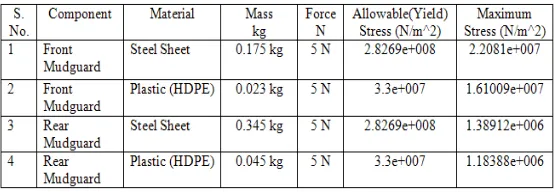
To control the environmental impacts, the analysis is being carried out for alternate material, i.e. plastic (HDPE) for Mudguards and Chaincover. We find out the cross section area of the parts of plastic at allowable stress that could bear ultimate load of 5 N.
Table 1: Various Parameters of Steel and plastic (HDPE)
The table 1 shows the technical analysis of the mudguards and also various parameters of steel and plastic related with design. It will impart the required strength of the parts. Consequentially the overall weight reduction of the Bicycle will be reduced by 6.0%. The weight reduction of mudguards will be 87 % and of chaincover will be 91 %. Table 1 shows the technical details of the parts for both the materials.
4. Results and Discussions
4.1 Results
Figure 2: The Environmental Impacts for three stages of life cycle of Bicycle-Mudguard for Steel and Plastic as per EDIP, FRED (ISO-14040) and Eco-Indicator 99 (Logarithmic Scale)
4.2 Discussions
Some Impact categories have much higher values than other, so we are presenting the results on logarithmic scale. Ecotoxicity and human toxicity is much higher than other impacts. Global warming is also very much higher than other impacts. The results show that Plastic has very less impact on various impact categories of EDIP, EcoIndicator 99 and FRED (ISO14040) as compared to the Steel. Steel as well as plastic both have a very larger impact on Ecotoxicity, human toxicity and Global warming as compared to other impact category of EDIP. The Steel and plastic both can be easily recycled. But during recycle process Steel has more impact on environment as compared to Plastic.
All alternative of eco design of chaincover analyzed. Full Chaincover of steel sheet has large impact, The half chaincover of steel sheet has more impact as compared to half chain cover of plastic, but it has more impact than the chain cover totally removed. But functionally the removal of chain cover is not suitable for the user. So it is better to have half chaincover of plastic. It is a optimal solution of the problem.
So we choose the combination of plastic mudguards (front & Back) and half chain cover of plastic for interpreting the results for further developments in the Bicycle.
Environmental Improvement during Ecodesign of Mudguard and chain cover of Bicycle:
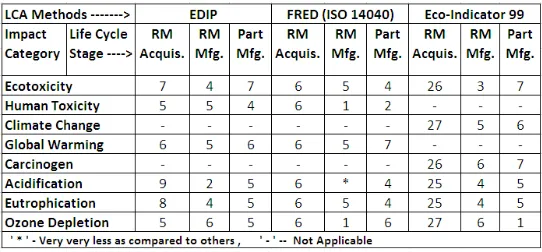
The work done by three methods of LCA, because it covers all aspects of the environmental impacts . Here the work is emphasized mainly on those impacts categories which have large impact as compared to other, i.e. Ecotoxicity, Human toxicity, Global warming, Eutrophication, Acidification and Ozone depletion. The table 2, shows the environmental impact improvement (in percentage) for three main stages of life cycle through three LCA methods after considering the suggested changes in design of parts of bicycle.
Table 2: Environmental Impact Improvement category wise (in percentage) according to three LCA Methods and as per suggested changes in design.
5. Conclusion
The quantitative method of LCA can be used to provide the quantitative environmental evaluation of the product by impact categories on local, regional and global level. The results can support the designers to develop the products with improved environmental properties. The Eco Design guidelines will be the basis for developing the new concept for product development.
The above framework demonstrated the use of LCA methods for product development through computing the environmental impacts of the product for Ecodesign of two parts. This framework and its implementation can be easily expanded to include more parts of the product and LCA methods.
6. References
[1] Inga Gurauskienė, Visvaldas Varžinskas,Eco-design Methodology for Electrical and Electronic Equipment Industry, Institute of Environmental Engineering, Kaunas University of Technology (received in July, 2006; accepted in September, 2006)
[2] Appelbaum, A., Europe Cracks Down on E-Waste,IEEE Spectrum, Vol. 39, No. 5, May 2002, pp.. 46-51.
[3] Widmer, R., Oswald-Krapf, H., Sinha-Khetriwal, D.,Schnellmann, M., Bön, H., Global perspectives on ewaste.Environmental Impact Assessment Review,Volume 25, Issue 5, July 2005, pp. 436-458.
[4] M. Charter, T. Clark,. An eco-design route map for the Taiwan electronics sector, The Centre for Sustainable Design, UK, for the Department of Industrial Technology and the Electronics Testing Centre (ETC): Taiwan, October 2002.
[5] M. Charter, J. Boyce, D. Burrell, Ecodesign and Environmental Management in the Electronics Sector in China, Hong Kung and Taiwan. The Centre for Sustainable Design: UK, for DTI: UK, November 2003
[6] Jahau Lewis Chen, Li-Hsing Shih, Jyh-Shing Yang, Thomas Chen, Eco-design Activities in Taiwan Department of Mechanical Engineering, National Cheng Kung University, Tainan, TAIWAN, [email protected], Department of Resources Engineering, National Cheng Kung University, Tainan, TAIWAN, Ihshih@mail. ncku. edu. Tw, CESH, ITRI, Hsin-Chu, TAIWAN, [email protected],IEK, ITRI, Hsin-Chu, TAIWAN,[email protected], l-4244-0081-3/05/$20.00 ©2005 IEEE.
[7] Bert Bras ,Systems Realization Laboratory,The George W. Woodruff School of Mechanical Engineering,Georgia Institute of Technology,Incorporating Environmental Issues,in Product Design and Realization,Atlanta, Georgia 30332-0405,U.S.A. Published in Industry and Environment, Special Issue on Product Design and the Environment,United Nations Environment Programme Industry and Environment (UNEP/IE), Vol. 20, No. 1-2(double issue), 1997.
[8] Martin Charter, Alex Young, Aleksandra Kielkiewicz-Young and Inga Belmane, Integrated product policy and eco-product development ,The Centre for Sustainable Design, UK, Greenleaf Publishing Ltd. © 2001
[9] Nielsen, P.H. and Wenzel, H., Integration of environmental aspects in product development: a stepwise procedure based on quantitative life cycle assessment, Journal of Cleaner Production, Vol. 10,p247-257 (2002).
[10] Environmental Protection Agency USA, EPA/600/R-00/095, Framework for Responsible Environmental Decision making (FRED): Using Life Cycle Assessment to Evaluate Preferability of Products, http://lcacenter.org/pdf/fred.pdf (Oct. 2001)
[11] Yanchun Luo; Zhiming Ji; Caudill, R.J.; Leu, M.C. Electronics and the Environment, 2000. ISEE 2000. Lifecycle analysis for environmentally conscious solid freeform manufacturing, Proceedings of the 2000 IEEE International Symposium on Volume, Issue, 2000Page(s):33–38,Digital Object Identifier 10.1109/ISEE.2000.857622.
[12] G. Rebitzer, T. Ekvall, R. Frischknecht, D. Hunkeler, G. Norris, T. Rydberg, W.-P. Schmidt, S. Suh, B. P. Weidema and D. W. Pennington, Life Cycle Systems Group, GECOS, ENAC, Swiss Federal Institute of Technology—Lausanne (EPFL), CH-1015, Lausanne, Switzerland b
Energy Systems Technology, Chalmers University of Technology, SE-412 96, Life cycle assessment Part 1: Framework, goal and scope definition, inventory analysis,and application, 12 April [email protected] International Volume30,Issue 5,July2004,Pages 701-720.
[13] Hesamedin Ostad Ahmad Ghorabi, EcoDesign ABCs: How to develop a sustainable product design, Production & Operations Monthly Newsletter in the field of Operations Management, Institute for Engineering Design – Ecodesign, Technical University of Vienna,April 01, 2007 Volume,http://www.pomonthly.com/Newsletter6-Sustainability/NL-6.htm
[14] Jyri Seppa¨la¨ *, Sirkka Koskela, Matti Melanen, Matti Palperi, Resources, Conservation and Recycling, The Finnish metals industry and the environment Finnish Environment Institute,PB 140, FIN-00251 Helsinki,Finland.35 (2002), 61-76.www.elsevier.com/locate/resconrec.
[15] Alexandre Thiriez and Timothy Gutowaski,An Environmental Analysiis of Injection Molding Extended Abstract- Green Manufacturing Processes, Department of Mechanical Engineering, Massachusetts Institute of Technology,Rm.35-234,77 Massachusetts Ave. Camnbridge,MA 02139, 2006 IEEE.
[16] Suman Sharma, Durgesh Joshi, Dr. N.K.Nagar, Framework and Implementation of Life Cycle Assessment of a Product, International conference, UEC, Ujjain, Dec 2007.