Circulating Neutrophils in Septic Preterm Neonates: Comparison of Two
Reference Ranges
William D. Engle, MD*; Charles R. Rosenfeld, MD*; Anna Mouzinho, MD; Richard C. Risser‡; Fiker Zeray, RN*; and Pablo J. Sanchez, MD*
ABSTRACT. Objective. To study the effect of sepsis on circulating neutrophils in very low birth weight neo-nates and to assess the usefulness of recently revised reference ranges for circulating neutrophils in the diag-nosis of sepsis in this population by comparison with previously reported reference ranges.
Methods. Neutrophil parameters (absolute total neu-trophils, absolute total immature neuneu-trophils, and the immature:total neutrophil proportion) were analyzed ret-rospectively in 202 sepsis episodes in 192 neonates (birth weight5 1055 6 246 g, X6 SD; estimated gestational age52962 weeks) between birth and 30 days of age. The percentage of values lying outside the reference ranges reported recently by Mouzinho et al32and previ-ously by Manroe et al24 were compared. To more accu-rately assess possible differences in specificity between the two reference ranges, neonates with early-onset group B streptococcal infection (n519) were compared with a matched control group (n551) using conditional logistic regression.
Results. Greater sensitivity was observed using the previous reference ranges of Manroe et al24over the en-tire study period (0 to 720 hours) both for the initial and the second complete blood count (CBC). The previous reference ranges also were more sensitive than the re-vised ranges for the initial CBC at 0 to 72 and at 73 to 720 hours and for infections attributable to coagulase-nega-tive staphylococci. However, specificity in neonates without group B streptococcal infection was significantly greater with the revised reference ranges compared with those of Manroe et al24(initial CBC, 73% vs 45%; serial CBCs, 59% vs 10%).
Conclusion. The observed differences in sensitivities may be of limited clinical significance because very low birth weight infants often are begun on antibiotic ther-apy regardless of laboratory values. However, the strik-ing differences in specificity usstrik-ing the revised reference ranges suggest that these ranges may be clinically useful in determining length of antimicrobial therapy in infants in whom cultures remain sterile. Pediatrics 1997;99(3).
URL: http://www.pediatrics.org/cgi/content/full/99/3/e10;
sepsis, very low birth weight neonate, neutrophils.
ABBREVIATIONS. VLBW, very low birth weight; CBC, complete blood count; BW, birth weight; GBS, group B streptococcal (infec-tion); ATI, absolute total immature neutrophil count; I:T, imma-ture neutrophil:total neutrophil proportion; ATN, absolute total neutrophil count; PPV, positive predictive value; NPV, negative predictive value.
The timely diagnosis of sepsis in the very low birth weight (VLBW;#1500 g) neonate is critical because the illness can be rapidly progressive and in some instances fatal.1,2Numerous investigators have
eval-uated the usefulness of various laboratory tests in the diagnosis of systemic infection in this population.3– 6
These include determination of C-reactive protein,7
erythrocyte sedimentation rate,8haptoglobin,9
oroso-mucoid,10 fibronectin,5elastase-a-1-proteinase
inhib-itor complex,11 C3d,12 endotoxin,13 acridine orange
cytospin,14and nitroblue tetrazolium reduction.15
Al-though multiple tests have been used together for this purpose, perhaps the single test of greatest util-ity in establishing a diagnosis of sepsis has been the complete blood count (CBC) and in particular the various neutrophil parameters.2,16 –23 In studies
re-ported in 1979,24we established reference ranges for
circulating neutrophils in neonates with postnatal age#30 days. Although the gestational age and birth weight (BW) of these neonates ranged from 29 to 44 weeks and from 860 to 5000 g, respectively, these data were obtained between 1974 and 1976, when the survival of preterm, VLBW neonates was substan-tially less than that observed more recently. In this report and others, neutropenia was associated with neonatal sepsis, especially attributable to group B streptococcus (GBS).25,26
Based on subsequent studies from our institution and elsewhere,27–31it appeared, however, that many
normal VLBW neonates were considered to be neu-tropenic using the references ranges of Manroe et al.24 More recently, we reported revised reference
ranges for circulating neutrophils in VLBW neo-nates.32 Although the reference ranges for absolute
total immature neutrophils (ATI) and the immature: total neutrophil proportion (I:T) were unchanged, the reference ranges for absolute total neutrophils (ATN) differed from those previously reported. There was a broader distribution for ATN values during the first 72 hours after birth, primarily reflect-ing a markedly lower limit throughout this period of time and a shift in the peak upper range from 10 to 12 hours to 18 to 24 hours after birth (see Figure). Because more VLBW neonates would now have
From the Departments of *Pediatrics and ‡Academic Computing, Univer-sity of Texas Southwestern Medical Center, Dallas, TX 75235–9063. Presented in part at the Annual Meeting of the American Pediatric Society/ Society for Pediatric Research, San Diego, CA, May 8, 1995.
Dr Ana Mouzinho was a visiting Research Scientist from Portugal. Received for publication Nov 17, 1995; accepted Jun 13, 1996.
Reprint requests to (W.D.E.) University of Texas Southwestern Medical Center at Dallas, Department of Pediatrics, 5323 Harry Hines Blvd, Dallas, TX 75235–9063.
ATN values that would fall into the normal range, we hypothesized that the usefulness of peripheral neutrophil values in helping to establish a diagnosis of sepsis in this population might be diminished. To address this concern, we analyzed circulating neu-trophil values obtained from 192 VLBW neonates born between 1987 and 1993 with proven sepsis in the first postnatal month. Neutrophil values were examined using the reference ranges of Manroe et al24 as well as those of Mouzinho et al32 to assess
differences in sensitivity between the two methods. In addition, a subset of the population [19 infants with early-onset (0 to 72 hours) GBS infection] was compared with a matched control group to assess differences in specificity between the reference ranges of Manroe et al24and Mouzinho et al.32
METHODS Subjects
The study population consisted of 192 VLBW neonates deliv-ered at Parkland Memorial Hospital between January 1, 1987 and December 31, 1993 who had a positive bacterial or fungal isolate from blood and/or cerebrospinal fluid in the first month of life (Table 1). The 192 study infants had a total of 202 episodes of culture-proven sepsis identified by prospective surveillance and they represented 11% of the 1732 neonates with BW #1500 g admitted to the neonatal intensive care unit during the study period. Furthermore, they represented all infants in this BW group with proven sepsis and at least one CBC obtained at the time of the evaluation for sepsis. Four infants with sepsis were excluded because CBC data was unavailable. A subset of this population, ie, 19 neonates with early-onset GBS infection, is described in Table 2. One infant with early onset GBS was excluded because CBC data was unavailable. None of the mothers of these 19 infants received intrapartum antibiotics. Using a preexisting database for all VLBW neonates admitted to the intensive care nursery, we subsequently identified a control group consisting of 51 neonates without early-onset infection who were matched with those with GBS disease using the date of birth, sex, race, gestational age (within 3 weeks) and BW (within 15%). All matched neonates were born within 10 months of the index case who had GBS disease; for 11/19 index cases (58%), control neonates were born within 30 days (Table 2). Between 2 and 4 neonates were matched for each index cases with CBCs obtained at similar postnatal ages in the first 72 hours of life.
Laboratory Methods
CBCs, using a sample obtained by venipuncture, heel stick, or from an umbilical catheter, were determined in all neonates at the time of evaluation for sepsis and were analyzed retrospectively. Sequential values were available for analysis 12 to 24 hours after the initial CBC in 147 neonates (77%). Neutrophil indices were calculated as previously described by Manroe et al.24Peripheral blood nucleated cell counts were performed with a Sysmex TM NE 8000 (Toa Medical Electronics Co, Ltd, Kobe, Japan) and a manual 100-cell differential cell count was performed on Wright-stained blood films for white blood cell counts,30 000/mm3and on 200 cells if the white blood cell count exceeded 30 000/mm3. The ATN count was determined from the sum of mature and immature neutrophils. The ATI count included bands and other granulocyte precursors. The I:T proportion was calculated as ATI/ ATN. All neutrophil values were determined by the routine hematology lab, the reliability of which has been reported pre-viously.24,27
Sepsis was defined as a positive blood and/or cerebrospinal fluid culture in a neonate who was evaluated either shortly after birth or within 30 days after birth attributable to an alteration in clinical course in which infection was considered in the differen-tial diagnosis. Instances in which sepsis was strongly suspected but cultures remained sterile were not included. In the case of coagulase-negative staphylococci, two of two positive blood cul-tures were required for a diagnosis of sepsis, otherwise the isolate Figure. Reference ranges for total neutrophil values in the first
60 hours after birth. The solid lines depict the boundaries of the revised reference range of Mouzinho et al32in infants#1500 g. The dotted lines depict the reference range of Manroe et al.24For the latter, the minimum value of 1750 total neutrophils/mm3is estab-lished by 72 hours of age; a stable maximum value of 5400 neu-trophils/mm3is reached at 120 hours.
TABLE 1. Characterization of Study Population
Number of infants 192
Birth weight (g) range* 10556246 (570–1500) Gestational age (wk) range* 28.762.2 (24–34) Sex
Males 109 (57)†
Females 83 (43)
Race
African-American 103 (54)
Latin-American 44 (23)
White 40 (21)
Asian 5 (2)
Clinical
Maternal PIH‡ 27 (14)
5-min Apgar score#5 43 (23) Respiratory distress syndrome 114 (59) Mechanical ventilation 164 (85) Apnea of prematurity 155 (81)
* Values are presented as means6SD.
† Numbers in parentheses are percentages (except for range). ‡ Pregnancy-induced hypertension.
TABLE 2. Neonates With Early-onset Group B Streptococcal (GBS) Sepsis and Their Matched Controls
Early-onset GBS
Matched Controls
Number of infants 19 51
Birth weight (g)* 10196267 10576270 Gestational age (wk)* 28.562.5 28.662.6 Sex
Males 5 (26)† 14 (27)
Females 14 (74) 37 (73)
Race
African-American 14 (74) 39 (76) Latin-American 2 (10.5) 6 (12)
White 2 (10.5) 6 (12)
Asian 1 (5) 0 (0)
Clinical
Maternal PIH‡ 2 (11) 11 (22) 5-min Apgar score#5 8 (42) 10 (20) Respiratory distress syndrome 9 (47) 35 (69) Mechanical ventilation 14 (74) 36 (71) Apnea of prematurity 10 (53) 37 (73)
was considered to be a contaminant and not included in the analysis. Of the 215 causative organisms, 173 (80%) were Gram-positive, 34 (16%) were Gram-negative, and 8 (4%) were Candida species. Of the Gram-positive isolates, 82 (47%) were coagulase-negative staphylococci and 26 (15%) were GBS. In 9 sepsis epi-sodes, more than one organism was isolated.
Statistical Analysis
Sepsis episodes were grouped into those occurring in the first 72 hours after birth (early-onset) and those occurring between 73 and 720 hours (late-onset). ATN values were assessed using the new reference ranges for VLBW neonates32and those previously reported by Manroe et al.24Differences in the ability of the refer-ence ranges to detect infants with sepsis on the basis of neutrophil values outside the limits were statistically compared by McNe-mar’s test.33 Data also were analyzed in an organism-specific manner for neonates with sepsis attributable to coagulase-nega-tive staphylococci, Gram-negacoagulase-nega-tive organisms, or GBS. Conditional logistic regression was used to compare the early-onset GBS cases and matched controls based on the quantitative neutrophil indi-ces, the characterization of neutrophil indices as normal or abnor-mal considering both the revised reference ranges and the Manroe et al reference ranges,24and the presence of one or more neutro-phil index abnormalities considering both set of reference ranges. Sensitivity was defined as the percentage of infants with culture-proven sepsis who had an abnormal neutrophil index value. Spec-ificity was defined as the percentage of matched controls with normal neutrophil index values. Sensitivity and specificity based on the two sets of reference ranges were compared using McNe-mar’s test considering the cases and matched controls, respec-tively. Positive predictive value (PPV) and negative predictive value (NPV) also are reported for the reference ranges. It should be noted that reporting PPV and NPV directly from a case-control study can be inappropriate because the observed prevalence is an artificial construct of the study design, and PPV and NPV are dependent on prevalence.34However, more readily interpretable estimates of PPV (number of infants with sepsis and abnormal neutrophil index value4total number of infants with abnormal neutrophil index value) and NPV (number of control infants with normal neutrophil index values4total number of infants with normal neutrophil index values) can be obtained based on an assumed but more realistic level of prevalence; the PPV and NPV
we report are based on an assumed prevalence of 1% attributable to our recent history of 19 cases of early-onset GBS among 1732 VLBW admissions to the nursery.
The nature of this study did not require informed consent as per our Institutional Review Board. Our Institutional Review Board does not require formal approval of a study protocol that involves only retrospective analysis of clinical information and in which no identification of individual patients is made. The pro-spective surveillance of positive cultures is routine infection con-trol policy in our institution.
RESULTS Analysis of Sensitivity
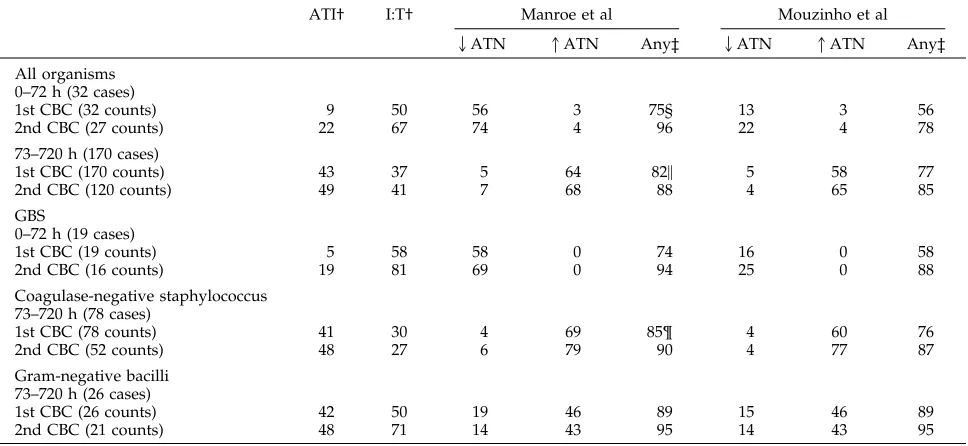
There were 202 CBCs obtained at the time of initial evaluation for sepsis from the 192 study infants (10 study infants had more than one sepsis episode dur-ing the first 30 days of life). Thirty-two of these were obtained from 0 to 72 hours, while 170 were obtained between 73 and 720 hours. Follow-up CBCs, gener-ally obtained 12 to 24 hours after the initial evalua-tion, were available in 27 episodes (84%) occurring from 0 to 72 hours and 120 episodes (71%) occurring from 73 to 720 hours. The proportion of neutrophil values outside the reference ranges of Manroe et al24
and Mouzinho et al32 is presented in Table 3. In
episodes of early-onset sepsis, neutropenia was by far the predominant abnormality of ATN values ir-respective of the reference range used. In contrast, neutrophilia was significantly more common in CBCs obtained from 73 to 720 hours after birth (P, .001 for each reference range).
When data from the entire neonatal period (0 to 720 hours) were analyzed, ATN values from both the first and second CBC were more likely to have at least one abnormality using the reference ranges of Manroe et al24(81% and 89%, respectively) than with
TABLE 3. Comparison of the Sensitivity of the Revised Reference Range32and That of Manroe et al24for Neutrophil Values in VLBW Neonates With Proven Sepsis
ATI† I:T† Manroe et al Mouzinho et al
2ATN 1ATN Any‡ 2ATN 1ATN Any‡
All organisms 0–72 h (32 cases)
1st CBC (32 counts) 9 50 56 3 75§ 13 3 56
2nd CBC (27 counts) 22 67 74 4 96 22 4 78
73–720 h (170 cases)
1st CBC (170 counts) 43 37 5 64 82\ 5 58 77
2nd CBC (120 counts) 49 41 7 68 88 4 65 85
GBS
0–72 h (19 cases)
1st CBC (19 counts) 5 58 58 0 74 16 0 58
2nd CBC (16 counts) 19 81 69 0 94 25 0 88
Coagulase-negative staphylococcus 73–720 h (78 cases)
1st CBC (78 counts) 41 30 4 69 85¶ 4 60 76
2nd CBC (52 counts) 48 27 6 79 90 4 77 87
Gram-negative bacilli 73–720 h (26 cases)
1st CBC (26 counts) 42 50 19 46 89 15 46 89
2nd CBC (21 counts) 48 71 14 43 95 14 43 95
Values are the percent of counts outside the reference range.
† The reference ranges for ATI and I:T values were the same using data of Manroe et al24and that of Mouzinho et al.32 ‡ This indicates that at least one abnormal value was present from ATN, ATI and I:T values.
that of Mouzinho et al32(73% and 84%, respectively).
These differences were significant by McNemar’s test (P, .001 for initial neutrophil values and P5 .008 for the second CBC). A similar difference in sensitiv-ity for any abnormalsensitiv-ity also was noted between the new and old reference ranges for the initial CBC both at 0 to 72 hours (P5.031) and at 73 to 720 hours (P5 .002) (Table 3). However, there were no significant differences between reference ranges for neutrophilic parameters in the second CBC, or when any neutro-phil abnormalities from both the first and second CBCs were considered for either early-onset or late-onset sepsis episodes.
Among the 19 cases of early-onset GBS infection, no neonate demonstrated neutrophilia with either of the ATN reference ranges, and the occurrence of neutropenia was;70% lower with the revised com-pared with the previous reference ranges. Using the reference ranges of Mouzinho et al, at least one neu-trophil value was abnormal in 58% and 88% of first and second CBCs, respectively (Table 3). This did not differ significantly from that seen with the values reported by Manroe et al,24 74% and 94%,
respec-tively. Among the 16 infants who had both a first and second CBC performed, comparison of earlier and later neutrophil values failed to show differential sensitivity, regardless of which reference ranges were used.
Because only 3 cases of sepsis attributable to coag-ulase-negative staphylococci occurred in the first 72 hours, data are reported for only those sepsis epi-sodes (n 5 78) that occurred from 73 to 720 hours (Table 3). With the ATN reference range of Mouz-inho et al,32at least one neutrophil value was
abnor-mal in 76% and 87% of first and second CBCs, re-spectively, as compared with 85% and 90%, respectively, using the range of Manroe et al. The difference in sensitivity was only significant for the first CBC (P5.016). There also was no difference in the sensitivities when abnormalities on either the first or second CBC were considered, 84% and 95%, respectively.
Only 3 cases of sepsis attributable to Gram-nega-tive organisms occurred in the first 72 hours; there-fore, data are reported only for the 26 late-onset episodes. As seen in Table 3, the percentage of ab-normal neutrophil values was identical using either reference range, ie,$89%. Furthermore, the sensitiv-ities using both first and second CBCs were 100% with either ATN reference ranges.
Analysis of Specificity
Results of the comparison between neonates with early-onset GBS infection and their matched, unin-fected controls permit an assessment of specificity; these data are presented in Table 4. When the first CBC was examined, ATN and ATI values, whether assessed quantitatively (cells/mm3) or qualitatively
(ie, the relative number within vs outside the refer-ence range), did not differ between GBS cases and controls. Although the quantitative difference in the initial I:T proportion between cases and controls was of marginal significance (P5.06), there was a highly significant difference (P5.002) when the I:T
propor-tion was assessed qualitatively, ie, 58% of the cases were outside the I:T reference range as compared with 14% of the matched controls.
Of the GBS-infected neonates, 58% had$1 abnor-mality in neutrophil values detected on the first CBC using the data of Mouzinho et al32vs 27% of controls
(P5.03). Corresponding percentages using the ref-erence ranges of Manroe et al24(74% vs 55%,
respec-tively) are not significantly different. Thus specificity for the initial CBC using the reference ranges of Mouzinho et al32was significantly greater than that
of Manroe et al,24 73% vs 45% (P 5 .003 by
McNe-mar’s test).
When we analyzed serial CBC data using the pres-ence of $1 abnormality, there was no significant difference in sensitivity between the two reference ranges (100% for Manroe et al,2494% for Mouzinho et
al32; P 5 1.0). However, as shown in Table 4, the
specificity was significantly better using the data of Mouzinho et al32 vs Manroe et al,24 59% (100% 2
41%) vs 10% (100%2 90%) (P,.0001).
Considering the reference ranges of Mouzinho et al32and estimating prevalence of early-onset GBS at
1%, the PPV and NPV for the initial CBC were 2.1% and 99.4%, respectively. Corresponding values for the Manroe et al24 reference ranges were 1.3% and
99.3%. When serial counts were used, the PPV and NPV for the Mouzinho et al32 reference ranges were
1.5% and 99.7%, respectively; corresponding values for Manroe et al24were 1.1% and 100%, respectively.
DISCUSSION
Sepsis in the VLBW neonate can be a devastating problem, leading to considerable morbidity and mor-tality.1,2The inability to adequately exclude the
diag-nosis of neonatal sepsis, on the other hand, can result in unnecessary and prolonged exposure to antibiot-ics. Thus, laboratory tests that assist the clinician in the diagnosis of infection in VLBW neonates have TABLE 4. Comparison of Neutrophil Indices in Neonates With Proven Early-onset Group B Streptococcal Sepsis and Matched, Uninfected Control Neonates
GBS (n519)
Control (n551)
P Value
A. Analysis of first CBC
ATN (cells/mm3) 211861441* 304462729 .20 ATI (cells/mm3) 3156330 2516519 .72 I:T 0.256.26 0.106.22 .06 ATN
Outside Mouzinho reference range
16† 20 .52
Outside Manroe reference range
58 51 .64
ATI outside reference range 5 8 .54 I:T outside reference range 58 14 .002 $1 Abnormality
Mouzinho reference range 58 27 .03 Manroe reference range 74 55 .16 B. Analysis of serial CBCs‡
$1 Abnormality
Mouzinho reference range 94 41 ,.001 Manroe reference range 100 90 .210
* Values are means6SD. † Values are percentages.
considerable relevance. In 1979, we24reported
refer-ence ranges for circulating neutrophils in neonates #30 days and demonstrated their utility in confirm-ing the presence or absence of neonatal sepsis.23,25,27
More recently, we and others27–31 observed the
fre-quent occurrence of neutropenia in otherwise healthy VLBW neonates when the 1979 reference ranges were used. Because of these findings, we ex-amined the reference ranges for circulating neutro-phils in VLBW neonates #30 days, a group of neo-nates whose survival had increased significantly over the ensuing 14 to 15 years.32 In this study, we
observed a broader distribution for ATN values in the first 72 hours after birth. Thus, although we revised these reference ranges, those for ATI and I:T values were unchanged. Because of the small num-ber of infants with sepsis in that study,32no
conclu-sions regarding the usefulness of the revised refer-ence ranges in the diagnosis of infection could be made. Thus, we undertook the present study to as-sess whether there are differences in the usefulness of the previous24 and revised32 reference ranges
re-ported by us in establishing or ruling out a diagnosis of sepsis in the VLBW neonate.
In the present report, the sensitivity for diagnosing neonatal sepsis is reduced using the more BW-spe-cific ATN reference ranges of Mouzinho et al32 in
certain circumstances. This might have been antici-pated since Mouzinho et al32observed a decrease in
the lower limit of normal for ATN values throughout the first 60 hours after birth. Because GBS sepsis and pneumonia are most common during the first 72 hours after birth, one might expect that differences in the sensitivity of neutrophil values between the two reference ranges would be most apparent in these neonates in whom neutropenia has been shown to occur frequently.24 –26 However, in the presence of
early-onset GBS infection, at least one neutrophil value was abnormal in 58% to 74% of initial CBCs and 88% to 94% of second CBCs, the latter demon-strating the value of serial CBC determinations, and there was no significant difference in sensitivity be-tween the reference ranges of Mouzinho et al32 and
Manroe et al.24
The occurrence of neutropenia in association with early-onset sepsis has been reported previously by us25 and others.3,26 Christensen35 has suggested that
this is likely attributable to bone marrow depletion as well as a diminished capacity for accelerated neu-trophil production by the preterm, VLBW neonate. This, however, appears to be limited to the first week after birth, because neutrophilia and elevated ATI and I:T values are commonly observed after that time.32The current study, in which most instances of
neutropenia occurred in the first 72 hours after birth, supports our previous observations. Furthermore, it is notable that late-onset infection with coagulase-negative staphylococci is rarely associated with neu-tropenia, whereas 15% to 20% of episodes of late-onset Gram-negative infection presented with or developed neutropenia. The reason for this differ-ence is not known, but it may be related to the virulence of the infecting organism.
The differences in sensitivity that were observed
between the two reference ranges may have limited clinical importance. For example, when all organisms were considered during the 73 to 720-hour period, the difference in sensitivity was minimal, 82% (Man-roe et al24) vs 77% (Mouzinho et al32). However, the
greater specificity shown for the Mouzinho et al32
reference ranges may be clinically relevant. We found that control neonates, matched with cases of early-onset GBS infection, were much less likely to have abnormal neutrophil values according to the Mouzinho et al32reference ranges than with those of
Manroe et al24(first CBC, P5.004; serial CBCs, P,
.0001). The enhanced specificity with the revised ref-erence ranges shown for early-onset GBS sepsis, es-pecially when considered in light of the very high sensitivity associated with serial neutrophil values, may be useful in determining the duration of treat-ment in neonates begun on antibiotics, but in whom cultures are either sterile or suggestive of contami-nation after 48 hours of treatment.
The results of this study provide support for the utility of assessing circulating neutrophil values in the diagnosis of sepsis in VLBW neonates, although not all investigators consider the laboratory differen-tiation of neutrophil values to be a reliable test in the neonate.36 In a large group of VLBW neonates with
proven sepsis during a 7-year period, there was only a 6% and 11% likelihood of all neutrophil values being normal, using the reference ranges of Manroe et al24and Mouzinho et al,32respectively. Estimations
of PPV and NPV indicated that PPV is fairly low while NPV is very high (90%-100%). As noted above, these values are dependent on prevalence, and thus in institutions with a higher prevalence of early-onset GBS, values for PPV and NPV can be different; as prevalence increases, PPV also increases but NPV decreases (if sensitivity and specificity are constant). Antibiotic therapy should not be withheld in neo-nates considered at risk for sepsis while awaiting the results of an initial CBC, because these neutrophil values may frequently be normal. Indeed, this ap-pears to reflect current practice in most nurseries. It is reassuring that completely normal neutrophil val-ues on serial CBCs were unlikely to occur in septic VLBW neonates. Conversely, normal values were observed in the majority of matched-controls. Based on these findings and our experience, discontinua-tion of antibiotics after 48 hours37seems appropriate
in infants with normal serial neutrophil values (Mouzinho et al32 reference ranges) and clinical
in-formation suggesting the absence of infection. We conclude that the revised reference ranges of Mouz-inho et al32 can be used to better assess circulating
neutrophil values in the VLBW neonate with possi-ble sepsis, generally by decreasing the number of false positives compared with the Manroe et al24
reference ranges.
ACKNOWLEDGMENTS
REFERENCES
1. Freij BJ, McCracken GH. Acute infections. In: Avery GB, et al.
Neonatology: Pathophysiology and Management of the Newborn. 4th ed.
Philadelphia, PA: JB Lippincott Co; 1994:1082–1116
2. Gerdes JS. Clinicopathologic approach to the diagnosis of neonatal sepsis. Clin Perinatol. 1991;18:361–381
3. Rodwell RL, Leslie AL, Tudehope DI. Early diagnosis of neonatal sepsis using a hematologic scoring system. J Pediatr. 1988;112:761–767 4. Philip AGS, Hewitt JR. Early diagnosis of neonatal sepsis. Pediatrics.
1980;65:1036 –1041
5. Gerdes JS, Polin RA. Sepsis screen in neonates with evaluation of plasma fibronectin. Pediatr Infect Dis J. 1987;6:443– 446
6. Kite P, Millar MR, Gorham P, Congdon P. Comparison of 5 tests in diagnosis of neonatal bacteraemia. Arch Dis Child. 1988;63:639 – 643 7. Philip AGS. Response of C-reactive protein in neonatal Group B
strep-tococcal infection. Pediatr Infect Dis J 1985;4:145–148
8. Adler SM, Denton RL. The erythrocyte sedimentation rate in the new-born period. J Pediatr. 1975;86:942–948
9. Philip AGS. Neonatal Sepsis and Meningitis. Boston, MA: GK Hall & Co; 1985:97–98
10. Sann L, Bienvenu F, Bienvenu J, Bourgeois J, Bethenod M. Evolution of serum prealbumin, C-reactive protein, and orosomucoid in neonates with bacterial infection. J Pediatr 1984;105:977–981
11. Speer CP, Ninjo A, Gahr M. Elastase-a1-proteinase inhibitor in early
diagnosis of neonatal septicemia. J Pediatr. 1986;108:987–990
12. Guillois B, Berthou C, Awad H, Bendaoud B, Guillemin MG. The importance of C3d estimation in the diagnosis of generalized bacterial infections in newborn infants. Acta Paediatr Scand. 1989;78:369 –372 13. Scheifele DW, Melton P, Whitchelo V. Evaluation of the Limulus test for
endotoxemia in neonates with suspected sepsis. J Pediatr. 1981;98: 899 –903
14. Kleiman MB, Reynolds JK, Schreiner RL, Smith JW, Allen SD. Rapid diagnosis of neonatal bacteremia with acridine orange-stained buffy coat smears. J Pediatr. 1984;105:419 – 421
15. Chandler BD, Kapoor N, Barker BE, Boyle RJ, Oh W. Nitroblue tetra-zolium test in neonates. J Pediatr. 1978;92:638 – 640
16. Xanthou M. Leukocyte blood picture in healthy full-term and prema-ture babies during neonatal period. Arch Dis Child. 1970;45:242–249 17. Xanthou M. Leukocyte blood picture in ill newborn babies. Arch Dis
Child. 1972;47:741–746
18. Gregory J, Hey E. Blood neutrophil response to bacterial infection in the first month of life. Arch Dis Child. 1972;47:747–753
19. Akenzua GI, Hui TY, Milner R, Zipursky A. Neutrophil and band counts in the diagnosis of neonatal infection. Pediatrics. 1974;54:38 – 42
20. Zipursky A, Palko J, Milner R, Akenzua GI. The hematology of bacterial infections in premature infants. Pediatrics. 1976;57:839 – 853
21. Boyle RJ, Chandler BD, Stonestreet BS, Oh W. Early identification of sepsis in infants with respiratory distress. Pediatrics. 1978;62:744 –750 22. Benuck I, David RJ. Sensitivity of published neutrophil indexes in
identifying newborn infants with sepsis. J Pediatr. 1983;103:961–963 23. Engle WD, Rosenfeld CR. Neutropenia in high-risk neonates. J Pediatr.
1984;105:982–986
24. Manroe BL, Weinberg AG, Rosenfeld CR, Browne R. The neonatal blood count in health and disease, I. Reference values for neutrophilic cells.
J Pediatr. 1979;95:89 –98
25. Manroe BL, Rosenfeld CR, Weinberg AG, Browne R. The differential leukocyte count in the assessment and outcome of early-onset neonatal group B streptococcal disease. J Pediatr. 1977;91:632– 637
26. Christensen RD, Rothstein G. Exhaustion of mature marrow neutrophils in neonates with sepsis. J Pediatr. 1980;96:316 –319
27. Mouzinho A, Rosenfeld CR, Sanchez PJ, Risser R. Effect of maternal hypertension on neonatal neutropenia and risk of nosocomial infection.
Pediatrics. 1992;90:430 – 435
28. Faix RG, Hric JJ, Naglic RA. Neutropenia and intraventricular hemor-rhage among very low birth weight (less than 1500 grams) premature infants. J Pediatr. 1989;114:1035–1038
29. Baley JE, Stork EK, Warkentin PI, Shurin SB. Neonatal neutropenia. Clinical manifestations, cause and outcome. Am J Dis Child. 1988;142: 1161–1166
30. Lloyd BW, Oto A. Normal values for mature and immature neutrophils in very preterm babies. Arch Dis Child. 1982;53:233–235
31. Coulombel L, Dehan M, Tehernia G, Hill C, Vial M. The number of polymorphonuclear leukocytes in relation to gestational age in the newborn. Acta Paediatr Scand. 1979;68:709 –711
32. Mouzinho A, Rosenfeld CR, Sanchez PJ, Risser R. Revised reference ranges for circulating neutrophils in very low birth weight neonates.
Pediatrics. 1994;94:76 – 82
33. Zar JH. Biostatistical Analysis. 2nd ed. Englewood Cliffs, NJ: Prentice-Hall; 1984
34. Galen RS, Gambino SR. Beyond Normality: The Predictive Value and
Effi-ciency of Medical Diagnoses. New York, NY: John Wiley & Sons; 1975
35. Christensen RD. Hematopoiesis in the fetus and neonate. Pediatr Res. 1989;26:531–535
36. Schelonka RL, Yoder BA, Hall RB, et al. Differentiation of segmented and band neutrophils during the early newborn period. J Pediatr. 1995; 127:298 –300
DOI: 10.1542/peds.99.3.e10
1997;99;e10
Pediatrics
Zeray and Pablo J. Sanchez
William D. Engle, Charles R. Rosenfeld, Anna Mouzinho, Richard C. Risser, Fiker
Reference Ranges
Circulating Neutrophils in Septic Preterm Neonates: Comparison of Two
Services
Updated Information &
http://pediatrics.aappublications.org/content/99/3/e10
including high resolution figures, can be found at:
References
http://pediatrics.aappublications.org/content/99/3/e10#BIBL
This article cites 33 articles, 10 of which you can access for free at:
Permissions & Licensing
http://www.aappublications.org/site/misc/Permissions.xhtml
in its entirety can be found online at:
Information about reproducing this article in parts (figures, tables) or
Reprints
http://www.aappublications.org/site/misc/reprints.xhtml
DOI: 10.1542/peds.99.3.e10
1997;99;e10
Pediatrics
Zeray and Pablo J. Sanchez
William D. Engle, Charles R. Rosenfeld, Anna Mouzinho, Richard C. Risser, Fiker
Reference Ranges
Circulating Neutrophils in Septic Preterm Neonates: Comparison of Two
http://pediatrics.aappublications.org/content/99/3/e10
located on the World Wide Web at:
The online version of this article, along with updated information and services, is
by the American Academy of Pediatrics. All rights reserved. Print ISSN: 1073-0397.