International Journal of COPD
Dove
press
O r I g I n a l r e s e a r C h open access to scientific and medical research
Open access Full Text article
Continuing to Confront COPD International
Physician survey: physician knowledge and
application of COPD management guidelines
in 12 countries
Kourtney J Davis1
sarah h landis2
Yeon-Mok Oh3
David M Mannino4
Meilan K han5
Thys van der Molen6
Zaurbek aisanov7
ana M Menezes8
Masakazu Ichinose9
hana Muellerova1 1Worldwide epidemiology, glaxosmithKline, Wavre, Belgium; 2Worldwide epidemiology, glaxosmithKline, Uxbridge, UK; 3University of Ulsan College of Medicine, asan Medical Center, seoul, south Korea; 4University of Kentucky College of Public health, lexington, KY, Usa; 5Division of Pulmonary and Critical Care, University of Michigan, ann arbor, MI, Usa; 6University Medical Center groningen, University of groningen, groningen, the netherlands; 7Pulmonology research Institute, Moscow, russia; 8Federal University of Pelotas, Pelotas, Brazil; 9Tohoku University graduate school of Medicine, sendai, Japan
Correspondence: sarah h landis Worldwide epidemiology,
glaxosmithKline, stockley Park West, Uxbridge, Middlesex UB11 1BT, UK email [email protected]
Aim: Utilizing data from the Continuing to Confront COPD (chronic obstructive pulmonary
disease) International Physician Survey, this study aimed to describe physicians’ knowledge
and application of the GOLD (Global initiative for chronic Obstructive Lung Disease) Global
Strategy for the Diagnosis, Management and Prevention of COPD diagnosis and treatment recommendations and compare performance between primary care physicians (PCPs) and respiratory specialists.
Materials and methods: Physicians from 12 countries were sampled from in-country profes-sional databases; 1,307 physicians (PCP to respiratory specialist ratio three to one) who regu-larly consult with COPD, emphysema, or chronic bronchitis patients were interviewed online, by telephone or face to face. Physicians were questioned about COPD risk factors, prognosis, diagnosis, and treatment, including knowledge and application of the GOLD global strategy using patient scenarios.
Results: Physicians reported using spirometry routinely (PCPs 82%, respiratory specialists
100%; P,0.001) to diagnose COPD and frequently included validated patient-reported outcome
measures (PCPs 67%, respiratory specialists 81%; P,0.001). Respiratory specialists were more
likely than PCPs to report awareness of the GOLD global strategy (93% versus 58%, P,0.001);
however, when presented with patient scenarios, they did not always perform better than PCPs with regard to recommending GOLD-concordant treatment options. The proportion of PCPs and respiratory specialists providing first- or second-choice treatment options concordant with GOLD strategy for a GOLD B-type patient was 38% versus 67%, respectively. For GOLD C and D-type patients, the concordant proportions for PCPs and respiratory specialists were 40% versus 38%, and 57% versus 58%, respectively.
Conclusion: This survey of physicians in 12 countries practicing in the primary care and respi-ratory specialty settings showed high awareness of COPD-management guidelines. Frequent use of guideline-recommended COPD diagnostic practices was reported; however, gaps in the application of COPD-treatment recommendations were observed, warranting further evaluation to understand potential barriers to adopt guideline recommendations.
Keywords: chronic obstructive pulmonary disease, physician beliefs, adherence to guidelines
Introduction
Chronic obstructive pulmonary disease (COPD) is a chronic inflammatory lung dis-ease that is complex and progressive, but which is also considered preventable and
treatable.1 The multicomponent nature of COPD is now reflected in several regional
International Journal of Chronic Obstructive Pulmonary Disease downloaded from https://www.dovepress.com/ by 118.70.13.36 on 22-Aug-2020
For personal use only.
Number of times this article has been viewed
This article was published in the following Dove Press journal: International Journal of COPD
Dovepress
Davis et al
and international management guidelines2,3 and the recently
released Global Strategy for the Diagnosis, Management and
Prevention of COPD released by GOLD (Global initiative
for chronic Obstructive Lung Disease).1 The GOLD global
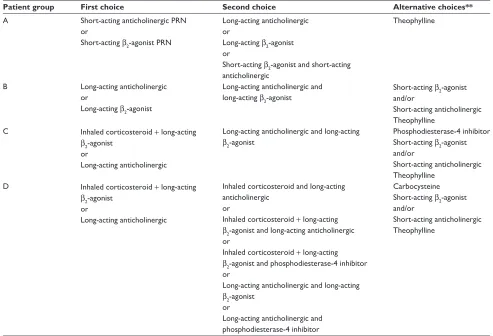
strategy outlines preferred diagnosis methods for COPD, including evaluation of signs/symptoms, assessment of patient history and past exposure to risk factors, and post-bronchodilator spirometric confirmation. Once a COPD diagnosis is confirmed, the GOLD global strategy also recom-mends a new disease-classification approach that combines symptoms (modified Medical Research Council [mMRC] dyspnea grade or COPD Assessment Test) and exacerbation risk (airflow limitation and/or history of exacerbations) to categorize patients into four groups from A (low risk, fewer symptoms) to D (high risk, more symptoms). Pharmaco-logical treatment recommendations for disease management are provided for these groups, ranging from a short-acting
anticholinergic and/or short-acting β2-agonist for group A
patients to combined therapy with an inhaled corticosteroid
(ICS) and a long-acting β2-agonist (LABA) or long-acting
anticholinergic (long-acting muscarinic antagonist [LAMA]) for groups C and D (with the possibility of triple therapy with
LAMA + ICS/LABA for group D) (Table 1).
Despite the availability of international disease-man-agement guidelines, including those specifically aimed at primary care, COPD often remains underdiagnosed and
inappropriately treated.4–7 A large web-based survey in 2011
of primary care physicians (PCPs) across the regions of Asia Pacific, Africa, Eastern Europe, and Latin America showed limited knowledge of COPD guidelines, including underuti-lization of spirometry for diagnosis of COPD and a general lack of awareness about the significance of exacerbations as
an important factor in the management of COPD.8
Country-specific surveys largely conducted in primary care in Western Europe,5,6,9–11 Japan,12 Mexico,13 and the USA14–16 have also
shown that despite knowledge of guidelines, there is a lack of adherence to guideline recommendations for the treat-ment of COPD. In the USA, the main barriers to guideline implementation have been reported as low familiarity, low ability or confidence in interpreting recommendations,
Table 1 Initial pharmacological management of COPD*
Patient group First choice Second choice Alternative choices**
a short-acting anticholinergic Prn or
short-acting β2-agonist Prn
long-acting anticholinergic or
long-acting β2-agonist or
short-acting β2-agonist and short-acting anticholinergic
Theophylline
B long-acting anticholinergic
or
long-acting β2-agonist
long-acting anticholinergic and long-acting β2-agonist
short-acting β2-agonist and/or
short-acting anticholinergic Theophylline
C Inhaled corticosteroid + long-acting β2-agonist
or
long-acting anticholinergic
long-acting anticholinergic and long-acting β2-agonist
Phosphodiesterase-4 inhibitor short-acting β2-agonist and/or
short-acting anticholinergic Theophylline
D Inhaled corticosteroid + long-acting β2-agonist
or
long-acting anticholinergic
Inhaled corticosteroid and long-acting anticholinergic
or
Inhaled corticosteroid + long-acting β2-agonist and long-acting anticholinergic or
Inhaled corticosteroid + long-acting β2-agonist and phosphodiesterase-4 inhibitor or
long-acting anticholinergic and long-acting β2-agonist
or
long-acting anticholinergic and phosphodiesterase-4 inhibitor
Carbocysteine short-acting β2-agonist and/or
short-acting anticholinergic Theophylline
Notes: *Medications in each box are mentioned in alphabetical order, and thus not necessarily in order of preference; **medications in this column can be used alone or in
combination with other options in the first and second columns. From the Global Strategy for Diagnosis, Management and Prevention of COPD 2014, © Global initiative for
chronic Obstructive lung Disease (gOlD), all rights reserved. available from http://www.goldcopd.org.1 Abbreviations: COPD, chronic obstructive pulmonary disease; Prn, pro re nata (as needed).
International Journal of Chronic Obstructive Pulmonary Disease downloaded from https://www.dovepress.com/ by 118.70.13.36 on 22-Aug-2020
Dovepress Continuing to Confront COPD International Physician survey
time constraints, and low outcome expectancy among physicians.15,16
The Continuing to Confront COPD International Physi-cian Survey aimed to describe physiPhysi-cian beliefs and behaviors related to COPD risk factors, prognosis, diagnosis, and treat-ment in a broad sample of PCPs and respiratory specialists across 12 countries worldwide. The objective of this analysis was to describe physicians’ knowledge and application of the GOLD global strategy (2011 version) diagnosis and treatment recommendations and compare performance between PCPs and respiratory specialists.
Materials and methods
study design and participants
The Continuing to Confront COPD International Physician Survey was a survey of PCPs and respiratory specialists in 12 countries (Brazil, France, Germany, Italy, Japan, Mexico, the Netherlands, Russia, South Korea, Spain, the UK, and the USA) conducted between January and May 2013. Physicians were required to consult with five or more patients with COPD, emphysema, or chronic bronchitis per month, on average.
The sample of physicians was drawn from in-country databases of professional associations (eg, American Medical Association) and registries with the aim of having a national sample of PCPs and respiratory specialists at a ratio of three to one. This ratio was determined a priority in order to ensure an adequate sample size of each physician type within each country, and was not intended to represent the ratio of these physicians types practicing, or treating patients with COPD in an individual country. Each sample was proportionate to the subnational regions in each country, with the excep-tion of Russia, where the sample was drawn to be roughly
representative of the general population of the 12 most devel-oped and populous cities.
Data collection
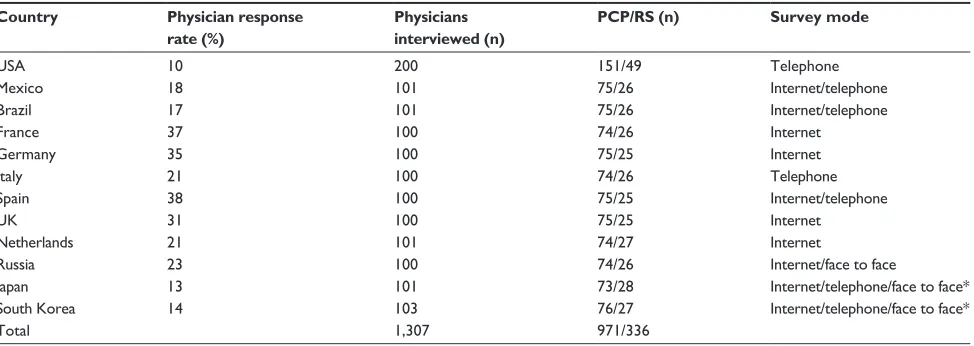
A standardized questionnaire was used in all countries to assess physician knowledge of COPD-management guide-lines, diagnosis and treatment practices for COPD, and beliefs about COPD risk, natural history, and treatment effec-tiveness. The standardized questionnaire was translated into local languages in-country and reviewed by an independent translator and a local GlaxoSmithKline clinical advisor for accuracy and cultural relevance. The surveys were conducted online, by telephone, or face to face according to cultural preferences in each country, and were approximately 20 minutes in duration. Where possible, more than one mode of survey methodology was offered to accommodate the preferences of the physicians and to minimize the rate of refusal (Table 2). Modest payments to physicians for their time completing the survey were permitted in line with coun-try regulations. For quality-control purposes, a minimum of 10% of interviews (all sampling methods) were validated by recontact or review of recorded interviews.
The sampling and screening process identif ied 1,307 physicians who agreed to be interviewed, compris-ing 200 physicians from the USA and approximately 100 each in the remaining countries (Table 2). The response rate by country ranged from 10% (USA) to 38% (Spain). No association was observed between poor response rates and type of interview technique used (telephone/internet/face to face); countries with the lowest response rates had the highest rates of “noncontact” issues (data not shown). For the total study population, the proportion of PCPs and respiratory
Table 2 Physician response rate, physician type, and survey method in each country: Continuing to Confront COPD International survey, 2012–2013
Country Physician response
rate (%)
Physicians interviewed (n)
PCP/RS (n) Survey mode
Usa 10 200 151/49 Telephone
Mexico 18 101 75/26 Internet/telephone
Brazil 17 101 75/26 Internet/telephone
France 37 100 74/26 Internet
germany 35 100 75/25 Internet
Italy 21 100 74/26 Telephone
spain 38 100 75/25 Internet/telephone
UK 31 100 75/25 Internet
netherlands 21 101 74/27 Internet
russia 23 100 74/26 Internet/face to face
Japan 13 101 73/28 Internet/telephone/face to face*
south Korea 14 103 76/27 Internet/telephone/face to face*
Total 1,307 971/336
Note: *Face-to-face available only in capital cities, ie, Tokyo and seoul.
Abbreviations: COPD, chronic obstructive pulmonary disease; PCP, primary care physician; rs, respiratory specialist.
International Journal of Chronic Obstructive Pulmonary Disease downloaded from https://www.dovepress.com/ by 118.70.13.36 on 22-Aug-2020
Dovepress
Davis et al
specialists was 74% and 26%, respectively. The sample size
of 1,307 physicians allowed for a sample precision of ±3.1%
for population responses or proportions around 50%.
Outcome definitions
The primary objective of the present analysis was to describe physicians’ knowledge and application of the GOLD global strategy diagnosis and treatment recommendations and compare performance in applying these guidelines between PCPs and respiratory specialists.
To evaluate physician knowledge about COPD-manage-ment guidelines, respondents were queried about whether they were aware of any local/countrywide COPD guidelines, and if so, to what degree these guidelines influenced their everyday treatment practice. Respondents were similarly queried about the GOLD global strategy recommendations and its influence on their practice.
Physician-diagnosis practices were assessed by present-ing respondents with a predefined list of diagnostic tests and instructing them to indicate which test(s) they normally conduct in order to establish a diagnosis of COPD (physicians could answer “Yes”, “No”, or “Test not available” for each test). Respondents were also asked to name the three most important factors in a patient’s history when establishing a diagnosis of COPD.
Lastly, physician concordance with prescribing a GOLD global strategy-recommended treatment for different types of COPD patients was evaluated using patient case scenarios (see Table S1 for scenario descriptions). Each patient vignette was emblematic of a typical GOLD B, C, or D patient (respondents were not told the patients’ GOLD classification as part of the descriptive text). After the scenario was read to the respondents (or displayed online), they were asked to consider which medication(s) they would typically prescribe to such a patient. Respondents could pick one or more of the medication options from a prespecified list that included: 1) short-acting bronchodilator, 2) LAMA, 3) LABA, 4) ICS/ LABA combination inhaler, 5) theophylline, 6) roflumilast, 7)
triple therapy (LAMA + LABA/ICS fixed-dose combination
in two inhaler devices), or 8) oral corticosteroids (chronic use). Respondents could also specify other medications not included in the predefined list; these were reviewed, and those that matched one of the eight prespecified classes of drugs were recoded prior to data analysis. “Concordance” with GOLD strategy for this analysis was defined as selecting a GOLD global strategy first- or second-choice treatment option for the specific type of patient, regardless of whether a medication from the alternative choice was also selected
(Tables 1 and S1). Respondents could select multiple first- (or second)-choice options and still be considered concordant. The second-choice option “LAMA and LABA” (for GOLD B, C, or D) was not evaluated, because this combination was not included in the prespecified list (no LAMA/LABA fixed-dose combination products were commercially available at the time of survey development). Given the prespecified response categories, we could not ascertain if a physician who selected both 1) LABA and 2) LAMA intended for the products to be used concomitantly or separately. For similar reasons, we did not evaluate the second-choice option of “LAMA and ICS” (for GOLD D). For the GOLD D patient scenario, if a respondent selected either LABA/ICS or LAMA and also selected roflumilast, we assumed that the physician intended to use these in combination, consistent with the indication for roflumilast for use as an add-on therapy to
bronchodilator treatment.17 Respondents were considered
“discordant” with GOLD strategy if they 1) selected neither a first- nor choice option, 2) selected a first- or second-choice option(s) along with additional nonrecommended therapies, or 3) selected a medication from the alternative choice alone.
statistical analysis
In order to evaluate the hypothesis that PCPs and respiratory specialists vary with regard to key outcomes (utilization of GOLD global strategy-recommended diagnostic tests and guideline-concordant behavior), all countries were combined to obtain a sufficient sample size. While there was some heterogeneity observed across countries, the direction of association was similar (see Supplementary materials for country-specific data). These physician sample data are not weighted because standardized and reliable estimates of the key demographic parameters of the universe of physicians in each country were not readily available. Multivariate logistic regression models, built for each outcome separately, con-sidered physician type as the main exposure and included potential confounding variables. While several potential con-founders were considered (knowledge and influence of local/ professional guidelines, knowledge and influence of GOLD global strategy, sex, year since graduated medical school, and participation in COPD-based continuing education courses), only awareness of the GOLD global strategy was significantly associated with each outcome and with physician type in univariate analyses. Therefore, all models were adjusted for awareness of the GOLD global strategy and country, and the
statistical tests reported herein represent the P-value of the
physician-type β-coefficient from this final adjusted model.
International Journal of Chronic Obstructive Pulmonary Disease downloaded from https://www.dovepress.com/ by 118.70.13.36 on 22-Aug-2020
Dovepress Continuing to Confront COPD International Physician survey
Results
Demographics of physician sample
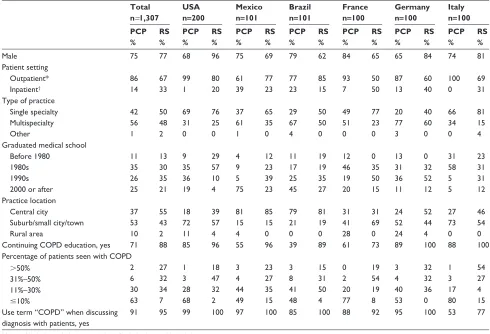
In the global sample from 12 countries, approximately three-quarters of the physicians were male and about half graduated from medical school after 1990, with a simi-lar pattern observed for PCPs and respiratory specialists (Table 3). The proportion of physicians in a multispecialty practice was slightly higher for PCPs (56%) compared with respiratory specialists (48%). Respiratory specialists were more likely to be practicing in urban/city areas (55% versus 37% of PCPs) and to report that they treated COPD patients in an inpatient or hospital-based clinic (33% versus 14% of PCPs). Respiratory specialists had a higher case mix of COPD patients (59% reported at least a third of all patients they treat regularly have COPD versus 8% of PCPs). The majority of physicians had received some continuing educa-tion on COPD (88% of respiratory specialists, 71% of PCPs), and most reported using the term “COPD” when discussing the diagnosis with their patients.
Across countries, the proportion of male physicians was greater in Japan and South Korea and lower in Russia compared with the total population; Russia had very few single-specialty practices, and fewer physicians in Japan reported that they received some continuing education on COPD (19% of PCPs; 43% of respiratory specialists). The type, setting, and location of practices showed some variation across countries (Table 3).
Knowledge of guidelines
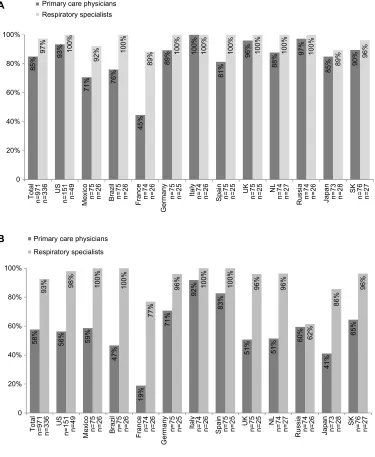
Across all countries, a high awareness of any professional guidelines for COPD diagnosis/management, including local guidelines, was reported for both PCPs (85%) and respiratory
specialists (97%) (P,0.001, Figure 1A). Results were
gener-ally consistent across countries, with the exception of France, where less than half of PCPs reported familiarity with any guidelines. The majority of physicians disclosed that profes-sional guidelines informed their practice (88% of PCPs, 91% of respiratory specialists). Among those who stated that guidelines
Table 3 Demographic characteristics of physicians by country: Continuing to Confront COPD International survey, 2012–2013
Total n=1,307
USA
n=200 Mexico n=101 Brazil n=101 France n=100 Germany n=100 Italy n=100 PCP % RS % PCP % RS % PCP % RS % PCP % RS % PCP % RS % PCP % RS % PCP % RS %
Male 75 77 68 96 75 69 79 62 84 65 65 84 74 81
Patient setting Outpatient* Inpatient† 86 14 67 33 99 1 80 20 61 39 77 23 77 23 85 15 93 7 50 50 87 13 60 40 100 0 69 31 Type of practice
single specialty Multispecialty Other 42 56 1 50 48 2 69 31 0 76 25 0 37 61 1 65 35 0 29 67 4 50 50 0 49 51 0 77 23 0 20 77 3 40 60 0 66 34 0 81 15 4 graduated medical school
Before 1980 1980s 1990s 2000 or after
11 35 26 25 13 30 35 21 9 35 36 19 29 57 10 4 4 9 5 75 12 23 39 23 11 17 25 45 19 19 35 27 12 46 19 20 0 35 50 15 13 31 36 11 0 32 52 12 31 58 5 5 23 31 31 12 Practice location Central city suburb/small city/town rural area 37 53 10 55 43 2 18 72 11 39 57 4 81 15 4 85 15 0 79 21 0 81 19 0 31 41 28 31 69 0 24 52 24 52 44 4 27 73 0 46 54 0
Continuing COPD education, yes 71 88 85 96 55 96 39 89 61 73 89 100 88 100
Percentage of patients seen with COPD .50% 31%–50% 11%–30% #10% 2 6 30 63 27 32 34 7 1 3 28 68 18 47 32 2 3 4 44 49 23 27 35 15 3 8 41 48 15 31 50 4 0 2 20 77 19 54 19 8 3 4 40 53 32 32 36 0 1 3 17 80 54 27 4 15 Use term “COPD” when discussing
diagnosis with patients, yes
91 95 99 100 97 100 85 100 88 92 95 100 53 77
Notes: *Includes ambulatory care clinic; †includes hospital-based clinic.
Abbreviations: COPD, chronic obstructive pulmonary disease; PCP, primary care physician; rs, respiratory specialist.
International Journal of Chronic Obstructive Pulmonary Disease downloaded from https://www.dovepress.com/ by 118.70.13.36 on 22-Aug-2020
Dovepress
Davis et al
did not inform their practice (n=123 [11%]), the reasons most
frequently given were: “I prefer to use my clinical experience” (n=41), “Guidelines do not allow for tailoring treatment to
dif-ferent patient circumstances” (n=35), “Guideline-suggested
choice is not available” (n=31), “Guideline is not relevant/
disagree with them” (n=27), and “Patient does not prefer/will
not adhere to guideline-suggested choice” (n=18).
Respiratory specialists were statistically significantly more likely to report awareness of the GOLD global strat-egy (58% of PCPs versus 93% of respiratory specialists,
P,0.001, Figure 1B); some variability across countries
was observed. Despite lower awareness of the GOLD global strategy, PCPs were more likely to report they had made changes to their management of COPD patients based on these guidelines (61% of PCPs versus 51% of respiratory specialists). Among all physicians who reported that they had made changes to their management as a result of the
GOLD global strategy (n=500 [57%]), changes included
“Using different therapies than those previously used” (59%), “Incorporating lung function measurements” (25%) and “Incorporating the use of the COPD Assessment Test patient-reported outcome instrument” (20%).
establishing a COPD diagnosis
Both PCPs and respiratory specialists reported frequently using spirometry testing to establish a COPD diagnosis (100% of respiratory specialists indicated they use
spirom-etry versus 82% of PCPs [P,0.001]) (Table 4). An average
of 16% of PCPs reported that spirometry was not available in their practice, ranging from 0 to 5% (Russia, UK, Spain, Netherlands, Germany, Brazil) to 46% in France and 82% in Italy (Table S2). Despite the GOLD global strategy recom-mendation that postbronchodilator spirometry is required for diagnosis and assessment of COPD severity, 22% and 15% of PCPs and respiratory specialists, respectively, indicated that they only use prebronchodilator spirometry. Patient-reported outcomes (eg, dyspnea measure or COPD Assessment Test) were used frequently by both PCPs (67%) and respiratory specialists (81%) as part of assessing COPD. Significantly greater proportions of respiratory specialists than PCPs reported the use of chest X-ray, blood tests/oximetry, bron-chodilator responsiveness, computerized tomography or magnetic resonance imaging scans, and patient-reported outcome instruments. Diagnostic practices varied somewhat by country (Table S2).
Table 3 Demographic characteristics by country: Continuing to Confront COPD International survey, 2012–2013 (continued)
Spain n=100 UK n=100 NL n=101 Russia n=100 Japan n=101 SK n=103 PCP % RS % PCP % RS % PCP % RS % PCP % RS % PCP % RS % PCP % RS %
Male 81 56 73 76 76 78 41 62 96 86 92 89
Patient setting Outpatient* Inpatient† 91 9 72 28 93 7 24 76 92 8 85 15 80 20 62 39 51 49 32 68 92 8 96 4 Type of practice
single specialty Multispecialty Other 57 40 3 72 24 4 23 77 0 16 84 0 28 70 1 26 70 4 1 99 0 8 92 0 48 52 0 54 46 0 54 41 5 11 74 15 graduated medical school
Before 1980 1980s 1990s 2000 or after
17 47 23 12 8 40 32 20 13 41 25 17 8 8 40 40 10 41 30 16 7 15 56 19 5 26 24 45 12 19 12 58 8 45 32 12 18 36 21 25 4 20 43 26 4 22 63 11 Practice location Central city suburb/small city/town rural area 27 63 11 44 56 0 16 67 17 56 44 0 39 58 3 70 30 0 19 80 0 23 73 0 29 55 16 43 39 18 74 22 4 96 4 0
Continuing COPD education, yes 85 92 84 80 84 93 93 96 19 43 50 93
Percentage of patients seen with COPD 51%–100% 31%–50% 11%–30% 1%–10% 1 2 43 53 40 28 32 0 3 4 25 68 40 32 28 0 3 2 15 80 26 33 33 7 10 33 41 16 54 31 12 4 1 0 30 69 14 11 64 11 0 1 15 84 4 19 56 22 Use term “COPD” when discussing
diagnosis with patients, yes
96 96 100 100 99 100 92 89 84 82 93 100
Notes: *Includes ambulatory care clinic; †includes hospital-based clinic.
Abbreviations: COPD, chronic obstructive pulmonary disease; PCP, primary care physician; rs, respiratory specialist; nl, the netherlands; sK, south Korea.
International Journal of Chronic Obstructive Pulmonary Disease downloaded from https://www.dovepress.com/ by 118.70.13.36 on 22-Aug-2020
Dovepress Continuing to Confront COPD International Physician survey
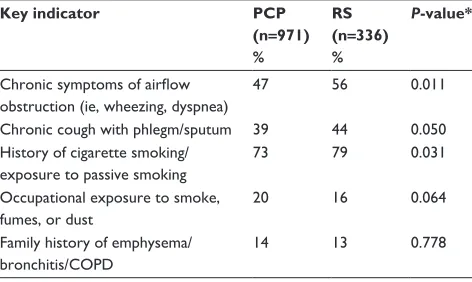
In response to an open-ended question asking physicians to state up to three top patient factors they consider when establishing a COPD diagnosis, the most frequently reported indicators, as referenced in the GOLD global strategy, were “History of smoking/exposure to passive smoking” (PCPs
73%, respiratory specialists 79%, P=0.031), and “Chronic
symptoms of airflow obstruction” (PCPs 47%, respiratory
specialists 56%, P=0.011) (Table 5). This pattern was
generally consistent across countries, with the exception of Russia, where “Chronic symptoms of airflow obstruction” followed by “Chronic cough with phlegm” were most fre-quently reported, and Mexico and Germany, where “History of smoking/exposure to passive smoking” followed by
“Occupational exposure to smoke/fumes/dust” were most frequently reported (Table S3).
application of gOlD global
strategy management guidelines
using patient scenarios
For the GOLD category B patient scenario, only one in three PCPs (38%) provided a response that was concordant with treatment recommendations, with respiratory specialists statistically significantly more likely to provide a concordant
answer (67%, P,0.001, Figure 2). The most commonly
selected concordant option among both types of physi-cians was LAMA (PCP 22%, respiratory specialists 39%).
Total n=971 n=336
Total n=971 n=336
85%
58%
97%
93%
US
n=151 n=49
US
n=151 n=49 93% 100%
56%
98%
Mexico n=75 n=26
Mexico n=75 n=26
71%
59%
92%
100%
Brazil n=75 n=26
Brazil n=75 n=26
76%
47%
100%
100%
France n=74 n=26
France n=74 n=26
19%
45%
89%
77%
Germany
n=75 n=25
Germany
n=75 n=25
71%
89%
96%
100%
Italy n=74 n=26 Italy n=74 n=26
92% 100% 100% 100%
Spain n=75 n=25 Spain n=75 n=25
83%
81%
100%
100%
UK n=75 n=25 UK n=75 n=25
51%
96% 100%
96%
NL
n=74 n=27
NL
n=74 n=27
51%
88%
96%
100%
Russia n=74 n=26 60% 62% Russia n=74 n=26
97% 100%
Japan n=73 n=28
41%
Japan n=73 n=28 85% 89%
86%
SK
n=76 n=27
65%
SK
n=76 n=27 90% 96%
96%
A Primary care physicians
Respiratory specialists
100%
80%
60%
40%
20%
0
B Primary care physicians
Respiratory specialists
100%
80%
60%
40%
20%
0
Figure 1 awareness of (A) any professional guidelines and (B) 2011 gOlD global strategy guidelines.
Note:P,0.001 comparing total primary care physicians to respiratory specialists, adjusted for country.
Abbreviations: gOlD, global initiative for chronic Obstructive lung Disease; COPD, chronic obstructive pulmonary disease; nl, the netherlands; sK, south Korea.
International Journal of Chronic Obstructive Pulmonary Disease downloaded from https://www.dovepress.com/ by 118.70.13.36 on 22-Aug-2020
Dovepress
Davis et al
PCPs were far more likely to report a discordant option of either an ICS-containing regimen or alternative option (short-acting bronchodilator or theophylline alone) than respiratory specialists. Across countries, a similar pattern was observed, with the exceptions of Germany, Italy, and Japan, where the concordance was similar for PCPs and respiratory special-ists (Table S4).
In contrast to the GOLD category B patient, PCPs and respiratory specialists performed similarly (40% and 38%,
respectively; P=0.181) for the GOLD category C patient
sce-nario (Figure 3). PCPs indicated that they would most likely
prescribe ICS/LABA combination inhalers alone (16%), while respiratory specialists commonly selected LAMA alone (13%). The most commonly mentioned discordant option reported by both physician types was triple therapy, which is only recommended for the more severe GOLD D-type patient (PCPs 16%, respiratory specialists 23%). Country-specific data were consistent with the main findings, other than in Spain, Germany, and Japan, where PCPs demonstrated higher levels of concordance versus respiratory specialists, and in Russia respiratory specialists were substantially more concordant than PCPs (Table S4).
For the GOLD category D patient scenario, both physician types performed similarly, with slightly over half providing
a concordant response (P=0.513, Figure 4). The most
com-monly selected concordant option was triple therapy (27% of PCPs and 33% of respiratory specialists); ICS/LABA was also commonly selected. Discordant answers commonly included triple therapy in combinations not recommended by GOLD, including oral corticosteroids (PCPs 7%) and phosphodiesterase 4 inhibitors (respiratory specialists 10%). Countries that were not consistent with the overall pattern of concordance were the USA and Russia (less than 50% of PCPs and respiratory specialists were concordant) and Brazil and Germany (less than 50% of respiratory specialists were concordant) (Table S4).
Discussion
The Continuing to Confront COPD International Physician Survey aimed to describe PCPs’ and respiratory special-ists’ beliefs and behaviors in relation to COPD diagnosis
Table 4 Tests typically used to establish a COPD diagnosis, by physician type: Continuing to Confront COPD International survey, 2012–2013
Diagnostic test PCP (n=971)
%
RS (n=336) %
P-value*
Yes No Not available Yes No Not available
spirometry testing 82 2 16 100 0 0 ,0.001
Prebronchodilator Postbronchodilator Both
22 7 69
15 21 64
Peak expiratory flow 55 29 16 43 51 6 ,0.001
Bronchodilator responsiveness 68 23 9 80 19 2 ,0.001
Oral corticosteroid responsiveness 38 52 9 28 65 7 ,0.001
Chest X-ray 76 11 13 89 10 2 ,0.001
Blood test/oximetry 45 32 23 69 27 4 ,0.001
CaT/CT/MrI scans 21 53 25 44 51 5 ,0.001
Patient-reported outcomes (eg, dyspnea measure or COPD-assessment test)
67 28 5 81 18 1 ,0.001
Note: *P-value comparing PCP to rs for responses of yes versus no/not available, adjusted for country and awareness of gOlD global strategy.
Abbreviations: COPD, chronic obstructive pulmonary disease; PCP, primary care physician; rs, respiratory specialist; CaT, computerized axial tomography; CT, computerized tomography; MrI, magnetic resonance imaging; gOlD, global initiative for chronic Obstructive lung Disease.
Table 5 Key indicators for considering a COPD diagnosis: Continuing to Confront COPD International survey, 2012–2013
Key indicator PCP
(n=971) %
RS (n=336) %
P-value*
Chronic symptoms of airflow
obstruction (ie, wheezing, dyspnea)
47 56 0.011
Chronic cough with phlegm/sputum 39 44 0.050 history of cigarette smoking/
exposure to passive smoking
73 79 0.031
Occupational exposure to smoke, fumes, or dust
20 16 0.064
Family history of emphysema/ bronchitis/COPD
14 13 0.778
Notes: *P-value comparing PCP to rs, adjusted for country and awareness of gOlD global strategy. Percentages within a physician type will sum to greater than 100%; results from an open-ended question asking physicians to provide the top three most important factors in a patient’s history when establishing a COPD
diagnosis; no predefined list provided.
Abbreviations: COPD, chronic obstructive pulmonary disease; PCP, primary care physician; rs, respiratory specialist; gOlD, global initiative for chronic Obstructive lung Disease.
International Journal of Chronic Obstructive Pulmonary Disease downloaded from https://www.dovepress.com/ by 118.70.13.36 on 22-Aug-2020
Dovepress Continuing to Confront COPD International Physician survey
and treatment. Most PCPs and respiratory specialists reported that professional guidelines for COPD diagnosis/management informed their practice, which was widely reflected in the frequent self-reported use of spirometry to establish a diag-nosis of COPD. However, with respect to the application of the GOLD global strategy for COPD management, a large proportion of both PCPs and respiratory specialists chose nonconcordant treatments for different patient scenarios.
In the current survey of 12 countries, 85% of PCPs and 97% of respiratory specialists reported an awareness of any professional guidelines for COPD diagnosis/management, including local guidelines, which is higher than that reported in a PCP survey in the USA, which showed that only between a third and a half are highly familiar with GOLD and/or American Thoracic Society/European Respiratory Society guidelines.14,15 We observed that significantly fewer PCPs
(58%) were familiar with the GOLD global strategy com-pared with respiratory specialists (93%), similar to findings
in previous surveys.8,10 This may be related to perceptions
that the new GOLD categories have limited application in
primary care and the previous suggestion that development of new treatment algorithms should involve the primary care
community in order to fully engage their support.18
Despite the GOLD global strategy recommendation that spirometry is required to make a clinical diagnosis of COPD, barriers to using spirometry have previously been cited as a lack of access to spirometers, cost of testing/ inadequate reimbursement for testing, patient reluctance to have the test, lack of familiarity with recommendation, and
time constraints.15,16 The self-reported use of spirometry by
physicians in the Continuing to Confront COPD International Physician Survey was 80%–100%, which is among the high-est reported in similar surveys. In Aisanov et al, 10%–48% of physicians self-reported using spirometry as a COPD
diagnostic tool,8 while other studies show that even when
physicians agree on the importance of spirometry, the actual
use is only 23%–54%.10,15 Self-reported spirometry use in
our study is also higher than benchmarks of actual use cap-tured in population-based electronic medical records and
health care-claims databases in the USA and UK.19,20 In our
PCPs (n=971)
A
B
Concordant, 38%
Discordant, 62% First choice
– LABA: 7% – LAMA: 22% – LABA, LAMA*: 8%
Second choice
LAMA and LABA: NE§
Alternative options alone (SABD or theophylline): 16%
ICS/LABA: 15% LAMA, ICS/LABA*: 7% Triple therapy: 5%
LAMA, ICS/LABA, triple therapy*: 3% Other: 16%
Respiratory specialists (n=336)
First choice
– LABA: 7% – LAMA: 39% – LABA, LAMA*: 21%
Second choice
LAMA and LABA: NE§
Concordant,
67% Discordant,33%
Alternative options alone (SABD or theophylline): 8%
ICS/LABA: 7% Triple therapy: 6% LAMA, ICS/LABA*: 4%
LAMA, ICS/LABA, triple therapy*: 2% Other: 7%
P<0.001¥
Figure 2 Proportion of (A) primary care physicians (PCPs) and (B) respiratory specialists concordant with first- or second-choice GOLD 2011 global strategy treatment options for gOlD category B patient.
Notes: Triple therapy defined as LAMA + LABA/ICS fixed-dose combination in two inhaler devices. gOlD B scenario: this patient has an mMrC dyspnea scale score of 2, a
GOLD airflow-limitation classification of 2, and had one exacerbation in the past year. *respondent independently selected all listed treatment options; does not necessarily
reflect the respondent’s intention to use these medications simultaneously; §second-choice option of laMa and laBa not evaluable; ¥P-value comparing PCPs to respiratory specialists, adjusted for country and awareness of the gOlD global strategy. Individual treatment choices may not add to concordant or discordant response percentage due to rounding.
Abbreviations: gOlD, global initiative for chronic Obstructive lung Disease; saBD, short-acting bronchodilator; laMa, acting muscarinic antagonist; laBa, long-acting β2-agonist; ICS, inhaled corticosteroid; mMRC, modified Medical Research Council; NE, not evaluable.
International Journal of Chronic Obstructive Pulmonary Disease downloaded from https://www.dovepress.com/ by 118.70.13.36 on 22-Aug-2020
Dovepress
Davis et al
population, only 16% of PCPs and 0 respiratory specialists reported that they did not have access to spirometry, which may in part explain the higher rate of spirometry use in our survey. However, we did observe a large variation in lack of access by country, ranging from 0 (Russia, UK) up to 46% (France) and 82% (Italy), reported by PCPs. While there are likely some true intercountry differences in the availability of spirometry, some of the variability observed may have been due to differences in understanding of the questionnaire (ie, some respondents interpreted a lack of access as no direct access to spirometry in their clinic, while others interpreted it as no direct access plus no access via a specialist).
While reported diagnostic practices appear largely to reflect guideline recommendations, application of the GOLD global strategy management guidelines was considerably lower. Despite respiratory specialists being significantly more likely to report knowledge of the GOLD global strategy, they did not perform appreciably better than PCPs in providing
guideline-concordant answers, possibly suggesting that awareness does not necessarily translate into implementation, given the many variables that factor into the ultimate pre-scribing decision (eg, physician experience, local formulary, costs, and patient preferences). These findings are similar to those reported in a survey of PCPs and practice nurses in the UK, which showed high awareness levels of national COPD guidelines were not reflected in diagnoses or management
strategies when presented with several case scenarios.9
However, these concordance findings must be interpreted within the limitations of the data available, as clinical scenar-ios are incomplete reflections of the complexity of physicians’ treatment decision making in the clinic, including the role of constraints faced by physicians with regard to formularies or local guidelines. For example, respiratory specialists in our survey showed a greater reluctance to change their practice or fully adopt guidelines, with many stating they prefer to rely on their clinical experience or feel that guidelines do
PCPs (n=971) A
B
First choice
– ICS/LABA: 16% – LAMA: 11%
– ICS/LABA, LAMA*: 13%
Second choice
LAMA and LABA: NE§
Concordant,
40% Discordant,60%
Triple therapy: 16%
Alternative options alone (SABD, theophylline or PDE4 inhibitor): 8% LABA, LAMA*: 6%
LABA: 5%
LAMA, ICS/LABA, triple therapy*: 5% LABA, LAMA, ICS/LABA, triple therapy*: 5%
Other: 15%
Respiratory specialists (n=336)
First choice
– ICS/LABA: 10% – LAMA: 13%
– ICS/LABA, LAMA*: 15%
Second choice
LAMA and LABA: NE§
Concordant,
38% Discordant,62%
Triple therapy: 23% LABA, LAMA*: 13%
LABA, LAMA, ICS/LABA, triple therapy*: 6%
LAMA, ICS/LABA, triple therapy*: 6% Alternative options alone (SABD, theophylline or PDE4 inhibitor): 3% Other: 10%
P=0.181¥
Figure 3 Proportion of (A) primary care physicians (PCPs) and (B) respiratory specialists concordant with first- or second-choice GOLD 2011 global strategy treatment options for gOlD category C patient.
Notes: Triple therapy defined as LAMA + LABA/ICS fixed-dose combination in two inhaler devices. gOlD C scenario: this patient has an mMrC dyspnea scale score of 0,
a GOLD airflow-limitation classification of 3, and had one hospitalized exacerbation in the past year. *respondent independently selected all listed treatment options; does
not necessarily reflect the respondent’s intention to use these medications simultaneously; §second-choice option of laMa and laBa not evaluable; ¥P-value comparing PCPs to respiratory specialists, adjusted for country and awareness of the gOlD global strategy. Individual treatment choices may not add to concordant or discordant response percentage due to rounding.
Abbreviations: gOlD, global initiative for chronic Obstructive lung Disease; saBD, short-acting bronchodilator; laMa, acting muscarinic antagonist; laBa, long-acting β2-agonist; ICS, inhaled corticosteroid; mMRC, modified Medical Research Council; NE, not evaluable; PDE; phosphodiesterase.
International Journal of Chronic Obstructive Pulmonary Disease downloaded from https://www.dovepress.com/ by 118.70.13.36 on 22-Aug-2020
Dovepress Continuing to Confront COPD International Physician survey
not adequately account for individual patient symptoms or circumstances, including ability to adhere to recommended medications. Further, our definition of a “concordant response” required a detailed knowledge of both the GOLD patient-severity schema (A–D) and the paired treatment recommendation for each patient type. PCPs in our sample were more likely to report following local guidelines, many of which have yet to adopt the GOLD patient-severity schema or have incorporated different multidimensional indices to define
disease severity.21 As the GOLD global strategy evolves and
is further incorporated into local guidelines, it will be of inter-est to repeat this type of analysis to evaluate improvement in concordance among PCPs and respiratory specialists.
Another limitation of the data that may have affected the percentage reporting a concordant response was that we could not ascertain if a physician who selected the GOLD
second-choice options of “LAMA and LABA” or “LAMA and ICS” intended for the products to be used together or as individual therapies. The impact of this limitation was likely to be minimal, however, as such combinations as “LABA and LAMA” were not commercially available in a single device, and concomitant prescriptions of the two medication classes
were infrequent at the time of the survey.22
The inclusion of both PCPs and respiratory specialists in the Continuing to Confront COPD International Survey provides a unique opportunity to compare physician types with regard to attitudes and behaviors. However, the overall sample from each country was fairly small, making inter-country comparisons challenging statistically. Further, the representativeness of the sample within certain countries may be limited due to low response rates. Such low response rates did not appear attributable to the type of interview technique
First choice
– ICS/LABA: 10% – LAMA: 5% – ICS/LABA, LAMA*: 10%
Second choice§
– Triple therapy: 27% – ICS/LABA + PDE4 inhibitor: <1% – LAMA + PDE4 inhibitor: <1%
– Triple therapy, ICS/LABA + PDE inhibitor*: 0% – Triple therapy, LAMA + PDE4 inhibitor*: <1% – ICS/LABA, LAMA + PDE4 inhibitor*: 1%
Combinations of first and second choice
– Triple therapy, ICS/LABA*: 1% – Triple therapy, LAMA*: 1% – Triple therapy, ICS/LABA, LAMA*: 2%
Concordant,
57% Discordant,43%
Triple therapy, OCS*: 7%
LABA, LAMA, LABA/ICS, triple therapy*: 4% LABA: 4%
LABA, LAMA, LABA/ICS*: 3% LAMA, ICS/LABA, triple therapy, OCS*: 2% Other: 24%
Respiratory specialists (n=336) PCPs (n=971)
A
B
First choice
– ICS/LABA: 4% – LAMA: 2% – ICS/LABA, LAMA*: 10%
Second choice§
– Triple therapy: 33% – ICS/LABA + PDE4 inhibitor: 1% – LAMA + PDE4 inhibitor: <1%
– Triple therapy, ICS/LABA + PDE4 inhibitor*: 1% – Triple therapy, LAMA + PDE4 inhibitor*: 1% – ICS/LABA, LAMA + PDE4 inhibitor*: 2%
Combinations of first and second choice
– Triple therapy, ICS/LABA*: 1% – Triple therapy, LAMA*: 1% – Triple therapy, ICS/LABA, LAMA*: 2%
Concordant, 58%
Discordant, 42%
Triple therapy, PDE4 inhibitor*: 10% LABA, LAMA, LABA/ICS, triple therapy, PDE4 inhibitor*: 4%
LABA: 3%
LABA, LAMA, LABA/ICS, triple therapy:* 2% LABA, LAMA*: 2%
Other: 20%
P=0.513¥
Figure 4 Proportion of (A) primary care specialists (PCPs) and (B) respiratory specialists concordant with first- or second- choice GOLD 2011 global strategy treatment options for gOlD category D patient.
Notes: Triple therapy defined as LAMA + LABA/ICS fixed-dose combination in two inhaler devices. gOlD D scenario: this patient has an mMrC dyspnea scale score of 2, a GOLD airflow-limitation classification of 3, and had two exacerbations in the past year. *respondent independently selected all listed treatment options; does not
necessarily reflect the respondent’s intention to use these medications simultaneously; §second-choice options of 1) laMa and laBa and 2) ICs and laMa not evaluable; ¥P-value comparing PCPs to respiratory specialists, adjusted for country and awareness of gOlD global strategy. Individual treatment choices may not add to concordant or discordant response percentage due to rounding.
Abbreviations: gOlD, global initiative for chronic Obstructive lung Disease; OCs, oral corticosteroid; laMa, long-acting muscarinic antagonist; laBa, long-acting
β2-agonist; ICS, inhaled corticosteroid; mMRC, modified Medical Research Council; PDE; phosphodiesterase.
International Journal of Chronic Obstructive Pulmonary Disease downloaded from https://www.dovepress.com/ by 118.70.13.36 on 22-Aug-2020
Dovepress
Davis et al
used in the survey, but were most notable in countries with the greatest issues relating to physician “contact”, and this, together with incentivizing respondents with a modest financial reward, may have introduced some responder bias. However, low physician response rates and varied response by country (10% in the USA to 38% in Spain) were broadly consistent with ranges previously reported in published
surveys of representative physician samples,10,23,24 and may
reflect the two-stage process of this survey (initial contact by post/email that invited the physician to contact the survey research organization for an appointment to complete the questionnaire at their convenience).
In summary, this global survey of PCPs and respiratory specialists showed high awareness of COPD-management guidelines. These guidelines appear to be widely followed by both PCPs and respiratory physicians with regard to diagnostic practices, including reported use of spirometry and frequent consideration of risk factors, including smoking history, symp-tom presentation, and family history. However, there appears to be less adoption of guidelines when applied to COPD treat-ment choice, with fewer physicians of both types selecting a suggested GOLD global strategy treatment choice in patient scenarios. Further research is needed to better understand the barriers to implementing treatment recommendations and rationale for alternative treatment choices using a tailored approach for different medical specialties. These data can inform physician-education strategies and public health infra-structure relevant to country-specific/local guidelines with the aim to improve COPD disease management and outcomes.
Acknowledgments
The survey was conducted by Abt SRBI, a global survey research firm that specializes in health surveys. The authors would like to acknowledge editorial support in the form of draft manuscript development, assembling tables and figures, collating author comments, and copyediting, which was pro-vided by Kate Hollingworth of Continuous Improvement Ltd. The authors would like to further acknowledge the analytical support provided by Joe Maskell. This support was funded by GlaxoSmithKline (GSK).
Disclosure
This study was funded by GSK. All authors meet the International Committee for Medical Journal Editors criteria for authorship. SL, KD, and HM are employees of GSK and hold GSK shares. YMO, DM, MH, TvdM, ZA, AM, and MI served on the Scientific Advisory Committee for the Continuing to Confront COPD Survey and were paid for
advisory services. Scientific Advisory Committee members were not paid for authorship services.
References
1. Global initiative for chronic Obstructive Lung Disease. Global Strategy for the Diagnosis, Management and Prevention of COPD. Bethesda (MD): GOLD; 2014.
2. National Institute for Clinical Excellence (NICE). Chronic Obstructive Pulmonary Disease: Management of Chronic Obstructive Pulmonary Disease in Adults in Primary and Secondary Care (Partial Update). London: NICE; 2010. Available from: http://www.nice.org.uk/guidance/ cg101/resources/guidance-chronic-obstructive-pulmonary-disease-pdf. Accessed November 13, 2013.
3. Bellamy D, Bouchard J, Henrichsen S, et al. International Primary Care Respiratory Group (IPCRG) Guidelines: management of chronic obstructive pulmonary disease (COPD). Prim Care Respir J. 2006;15: 48–57.
4. Sobradillo-Peña V, Miravitlles M, Gabriel R, et al. Geographic variations in prevalence and underdiagnosis of COPD: results of the IBERPOC multicentre epidemiological study. Chest. 2000;118: 981–989.
5. Corrado A, Rossi A. How far is real life from COPD therapy guidelines? An Italian observational study. Respir Med. 2012;106:989–997. 6. Jones RC, Dickson-Spillmann M, Mather MJ, Marks D, Shackell BS.
Accuracy of diagnostic registers and management of chronic obstruc-tive pulmonary disease: the Devon primary care audit. Respir Res. 2008;9:62.
7. Rennard S, Decramer M, Calverley PMA, et al. Impact of COPD in North America and Europe in 2000: subjects’ perspective of Confront-ing COPD International Survey. Eur Respir J. 2002;20:799–805. 8. Aisanov Z, Bai C, Bauerle O, et al. Primary care physician perceptions
on the diagnosis and management of chronic obstructive pulmonary disease in diverse regions of the world. Int J Chron Obstruct Pulmon Dis. 2012;7:271–282.
9. Halpin DM, O’Reilly JF, Connellan S, Rudolf M. Confidence and understanding among general practitioners and practice nurses in the UK about diagnosis and management of COPD. Respir Med. 2007;101:2378–2385.
10. Glaab T, Banik N, Rutschmann OT, Wencker M. National survey of guideline-compliant COPD management among pneumologists and primary care physicians. COPD. 2006;3:141–148.
11. Glaab T, Vogelmeier C, Hellmann A, Buhl R. Guideline-based survey of outpatient COPD management by pulmonary specialists in Germany.
Int J Chron Obstruct Pulmon Dis. 2012;7:101–108.
12. Fukuhara S, Nishimura M, Nordyke RJ, Zaher CA, Peabody JW. Patterns of care for COPD by Japanese physicians. Respirology. 2005;10: 341–348. 13. Laniado-Laborín R, Rendón A, Alcantar-Schramm JM, Cazares-Adame R,
Bauerle O. Subutilization of COPD guidelines in primary care: a pilot study. J Prim Care Community Health. 2013;4:172–176. 14. Yawn BP, Wollan PC. Knowledge and attitudes of family physicians
coming to COPD continuing medical education. Int J Chron Obstruct Pulmon Dis. 2008;3:311–317.
15. Salinas GD, Williamson JC, Kalhan R, et al. Barriers to adherence to chronic obstructive pulmonary disease guidelines by primary care physicians. Int J Chron Obstruct Pulmon Dis. 2011;6:171–179. 16. Perez X, Wisnivesky JP, Lurslurchachai L, Kleinman LC, Kronish IM.
Barriers to adherence to COPD guidelines among primary care providers. Respir Med. 2012;106:374–381.
17. Takeda. Daxas [summary of product characteristics]. Oranienburg, Germany: Takeda; 2010. Available from: http://www.ema.europa. eu/docs/en_GB/document_library/EPAR_-_Product_Information/ human/001179/WC500095209.pdf. Accessed December 12, 2013.
18. Jones R, Price D, Chavannes N, et al. GOLD COPD categories are not fit for purpose in primary care. Lancet Respir Med. 2013;1:e17.
International Journal of Chronic Obstructive Pulmonary Disease downloaded from https://www.dovepress.com/ by 118.70.13.36 on 22-Aug-2020
Dovepress Continuing to Confront COPD International Physician survey 19. Müllerová H, Lu C, Li H, Tabberer M. Prevalence and burden of
breathlessness in patients with chronic obstructive pulmonary disease managed in primary care. PLoS One. 2014;9(1):e85540.
20. National Committee for Quality Assurance (NCQA). Improving Quality and Patient Experience: The State of Health Care Quality 2013. Washington: NCQA; 2013. Available from: http://www.ncqa. org/Portals/0/Newsroom/SOHC/2013/SOHC-web_version_report.pdf. Accessed September 16, 2014.
21. Miravitlles M, Soler-Cataluña JJ, Calle M, et al. A new approach to grading and treating COPD based on clinical phenotypes: summary of the Spanish COPD guidelines (GesEPOC). Prim Care Respir J. 2013;22:117–121.
22. Wurst K, St Laurent S, Muellerova H, Davis KJ. Characteristics of patients with COPD newly prescribed a long-acting bronchodilator: a retrospective cohort study. Int J Chron Obstruct Pulmon Dis. 2014;9:1021–1031.
23. Barr RG, Celli BR, Martinez FJ, et al. Physician and patient perceptions in COPD: the COPD Resource Network Needs Assessment Survey.
Am J Med. 2005;118(12):1415.
24. Hernandez P, Balter MS, Bourbeau J, Chan CK, Marciniuk DD, Walker SL. Canadian practice assessment in chronic obstructive pulmonary disease: respiratory specialist physician perception versus patient reality. Can Respir J. 2013;20(2):97–105.
International Journal of Chronic Obstructive Pulmonary Disease downloaded from https://www.dovepress.com/ by 118.70.13.36 on 22-Aug-2020
Dovepress
Davis et al
Table
S1
Definitions used to identify responses concordant with the GOLD global strategy treatment recommendations
Patient scenario read to physician
GOLD group (answer not provided to respondent) For a patient like this, what would you typically prescribe? (Multiple responses allowed) “Concordant” response definition used for this analysis First choice
Second choice
58-year-old female, quit smoking
1
0 years ago,
breathlessness rated as “I walk slower than most people my age”, F
eV
1
6
5% of predicted,
one moderate exacerbation requiring antibiotics in last year, unable to clean her house without becoming fatigued
B o s hort-acting bronchodilator o la M a o la Ba o IC s/ la Ba combination inhaler o Theophylline o Roflumilast o
Triple therapy (
la
M
a
+
LABA/ICS
fixed-dose combination in two inhaler devices)
o
Oral corticosteroids (chronic use)
la
Ba
(
±
sa
BD or theophylline)
or laM
a
(
±
sa
BD or theophylline)
or laBa
, la
M
a
(respondents
ticked both options) (
± sa BD or theophylline) n ot evaluated* 66 -y ea r-ol d m al e, a ct iv e sm ok er s in ce a ge 26 y ea rs , c om or bi d hi gh c ho le st er ol a nd d ia be te s, br ea th le ss ne ss r at ed a s “o nl y af te r vi go ro us exercise”, F eV 1 4 0% o f p re di ct ed , o ne s ev er e ex ac er ba tio n re qu iri ng h os pi ta liz at io n in la st y ea r,
primary complaint is cough and sputum
C o s hort-acting bronchodilator o la M a o la Ba o IC s/ la Ba combination inhaler o Theophylline o Roflumilast o
Triple therapy (
la
M
a
+
LABA/ICS
fixed-dose combination in two inhaler devices)
o
Oral corticosteroids (chronic use)
IC s/ la Ba combination inhaler ( ±
SABD, theophylline, or roflumilast)
or laM
a
(
±
sa
BD, theophylline, or
roflumilast) or ICs/
la Ba combination inhaler, la M a
(respondents ticked both options) (± SABD, theophylline, or roflumilast)
n ot evaluated* 83 -y ea r-ol d m al e, a ct iv e sm ok er , c om or bi d co ro na ry a rt er y di se as e an d a hi st or y of a st hm a, br ea th le ss ne ss r at ed a s “I h av e to s to p fo r br ea th
even when walking on level ground at my own
pace”, F eV1 3 2% o f p re di ct ed , h e is co m in g in fo r a fo llo w -u p af te r re co ve rin g fr om h is se co nd
exacerbation in the last year
D o s hort-acting bronchodilator o la M a o la Ba o IC s/ la Ba combination inhaler o Theophylline o Roflumilast o
Triple therapy (
la
M
a
+
LABA/ICS
fixed-dose combination in two inhaler devices)
o
Oral corticosteroids (chronic use)
IC s/ la Ba combination inhaler ( ± sa
BD or theophylline)
or laM
a
(
±
sa
BD or theophylline)
or ICs/
la Ba combination inhaler, la M a
(respondents ticked both options) (± sa
BD or theophylline)
Triple therapy (
± s a BD o r
theophylline) or ICs/
la
Ba
combination inhaler
+
roflumilast (respondents ticked both options) (
±
sa
BD or theophylline)
or laM
a
+
roflumilast (respondents ticked
both options) (
±
sa
BD or theophylline)
la M a + la Ba n ot evaluated* IC s + la M a n ot evaluated † Notes : *The GOLD-r ecommended second choice of LAMA and LABA was not provided in the predefined medication list on the survey, as no fixed-dose combination products were commercially available at the time of the survey. Further, it was not possible to ascertain if a physician who selected both of these response s individually intended to use the products together or separately, and thus we assumed that they intended them as separate potential options;
†the GOLD-recommended second choice of LAMA and ICS was not provided in the predefined medication list on the survey, as no fixed-dose combination products were commer
cially available at the time of the survey.
Abbreviations: g O lD, g lobal initiative for chronic Obstructive lung Disease; sa BD, short-acting bronchodilator; la M a , long-acting muscarinic antagonist; la Ba , long-acting β2 -agonist; IC s, inhaled corticosteroid; Fe V1 , forced
expiratory volume in
1
second.
Supplementar
y materials
International Journal of Chronic Obstructive Pulmonary Disease downloaded from https://www.dovepress.com/ by 118.70.13.36 on 22-Aug-2020
Dovepress Continuing to Confront COPD International Physician survey
Table
S2
Tests typically used to establish a COPD diagnosis by country and by physician type
USA n=200 Mexico n=101 Brazil n=101 France n=100 Germany n=100 Italy n=100 Spain n=100 UK n=100 NL n=101 Russia n=100 Japan n=101 SK n=103
PC RS PC RS PC RS PC RS PC RS PC RS PC RS PC RS PC RS PC RS PC RS PC RS
spirometry Yes n
o
n
ot available
84 5 11 100 0 0 84 1 15 100 0 0 93 1 5 100 0 0 50 4 46 100 0 0 96 1 3 100 0 0 15 3 82 100 0 0 96 0 4 100 0 0 100 0 0 100 0 0 96 1 3 100 0 0 100 0 0 100 0 0 79 4 16 100 0 0 83 0 17 96 4 0
Peak expiratory flow Yes n
o
n
ot available
63 30 7 35 65 0 61 15 24 54 46 0 49 33 17 38 58 4 77 12 11 50 50 0 77 16 7 88 12 0 18 43 39 50 50 0 59 28 13 28 72 0 72 28 0 16 84 0 41 55 4 26 74 0 38 34 27 35 8 58 45 27 27 71 18 11 50 28 22 33 63 4
Bronchodilator responsiveness Yes n
o
n
ot available
66 27 7 80 20 0 69 19 12 81 19 0 73 21 5 77 23 0 76 18 7 85 15 0 88 9 3 100 0 0 24 41 35 85 8 4 76 13 11 92 8 0 76 21 3 48 52 0 68 27 5 74 26 0 89 9 0 100 0 0 53 38 8 57 25 18 57 33 11 78 22 0
Oral corticosteroid responsiveness Yes n
o
n
ot available
32 60 7 29 71 0 55 31 15 23 73 4 44 49 7 35 62 4 46 45 9 23 77 0 52 44 4 64 36 0 28 55 16 42 54 4 35 53 12 32 68 0 37 60 3 4 88 8 35 62 3 11 89 0 14 57 26 23 12 62 36 60 4 39 50 11 50 39 9 7 89 4
Chest X-ray Yes n
o
n
ot available
84 12 4 86 14 0 91 7 3 92 8 0 84 12 4 92 8 0 58 16 26 88 12 0 59 15 27 80 20 0 5 15 80 77 8 15 91 8 1 96 4 0 84 13 3 84 16 0 55 30 15 81 15 4 99 1 0 96 4 0 96 3 1 100 0 91 3 7 93 7 0
Blood test/oximetry Yes n
o
n
ot available
38 53 9 84 16 0 80 13 7 73 15 12 53 29 17 62 35 4 30 28 42 85 12 4 33 24 43 84 16 0 4 19 76 58 27 15 53 29 17 68 32 0 37 49 13 40 60 0 26 53 22 44 48 7 92 8 0 85 12 4 78 12 10 86 11 4 22 43 34 52 44 4
C
a
T/CT/M
r
I scans
Yes no not available 15 68 16 33 67 0 24 47 29 42 54 4 37 43 20 46 42 12 19 47 34 54 42 4 12 49 39 48 52 0 1 59 38 35 46 15 12 53 35 56 44 0 4 72 24 16 80 4 5 72 23 4 89 7 39 55 0 88 12 0 67 8 25 79 14 7 28 41 32 41 52 7
Patient-reported outcomes Yes n
o
n
ot available
75 19 5 82 18 0 84 13 3 92 8 0 95 4 1 92 8 0 65 31 4 65 27 8 79 16 5 84 16 0 53 38 8 96 4 0 55 39 7 92 8 0 64 32 4 60 36 4 78 19 3 81 19 0 59 39 0 88 12 0 37 53 10 71 29 0 54 38 8 70 26 4
Abbreviations:
COPD, chronic obstructive
pulmonary disease; nl , the n etherlands; sK, south Korea; PC, primary care; rs , respiratory specialist; C a T, computerized axial tomog raphy; CT, computerized tomography; M r I, magnetic resonance imaging.
International Journal of Chronic Obstructive Pulmonary Disease downloaded from https://www.dovepress.com/ by 118.70.13.36 on 22-Aug-2020
Dovepress
Davis et al
Table
S3
Key indicators for considering a COPD diagnosis:
g
O
lD global strategy by country and by physician type
USA n=200 Mexico n=101 Brazil n=101 France n=100 Germany n=100 Italy n=100 Spain n=100 UK n=100 NL n=101 Russia n=100 Japan n=101 SK n=103
PC RS PC RS PC RS PC RS PC RS PC RS PC RS PC RS PC RS PC RS PC RS PC RS
Chronic symptoms of airflow obstruction (wheezing, dyspnea) Yes (%)
53 59 15 19 55 69 23 50 20 28 54 81 48 36 51 44 80 85 80 88 41 50 42 59
Chronic cough with phlegm/sputum Yes (%)
36 41 11 15 44 62 38 50 20 12 61 65 37 24 49 24 59 81 61 73 22 32 32 44 h
istory of cigarette smoking/exposure to passive smoking Yes (%)
77 78 88 85 59 73 85 100 84 76 72 62 44 84 85 92 73 78 50 42 95 89 66 85
Occupational exposure to smoke, fumes, or dust Yes (%)
9 6 59 77 8 4 27 15 31 20 30 15 8 4 15 16 8 0 15 12 19 14 24 19
Family history of emphysema/bronchitis/COPD Yes (%)
11 10 4 8 15 12 23 15 11 20 7 4 32 48 19 16 8 0 16 23 4 11 18 0 Notes: Percentages within a physician type will sum to greater than 1 00%; results from an open-ended question asking physicians to provide the top three most important factors in a patient’s history when establishing a COPD diagnosis;
no predefined list provided. Abbreviations:
COPD, chronic obstructive pulmonary disease;
g
O
lD,
g
lobal initiative for chronic Obstructive
lung Disease; nl , the n etherlands; sK,
south Korea; PC, primary care;
rs
, respiratory specialist.
Table
S4
Proportion of primary care physicians and respiratory specialists concordant with first- or second-choice GOLD
2
011 global strategy treatment options by country
USA n=200 Mexico n=101 Brazil n=101 France n=100 Germany n=100 Italy n=100 Spain n=100 UK n=100 NL n=101 Russia n=100 Japan n=101 SK n=103
PC RS PC RS PC RS PC RS PC RS PC RS PC RS PC RS PC RS PC RS PC RS PC RS g O
lD category B patient
a,¥ Concordant (%) 21 67 19 62 29 65 55 81 67 72 50 54 48 84 49 84 51 89 8 27 47 54 28 63 g O
lD category C patient
b,¥ Concordant (%) 24 37 32 23 28 31 38 31 49 32 58 54 32 16 48 48 50 52 28 62 59 25 51 48 g O
lD category D patient
c,† Concordant (%) 24 41 63 65 56 38 74 69 68 44 68 69 53 56 72 88 72 85 49 38 62 64 57 52 Notes: ascenario described to physician: this patient has an mM r C dyspnea scale score of 2 , a GOLD airflow-limitation classification of 2 , and had one exacerbation in the past year; bscenario described to physician: this patient has an mM r C dyspnea scale score of 0 , a GOLD airflow-limitation classification of 3 , and had one hospitalized exacerbation in the past year; cscenario described to physician: this patient has an mM r C dyspnea scale score of 2 , a GOLD airflow-limitation classification of 3 , and had two exacerbations in the past year; ¥second-choice option of la M a and la Ba not evaluable; †second-choice options of LAMA and LABA or ICS and LAMA not evaluable. Triple therapy defined as la M a +
LABA/ICS fixed-dose combination in two inhaler devices.
Abbreviations: g O lD, g lobal initiative for chronic Obstructive lung Disease; nl , the n etherlands; sK, south Korea; PC, primary care; rs , respiratory specialist; la M a , long-acting muscarinic antagonist; la Ba , long-acting β2 -agonist;
ICS, inhaled corticosteroid; mMRC, modified Medical Research Council.
International Journal of Chronic Obstructive Pulmonary Disease downloaded from https://www.dovepress.com/ by 118.70.13.36 on 22-Aug-2020