syndrome and knee pain: a randomised
controlled trial comparing exercise into
hypermobile versus neutral knee extension
Pacey
et al.
R E S E A R C H
Open Access
Exercise in children with joint hypermobility
syndrome and knee pain: a randomised
controlled trial comparing exercise into
hypermobile versus neutral knee extension
Verity Pacey
1,2,4*, Louise Tofts
2,5, Roger D Adams
6, Craig F Munns
3,5and Leslie L Nicholson
2,4Abstract
Background:Knee pain in children with Joint Hypermobility Syndrome (JHS) is traditionally managed with exercise, however the supporting evidence for this is scarce. No trial has previously examined whether exercising to neutral or into the hypermobile range affects outcomes. This study aimed to (i) determine if a physiotherapist-prescribed exercise programme focused on knee joint strength and control is effective in reducing knee pain in children with JHS compared to no treatment, and (ii) whether the range in which these exercises are performed affects
outcomes.
Methods:A prospective, parallel-group, randomised controlled trial conducted in a tertiary hospital in Sydney, Australia compared an 8 week exercise programme performed into either the full hypermobile range or only to neutral knee extension, following a minimum 2 week baseline period without treatment. Randomisation was computer-generated, with allocation concealed by sequentially numbered opaque sealed envelopes. Knee pain was the primary outcome. Quality of life, thigh muscle strength, and function were also measured at (i) initial
assessment, (ii) following the baseline period and (iii) post treatment. Assessors were blinded to the participants’ treatment allocation and participants blinded to the difference in the treatments.
Results:Children with JHS and knee pain (n=26) aged 7-16 years were randomly assigned to the hypermobile
(n=12) or neutral (n=14) treatment group. Significant improvements in child-reported maximal knee pain were found following treatment, regardless of group allocation with a mean 14.5 mm reduction on the visual analogue scale (95% CI 5.2–23.8 mm, p=0.003). Significant differences between treatment groups were noted for
parent-reported overall psychosocial health (p=0.009), specifically self-esteem (p=0.034), mental health (p=0.001) and behaviour (p=0.019), in favour of exercising into the hypermobile range (n=11) compared to neutral only (n=14). Conversely, parent-reported overall physical health significantly favoured exercising only to neutral (p=0.037). No other differences were found between groups and no adverse events occurred.
Conclusions:Parents perceive improved child psychosocial health when children exercise into the hypermobile range, while exercising to neutral only is perceived to favour the child’s physical health. A physiotherapist
prescribed, supervised, individualised and progressed exercise programme effectively reduces knee pain in children with JHS.
(Continued on next page)
* Correspondence:[email protected]
1Physiotherapy Department, The Children’s Hospital at Westmead, Sydney,
Australia
2Kids Rehab, The Children’s Hospital at Westmead, Sydney, Australia
Full list of author information is available at the end of the article
(Continued from previous page)
Trial registration:Australia & New Zealand Clinical Trials Registry; ACTRN12606000109505.
Keywords:Hypermobility, Knee pain, Physiotherapy, Intervention, Joint hypermobility syndrome, Ehlers-Danlos syndrome, Exercise, Randomised controlled trial, Hyperextension, Range of motion
Background
Generalised joint hypermobility (GJH) is prevalent in 27.5% of girls and 10.6% of boys of mixed races in the United Kingdom [1] and is diagnosed when greater than normal physiological range of motion is evident in mul-tiple joints. The prevalence of GJH in children varies across populations, due to differing methodologies and ethnicities, with rates varying from 12% of Turkish adoles-cents [2], 16% of Egyptian children [3], 28% of Chinese ad-olescents [4], 35% of Italian school-aged children [5] and 59% of Indian children [6]. While children with GJH can be asymptomatic [7], reports of musculoskeletal symp-toms in hypermobile individuals are increasing [8] and children with GJH are at greater risk of developing chronic pain [9]. Knee pain is the most common musculoskeletal complaint in these children [8].
In the presence of chronic joint pain, or in conjunction with multi-system involvement of the skin, eyes, or cardio-vascular system, hypermobile individuals meet the diagnosis of Joint Hypermobility Syndrome (JHS) using the Brighton criteria [10]. Children with JHS and pain have reduced physical activity and participation in functional childhood tasks such as helping round the home or riding a bike [11].
In conjunction with GJH, an individual with JHS may present with other signs and symptoms including recur-rent joint dislocations or subluxations, chronic pain, marfanoid habitus, stretchy skin, varicose veins or organ prolapses. This condition can only be diagnosed follow-ing the exclusion of other known heritable connective tissue disorders [10]. Recently recognised as the same entity as Ehlers-Danlos Syndrome hypermobile type [12], JHS is now a better described condition. Current expert opinion is that physiotherapy should be the first line of treatment for knee pain in JHS [13].
At present, there is relatively little research evaluating the effectiveness of physiotherapy in reducing pain in hypermobile individuals. One cohort study [14] supports the efficacy of a lower limb closed-chain strengthening exercise programme progressed weekly in a pre-determined manner for adults with JHS, although the range in which these exercises were performed was not reported or monitored. Outcome measures of proprio-ception, balance, muscle strength, quality of life and pain perception all significantly improved following the single session with a physiotherapist and subsequent 8 week home-based exercise programme. This study suggests that a standardised time-contingent, progressive exercise
programme undertaken with minimal supervision can assist in reducing knee pain in adults with JHS.
To date, one randomised controlled trial (RCT) has been published assessing the effectiveness of 4-6 weeks of individualised supervised physiotherapy sessions in the management of children with JHS [15]. This study com-pared a targeted exercise programme aimed at improving motion control of symptomatic joints through their entire range of motion with a general exercise programme includ-ing tasks such as step-ups and shuttle runs. In both groups, exercises were progressed as children gained competency in the skill. Both groups showed significant improvements in pain. No difference was found between the two prog-rammes in reducing pain and improving function [15].
A problem for researchers trying to link intervention with theory is that the cause of joint pain in hypermobile individuals remains unknown [16]. Repetitive soft tissue microtrauma at the end of range is one possibility [17]. Recent studies of children with JHS reveal knee joint pro-prioceptive and muscle strength deficits [18] and reduced knee flexion throughout the gait cycle [19]. Weightbearing with knees hyperextended, together with reduced motion control arising from poor proprioceptive acuity, and re-duced muscle strength and endurance to control this movement, may cause repetitive microtrauma and abnor-mal loading of the knee joint, resulting in knee pain.
In addressing these impairments, two paradigms for intervention may be implemented. The first involves avoiding exercise into the hypermobile range, to minimise repetitive end of range microtrauma. This paradigm views the hypermobile range as“abnormal”and implies that the patient should learn to avoid it in activities of daily living. The second paradigm regards the hypermobile range as “normal” for these patients. While biomechanically disad-vantageous, this is the range in which hypermobile pa-tients function during daily activities such as walking, and consequently where the most stability and control is re-quired. Hence intervention should include strengthening and motion control within this hypermobile range.
evidence supports the hypothesis that exercises should be performed into the full hypermobile range.
Therefore, the present study aimed to determine if a su-pervised, individualised and competency-based progressive physiotherapy programme focused on improving strength and control around the knee joint is effective in reducing knee pain in hypermobile children, and whether these exercises are more, equivalently, or less effective when performed into knee hyperextension range, compared to performing them only to neutral knee extension.
Methods Trial design
A single-centre, double-blind randomised controlled trial comparing two variations of an exercise program in paral-lel groups for children and adolescents with generalised joint hypermobility and knee pain was conducted in a ter-tiary hospital setting in Sydney, Australia.
Setting and participants
Children with knee pain referred to The Children’s Hospital at Westmead’s Physiotherapy, Sports Medicine, Orthopaedic Knee, Connective Tissue Dysplasia and Rheumatology clinics between January 2007 and February 2011, were screened for eligibility by the treating clinician. Participants with a Beighton score [23] of≥5/9 and >10° knee hyperextension were informed of the study. Any vol-unteers with a history of previous knee or patella disloca-tions, any current acute knee pathology or ligamentous insufficiency were excluded from participation. Partici-pants were initially eligible if aged 12-16 years, but follow-ing difficulties with recruitment, ethical approval was granted to increase the age range to 7-16 years. All out-come measures remained suitable for use with the youn-ger children, and their ability to undertake an exercise programme has been shown to be effective in the one pre-vious RCT with children with JHS [15]. Thirty percent of children with JHS aged less than 10 years have chronic joint pain [24]. The Human Ethics Committee of both the Children’s Hospital at Westmead and The University of Sydney granted ethical approval for this study.
Baseline assessment and outcome measures
An initial medical assessment was performed by a phys-ician from the Connective Tissue Dysplasia Clinic. This assessment included the Beighton score, height, weight and full medical history, and confirmed eligibility for the trial. The diagnosis of JHS was assessed using the Brighton criteria [10] although this was not one of the inclusion cri-teria and it has not been validated for use in children to date. All participants were referred for routine echocardi-ography. Participants with three or more fractures were referred for bone density testing, and participants with a history of visual problems other than refractory errors
were referred for ophthalmological review. These investi-gations were undertaken to exclude children who may have other known heritable connective tissue disorders such as Marfan’s syndrome, Ehler’s Danlos Syndrome (vas-cular type) or Osteogensis Imperfecta [25]. Eligible pa-tients were recruited at the initial assessment by the physician and written, informed parental/patient consent/ assent was obtained.
A physician or physiotherapist from the Connective Tissue Dysplasia Clinic assessed all outcome measures on three occasions; at inception, a minimum of 2 weeks following enrolment in the trial prior to commencing physiotherapy, and following completion of the 8 week physiotherapy programme. The second assessment was undertaken to determine the effect of recruitment, and the final assessment to measure the effectiveness of the intervention.
The primary outcome measure was child-reported average and maximum knee pain over the last week, recorded on a visual analogue scale (VAS). The VAS is reliable when used for assessing knee pain [26] and in children aged 7 and above [27].
Several secondary outcome measures were also taken. Firstly, the participant’s perception of the impact of the intervention on their condition was measured using the Patient’s Global Impression of Change (PGIC) scale [28]. This 7-point scale, yet to be validated for use with children, ranges from very much worse (7) through no change (4) to very much improved (1). Secondly, the participant’s func-tional abilities in daily living activities were measured using the Childhood Health Assessment Questionnaire (CHAQ), previously validated in rheumatological conditions [29] and used with hypermobile children [15,30]. Thirdly, the Child Health Questionnaire (CHQ), measuring 12 domains scored from 0 (worst possible health status) to 100 (best possible health status), was used to assess change in parent-reported health-related quality of life. Physical and psycho-social summary scores were then calculated according to user guidelines, where a score of 50 represents the mean of the normative population and one standard deviation is 10 [31]. The CHQ individual domain and summary scores are used extensively within rheumatological literature [32,33] and the Australian adaptation used has been validated [34].
on completion using the OMNI Scale, validated in children within this age range [36]. Stair ascent and descent was chosen to assess function in this population as this challen-ging task requires greater dynamic knee control and force production in a common activity of daily living [37].
Group interventions
Following the 2nd assessment, participants were randomly assigned to either exercise programme. The simple ran-domisation list was generated in a 1:1 ratio using a computer-generated sequence by a person independent of the research group. Treatment allocation was concealed in a sealed, opaque, sequentially numbered envelope which was opened by the treating physiotherapist just prior to the participant’s first physiotherapy session. All physiotherapy
sessions were provided by an experienced pediatric physio-therapist who was blinded to the assessment results, and patients were blinded to the difference between the two ex-ercise programmes. Each child received weekly physiother-apy sessions for 4 weeks, followed by fortnightly sessions for 4 weeks, with a total of 6 sessions provided over the 8 week treatment period. Each session lasted 30 – 60 mi-nutes and included review and progression of the exercise programme.
The same exercises were provided to each treatment group, with the only difference being the range in which exercises were carried out (Figure 1). Participants in one group were required to perform all exercises to neutral knee extension only, and actively discouraged from mov-ing into any knee hyperextension by verbal prompts and
Exercises to neutral knee extension only Exercises to full knee hyperextension range
physical blocks. The other group were actively encouraged to exercise into their full knee hyperextension range and positioned for all exercises to allow this. All participants were advised that exercises should be performed painlessly and, if required, modifications were made by the physio-therapist to each exercise to ensure they remained pain-free. The range into which the children exercised was checked by the physiotherapist as the child performed the exercise and reinforced at each session.
The exercise programme consisted of 8 exercises of in-creasing difficulty, including isometric exercises of the hamstrings and quadriceps muscles in supine, theraband resisted and joint control exercises in standing, eccentric hamstring strengthening in prone, gluteus medius strengthening in side lying and hip abductor strengthening in standing. All participants began with the same basic ex-ercises and as they gained control and competence of each exercise, exercises were progressed by increasing repeti-tions and resistance and adding more complex exercises on an individual basis. Exercise progression ensured the participant was constantly being challenged while good form was being maintained. Participants were given 3 - 5 exercises within their individual capacity to complete at home a minimum of 5 times per week, and advised they should take no more than 30 minutes per session. This programme was designed to follow the American Academy of Pediatrics’ policy for strength training in children and adolescents [38]. Handouts with pictures depicting the ex-ercises to be performed were given to the participants at each physiotherapy session. Participants and their parents were asked to record their exercise compliance in a diary.
Following the 8 week intervention, participants under-went a third assessment by an assessor blinded to treat-ment allocation.
Statistical methods & data analysis
To have 80% power to detect differences as large as one standard deviation (Cohen’s D =1) on each measure at 5% significance, 26 participants (13 per group) were required. A further 3 participants were included to allow for a pre-dicted 10% withdrawal and drop-out rate [39]. Data ana-lysis was performed using SPSS version 19.0 following completion of all assessments. Baseline demographic data was recorded. Body mass index (BMI) centiles were calcu-lated from age and gender specific reference values [40]. Means and standard deviations were calculated for con-tinuous data, and frequencies calculated for categorical data. Baseline demographics were examined for any differ-ences between groups using an unpaired t-test for con-tinuous data and chi-square test for categorical data. Analysis was performed on intention-to-treat principles, using a groups-by-repeated measures ANOVA, with two treatment groups and three measurement occasions. A set of two orthogonal planned contrasts was selected for the
three-level factor Time, where contrast one compared the first and second assessment scores in the control period to check for any change in status, and contrast two analysed the effect of training by comparing the final assessment with the mean of the first two assessments. Means and standard deviations are presented for all variables, with 95% confidence intervals calculated, and significance determined at the 0.05 level for secondary measures and at the 0.001 level for primary measures. A unitless effect size measure is represented as Cohen’s D where 0.2 is considered a small effect, 0.5 a moderate and 0.8 a large effect [39].
Results
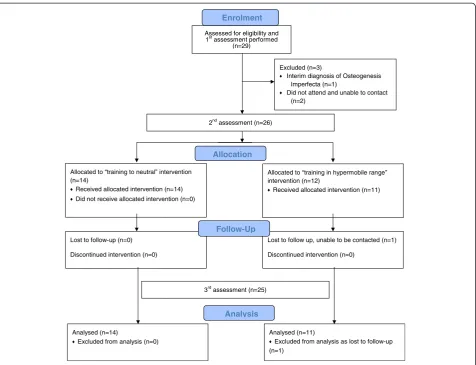
Twenty nine children were recruited for the trial, with 4 drop-outs (Figure 2), including 1 patient excluded fol-lowing bone densitometry results and further medical assessment resulting in a provisional diagnosis of Osteo-genesis Imperfecta. Twenty-five children were then ran-domly allocated to receiving physiotherapy treatment exercising in either the hypermobile range or only to neutral knee extension. The trial stopped when ethical approval ceased at 5 years. No adverse events, defined as joint injuries including dislocations and subluxations, were reported in either treatment group.
Baseline data
Table 1 presents the baseline characteristics of each treatment group and combined data. Children in the hypermobile training group were older (p=0.04) with no other statistically significant differences present at base-line. All participants met the Brighton criteria [10] for the diagnosis of JHS. All children reported experiencing knee pain for≥3 months. Back pain and hand pain when writing, constituted the most common musculoskeletal complaints in addition to knee pain. Most participants were recruited from the Orthopaedic (n=11) and Con-nective Tissue Dysplasia (n=9) clinics with the remainder from the Sports Medicine (n=5), Physiotherapy (n=3) and Rheumatology (n=1) clinics.
Effects of the control period prior to the intervention Statistical analysis was conducted to check for any chan-ging values during the control period between the first and second assessments. The parent-reported role limi-tations in emotion and behaviour domain of the CHQ (p=0.02), and consequently the psychosocial summary score (p=0.03), significantly improved during the base-line control period (Additional file 1). No other signifi-cant differences were found (all p>0.06).
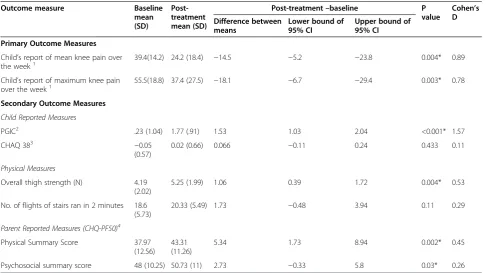
Outcome for combined groups
in thigh strength, child report of knee pain, and parent-reported physical and psychosocial summary scores, whereas there were no significant pre-post changes in the functional measures of the CHAQ or stair ascent/ descent. The individual domains of physical functioning, behaviour, bodily pain, self-esteem, mental health and parent emotional impact on the CHQ all showed signifi-cant pre-post improvements (Additional file 2).
Comparison of effects of treatment between training groups
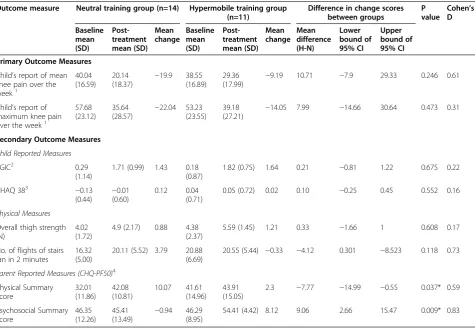
No significant differences were found between treatment groups in the primary outcome measure of pain, or on any of the secondary child reported or physical measures of strength or function (Table 3). For between-group tests, a significant difference showing better outcome for the group exercising into their hypermobile range was evident in the CHQ psychosocial summary score (p=0.009), whereas the group exercising into their neu-tral range had statistically significant greater improve-ments in their physical summary score (p=0.037). Three
Table 1 Baseline characteristics
Characteristicsa Hypermobile training group
(n=12)
Neutral training group (n=14)
Combined (n=29)†
Age, years 13.48 (3.05) 11.02 (2.51)* 12.04 (2.93)
Gender: female,n (%)
10 (83.3%) 8 (57.1%) 19 (65.5%)
BMI centile 51.25 (26.74) 65.67 (33.11) 61.36 (30.17)
Patient new to service: yes,n(%)
11 (91.6%) 10 (71.4%) 24 (82.8%)
Beighton Score (/9)
7.7 (1.0) 6.9 (1.1) 7.14 (1.16)
a
Categorical variables: number of participants (%), Continuous variables: mean (S.D).
†Includes drop-outs.
* p<0.05 indicating statistically significant difference between the neutral and training groups.
Assessed for eligibility and 1stassessment performed
(n=29)
Excluded (n=3)
Interim diagnosis of Osteogenesis Imperfecta (n=1)
Did not attend and unable to contact (n=2)
Analysed (n=14)
Excluded from analysis (n=0) Lost to follow-up (n=0)
Discontinued intervention (n=0)
Allocated to “training to neutral” intervention (n=14)
Received allocated intervention (n=14) Did not receive allocated intervention (n=0)
Lost to follow up, unable to be contacted (n=1)
Discontinued intervention (n=0) Allocated to “training in hypermobile range” intervention (n=12)
Received allocated intervention (n=11)
Analysed (n=11)
Excluded from analysis as lost to follow-up (n=1)
Allocation
Analysis Follow-Up
2ndassessment (n=26)
Enrolment
3rdassessment (n=25)
of the individual domains–self-esteem (p=0.03), behav-iour (p=0.019) and mental health (p=0.001)–significantly favoured exercise into the hypermobile range (Figure 3 and Additional file 3). The self-esteem and mental health domains were significantly lower than Australian normative values [34] at baseline (all p<0.05) with only the hypermobile training group equaling Australian norms post treatment (self-esteem: hypermobile p=0.84, neutral p<0.05; mental health: hypermobile p=0.53, neutral p<0.05). There were no statistically significant differences between the mean scores of either training group and the Australian norms pre- or post-training in the behaviour domain (all p>0.05). None of the individual domains significantly favoured the group exercising to the neutral range.
Discussion
Joint pain is the most common complaint in children with JHS [8] and pain severity was therefore chosen as the pri-mary outcome measure in this trial. Large effect sizes and statistically significant differences were found following the exercise period. Child reported mean knee pain decreased by 36%, maximum knee pain decreased by 32%, and parent-reported bodily pain improved by 37%. A 30% im-provement in pain scores is considered clinically significant
in other rheumatological conditions [41] and these im-provements are similar to those found previously when assessing the efficacy of exercise for children with JHS [15]. As the treatment was provided to children and ado-lescents of both genders across ages 7-16 years, the results suggest that this programme may provide similar pain re-ductions in pain intensity for other children and adoles-cents with JHS and knee pain seen within the Australian healthcare setting. To provide a more comprehensive un-derstanding of the impact of physiotherapy based interven-tions on the child’s overall pain experience, future research should also assess pain frequency and duration.
As knee hyperextension may result in infrapatellar fat pad, or anterior capsule impingement eliciting pain, it is possible that the children exercising to full hyperextension may have had greater difficulties performing the exercise programme pain-free. Consequently, those patients who actively limited exercises to neutral knee extension only may have gained greater physical benefits from the exer-cise programme over the 8-week period. It may be appro-priate when managing these patients to exercise first to neutral knee extension until symptoms settle, before chal-lenging their motion control in the hyperextension range. Given the physical benefits of an exercise to neutral para-digm and the psychosocial benefits of an exercise into
Table 2 Overall effects of exercise training (groups combined n=25)
Outcome measure Baseline
mean (SD)
Post-treatment mean (SD)
Post-treatment–baseline P
value
Cohen’s D Difference between
means
Lower bound of 95% CI
Upper bound of 95% CI
Primary Outcome Measures
Child’s report of mean knee pain over
the week1 39.4(14.2) 24.2 (18.4) −14.5 −5.2 −23.8 0.004* 0.89
Child’s report of maximum knee pain over the week1
55.5(18.8) 37.4 (27.5) −18.1 −6.7 −29.4 0.003* 0.78
Secondary Outcome Measures
Child Reported Measures
PGIC2 .23 (1.04) 1.77 (.91) 1.53 1.03 2.04 <0.001* 1.57
CHAQ 383 −0.05
(0.57)
0.02 (0.66) 0.066 −0.11 0.24 0.433 0.11
Physical Measures
Overall thigh strength (N) 4.19 (2.02)
5.25 (1.99) 1.06 0.39 1.72 0.004* 0.53
No. of flights of stairs ran in 2 minutes 18.6 (5.73)
20.33 (5.49) 1.73 −0.48 3.94 0.11 0.29
Parent Reported Measures (CHQ-PF50)4
Physical Summary Score 37.97 (12.56)
43.31 (11.26)
5.34 1.73 8.94 0.002* 0.45
Psychosocial summary score 48 (10.25) 50.73 (11) 2.73 −0.33 5.8 0.03* 0.26
1
Using 2 separate 0 - 100 mm VAS’s, a higher score depicts more pain. 2
Patient’s Global Impression of Change (PGIC). 3
Child Health Assessment Questionnaire–38 question version (CHAQ-38). 4
hypermobile exercise paradigm, we propose that clinicians begin with the neutral, and progress to the hypermobile range, to achieve a more holistic outcome. This graded ap-proach to exercise in JHS has been previously proposed by a group of expert therapists [42]. Rate of exercise progres-sion and use of analgesia was not measured within this study, but would be worthwhile to consider in future research.
Considering the overall improvement when results of the two training groups were combined, moderate effect sizes were demonstrated in all other statistically significant findings. The effect sizes observed here suggests that stud-ies with larger sample sizes would be worthwhile.
Parent ratings of a child’s behaviour, self-esteem and mental health are important indicators of their percep-tion of their child’s psychosocial wellbeing. These mea-sures were specifically influenced by an exercise program that took the child’s limbs into hypermobile range, over and above the general effects of exercise shared by both groups. The improvements seen in these domains were not only significantly different between
groups, but also demonstrated that exercising into the hypermobile range significantly improved self-esteem and mental health levels to equal that of Australian nor-mative values [34]. The reason for this finding may be due to a shift in parental perception of their child’s con-dition contingent on them exercising into hypermobile range. Children and parents were only aware that two different exercise programmes were being studied and were blinded to the range differences. Having the
physiotherapist encourage movement within the
hypermobile range may have “normalised” the parent’s perception of their child’s everyday movements that they previously considered unusual and undesirable. The consequent impact on perception of their hyper-mobility may explain improvements in these psychosocial measures. In light of the known incidence of anxiety disor-ders with the adult JHS population [43], further research on the mechanism behind this finding is warranted, with the inference that measurement of the child’s own percep-tion of their self-esteem and mental health would be worthwhile.
Table 3 Comparison of effects of exercise training between treatment groups
Outcome measure Neutral training group (n=14) Hypermobile training group (n=11)
Difference in change scores between groups
P value
Cohen’s D Baseline mean (SD) Post-treatment mean (SD) Mean change Baseline mean (SD) Post-treatment mean (SD) Mean change Mean difference (H-N) Lower bound of 95% CI Upper bound of 95% CI
Primary Outcome Measures
Child’s report of mean knee pain over the week1 40.04 (16.59) 20.14 (18.37) − 19.9 38.55 (16.89) 29.36 (17.99) −
9.19 10.71 −7.9 29.33 0.246 0.61
Child’s report of maximum knee pain over the week1
57.68 (23.12) 35.64 (28.57) − 22.04 53.23 (23.55) 39.18 (27.21) −
14.05 7.99 −14.66 30.64 0.473 0.31
Secondary Outcome Measures
Child Reported Measures
PGIC2 0.29
(1.14)
1.71 (0.99) 1.43 0.18 (0.87)
1.82 (0.75) 1.64 0.21 −0.81 1.22 0.675 0.22
CHAQ 383
−0.13 (0.44) − 0.01 (0.60) 0.12 0.04 (0.71)
0.05 (0.72) 0.02 0.10 −0.25 0.45 0.552 0.16
Physical Measures
Overall thigh strength (N)
4.02 (1.72)
4.9 (2.17) 0.88 4.38 (2.37)
5.59 (1.45) 1.21 0.33 −1.66 1 0.608 0.17
No. of flights of stairs ran in 2 minutes
16.32 (5.00)
20.11 (5.52) 3.79 20.88 (6.69)
20.55 (5.44) −0.33 −4.12 0.301 −8.523 0.118 0.73
Parent Reported Measures (CHQ-PF50)4
Physical Summary Score 32.01 (11.86) 42.08 (10.81) 10.07 41.61 (14.96) 43.91 (15.05)
2.3 −7.77 −14.99 −0.55 0.037* 0.59
Psychosocial Summary Score 46.35 (12.26) 45.41 (13.49)
−0.94 46.29 (8.95)
54.41 (4.42) 8.12 9.06 2.66 15.47 0.009* 0.83
1
Using the 0 - 100 mm VAS. 2
Patient’s Global Impression of Change (PGIC). 3
Child Health Assessment Questionnaire–38 question version (CHAQ-38). 4
In contrast to the improvements in psychosocial mea-sures, overall parent-rated physical function improvements favoured those children exercising to only neutral knee ex-tension. Despite strict randomisation, the neutral training group were significantly younger, contrasting to the known effect of strength trainability increasing linearly with age [44]. However, this result may have been due to a ceiling effect, as despite strict randomisation, the group exercising to neutral knee extension had significantly lower physical summary scores at baseline, while final summary scores for each group were similar. Future research with larger study samples would provide definitive results as to whether limiting exercises only to the neutral range does
result in measurable differences in physical function outcome.
The CHAQ showed minimal effect from the training intervention and this may be due to the global nature of the questionnaire. Questions included those related to fine motor function and daily activities such as eating and dressing which would not be expected to change when undertaking an exercise programme aimed only at knee joint function. This provides important methodological considerations for future studies in this patient population as the use of a functional measure for children more spe-cific to the knee joint might have been more sensitive to change. Recently, the Knee Injury and Osteoarthritis Out-come score has been modified for children (KOOS-Child) [45] and the Modified International Knee Documentation Committee Subjective Knee Form has demonstrated ac-ceptable psychometric properties for use in children with a variety of knee disorders (Pedi-IKDC) [46]. The use of one of these new measures is likely to be more appropriate in this population.
Similarly, no significant changes were seen in the child’s ability to climb flights of stairs in 2 minutes, most likely as a result of a ceiling effect. Each flight consisted of 12 stairs and even when running, no greater than 25 flights was ever achieved in the 2 minutes allowed. This provided minimal opportunity for improvement in many of the participants.
Significant moderate sized improvements in muscle strength resulted from training regardless of group allo-cation. As expected, as both training groups were exer-cising to the same intensity and duration, no differences were evident between groups.
Knee joint proprioception has previously been shown to be reduced in children with JHS [18] and exercise programmes in adults with JHS have demonstrated im-provements in proprioception as a result of exercise training [14]. The inclusion of knee joint proprioception as an outcome measure for this study may have provided further insight into the mechanisms by which pain in-tensity and function gained improvements.
No significant differences were found during the base-line period with the exception of parent-reported role lim-itations in emotion and behaviour and hence the psychosocial summary score. We hypothesise that the im-provement in the child’s behaviour may have occurred as a result of enrolment into the trial. The first assessment occurred at this point and children met with a specialist in
the area who acknowledged their symptoms and
hypermobility as the cause of it, and provided reassurance that physiotherapy would help to improve their pain. Within this cohort, 83% of the children were previously unknown to the multidisciplinary hypermobility service at our centre. Despite all children having GJH and signifi-cant knee pain (mean 39.4/100 on the VAS over the
CHQ-PF5
0 Sc
ore
50 60 70 80 90 100
Mental Health
50 60 70 80 90 100
Self-esteem
50 60 70 80 90 100
Behaviour
Pre-treatment Post-treatment
previous week), these children had not previously been recognised as having JHS. Delayed diagnosis of this con-dition has previously been reported in the literature [8] and this delay may contribute to provision of less than optimal management [47].
A multi-system disorder, JHS has significant adverse impacts on the affected child and their family’s daily functioning. Adib et al [8] reported 41% of children with JHS miss important periods of schooling and 67% ex-perience limitations in their physical activities as a result of their symptoms. Children with JHS and knee pain also experience significantly reduced quality of life compared to their healthy peers [48]. There is therefore a critical need for empirically-based evidence to guide the man-agement of this condition.
The present study is the first RCT comparing the effect-iveness of performing individualised and progressive exer-cises either to neutral or into the full hypermobile range of motion for individuals with symptomatic hypermobility, and the second RCT on the effectiveness of physiotherapy management for children with JHS. It provides further evi-dence to support the use of physiotherapy management, however because no long term follow-up was undertaken within this study, it remains unknown if the effect of the intervention washes out. The impact of this intervention on medication use and participation in daily activities such as school attendance and physical activities also warrants further investigation.
Conclusions
This study has demonstrated that a physiotherapist-supervised exercise programme is significantly effective in reducing pain, improving health-related quality of life, and increasing muscle strength in children with JHS and knee pain. In addition, these exercises were found to be more ef-fective in improving the child’s self-esteem, mental health and behaviour when performed into the full hypermobile range rather than when performed only to neutral knee ex-tension. Conversely, parent-reported overall physical health significantly favoured exercising only to neutral extension.
Additional files
Additional file 1:Effects of the control period prior to the intervention (n=26): All outcome measures.
Additional file 2:Overall effects of exercise training (groups combined n=25): Individual domains of the CHQ-PF50.
Additional file 3:Comparison of effects of training between treatment groups (neutral n=14, hypermobile n=11): Individual domains of the CHQ-PF50.
Abbreviations
JHS:Joint hypermobility syndrome; GJH: Generalised joint hypermobility; RCT: Randomised controlled trial; VAS: Visual analogue scale; PGIC: Patients’ global impression of change; CHAQ: Child health assessment questionnaire; CHQ: Child health questionnaire.
Competing interests
The authors declare that they have no competing interests.
Authors’contributions
VP was involved in the study conception and design, data acquisition and analysis. LT was involved in study conception and design, data acquisition and analysis. RA was involved in study design, data analysis and interpretation. CM was involved in data acquisition and interpretation. LN was involved in study design, data analysis and interpretation. All authors were involved in manuscript preparation and have read and approved the final manuscript.
Acknowledgements
We would like to thank the children and their families who participated in this study, the specialists who assisted in the recruitment, and the physiotherapists of The Children’s Hospital at Westmead outpatient team who assisted in the treatment of these children. This study was supported by a grant from The Children’s Hospital at Westmead Nursing and Allied Health Research Committee and a grant from the Connected Foundation, funding patient parking and additional physiotherapy sessions. VP is supported by The Menzies Foundation Sir Robert Menzies Memorial Research Scholarship in the Allied Health Sciences.
Author details
1Physiotherapy Department, The Children’s Hospital at Westmead, Sydney,
Australia.2Kids Rehab, The Children’s Hospital at Westmead, Sydney, Australia.3Department of Endocrinology, The Children’s Hospital at
Westmead, Sydney, Australia.4Discipline of Biomedical Sciences, The University of Sydney, Sydney, Australia.5Discipline of Pediatrics and Child
Health, The University of Sydney, Sydney, Australia.6Discipline of Physiotherapy, The University of Sydney, Sydney, Australia.
Received: 11 May 2013 Accepted: 8 August 2013 Published: 14 August 2013
References
1. Clinch J, Deere K, Sayers A, Palmer S, Riddoch C, Tobias JH, Clark EM:
Epidemiology of generalized joint laxity (hypermobility) in
fourteen-year-old children from the UK: a population-based evaluation.
Arthritis & Rheumatism2011,63:2819–2827.
2. Seckin U, Tur BS, Yilmaz O, Yagci I, Bodur H, Arasil T:The prevalence of joint hypermobility among high school students.Rheumatol Int2005,25:260–263. 3. El-Garf AK, Mahmoud GA, Mahgoub EH:Hypermobility among Egyptian
children: prevalence and features.J Rheumatol1998,25:1003–1005. 4. Cheng JC, Chan PS, Hui PW:Joint laxity in children.J Pediatr Orthop1991,
11:752–756.
5. Leone V, Tornese G, Zerial M, Locatelli C, Ciambra R, Bensa M, Pocecco M:
Joint hypermobility and its relationship to musculoskeletal pain in schoolchildren: a cross-sectional study.Arch Dis Child2009,94:627–632. 6. Hasija RP, Khubchandani RP, Shenoi S:Joint hypermobility in Indian
children.Clin Exp Rheumatol2008,26:146–150.
7. Juul-Kristensen B, Kristensen JH, Frausing B, Jensen DV, Rogind H, Remvig L:
Motor competence and physical activity in 8-year-old school children with generalized joint hypermobility.Pediatrics2009,124:1380–1387. 8. Adib N, Davies K, Grahame R, Woo P, Murray KJ:Joint hypermobility
syndrome in childhood. A not so benign multisystem disorder?
Rheumatol (Oxford)2005,44:744–750.
9. El-Metwally A, Salminen JJ, Auvinen A, Macfarlane G, Mikkelsson M:Risk factors for development of non-specific musculoskeletal pain in preteens and early adolescents: a prospective 1-year follow-up study.
BMC Musculoskelet Disord2007,8:46.
10. Grahame R, Bird HA, Child A:The revised (Brighton 1998) criteria for the diagnosis of benign joint hypermobility syndrome (BJHS).J Rheumatol
2000,27:1777–1779.
11. Schubert-Hjalmarsson E, Ohman A, Kyllerman M, Beckung E:Pain, balance, activity, and participation in children with hypermobility syndrome.
Pediatr2012,24:339–344.
13. Murray KJ:Hypermobility disorders in children and adolescents.Best Pract Res Clin Rheumatol2006,20:329–351.
14. Ferrell WR, Tennant N, Sturrock RD, Ashton L, Creed G, Brydson G, Rafferty D:
Amelioration of symptoms by enhancement of proprioception in patients with joint hypermobility syndrome.Arthritis Rheum2004,50:3323–3328. 15. Kemp S, Roberts I, Gamble C, Wilkinson S, Davidson JE, Baildam EM, Cleary AG,
McCann LJ, Beresford MW:A randomized comparative trial of generalized vs targeted physiotherapy in the management of childhood hypermobility.
Rheumatol (Oxford)2010,49:315–325.
16. Castori M, Morlino S, Celletti C, Celli M, Morrone A, Colombi M, Camerota F, Grammatico P:Management of pain and fatigue in the joint
hypermobility syndrome (a.k.a. Ehlers-Danlos syndrome, hypermobility type): principles and proposal for a multidisciplinary approach.Am J Med Genet A2012,158A:2055–2070.
17. Gedalia A, Brewer EJ:Joint hypermobility in pediatric practice–a review.
J Rheumatol1993,20:371–374.
18. Fatoye F, Palmer S, Macmillan F, Rowe P, van der Linden M:Proprioception and muscle torque deficits in children with hypermobility syndrome.
Rheumatol (Oxford)2009,48:152–157.
19. Fatoye FA, Palmer S, van der Linden ML, Rowe PJ, Macmillan F:Gait kinematics and passive knee joint range of motion in children with hypermobility syndrome.Gait Posture2011,33:447–451.
20. Keer R:Chapter 6 - Physiotherapy assessment of the hypermobile adult. InHypermobility Syndrome.Edited by Rosemary K, SRP MSMM, Rodney Grahame CMFF. Oxford: Butterworth-Heinemann; 2003:67–86.
21. Keer R, Simmonds J:Joint protection and physical rehabilitation of the adult with hypermobility syndrome.Curr Opin Rheumatol2011,23:131–136. 22. Russek LN:Examination and treatment of a patient with hypermobility
syndrome.Phys Ther2000,80:386–398.
23. Beighton P, Solomon L, Soskolne CL:Articular mobility in an African population.Ann Rheum Dis1973,32:413–418.
24. Castori M, Sperduti I, Celletti C, Camerota F, Grammatico P:Symptom and joint mobility progression in the joint hypermobility syndrome (Ehlers-Danlos syndrome, hypermobility type).Clin Exp Rheumatol2011,29:998–1005. 25. Tofts LJ, Elliott EJ, Munns C, Pacey V, Sillence DO:The differential diagnosis
of children with joint hypermobility: a review of the literature.
Pediatr Rheumatol Online J2009,7:1.
26. Crossley KM, Bennell KL, Cowan SM, Green S:Analysis of outcome measures for persons with patellofemoral pain: which are reliable and valid?Arch Phys Med Rehabil2004,85:815–822.
27. Shields BJ, Palermo TM, Powers JD, Grewe SD, Smith GA:Predictors of a child’s ability to use a visual analogue scale.Child Care Health Dev2003,
29:281–290.
28. Farrar JT, Young JP, LaMoreaux L, Werth JL, Poole RM:Clinical importance of changes in chronic pain intensity measured on an 11-point numerical pain rating scale.Pain2001,94:149–158.
29. Nugent J, Ruperto N, Grainger J, Machado C, Sawhney S, Baildam E, Davidson J, Foster H, Hall A, Hollingworth P,et al:The British version of the childhood health assessment questionnaire (CHAQ) and the child health questionnaire (CHQ).Clin Exp Rheumatol2001,
19:S163–S167.
30. Ruperto N, Malattia C, Bartoli M, Trail L, Pistorio A, Martini A, Ravelli A:
Functional ability and physical and psychosocial well-being of hypermobile schoolchildren.Clin Exp Rheumatol2004,
22:495–498.
31. Landgraf JM, Abetz L, Ware JE:The CHQ User’s Manual.Boston: The Health Institute, New England Medical Centre; 1996.
32. Oliveira S, Ravelli A, Pistorio A, Castell E, Malattia C, Prieur AM, Saad-Magalhães C, Murray KJ, Bae SC, Joos R,et al:Proxy-reported health-related quality of life of patients with juvenile idiopathic arthritis: the pediatric rheumatology international trials organization multinational quality of life cohort study.
Arthritis Rheum2007,57:35–43.
33. Ruperto N, Pistorio A, Ravelli A, Hasija R, Guseinova D, Filocamo G, Demirkaya E, Malattia C, Martini A:Criteria to define response to therapy in paediatric rheumatic diseases.Eur J Clin Pharmacol2011,67(Suppl 1):125–131. 34. Waters E, Salmon L, Wake M, Hesketh K, Wright M:The child health
questionnaire in Australia: reliability, validity and population means.Aust N Z J Public Health2000,24:207–210.
35. Hébert LJ, Maltais DB, Lepage C, Saulnier J, Crête M, Perron M:Isometric muscle strength in youth assessed by hand-held dynamometry: a feasibility, reliability, and validity study.Pediatr Phys Ther2011,23:289–299.
36. Utter AC, Robertson RJ, Nieman DC, Kang J:Children’s OMNI scale of perceived exertion: walking/running evaluation.Med Sci Sports Exerc2002,
34:139–144.
37. Bovi G, Rabuffetti M, Mazzoleni P, Ferrarin M:A multiple-task gait analysis approach: Kinematic, kinetic and EMG reference data for healthy young and adult subjects.Gait Posture2011,33:6–13.
38. McCambridge TM, Stricker PR:Strength training by children and adolescents.Pediatrics2008,121:835–840.
39. Cohen J:A power primer.Psychol Bull1992,112:155–159.
40. Kuczmarski RJ, Ogden CL, Grummer-Strawn LM, Flegal KM, Guo SS, Wei R, Mei Z, Curtin LR, Roche AF, Johnson CL:CDC growth charts: United States.
Advance data2000,314:1–27.
41. Giannini EH, Ruperto N, Ravelli A, Lovell DJ, Felson DT, Martini A:
Preliminary definition of improvement in juvenile arthritis.Arthritis Rheum
1997,40:1202–1209.
42. Simmonds JV, Keer RJ:Hypermobility and the hypermobility syndrome, part 2: assessment and management of hypermobility syndrome: illustrated via case studies.Manual Ther2008,13:e1–e11. 43. Bulbena A, Gago J, Pailhez G, Sperry L, Fullana MA, Vilarroya O:Joint
hypermobility syndrome is a risk factor trait for anxiety disorders: a 15-year follow-up cohort study.Gen Hosp Psychiatry2011,33:363–370.
44. Behringer M, Vom Heede A, Yue Z, Mester J:Effects of resistance training in children and adolescents: a meta-analysis.Pediatrics2010,126:e1199–e1210. 45. Ortqvist M, Roos EM, Brostrom EW, Janarv PM, Iversen MD:Development of the
Knee Injury and Osteoarthritis Outcome Score for children (KOOS-Child): comprehensibility and content validity.Acta orthopaedica2012,83:666–673. 46. Kocher MS, Smith JT, Iversen MD, Brustowicz K, Ogunwole O, Andersen J, Yoo WJ, McFeely ED, Anderson AF, Zurakowski D:Reliability, validity, and responsiveness of a modified international knee documentation committee subjective knee form (Pedi-IKDC) in children with knee disorders.Am J Sports Med2011,39:933–939.
47. Ross J, Grahame R:Joint hypermobility syndrome.Br Med J2011,342:c7167. 48. Fatoye F, Palmer S, Macmillan F, Rowe P, van der Linden M:Pain intensity and quality of life perception in children with hypermobility syndrome.
Rheumatol Int2012,32:1277–1284.
doi:10.1186/1546-0096-11-30
Cite this article as:Paceyet al.:Exercise in children with joint hypermobility syndrome and knee pain: a randomised controlled trial comparing exercise into hypermobile versus neutral knee extension. Pediatric Rheumatology201311:30.
Submit your next manuscript to BioMed Central and take full advantage of:
• Convenient online submission
• Thorough peer review
• No space constraints or color figure charges
• Immediate publication on acceptance
• Inclusion in PubMed, CAS, Scopus and Google Scholar
• Research which is freely available for redistribution