AN IMPLEMENTATION OF SUITABLE
IMAGE FUSION APPROACHES BASED
ON THE VARIOUS INPUT IMAGES
ASWIN KUMER S V
Research Scholar
Department of Electronics and Communication Engineering, SCSVMV University, Enathur Kanchipuram, Tamil Nadu-631502, India
Dr.S.K.SRIVATSA
Senior Professor (Retd) Anna University, MIT Chromepet Chennai, Tamil Nadu-600028, India [email protected]
Abstract The term image fusion is referred as to obtain the high Quality image which has more informative than the two input images of less Quality. The process of Image Fusion consists of three layers. They are the input layer, Hidden layer and the Output layer. This paper describes each and every layer. The images like IKONOS, LANDSAT and QUICKBIRD have different features, so that the algorithm going to implement for the image fusion process may vary based on the problem domain which have taken. This paper proposes the different methodologies to implement image fusion process like Intensity, Hue and Saturation (IHS) Transform, Principal Component Analysis (PCA) Based Fusion and Wave Atom Transform.
Key words: Image Fusion; IHS Transform; Principal Component Analysis; Wave Atom Transform
1. Introduction
An implementation of image fusion techniques are broadly classified into two types. They are spatial domain method and Frequency Domain method [1]. The spatial domain methods can be processed in very less time. So, those methods are implemented in real time applications [2]. The Frequency domain methods consumes more time for processing, which are not widely used for real time applications. The simple averaging Fusion technique, Select maximum Fusion technique, Intensity, Hue and Saturation (IHS) Transform technique and Principal Component Analysis (PCA) Based image Fusion technique are comes under the spatial domain methods. The High pass Filtering technique, Laplacian pyramid technique, Discrete Cosine Transform (DCT) technique, Discrete wavelet Transform (DWT) technique, Integer Lifting DWT technique and Wave Atom Transform technique are comes under Frequency domain methods [12].
In this proposed approach considers two spatial domain methods like Intensity, Hue and Saturation (IHS) Transform technique [3] and Principal Component Analysis (PCA) [4] Based image Fusion technique and only one frequency domain approach of Wave Atom Transform. The IHS Transform is easy to implement and consumes very less time for processing and gives more efficient output. But, the color distortions are present in the output. The PCA based method has high spatial quality and processing is very fast. But, it results spectral degradation and the color distortions are also present in the fused image. In Wave Atom Transform, the output has good visual quality and also has better signal to noise ratio (SNR). But the spatial resolution is very less and also it takes much time to process [12].
The acquisition process of low quality multispectral image and the high Spatial quality panchromatic image and the process of feature extraction [5] are considered as the input layer shown in figure 2. An implementation of convolution process of image parameters and weighted average [6] are represented as hidden layer in image fusion process. The summation process implemented in the output of the convolution and the construction of high quality fused output image are established as a output layer [11] [13].
2. Proposed Methodology
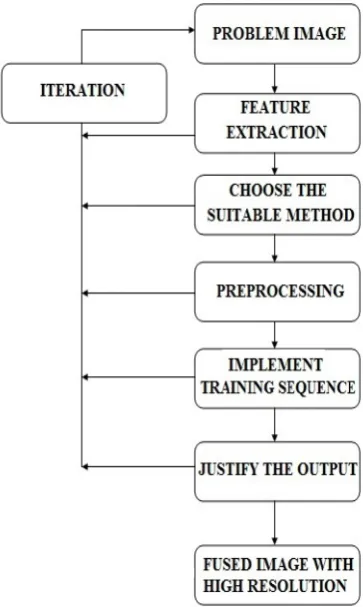
Fig. 1. Representation of Flow Sequence of the proposed methodology
3. Fusion Methodology
Fig.2. Representation of Flow Sequence of the Fusion methodology
Fused Image,
( ) = ∗
,
(1)
Where,
f (n) – Fused image ci – Weighted Average dj – Image Feature Parameters N – Number of Image parameters
4. Performance Evaluation
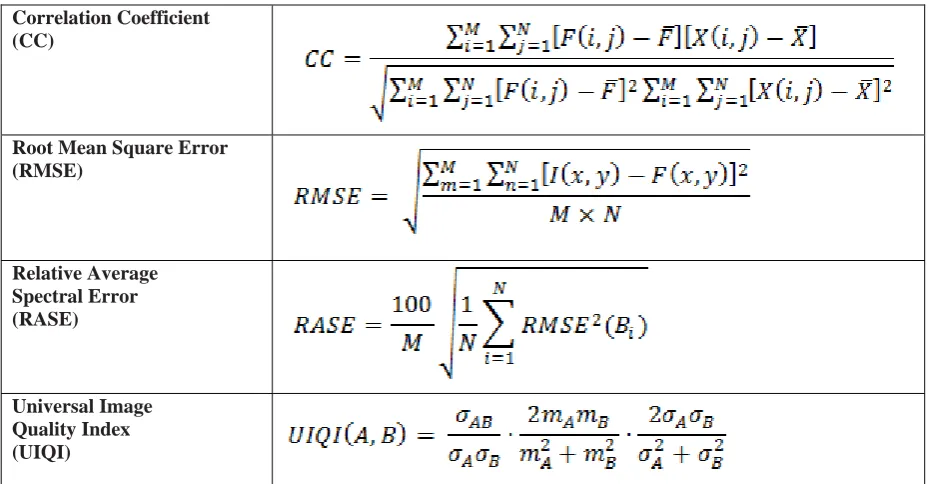
The following parameters are going to justify the output image.
Table 1: Performance Evaluation Parameters
Correlation Coefficient (CC)
Root Mean Square Error (RMSE)
(a) (b) (c)
Figure 3 IKONOS (a) Low Spectral Quality Input Image
(b) High Spatial Quality Input Image (c) Fused High Resolution Output Image
Table 2: Performance Parameters of the IKONOS Image
Type of Approach
Correlation Coefficient
Root Mean Square Error
Relative Average Spectral Error
Universal Image Quality Index
IHS 0.862 35.55 38.13 0.725
PCA 0.920 23.92 21.65 0.786
WAT 0.945 16.12 15.85 0.833
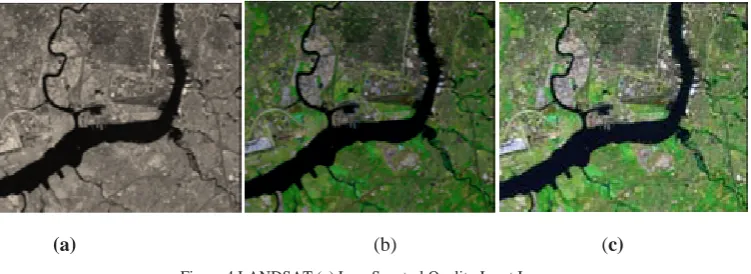
The figure 4 shows the implementation of Principal Component Analysis (PCA) based Image Fusion Technique in LANDSAT image which shows high spatial quality and very less spectral quality. The color distortions are also present in an output image.
(a) (b) (c)
Figure 4 LANDSAT (a) Low Spectral Quality Input Image
(b) High Spatial Quality Input Image (c) Fused High Resolution Output Image
Table 3: Performance Parameters of the LANDSAT Image
Type of Approach
Correlation Coefficient
Root Mean Square Error
Relative Average Spectral Error
Universal Image Quality Index
IHS 0.939 43.92 10.99 0.794
PCA 0.960 36.87 9.67 0.838
WAT 0.972 31.05 8.45 0.881
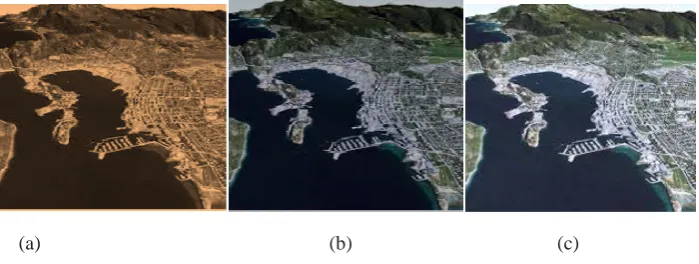
(a) (b) (c)
Figure 5 QUICKBIRD ((a) Low Spectral Quality Input Image
(b) High Spatial Quality Input Image (c) Fused High Resolution Output Image
Table 4: Performance Parameters of the QUICKBIRD Image
Type of Approach Correlation Coefficient Root Mean Square Error
Relative Average Spectral Error
Universal Image Quality Index
IHS 0.979 25.82 20.20 0.730
PCA 0.988 16.72 11.15 0.812
WAT 0.992 11.94 9.95 0.872
5. Conclusion
Thus the proposed method combines the merits of spectral domain approach and spatial domain approach like fast and efficient processing with high Spatial Quality of an image [12]. The selection of implementing the suitable approaches based on the needs for the applications of an image. And also it overcomes the Demerits of the Frequency domain approach and spatial domain approach like time consumption and low spatial resolution. These approaches provide good visual quality and better signal to noise ratio.
7. References
[1] Anjali Malviya, S.G.Bhirud, (2009). Image fusion of digital image, International journal of recent trends in engineering, 2(3). [2] A.Toet, (1989). Image fusion by a ratio of low pass pyramid, in pattern Recognition Letters, 9(4), 245-253.
[3] Desale, Rajenda Pandit, and Sarita V. Verma, (2013). Study and analysis of PCA, DCT & DWT based image fusion techniques, IEEE International Conference on Signal Processing Image Processing & Pattern Recognition (ICSIPR), Coimbatore, 66-69.
[4] Gonzalo Pajares and Jesus Manuel de la Cruz, (2004). A wavelet-based Image Fusion Tutorial, in pattern Recognition, 37(9), 1855-1872.
[5] Haghighat, M. B. A.; Aghagolzadeh, A.; Seyedarabi, H. (2011). "Multi-focus image fusion for visual sensor networks in DCT
domain". Computers & Electrical Engineering. 37 (5): 789–797.
[6] Haghighat, M. B. A.; Aghagolzadeh, A.; Seyedarabi, H. (2011). "A non-reference image fusion metric based on mutual information of
image features". Computers & Electrical Engineering. 37 (5): 744–756.
[7] H.Li, S.Manjunath and S.K.Mitra, (1995). Multi-sensor image fusion using the wavelet transform, in Graphical Models and Image processing, 57(3), 235-245.
[8] H. Nasir, V. Stankovic, S. Marshall, (2011). Singular value decomposition based fusion for super resolution image reconstruction, in Proc. IEEE International Conference on Signal and Image Processing Applications (ICSIPA).
[9] Min Xu; Hao Chen; Varshney, P.K. (2011). An Image Fusion Approach Based on Markov Random Fields, IEEE Transactions on Geoscience and Remote Sensing, 49(12), 5116-5127.
[10] Mohamed, M. A., and B. M. El-Den, (2011). Implementation of image fusion techniques for multi-focus images using FPGA, IEEE
28th National Radio Science Conference (NRSC), Cairo, 1-11.
[11] Patil, Ujwala, and Uma Mudengudi, (2011). Image fusion using hierarchical PCA, IEEE International Conference on Image
Information Processing (ICIIP), 1-6.
[12] Vibha Gupta, Sakshi Mehra (2016). Image Fusion Techniques-A Comparitive Study, International Journal of Engineering Trends and
Technology (IJETT) – Volume 32 Number 2- February 2016 ISSN 2231-5381, page 113-118
[13] V.P.S.Naidu and J.R.Raol, (2008). Pixel-level Image Fusion using Wavelets and Principal Component Analysis, in Defence Science Journal, 58(3), 338-352.
[14] Yufeng Zheng, Edward A. Essock and BruceC.Hansen, (2004). An Advanced Image Fusion Algorithm Based on Wavelet