KNOWLEDGE MANAGEMENT
IMPLEMENTATION STEPS FOR
INDIAN SMALL & MEDIUM SIZED
ENTERPRISES
A. Anand*
Research Scholar
Mechanical Engineering Department
M.N. National Institute of Technology, Allahabad-211004, Uttar Pradesh, India
M. D. Singh
Professor
Mechanical Engineering Department
M.N. National Institute of Technology, Allahabad-211004, Uttar Pradesh, India
Abstract:
This paper present review of literature on Knowledge management (KM) in small and medium sized enterprises (SMEs). It focuses on the strategy, implementation, technological and performance measurement & benchmarking issues regarding KM in Indian SMEs. KM is a practical tool for any organization. So KM does not remain just a theory now but it paves the way to formulating an understanding of KM and its role within SMEs. KM has gained importance in the today’s global knowledge economy. It is important not only for big firms, but for small and medium size enterprises (SMEs) also. The Indian SMEs sector is also one of the fastest growing sectors of Indian economy. So it is very important for SMEs to know what their knowledge assets are, and how to manage and make best use of these assets to get maximum return, since without proper KM approaches, SMEs are likely to have more to lose than larger enterprises. This paper tries to identify the steps regarding implementation of KM in Indian SMEs for improving competitiveness of SMEs in a globalised market.
Keywords: Small to medium-sized enterprises, Learning organizations, Knowledge management, Globalization, Competitive strategy.
1. Introduction
point; they take a very practical approach to knowledge, that is, how knowledge can contribute to organizational effectiveness (Hlupic et al., 2002). SMEs are defined by a number of factors and criteria, such as location, size, age, structure, organization, number of employees, sales volume, worth of assets, ownership through innovation and technology (Rahman, 2001).There is differences of opinions on defining SMEs across the world. We are following the definition used in India. A micro enterprise is an enterprise where the investment in plant and machinery should not exceed Rs. 25 lakh. A small enterprise is an enterprise where the investment in plant and machinery is more than Rs.25 lakh but does not exceed Rs.5 crore; and a medium enterprise is an enterprise where the investment in plant and is more than Rs.5 crore but does not exceed Rs.10 crore (Ministry of MSME, Government of India, 2010).
S no. SMEs Type Investment in plant and machinery
A. Micro enterprise Should not exceed Rs. 25 lakh
B. Small enterprise More than Rs. 25 lakh but does not exceed Rs. 5 crore
C. Medium enterprise More than Rs.5 crore but does not exceed Rs.10 crore
Table1: Definition of Indian SMEs
2. A Review of Literature
Research literature, which primarily focuses on organizational studies, shows that an organization’s size matters a lot. It has impact on both structure and organizational behavior. As the organizational size increases, so do specialization, standardization and formalization. Pugh & Hickson (1976) write: ‘In terms of size, this means that bigger organizations are very likely to be highly structured in their activities i.e. to have the fullest extent of specialist offices, procedures, paperwork, and hierarchy constituting a bureaucratic framework’. Small firms, on the other hand, have a flat structure and an organic, free-floating management style that encourages entrepreneurship and innovation. They tend to be informal, non-bureaucratic and there are few rules. Control tends to be based on the owner’s personal supervision and formal policies tend to be absent in SMEs (Daft, 2004).Chen et al. (2006) have given emphasis on the importance of external knowledge, knowledge transfer, knowledge transfer activities, social and electronic network and have found out that all relate to business performance of SMEs in UK. Beijerse (2000) found out in a study of 12 SMEs in the Netherlands that there was no explicit policy that was targeted at strategic KM. Most of the firms treated KM on an operational level – at the level of systems and instruments. Many such instruments were found within the firms, but they were often not seen as an instrument for KM within the companies. Matlay (2000) in his study of 600 SMEs in UK. His main conclusion is that strategic learning and Knowledge orientation leads to survival and solid growth in the long run, although there might be other ways of obtaining short-term gains. Most of the SMEs in the study adopted short-term unstructured ways towards organizational learning (Matlay, 2000). Alam et.al. (2009) identified key factors on knowledge sharing behavior of employees in the SMEs in Malaysia. The results of the study shows that reward system, culture, trust and technology are the four key factors which influenced the knowledge sharing behavior in the SMEs. Skok and Thair (2010) investigate the issue of knowledge sharing and KM in an Arab context, by identifying the main issues and obstacles which arise as a result of the Arab culture. Almahamid et al., (2010) found out in a study of 91 SMEs in Jordan that there is a significant statistical relationship between organizational knowledge sharing practices, employees learning commitments, employee’s adaptability, and employee job satisfaction. McAdam & Reid (2001) shown that research on KM have focused primarily on larger organizations. There is relatively little information available on KM in SMEs. In their survey of 296 small and large firms in the UK, they found certain differences regarding KM. Among these were that the SME sector appeared to be less advanced in terms of knowledge construction, having a more mechanistic approach to knowledge construction and relying less on social interaction. Also, the SME sector was weaker on formal and systematic discussion in order to share tacit knowledge than larger firms, who were, furthermore, stronger on formal KM strategy. Very few studies have focused on the benefits of KM for SMEs. In their study, McAdam & Reid (2001) emphasizes that the benefit of KM on studied organizations were mainly based on reduced costs, and improved quality and efficiency. The benefits of KM reported in the study were related to improved human resources and direct market effects (Edler, 2003). Interesting results on the correlation between KM and the growth of 108 Finnish SMEs were found in a study by Saloja¨rvi et al. (2005). They argue that firms that work with KM on a systematic basis, grow faster (annual sales growth) than firms that do not have a KM strategy and practice.
in India. Only one survey reports about the KM implementation in the engineering industries (Singh et al., 2006) and a paper on KM in SMEs in Indian automotive components sector (Pillania et al., 2008c) could be found out. The survey paper was basically has emphasis on the engineering industries most of the participating organizations were from the large scale sector. The second paper focuses on the only automotive sector and leaving behind all other sectors in SMEs which is its biggest limitation and we could not get the real picture yet.
3. Conceptual Steps for KM Implementation in Indian SMEs
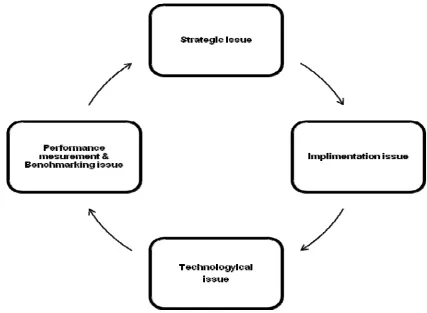
Based on literature review major critical steps have been identified for successful implementation of KM in Indian SMEs (see Figure 1). Therefore, priorities will have to be decided very carefully because it will set the direction for adoption of by the organization.
Fig. 1 Issues for KM implementation in Indian SMEs
3.1. Strategic Issue
3.2. Implementation Issue
KM implementation will affect both the internal and external operations of an organization. Hence successful implementation and use are critical to organizational performance and survival (Markus et al., 2000). KM implementation will brings with it tremendous organizational change, structural, cultural and technological. This is on account of the best practice business processes that KM system is based on. Implementations issue is to be looked at from strategic, organizational and technical dimensions. Organizations need competence to organize and manage work processes in new and efficient ways to compete in the market. For the implementation here are the key issues which are to be identified and investigated (see Figure2)
3.3. Technological issues
Technological infrastructure helps to interact among technology, techniques and people of the organization (Bhatt, G. D., 2001). IT support KM for generating knowledge, accessing knowledge, transferring knowledge, sharing knowledge and codifying knowledge (Ruggles, R., 1998). The greatest contribution of IT to the KM is the speed. There are wide varieties of technologies such as business intelligence, knowledge base, collaboration, portals, customer relation management and workflow, etc. to support KM activities. The selection of appropriate technology improves the business performance. Business executives of SMEs must regard IT as a strategic resource (Anand and Singh, 2011; Floyd and McManus, 2005). SMEs can get a competitive advantage by having integrated information systems (Koh and Simpson, 2005; Blackwell et al., 2006). IT has both indirect and a direct effect on performance (Rivard et al., 2006). According to Corbett and Campbell-Hunt (2002), IT has become an important part of the manufacturing strategy for SMEs. Manufacturing performance of SMEs can be improved as a consequence of the use of the most appropriate IT tools without any major changes in business practices, manufacturing operations or the production facilities (Lal, 2004; Hodgkinson and McPhee, 2002). For implementation here are the key issues which are to be identified and investigated (see Figure2).
3.4. Performance measurement & Benchmarking issue
Fig. 2 Key issues which are to be identified and investigated for KM implementation in Indian SMEs
4. Summary and Focus
This paper has tried to review the literature on different areas of strategy for KM implementation in SMEs to achieve competitiveness. Major areas considered in this study are strategy, implementation, and technology, performance measurement & benchmarking. In this regard 39 research papers are reviewed. Most of the studies were conducted in the Western countries and in the United States, so these studies do not give a clear idea about Indian context. Those countries SMEs are more developed and have the advantage of having strong economic, infrastructure and financialcapabilities. This is not the same for Indian SMEs though we are the fastest growing economy. Hence KM activities for Indian SMEs are to think in a fresh in order cope up the global competition and competitiveness .Available studies on Indian context are very few, so this gap is to be filled, as SMEs is considered as a major source of economic growth and development.
5. Conclusions
The answer to the main question in this article, whether KM is correlated with SMEs growth, the answer is: yes. It seems clear that KM maturity is positively correlated with growth and it is not a casual relationship. The paper predicts that SMEs with a more comprehensive and strategic approach to KM will grow more than those with a less balanced approach. The SMEs who want to grow fast must apply KM-related activities in a comprehensive and balanced way covering all aspects of their intangible assets, rather than as eclectic discreteactivities. Indian SMEs is not following any comprehensive framework on KM. The present paper has tried to identify issues for successful KM implementation in Indian SMEs .On the basis of the gap identified, further study need to be carried out to develop a comprehensive framework on KM for Indian SMEs considering all aspects of organizational performance and approach. Further research work will be required in order to validate this framework. The comprehensive framework can be validated using several hypotheses based on the analysis of empirical research. This framework will also acts as benchmarking of process and performance for continuous improvement for Indian SMEs.
6. References
[1] Akhter, S.H., (2003), Strategic planning, hyper-competition, and knowledge management, Business Horizons, pp.19-24.
[2] Alam,S., Abdullah, Z., Ishak, A. N., and Zain, M. Z. Assessing Knowledge Sharing Behaviour among Employees in SMEs: An Empirical Study, International Business Research 2, 2 (2009), 115-120.
[3] Almahamid,S., McAdams, A. C., and Kalaldeh, T. The Relationships among Organizational Knowledge Sharing Practices: An Empirical Investigation of the Listed Manufacturing Companies in Jordan, Interdisciplinary Journal of Information, Knowledge, and Management 5 (2010), 337-56.
[4] Anand, A and Singh, M. D. (2011), “Understanding Knowledge Management: a literature review”, International Journal of Engineering Science and Technology, 3(2), 926-939.
[5] Beijerse RP (2000) Knowledge management in small and medium-sized companies: knowledge management for entrepreneurs. Journal of Knowledge Management 4(2), 162.
[7] Blackwell, P., Shehab, E.M. and Kay, J.M. (2006), “An effective decision-support framework for implementing enterprise information systems within SMEs”, International Journal of Production Research, Vol. 44 No. 17, pp. 3533-52.
[8] Carpinetti, L.C.R. and Melo, A.M. (2002), “What to benchmark? A systematic approach and cases”, Benchmarking: An International Journal, Vol. 9 No. 3, pp. 244-55.
[9] Cassell, C., Nadin, S. and Gray, M.O. (2001), “The use and effectiveness of benchmarking in SMEs”, Benchmarking: An International Journal, Vol. 8 No. 3, pp. 212-22.
[10] Chen, S, Duan, Y, Edwards, S., and Lehaney, B. Toward understanding inter organizational knowledge transfer needs in SMEs: insight from a UK investigation, Journal of knowledge management 10, 3 (2006), 6-23.
[11] Choy Chong Siong, Suk Choi Yong (2005) Critical Factors In The Successful Implementation Of Knowledge Management, Journal of Knowledge Management Practice, Vol. 6, No. 2.
[12] Corbett, L.M. and Campbell-Hunt, C. (2002), “Grappling with a gusher! Manufacturing’s response to business success in small and medium enterprises”, Journal of Operations Management, Vol. 20 No. 5, pp. 495-517.
[13] Davis, T. (1996) Managing knowledge-work support functions, Journal of General Management, Vol. 22, No. 1, pp. 68-86.
[14] Edler J (2003) How German companies employ knowledge management. An OECD survey on usage, motivations and effects. In Knowledge Management. Concepts and Best Practice (MERTINS K, HEISIG P, and VORBECK J, Eds), pp 207–221, Berlin, Springer.
[15] Errin, E. (2004), “Technological intelligence and competitive strategies: an application study with fuzzy logic”, Journal of Intelligent Manufacturing, Vol. 15 No. 4, pp. 417-29.
[16] Floyd, D. and McManus, J. (2005), “The role of SMEs in improving the competitive position of the European Union”, European Business Review, Vol. 17 No. 2, pp. 144-50.
[17] Garengo, P., Biazzo, S. and Bitici, U.S. (2005), “Performance measurement systems in SMEs: a review for a research agenda”, International Journal of Management Reviews, Vol. 7 No. 1, pp. 25-47.
[18] Hlupic V, Pouloudi A and Rzevski G (2002) “Towards an integrated approach to knowledge management: ‘hard’, ‘soft’ and ‘abstract’ issues. Knowledge and Process Management 9(2), 90–102.
[19] Hodgkinson, A. and McPhee, P. (2002), SME Information Sourcing for Innovation and Export Market Developments: From Local or External Networks, Department of Economics, University of Wollongong, Wollongong.
[20] Koh, S.C.L. and Simpson, M. (2005), “Change and uncertainty in SME manufacturing environments using ERP”, Journal of Manufacturing Technology Management, Vol. 16 No. 6, pp. 629-53.
[21] Lal, K. (2004), “E-business and export behaviour: evidence from Indian firms”, World Development, Vol. 32 No. 3, pp. 505-17. [22] Liebowitz, J., (1999), Key ingredients to the success of an organization’s knowledge management strategy, Knowledge and Process
Management, Vol.6 No.1, pp.37-40.
[23] M.D. Singh, R Shankar, R. Narain, and A. Kumar, “Survey of knowledge management practices in Indian manufacturing industries,” Journal of Knowledge Management, Vol. 10, No. 6, pp. 110-128, 2006.
[24] Markus M. L, Axline S., Petrie D, Tanis C, (2000), “Learning from adopter’s experience with ERP: problems encountered and success achieved”, Journal of Information Technology, Vol. 15, pp. 245-65.
[25] Matlay H (2000) Organizational learning in small learning organizations: an empirical overview. Education and Training 42(4/5), 202-211.
[26] Matri, J.M.V. (2004) Strategic Knowledge benchmarking system (SKBS): a knowledge-based strategic management information system for firms, Journal of Knowledge Management, Vol. 8, No. 6, pp. 31-49.
[27] Mcadam R and Reid R (2001) SME and large organization perception of knowledge management: comparisons and contrasts. Journal of Knowledge Management 5(3), 231–241.
[28] Ministry of MSME, Government of India, 2010, Website.
[29] Muda, M.S. and Hendry, L. (2003), “The SHEN model for MTO SMEs: a performance improvement tool”, International Journal of Operations & Production Management, Vol. 23 No. 5, pp. 470-86.
[30] O’Dell, C., Wiig, K., Odem, P., (1999), Benchmarking unveils emerging knowledge management strategies, Benchmarking: An International Journal, Vol.6 No.3, pp. 202-211.
[31] Pillania, R.K. (2004a), “State-of-art of knowledge management in Indian industry”, Management and Change, Vol. 9 No. 1, pp. 41-7. [32] Pillania, R.K. (2005b), “IT strategy for knowledge management in Indian industry”, Journal of Information and Knowledge
Management (JIKM), Vol. 4 No. 3, pp. 32-43
[33] Pillania, R. (2008c), “Knowledge management in SMEs in India – a study of auto components sector”, International Journal of Electric and Hybrid Vehicles (IJEHV), Vol. 1 No. 3, pp. 308-18.
[34] Pugh DS and Hikson DJ (1976) Organizational Structure in its Context: The Aston Program I. Saxon House, London.
[35] Rahman, S. (2001), “A comparative study of TQM practice and organizational performance of SMEs with and without ISO 9000 certification”, International Journal of Quality & Reliability Management, Vol. 18 No. 1, pp. 35-49.
[36] Raymond, L. and St-Pierre, J. (2005), “Antecedents and performance outcomes of advanced manufacturing systems sophistication in SMEs”, International Journal of Operations & Production Management, Vol. 25 No. 6, pp. 514-33.
[37] Rivard, S., Raymond, L. and Verreault, D. (2006), “Resource-based view and competitive strategy: an integrated model of the contribution of information technology to firm performance”, Journal of Strategic Information Systems, Vol. 15 No. 1, pp. 29-50. [38] Ruggles, R. (1998) The State of the notion: Knowledge management in practice, California Management Review, Vol. 40, No. 3, pp.
80-90.
[39] Saloja¨Ravi, Furu P and Sveiby KE (2005) Knowledge management and growth in Finnish SMEs. Journal of Knowledge Management 9(2), 103–122.
[41] Skokand,W., and Thair,S. Developing a KM strategy for the Arab World, The Electronic Journal on Information Systems in Developing Countries 41,7 (2010) , 7-11.