Review On Bubble Deck Slabs Technology And
Their Applications
Samantha.Konuri, Dr.T.V.S.Varalakshmi
Abstract: A structural system of Tremendous importance in constructions are slabs or floor systems, it is called two dimensional slab structural elements, where the third dimension is small compared with the other two basic dimensions. Loads acting perpendicular slabs, to the flat principal, may be from different shapes Y configurations relying on the need for which apply at all times seeks to make them lighter but covering the greatest possible distances and always seeking to improve productivity and energy savings in construction. A widely used type slabs are currently slabs reinforced concrete, these systems have several advantages such as high resistance to compressive stresses and flexural actions, in addition to a particularly low value in the construction of the elements. However, it has certain disadvantages in terms of weight and maintenance of structures, renovation in large-scale constructions. In this area, the mid-20th century systems relieved hollow concrete slabs were created in order to reduce high ratios weight-resistance of conventional systems. These systems reduce or change the concrete within the middle of the slab by a lighter material to from reduce the weight own from the structure. But nevertheless these relieved as in slabs reduce the strength thereof before exposure to shear forces and fire. In the early 90s German engineer Jorgen Breuning found a way to improve these drawbacks in slabs, linking the air space, steel and concrete in a hollow slab bidirectional, using spheres made of plastic thus giving rise to the BDT. BD is a biaxial technology that will increase span lengths and makes floors thinner by means of lowering the weight at the same time as keeping the performance of reinforced concrete slabs. This paper gives some of the reviews related to bubble Deck slab.
Index Terms: Bubble Deck Technology(BDT), Bubble Deck Slabs(BDS), Traditional Slabs(TS), Plastic hollow balls, , reinforced module, Filigree Module, Finished Plank.
—————————— ——————————
1. INTRODUCTION
The Danish Ministry of Housing held a design competition in 1997 with the intention of bringing about a starting point that would lead to the development of flexible and sustainable structures. Unfortunately, the competition did now not cause any breakthroughs. But, the concept intrigued Jorgen Breuning, who at the time have been specializing in unique building systems, in particular shell constructions. Soon after, Breuning invented BDT in 1990‟s, the first true bi-axial hollow flat slab, which fulfilled the demands for flexibility, sustainability and material reduction within the construction industry. BDT can be certainly defined as an exceedingly efficient flat slab machine, which reduces construction prices and project times considerably. Those financial savings in time and money have been made through the entire elimination of beams in concrete systems, as well as through the reduction in the no. of structures, load-bearing walls required. The main idea of the BD voided flat slab replacing the inactive concrete by placing the hollow recycled plastic balls in between two layers of Reinforced mesh in middle of concrete slab. The hollow balls are sandwiched between top and bottom meshes developing a natural cell like structure that concrete performs just like a traditional solid reinforcement concrete slab. Due to the substitute of concrete with air bubble the slab have a lower dead load and then a higher allowable span. The Execution of replacing concrete part in the slabs with plastic hollow ball reduces the amount of concrete i.e. money saving and
resources as well as lighter the entire structure then the columns and foundations will also reduces in their size. The essential projects around the world have chosen the BDT as the low-risk way to build large and complex projects and also for green house buildings. BD eliminates up to 35% of the structural concrete. when coupled with the reduced ground thickness and facade, smaller foundations and columns, construction fees may be reduced by as lots as 10%.Experience has proven that the most price powerful application of the technology is with semi-precast panels. On most tasks this technique gets rid of over 95% of highly-priced formwork as compared with conventional concrete structures. With truly no formwork, no downturn beams or drop heads, and speedy coverage of generally 350ft2 in step with panel, the use of BD manner ground cycles up to 20% quicker than traditional construction techniques. Regardless of project size, shape or complexity; simply shore, area, and pour to quickly deploy concrete decks. Off-site manufacturing, fewer vehicle trips and crane lifts in addition to simple installation all integrate to limit working risks, in addition to decrease health & safety risks. As a end result, principal tasks around the world have selected the BDT because the low-danger manner to construct massive and complicated initiatives.
2
REVIEW
ON
BUBBLE
DECK
SLABS
P. Prabhu Teja .et al (2012) mentioned discussed about properties of Bubble deck slab based on the various studies accomplished overseas. Moment, deflection and stress distributions are proven the usage of Finite element method (FEM) in SAP2000. The outcomes are Bending stresses within the bubble deck slabs are discovered to be 6.43% lesser than that of a traditional slabs and Deflection of Bubble deck is 5.88% over the traditional slabs because the stiffness is decreased because of the hollow portion. And additionally the Shear resistance of bubble deck slabs is 0.6 times the shear resistance of the traditional slabs of identical thickness. But needed resistance are regularly carried out by providing vertical reinforcement the load reduction is 35% as compared to traditional slabs.Amer M Ibrahim .et al (2013) affords the flexural capacities and property evaluation of concrete (RC) ————————————————
Samantha.Konuri, research Scholar in University of college of Engineering & Technology in Acharya Nagarjuna University, A.P., ph-9182421740.Email:[email protected]
428 two way hollow slabs with polymer sphere voids, moreover
called Polymer bubbled RC slabs system. There in Eleven RC sq. slabs of 1000mm x 1000mm dimensions are tested to get the flexural behavior. Variables of the experimental work are: diameter of compound spheres, thickness of concrete slabs, and percentage of Metakaolin (cement replacement). it's been observed that bubbled RC slabs, (with quantitative relation of bubble diameter B to slabs thickness H, B/H=0.51 to 0.80), has concerning (90 to 100%) of the closing load capability of an equal reference traditional slabs(which has equal slab thickness). Also, bubbled slab consume regarding (70 to 75%) of the concrete required for the comparable traditional slab. A upward thrust within the deflection at 0.7Pu by means of concerning (17 to 27%), at identical time, the cracking load is observed to be shriveled by means of regarding (7 to 18%) relative to traditional slabs system. the bubbled slabs result a rise within the final load capability of bubbled slab by concerning (30%) and a reduction in the deflection at 0.7Pu through regarding (24%). At identical time, the cracking load is located to be raised by way of concerning (29%).The use of Metakaolin (cement replacement) at proportion (10%) gives a rise within the Ultimate load capability of (8%) and a reduce in the deflection at 0.7Pu by way of (10%). consequently, the cracking load is determined to be raised through regarding (18%), as compared with the reference bubbled slabs (without Metakaolin).Immanuel Joseph Chacko .et al (2016) studied on Structural Behaviour of BDS the use of Indian standards. BDT is carried out in this mission using Indian standards and Indian codal Provisions (IS 456:2000) which has not been experimentally tested to-date. The principal benefit of this assignment is that it makes use of non-degradable waste plastic thus a very eco-friendly practice. The mission conducts trial on various diameter of balls, on account that trials was achieved using the Indian Codes as benchmark, a success effects can offer for provisions in Indian Code for growing BDS the usage of plastic waste. The BDT is first of its kind using Indian Code as benchmark for design of BDS. Experimental results of the above project shows that there is no much reduction in strength and various aspects compared to normal reinforced concrete slab. Hence this is a highly innovative practice that can be implemented using Indian Standard codes which has not yet implemented in the Indian scenario.Neeraj Tiwari1 .et al (2016) gives the structural behavior of BDS. The Bubble Deck slab is a newly designed slab made by means of way of reinforcement mesh, hollow HDPE ball, reinforcement mesh once extra at bottom. It's a hollow deck whereby HDPE sphere ball act the purpose of decreasing concrete that has no carrying effect. Through adapting the mesh width & the geometry of the field, a totally unique and optimized concrete creations obtained, with regular maximum use of every moment and shear zones. The reinforcement mesh catches, distributes & fixes the spheres at specific function factor, whilst the spheres form the air extent. It controls the degree of reinforcement mesh and additionally stabilizes the spatial lattice. The outcomes of this paper as the shear strength of concrete slab specially depends on effective mass of concrete in the slab. Due to presence of HDPE spheres, the shear resistance of BDS is largely decreased in comparison to conventional slabs. Tae-Young Jang .et al represents a New Eco-friendly Two-way Void Slab. The environmental sustainability caused by greenhouse gas increase is the most critical issue now a days in the global society. In keeping with the announcement on Low Carbon green boom in South
Korea, the hobby in green constructing, ecological constructing, or sustainable constructing has been elevated. Here, „sustainable‟ ability the environment-friendly design, construction, upkeep and demolition of buildings. Also the macroscopic concept of „sustainable‟ consists of the economic, environmental, and social elements for the duration of the whole life cycle of buildings. Two-way Void Slab was developed already in 90's in foreign countries and utilized to the several projects. But it was once developed just a few years ago in South Korea and started to follow to the some projects. Two.-way Void Slab machine certified for green constructing certification in Europe, North America, Oceania, and so on. The certification are because due to eco-friendly effects such as saving together with saving fossil electricity and lowering CO2 emission by the reduction of concrete and reinforcing bar, increasing insulation overall performance and the usage of reducing seismic load with the aid of vacating
middle of slab through recycled plastic ball as void former. Table-1
Some more relevant reviews on Bubble Deck slabs Sl.
no
Author
Names Description
1 Tim Gudmand.e t al - Denmark- (2003)
In Bubble deck construction there are necessarily joints of different kinds. The in-situ a section of the BD is cast on a prefabricated slab (a filigran deck).On this take a look at the bond strength of the reinforcement is calculated in a joint amongst precast slabs. The bond strength is encouraged through the casting joint among the precast slab and the in-situ concrete.. It has been shown in the note how the load carrying capacity of a joint in a Bubble deck may be calculated using the theory of plasticity. A direct use of code rules is impossible in such a complicated case. Therefore the note also demonstrates the advantage of having a theory instead of relying on empirical rules with doubtful extrapolations.
2
Corneille Charles Marais.et al- South Africa- (2009)
The goal of this take a look at is to set up the least expensive variety of spans in which Cobiax flat slabs can be used for a sure load criteria, in addition to addressing the protection of crucial design standards of Cobiax slabs in terms of SANS 10100:2000. Vertical shear, horizontal shear and deflection might be investigated a good way to motivate the secure use of German research elements in mixture with SANS 10100:2000. The financial system of Cobiax slabs can also be investigated to establish graphs comparing Cobiax slabs, coffer slabs and post-tensioned slabs for different spans and load intensities. Those graphs are to simplify the consulting engineer‟s preference whilst having to determine on the most cost-efficient slab systems for a particular span length and load application.
3 Mihai Bindea.et al- (2013)
4
Kivanc Taskin.et al-(2014)
This studies is based totally on the modeling of void slabs the usage of different structural evaluation program (SAP 2000 etc) due to TS 500 (necessities for design and production of strengthened Concrete systems Turkish widespread).Additionally this have a look at scrutinizes the economy of numerous slab structures (waffle, mushroom, rib and so on.), exposed to distinct load intensities and practical span tiers. The consequences shows that the plastic voided slab systems offer an outstanding opportunity to stable concrete slabs for many applications. Weight and cost savings as well as architectural flexibility can be achieved with plastic voided slabs.
5 Ma. Leilani T. Manalaysay .et.al-Philippine (2014)
The local government of Mandaluyong wants to construct its very own cultural center in the city. They need this building in order to showcase Mandaluyong‟s history. The cultural centre will consist of a museum and an auditorium. This will provide the people knowledge about the city, and some opportunities that will showcase their artistic talent. This project would give the local government of Mandaluyong the design needed to construct the said building. The researchers would be using BD System in an effort to reduce the weight and increase the slabs Strength.
6
Dr. Thaar Saud Salman -(2015)
This paper presents the consequences of experimental program investigating the impact of fire flame (excessive temperature) at the structural overall performance of BDS. This system consisted casting and trying out 9 specimens. the dimensions of the specimens have been 270 X 500mm in plane and with two special thicknesses; 90 and 140mm.The test consequences confirmed that, the residual strength of specimens reduced from 71.8% to 21.6% and their significant deflection multiplied with growing the fire flame temperature from 200 to 800oC and exposure time from 1 to 2 hours. For unexpectedly cooling specimen the residual flexural strength and primary deflection had been much less than those of equal specimen while cooled regularly. Later, growing the thickness of bubble slabs via 56% progressed surprisingly each the residual energy about 45% and stiffness of specimens.
7
Teodoro Esteban Amaya Astudillo.et
al -
University of Cuenca- (2015)
In This project to first order structural analysis was Performed for the behavior of the application and BD slabs of esta system, Compared With waffle slabs systems. The models have been made inside the program SAP2000, for the evaluation of the inner strain distribution, slab systems modeled have been With the inclusion of spheres of high density polyethylene; for the evaluation of BDS in application rates, different varieties of BDS modeled were With the dimensions precise for every case. As a end result values of stresses have been obtained and Their distribution interior a BDS thinking about the presence of polyethylene spheres, also it became obtained deflections produced in every sort of BDS and sooner or later to technical and monetary contrast of the effects of the usage of BDS and waffle slabs in buildings as much as 4 flooring.
8
Reshma Mathew et al - (2016)
In this have a look at GFRP(Glass Fiber reinforced Polymer) strips with diverse orientation is used as a strengthening gadget for bubble deck slab .Finite element analysis was done using ANSYS software program. She concluded that Punching shear capacity of bubble deck slab is a prime hassle due to its decreased weight. GFRP strengthening system is used on this report. Strengthened slabs have greater punching potential compared with normal BDS. Increase in load carrying capacity up to 20 percent because of strong of BDS with GFRP. Reinforced bubble deck has low deflection compared to un reinforced bubble deck slab.
9
Sameer Ali.et al - (2017)
The objective of this take a look at is to perform the behavioral evaluation of conventional slab and bubble deck slab using Ansys workbench 14.0. This study includes the take a look at of normal slab and BDS with HDPE ball. The analysis result confirmed the maximum stresses and internal forces within the BD about to 40% lower than the normal slab due to the reduced useless load from using HDPE balls in place of concrete. The deflection of the BDS was slightly higher but the stiffness reduced due to the presence of the HDPE ball, but this situation will be overcome by the reduced overall stress in the slab. Upon the brief study of the bridge deck slab shows that it don‟t follows the office slab of the models which was created with the same general parameters. 10 Mr. Muhammad Shafiq Mushfiq.et al - (2017)
This take a look at presents the Experimental take a look at of the BDS based totally on B/H Ratios. In the BDS, one has spherical balls of size 90 mm wherein (164 kg) of concrete become used and the other has spherical balls of length 120mm in which (151.54kg) of concrete become used and B/H ratios of 0.60 & 0.80 having 35 and 16 spherical balls respectively. The conventional slab became casted with (183.35 kg) of concrete. Experimental tests outcomes indicate that the conventional slab carried a load of 424.95KN and reason 12.1 mm deflection with crack taking place after a load of 164KN. The bubble deck slab with B/H ratio 0.60, carried load of 350 KN and cause 12.64 mm deflection with crack taking place after a load of 168 KN. The remaining Bubble Deck slab with B/H ratio 0.80, carried a load of 398.2KN and reasons thirteen.3mm deflection with crack going on after a load of 300KN. a complete of 10.55% of concrete became stored within the first Bubble Deck slab and 17% of concrete saved in the 2nd one. This means that the bubble deck slabs have less load wearing capacity compared to the conventional slab.
3 APPLICATIONS
OF
BDS:-
3.1 MPCC Building
430 excellence in Environment and Sustainability building.
Fig.1. Mills Park Community Centre (MPCC)
3.2 Office Building
National building construction, engineering and belongings improvement business enterprise Georgiou institution has constructed homes of a landmark blended-use development at the nook of Loftus road and Railway Parade, West Leederville. Comprising 3 stages of underground car parking, 5 ranges of workplace space. The layout by way of Meyer Shircore architects calls for large two-manner spans commonly 8.5 meters by way of eight meters, and structural engineers pink certain BD280 slab all through to achieve a low value concrete slab with easy construction. the one prefabricated device meets all the distinct necessities of car park, office regions. about thirteen,400 rectangular meters of BD semi-precast panels made by way of certified producer Austral Precast. The building accommodates 2 levels of car parking, floor ground office tenancy along with a café, and four flooring of office space. approximately 5,500 square meters of BDS could be used in constructing the building.
Fig.2. Office Building
3.3 Millennium Tower
The Millennium Tower in the city of Rotterdam in the Netherlands, was the first work to be constructed with slabs bubble deck. Initially, the project included the use of Bubble deck hollow slabs. But before construction was started it was decided to use the concept of slabs bubble deck, which resulted in an acceleration of 10 cycles of floors for 4 days. It also meant a reduction by 50% of the pillars used in the work, and a saving of five hundred truck trips. It was possible to add two floors the most due to the decrease of the right foot, since the technology does not use beams. Millennium Tower is 130.8m height with 35 storey and was completed in 2000 and it is the second largest building in the Netherlands designed by WZMH Architects and AGS Architecten.
Fig.3. Millennium Tower
4
BENEFITS OF BDS:-
According to representatives of technology in Brazil, many benefits can be cited for BDT, such as: :
1. Elimination of beams - formwork economy, cheaper and faster execution of masonry and facilities
2. Reducing the volume of concrete - 3.5 kg of recyclable plastic balls 14,31kg replace concrete;
3. carbon energy and emission reduction - due to the use of recyclable plastic, reducing the consumption of raw materials
4. Freedom in the projects - flexible layouts that adapt easily to curved and irregular layouts.
5. Increasing gaps in both directions - slab connection directly to the pillars with no beam through concrete in-situ
6. Reduced own weight - 35% smaller, allowing reduction in the foundations;
7. Increased interior pillar - up to 50% more than traditional structures.
5 CONSTRUCTION
METHOD:-
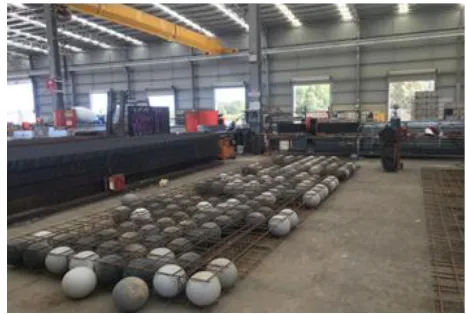
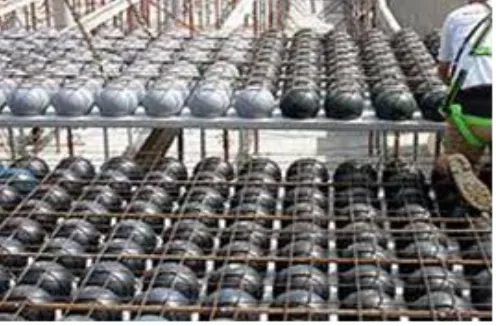
In this different modules were presented for bubble deck slab with their Usage.The Fig 4 shows the Bubble Reinforcement. It means the top and bottom mesh reinforcement, size to ensemble the specific parameters, joined together with vertical lattice girder with bubble void farmer trapped between top and bottom mesh reinforcement to fix their position.
Fig 4. Layout of a module bubbledeck
Fig 5. Precast concrete module BD
The Fig 6 shows the Finished panel of BD. It sees like Traditional Concrete or Conventional Concrete.
Fig 6. Finished panel BD
6 PLACEMENT OF BD PANNELS
:-1. precast elements positioned with the use of mechanical equipment;
2. Ribs joints - bonding between the reinforcement pre-molded parts and connection between the upper reinforcement mesh;
3. Capitals - Top additional reinforcement in the area of the pillars and possible strengthening of armor; 4. peripheral reinforcement - placing reinforcement on
the perimeter of the slab, if necessary;
5. Preparation - sealing joints, cleaning and water saturation of the precast module;
6. Concreting - launch concrete density of the second stage and removal of shoring;
7. Finishes - no additional work is required unless you want another type of different finish the exposed concrete.
7
CONCLUSION
The BD slabs are economic ,feasibility, construction aspects and qualities were demonstrated.
1. The slab BD analyzed the project proved the most applicable and cost-effective taking into account the results obtained when compared to the others. The slab using such technology resulted in a lower steel consumption, lower consumption of concrete and lower
maximum deflection, a criterion that invalidated the use of smooth slab of 18cm. Importantly, in addition to economic factors BD also takes advantage of the comfort generated to the user, mentioned above, verified by renowned institutions and also lived in several buildings around the world.
2. The solution proved to be very simple in its design when adapted to the Brazilian standard and demonstrates a constructive ease, with different play styles for each specific case.
3. Also related to the financial aspect of the project, it may be mentioned that the foundations are a considerable part in the final cost of the structure and therefore a structure that uses less material, such as BD, transmit less load to the ground and therefore need smaller foundations.
4. Therefore, though it requires a greater degree of sophistication in their execution, such as hand labor more specialized, the slabs bubble deck they proved advantageous in almost all aspects, such as: material savings, structural performance and comfort to users. 5. Finally, this project combined with the opportunity to
monitor projects with technology BD, that will run in Brazil, being of great value to training as a civil engineer.
6. For future work is suggested to carry out experimental tests in order to confirm that the data provided by the slab manufacturer BD, they are consistent. It is also important to make a comparative analysis of execution time and cost to get a better evaluation of the results.
REFERENCES
[1] P. Prabhu Teja , “Structural Behaviour of Bubble Deck Slab” ( IEEE-International Conference On Advances In Engineering, Science And Management (ICAESM -2012 March 30, 31, 2012)W.-K. Chen, Linear Networks and Systems. Belmont, Calif.: Wadsworth, pp. 123-135, 1993. (Book style)
[2] Amer M. Ibrahim , Nazar K. Ali Oukaili and Wissam D. Salman , “Flexural Behavior and Sustainable Analysis of Polymer Bubbuled Reinforced Concrete Slabs” (Fourth Asia-Pacific Conference on FRP in Structures (APFIS 2013)11-13 December 2013, Melbourne, Australia© 2013 [3] Er. Immanuel Joseph Chacko, Er.Sneha M. Varghese,
“Structural Behaviour of Bubble Deck Slab using Indian Standards (International Journal of Innovative Research In Technology, IJIRT 143950, September 2016 | IJIRT | Volume 3 Issue 4 | ISSN: 2349-6002)R. Nicole, "The Last Word on Decision Theory," J. Computer Vision, submitted for publication. (Pending publication)
[4] Neeraj Tiwari1, Sana Zafar, “Structural Behaviour of Bubble Deck Slabs and Its Application” ( IJSRD - International Journal for Scientific Research & Development| Vol. 4, Issue 02, 2016 | ISSN (online): 2321-0613).D.S. Coming and O.G. Staadt, "Velocity-Aligned Discrete Oriented Polytopes for Dynamic Collision Detection," IEEE Trans. Visualization and Computer Graphics, vol. 14, no. 1, pp. 1-12, Jan/Feb 2008, doi:10.1109/TVCG.2007.70405. (IEEE Transactions ) [5] Tae-Young Jang, Sang-Mo Kim2, Sang-Dae Kim, “New
Eco-friendly Two-way Void Slab” (International Conference on Sustain Building Asia)
432 Universitet,byg•dtu R-074,ISSN 1601-2917,2003,ISBN
87-7877-137-4)
[7] Corneille Charles Marais, “Design Adjustment factors and the Economical Application of Concrete Flat-Slabs with Internal Spherical voids in South Africa” (University of Pretoria,August 2009)
[8] Mihai Bindea, Raul Zagon, Zoltan Kiss, “Flat slabs with spherical voids. Part II: Experimental tests concerning shear strength” ( ActaTechnicaNapocensis: Civil Engineering & Architecture Vol. 56, No. 1 (2013),Received 26 February 2013; Accepted 15 August 2013)
[9] Kivanc Taskin , Kerem Peker, “ Design Factors and the Economical application of Spherical Type Voids in RC Slabs” (International Scientific Conference People, Buildings and Environment 2014 (PBE2014) 15-17 October, 2014, Kromeriz, Czech Republic)
[10]Ma. Leilani T. Manalaysay, Neil Bryan P. Robles, Ayah Rose M. Rosete and Melchor F. Pilones, “Design of Two-Storey Cultural Center Localizing Bubble Deck System” (School of Civil, Environmental and Geological Engineering, Philippine,September 2014, CEGE Journal ).
[11]Teodoro Esteban Amaya Astudillo and Boris Jaime Galindo Bacuilima, “Behavioral Analysis and Application of Slab Bubble Deck” (University of Cuenca , 2015)
[12]Reshma Mathew, Binu.P, “Punching Shear Strength Development of Bubble deck Slab Using GFRP Stirrups” (IOSR Journal of Mechanical and Civil Engineering (IOSR-JMCE) e-ISSN: 2278-1684, p-ISSN: 2320-334X, PP 01-06 and International Conference on Emerging Trends in Engineering & Management, (ICETEM-2016)
[13]Sameer Ali, Manoj Kumar, “Analytical study of Conventional slab and Bubble Deck Slab under various support and loading Conditions using ANSYS workbench 14.0” (International Research Journal of Engineering and Technology (IRJET), e-ISSN: 2395 -0056,p-e-ISSN: 2395-0072, Volume: 04 Issue: 05 | May -2017, www.irjet.net)
[14]Mr. Muhammad Shafiq Mushfiq, Shikha Saini, Nishant Rajoria, “Experimental Study on Bubble Deck Slab” (International Research Journal of Engineering and Technology (IRJET), e-ISSN: 2395 -0056, p -e-ISSN: 2395-0072, Volume: 04 Issue: 05 | May 2017, www.irjet.net)
[15]Prasad, C.V.S.R., Lakshmi, T.V., 2019. Effect of Crushed Sand and Bacillus Subtilis on the Cantabro Loss of Bacterial Concrete. International Journal of Technology. Volume 10(4), pp. 753-764
[16]Mr. Muhammad Shafiq Mushfiq, Shikha Saini, Nishant Rajoria, “Experimental Study on Bubble Deck Slab” (International Research Journal of Engineering and Technology (IRJET), e-ISSN: 2395 -0056, p -e-ISSN: 2395-0072, Volume: 04 Issue: 05 | May 2017, www.irjet.net)
[17]www.Bubbledeck.com
[18]Wikipedia-Bubbledeck-Rotterdam [19]https://core.ac.uk/download/pdf/4425176