9
Auditor Performance From The Perspective Of
Emotional Intelligence And Spiritual Intelligence
At The Office Of The Financial And Development
Supervisory Agency (BPKP) Of The North
Sumatra Representative
Henny Zurika Lubis, Sulaiman Effendi, Dahlena Sari Marbun, Muhammad Fitri Rahmadana
Abstract: This study aims to examine the effect of emotional intelligence and spiritual intelligence of auditors on the North Sumatra BPKP office. The research approach used is the Associative Approach. Measurement of emotional and spiritual intelligence on performance uses instruments adopted from Cooper and Sawaf (1998), while spiritual intelligence is adopted from Khawari (2000). The analytical tool used in this study is Path Analysis, which is used to determine the effect of emotional intelligence and spiritual intelligence both directly and indirectly on auditor performance. The analysis shows that the emotional intelligence and spiritual intelligence of auditors directly affect the performance of auditors both jointly and partially. However, emotional intelligence contributes and has a greater influence on auditor performance compared to auditor's spiritual intelligence. Indirectly emotional intelligence also affects the performance of auditors through spiritual intelligence.
Index Terms: Emotional Intelligence, Spiritual Intelligence, Auditor Performance, and Path Analysis.
—————————— ——————————
1.
INTRODUCTION
The role of the Internal Audit Judgment in making all decisions on the results of the audit is very important. One of the roles of the Internal Audit Judgment is to provide an independent and objective assessment in making an organization's decision to examine, assess and evaluate internal control (Hiro, 2006). Internal Audit Judgment runs well and correctly when the Auditor has leadership and has strong principles on his emotional and spiritual intelligence. By expressing all the potential possessed by an auditor, it will be able to show optimal performance. This will occur if someone can harmonize between emotions, feelings and the brain. Scandal and manipulation are actions that would not be carried out by an auditor who has the right spiritual intelligence. Spiritual intelligence is the basic foundation of one's intelligence in carrying out an action to determine one's attitude in an agency in providing opinions, judgments and making decisions (Goleman, 2001). Doe and Walch (2001), revealed that spirituality is the basis for the growth of self-esteem, values, morals, and sense of belonging, giving direction and meaning to our lives of beliefs about non-physical forces greater than human self-strength. Someone who has high spiritual intelligence (SQ) is a person who has strong principles and vision, is able to interpret every aspect of life and is able to manage and endure hardships and pain. SQ is an intelligence that we use not only to find out existing values, but also to creatively find new values. We use SQ to achieve more complete self-development because we have the potential and
shape a character through a combination of experience and vision, the tension between what we really do and the bigger and better things we might do. Spiritual intelligence arises because of the debate about IQ and EQ; therefore the term arises because IQ and EQ are seen as only contributing some of the determinants of one's success in the life of Hoffman (2002). There are other factors that play a role, namely spiritual intelligence, which emphasizes more on the meaning of life and is not just limited to religious emphasis. To deal with performance problems, company management needs to know the factors that affect employee performance. If these factors are known, it will be easier for companies to find the right strategy in solving the problem. One way to overcome the problem is through employee training and development. Zohar and Marshall (2007), defines spiritual intelligence as intelligence to place and solve problems of meaning and value, namely intelligence to place human behavior and life in the context of a broader and richer meaning, intelligence to judge that one's actions or way of life are more meaningful than with others. Spiritual intelligence teaches the auditor to express and give meaning to each of his actions; the spiritual intelligence possessed by each auditor is related to the human psyche to know what is good and what is bad (Zohar, Danah, & Ian M, 2000). The auditor always tells the truth in the results of his audit, the nature of openness of an auditor in carrying out the task of being able to maintain the quality of Internal Audit Judgment. The influence of spiritual intelligence with audit judgment is because spiritual intelligence teaches us to express and give meaning to each of his actions. Not influenced by conflicts of interest or certain groups. Spiritual intelligence scale items in this study were arranged based on aspects of spiritual intelligence divided into 9 aspects, namely: the ability to be flexible, a high level of self-awareness, the ability to deal with and utilize suffering, the ability to deal with and overcome pain, quality of life inspired by vision and values, reluctance to cause unnecessary losses, the tendency to see the interrelationships between things, the real tendency to ask questions for answers that are fundamental and have ———————————————
Henny Zurika Lubis, University of Muhammadiyah Sumatera Utara, Indonesia, E-mail: [email protected]
Sulaiman Effendi, University of Muhammadiyah Sumatera Utara, Indonesia, E-mail: [email protected]
Dahlena Sari Marbun, Universitas Islam Sumatera Utara, Indonesia, E-mail: [email protected]
the ease of working against conventions or working alone (Zohar, Danah , & Ian M, 2000).
2
RESEARCH
METHODOLOGY
This research was conducted at the North Sumatra BPKP office with 83 respondents representing auditors at the North Sumatra BPKP office. Data was taken using a questionnaire that has been tested for validity and reliability for the three variables studied. Of the 83 questionnaires distributed, only 60 questionnaires (73%) returned, meaning that 23 questionnaires (27%) could not be used to test hypotheses, due to time constraints, the relevant respondent was unwilling to fill out the questionnaire the authors submitted and with various reasons others so that it cannot be forced to fill in the questionnaire. The data analysis technique used is Path Analysis to examine the direct and indirect effects between the variable Emotional Intelligence (EQ) and Spiritual Intelligence (SQ) on Auditor Performance in BPKP's North Sumatra representative office.
3 RESULT
AND
DISCUSSION
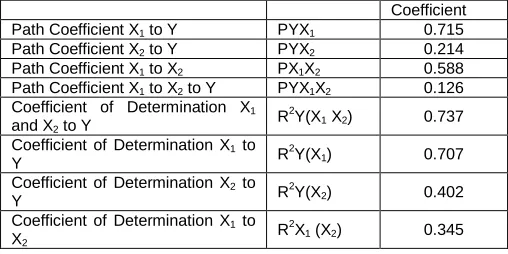
The analysis conducted for testing the hypotheses in this study is to use Path Analysis path analysis. Hypothesis testing is done through the magnitude of the estimated path coefficients or calculated based on observational data and statistical tests in the form of correlation coefficients of each path. Based on the calculation results obtained using the SPSS 23.0 statistical program can be seen in Table 1. The emotional intelligence variable (X1) directly affects the auditor performance variable (Y) with a path coefficient of 0.715. Spiritual Intelligence Variable (X2) directly affects the auditor performance variable (Y) with a path coefficient of 0.214. Indirectly, the emotional intelligence variable (X1) directly affects the auditor performance variable (Y) through the spiritual intelligence variable (X2) of 0.126. The variable of emotional intelligence (X1) directly affects the variable of spiritual intelligence (X2) with a path coefficient of 0.588. Based on the Coefficient of Determination results, the emotional intelligence variable (X1) can directly explain the auditor performance variable (Y) of 70.7%. Spiritual Intelligence Variable (X2) can explain directly the auditor performance variable (Y) of 40.2%. The variable of emotional intelligence (X1) can explain directly the variable of spiritual intelligence (X2) of 34.5%. Together the emotional intelligence variable (X1) and the spiritual intelligence variable (X2) can explain directly the auditor performance variable (Y) of 73.7%.
Table 1. Path coefficient between emotional intelligence (X1)
and spiritual intelligence (X2) on auditor performance (Y) Coefficient Path Coefficient X1 to Y PYX1 0.715
Path Coefficient X2 to Y PYX2 0.214
Path Coefficient X1 to X2 PX1X2 0.588
Path Coefficient X1 to X2 to Y PYX1X2 0.126
Coefficient of Determination X1
and X2 to Y R
2
Y(X1 X2) 0.737
Coefficient of Determination X1 to
Y R
2
Y(X1) 0.707
Coefficient of Determination X2 to
Y R
2Y(X
2) 0.402
Coefficient of Determination X1 to
X2 R
2
X1 (X2) 0.345
11 several research subjects in several companies, the results
obtained showed that employees who have high emotional intelligence scores would produce better performance. Can be seen from how the quality and quantity provided by these employees to the company. That although a person has a pretty good performance but if he has a closed nature and does not interact well with others, and then his performance will not be able to develop. Spiritual intelligence has a significant effect on auditor performance. This implies that a worker can show excellent performance if he himself gets the opportunity to express his full potential as a human being. This will be able to emerge if a person can interpret every work and can harmonize between emotions, feelings and brain. Spiritual intelligence teaches people to express and give meaning to each of their actions, so if you want to display good performance, spiritual intelligence is needed. The results of this study also support the research of Wiersma (2002), that spiritual intelligence influences one's goals in achieving his career in the world of work. Someone who carries the meaning of spirituality in his work will feel his life and work more meaningful. This encourages and motivates him to further improve the performance he has. The auditor's spiritual intelligence also has a significant positive effect on performance, which also remains consistent with the research conducted. In addition, this study also shows that the role of spiritual intelligence is greater towards optimal performance, which is in accordance with the statement of Zohar and Marshal (2000) which states that spiritual intelligence is more important and influential than the other two intelligences namely (IQ and EQ). Spiritual intelligence is a feeling of being connected to oneself. Other people and the universe as a whole. When people work, then they are required to direct their intellectuals; a worker can show excellent performance if he himself gets the opportunity to express his full potential as a human being. This will be able to emerge if someone can interpret every work and can harmonize between emotions, feelings and brain. Spiritual intelligence teaches people to express and give meaning to each of their actions, so if you want to display good performance, spiritual intelligence is needed. Research conducted by Wiersma (2000) provides evidence of the influence of spiritual intelligence in the world of work. He examines how spirituality influences career development behavior. The research was conducted over three years by conducting a qualitative study of 16 respondents. The results of his research turned out to show that spiritual intelligence affects one's goals in achieving his career in the workforce. Someone who carries the meaning of spirituality in his work will feel his life and work more meaningful. This encourages and motivates him to further improve the performance he has, so that in his career he can develop more advanced. The results of this study are the same as those of Biberman and Whittney (1997). They put forward the relationship between spiritual intelligence and work. Spiritual intelligence turns out to have an influence on a person's behavior at work. This research on spiritual intelligence has also been carried out by Chakraborty (2004). He conducts research on spiritual intelligence and leadership. Spiritual intelligence influences how a person behaves as a leader. Good leaders are those who have good spiritual intelligence, and can bring the values of spirituality in their leadership. Those who behave in this way will be valued more by their subordinates, so that the work produced will be better because everyone can learn to understand and respect each
other. Spiritual intelligence in the world of work, so some organizations create methods to fill and practice spiritual needs in order to encourage their employees' work behavior to be better, so that each employee can bring more optimal performance. The tool commonly used is the enneagram. Srinidhi and Vasarhelyi (1986) provide a study of the enneagram method to enhance and encourage spirituality in the world of work. In the mid-1990s, to be smart was not simply stated with a high IQ. A person must have a high SQ so that he can really be smart. Intelligence is also needed in the world of work, if all three of these intelligences can function effectively, then it will display outstanding work results. Today the world of work brings more concentration to spiritual matters. The workers get the values of life not only at home, but they also look for every meaning of life that comes from their work environment. Those who can give meaning to their lives and bring spirituality into their work environment will make them become better people, so that the resulting performance is also better than those who work without spiritual intelligence (Hoffman, 2002). Spiritual intelligence that everyone has is not the same. It depends on each individual person in giving meaning to his life. Spiritual intelligence is broader and is not limited to religion. Differences that are owned by each individual will make their work different. Other research results show the importance of spiritual intelligence in the world of work. (Wiersma 2002) in his research found that spiritual intelligence influences one's goals in achieving his career in the world of work. Someone who carries spiritual meaning in his work will feel his life and work more meaningful. This encourages and motivates him to further improve the performance he has, so that in his career he can develop more advanced. Research conducted by Chakraborty (2004) explains that spirituality influences how a person behaves as a leader. Good leaders are those who have good spiritual intelligence, and can bring spiritual values in their leadership. Their employees will value them so that the resulting performance will be better because of the employeesToday in the era of globalization auditors face pressure to improve their productivity. One key to getting out of this pressure is to improve auditor performance without compromising moral or religious ethical values. Some interpretations that can be drawn from the results of the test are related to the influence of emotional and spiritual intelligence on the auditor's actual behavior and performance, including:
be able to disrupt the alignment of team performance, which in the future will also affect the BPKP office as a whole. With a better ability to foster interpersonal relationships that is when will and are interacting with other audit teams, or skills to deal with and negotiate with clients, it is not impossible that the achievement of good performance related to himself or with others will be achieved by the auditors concerned in BPKP office. 2. The same thing was also revealed by Goleman (2001),
where it cannot be denied that intellectual or technical expertise is also highly needed and is a minimum requirement in carrying out tasks within the company (BPKP Office), which are included in the audit work in order to run well, but only with the ability to improve and manage emotional self and skills in influencing and cooperating with others, which will make a person special and excel either individually or collectively where both are emotional intelligence.
3. The results of this study are a conventional view which states that emotions are an obstacle in an auditor's work and are also quite consistent with previous research studies, which are indeed in the reality of emotional intelligence reflected in the skills, skills and values of emotional beliefs, are the key to being able to direct negative impulses of emotions into positive actions and work creativity as well as the ability to socialize in a work community (team work,) is one of the requirements in achieving optimal performance in the workplace (Cooper and Sawaf, 1998).
4. The results of the study of the influence of the auditor's spiritual intelligence on the auditor's performance at the North Sumatra BPKP office, are also consistent with the results of a study conducted by Mudali (2002) of 800 company executive managers. Where the mystical-spiritual values contained in mystical-spiritual intelligence (SQ) will underlie or become the image and spirit or positive work ethic in the audit work, which helps the auditor in achieving success or success in the workplace. This is also reinforced by the statement of Tasmara (2002) which also states that people who have spiritual intelligence (SQ) based on good mental values will show positive motivation in the workplace.
5. The pattern of synergy and balance between the two intelligences (EQ and SQ) in the workplace will produce a positive reaction that confronts and resolves various psychiatric problems and leads to success and work performance, even though between them the work or task differentiation still occurs. Emotions (EQ) that are controlled and well directed will lead to the auditor's good physical and mental health, which in turn will affect how auditors behave and place themselves in the office. While a pure heart (SQ) will also make auditors more wise and prudent and have broad insights and perspectives in addressing every problem without having to sacrifice ethical values, be firm in holding moral and religious principles. So that the more mature the emotional and spiritual intelligence of an auditor, the more mature the motivation is owned, act on moral-religious values, be creative, and have a positive mindset. Where all of them are methods in dealing with various psychomatic problems and work demands in the era of globalization.
4
CONCLUSION
Emotional intelligence and spiritual intelligence as independent or partial variables have a positive and significant effect on the performance of auditors in the North Sumatra Representative Office of the Financial and Development Supervisory Agency (BPKP). Emotional intelligence and spiritual intelligence simultaneously significantly have a positive influence on the performance of auditors in the office of the Financial and Development Supervisory Agency (BPKP) of the North Sumatra Representative. Although there are still other internal and external factors that influence and are not included in this study. Internal factors: The auditor's intelligence level (IQ), the auditor's physical condition, and the auditor's five senses. As for external factors: Usually related to the facilities and infrastructure or work facilities that exist in the auditor's work environment. Spiritual intelligence has more influence on auditor performance at the North Sumatra Representative Office of the Financial and Development Supervisory Agency (BPKP) than on emotional intelligence. The North Sumatra BPKP office management should pay attention to emotional intelligence and spiritual intelligence properly so that it has implications for auditor performance. The implication of this research theoretically shows that simultaneously emotional intelligence and spiritual intelligence variables are predictive variables for auditor performance. Practically, the results of this study indicate that to support the performance of auditors the company needs to support through improving employee intelligence.
ACKNOWLEDGMENT
This work was supported in part by University of Muhammadiyah Sumatera Utara.
REFERENCES
[1] Biberma, J, and Whittey, M, 1997, A Postmodern Spiritual Future Work, Journal of Organization Change Manajemen, Vol. 10 no.2 pp30-188.
[2] Boyatzis, R,R,Ron,S, 2001, Unleashing the power of self directing learning, case western reserve university, Cheveland, ohio USA
[3] Chakraborty, S.K, and Chakraborty, D, 2004, The transformed Leader and Spritual Psychology : A few Insight, Journal of Organizational Change management, Vol.17, No.2 pp.184-210.
[4] Cherniss, C., Goleman, D. Emmerling, R. Cowan, K., & Adler, M. 1998. Bringing emotional intelligence to the workplace. New Brunswick, 2(56), 249-276
[5] Cooper, R.K., dan A. Sawaf, 1998, Executive EQ: Kecerdasan Emosional dalam kepemimpinan dan Organisasi. Terjemahan oleh T. Hermaya, Jakarta : PT Garamedia Pustaka Utama.
[6] Doe & Walch, 2001, 10 Principles of spiritual parenting; how to grow and care for the souls of your children, Bandung: Kaifa
[7] Goleman, D., 2001. Emotional intelligence. Five basic skills are used as indicators of emotional intelligence in this study. Jakarta: Gramedia Pustaka Utama
[8] Hiro, T., 2006. Professional standards for internal auditing. (SPAI) Yogyakarta: Kanisius
[9] Hoffman, E. 2002. Psychological Testing At Work. Mc Graw Hill. New York.
13 [11] Srinidhi, B.N. & Vasarhelyi, M.A., 1986. Auditor judgment
concerning establishment of substantive tests based on internal control reliability. Journal of Practice & Theory, 5, 64-76.
[12] Wiersma, M.L, 2002, The Influence of Spiritual “Meaning-Making” On Career Behavior, Journal Of Management Development, Vol.21, No.17, pp 497-520.