LEARNING AND MOTIVATION29, 309-322 (1998) ARTICLE NO.LM981009
Functional Categorization of Objects and of Their Pictures
in Baboons (Papio anubis)
Dalila Bovet and Jacques Vauclair
CNRS, Centre de Recherche en Neurosciences Cognitives, Marseilles, France
Baboons were trained and tested on the natural category of food versus nonfood with real objects using an adapted version of a WGTA. Four subjects were first trained to categorize two objects, one food and one nonfood; then 80 other objects (40 food and 40 nonfood) were presented and categorical response to each object was recorded. The baboons showed a good and rapid transfer of their categorical abilities to the novel items. In subsequent experiments, two subjects were trained with cut-out photos or with whole photos (i.e., pictures with background) of one object in each of the previously learned category and then tested with a subset of photos of the objects used in the first experiment. After training with one pair of pictures, categorical transfer was high in both baboons for cut-out photos but one subject only correctly categorized whole photos of the objects. Results of these experiments and of additional control situations involving various modes of picture presentations further demonstrated the abilities of the baboons to relate real objects with their pictorial representations. © 1998 Academic Press
Wild animals often adopt adapted behavior in response to a novel stimulus, because this stimulus looks like stimuli already seen by the animal and to which it knows what response to provide. Such an adaptation expresses an ability to categorize. In effect, in the absence of categorization, each object or event would be perceived as unique and generalizations would be impossible. Therefore, it is not surprising to find categorical abilities in various animal species, although most of the empirical evidence concerns birds (mostly pi-geons) and primates. Categorization being a fundamental aspect of informa-tion processing, its study is thus crucial to increase our understanding of animals' cognitive abilities.
Several laboratory experiments have showed that pigeons (e.g.,
We are grateful to Dr. Pierre Lucciani for giving us access to the monkeys at the "Station de Primatologie" of Rousset. We thank Anne-Sophie Blandin, Alban Lemasson, and Anne Thiémonge for their help in conducting the experiments and Joël Fagot for his comments on an earlier version of the manuscript. These experiments were made possible with a grant from the Société Francophone de Primatologie to the first author.
Address correspondence and reprint requests to Dalila Bovet, CNRS-CRNC, 31, Chemin Joseph-Aiguier, 13402 Marseille Cedex 20, France. E-mail: [email protected] .
309
0023-9690/98 $25.00
Herrnstein, Loveland, & Cable, 1976; Zentall, Edwards, & Moore, 1981; Wasserman, Kiedinger, & Bhatt, 1988; Cook, Wright, & Kendrick, 1990; Lea & Ryan, 1990; Delius, 1992; Jitsumori, 1993; Watanabe, Lea, & Dit-trich, 1993) and monkeys (e.g., Thomas & Crosby, 1977; Schrier, Ang-arella, & Povar, 1984; Yoshikubo, 1985; Schrier & Brady, 1987; D'Amato & Van Sant, 1988; Jitsumori, 1994), including baboons (Vauclair & Fagot,
1996; Dépy, Fagot, & Vauclair, 1997), are able to form perceptual categories. Experiments concerning functional categorizations are less numerous. Wata-nabe (1993, 1997) demonstrated that pigeons could categorize food and non-food objects. The evidence for similar abilities in nonhuman primates comes from the work of Savage-Rumbaugh, Rumbaugh, Smith, & Lawson (1980) on chimpanzees. In one study by Watanabe (1993), pigeons were trained with real objects (4 edible and 4 not-edible stimuli) and then tested with printed color photographs (6 novel stimuli, each belonging either to the food or nonfood category). Generalization to the novel stimuli, regardless of the type of stimulus presented (picture or real object), was taken as evidence that pigeons displayed object-picture equivalence based on functional classi-fication. Such abilities were further demonstrated in a study which examined discrimination and integration of food versus nonfood real objects and their photographs (Watanabe, 1997). Although the aim of the study by Savage-Rumbaugh et al. (1980) was to demonstrate the mastery of reference in lin-guistically trained chimpanzees, this work offers very clear-cut evidence of categorical abilities in apes. In this experiment, the chimpanzees were first trained to classify real items in two categories (food and tools). Then, the subjects easily transferred their categorization to novel objects and, later, to pictures and arbitrary symbols (lexigrams) of the respective categories.
Our first experiment was aimed at investigating food versus nonfood cate-gorization for real objects in Anubis baboons. Our second experiment inves-tigated generalization of categorical abilities to representations of the objects, namely, pictures of food and nonfood items. Studies that have investigated animals' natural concepts have usually used color photographs or slides as stimuli (e.g., in pigeon work: Herrnstein et al., 1976; in monkey work: Schrier & Brady, 1987; for a review: Zayan & Vauclair, 1998). The sec-ond experiment was thus aimed at investigating the strength of categorical abilities that the baboons displayed in the first experiment when the to-be-categorized objects were replaced by their color pictures. In other words, the goal of Experiment 2 was to study the ability of the baboons to establish correspondence between the photographs and the objects they represent.
Subjects. The subjects were four laboratory-born adult baboons (Papio anubis):two males, Sylvestre (16-year-old), and Balthazar (13-year-old), and two females, Espérance (8-year-old) and Ida (4.5-year-old). These baboons are involved in the breeding program set up by the CNRS (French National Center for Scientific Research). The baboons were housed in social groups (one male and two or three females) reared in indoor and outdoor quarters (15 m2 each) at the Station de Primatologie, Rousset, France. They received their daily food ration (fruit, monkey chow, and vegetables) at the end of the daily training and testing. Subjects had never been involved in behavioral studies before the present experiments.
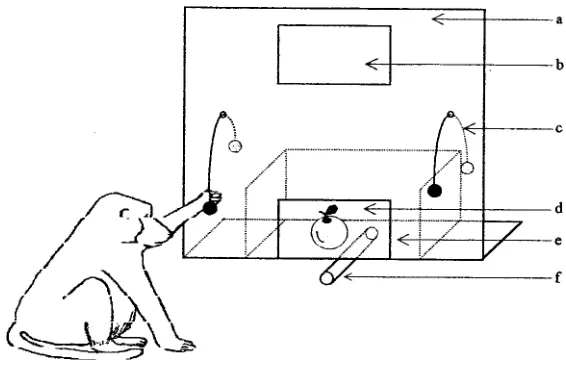
Apparatus. Subjects were tested in their home enclosure with an adapted version of a WGTA (see Fig. 1). The apparatus was attached to the bars of the enclosure for the experiment. It was made of a vertical board comprising a one-way screen, an horizontal board to present the stimuli, two openings for the manipulanda (two ropes): the animals had to pull one rope for
indicat-CATEGORIZATION IN BABOONS 311
some experience with pictures' recognition in order to establish an equiva-lence. Moreover, Winner & Ettlinger (1978) showed that chimpanzees had difficulty matching objects with their photographs, and Jitsumori (1991) re-ported that prior experience with slides was necessary for monkeys to per-ceive meaningful objects in slide pictures.
Method
EXPERIMENT 1
ing their choices for food objects and the other rope for nonfood objects. The apparatus also comprised a tube to dispense a food reward and a Plexi-glas window through which the subject could see the stimuli.
Stimuli. Food objects (n = 41) and nonfood objects (n = 41) were used as stimuli. Food objects comprised various types of fruits, vegetables, plants, cereals, and sweets. Nonfood objects comprised natural and manmade ob-jects of various forms and materials (e.g., glass, plastic, wood, metal, paper, and textile). The objects of both categories were matched as closely as possi-ble for size and color. Prior to the experiment, all stimulus objects had been left in the baboons' enclosure for one full day; the subjects had thus had ample opportunity to manipulate or/and eat them.
Procedure. Training was done in four phases. In Phase 1, each subject
was rewarded as soon as it pulled either of the two ropes. Indeed, each animal rapidly (in less than 100 trials) learned to pull a rope to obtain a food reward. Various food items were used as rewards (e.g., corn, small pieces of apple or carrot). In Phase 2, it had to refrain from pulling the rope until an object (an apple or a padlock) was placed on the horizontal board behind the Plexiglas window. In Phase 3, the subject was rewarded only when it pulled one of the ropes upon seeing an apple behind the Plexiglas, and the other rope if the stimulus was a padlock. For two subjects, the right-side rope was associ-ated with food, and the same rope was associassoci-ated with nonfood items for the other two subjects. In the final, transfer phase (Phase 4), 80 novel objects (40 food and 40 nonfood) were presented to the baboons in random order. Mastery of Phases 2-4 required an accuracy level greater than 80% across
100 consecutive trials.
At the start of each trial, the experimenter placed a stimulus object on the board, while the subject's view of the board was masked by an opaque screen. Then the screen was removed and the subject had 5 s to respond. If the subject did not respond during this interval, the screen was replaced for
5 additional seconds, and the same object was presented again. Subjects rarely failed to respond within the first 5 s. If the subject's response was correct, it was food-rewarded and another object was immediately presented. In case of error, a 10 s time-out was introduced. Eight correct responses out of 10 consecutive trials were required for a given object before a novel object was presented.
To avoid response automatization, trials with novel objects were inter-spersed among trials involving familiar objects. Thus, from 1 to 3 familiar objects were interspersed with trials involving each novel object. We re-corded responses (correct or incorrect) to the first presentation and we calcu-lated the percentage of correct responses for the first 10 presentations of each object. Chi-square analyses were used throughout the experiments.
were trained and tested in the presence of their mates, but female subjects were trained and tested in isolation.
Results
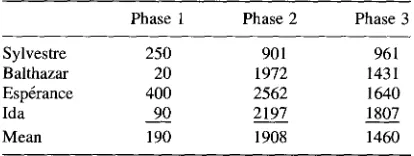
Table 1 reports the number of trials to criterion for each subject for the three training phases.
(Table 2B). Moreover, a training effect was observed on the accuracy for categorizing objects. Thus, on average 87.5% of responses were correct for the first 10 objects versus 93.5% for the 70 remaining objects.
Discussion
This experiment demonstrates that, with limited training with a few ob-jects, experimentally naive baboons were able (1) to functionally categorize
food and nonfood items and (2) to generalize this ability to novel objects. It appears that this functional categorization is rather easy to perform, pre-sumably because it has adaptive importance for the baboons. In effect, food and nonfood are probably natural categories that preexist in the baboon prior to any training. Sylvestre and Ida showed identical performances in their first choices for both categories. Espérance and Balthazar made fewer errors with food than with nonfood objects (in fact, Espérance was never wrong with food items, and Balthazar made only two errors with them). This asym-metry in performance for the two subjects may be due to the fact that Espér-ance and Balthazar were often observed chewing nonfood objects.
The goal of this experiment was to verify that the categorical abilities exhibited by the baboons in the first experiment could transfer when the real objects were replaced by their color pictures. For that purpose, two of the baboons involved in Experiment 1 were tested for their capacities to catego-rize food and nonfood stimuli when the latter were presented either as cut-out photographs following the object's cut-outline or whole photographs (i.e., pictures of the object with background) of some of the previously used ob-jects. The pictures utilized in this experiment matched the real objects, as
much as possible, with respect to color and size.
Methods
EXPERIMENT 2
Subjects. Twobaboons, Sylvestre and Espérance served as subjects. These monkeys were tested immediately after the completion of Experiment 1. These baboons had never seen photographs before the present experiment.
Experiment 2A
CATEGORIZATION IN BABOONS 315
Results
During the training phase, at first, the baboons assigned the picture of the apple (and, of course, that of the padlock) to the nonfood category. Sylvestre and Espérance needed 313 trials and 494 trials respectively to learn this ini-tial pictures' categorization. After this training, both subjects obtained high performances with the 28 other cut-out photographs. Thus, for the first pre-sentation, Sylvestre had 100% correct responses and Espérance 84% (see Table 3). It is interesting to note that, for further presentations of the set of pictures, the percentage of correct responses tended to decrease, particularly for the spherical fruit (e.g., an orange or a tomato: see Table 3b). It seems that the baboons had first confused the photographs with the real fruit; then they may have realized that they were not edible items and thus had to be "logically" assigned to the nonfood category. After subsequent training of five hours (corresponding to about 550 trials) with the pictures, percentages of correct responses increased to well beyond the 80% correct criterion for the two subjects. Notwithstanding, certain pictures of fruits, such as that of an orange, which were apparently not recognized, were systematically classified in the nonfood category.
In brief, this experiment showed that after limited experience with only two pictures, the two baboons were able to generalize categorization from real objects to cut-out pictures of these same objects.
Experiment 2B
presence of a background on the same plane as the object would affect dis-crimination. The stimuli (16 cm X 22.5 cm) depicted the same pictures as those of Experiment 2A along with 4 novel pictures (2 food and 2 nonfood). The background on the whole pictures was kept as homogeneous as possible (e.g., dark blue). The shadows of the objects were visible and pictures were printed on a glossy paper. Each picture was vertically presented once in the apparatus to the two subjects (other procedural details were similar to those of Experiment 1).
Results
Results of Experiment 2B indicate poorer transfer for the whole pictures compared to the cut-out stimuli of Experiment 2A (see Table 4). Sylvestre transferred to the whole pictures at 82% correct responses (P < .001). Appar-ently Espérance did not recognize the objects in whole photographs for the first 10 trials, but she improved somewhat with presentation of additional stimuli. Thus, she transferred at 56% correct overall (40% for the first 10 photographs and 80% for the last 10 photographs).
It appears that Sylvestre's choices were less affected by the use of whole pictures than were those of Espérance. Indeed, although Sylvestre's perfor-mance decreased with whole photos compared to cut-outs, he transferred well above chance. Espérance's performance was poor during early trials, but she showed significant improvement and correctly categorized the later stimuli in the series.
Experiment 2C
Experiment 2C was performed to investigate possible confusion between real objects and their pictures in our two subjects. The rationale of Experi-ment 2C was based on the observation that baboons would hold out their hands to grab the food objects and would show less interest when nonfood objects were used. We thus decided to record the behavior of the monkeys (reaching for the stimulus through the bars of the enclosure) as a function of the category of the object depicted on the photos.
Results
CATEGORIZATION IN BABOONS 31 7
cut-outs of Experiment 2A and the 34 whole photos of Experiment 2B) were presented to the baboons through the bars (the apparatus was not used in
this Experiment). All cut-out pictures were vertically presented first in a ran-dom order. Next, whole pictures were ranran-domly shown to the subjects. Each picture was presented once to the subject for a maximum of 3 s. The behavior of the baboon (holding out the hand reaching towards the picture) was re-corded. Because no reward was used in this experiment, and in order to avoid the response's extinction, less than 10 trials were run each day and, on some trials, real food objects were presented to the baboons for which, of course, they held their hands out.
For the cut-out pictures, Sylvestre and Espérance did not hold their hands out at all when offered nonfood pictures, but they held their hands out for 10 of the 15 food pictures. The five food pictures that did not elicit grabbing attempts (the same for the two subjects) were precisely those they tended to classify in the nonfood category for Experiments 2A and 2B.
The reaction of the two subjects to the whole pictures was identical for both subjects: there was no attempt at all to reach for the pictures, whatever the category. In sum, reactions toward cut-out pictures might indicate that the two subjects confused them with real objects. However, the total absence of reaching toward whole pictures suggests that they differentiated between these pictures and the real objects. As the performance with cut-out photos could be due to a confusion between real objects and their representations, another experiment was conducted in an attempt to prevent such confusion.
Experiment 2D
In this experiment, the 30 cut-out photographs were held out again to the two monkeys. Each stimulus was shown once in rotation (on its vertical axis) and then once in still position. In the former experimental condition, the subject was first shown the back of the picture and then its front. This rotation lasted about 3 s. Reaching attempts performed by the two subjects were recorded in each condition. No reward was used in this experiment, as in the previous experiment, and the same care was taken to avoid response's extinction, namely, less than 10 trials were run each day and test trials were interspersed with trials involving real food objects.
Results
Sylvestre never attempted to reach for the pictures from either category. Espérance held out her hand for 28,6% of the cut-out photographs in rotation
and for 21,4% of the cut-out photographs in still position.
in still position. Results are less clear for Espérance who still expressed some interest for the pictures depicting food in both conditions.
A final experiment was carried out to verify that the procedures introduced during Experiment 2D would affect the way the two subjects categorized the pictures.
Experiment 2E
The 30 cut-out photos used in Experiment 2A were also used in Experi-ment 2E. Each stimulus was presented to the subject on the vertical board once in rotation (on its vertical axis) with the same procedure used in Experi-ment 2D. Afterwards, the subject was required to indicate its categorical choice by pulling the appropriate rope. Responses to each photograph were recorded as in Experiment 1.
Results
Results show differential effects of this experimental manipulation on the two subjects (see Table 5). Thus, Sylvestre's overall performance was at 80% correct. But when only food pictures were considered, his correct choices dropped to 60% correct (P > .1). Espérance's overall percentage correct was low (62%).
To summarize, when the confusion between object and picture was pre-vented, categorical performance for pictures tended to decline. This effect was especially strong for the female subject.
GENERAL DISCUSSION
Experiment 1 clearly demonstrated the ability of these baboons to learn and to generalize the categorization between the two classes of food and nonfood objects. We suggest that the relative ease with which our monkeys solved the task is due to the adaptive significance of the test material, because grouping objects in food and nonfood categories has obvious ecological sig-nificance for these animals.
CATEGORIZATION IN BABOONS 31 9
properly classify cut-out photographs of food or nonfood objects at their first presentation. However, some training with two photographs was necessary before subjects could transfer their categorical skills to novel pictures. Two factors could account for this lack of immediate transfer from objects to pictures when the first pair of stimuli was used. First, the monkeys had to experience the obvious fact that a picture of a food item was not edible. Second, it appears that the initial training pair of pictures (apple and padlock) comprised a spherical stimulus (the apple) that the subjects had some diffi-culty in discriminating, as revealed by their behavior in subsequent experi-ments.
A second finding shows that the baboons encountered more difficulties with whole photographs than with cut-outs. The whole photographs probably resemble real objects less than the cut-outs. Furthermore, training was carried out with cut-out photographs. One subject (Sylvestre) did recognize most of the food objects, with the exception of the spherical fruits, which were clearly not recognized, even on cut-out photographs. This failure reduced this sub-ject's overall level of performance. For the other subject (Espérance), the reactions were different: she also had difficulty recognizing spherical fruit, but she was biased to pull the right rope (the one associated to the food category) whenever she was uncertain. Espérance often showed a right re-sponse bias following any change brought in the apparatus (e.g., a new Plexi-glas window) or when a stranger was present during the experiment.
We tried to understand the particular difficulty encountered by the two baboons in recognizing spherical fruits. At first, it must be noticed that confu-sion happened only with big spherical fruits like the apple or the orange and not with smaller fruits, like the cherry. Big but nonspherical fruits, like a banana, were also easily recognized. It can be hypothesized that baboons, probably like humans, had some problems perceiving depth in these two-dimensional pictures. In effect, Miller (1973) has reviewed a number of sources which suggest that people not used to seeing pictures, even if they
succeeded in perceiving objects in pictorial representations, often had prlems perceiving depth cues in those pictorial materials. In big, spherical ob-jects, the third dimension is more important than in other objects (because the food objects were, of course, presented in their longer side), and this
dimension is particularly altered in a pictorial representation. Thus, the ba-boons were certainly disturbed because they did not see the depth (and the third dimension they are used to) in their recognition of spherical objects.
edible (he didn't try to grab them). Espérance had a bias to the right rope (i.e., she was biased to classify stimuli as belonging to the nonfood category) on the first presentation of the set of photographs. Moreover, she continued to hold her hand out for the photographs, but she did so after they had been presented in rotation and thus they could not be confused with real objects. Perhaps Espérance wanted to better observe what were those pieces of paper which were so similar to real food?
It should be noted that the very nature of pictures (e.g., their bi-dimension-ality, the fact that they do not necessarily show all visual cues provided by real objects, such as depth), prevents the establishment of a strict equivalence between objects and their photographed representations. It is thus not ex-pected that subjects will treat a natural object and its picture exactly the same way. According to Wilkie, Willson, & MacDonald (1992), it is probably more appropriate to search for correspondences between objects and pictures than for strict equivalences between the two.
If a subject responds to pictures as it would to actual objects, there is evidence for correspondence. The data reported in the present experiments provide evidence for such correspondence. Moreover, the similarity in the responses shown for processing objects and their pictures was found in the context of categorical judgments. Thus, in spite of repeated presentations and the absence of reward for incorrect responses, Sylvestre never learned to classify the picture of an orange correctly. This result might indicate that learning by this baboon was not realized on the basis of one stimulus after the other, but that Sylvestre relied upon a categorization procedure to make his choices.
In short, the present experiments are among the few available in the animal literature that demonstrate the abilities of monkeys to perform efficient func-tional categorization of objects and their pictures within each experiment. In line with other studies demonstrating successful picture-to-object transfer in a cross modal matching paradigm both with apes (Davenport & Rogers, 1971) and monkeys (Tolan et al., 1981), the results of Experiment 2 suggest that our monkeys can generalize their categorical abilities to pictures. How-ever, transfer is not immediate and perfect and experience with the material (e.g., one pair of pictures) is needed to evidence discrimination and general-ization. In this respect, our results are congruent with the limitations observed among human babies to equate objects and pictures (e.g., Slater, Rose, & Morrison, 1984) as well as among human adults who lack routine experience with pictorial material (e.g., Deregowski, 1989).
REFERENCES
CATEGORIZATION IN BABOONS 32 1
D'Amato, M. R., & Van Sant, P. (1988). The person concept in monkeys (Cebus apella). Journal of Experimental Psychology: Animal Behavior Processes, 14, 43-56. Davenport, R. K., & Rogers, C. M. (1971). Perception of photographs by apes. Behaviour,
39,318-320.
Delius, J. D. (1992). Categorical discrimination of objects and pictures by pigeons. Animal Learning and Behavior, 20, 301-311.
Deregowski, J. B. (1989). Real space and represented space: Cross cultural perspectives. The Behavioral and Brain Sciences, 12, 51-119.
Dépy, D., Fagot, J., & Vauclair, J. (1997). Categorization of three-dimensional stimuli by humans and baboons: Search for prototype effects. Behavioural Processes, 39, 299-306. Herrnstein, R. J., Loveland, D. H., & Cable, C. (1976). Natural concepts in pigeons. Journal
of Experimental Psychology: Animal Behavior Processes, 2, 285-302.
Hochberg, J., & Brooks, V. (1962). Pictorial recognition as an unlearned ability: A study of one child's performance. American Journal of Psychology, 75, 624-628.
Jitsumori, M. (1991). Do monkeys see meaningful objects in slide pictures? In A. Eharu et al. (Eds.), Primatology today (pp. 293-296). Amsterdam, Netherlands: Elsevier Science Publishers.
Jitsumori, M. (1993). Discrimination of artificial polymorphous stimuli based on feature learn-ing. Journal of Experimental Psychology: Animal Behavior Processes, 19, 244-254. Jitsumori, M. (1994). Discrimination of artificial polymorphous categories by rhesus monkeys
Macaca mulatta. The Quarterly Journal of Experimental Psychology, 47B, 371-386. Lea, S. E. G., & Ryan, M. E. (1990). Unnatural concepts and the theory of concept
discrimina-tion in birds. In M. L. Commons, R. J. Herrnstein, S. M. Kosslyn, & D. B. Mumford (Eds.), Quantitative analyses of behavior (Vol. VIII, pp. 165-184). Hillsdale, NJ: Erl-baum.
Miller, R. J. (1973). Cross-cultural research in the perception of pictorial materials. Psychologi-cal Bulletin, 80, 135-150.
Savage-Rumbaugh, E. S., Rumbaugh, D. M., Smith, S. T., & Lawson, J. (1980). Reference: The linguistic essential. Science, 210, 921-925.
Schrier, A. M., & Brady, P. M. (1987). Categorization of natural stimuli by monkeys Macaca mulatta: Effects of stimulus set size and modification of exemplars. Journal of Experi-mental Psychology: Animal Behavior Processes, 13, 136-143.
Schrier, A. M., Angarella, R., & Povar, M. L. (1984). Studies of concept formation by stump-tailed monkeys: Concept humans, monkeys, and letter A. Journal of Experimental Psy-chology: Animal Behavior Processes, 10, 564-584.
Slater, A., Rose, D., & Morrison, V. (1984). Newborn infants' perception of similarities and differences between two- and three-dimensional stimuli. British Journal of Develop-mental Psychology, 2, 287-294.
Thomas, R. K. K., & Crosby, T. N. (1977). Absolute versus relative class conceptual behavior in squirrel monkeys (Saimiri sciureus). Animal Learning & Behavior, 5, 265-271. Tolan, J. C., Rogers C. M., & Malone, D. R. (1981). Cross-modal matching in monkeys:
Altered visual cues and delay. Neuropsychologia, 19, 289-300.
Vauclair, J., & Fagot, J. (1996). Categorization of alphanumeric characters by Guinea baboons: Within- and between-class stimulus discrimination. Current Psychology of Cognition, 15,449-462.
Categories, subcategories, and pseudocategories. Journal of Experimental Psychology: Animal Behavior Processes, 14, 235-246.
Watanabe, S. (1993). Object-picture equivalence in the pigeon: an analysis with natural con-cept and pseudo concon-cept discriminations. Behavioural Processes, 30, 225-232. Watanabe, S. (1997). Visual discrimination of real objects and pictures in pigeons. Animal
Learning & Behavior, 25, 185-192.
Watanabe, S., Lea, S. E. G., & Dittrich, W. H. (1993). What can we learn from experiments on pigeons' concept discrimination? In H.-J. Bischold & H. P. Zeipler (Eds), Avian vision and cognition (pp. 352-376). Cambridge, MA: MIT Press.
Wilkie, D. J., Willson, R. J., & MacDonald, S. E. (1992). Animals' perception and memory for places. In W. K. Honig & J. G. Fetterman (Eds.), Cognitive aspects ofstimulus control, (pp. 89-112). Hillsdale, NJ: Erlbaum.
Winner, H., & Ettlinger, E. (1978). Do chimpanzees recognize photographs as representations of objects? Neuropsychologia, 17, 413-420.
Yoshikubo, S. (1985). Species discrimination and concept formation by rhesus monkeys (Ma-caca mulatta). Primates, 26, 285-299.
Zayan, R., & Vauclair, J. (1998). Categories as paradigms for comparative cognition. Behav-ioural Processes, 42, 87-99.
Zentall, T. R., Edwards, A. E., & Moore, B. S. (1981). Identity: The basis for both matching and oddity learning in pigeons. Journal of Experimental Psychology: Animal Behavior Processes, 7, 70-86.