______________________
Shalini Saxena is research scholar at Central Institute of Plastics Engineering and Technology, Lucknow, Uttar Pradesh, India - 226008. [email protected]
Arvind Kumar Saxena is Director, DMSRDE, Kanpur, Uttar Pradesh-India 208013.
Preparation And Characterization Of Silicon
Carbide Foam By Using In-Situ Generated
Polyurethane Foam
Shalini Saxena, Arvind Kumar SaxenaAbstract: The open cell silicon carbide (SiC) foam was prepared using highly crosslinked hybrid organic- inorganic polymer resin matrix. As inorganic polymer polycarbosilane was taken and organic resin was taken as a mixture of epoxy resin and diisocyanates. The resultant highly crosslinked hybrid resin matrix on heating and subsequently on pyrolysis yielded open cell silicon carbide foam. The hybrid resin matrix was characterized by Fourier transform Infrared Spectroscopy (FT-IR) and thermal properties i.e., Thermogravimetric analysis (TGA) & Differential Scanning Calorimetry (DSC) were also studied. The morphological studies of silicon carbide ceramic foam were carried out using X-ray Spectroscopy (XRD) & Scanning Electron Microscopy (SEM).
Keywords: Diisocyanates, Polycarbosilane, Polyol, Polyurethane foam, Preceramic foam, Pyrolysis, Silicon Carbide foam.
————————————————————
1.
Introduction
Silicon carbide (SiC) foam has found a variety of technological applications in the form of thermal insulating material, space mirrors, corrosive substance filters, heat shields, gas burner media, membrane supports, fusion reactors, molten melt filteration, hot gas filteration, catalyst support and light weight structural parts for high temperature applications etc [1], [2], [3], [4], [5], [6], [7], [8], [9], [10], [11], [12], [13], [14], [15], [16], [17], [18], [19], [20], [21], [22], [23], [24], [25], [26]. The general technique used for making SiC foam is by the fixing of coarse and fine slurry of SiC powder onto the Polyurethane foam which on pyrolysis yielded open cell SiC foam [21],[27], [28], [29]. In such case, the desired shape and size SiC foam could not be made to fit in the complicated engineering systems because ceramics are brittle in nature[30], [32]. Recently, it has also been found that polycarbosilane (PCS) bearing reactive Si-H functionalities on heating yielded silicon carbide ceramic foam [32], [33], [35]. Such systems, have an advantage that the resin matrix being meltable[26], can be shaped to any structure as per the mould design and can be fitted without machining in any engineering systems. But, these foams yielded closed cell structure, so cannot be used for the storage of gases and filters etc. To overcome such limitations, it has been considered worthwhile to prepare open cell SiC using meltable resin matix. So, in the present investigation we wish to report a very convenient and potential method for the preparation of desired shape and size open cell SiC foam using hybrid resin matrix containing PCS, epoxy resin and organic diisocyanates.
2
E
XPERIMENTAL2.1 Chemicals Used
Commercially available LY-556 Epoxy resin was obtained
from Huntsman, Butanediol and 2 ethyl-2(hydroxyl methyl)-1,3-propanediol (TMP) were obtained from Merck India Ltd. and Lancaster respectively. Hexamethyldiisocyanate (HMDI) 98% Methylenedianiline (MDA) 97% was procured from Acros chemicals and were used as such. Polycarbosilane (PCS) was prepared by the thermal backbone rearrangement of polydimethylsilane in strict inert atmosphere for 125 hours in the temperature range 250-450 °C as reported earlier [32], [33], [34], [35], [36], [37], [38], [39], [40], [41].
2.2 Sample preparation
2.5 g of 2 ethyl-2(hydroxyl methyl)-1,3-propanediol(TMP) and 22.5 g of butanediol were mixed mechanically, which was further added to 2.5 g of epoxy resin LY556. This mixture was added to 50 gm of finely powdered polycarbosilane (PCS). The composition was heated upto ~140 °C under strict argon atmosphere. Further, the above composition was cooled to room temperature. Again, it was heated to ~ 80 °C and 0.675 gm MDA was mixed to it. Immediately, 25 gm of HMDI was also added with continuous stirring thus resulting in foaming of the material because of generation of in-situ polyurethane foam. The preceramic foam thus obtained was pyrolysed in the furnace upto ~1100 °C under argon atmosphere at the heating rate of 2 °C/min and then soaking at 1100 °C for 2 hrs. Afterwards, the furnace was allowed to cool until it attains room temperature under argon atmosphere. On cooling, the sample thus obtained, was characterized using TGA, DSC, FT-IR, SEM and XRD.
2.3 Sample characterization
microstructure and scanning electron microscope (SEM) studies were carried out using Carl Zeiss Evo 50 SEM.
3 Results and discussion
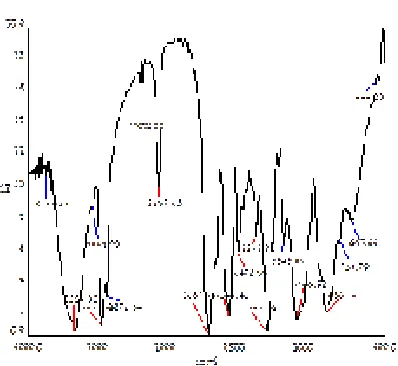
The polycarbosilane synthesized showed characteristic IR absorption peaks at ~1404, ~2462, ~2893, ~2951 cm-1 (ν C-H), ~650 , ~800 and ~1246 cm-1 (ν Si-CH3), ~1023 and
~1352 cm-1 (ν Si-CH2-Si-) and ~2100 cm
-1 (ν Si-H) [22,24].
With the progress of the reaction between polycarbosilane with epoxy, Si-H absorption peak at ~2100 cm-1 starts diminishing, showing other peaks at ~ 1024 cm-1 (ν Si-CH2), ~1255 cm
-1
( ν SiCH3) and ~3488 cm -1
(ν OH). This on further reaction with polyols, di-isocyanates and diamine shows IR peaks at ~3324 cm-1 (ν NH str), ~2938 cm-1 (ν CH str), ~2107 cm-1 (ν SiH), ~1687 cm-1
(ν Si-CH), ~1541 cm-1 (ν NH def), ~1261 cm-1 (ν SiCH3 ), ~1049 cm
-1 (ν
Si-CH2-Si ) (fig. 1).
Fig. 1a. FTIR spectra of epoxy poycarbosilane
Fig. 1b. FTIR spectra of preceramic foam
Thermogravimetric analysis of preceramic foam shows a three step decomposition as shown in fig. 2.First degradation starts at ~150 °C with a ~7% weight loss which may be attributed to the trapped impurities and decomposition of low molecular weight polymers. Weight loss of ~ 45 % at 310 °C in the second stage, may be
hydrocarbon gases and may be due to the decomposition of polyurethane foam formed during the reaction. Moreover, a weight loss of ~12 % at 440 °C in the third step is also seen, which may be due to the decomposition of higher molecular weight polymers. Further, there was no further weight loss upto 1000 °C. Thus around 40% residue was left up to 1000 °C.
Fig. 2 TGA graph of preceramic foam
The DSC studies of preceramic foam from ambient to 500 °C showed (fig. 3) a very small endotherm at ~113 °C (11.72 J/g) and an exotherm transition at ~366 °C (236.7 J/g). Endotherm at ~113 °C may be attributed to the melting of the polymer. Exotherm appearing at ~366 °C may be attributed due to the cleavage of Si-Si bonds which is well in accordance with the significant weight loss of 45 % in the range of 310-360 °C.
Fig. 3 DSC plot of preceramic foam
30 40 50 60 70 10
20 30 40 50 60 70 80 90 100
Intens
ity
(a.u.)
2 Theta
Fig.4 XRD pattern of silicon carbide foam
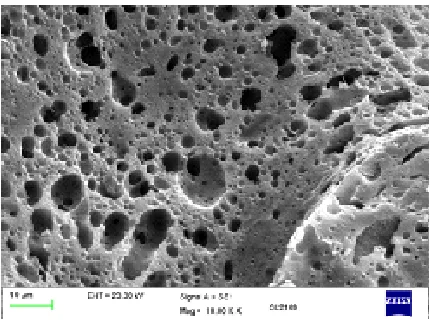
Fig. 5(a,b,c) shows a series of the SEM micrographs of preceramic foam produced after the pyrolysis at different magnifications 500X, 1.50KX, 10.0 KX. All of the figures show the open cell porous structure with interconnected pores with a few of closed cells.
Fig. 5a. SEM image of SiC Foam at 500X
Fig. 5b. SEM image of SiC at 1.50K X
Fig. 5c. SEM image of SiC foam at 10.00KX
4 Conclusion
It may be concluded out that using functional polycarbosilane bearing reactive secondary alcoholic group reacted with diisocyanate & polyols which yielded in preceramic foams & thereby on its pyrolysis under strict inert atmosphere, we have been able to synthesize open cell silicon carbide foam.
Acknowledgement
Authors are thankful to Dr. N. C. Mehra, USIC Department, University of Delhi for helping us to carryout SEM analysis and NPL, New Delhi to carryout XRD studies. Thanks are also due to the director DMSRDE, Kanpur for providing lab facilities and encouragement.
References
[1] K. Koumoto, M. Shimohigoshi, S. Takeda, H. Yanagida Thermoelectric Energy Conversion By Porous SiC Ceramics J. Mater. Sci. Lett., 6 (1987), pp. 1453–1455
[2] T. Matsumoto, J. Takahashi, T. Tamaki, T. Futagi, H. Mimura Blue-green luminescence from porous silicon carbide Appl. Phys. Lett., 64 (1994), pp. 226–228
[3] Suwanmethanond, E. Goo, P.K.T. Liu, G. Johnston, M. Sahimi, T. Tsotsis Porous Silicon Carbide Sintered Substrates For High Temperature Membrane Ind. Eng. Chem. Res., 39 (2000), pp. 3264–3271
[4] M. Droschel, M.J. Hoffmann, R. Oberacker, V.H. Both, W. Schaller, Y.Y. Yang, D. MunzKey SiC- Ceramics with Tailored Porosity Gradients for Combustion Chambers Eng. Mater., 175–176 (2000), pp. 149–162
[5] G.Q. Jin, X.Y. Gou Synthesis and Characterization of Mesoporous Silicon Carbide Microporous Mesoporous Mater., 60 (2003), pp. 207–212
[7] T. Nagano, K. Sato, T. Saitoh, Y. Iwamoto Gas Permeation Properties Of Amorphous SiC Membrane Synthesized From Polycarbosilane Without Oxygen Curing Process J. Ceram. Soc. Jpn., 114 (2006), pp. 533–538
[8] T.E. Wilkes, M.L. Young, R.E. Sepulveda, D.C. Dunand, K.T. Faber Mechanical Properties Of Wood Derived Silicon Carbide Aluminium Alloy Composites As A Function Of Temperature Scr. Mater., 55 (2006), pp. 1083–1086
[9] P. Krawiec, S. Kaskel Thermal Stability Of High Specific Area Silicon Carbide Materials J. Solid State Chem., 179 (2006), pp. 2281–2289
[10]M. Fukushima, Y. Zhou, H. Miyazaki, Y. Yoshizawa, K. Hirao, Y. Iwamoto, S. Yamazaki, T. Nagano Microstructural Characterization Of porous Silicon Carbide membrane Supports J. Am. Ceram. Soc., 89 (2006), pp. 1523–1529
[11]J.S. Lee, S.H. Lee, S.C. Choi Improvement Of Porous Silicon Carbide Filters By Growth OF Silicon Carbide Nanowires Using A Modified Carbothermal Reduction Process J. Alloys Compd., 467 (2009), pp. 543–549
[12]K.Y. Lim, Y.W. Kim, I.H. Song Porous Sodium-Borate Bonded SIC Ceramics Ceram. Int., 39 (2013), pp. 6827–6834
[13]J. Marchi, J. C. Bressiani, A.H.A. Bressiani Densification Studies Of Silicon carbide Based Ceramics With Yttria, Silica And Alumina As Sintering Additives Materials Research Vol. 4, No. 4, 231-236 (2001) .
[14]K. Yoshida, K. Matsukawa, T. Yano Microstucture And Mechanical Properties Of Silicon Carbide Fibre- Reinforced Silicon Carbide Composite Fabricated By Eectrophoretic Deopsition And Hot Pressing J. Nuclear materials 386-388 (2009) 643-646.
[15]H. Zhang, J. Zhang, H. Zhang "Numerical predictions for radar absorbing silicon carbide foams using a finite integration technique with a perfect boundary approximation," Smart Material Structure 15, 759-766 (2006).
[16]Y. Yang, Q. Guo, S. Li, S. Zhao, J. Shi, L. Liu Silicon Carbide Foams Produced By Siliciding Carbon Foams Derived From Mixtures Of Mesophase Pitch And Nano-Sic Particles Materials Science and Engineering A 488 514-518 (2008).
[17]S. Zhu, S. Ding, H. Xi, R. Wang Low Temperature Of Porous SiC Ceramic By Preceramic Polymer Reaction Bonding Materials letters 59: 595-597 (2005).
[18]Y. Yang, Q. Guo, Shi, L. Liu Preparation Of SiC Foams By CVI-R Technique With SiCl4/ H2/CH4
System Materials Letters Vol. 63, Issue 2, 224-226 (2008).
[19]S. Ding, Y. P. Zeng, D.L. Jiang In-situ Reaction Bonding Of Porous SiC Ceramics Materials Characterization 59, 140-143 ( 2008).
[20]S. H. Chae, Y. W. Kim, I.H. Song, H.D. Kim, M. Narisawa Porosity Control Of Porous Silicon Carbide Ceramics J of the European Ceramic Society 29, 2867-2872 ( 2009) .
[21]Y. H. Eom, Y.W. Kim, I. H . Song, H. D. Kim Microstructure And properties of Porous Silicon Carbide Ceramics Fabricated By Carbothermal Reduction And Subsequent Sintering Process Materials Science and Engineering A 464, 129-134 (2007).
[22]F. Bai, One Dimensional Thermal Analysis Of Silicon Carbide Ceramic Foam Used For Solar Air Receiver International Journal of Thermal Sciences 49, 2400-2404 (2010).
[23]L. Montanaro, Y. Jorand, G. Fantozzi, A. Negro Ceramic Foams By Powder Processing Journal of European Ceramic Society 18, 1339-1350 (1988).
[24]S. Ding, Y. P. Zeng, D. Jiang Thermal Shock Resistance Of In-situ Reaction Bonded Silicon Carbide Ceramics Materials Science and Engineering A425 326-329 (2006).
[25]Y. Zhang, Microstructures and Mechanical Properties Of Silicon Nitride bonded Silicon Carbide Ceramic Foams Materials Research Bulletin 39, 755-761 (2004).
[26]J. S. Jhonson, K. Grobsky, Z. Corporation, D. J. Bray POCO Graphite, Rapid fabrication of Light Weight Silicon Carbide Mirrors INC. Proceedings of SPIE Vol. 4771 (2002).
[27]G. Liu, P. Dai, Y. Wang, J. Yang, G. Qiao Fabrication Of Pure SiC Ceramic Foams using SiO2 As A Foaming Agent Via High Temperature Recrystallization Materials Science and Engineering: A Vol. 528, Issue 6, 2418-2422 (2011).
[28]J.Y. Zhang, Y. M. Fu, X.M. Zeng Compressive Properties Of Open Cell Ceramic Foams Transactions Nonferrous Metals Society of China 16, s 453-s 457 (2006).
[29]U.F. Yogt, L. Gyorfy, A. Herzog, T. Graule, G. Plesch Macroporous Silicon Carbide Foams For Porous Burner Applications And Catalyst Supports Journal of Physics and Chemistry of solids 68, 1234-1238 (2007).
Material For Fusion Applications Fusion Science and Technology Vol. 47, 886-889 (2005).
[31]J.H. van Laar, J.F.M. Slabber, J.P. Meyer, I.J. vander Walt, G.J. Puts, P.L. Crouse Microwave-Plasma Synthesis Of nano-sized Silicon Carbide At Atmospheric Pressure Ceramics International 41 4326-4333 (2015).
[32]R.K. Gupta, R. Mishra, R.K. Tiwari, A. Ranjan, A.K. Saxena Studies On The Rheological behavior Of Polycarbosilane Part 1: Effect Of Time, Temperature And Atmosphere Silicon, DOI 10.1007/s 12633-010-9054-7.
[33]S.K.Shukla, R. K. Tiwari, A. Ranjan, A.K.Saxena, G. N. Mathur Some Thermal Studies Of Polysilanes And Polycarbosilanes Thermochim Acta 424, 209 (2004).
[34]Y. H. Kim, S. J. Jung, H. R. Kim, D. G. Shin, D. H. Riu Preparation Of Polycarbosilane Using A Catalytic Process J Materials DOI:10.2240/azojomo 0139, Sep 2005, vol1.
[35]R. Mishra, R.K. Tiwari, A.K. Saxena Synthesis Of Fe-SiC Nanowires Via Precursor Route J Inorg Organomet Polymer 19, 223-227(2009).
[36]S.Yajima, Special Heat Resisting Materials From Organomettalic Polymers Am. Ceram Soc Bull 62, 893 (1983)
[37]S. Yajima, Y. Hasegawa, J. Hayashi, M. I. Mura, Synthesis Of Continuous SiC Fibre With High Tensile Strength And High Youngs Modulus J. Mater. Sci. 13,2569 (1978) .
[38]M. Birot, J. P. Pillot, J. Dunogues Comprehensive Chemistry Of Polycarbosilanes, Polysilazanes And Polycarbosilazanes As Precursors Of Ceramics Chemical Review 95: 1443-1477 (1995).
[39]A.R. Maddocks, J. M. Hook, H. Stender, A. T. Harris Heterogeneously Catalysed Crosslinking Of Polycarbosilane With Divinylbenezene Journal of Materials Science 43, 2666-2674 (2008).
[40]E. Bacque, M. Birot, J. P. Pillot, P. Lapouyade, P. Gerval, C. Biran, J. Dunogues Synthesis Of Disilylmethanes And Polysilacarbosilanes, Precursors Of Silicon Carbide Based Materials Journal of Organomettalic Chemistry 521, 99-107 (1996).