http://www.sciencepublishinggroup.com/j/es doi: 10.11648/j.es.20180304.13
ISSN: 2578-9260 (Print); ISSN: 2578-9279 (Online)
Initial Study on Simulated Borate Concentrate
In-Drum-Drying by Microwave
Meilan Jia
*, Chao Gao, Hongxiang An, Honghui Li
China Institute of Radiation Protection, Taiyuan, China
Email address:
*Corresponding author
To cite this article:
Meilan Jia, Chao Gao, Hongxiang An, Honghui Li. Initial Study on Simulated Borate Concentrate In-Drum-Drying by Microwave.
Engineering Science. Vol. 3, No. 4, 2018, pp. 51-57. doi: 10.11648/j.es.20180304.13
Received: October 11, 2018; Accepted: December 28, 2018; Published: January 29, 2019
Abstract:
Drying the Borate Concentrate in Drum is one of the most useful method to reduce the total waste volume. Microwave is one heat option, To determinate the feasibility for Microwave-Drying of Simulated Borate Concentrate in Drum, a Sequence of tests have been designed, including pre-test in microwave oven and batch-test in 12L microwave device. Liquid temperature, evaporation rate and moisture have been recorded along with the drying process. The result said that it is feasible for microwave drying simulated borate concentrate in drum. For borate concentrate will generate “water diffusion barrier layer” during the drying process, batch-feeding is the prefer option; the most suitable batch-feeding amount is a compromise for evaporation, gravity, and intermolecular forces which affect the migration of water molecules. It is recommend that the batch feeding should be used for MDSBCD and the off gas temperature can be a sign of subsequence feeding; the first feeding must be moderate to avoid microwave reflection; the little batch-feeding amount is, the better product characters are. In the test, it is reasonable that the material can be supplemented or the drying be stopped when the temperature of ending vent raises to 72°C and keep increase rapidly; the first-feeding can be 2kg SBC, after- feeding can be 1kg SBC.Keywords:
Simulated Borate Concentrate, Microwave Drying, In-Drum Drying, Waste Treatment1. Introduction
Currently, more and more attentions are paid to the study on waste minimization technologies in industry as the simulated borate concentrate cement solidification process widely applied would result in capacity increasing of waste [1-4]. Such technologies cover large scope, in which, the drying in drum, as one technology with simplest process unit, indicates to concentrate the radioactive waste in the barrel directly to reduce the final storage/disposal volume [5-8]. This technology can limit the radioactive substance within certain scope to maximum extent and reduce the probability of transfer of radioactive substance from process unit to external environment. According to the literature, the foreign companies or research units used hot air, electric heating and microwave to complete drying test in barrel for many times. Each type of heating has its own risks and benefits. Comparing with other heating methods, microwave heating not only overcomes the disadvantage of long period of drying in barrel, but also properly improves the
developing the technology and device for drying Borate Concentrate in drum is a good choice to reduce the volume of waste, and microwave is a economic energy for water heating, therefore study on in-drum drying of simulated borate concentrate by microwave was designed. The study was designed to be two stages, such as preliminary experimental study and full-scale experimental study. The content of the preliminary experimental study is as follows.
2. Test
2.1. Test Device and Material
2.1.1. Preparation of Simulated Concentrate
The main chemical constituents of the simulated borate concentrate obtained from the radioactive waste water produced by pressurized water reactor power plant are sodium metaborate and boric acid and contain a small amount of sodium nitrate and sodium phosphate, and thus the test adopts the proportion (see as table 1), and the simulated concentrate was kept between 55°C~60°C.
Table 1. Components of Simulated Borate Concentrate.
Component Mass (g/L)
H2O 732.1
H3BO3 307.2
NaOH 45.7
NaNO3 100.0
Na3PO4·12H2O 33.6
2.1.2. Test Device and Materials
1) The instruments and materials for pre-test refer to table 2.
Table 2. Instrument and Material for Tests.
Name Type Quantity Remark
\Microwave oven KD21C-AN (B) 1 Inside cavity 700mm×650mm×600mm
Electronic platform scale LTBKA-1 1 Measuring scale-3000g, minimum graduation-0.1g
Thermometer 1 Measuring scale-200, minimum graduation-1°C
Polyethylene plastic barrel Some Φ115mm×160mm
2) The instruments and materials for bench test refer to table 3.
Table 3. Instrument and Material for Tests.
Name Type Quantity Remark
Microwave heater OM75P (31) 1 Located on the special heating cover
Heat insulation double jacketed barrel Not-Standard 1 2.5kW, internal capacity-30L
Electronic platform scale ACS-30A 2 Measuring range-30kg, minimum unit of measurement-10g
Microwave leak detector HI1600 1 Applicable at 915MHz and 2450MHz
Stainless steel barrel 12L 1 Φ250mm×250mm
Moisture meter MB45 1 Moisture determination of sample
Other accessories Some Stainless steel ruler, container
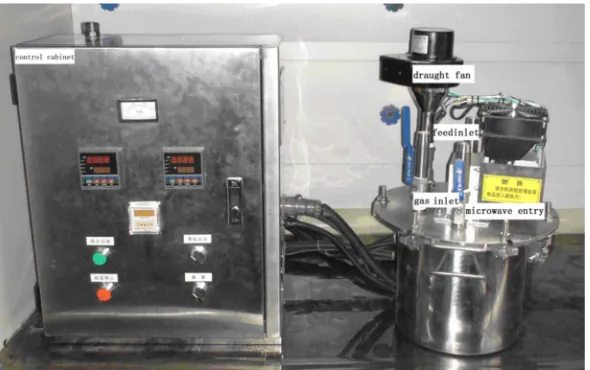
The microwave heating device special for bench test refer to figure 1.
2.2. Test and Results
The pre-test and bench test were carried out in turns on the basis of principle of “gradual amplification”. The drying of simulated borate waste liquid in microwave oven was applied to the pre-test so as to study the feasibility of the waste liquid and recognize the features of drying terminal point and the parameter which preliminarily affect the selection of moisture value of dry product. On the basis of pre-test, the bench test adopted 12L bench equipment to preliminarily study the process of drying of simulated borate waste liquid in barrel, including terminal point control and material feeding control, so as to provide data support for the operation procedure of amplification test.
2.2.1. Pre-test
The pre-test was completed by household microwave oven, including initial test (test under extreme condition), microwave power influence test and simulated liquid amount influence test. Each test process was similar to following procedure, that is, poured a certain mass of simulated liquid into the polyethylene plastic barrel and placed it at the center of turntable of microwave oven, and dried it under certain microwave power. Took out the polyethylene plastic barrel at regular intervals, observed the visual properties (such as viscosity) of material, and measured the weight and temperature.
1700.0g of simulated liquid was heated for 105min at 0.72kw of microwave power. During the test, took out the simulated liquid at the interval of 5min and observed its visual properties. The simulated liquid gradually concentrated
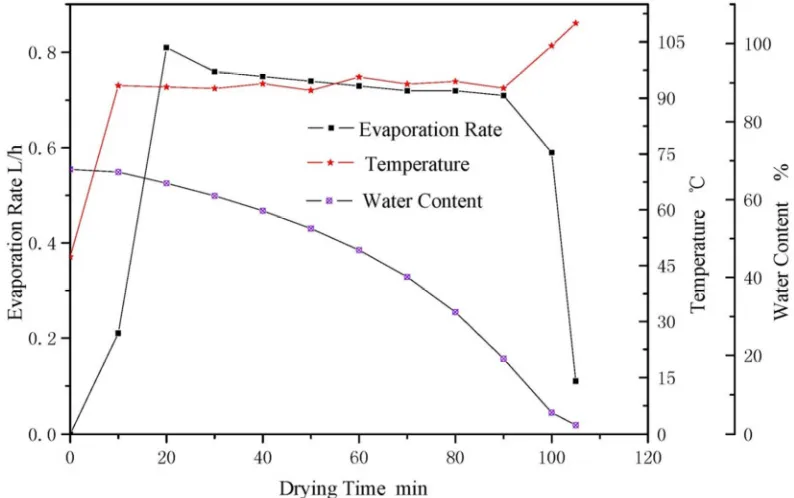
during this process. The thicker crust and obvious bubbles were found on the surface of simulated liquid when drying to 95min. Some indentations caused by lower layer of water vapor breaking the crust layer were left on the surface of the liquid when heating to 100min. And the volume of drying product expanded greatly when drying to 105min continuously. This situation indicated that the drying terminal point of simulated liquid should be controlled strictly, otherwise the volume reduction would be affected negatively. The change of simulated liquid temperature, evaporation rate and moisture during drying process are shown as figure 2. According to figure 2 and the properties of material in drying process, the drying of simulated waste liquid by microwave passed through 3 stages: the first was temperature raising and pre-heating stage, the second was temperature steady stage and this third was temperature raising without drying stage, shown as figure 2. The moisture in simulated concentrate was less and less and the temperature higher and higher. The temperature started to raise after the simulated concentrate evaporated constantly for a while, and the moisture of product was about 19% at this moment; and the evaporation rate dropped rapidly and the material temperature started to raise sharply in case of continuous evaporation. This situation indicated that the temperature and evaporation rate changed apparently at the end of drying process, which can be considered as the determination index of drying terminal point. According to the literature of foreign countries, the follow-up test adopted the condition of "stop microwave heating when mass change of simulated liquid is less than 2.5g/min" as the determination basis of drying terminal point.
Figure 2. Curves of Microwave Drying Simulated Borate Concentrate.
2.2.2. Bench Test
In order to truly simulate the drying in microwave barrel, a
follows: poured a certain mass (thickness) of simulated liquid into the stainless steel barrel, covered it and placed into the barrel, monitored the change of ending vent temperature, simulated liquid temperature and liquid mass and determined the supplementation or drying time. Selected different first-time feeding amount and batch type supplementation amount, observed the product’s properties (uniformity, density, moisture content and volume reduction factor), and determined the better feeding method.
1) Drying terminal point
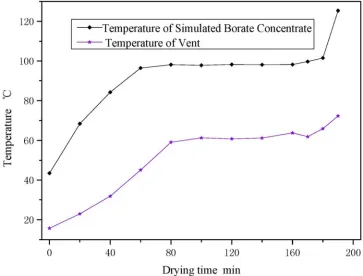
The change of ending vent temperature was related to that of simulated liquid temperature (refer to figure 3) during the process that 2kg of simulated liquid temperature was dried in 12L test device (shown as figure 1) by microwave. During the process of feeding in batches to supplementation, the temperature of simulated waste liquid and ending vent passed through such stages as rapidly rising, steady and re-rising, that is, the change of ending vent temperature was positively correlated with that of simulated borate waste liquid during the drying in this test. During the drying of simulated borate waste liquid by microwave, the moisture value of exhaust air gradually increased and kept balanced at the stage of rapid drying. At the end of drying, the microwave energy absorbed by the simulated borate waste liquid reduced, and that absorbed by exhaust air raised proportionally and its temperature also increased. The ending vent temperature was considered as the determination index of drying terminal
point. The microwave heating should be stopped when the temperature was controlled at 69°C, 72°C, 76°C and 85°C. The visual properties of product refer to figure 4. The uniformity and compaction degree of the product properties was only evaluated by eyes. The simulated borate waste liquid had been dried to make the product have a good uniformity and there was no pore-like structure when the ending vent temperature raised to 69°C. When the ending vent reached to 72°C, the simulated liquid had been dried to that condition that product have a good uniformity, without pore-like structure and the bubbles were only at some positions, and the plump crust shrank after cooling, without obvious pore-like structure (the pore-like structure was hardly observed after splitting). When the ending vent reached to 76°C, the uniformity of the liquid was destroyed, the pore-like structure was found on the surface layer (such structure was observed after splitting) and such structure was mainly caused by the reason that the water deeply under the crust evaporated and broke the crust. When the ending vent to 86°C, the uniformity was destroyed seriously and the pore-like structure was found on the surface and in poor uniformity and the moisture value was high in some positions. Therefore, regarding to the device for this test, the material can be supplemented or the heating was stopped when the ending vent temperature reached to 72°C and keep increase sharply under the condition that the reserved valve was opened.
Figure 4. Product View with Different Ending Vent Temperature.
2) Batch type feeding drying test
During this test, the feeding amount for the first time was less than 2kg (34mm), the electric spark was produced at the joint position of barrel cover and barrel, the electric spark was in the high voltage components which were used to generate the microwave, and the device failed to operate normally. The microwave returning to magnetron was caused by too thin material layer which damaged the micro generator, as a result that the microwave was reflected in case of contacting the conductor. And thus the feeding thickness for the first time should be more than 34mm under the test condition.
The temperature of upper layer was high and the lower layer was low owing to too thickness of added simulated liquid to form large resistance of heat and mass transfer because of limited spreading thickness of microwave in material. Additionally, the crust layer was found at the drying end of simulated liquid in pre-test, which hindered the water migration. Therefore, the batch type feeding drying test (the feeding amount of 1kg/batch to 5kg/batch) was completed. The average moisture value and volume reduction factor of product produced by the test refer to figure 5.
The figure 5 showed that the feeding method of 1kg/batch obtained the lowest moisture value of dried product and the moisture contents obtained by 2kg/batch, 3kg/batch, 4Kg/batch and 5kg/batch did not have big difference and just increased a little with the addition of supplementation amount. The volume reduction factor was largest, about 2.97g, in case of supplementing 1kg/batch; and that factor maintained at approximately 3.34g in case of supplementing 2kg/batch, 3kg/batch, 4kg/batch and 5kg/batch. As a result, the supplementation amount in batches greatly affected the drying.
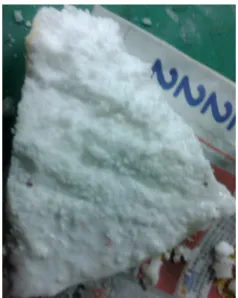
According to the difference of moisture value at different height of different batches of feeding product, it is inferred that the larger supplementation amount was, the more binding water molecule in the dry product was, and further the whole property of dried properties was reduced. The smaller supplementation amount was, the easier to discharge the water from drying process was, the better uniformity and density of dry product were, and the moisture value was relatively uniform and the average moisture value was relatively low. When the supplementation amount in batches reached to certain value, the “water diffusion barrier layer” had a large resistance to water transfer, which resulted in higher moisture value of lower layer of dry product. The free water was found at lower layer of product in case of supplementing the material by 5kg/batch.
Figure 6. Bottom Sample of Dry Product from 5kg/batch.
Combining with the feature of drying process of simulated liquid and character of volume heating of microwave, it is ensured that the water molecule in previous batch of drying material was kept at lower level and the material expansion was not resulted through prolonging the batch drying time a little in case that the batch supplementation amount was less.
Consequently, reduction of batch supplementation amount is the effective method to optimize the properties of drying product in case that other process conditions are fixed.
3) Verification test
On the basis of batch feeding bench test, it is considered that the drying product with optimum properties can be obtained in case that more than 2kg of material was added in the 12L small-size test device for the first time and 1kg per time added subsequently. So, the drying product with uniform
and dense property can be obtained in case of feeding 2kg of material for first time and supplementing 1kg per time subsequently. And then the drying product was cutted open along the section of central axis, shown as figure 7. Some sample was collected, and the sampling points was distributed in terms of 4×5 (row column) on the section (refer to figure 7), and the measured moisture value of sample is shown in table 4.
Figure 7. Section View of Drying Product.
Table 4. Moisture Value of Drying Product.
Axial Position
Radial Position
1 2 3 4 5
A 9.09 8.89 9.24 8.88 8.64
B 8.81 7.86 7.34 8.56 7.81
C 8.70 9.09 7.62 9.29 8.94
D 7.54 7.81 8.43 9.20 9.23
From table 6, the average moisture value of 20 sampling points at different sections is 8.54%, and variance is 0.395 and the variance of axial and radial moisture value is 0.074 and 0.107 respectively. It is concluded that the moisture distribution of product has reached a high uniformity. Comparing with the total distribution variance 11.083of moisture for first trial – in the trial, the simulated borate concentrate was filled up in drum once, the distribution uniformity of moisture of batch drying product is improved apparently with the total distribution variance 0.395. Therefore, this further proves that feeding a small amount of dried material in batches has a positive effect on improvement of uniformity of drying product in microwave barrel, in the Φ250mm×250mm drum, feeding a small amount of dried material in batches can improve the inhomogeneity of microwave heating.
3. Conclusion
The result of pre-test and bench test showed that it is feasible to dry the simulated borate concentrate in the microwave barrel which can achieve the volume reduction of borate radioactive waste to maximum extend.
test simulated borate concentrate, normal pressure), the material can be supplemented or the drying be stopped when the temperature of ending vent raises to 72°C and keep increase rapidly. For borate concentrate will generate “water diffusion barrier layer” during the drying process, batch-feeding is the prefer option; the most suitable batch-feeding amount is a compromise for evaporation, gravity, and intermolecular forces which affect the migration of water molecules. The feeding method of low amount and high frequency can ensure that the lower layer of material added every time reduces the moisture of drying product to maximum extend, which is beneficial to form the uniform and dense drying product. In the test, the distribution variance of moisture of product obtained after feeding 2kg of material for first time and supplementing 1kg per time subsequently is 0.395, and its uniformity is improved greatly.
Another problem that need to be considered in the enlarged scale test is the uniformity of drying, because of the inherent electromagnetic field inhomogeneity of microwave heating, maybe only depending on feeding a small amount of dried material in batches cannot be enough to improve heating heterogeneity in radial direction. Therefore, the enlarged experimental device need to be design for having a more uniform radial electromagnetic fields to support the evenly heating in test.
References
[1] Su Linsen, Yang Huiyu, Wang Fusheng, etc. 900MW PWR nuclear power plant system and equipment (Vo1 1) [M]. Beijing: Atomic Energy Press, 2005, 224-253. (in Chinese).
[2] Gu Zhongmao. Waste treatment and disposal [M]. Beijing: Atomic Energy Press, 2011. (in Chinese).
[3] Gong Li, Cheng Li, etc. Study on cement solidification of boric acid waste liquid and concentrated waste liquid produced by PWR nuclear power station [J]. Radiation Protection, 1995, 1. (in Chinese).
[4] Huang Laixi, He Xinwen, Chen Dejin, etc. Radioactive solid waste management in Dayawan nuclear power station [J]. Radiation Protection, 2004, 2. (in Chinese).
[5] IAEA. Methods for the Minimization of Radioactive Waste from Decontamination and Decommissioning of Nuclear Facilities [R]. Vienna: IAEA, 2001, 37-38.
[6] IAEA. Innovative Waste Treatment and Conditioning Technologies at Nuclear Power Plants [R]. Vienna: IAEA, May, 2006: 30-31.
[7] IAEA. Processing of Nuclear Power Plant Waste Streams Containing Boric Acid [R]. Vienna: IAEA, 1996.
[8] Frank. Richard. Radioactive Waste Management for U.S. EPR [R]. WM Conference, 2008.
[9] H. Gen thner, A. Best, W. Lins. Solidification of Low Level Salt Solutions With Microwave [EB/OL]: Google Scholar.
[10] Wetteborn K, Gutmann A, Linn H, et al. Apparatus for Concentrating Salt-Containing Solutions with Microwave Energy: US Patent, 6080977[P]. 2000-06-27.
[11] Giessmann Christian. Microwave in-Drum Drying [J]. Rad waste Solutions, 2007:21-24.
[12] Szalo Anton, Zatkulak Milan. Borate Compound Content Reduction in Liquid Radioactive Waste from Nuclear Power Plants with VVER Reactor [R]. Slovenia, September, 2000.
[13] T. L. White, J. B. Berry. Microwave Processing of Radioactive Materials-1[R]. Dallas, Texas: American Chemical Society, 1989.
[14] G. S. Sprenger, V. G. Eschen. Critical Operating Parameters for Microwave Solidification of Hydroxide Sludge [R]. Technology Development, Waste Projects EG&G Rocky Flats, Rocky Flats Plant, 1993-10-26.
[15] Dixon D, Erle R, Eschen V, et al. Microwave Solidification Development for Rocky Flats Waste [EB/OL].: http://www.osti.gov, 1994-04.
[16] Erle R R, Eschen V G, Sprenger G S. Optimization of Microwave Heating in an Existing Cubicle Cavity by Incorporating Additional Wave Guide and Control Components [R]. USDOE, 1995.
[17] T. L. White. Microwave Applicator for in-Drum Processing of Radioactive Waste Slurry: US Patent, 5324485[P]. 1994-06-28.
[18] Sprenger G S, Petersen R D. Microwave Waste Processing
Technology Overview [EB/OL]:
http://www.osti.gov/bridge/servlets, 1993-02.
[19] T. L. White, E. L. Youngblood, J. B. Berry. First Result of In-can Microwave Processing Experiments for Radioactive Liquid Wastes at Oak Ridge National Laboratory [EB/OL]: http://www.osti.gov/bridge/servlets, 2010.
[20] T. L. White, E. L. Youngblood, J. B. Berry, and A. J. Mattus. Status of Microwave Process Development for RH-TRU Wastes at Oak National Laboratory [EB/OL]: http://www.osti.gov/bridge/servlets, 2010.
[21] T. L. White. Heat Transfer Enhanced Microwave Process for Stabilization of Liquid Radioactive Waste Slurry [R]. CRADA, 1995-03-31.