Is Technology Mediated Learning Really Improving
Performance Of Students?
Leonardo Caporarello
1,
Massimo Magni
1Ferdinando Pennarola
1,* 1Università L. BocconiAbstract
This paper examines the role of information technology in learning environments. In particular, it goes through the analysis of the impact of the use of information technology in high school students’ performance. It describes and analyzes the initiative carried on by Impara Digitale StudyCenter: 370 students from different high schools experienced a full school year with a newteaching model, using tablets and computers instead of text books, according to a cooperative model, where each learner adopted his own device. The experience is paramount and it opens astream of questions for further and more extensive diffusion, i.e. institutionalizing the adoption ofpersonal devices in learning environments. We explored the different theories that can help with answers and we designed our research by using the widely adopted TAM Model, where gradesare used as a measure of learning effectiveness. We also measured learning effectiveness in a control sample, using in the same schools same teachers and more traditional learningapproaches. Our conclusions show that the new method improves students’ performance only if teachers, who play a pivotal role in their technology acceptance, properly support them.
Keywords: TAM, Technology Mediated Learning, Learning Effectiveness
Received on 01 May 2016, accepted on 10August 2016, published on 02 December 2016
Copyright © 2016Leonardo Caporarelloet al., licensed to EAI. This is an open access article distributed under the terms of the Creative Commons Attribution licence (http://creativecommons.org/licenses/by/3.0/), which permits unlimited use, distribution and reproduction in any medium so long as the original work is properly cited.
doi: 10.4108/eai.2-12-2016.151719
*Corresponding author. Email: [email protected]
1.
Learning through technology: a long
debated issue in information systems
research,but still a challenge for
schools and educators
Digital revolution has an impact on every aspect of life. One of the most discussed issues regarding the influence of technology in everyday activities is education. Today’s, the young generation lives in a connected world surrounded by digital technologies, and many observers predict a growing distance between school and out-of-school experiences for students, unless schools update their instructional tools and methods. This posed a great number of questions in the literature, stimulating a new flow of study regarding the use of ICT in educational environments (Rienties et al. 2016).
The main problem of technology in school is related to the fact that the closed classroom represents a physically outdated teaching model which does not match the interconnected virtual world in which students live in: they are learning collaboratively through a vast array of informal learning spaces both on and off school, but, when it comes to daily school life, they are still packed into outdated traditional models. These learning spaces need to adapt to meet the emerging needs of a wide range of pedagogies. Meanwhile, the “consumerization” of IT, with mass market devices that can be also used for work related reasons, is pouring into the kids’ pockets powerful tools that are also contributing in life changes. In this research we explored to what extent the adoption of tablet technologies, originally designed for a mass consumption market, can be also powerful tools for learning (Bourgonjon et al. 2013). Schools, in many circumstances, are acting as the linking point to introduce students into the work worlds; they can profit from widely adopted technologies, by leveraging on the diffused practice of Bringing Your Own Device (BYOD).
2 What happens when students bring their tablets to school? Could the teaching / learning environment be revolutionized thanks to this consumer oriented technology? Is it possible to fully integrate such devices into the teaching and learning process? What can be the results of this experience in terms of learning improvements? The key word here is integration: bringing a tablet to school is just the beginning of a new learning journey.
While there have been past initiatives on ICT in education, they were limited to the introduction of digital devices and isolated competences within the learning sector (Cheung and Vogel, 2013). Not enough attention was paid to integration and support actions. Devices were placed in separated classrooms and competences were isolated in a minority of professors in the scientific areas. Past research has explored the issue in many ways. Therefore, our research is particularly worthwhile because it helps to shed further light on the role of technology for learning purposes in a more extensive setting. Indeed, we look at digital education in a wider setting, thus involving students not in just one specific activity, but throughout their entire learning experience across all the different topics. Thus, by relying on traditional theoretical framework we outline how a comprehensive approach toward technology-supported learning may affect students’ behaviors.
Researchers conducted several studies in order to understand whether technology improves the learning experience in some way, and most importantly, if it enhances students’ performance too. Bernard et al. (2004) perform a meta-analysis of representative prior studies and argue that the use of information and communication technologies cannot guarantee greater learning effectiveness or satisfaction than classroom-based, face-to-face learning. Information System analysts also caution that the capabilities offered by multimedia only provide an opportunity to generate benefits rather and guaranting them (Lim, Benbasat, and Ward, 2000).
Anyhow, schools began to introduce digital tools in education about twenty years ago, buying computers and starting computing courses. From that moment, schools felt the urge to keep the pace with technology innovation trying to encourage students to have a more interactive relationship with study material. United States have been the precursor of this trend over the years, followed in a non-uniform way by other industrialized countries. The primary aim of integration of technology into schools was to improve teaching and learning in different subjects and also with an aim of increasing motivation for both students and teachers (Bourgonjon et al. 2013).
Arguments to sustain this purpose were that ICT can have several advantages, like creating more dynamic interaction between students and teachers, increasing collaboration and team work in problem
2.
When real adoption matters: the
development of the Technology
Acceptance research stream
EAI Endorsed Transactions on e-Learning
06 - 11 2016|Volume3|Issue 12|e5
EAI
European Alliancefor Innovation
solving activities, stimulating creativity and helping students to control and monitor their own learning. Further, students will have to be able to use ICT as adults in working environments, whatever they’ll be, so the introduction of technology in schools would allow them to develop skills that will be useful for them in their future academic and professional lives (Bourgonjon et al. 2013). Another aspect to be considered is that technology characteristics can enhance or inhibit efficient delivery of instructional material (Alavi and Leidner, 2001) and thus may play a crucial role in influencing the learning process (Kozma, 1991). Nicholson, Nicholson and Valacich (2008) analyzed two key characteristics: vividness and interactivity. In their study they proved that a more vivid and interactive presentation is likely to increase both students’ satisfaction and interest. They went further in their analysis, investigating the relationship between technology characteristics and task complexity. This represents a major factor to be taken into consideration, since complexity influences the effectiveness of technology characteristics for the learner.
Wood (1986) states that it is more complex when there are more information cues to process, more acts to execute or increased interdependence between the cues and acts. Then, more complete tasks require the learner to generate a more elaborate model (White and Frederiksen, 1990), thus there is an increase in cognitive load, and this can result in lower performance and learning (Bannert, 2002). This means that students that have to face more complexity need to reach higher levels of attention and engagement in order to succeed and to obtain better performance. A direct consequence of this fact is that students will have higher performance in tasks that are more complex when vividness and interactivity are high, and the same applies for the students’ perceived mental effort (Nicholson, Nicholson and Valacich, 2008). Schools have to analyze all of these elements when making the choice between face-to-face lessons and Technology Mediated Learning, and they also have to deeply assess the kind of technological support they want to invest in.
• Attitude Toward Behavior: “an individual’s positive or negative feelings (evaluative affect) about performing the target behavior” (Fishbein and Ajzen 1975, p.216)
• Subjective Norm: “the person’s perception that most people who are important to him think he should or should not perform the behavior in question” (Fishbein and Ajzen 1975, p.302).
The authors referred to the intention that a person has, prior to an actual behavior, as the behavioral intention of that person, and defined it as a measure of one’s intention to perform a behavior. The Attitude toward behavior is the sum of the products of all of the main beliefs (bi) about the consequences of performing that behavior and the evaluation of those consequences (ei): A = Σ bi ei
They also considered the Subjective norm as the sum of the product of an individual’s normative beliefs (nbi) and his/her motivation to comply to them (mci): SN = Σ nbi mci
Thus, Behavioral Intention is calculated as the sum of A and SN: B = A + SN
Starting from Fishbein and Ajzen’s TRA, Fred Davis proposed his first version of TAM in 1985. The concept behind his model was that System Use is a response determined by User motivation, which in turn is directly explained by an external stimulus that consists in the actual system’s features and capabilities (Davis, 1985). Starting from this basis Davis refined the model, obtaining the first version of the Technology Acceptance Model. The first TAM was based on three factors: Perceived ease of use, Perceived usefulness and Attitude toward using the system. Davis referred to Perceived usefulness saying that “people tend to use or not use an application to the extent they believe it will help them perform their job better” (Davis, 1989 – p.2), while the importance of Ease of use was to be found in the evidence of the Effort being a finite resource that an individual could allocate to various activities for which he/she is responsible (Radner and Rotschild, 1975).
The impact of perceived usefulness on system utilization was suggested by Schulz and Slevin (1975), and expanded by Robey (1979). The latter theorized that: “A system that does not help peopleperform their jobs is not likely to be received favorably in spite of careful implementation efforts” (Robey, 1979 – p. 537). These studies proved that perceived usefulness provided a reliable prediction for use. At the same time, support for the relevance of perceived ease of use could be found in the meta-analysis of Tornatzky and Klein’s (1982) research on innovation adoption, where they studied the connection between the characteristics of a system and its adoption, finding that the complexity of an innovation was the factor that had the most consistent significant relationship with the adoption.
Bandura (1982) then showed the effect of both perceived ease of use and perceived usefulness in predicting behavior, suggesting that the latter would be best predicted by both, self-efficacy and outcome judgments. These two factors were defined by Davis (1985) andput together in the first TAM. In 1991, Ajzen expanded the TRA – Theory of Reasoned Action (1975). It was made necessary, in the author’s word, by the original model’s limitations in dealing with behaviors over which peoplehave incomplete control. Ajzen suggested that the stronger is the intention to engage in abehavior, the more likely should be its performance, but this holds true only if the individual can actually decide to perform or not the behavior in question. The fundamental assumption that lies under this model is that people’s intentions capture the motivational factors that influencebehaviors. But intention is not sufficient to explain the performance of the behavior, because there is a pivotal element to be assessed: people’s actual control over the behavior itself. This consists, in fact, in the set of non-motivational factors (as availability of requisites, opportunities and resources) that influence the performance (or non performance) of a behavior. But more important then the actual control over the behavior is the person’s perception of the control over the behavior: this element is the main element of differentiation from the Theory of Reasoned Action. Perceived behavioral control refers to people’s perception of the ease or difficulty of performing thebehavior, and in this case Ajzen intended this concept in a way similar to the Bandura’s (1982)concept of self-efficacy which “is concerned with judgments of how well one can execute courses of action required to deal with prospective situations” (Bandura, 1982 – p.122).
In 1991 Thompson, Higgins and Howell proposed the Model of PC Utilization, based on Triandis’(1977) theory of human behavior. Triandis believed that much of the work in psychology wasbecoming fragmented, lacking a theoretical framework for guiding future research, so he developed a comprehensive model synthesizing relations among attitudes, values, and other acquired behavioral dispositions to action. This model does not suggest a causal relationship between the cognitive component of attitudes and the affective component, instead they are seen as independent (even if related) factors that determine behavior indirectly through intentions.
The affective component of attitudes has a like/dislike connotation:
- Perceived consequences are related to the evidence that an act is perceived as having potential consequences, which carry a value and a probability of happening;
- Social factors are made of the person’s internalization of norms, roles and values. These elements affect the individual’s opinions on behaviors that are appropriate, desirable or morally correctly;
4 Thompson et al. (1994) argue that this model is too complex and it would be hard to employ it in its entirety. Starting from this point they developed the Theory of Planned Behavior, including six factors that were hypothesized to have an effect on the use of PCs:
- Social factors (norms) influencing PC use - Affect toward PC use
- Complexity of PC use - Job Fit with PC use
- Long-term consequences of PC use - Facilitating conditions for PC use
The result of this research, was a scheme that was different from the Triandis model, but was not a complete framework yet, due to the fact that previous experience was not fitted into the model.
Contributions continue in 1994, Thompson Higgins and Howell introduced the concept of Experience, seen as a “reinforcement” (in the words of the authors): objective consequences are interpreted by the individual, and this leads to reinforcement that affects the perceived consequences in two ways, because on one hand it changes the perceived odds that a behavior will have particular repercussions, and it varies the value of these repercussions. This way of defining the concept of experience allows including a feedback loop in the model.
Innovation Diffusion Theory played an important role in this development. This theory has its basic foundations in the acknowledgment of the fact that potential users’ perception of the information technology innovation influences its adoption, and is based on the Rogers’ identification of five characteristics of an innovation (Rogers, 1983) which affect the rate of diffusion of it. The main problem was that the existing tools used at the time to tap these factors were not reliable. Thus, the main constructs used to build this model were the various Perceived Characteristics of using an innovation. Rogers focused on five key characteristics: - Relative advantage: “the degree to which an innovation is perceived as being better than its precursor”;
- Compatibility: “the degree to which an innovation is perceived as being consistent with the existing values, needs and past experiences of potential adopters”;
- Complexity: “the degree to which an innovation is perceived as being difficult to use”;
- Observability: “the degree to which the results of an innovation are observable to others”;
- Trialability: “the degree to which an innovation may be experimented with before adoption”.
These influence the phase of Perception that is the antecedent of Decision.
The conclusion of this model is that innovation that are perceived by potential users as having greater relative advantage, compatibility, trialability, observability, and less complexity, will be adopted more rapidly than other innovations. It is important to remember that the premise of this model was the work of Rogers (1962) whose conclusion was that with successive groups of consumers adopting the
new technology its market share would eventually reach the saturation level in the future.
Social Cognitive Theory also contributed in this domain. One of the most important works in psychology was Bandura’s (1986) Social Cognitive Theory, a widely accepted and empirically validated model of individual behavior. Campeau and Higgins (1991,1995) applied an extended version of it to the context of computer utilization in order to study performance. Their model included five constructs:
- Behavior Modeling: several studies showed that observing someone else performing the target behavior increases the subjects’ perception of their ability to do it successfully (Bandura et al. 1977, Brown and Inouye 1978, Schunk 1981, Bandura 1982), thus this model hypothesizes that people who received behavioral modeling training will develop higher perceptions of self-efficacy. Furthermore, modeling has been demonstrated (Bandura 1971) to influence outcome expectations as well; in fact, modeled behavior that is rewarded is usually adopted by the observers, and it can also directly influence performance.
- Self-efficacy: SCT argues that self-efficacy perception affects a person’s outcome expectation (Bandura 1978) and it is also a determinant of the subject’s actual ability to perform the behavior.
- Outcome Expectations: it is inferred directly from SCT that expectations about the consequences of behavior are a strong drive guiding people’s actions. This holds true because individuals are more likely to undertake actions that they consider to be resulting in valued outcomes than those that they do not see as having desirable consequences.
- Prior Experience: Wood and Bandura (1989) demonstrated that prior success is expected to increase self-efficacy, while prior adversity decreases self-efficacy. Also it can contribute to the formation of outcome expectations, as noted by Bandura (1986) “response outcomes influences behavior antecedently by creating expectations of similar outcomes on future occasions” (p. 229). It also has been found to be a significant predictor of current performance.
Finally, Venkatesh and Davis proposed a second version of the Technology Acceptance Model, named TAM2, in 2000. They conducted a study in order to extend the original TAM including additional key determinants of the model’s Perceived usefulness and Intention to use constructs, and also to understand how these determinants are influenced by increasing in user experience over time with the system.
It is important to notice that in this model, the subjective norm construct has a direct effect on intention to use: the rational for such an effect is that individuals may choose to perform a behavior (use a system in the case of technology), even if they are not favorable toward it or its consequences, if they feel that people important to them think that they should (Fishbein and Ajzen 1975; Ajzen 1991). The introduction of voluntariness is another factor on novelty in respect to the original model. This choice was made on the base of a study conducted by Hartwick and Barki (1994) where the authors
EAI Endorsed Transactions on e-Learning
06 - 11 2016|Volume3|Issue 12|e5
EAI
European AllianceThe first real initiative of this kind was launched in the early 1990s, the “Program for the Development of Educational Technologies”, that offered support to all schools to create computer labs and to invest in the professional development of all teachers. Along with these national initiatives, local authorities and sometimes single schools have led their own policies in the field of ICT for education, since in Italy, school building and maintaining are under the responsibility of local governments. Moreover, schools are granted significant administrative autonomy, and can raise funds from the private sector in order to improve their infrastructure. This structure of governance implies that by 2007, some schools had already been equipped with ICT infrastructures beyond the standard computer labs. The National Plan for Digital Schools consists in one large-scale intervention and three pilot projects:
- LIM Plan: Interactive whiteboards - Cl@asse 2.0
- Scuol@ 2.0 - Digital Publishing
Only voluntary schools participate and, for the most intensive interventions, schools have to elaborate and submit a project explaining the intended objectives of ICT introduction. The main objective of the plan is to introduce ICT as part of the daily tools of classroom activities, and at the same time it aims at innovating teaching practices in Italian schools.
Impara Digitale is an association born in 2010 to promote the development of an innovative teaching methodology, which permits Italian schools to benefit from the introduction of new technologies. The main purpose of the association is the modeling of a teaching methodology for a school embedded in the cloud-computing environment, through the use of personal mobile technologies. Impara Digitale‘s main activities are research, experimentation, sharing and diffusion of findings, inside of a stable national network.
Schools can choose to become part of the association on a voluntary basis. Those that adhere, receive in exchange a number of services all centered around a “cloud learning” model: sharing teaching pedagogies and learning resources on the cloud to improve learning and to make it more closer with the digital life experiences students experiment everyday.
In 2010 a 2-year pilot experiment started in selected classes of one Italian high school. The experiment rapidly spread over the country and a network of 14 participating institutions was gathered at the beginning of the school year 2012/13.
4.
The initiative and the research settings
A report prepared for the U.S. Department of Education (2011), “International Experiences with Technology in Education”, shows that most countries are investing in ICT. Given the low penetration of ICT in education compared to most other OECD countries, in 2007 Italian Government started the current national policy for large scale introduction of ICT in all schools, namely the “National Plan for Digital Schools”, in order to reduce the digital divide of the school environment. The current policy marks a clear discontinuity with previous national efforts, because it aims at introducing the use of ICT directly in the everyday classroom, rather than in separated computer labs, and it transcends the disciplinary boundaries: it seeks ICT adoption in all subject fields (Abdullah & Ward, 2016).
3.
Enhancing learning experience through
6 Each school proposed one or more of its high classes (average size of 25 students): students were asked to buy their own tablet – as substitute of textbooks – and bring it to school every day. Teachers were trained to restructure their teaching syllabus in order to leverage digital resources, by accessing to (but not only) a centralized database of certified public available sources on all subjects taught (i.e. mathematics,
Italian literature, history, physics, chemistry, biology, music, etc.). A constructivist learning approach was used to design the whole learning calendar: students were asked to learn and interact in teams and individually, supported by their teachers. It is important to remark that in Italy the single class is a strong organizational unit. In fact, the student group stays the same not only throughout the day, but also over the whole school cycle (5 year term for high school grade). Similarly, the group of teachers follows the class throughout its entire cycle. Regular tests were held along the school year – as with traditional classes (text based learning) in the respective institutions – and each student received grades and feedbacks. Each school appointed a control sample, i.e. one or more class unit with traditional teaching and learning methods, using the same faculty body of the experimental class. This allowed for a close comparison that controls for teachers’ method and grades policy. While the resources and tools are different, the studied contents are the same. After the data cleaning, our valid dataset has an experimental sample of 370 students of 21 classes in 9 different high schools.
Each student participating to the study was profiled anonymously (his/her identity was hidden with a numeric code) and filled out an entry (beginning of the school year) and an exit questionnaire (end of the school year). Questionnaires were built around the TAM described earlier. 13 constructs were identified and every survey question is linked to a construct’s measurement (2). The Questionnaire counts a total of 62 questions, grouped into thirteen constructs, expression of the variables of the TAM, plus a social mapping section made by two additional questions. Every school’s registrar provided the whole grade record (all the subjects learned) for each student participating to the study.
The main question of this work is whether new technologies have a significant positive impact on students’ performance or not. In order to find an answer, database construction has been a fundamental step of the research project. A series of datasets was necessary in order to analyze different aspects. Schools sent two tables of grades for every student involved, one for each quarter of the school year, containing every single vote that the student received for each subject. In the questionnaire, students were asked to answer questions in a scale from 1 to 5 where 1 = “I definitely disagree”, 5 = “I totally agree”.
The first operation was to transform negative answers in positive ones in order to be able to compare all of them, for example: “I do not plan to use much this technology during the rest of the quarter”, was part of the construct “Intention to use”, but it was posed in a negative form, so when the student answered 5 = “I totally agree”, it meant exactly the opposite in terms of intention to use. The single answers were grouped into constructs, and a mean was calculated for every student and construct, in a way that allows relating performance and TAM variables. The following are our research hypothesis:
Hypothesis 1. Students perceive the technology is useful, but they do not sense a comparative advantage in relationship to books, unless they have an effective teachers encouragement, that help them use the technology as a real tool for their studies.
1a. Perceived usefulness has a positive significant effect on students’ performance in term of total grades average.
1b. Perceived advantage (meaning comparative advantage of
the use of technology versus the
use of books) has a negative significant effect on students’ performance.
1c. Perceived teachers encouragement has a positive significant effect on student’s performance.
Hypothesis 2. Classmates’ encouragement has a positive but marginally significant effect on students’ performance.
Hypothesis 3. Perceived advantage and Satisfaction have a positive significant effect on perceived usefulness.
Hypothesis 4. Top students do not perceive the technology as useful, and they do not sense a comparative advantage in relation to books. Teachers are still the main factor influencing students’ performance.
4a. Perceived Usefulness has no significant effect on high performing students
4b. High performing students do not perceive a comparative
advantage of technology in relation to
books.
4c. Teachers’ encouragement has a positive significant effect on high performing students’ performance.
Hypothesis 5. Low performing students perceive the technology is useful, but not better than books in comparative terms. Teachers’ encouragement has the most significant effect on performance, and previous experience has a positive but marginally significant effect on performance.
5a. Perceived usefulness has a positive significant effect on performance of bad students.
EAI Endorsed Transactions on e-Learning
06 - 11 2016|Volume3|Issue 12|e5
EAI
European Alliancefor Innovation
5b. Perceived Advantage of technology has a negative significant effect on performance of bad students.
5c. Teachers’ encouragement has a positive significant effect on bad students’ performance.
5d. Previous experience in the use of technology has a positive but marginally significant effect on bad students’ performance.
Hypothesis 6. Students that perceive a higher teachers encouragement show a higher positive and more significant effect of perceived usefulness on their performance, than students that perceive a lower teachers encouragement.
Hypothesis 7. Intention to use has a positive significant effect on students’ performance.
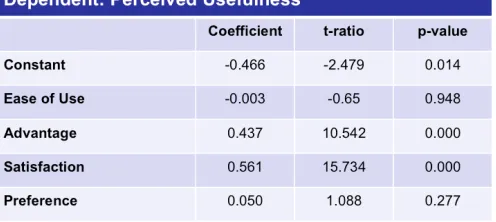
Also the second hypothesis is confirmed by this regression: 2. Classmates’ encouragement has a positive (coeff. = 0.160) but marginally significant (p-value = 0.075) effect on students’ performance. Since Perceived Usefulness appears to be a fundamental variable, we ran a regression using it as dependent variable, with Ease of Use, Perceived Advantage of technology, Satisfaction and Preference as independent variables. Results are below:
Table 2
To test the first hypothesis we run a regression where performance was the dependent variable, and constructs were the independent ones. In particular we used all of the constructs except: Intention to use3, Awareness of true
technology potential and Self-Efficacy in using the computer and the Internet.
Results are shown in the table below:
Table 1
3 The reason for exclusion of Intention to Use from the set of independent variables was that in TAM literature this construct takes the place of dependent variable. Because of this, the impact of Intention to Use on performance is tested separately from other constructs.
5
.
Results
Thus, it can be inferred that each part of the first hypothesis is confirmed: 1a. Perceived Usefulness has a positive (coeff. = 0.261) significant (p-value = 0.019) effect on students’ performance.
1b. Perceived Advantage of Technology has a negative (coeff. = -0.545) significant (p-value = 0.000) effect on students’ performance.
1c. Teachers Encouragement has a positive (coeff. = 0.462)
significant (p-value = 0.000) effect on
students’ performance.
This regression confirms the third hypothesis:
3. Perceived Advantage has a positive (coeff. = 0.437) and
significant (p-value = 0.000) effect on
Perceived Usefulness, as well as Satisfaction (coeff. = 0.561, p-value = 0.000).
In order to make a deeper analysis we divided the sample in
two groups using their annual grades
average:
- Top students are those whose average is equal or greater
than 7 on a scale from 1 to 10;
- Low performing students are those whose average is minor than 7 on a scale from 1 to 10.
At this point we run two different regressions using these
two sub-samples. Results of the first one
are shown in the table below:
8
Only top students make the first sub-sample. These results prove the fourth hypothesis to be true in each of its part:
4a. Perceived Usefulness has no significant effect (p-value = 0.182) on top students’ performance.
4b. Top Students do not perceive a comparative advantage of technology in relationship with books (Advantage coeff. = -0.490, p-value = 0.000).
4c. Teachers’ encouragement has a positive (coeff. = 0.247) significant (p-value = 0.029) effect on top students’ performance.
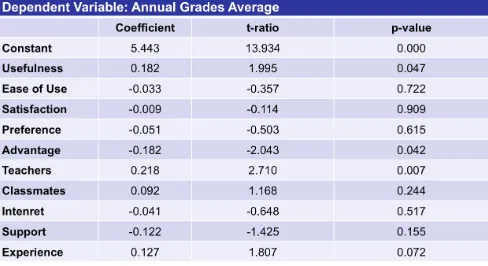
We ran the same regression on the second sub-sample, composed by low performing students:
Table 4
Results show that the fifth hypothesis holds true in each of its part:
5a. Perceived usefulness has a positive (coeff. = 0.182) significant (p-value = 0.047) effect on performance of bad students.
5b. Perceived Advantage of technology has a negative (coeff. = -0.182) significant (p-value = 0.042) effect on performance of bad students.
5c. Teachers’ encouragement has a positive (coeff. = 0.218) significant (p-value = 0.007) effect on bad students’ performance.
5d. Previous experience in the use of technology has a positive (coeff. = 0.127) but marginally significant (p-value = 0.072) effect on bad students’ performance.
Hypothesis 5b means that low performing students perceive the technology to be useful, but they do not feel a real advantage of technology compared to books. The key role of teachers’ encouragement is clearly confirmed.
Since teachers’ encouragement has been proven to be a key variable in almost every analysis conducted until now, the original sample was divided into two sub-sample on the base of teachers’ encouragement perception:
- Students perceiving a high teachers encouragement, who expressed a judgment equal or greater than 3.5 on a scale from 1 to 5;
- Students perceiving a low teachers encouragement, who expressed a judgment minor than 3.5 on a scale from 1 to 5.
We ran two separate regression, one for each sub sample. Results appear in the tables below:
Table 5
EAI Endorsed Transactions on e-Learning
06 - 11 2016|Volume3|Issue 12|e5
EAI
European Alliancefor Innovation
Results show that Hypothesis 6. is confirmed: the first sub sample show a higher impact of Perceived Usefulness (0.414 > 0.238) with a higher significance (p-value 0.068 < 0.079). Also it’s worth to be pointed out that even if the second group gives a grade of 3.5 to teachers’ encouragement, it still remains a key determinant of students’ performance. In order to go further with this analysis on teachers encouragement we also made a One-Way ANOVA, using Perceived teachers encouragement as discriminant to divide the sample in two groups, and taking all of the constructs using until now as dependent variables of the Analysis of Variance:
Table 6
This result proves the fundamental role played by teachers’ encouragement on the perception that students have of technology and, thus on their attitude toward it.
Finally, to test the impact of Intention to Use on Students’ performance, we ran a final regression, using Annual Grades Average as dependent variable, and all of the constructs as independent variables, including those that were eliminated from the analysis at the beginning. The impact of Intention to Use on the dependent variable resulted to be positive and significant:
Table 7
This result proves the seventh hypothesis to hold true: 7. Intention to Use has a positive (coeff. = 0.208) and significant (p-value = 0.048) effect on students’ performance.
This paper analyzed the impact of technology on high school students’ performance. The attempt of it was to understand whether technology is improving them or not, and it can be concluded that one year of experimentation is not sufficient to give a final answer to this question. Once the technology absorption will be fully completed, another investigation should test the same hypothesis and check the validity of the model. It is evident that both teachers and students have to adapt to the new teaching methodology that technology requires them to use in order to be effective.
This work gives a contribution to the understanding and application of technology-mediated learning. Consistent with previous studies, we demonstrated that we couldn’t expect technology per se to revolutionize teaching and learning. Indeed, the effectiveness of technology is tied to the organizational environment in which it is implemented and on the characteristics of the users. Part of the students’ responses is to be ascribed to teachers: Italian school system is very static, and resistant to change and reforms, and teachers play a big role in this environment. It is not new or unusual that teachers are the first actors of resistance toward change in educational environments, and schools should take advantage of the champions of change among the teaching committee to involve everyone in the change (Bourgonjon et al. 2013). Without this involvement students will never have the support and the encouragement they need in the use of technology at school, and this will lead to poor performance improvement. Also, students should receive a better training in the use of technology, because even if they are considered “digital natives” truth is that they are used to employ technology only in social and informal contexts, and the result of this kind of usage is that they do not learn how to fully take advantage of technology in their learning processes.
The results of this research shows that teachers should act on two sides: on one hand they should try engaging more the students to understand the usefulness of technology in class, and at the same time they should try listening more to students and cooperating with them to meet their expectations on how school should be, on their idea of school. Digital natives are bored by the current system, where there is little exchange of ideas between students and teachers, and where the lesson is passive for them: traditional lectures do not make sense anymore for a generation made of people that can get all of the notions they are interested in from the internet (Rienties et al. 2016). They have to be involved and truly engaged and curious about the topics that schools want them to learn about. Even if there is no evidence of significant improvement in students’ performance with technology, we all can see that the traditional method is not working anymore for new students, and it has to be changed. Technology sure can be helpful in this direction, but only if the actors of the school environment are willing to embrace the change and be an active part of it.
Furthermore, we cannot expect students to be enthusiastic of change in schools, if they do not believe it can truly happen on a bigger scale, and not only in isolated initiatives like the one presented in this work.
Future research could focus on teachers’ training, their teaching methods and the choice of resources. They are all
factors potentially determining the perceived
“Encouragement” as described in this paper. Finally, as the consumerization of IT spreads mainly among young generations, an interesting research opportunity would be to explore the introduction of digital learning earlier at school. Aware of the potential of such initiatives, some primary schools are already experimenting education mediated by tablet. This trajectory could be beneficial for the educational institution on the advantages in terms of decision making and learning processes that are tied to the introduction of systems that support individuals in the sharing, managing and exchange information.
Finally, our model should be also replicated in other cultures. Indeed, previous studies outlined that acceptance of technology and individuals’ behaviors in a technology mediated environment may vary across cultures (e.g. Farrell, 2015).
5
.
Conclusions and further research
directions
References
[1] Abdullah, F., & Ward, R. (2016). Developing a General Extended Technology Acceptance Model for E-Learning (GETAMEL) by analyzing commonly used external factors. Computers in Human Behavior, 56, 238-256.
10
[3] Ajzen, I. (1991). The theory of Planned Behavior. Organizational Behavior and Human Decision Processes, 50(2), pp. 179-211.
[4] Alavi, M and Leidner D.E. (2001). Technology-mediated learning – a call for greater depth and breadth of research. Information Systems Research, 12(1), pp. 1-10.
[5] Anderson, R.D. (1995). Curriculum reform: Dilemmas and promise. Phil Delta Kappan, 77, pp. 33- 36.
[6] Anderson, R.D. and Helms, J.V. (2001). The ideal of standards and the reality of schools: needed research. Journal of Research in Science Teaching, 38(1), pp. 3-16.
[7] Avvisati, F., Hennessy, S., Kozma, R.B. and Vincent Lancrin, S. (2013), Review of the Italian Strategy for Digital Schools, OECD Education Working Papers No. 90, OECD Publishing.
[8] Bandura, A. (1978). Reflections on Self-Efficacy. Advances in Behavioral Research and Therapy, 1, pp. 237-269.
[9] Bandura, A. (1982). Self-Efficacy Mechanism in Human Agency. American Psychologist, 37(2), pp. 122-147.
[10] Bandura, A. (1986). Social Foundations of Thought and Action: A social cognitive theory, Prentice Hall, Englewood
Cliffs, NJ.
[11] Bandura, A., Adams, N.E. and Beyer, J. (1977). Cognitive Processes Mediating Behavioral Change. Journal of Personality and Social Psychology, 35(3), pp. 125-139. 59
[12] Bannert, M. (2002). Managing Cognitive Load: Recent Trends in Cognitive Load Theory. Learning and Instruction, 12, pp. 139-146.
[13] Bernard, R.M., Abrami P.C., Lou, Y. and Borokhovski, E. (2004). A methodological morass? How we can improve quantitative research in distance education. Distance Education, 25, pp. 175-198.
[14] Bernard, R.M., Abrami, P.C., Lou, Y., Borokhovski, E., Wade, A. and Wozney, L. (2004). How does distance education compare with classroom instruction? A meta analysis of empirical literature. Review of Educational Research, 74(3), pp. 379-439.
[15] Bourgonjon, J., De Grove, F., De Smet, C., Van Looy, J., Soetaert, R., & Valcke, M. (2013). Acceptance of game-based learning by secondary school teachers. Computers & Education, 67, 21-35.
[16] Brown, I. Jr., and Inouye, D.K. (1978). Learned Helplessness Through Modeling: the Role of Perceived Similarity in Competence. Journal of Personality and Social Psychology, 36(8), pp. 900- 908.
[17] Campeau, D.R. and Higgins, C.A. (1991). A Social Cognitive Theory Perspective on Individual Reactions to Computing Technology. Proceedings of the 12th International Conference on Information Systems, New York, NY, pp. 187-198.
[18] Campeau, D.R. and Higgins, C.A. (1995). Application of Social Cognitive Theory to Training for Computer Skills. Information Systems Research, 6(2), pp. 118-143.
[19] Campeau, D.R., Higgins, C.A. (1995). Computer Self Efficacy: Development of a Measure and Initial Test. MIS Quarterly, 19(2), pp.189-211.
[20] Campeau, D.R., Higgins, C.A. and Huff, S. (1999). Social Cognitive Theory and Individual Reactions to Computing Technology: a Longitudinal study. MIS Quarterly, 23(2), pp. 145-158.
[21] Cheung, R., & Vogel, D. (2013). Predicting user acceptance of collaborative technologies: An extension of the technology acceptance model for e-learning. Computers & Education, 63, 160-175.
[22] Cuban, L. (2001). Oversold and Underused: Computers in the Classroom. Cambridge, MA: Harvard University Press. 60
[23] Davis, F. (1993). User acceptance of information technology: system characteristics, user perceptions and behavioral impacts. Int. J. Man-Machine Studies, 38, pp. 475-487.
[24] Davis, F.D. (1985). A Technology Acceptance Model for Empirically testing new end user Information Systems: Theory and Results. Doctoral Dissertation, MIT Sloan School of Management, Cambridge, MA.
[25] Davis, F.D. (1989). Perceived Usefulness, Perceived Ease of Use, and User Acceptance of Information Technology. MIS Quarterly, 13(3), pp. 319-340.
[26] Farrell, W. (2015). A Framework to Support Global Corporate M-Learning: Learner Initiative and Technology Acceptance across Cultures. International Association for Development of the Information Society.
[27] Fishbein, M. and Ajzen, I. (1975). Belief, Attitude, Intention and Behavior: an Introduction to Theory and Research. Addison-Wesley, Reading, MA.
[28] Hartwick, J. and Barki, H. (1994). Explaining the Role of User Participation in Information System Use. Management Science, 40(4), pp.40-465.
[29] Karahanna, E. and Straub, D.W. (1999). The Psychological Origins of Perceived Usefulness and Ease of Use. Information and Management, 35(4), pp. 237-250.
EAI Endorsed Transactions on e-Learning
06 - 11 2016|Volume3|Issue 12|e5
EAI
European Alliance[30] Karahanna, E., Straub, D.W. and Chervany, N.L. (1999). Information Technology Adoption across time: a Cross-Sectional Comparison of Pre-Adoption and Post-Adoption Beliefs. MIS Quarterly, 23(2), pp. 183-213.
[31] Keys, C.W. and Bryan, L.A. (2001). Co-constructing inquiry-based science with teachers: Essential research for lasting reform. Journal of Research in Science Teaching, 38(6), pp. 631-645.
[32] Lim, K.H., Benbasat, I. and Ward, L.M. (2000). The role of multimedia in changing first impression bias. Information Systems Research, 11(2), pp. 115-136. 61
[33] Moore, G.C., and Benbasat, I. (1991). Development of an Instrument to Measure the Perceptions of Adopting an Information Technology Innovation. Information Systems Research, 2(3), pp. 192-222.
[34] Nicholson, J.A., Nicholson, D.B. and Valacich, J.S. (2008). Examining the Effects of Technology Attributes on Learning: a Contingency Perspective. Journal of Information Technology Education, 7, pp. 185-204.
[35] OECD (2010), The Nature of Learning, OECD Publishing.
[36] Papert, S. (1987). Computer criticism vs. Technocentric thinking. Educational Researcher, 16(1), pp. 22-30.
[37] Radner, R. and Rothschild, M. (1975). On the allocation of effort. Journal of Economic Theory, 10, pp. 358-376.
[38] Rienties, B., Giesbers, B., Lygo-Baker, S., Ma, H. W. S., & Rees, R. (2016). Why some teachers easily learn to use a new virtual learning environment: a technology acceptance perspective. Interactive Learning Environments, 24(3), 539-552.
[39] Robey, D. (1979). User attitudes and management information system use. Academy of Management Journal, 22, pp. 527-538
[40] Rogers, E.M. (1962). Diffusion of Innovation, Free press, Glencoe.
[41] Rogers, E.M. (1983). Diffusion of Innovation. Third Edn., Free Press, New York, NY.
[42] Schultz, R.L. and Slevin, D.P. (1975). Implementation and organizational validity: an empirical investigation. Implementing Operations Research / Management Science, R.L. Schultz and D.P. Slevin (eds.), American Elsevier, New York, NY, pp.153-182.
[43] Schunk, D.H. (1981). Modeling and Attributional effects on children’s achievement: a Self-Efficacy
[44] Analysis. Journal of Educational Psychology, 73, pp.93-105.
[45] Taylor, S. and Todd, P.A. (1995a). Assessing IT Usage: the Role of Prior Experience. MIS Quarterly, 19(2), pp. 561-570. 62
[46] Taylor, S. and Todd, P.A. (1995b). Understanding Information Technology Usage: a test of competing models. Information Systems Research, 6(4), pp. 144-176.
[47] Thompson, R.L., Higgins, C.A., and Howell, J.M. (1991). Influence of Experience on Personal Computer Utilization: Testing a Conceptual Model. MIS Quarterly, 15(1), pp. 124-143.
[48] Tornatzky, L.G. and Klein, K.J. (1982). Innovation Characteristics and Innovation Adoption- Implementation: a meta-analysis of findings. IEE Transaction of Engineering Management, EM 29(1), pp. 28-45.
[49] Triandis, H.C. (1977). Interpersonal Behavior, Brooke Cole, Monterey, CA. U.S. Department of Education, Office of Educational Technology (2011), International Experiences with Technology in Education: Final Report, Washington, DC.
[50] Venkatesh, V. and Davis, F.D. (2000). A theoretical Extension of the Technology Acceptance Model: four Longitudinal field Studies. Management Science, 46(2), pp. 186-204.
[51] Venkatesh, V., Morris, M.G., Davis, G.B. and Davis, F.D. (2003). User Acceptance of Information Technology: Toward a Unified View. MIS Quarterly, 27(3), pp. 425-478.
[52] Venkatesh, V., Thong, Y.L. and Xu X. (2012). Consumer Acceptance and Use of Information Technology: Extending the Unified Theory of Acceptance and Use of Technology. MIS Quarterly, 36(1), pp. 157-178.
[53] White, B.Y. and Frederiksen, J.R. (1990). Casual Model Progressions as a Foundation for Intelligent Learning Environments. Artificial Intelligence, 42, pp. 99-157.
[54] White, B.Y. and Frederiksen, J.R. (1998). Inquiry, Modeling and Metacognition: Making science accessible to all students. Cognition and Instruction, 16, pp. 3-118. 63
[55] Wood, R. (1986). Task Complexity: Definition of the construct. Organizational Behavior and Human Decision Processes, 37(1), pp. 60-82.