R E S E A R C H
Open Access
High-performance on-road vehicle detection
with non-biased cascade classifier by
weight-balanced training
Hanmin Cho and Sun-Young Hwang
*Abstract
In this paper, we propose a cascade classifier for high-performance on-road vehicle detection. The proposed system deliberately selects constituent weak classifiers that are expected to show good performance in real detection environments. The weak classifiers selected at a cascade stage using AdaBoost are assessed for their effectiveness in vehicle detection. By applying the selected weak classifiers with their own confidence levels to another set of image samples, the system observes the resultant weights of those samples to assess the biasing of the selected weak classifiers. Once they are estimated as biased toward either positive or negative samples, the weak classifiers are discarded, and the selection process is restarted after adjusting the weights of the training samples. Experimental results show that a cascade classifier using weak classifiers selected by the proposed method has a higher detection performance.
Keywords:Vehicle detection; AdaBoost; Cascade classifier; Weak classifier; Biased classifier
1 Introduction
Vehicle detection is a binary classification problem that distinguishes vehicles of different colors and shapes from cluttered backgrounds. Vehicle detection is employed in driver assistance systems and in autonomous vehicles [1, 2]. In surveillance systems that perform object detec-tion using images from a static camera, differential im-ages are used to locate the region of interest (ROI). In on-road detection environments, the background of im-ages captured in a moving vehicle is not fixed and changes continuously. The ROI cannot be identified and the whole region of an image should be searched to de-tect vehicles. This means that a much larger number of operations is required. In applications related to on-road vehicle and transportation, driver safety is as important as convenience; thus, a robust and real-time detection system should be capable of providing an instant alarm to the driver or system [1]. From the driver’s viewpoint, a late alarm would, in effect, be equivalent to a detection error. The system should give a warning to the driver as early as possible and needs to detect vehicles in the
distance. This requires increased image resolution and makes the detection system more complex.
Radar sensors have been used for vehicle detection [1, 3]. They can detect objects without complex computa-tion, even under poor illumination conditions. However, due to interference problems among sensors and poor lat-eral resolution [4], passive sensors such as cameras have been commonly employed for vehicle detection. Recently, the part-based model approach proposed by Felzenszwalb et al. [5] was applied to vehicle detection systems [6–8]. By detecting the parts of vehicles from images, their model combines the detected parts to detect vehicles [6]. While the part-based vehicle model improves detection performance, its computation complexity increases due to its algorithmic structure. Neural networks have emerged as a powerful machine learning model and have shown outstanding performance in detection systems [9, 10]. However, they require a tremendous amount of comput-ing time, which makes it difficult to apply them to the de-tection of multiple moving objects in real time.
The cascade classifier proposed by Viola and Jones [11] has been commonly employed for real-time vehicle detection. The cascade classifier achieves both high pro-cessing speed and detection performance by employing * Correspondence:[email protected]
Department of Electronic Engineering, Sogang University, 35 Baekbeom-ro, Mapo-gu, Seoul 121-742, Korea
simple classifiers at early stages to reject non-objects and complex classifiers at later stages. However, the de-tection rate is decreased as the stage proceeds in the cascade, and there is a large gap between the observed detection rate and the theoretical one. This is caused by biased classifiers. A classifier may be biased by unbal-anced training samples due to a disparity between the difficulty of positive samples and that of negative ones. Each stage of a cascade classifier is trained by AdaBoost with training samples prepared using bootstrapping. Bootstrapping collects samples misclassified at a previ-ous stage. It makes negative samples more difficult than positive ones as the stage proceeds; thus, training comes to focus more on negative samples.
Several methods have been proposed to improve the detection performance of cascade classifiers by assigning larger weights to positive samples. Most of these studies assumed that AdaBoost has a faulty weight update and modified it to assign larger weights to positive samples. These works improved detection performance for face detection; however, they failed to provide the weight values to be assigned to the positive samples.
In this paper, a new cascade classifier is proposed, in which the weak classifiers selected at each stage are con-firmed for their effectiveness in the detection process using another sample set (reservoir set). The weights of these samples are updated by applying the selected weak classifiers using the same process in AdaBoost. The dis-parity, between the total weight assigned to the positive and negative samples in the reservoir set, is regarded as the degree of weight unbalance in the positive/negative training samples and bias in the selected weak classifiers. To generate non-biased classifiers, the disparity should be reduced. If the initial weight of the training samples is adjusted prior to training, the unbalance in the train-ing samples is expected to be reduced and the weak clas-sifiers selected after retraining are expected to be less biased. To determine the initial weight, the ratio of total weight assigned to the positive to the negative samples in the reservoir set is used as a reference value. This process is continued at each stage until non-biased weak classifiers are selected.
The rest of this paper is organized as follows: Section 2 presents the AdaBoost algorithm, the conventional cas-cade classifier, and asymmetric boosting. Section 3 de-scribes the proposed system and its algorithmic flow. Experimental results showing the performance of the pro-posed system are presented in Section 4. Conclusions are drawn in Section 5.
2 Background and related works
In this section, a background is provided that is required for the understanding of the proposed system. The Ada-Boost and conventional cascade learning algorithms are
briefly described. Asymmetric boosting is then presented together with related research works.
2.1 AdaBoost and cascade learning
AdaBoost is known to provide a principled and highly efficient mechanism for feature selection [12, 13]. In AdaBoost, a strong classifier is constructed by iterating rounds of weak classifier selection and sample weight updating. The weights are decreased for correctly classi-fied samples and increased for incorrectly classiclassi-fied ones so that AdaBoost can focus on difficult samples [14, 15]. Freund and Schapire proved that the training error of a strong classifier approaches zero exponentially in the number of rounds [16, 17].
Letxi∈X= {x1, x2,…,xN} be an image in image setX, and yi ∈ Y= {+1, −1} be a class label of xi, where Nis the number of images. To initialize the weight ofxiprior to training, it is assigned as in (1)
wið Þ ¼0
1=
2⋅Nþ; ifyi¼ þ1
1=
2⋅N− ; ifyi¼ −1
;
ð1Þ
whereN+and N_ are the numbers of positive and nega-tive samples inX, respectively.
A weak classifier is selected from set W as in (2), wherewi(t) denotes the weight of samplexiat roundt.
ht ¼ arg min hj∈W
errhj;where errhj ¼X
N
i¼1
wið Þt⋅yi−hjð Þxi
ð2Þ
The error of each weak classifier is calculated, and the one with the minimum error,ht, is selected. After a weak classifier is selected, the weights of the samples are up-dated by applying it as in (3).Zt+1, as shown in (4), is a normalization factor that makes the sum ofwi(t+ 1) 1.
wiðtþ1Þ ¼wið Þt ⋅
expð−yi⋅htð Þxi Þ
Ztþ1 ð
3Þ
Ztþ1¼ XN
i¼1
wið Þt ⋅expð−yi⋅htð Þxi Þ ð4Þ
A strong classifier is constructed through a linear combination of the selected weak classifiers as shown in (5), whereTand atare the numbers of weak classifiers and the confidence level ofht(xi), respectively.
H xð Þ ¼i sign
XT
t¼1 αthtð Þxi
!
ð5Þ
of the cascade reflects the fact that within any single image, the overwhelming majority of sub-windows are negative [11]. The bootstrapping procedure [20] is employed to collect negative samples in the training cas-cade. Each stage uses misclassified samples at its prece-dent stage by bootstrapping its training samples. Later stages are trained by more difficult negative samples, and the classifiers become more complex.
Given a trained cascade, its detection rate (D) and false positive rate (F) are calculated as in (6) and (7), respect-ively [11]. Here,kdenotes the number of stages in a cas-cade. di and fi are the detection rate and false positive rate of thei-th stage, respectively.
D¼Y
k
i¼1
di ð6Þ
F¼Y
k
i¼1
fi ð7Þ
For example, to achieve a detection rate of 0.95 and a false positive rate of 6 × 10⁻⁶ by a 10-stage cascade, the performance goals of each stage include a detection rate of 0.995 (0.99510≈0.95) and a false positive rate of 0.3 (0.310≈6 × 10⁻⁶). The amount of operations in a detection cascade is estimated by the number of features (ni) and the positive rate (pi) of thei-th stage as shown in (8).
N¼n1þ Xk
i¼2
ni
Y
j<ipj
!
≈n1þ Xk
i¼2
ni
Y
j<ifj
!
ð8Þ
The positive rate (pj), which is the rate of true and false positives against the number of samples, can be ap-proximated to fj, as positive samples are extremely rare in detection environments [11].
2.2 Asymmetric boosting
Asymmetric boosting has been proposed by several re-searchers [12, 17, 21–24]. It assigns larger weights to positive samples than negative ones to overcome the problem that false positives and false negatives are treated without distinction in AdaBoost. According to Viola and Jones, one limitation of AdaBoost arises in the rare occurrence of positive samples [9]. The impact of misclassified positive samples is much higher than that of misclassified negative ones, and rejected positive sam-ples cannot be restored in a cascade classifier. This ne-cessitates that false negatives be minimized. Various researchers have proposed methods to improve the per-formance of the AdaBoost algorithm through asymmet-ric weight assignment. The weight update of AdaBoost was modified so that false negatives are assigned larger weight than false positives [12, 17, 21, 22, 24].
Viola and Jones [12] applied asymmetry to AdaBoost by assigningktimes larger weight to false negatives than false positives. Fan et al. [21] proposed AdaCost, a cost-sensitive extension of AdaBoost, in which false negatives are assigned larger weights than false positives and true negatives are assigned smaller weights than true posi-tives. Ting [22] proposed a method that assigns larger weights to false negatives based on a cost function that reflects the importance of misclassified samples. While these methods achieve higher detection performance, the weight update is heuristic, making it difficult to pre-dict performance prior to in-field use.
Landesa-Vázquez and Alba-Castro [23] showed that asymmetric boosting can be achieved by assigning a lar-ger initial weight to positive samples. Given an asym-metry parameter of γ, the initial weight of the i-th sample,wi, is calculated as in (9).
wi¼
γ=
Nþ ; ifyi¼ þ1
1−γ
ð Þ=
N−; ifyi¼ −1
ð9Þ
They did not suggest any method that derives an optimal asymmetry parameter ofγfor performance improvement.
3 Proposed system
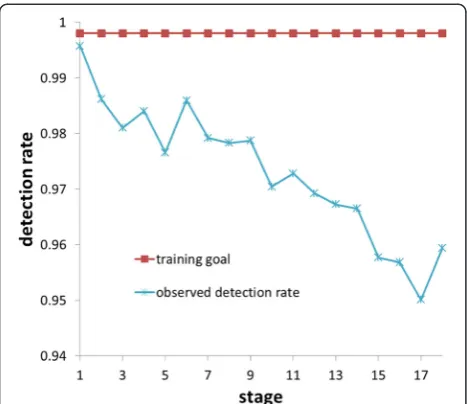
In the cascade learning process, samples are prepared at each stage with bootstrapping. The bootstrapping pro-cedure collects samples, which consist of misclassified examples of its previous stage as well as additional ones prepared for training. It makes negative samples more difficult. The training cascade is set to focus on negative samples as the stage goes on, and the selected weak clas-sifiers become well-trained to negative samples rather than positive ones. This fact can be confirmed by serving the detection rate at each cascade stage of an ob-ject detector based on the Viola and Jones algorithm, as illustrated in Fig. 1. Although each stage was trained to achieve the performance goal for detection rate (0.998), there is a gap in the observed detection rate, and the gap becomes larger as the stage proceeds. This is due to the increased difficulty of classifying negative samples. To balance the difficulty between the positive and negative samples, larger weights should be assigned to the posi-tive samples. In this work, the weights are adjusted so that the total weight of the positive samples is compar-able to that of the negative samples.
were trained using the samples collected by bootstrapping. Therefore, the weak classifiers tend to become biased as unbalance between the positive and negative samples in the training set increases. In detection environments, false negatives are much more critical than false positives, while objects are less frequent than objects. Thus, non-biased weak classifiers are desired. The estimated bias in the selected weak classifiers is used to adjust the weights in the training samples. By adjusting the initial weight of the training samples prior to training, the unbalance be-tween positive and negative samples in the training set is reduced, and the weak classifiers selected by using weight-adjusted samples are less biased. In the proposed system, this is handled as follows: By applying weak classifiers to another set of samples, the reservoir set, the weights of these samples are updated with the same process that up-dates the weights of the samples in training. The degree of weight disparity in the positive and negative samples is es-timated with the weight ratio, which is the ratio of the total weight assigned to positive to negative samples. In this research, the weight ratio is used as a reference to esti-mate to what extent the selected weak classifiers are biased to positive or negative samples. The training is then restarted using the training samples whose weights are ad-justed by the weight ratio. If the positive and negative samples in the training set are balanced, the weight ratio converges to 1. This process prevents the detection rate by the selected weak classifiers from decreasing in later stages; thus, the detection performance of the cascade classifier improves.
Figure 2 shows the algorithmic flow of the proposed system for training a cascade stage. First, the weights of the samples in the training set are initialized and a cas-cade stage is trained using the provided samples. In
training, weak classifiers that can achieve the given per-formance goal are selected. The selected weak classifiers may satisfy the performance goal for the training set, but they may not be efficient when used for detecting vehi-cles. The samples in the training set are collected with bootstrapping, and the training samples are unbalanced. In the proposed system, to estimate bias, the efficiency of the selected weak classifiers is assessed by applying them to different samples called the reservoir set. The weights of the samples in the reservoir set are initialized and updated by applying the selected weak classifiers. The weights updated by applying (t+ 1)-th weak classi-fier, w0jðtþ1Þandy
0
j denote thej-th sample and its class
sample in the reservoir set, respectively.
w0jðtþ1Þ ¼w 0
jð Þt ⋅exp −y 0 j⋅ht x
0 j
ð10Þ
Mdenotes the number of weak classifiers selected at a cascade stage, and the updated weight of j-th sample in the reservoir set,w0j, is calculated as (11).
w0j¼w0jð Þ0 ⋅exp −y0j⋅X M−1
t¼0
ht x 0 j
!
ð11Þ
Equation (12) shows that the sums of the weights assigned to positive and negative samples areS+ andS_, respectively, whereN'denotes the number of samples in the reservoir set.
Sþ¼
XN0
j¼1
w0j if y 0 j¼ þ1
S−¼
XN0
j¼1
w0j ify 0 j¼ −1
ð12Þ
The weight ratio is obtained as in (13).
WR¼Sþ
S− ð13Þ
If WR converges to 1, the training will be terminated and proceed to a subsequent stage. Otherwise, the weights of the samples in the training set are adjusted by WRcp, the cumulated product of WR, using (14), and all the selected weak classifiers will be discarded.
wið Þ ¼0
WRcp= 1þWRcp
ð Þ⋅Nþ; ifyi ¼ þ1
1= 1þWRcp
ð Þ⋅N−; ifyi¼ −1
(
ð14Þ
The training for the corresponding stage is restarted. This process is repeated until the weight ratio converges to 1 or there is no further improvement.
4 Experimental results
To show the effectiveness of the proposed system, a series of experiments were performed. For the positive samples, 26,000 vehicle images were obtained by crop-ping the images captured on the road with a camera mounted on vehicle. All of the vehicle samples were resized to 20 × 20 pixels. For each stage of the cascades, 6,000 samples were used for training. A half of re-maining 20,000 samples were used as the reservoir set, and the other half were used to evaluate the detection performance of the weak classifiers employing the pro-posed system. Over 500,000 negative samples were pre-pared by randomly cropping 1,085 background images that did not contain any vehicle objects. These samples
were included in the training set, the test set, and the reservoir set.
Vehicle detection systems were trained by three differ-ent approaches: the convdiffer-entional cascade learning ap-proach, the asymmetric boosting apap-proach, and the proposed system. Each stage in the cascade classifiers was trained to achieve a detection rate of 0.998 and a false alarm rate of 0.5. The detection system employing the asymmetric boosting approach was trained by assigning the initial weights to the training samples such that the sum of the positive sample weights is two times and four times greater than that of the negative sample weights. In the proposed system, the weight is assigned by extracting the latent asymmetry at each stage in the cascade classifier. The termination condition of each stage is set to have the weight ratio of 1.
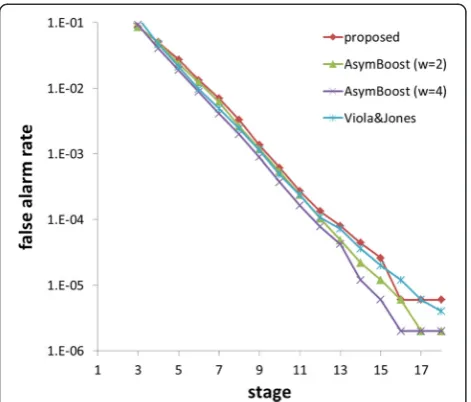
Figures 3 and 4 show the detection rate and the false alarm rate of the cascade classifiers trained employing the different approaches evaluated at the end of each stage, respectively. The cascade classifier trained employing the conventional cascade learning approach is labeled
“Viola&Jones”, and those trained employing the asym-metric boosting approach with the asymasym-metric weights of 2 and 4 are labeled“AsymBoost(W= 2)”and“ Asym-Boost(W= 4)”, respectively. Generally, cascade classifier characteristics entail that the detection rate and false alarm rate decrease as the stage moves forwards. The
Fig. 3False alarm rate of classifiers at the end of each stage
Fig. 4Detection rate of classifiers at the end of each stage
Fig. 5ROC curves of classifiers trained by different algorithms
Table 1Comparison of number of operations
Methods Number of operations Comparison w/ Viola&Jones
Viola&Jones 1,049,758 –
AsymBoost(W= 2) 904,741 −13.8 %
AsymBoost(W= 4) 945,914 −9.9 %
detection rate and false alarm rate of the cascade with 15 stages was approximately 0.97 (0.99815≈0.97) and 3 × 10⁻⁵(0.515≈3 × 10⁻⁵), respectively. While all the ap-proaches achieved the performance goal for false alarm rate, they failed to achieve the detection rate goal. The detection rate of the proposed system decreased slowly as the stages proceeded when compared with the others. With less stages, the cascade classifier based on the proposed system can achieve the required detection performance.
Figure 5 shows the receiver operating characteristic (ROC) curves of different classifiers trained in the cas-cade consisting of 12 stages. The cascas-cade classifier employing the proposed system shows significantly im-proved performance when compared with the others.
Table 1 shows the number of operations required for rejecting 100,000 negative sub-windows. It is calculated by using the false alarm rate and number of features, as shown in (8). The number of operations is also reduced in the proposed system compared to the other ap-proaches. This is due to the fact that the number of fea-tures used in the early cascade stages is smaller, even though more features are used in all the cascade stages of the proposed system in the detection environments.
5 Conclusions
To obtain a high-performance cascade classifier, weak classifiers constituting each stage should be selected con-siderately, even with increased training time. Weak classi-fiers not biased toward either positive or negative samples are desired. This is due to the fact that false negatives are much more critical than false positives while objects are less frequent than non-objects in detection environments. The selected weak classifiers in conventional cascade clas-sifiers are biased, and they lead to a gap between perform-ance goal and observed performperform-ance at each stage.
In this paper, a cascade classifier is proposed in which the selected weak classifiers are confirmed for their effective-ness in detection process. The main factor contributing to biased weak classifiers is unbalanced training samples pre-pared by the bootstrapping procedure. To assess the bias of the selected weak classifiers, they are applied to the samples in the reservoir set to update their weights. The disparity between the total weight of positive and negative samples in the reservoir set indicates the degree of unbalance in the positive and negative training samples. If they are found to be unbalanced, the weights of the training samples are ad-justed and the weak classifier selection process is restarted. Experimental results confirm the effectiveness of the pro-posed cascade classifier in vehicle detection by showing an improved performance over conventional ones.
Competing interests
The authors declare that they have no competing interests.
Received: 25 February 2015 Accepted: 2 June 2015
References
1. Z Sun, G Bebis, R Miller, On-road vehicle detection: a review. IEEE Trans. Pattern Anal. Mach. Intell.28(5), 694–711 (2006)
2. C Papageorgiou, T Poggio, A trainable system for object detection. Int. J. Comput. Vis.38(1), 15–33 (2000)
3. Z Sun, G Bebis, R Miller, On-road vehicle detection using Gabor filters and support vector machines, inProceedings of 14th Int. Conf. Digital Signal Processing(IEEE, Santorini, Greece, 2002), pp. 1019–1022
4. J Cui, F Liu, Z Li, Z Jia, Vehicle localization using a single camera, inProceedings of IEEE Intelligent Vehicle Symposium(IEEE, San Diego, CA, 2010), pp. 871–876 5. PF Felzenszwalb, RB Girshick, D McAllester, D Ramanan, Object detection with discriminatively trained part based models. IEEE Trans. Pattern Anal. Mach. Intell.32(9), 1627–1645 (2010)
6. Y Li, B Tian, B Li, G Xiong, F Zhu, Vehicle detection with a part-based model for complex traffic conditions, inProceedings of 14th IEEE Int. Conf. Vehicular Electronics and Safety(IEEE, Dongguan, China, 2013), pp. 110–113 7. LC Leon, R Hirata, Vehicle detection using mixture of deformable parts
models: static and dynamic camera, inProceedings of 25th SIBGRAPI Conf. Graphics, Patterns and Images(IEEE, Ouro Preto, Brazil, 2012), pp. 237–244 8. S Sivaraman, MM Trivedi, Real-time vehicle detection using parts at intersections,
inProceedings of 15th Int. IEEE Conf. Intelligent Transportation Systems(IEEE, Aleutian, Alaska, 2012), pp. 1519–1524
9. PM Daigavane, PR Bajaj, Vehicle detection and neural network application for vehicle classification, inProceedings of Int. Conf. Computational Intelligence and Communication Networks(IEEE, Gwalior, India, 2011), pp. 758–762
10. O Ludwig, U Nunes, Improving the generalization properties of neural networks: an application to vehicle detection, inProceedings of 11th Int. IEEE Conf. Intelligent Transportation Systems(IEEE, Beijing, China, 2008), pp. 310–315
11. P Viola, M Jones, Robust real-time face detection. Int. J. Comput. Vis.
57(2), 137–154 (2004)
12. P Viola, M Jones, Fast and robust classification using asymmetric AdaBoost and a detector cascade, inProceedings of Advances in Neural Information Processing Systems(NIPS, Vancouver, Canada, 2001), pp. 1311–1318 13. Y Freund, RE Schapire, A decision-theoretic generalization of on-line learning
and an application to boosting. J. Comput. Sys. Sci.55(1), 119–139 (1997) 14. R Duda, P Hart, D Stork,Pattern classification, 2nd edn. (Wiley-Interscience,
New York, 2001)
15. Y Freund, RE Schapire, A short introduction to boosting. J. Jpn. Soc. Artif. Intell.14(5), 771–780 (1999)
16. P Viola, M Jones, Rapid object detection using a boosted cascade of simple features, inProceedings of IEEE Computer Society Conf. Computer Vision and Pattern Recognition(IEEE, Kauai, HI, 2001), pp. 511–518
17. H Masnadi-Shirazi, N Vasconcelos, Asymmetric boosting, inProceedings of Int. Conf. Machine Learning(ACM, Corvallis, OR, 2007), pp. 609–619 18. R Xiao, L Zhu, HJ Zhang, Boosting chain learning for object detection, in
Proceedings of IEEE Int. Conf. Computer Vision(IEEE, Nice, France, 2003), pp. 709–715
19. J Wu, SC Brubaker, MD Mullin, JM Rehg, Fast asymmetric learning for cascade face detection. IEEE Trans. Pattern Anal. Mach. Intell.30(3), 369–382 (2008) 20. KK Sung, T Poggio, Example-based learning for view-based human face
detection. IEEE Trans. Pattern Anal. Mach. Intell.20(1), 39–51 (1998) 21. W Fan, SJ Stolfo, J Zhang, PK Chan, AdaCost: misclassification cost-sensitive
boosting, inProceedings of 16th Int. Conf. Machine Learning(ICML, Bled, Slovenia, 1999), pp. 97–105
22. KM Ting, A comparative study of cost-sensitive boosting algorithms, in Proceedings of 17th Int. Conf. Machine Learning(ICML, Stanford, CA, 2000), pp. 983–990
23. I Landesa-Vázquez, JL Alba-Castro, Shedding light on the asymmetric learning capability of AdaBoost. Pattern Recognit. Lett.33(3), 247–255 (2012) 24. Y Sun, MS Kamel, AKC Wong, Y Wang, Cost-sensitive boosting for classification of