Zigbee and GSM Based Data Acquisition & Controlling by
using ARM
1
Devichand Pattubala &
2B.Gopi Chandra Kumar
1
Devichand Pattubala, M.Tech Student, Department of ECE (Embedded Systems), /Sri Venkateswara
College of Engineering, JNTUA, Anantapur, Tirupati, Chittor district, Andhra Pradesh,
India,(e-mail:[email protected]).
2B.Gopi Chandra Kumar, Assistant Professor, Department of ECE, Sri Venkateswara College of
Engineering, JNTUA, Anantapur, Tirupati, Chittor dist, Andhra Pradesh, India (e-mail:
[email protected]).
Abstract –Design of ARM based mostly knowledge Acquisition
& management exploitation GSM & TCP/IP
Network is planned. The info acquisition,
observance and output management may be
economical by this planned system. ARM Processor
with RTOS is employed to style this technique.
associate degree embedded system with ARM
processor with RTOS may be used for industrial
applications committed a true time kernel for task
management, multi-tasking, managing the system
resources etc. Embedded system styleed provides a
generic design with all quite knowledge acquisition
and management. By writing the information
science Address of the LAN on the browser the
administrator and user get webpage on screen
contains all this standing of the devices. Immediate
notification is given to the administrator with the
assistance of the GSM Network.GSM may be
accustomed communicate with the individual at
instant Machine to Machine communication is
finished with Zigbee module. The system may period
management the devices through LAN Controller
and Zigbee.the system may is the embedded server
with the SD Card.
Keywords:-ARM-TDMI; μc/os-II; GSM; Ethernet; Memory card; Zigbee; Data acquisition
I. INTRODUCTION
In Industries, frameworks are turning out to be extremely intricate Industrial framework needs to test the site gear's and ecological conditions to track the condition of framework progressively [1]. This
framework requires outline, which must be adaptable and versatile, for that microcontroller based frameworks can be utilized. These frameworks are more solid and give elite to the framework.
Microcontroller is exceptionally commonsense and effectively used, the traditional 8 and 16-bit Microcontroller has its lacks when contrasted and 32-bit [1].Reduced Intruction Set Computer (RISC) is utilized as a part of The ARM construction modeling. This makes the direction set and related disentangle component much less difficult than those of small scale customized Complex Instruction Set Computers.
Results in a high direction throughput and noteworthy continuous intrude on reaction from a little and financially savvy processor center. Pipeline component is utilized with the goal that all parts of the preparing and memory frameworks can work constantly Due to pipelining while one guideline is being executed, its successor is being decoded, and a third direction brought from memory ARM based implanted framework will be more utilitarian, dependable, savvy, less in size ,and low power utilization. Microcontroller has impediment of low speed and poor memory so it execute basic control assignments. Principle two parts of RTOS are "Continuous" and "Operating System".
Common features of OS are multitasking, Synchronization, Interrupt and Event Handling, Input/ Output, Inter-task Communication, Timers and Clocks and Memory allocation and management. This enables its primary role of managing the hardware resources to meet the demands of application programs. RTOS is therefore an operating system that supports real-time applications for embedded systems by providing logically correct result within the deadline required. Such capabilities define its deterministic timing behavior and limited resource utilization nature.
Real time kernel is simple and stable. RTOS can cut a complex application into several mutually independent tasks based on task priority and it also has its own limitation [2]. RTOS, include the task management, task scheduling, interrupt handling etc.
Industrial application requires multiple tasks to be executed. Controlling the industrial system, processing of data, storing of the data and transmission of the data with polling technique require more time so use of multitasking is involved. When ARM processor combined with RTOS with timing constraint can be realized for the data acquisition and transmission of data. For e.g. transmission of data using Ethernet or RS-485 which requires industries standards like modbus protocol and it will have timing constraint.
II. METHODOLOGY
A. Proposed Architecture
Industrial system require data acquisition for which ADC is required, DAC is required for embedded control and for data backup SDRAM is required which we will contain entire log details. To communicate with desktop computer industries require modlus protocol so Ethernet control is required.
Fig: 1 block diagram for proposed architecture
Fig: Design of the proposed system
The proposed embedded system uses FL ASH and MMC memories for program running and data storage. The BIOS codes, user’s codes and the useful data a are stored in FLASH memories. RTC data is written on n MMC for data logging purpose. As far as the control and acquisition system concerned, the Analog to Digital C and acquisition is essential components. The ADCs applied for data are a Converter (ADC) acquisition. A RS-485 serial port is back ked up for more widely applications.
The LCD controller can be programmed to support different requirements on the screen. LCD is connected to the General Purpose Input/output ports (GPIO) of the microprocessor. The IP address of the system is burned in a serial EEPROM. The Ethernet controller r will read the IP address when reset. Ethernet is interfaced to serial peripheral interface of controller.
GSM is interfaced as it provides a wireless communication i.e. message can be sent to particular individual instantly. Zigbee port available so that the data can be send & control using wireless technology. ON-Chip RTC is configured so that it gives real time clock value which is very useful for data logging and data is written on MMC.
B.GSM Module
module in text mode. This design uses SIM300 GSM M module that provide 900/1800/1900MHz Tri-band for r VOICE, SMS, DATA, and FAX. This module operates on AT command over TTL interface. AT command is an abbreviation for Attention command that is recognized by GSM Module. This abbreviation is always used to start a command line to be send from TE (Terminal Equipment) to TA (Terminal Adaptor).
Fig 2: GSM Module
C. ZIGBEE
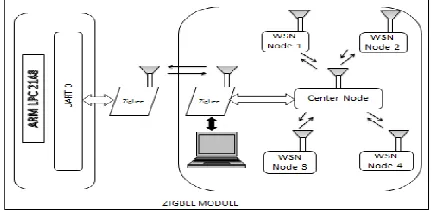
Centralized Node Connected E EWS Node via Zigbee Module, To this node all the other nodes sends the data this data can be display on the Laptops or PC and send to ARM LPC 2148 Via Zigbee. After Login it displays all the devices & there current status. This data can be send via Internet/Zigbee & The Plant can be controlled from anywhere.
fig3: ZIGBEE module
D. Ethernet Module
The ENC28J60 is a stand-alone Ethernet controller with an industry standard Serial Peripheral Interface (SPI). It is designed to serve as an Ethernet network k interface with SPI for any controller equipped. The ENC 28J60 meets all of the IEEE 802.3 standards. It incorporates a number of packet filtering schemes to limit incoming packets. The internal DMA module
provides fast data throughput and used in various hardware assisted checksum calculation network protocols. Host controller with communication is the SPI, with implemented via an interrupt pin and maximum 20 MHz clock rate two dedicate ed pins are used for LED link and network activity indication. With the ENC28J60, two pulse transformers and a few passive components are all that are required to connect a microcontroller to an Ethernet network. The embedded system in which field signal values are displayed on Web page or collected into Control center in re eal-time through RJ-45 with Embedded device (equipped w with SPI support) on to a network.
Fig 4: Ethernet Module ENC28J60
E. Hardware Clk Rate.
III.RTOS
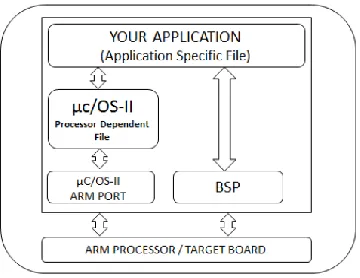
Fig 6: Hardware & μC/OS-II Interface
RTOS (μC/OS-II) manages up to 250 application tasks [19] RTOS can be ported to ARM hardware, and then the system can deal with m much more complicated tasks. Real-Time (RT) indicates an expectant response or reaction to an event on the instant of its evolution [4]. And Operating System (OS) is a system m program that provide an interface between hardware and application programs. RTOS(μC/OS-II) is very small real-time kernel with memory footprint is about 20KB and source code is about 5,500 lines, mostly in ANSI C. μC/OS-II can be scaled to only contain the features you need d for your application and thus provide a small foot print. Depending on the processor, on an ARM (Thumb mode) μC/OS-II can be reduced to as little as 6K bytes of code space and 500 bytes of data space (excluding s stacks). For most of the services the execution time is p provided by μC/OS-II is both constant and deterministic.
IV.IMPLEMENTATION:
Fig 7: Flow chart of Hardware & μCOS II Implementation
The heart of the system is a real-time kernel that uses preemptive scheduling to achieve multitasking on hardware platform. The previous sections dealt with μCOS_II porting to the application desired. This section deals with the implementation of hardware and software. Depending on the required application the number of tasks may vary. Porting of μC/OS-II we can perform simple tasks like Temperature sensor (i.e., ADC), 16x2 LCD (i.e., degree to Fahrenheit), UART (i.e., sending message through GSM), Ethernet (i.e. to communicate with desktop PC) MMC (i.e., memory card for data backup), & Zigbee (i.e. to send real time data to wireless nodes).
V. SOFTWARE
Keil IDE is used for implementation. Keil IDE is a windows operating system software program that runs on a PC to develop applications for ARM microcontroller and digital signal controller. It is also called Integrated Development Environment or IDE because it provides a single integrated environment to develop code for embedded microcontroller
Keil μVision4 IDE (Integrated Development Environment) is a Windows based front end for the C Compiler and assembler.
VI .RESULT
The proposed system is used for the industrial applications to collect the data and to control the particular site equipment in industry , to collect the environmental conditions sensors are used. Gas sensor, temperature, sensor, humidity sensors are used for to collect the data, the collected data is sent as message to the PC through the zigbee and GSM networks.
Fig: Temperature and humidity displayed on LCD.
Fig: Results displayed on PC through the zibbee.
VII. CONCLUSION
GSM and ETHERNET data Acquisition & Control using by using ARM is proposed offers to developing fast and efficient an application. The system can be used to perform real-time controls with RTOS. Using the Ethernet port of the embedded system, networked control and acquisitions can be achieved. The hardware and software provide a platform for diverse control and acquisition applications. This system enhances the reliability of the control and acquisition system and reduces the risks. In addition system uses the Zigbee and GSM Module for long distance provides an alternative interface for conventional control and acquisition applications. Our technology choice for both wireless data communication and fast wired communication embedded system is compact system and reduces the cost that is useful for industrial applications. As system is generic solution it becomes easy to provide machine to machine communication and entire embedded. This design can be used widely in remote data acquisition and control system in industry.
REFERENCES
[1] Gan-ping Li “Design of an Embedded Control and Acquisition System for Industrial Local Area Networks Based on ARM” 2010 IEEE.
[2] Hua Fang , Ming Tang , Lian Peng “Wireless data acquisition system based on ARM” 2011 IEEE. C.S. Wallace, “A Suggestion for a Fast Multiplier,” IEEE Trans. Electronic Computers, vol. 13, no. 1, pp. 14-17, Feb. 1964.
[3] Jiangchun Xu, Jiande Wu, Yuhui Li Published a paper titled “A Networks Data Collection Embedded System Based on ARMuCLinux” 2009 IEEE.
[4] Liu Zhongyuan, Cui Lili, Ding Hong, published a paper titled “Design of Monitors Based on ARM7 and Micro C/OS-II” 2010 IEEE
[5] Daogang Peng, Hao Zhang, Kai Zhang, Hui Li1, Fei Xia Published a paper titled “Research and Development of the Remote I/O Data Acquisition System Based on Embedded ARM Platform” 2009 IEEE..
[6] Yakun Liu, Xiaodong Cheng” Design and Implementation of Embedded Web Server Based on ARM and Linux” 2010 IEEE.
[7] M.Jenko, N.Medjeral & P. Butala, “Component-based software as a framework for concurrent design of programs and platforms an industrial kitchen appliance embedded system,” Microprocessors and Microsystems, September 2001, pp. 287–296.