An Efficient GA Based Detection Approach
for Visual Surveillance System
K.Shanmugapriya
1, Dr.R.Suja Mani Malar
2Assistant Professor, Dept. of ECE, Lord Jegannath College of Engineering & Technology, Kanyakumari, Tamilnadu, India 1
Professor & Head, Dept. of EEE, Cape Institute of Technology, Tirunelveli, Tamilnadu, India 2
ABSTRACT: Now-a-days, for an intelligent surveillance system, identification of an object from a video has attracted a great deal of interest. To detect the object from a video one need to perform some segmentation techniques. In real time application, Object segmentation and identification are two essential building block of smart surveillance system. In addition, some conditions make video object detection difficult such as non rigid object motion, target appearance variations due to changes in illumination and background clutter. This method is proposed on a multi object moving background based on Genetic algorithm. The video is preprocessed before segmentation. Motion segmentation is done to segment an object from a video. For motion detection, a genetic algorithm is used.In this, a Non maximum suppression filter is proposed to remove the unwanted object motion. This result is then used for object identification. Cellular automata based segmentation is performed to detect a particular object from a video. This method can detect any object at any drastic change in illumination.
KEYWORDS: Surveillance, Genetic algorithm, Cellular automata.
I.INTRODUCTION
Object tracking in real time application such as traffic monitoring, surveillance system becomes a critical task. Several methods are implemented for efficient tracking of the moving object. In [1], a fast video segmentation algorithm is proposed and it operates on four modes such as baseline mode, baseline mode, shadow cancellation mode, global motion compensation mode and adaptive threshold mode. With change detection and background registration techniques, this algorithm can give satisfying segmentation results with low computation load. Shadow cancellation mode can deal with light changing effect and shadow effect. Baseline mode can operate in still camera situation. Global motion compensation mode can deal with slight camera situation. Adaptive threshold mode can operate well in all the modes. The main drawback in this paper is switching of modes are done manually. Shadow cancellation cannot deal with strong light source. In paper [2], tracking an object is based on descriptors. It automatically tracks an object by using a compact piece of information about region and objects. In this shadow is tracked as a new object because no shadow cancellation technique is used. In [3], background registration; preprocessing is done by gradient filter. Benefits of gradient filter reduce if shadows appear in strong texture, some information will loss if object has weak edges. In [4], Adaptive filter algorithm is used. Main problem occurs due to background clutter. In [5], Differential earth mover distance algorithm is used in this large object motions cannot be handled well and occur local minima problem. In [6], color information is used for background subtraction and shadow detection. This method fails to adapt dynamic background situation. In [7], gradient descent optimization technique, Kalman filter is used for object detection. Segmentation result is inaccurate when the objects are in large motion. In existing method morphology is applied and the result is verified.In this proposed method Genetic algorithm is applied to track a particular object from the video and comparing the performance.
II. RELATED WORK
method to track moving objects in an outdoor environment. This tracking was achieved by using feature fusion and multiple cameras.In 2009, Saeed Rastegar et al.[11] have proposed a new method to overcome the disadvantages of Mean Shift Algorithm.They have also proposed an efficient MS procedure that uses the flexible kernels which are based on the normalized Metric Distance Transform is based on Wavelet transforms as feature vector extraction and Relevance Vector Machine classifier to differentiate between tracked targets from background.In 2011, Wilfried Elmenreich et al.[12] discussed that the multi-sensor object tracking is an important feature for advanced driver assistance systems in future automobiles.Most of the state-of-the-art systems cannot provide deterministic processing of the sensor values due to unsynchronized sensing and processing units. To solve all of these shortcomings they have proposed a paradigm shift towards a time-triggered system architecture.At the end of this review, we conclude that the Soft Computing technique has given better results.This paper will be a healthier foundation for the researchers in the field of Object Tracking.
III.PROPOSED WORK
The aim of the work is to detect a moving object from a video. In the proposed method object tracking is done efficiently by using cellular automata based segmentation. The video object segmentation algorithm introduced based on our previous work, in which a multi background registration scheme was proposed to model complex and dynamic backgrounds. To make it fully automatic for variant conditions, an automatic threshold decision technique that can automatically and precisely determine the threshold values for dynamic backgrounds is proposed and presented. The segmentation algorithm is also designed with a low memory requirement for background storage.
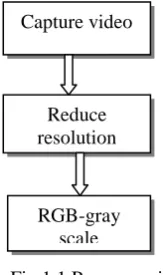
Preprocessing is a step done prior to segmentation to remove noise. In this the in- put video is remodeled for further operations in object tracking from a video sequence.In this method preprocessing is done by the method called Bicubic interpolation. It is a smoothening process. The input frames are enlarged to find some pixel values.If any Pixel value is missing then based on the adjacent pixel value it recovers the missing pixel value.
Image resizing enlarges an image; the output image contains more pixels than the original image. The image resize function uses interpolation to determine the values for the additional pixels. After resizing, the RGB image is converted into gray scale by eliminating the hue and saturation information.Bicubic interpolation is an extension of cubic interpolation for interpolating data points on a two dimensionalregular grid. The interpolated surface is smoother than corresponding surfaces obtained by bilinear interpolation.
Fig 1.1 Preprocessing
Method for segmentation: Motion segmentation is mainly done to obtain motion vectors. In this method optical flow measurement is done to denote the object motion in a video. Optical flow method is based on gradient of intensity for this purpose RGB value is converted to gray scale values. It is an iterative method and it uses Taylor series expansion. Block matching algorithm is used for accurate motion detection. Segmentation algorithm is to change detection in a video. Moving object region is separated from other part of the schene by the motion information. By using optical flow method, object motion regions are extracted in the first frame, and closed initial counters near the boundaries of object regions are constructed.In the first frame, we apply optical flow to detect motion regions whose boundaries are used as the initial counters. The optical flow for each pixel is represented by (u, v), where u and v are the optical flow velocity vector components in the x and y directions respectively. For a pixel whose optical flow magnitude is less than a threshold its optical flow is set to (0, 0), it is assigned as background. A rectangle shape is moved over the image and its size is changed to detect the motion region.
Non maximum suppression filter:The Non maximum suppression filter module will set all pixels in the current neighbourhood window that are lower than the maximum value in that window to zero(or black).The module is similar to the max filter in that the maximum value for the specified window is calculated. The current pixel is then compared to this maximum value. If lower it is set to black otherwise the value is unchanged.
Fig1.2. Non Maximum Suppression Filter Capture video
Reduce resolution
Initial Object Mask: Initial Object Mask is created to denote the foreground object. In this a rectangular shape is moved over the object, which specifies the moving object. Due to camera noise and irregular object motion there exists some noise region in the initial object mask.
IV. GENETIC ALGORITHM
Genetic algorithm is applied to detect motion of the object.A genetic algorithm is a search technique used in computing to find true or approximate solutions to optimization and search problems.Genetic algorithms belong to the larger class of evolutionary algorithms, which generate solutions to optimization problems. A typical Genetic algorithm requires a genetic representation of the solution domain and a fitness function to evaluate the solution domain.
Genetic Algorithms are good at taking large, potentially huge search spaces and navigating them, looking for optimal combinations of things, solutions you might not otherwise find in a lifetime.”
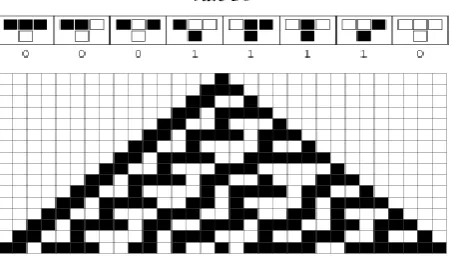
Cellular Automata: A cellular automata consists of a regular grid of cells, each in one of a finite number of states, such as on and off. The grid can be in any finite number of dimensions. For each cell, a set of cells called its neighborhood is defined relative to the specified cell. An initial state (time t=0) is selected by assigning a state for each cell. A new generation is created, according to some fixed rule that determines the new state of each cell in terms of the current state of the cell and the states of the cells in its neighborhood. Typically, the rule for updating the state of cells is the same for each cell and does not change over time, and is applied to the whole grid simultaneously, though exceptions are known, such as the stochastic cellular automata and asynchronous automata.
Fig 1.3 Cellular automata structuring element
The primary classifications of cellular automata as outlined by Wolfram are numbered one to four. They are, in order, automata in which patterns generally stabilize into homogeneity, automata in which patterns evolve into mostly stable or oscillating structures, automata in which patterns evolve in a seemingly chaotic fashion, and automata in which patterns become extremely complex and may last for a long time, with stable local structures.A cellular automaton is a collection of "colored" cells on a grid of specified shape that evolves through a number of discrete time steps according to a set of rules based on the states of neighboring cells. The rules are then applied iteratively for as many time steps as desired.
Cellular automata come in a variety of shapes and varieties. One of the most fundamental properties of a cellular automaton is the type of grid on which it is computed. The simplest such "grid" is a one-dimensional line. In two dimensions, square, triangular, and hexagonal grids may be considered. Cellular automata may also be constructed on Cartesian grids in arbitrary numbers of dimensions, with the dimensional integer lattice being the most common choice. Cellular automata on a dimensional integer lattice are implemented in mathematica as CellularAutomaton.
V. RESULT AND DISCUSSION
surveillance system etc.Fig 2 shows the tracking result of the proposed system and Fig 3 decribes about the Performance of the Proposed system.
Moving object detection from a video has attracted a great deal of interest. This proposed method operates well in any drastic change in illumination. Object detection is done using Genetic algorithm and cellular automata. A cellular automaton is to track a particular object from the video. This method can handle object with large motion. It is an efficient method to track object from a multi object moving background.The performance analysis are done to this work by various parameters such as frame rate, accuracy, delay etc.
Fig. 2 Tracking Result Fig. 3 Performance Graph
VI. CONCLUSION AND FUTUREWORK
Video object segmentation and tracking framework for smart cameras in visual surveillance network was proposed. This method of object tracking reduces computational complexity and enhanced segmentation result is obtained. The proposed method can track object at any drastic change in illumination. In real time application object tracking is an important task. With the improved technique we should perform some operation to track object with less complex and high tracking performance. The proposed method track object in less time and it can detect object that are partially occluded. In future it can be extended with other Soft Computing Techniques.
REFERENCES
.
[1]S.-Y.Chien, Y.-W.Huang, B.-Y.Hsieh, S.-Y.Ma and L.-G.Chen, “Fast video segmentation algorithm with shadow cancellation, global motioncompensation, and adaptive threshold techniques”,IEEE Transactions on Multimedia, Vol.6, pp.732–748, Oct.2004.
[2] A. Cavallaro, O.Steiger, and T. Ebrahimi, “Tracking video objects in cluttered background,” IEEE Transactions on Circuits Syst. Video Technol.,Vol. 15, pp. 732-748,Oct. 2004.
[3] S-Y chien, S-Y Ma, and L-G Chen, “Efficient moving object detection algorithm using background registration technique”, IEEE Trans. Circuit syst. Video Technol.,Vol. 12, pp. 577-586, Jul. 2002.
[4] E. Maggio, F. Smerladi, and A. Cavallaro, “Adaptive multifeature tracking in a particle filtering framework,” IEEE Trans.Circuit syst. Video Technol.,Vol. 17, pp. 1348-1359, Oct. 2007.
[5]Q. Zhao, Z. Yang, and H. Tao, “Differential earth mover’s distance with its applications to visual tracking”, IEEE Trans. Pattern anal. Mach. Intell., Vol.32, pp.274-287, Feb 2010.
[6] R.Cucchiara, C. Grana, M. Pioccardi, and A. Prati, “Detecting moving objects, ghosts, and shadows in video streams”,IEEE Trans. Patter Anal. Machine Intell.,vol. 25, pp. 1337-1342, Oct. 2003.
[7] D.Comaniciu, V. Ramesh, and P. Meer, “Kernel based object tracking”, IEEE Trans. Patter Anal. Machine Intell., Vol. 25, pp. 564-577, May 2003.
[9] Desmond Chung, James Maclean and Sven Dickinson, “ Integrating region and boundary information for spatially coherent object tracking”, Image and Vision Computing, Vol.24, pp.680-692,2006.
[10] Quming Zhou and Aggarwal, “Object tracking in an outdoor environment using fusion of features and cameras”, Image and Vision Computing, Vol.24,pp.1244-1255,2006.
[11]Saeed Rastegar, Mojtaba Bandarabadi, Yashar Toopchi and Saleh Ghoreishi, “ Kernel based Object Tracking Using Metric Distance Transform and RVM Classifier” Australian Journal of Basic and Applied Sciences, Vol.3 pp.2278-2290,2009.
[12] Wilfried Elmenreich and Moritz Koplin, “ A Time-Triggered Object Tracking Subsystem For Advanced Driver Assistance Systems”, Springer e&i Journal, Vol.128,pp.203-208,2011.