Genetic Algorithm based Iris Recognition with
optimized Hamming Distance
Urashveen Kour 1, Satnam Singh Dub2, Bhanu Gupta3
PG Student, Dept. of ECE, SSCET, Badhani, Punjab, India1
Head of Department, Dept. of ECE, SSCET, Badhani, Punjab, India2
Assistant Professor, Dept. of AE&IE, MBSCET, Jammu, Jammu and Kashmir, India3
ABSTRACT:Automatic Identification is provided by a biometric system on basis of unique features or characteristics of an individual. Recognition of Human Iris is considered the most reliable and accurate identification system. The identification is made by analysis of distinguished patterns available in iris of the human eye. The proposed system detects the iris in a human eye image and extracts the random patterns. The extracted iris patterns are transformed into a binary image and then into a binary template. The high frequency components are removed for increased efficiency. The test image taken is converted into a binary template by identical process and matched with the reference image in database using hamming distance criteria. The Genetic Algorithm is included for optimized feature selection which in-turn improves the recognition rate by optimizing the biometric comparator hamming distance. The system is implemented in MATLAB and is tested on two different databases for comparative performance evaluation. Comparative result analysis for 10 test images show 100% performance for CASIA database and 80% for UBIRIS database.
KEYWORDS: Biometrics, Iris Recognition, Genetic Algorithm, MATLAB, CASIA, UBIRIS.
I.INTRODUCTION
Iris based identification used the patterns of iris which is the textured and colored region of human eye that surrounds the pupil. The pioneer work in this field was originally performed by Dr. John Daugman, PhD, OBE, University of Cambridge, U.K. The iris based pattern recognition algorithms designed and developed by him for human identification have been tested globally and have resulted in no false matches. Based on this original work the iris identification biometric systems have grown into a leader in advance security systems as the demand for global and domestic security has increased. This elevated interest in iris based security systems has diverted the attention of many towards the advancement of iris recognition systems in field of academia or industry thus taking this emerging technology towards product development and commercialization. The field of iris recognition technology promises a highly accurate and efficient way of identity verification provided a good user interface is available on hand. This requires a major flexibility in iris image acquisition systems and application of novel emerging techniques to handle the issues with the acquired iris image quality. The reasons which affect the iris identification are physical in nature such as pupil dilations, contact lenses, natural aging of eyes etc. The systems are ignoring the high frequency noise components due to these physical issues. The research towards the technology is powered by the incentives generated by privacy and security issues.
Genetic algorithms are an approach to optimization and learning based loosely on principles of biological evolution,
these are simple to construct, and its implementation does not require a large amount of storage, making them a
sufficient choice for anoptimization problems. Optimal scheduling is anonlinear problem that cannot be solved easily
yet, a GA could serve to find a decent solution in a limitedamount of time Genetic algorithms are inspired by the
Darwin’s theory about the evolution “survival of fittest”, it search the solution space of a functionthrough the use of
simulated evolution (survival of the fittest) strategy. Generally the fittest individuals of anypopulation have greater
chance to reproduce andsurvive, to the next generation thus it contribute toimproving successive generations However
nonlinear problems by exploring all regions of the state space and exponentially exploiting promising areas through the application of mutation, crossover and selection operations to individuals in the population. The development of new software technology and the new software environments (e.g. MATLAB) provide the platform to solving difficult problems in real time. It integrates numerical analysis, matrix computation and graphics in an easy to use environment. MATLAB functions are simple text files of interpreted instructions Therefore; these functions can be re-implemented from one hardware architecture to another without even a recompilation step. The paper persents a system design of a iris recognition system developed using MATLAB and tested on two different eye image databases for performance. The Genetic Algorithms are used to optimize the biometric comparator Hamming distance.
II.LITERATURE REVIEW
It Kumar et al. Daugman’s algorithm is commercially viable in present iris biometrics. Daugman’s Operator successfully segments and normalizes an iris image [1]. Steve Zhou et al. uses 1-D Gabor filter, k dimensional tree and hamming distance for matching [2]. Sukhwinder Singh et al. has presented segmentation, normalization, feature extraction and matching as four main operations for iris recognition [3]. Bimi Jain et. al. presented FFT and moments for iris recognition. FFT converts image from spatial domain to frequency domain and also filters noise in the image[4]. Shrinivasrao B. Kulkarni et.al. India [proposed system takes an image of the eye, detects the iris and extracts it. Then a binary image of the extracted iris is created in order to form an equivalent barcode [5]. Desoky et.al. proposes an iris recognition algorithm in which a set of iris images of a given eye are fused to generate a final template using the most consistent feature data. Features consistency weight matrix is determined according to the noise level presented in the considered images [6]. Ashish Kumar et al. have developed an ‘open-source’ iris recognition system in order to verify both the uniqueness of the human iris and also its performance as a biometric [7]. Charansing N. Kayte et. al. implement an iris recognition system using MATLAB in order to verify the claimed performance of the technology [8]. Gunjan Sharma, et.al. used a fusion mechanism that uses both, a Canny Edge Detection scheme and a Circular Hough Transform, to detect the iris’ boundaries in the eye’s digital image [9]. P.P.Chitte et.al. have done work for the performance evaluation of iris recognition algorithms to construct very large iris databases. The authors propose n iris image synthesis method based on Principal Component Analysis (PCA), Independent component analysis (ICA) and Daugman’s rubber sheet model is proposed [10]. C.M.Patil et. al. publishes that Iris recognition is one of the most reliable biometric technologies. The performance of an iris recognition system can be undermined by poor quality images and result in high false reject rates (FRR) and failure to enroll (FTE) rates [11]. Zhonghua Lin et al. presented, Morlet wavelet transform used. Firstly, locate the iris, then makes normalization and get 512 columns and 64 rows rectangular iris image. Then convert into binary codes. Lastly matching the iris pattern to the stored data [12]. Mohammad Ramli et.al. provides special and automatic identification of an individual based on characteristics and unique features showed by individuals. The authors’ work examines the developing automated iris recognition for personal identification in order to verify both uniqueness of the human iris and also its performance as a biometric based on Hu invariant moment [13]. Mahboubeh Shamsi et.al. Malaysia, lohor, Malaysia publish that an Iris is a desirable biometric representation of an individual for security-related applications. Authors tested the algorithm using iris images from CASIA database and MMU database. The percentage detection on MMU iris database is 99% and that
of CASIA is 98% [14]. Hollingsworth et al. acquired multiple iris codes from the same eye and evaluate which bits are
results for an active contour that finds the pupil-iris border in slit lamp images of the eye. Preprocessing involves producing a variance image from the original image and then locating the annulus, of a given size, which has the lowest mean variance [22]. Boles at el. proposed an iris recognition method. Iris localization is started by locating the pupil of the eye, which was done by using some edge detection technique. As it was a circular shape, the edges defining it are connected to form a closed contour. The centroid of the detected pupil is chosen as the reference point for extracting the features of the iris. Iris outer boundary is also detected by using the edge-image [23]. Wildes et.al. had proposed an iris recognition system in which iris localization is completed by detecting edges in iris images followed by use of a circular Hough transform to localize iris boundaries. In a circular Hough transform, images are analyzed to estimate the three parameters of one circle [24]. Daugman patented Iris algorithm of integro-differential operator [25].
III.METHOLOGY
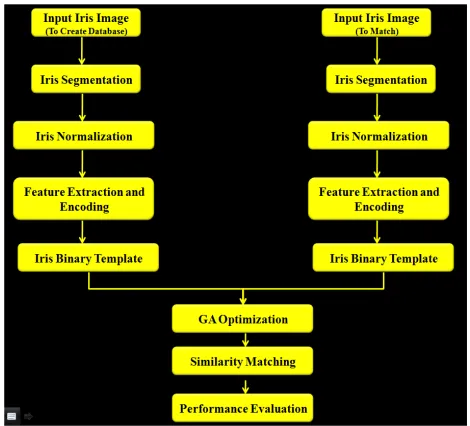
The traditional approach for iris recognition system implementation using Daugman’s Algorithm is shown in Fig. 1.
Fig. 1 Basic Iris Recognition System
The traditional system is modified using Genetic Algorithms is shown in figure below.
The genetic algorithm applied in the simplest form is shown as under.
Fig. 3 Flowchart Depicting Simple Genetic Algorithm Optimization
IV.RESULTS AND DISCUSSSIONS
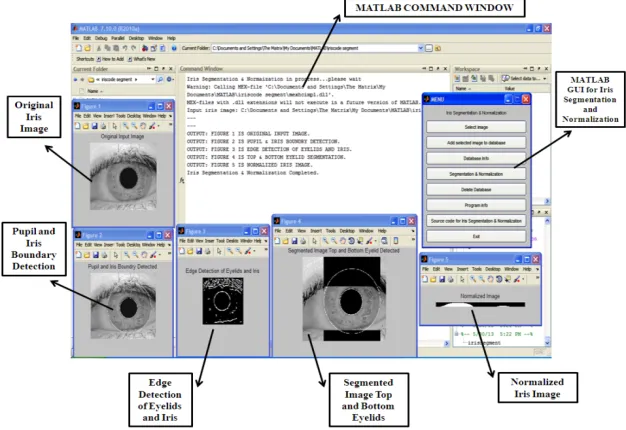
The developed MATLAB GUI for Iris Recognition System is shown along with the iris image segmentation, eyelids removal and eyelashes removal. Iris image normalization results are also depicted for the same in Fig. 4.
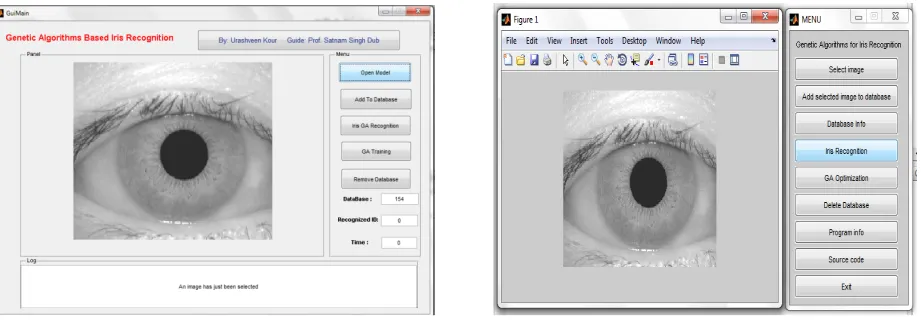
The iris segmentation and normalization system implemented above is further modified into an iris recognition system and tested on two databases CASIA and UBIRIS for performance evaluation. The modified MATLAB GUI for iris recognition is shown in Fig. 5.
Fig. 5 GA based Iris Recognition GUI Snapshots
The procedure to use the GUI is as follows. First, add all the files in MATLAB current directory. Next, Type "irisrecognition" on MATLAB command window and Press Enter. The Working Software Functions and their Description is as follows.
Select image: read the input image
Add selected image to database: the input image is added to database and will be used for training.
Database Info: show information about the images present in database.
Iris Recognition: iris normalization, iris template and template matching (here the selected input image is
processed and matched).
Delete Database: remove database from the current directory.
Program Info: shows information about the iris recognition system software.
Source code for Iris Recognition System: to view the complete source code.
Exit: quit program.
The test results evaluated for CASIA Database and UBIRIS database are tabulated in Table I. The results and performance evaluation is also graphically illustrated. The results were generated in two phases. Initial test was done for 10 images for each database. Fig. 6 shows performance analysis graph for 10 test images for CASIA based on Hamming Distances.
Fig. 7 shows performance analysis graph for 10 test images for UBIRIS based on Hamming Distances.
Fig. 7 2D- Representation of GA Optimized Hamming Distance and Recognition Id on UBIRIS for 10 test images
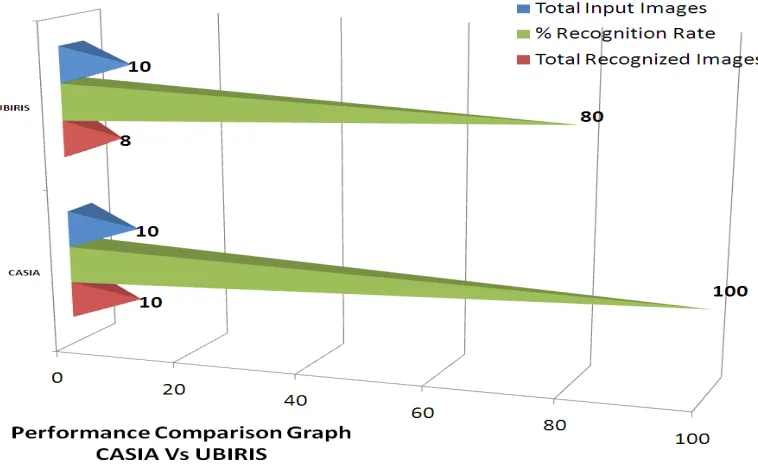
Fig. 8 shows performance comparison graph for 10 test images for CASIA Vs UBIRIS based on % Recognition Rate and Recognized Id.
V. CONCLUSION
The results confirm that iris recognition is a reliable and accurate biometric technology. The inclusion of moving averaging filters allowed us to achieve a 100% recognition rate and 100% database compatibility for CASIA Database, but the performance was not up-to the mark for UBIRIS as only 80% of Database compatibility resulted in errors though achieving accurate matches for all the 2 images compatible out of 10 images. The system is tested on two different databases and the comparative performance evaluation of results on both the databases is also achieved. The comparative result analysis for 10 test images for each database shows 100% performance for CASIA and 80% performance for UBIRIS. The issues at hand is to evaluate the performance of Genetic Algorithm optimization for biometric comparator i.e. Hamming Distance on a more extensive and comprehensive dataset of two databases and evaluate and analyse the system for recognition rate, recognition speed and accuracy.
.
REFERENCES
[1] Kumar, A.; Asati, A.R., "Iris based biometric identification system," International Conference on Audio, Language and Image Processing (ICALIP), 2014 pp.260,265, 7-9 July 2014.
[2] Steve Zhou and Junping Sun “A Novel Approach for Code Match in Iris Recognition”, IEEE International Conference on Computer And Information Science, June 2013.
[3] Sukhwinder Singh, Ajay Jatav, “A Closure Looks To Iris Recognition System”, International Journal Of Scientific & Engineering Research, Vol. 3, March 2013.
[4] Bimi Jain, Dr.M.K.Gupta, Prof.JyotiBharti, “ Efficient Iris Recognition Algorithm Using Method Of Moments” International Journal of Artificial Intelligence & Applications (IJAIA), Vol.3, September 2012.
[5] Shrinivasrao B. Kulkarni, Ravindra S. Hegadi, Umakant P. Kulkarni, “A Novel Approach for Iris Encryption”, International Conference & Workshop on Recent Trends in Technology 2012, TCET, Mumbai, India.
[6] Aly I. Desoky, Hesham A. Ali, Nahla B. Abdel-Hamid,” Enhancing iris recognition system performance using templates fusion”, Ain Shams Engineering Journal Volume 3, pp 133–140 [2012].
[7] Ashish Kumar Dewangan, Majid Ahmad Siddhiqui, “Human Identification and Verification Using Iris Recognition by Calculating Hamming Distance”, International Journal of Soft Computing and Engineering (IJSCE) ISSN: 2231-2307, Volume-2, Issue-2, May 2012.
[8] Charansing N. Kayte, Dr V.P.Pawar, Chandrasekhar D.Sonwane, “Efficient Biometric for Human Identification and Verification through Iris Recognition”, Indian Streams Research Journal Vol.1, Issue.V/June; 12pp.1-4.
[9] Gunjan Sharma, RL Sharma and Puja Nigam, “Recognition of Human Iris Patterns for Biometric Identification”, VSRD-IJEECE, Vol. 2 (6), 2012.
[10] Mr. P.P.Chitte, Prof. J.G.Rana, “IRIS Recognition System Using ICA, PCA, Daugman’s Rubber Sheet Model Together” International Journal of Computer Technology and Electronics Engineering (IJCTEE), Vol. 2, 2010.
[11] Dr.Chandrashekar.M.Patil, “An Efficient Iris Recognition System to Enhance Security Environment for Personal Identification”, International Journal of Communications Networking System Vol:02, December 2013, Pages: 174-179
[12] Lin Zhonghua, Lu Bibo, “Adaptive Iris Recognition Method Based on the Marr Wavelet Transform Coefficients” School of Computer Science and Technology Henan Polytechnic University,2009.
[13] Mohammad Ramli, Nurul Akmar, Kamarudin, Muhammad Saufi and JORET Ariffuddin “IrisRecognition for Personal Identification” The International Conference on Electrical Engineering, 2008 ” July 6-10, 2008, OKINAWA, JAPAN No. O-099.
[14] Mahboubeh Shamsi, Puteh Bt Saad, Subariah Bt Ibrahim, Abdolreza Rasouli, Nazeema Bt Abdulrahim, “A New Accurate Technique for Iris Boundary Detection”, WSEAS Transactions on Computers, 2008.
[15] Hollingsworth Karen, Bowyer Kevin, Flynn Patrick,” All iris code bits are not created equal”, Biometrics: theory, applications, and systems; September 2007.
[16] Liu Chengqiang, Xie Mei, “Iris recognition based on DLDA”, International conference on pattern recognition; August 2006. p. 489–92. [17] Schmid Natalia A, Ketkar Manasi V, Singh Harshinder, Cukic Bojan, “Performance analysis of iris-based identification system at the
matching score level”, IEEE Trans Inform Forensics Secur 2006;1(2):154–68.
[18] Krichen Emine, Allano Lore`ne, Garcia-Salicetti Sonia, Dorizzi Bernadette, “Specific texture analysis for iris recognition, ‘International conference on audio- and video-based biometric person authentication”, 2005. p. 23–30.
[19] Libor Masek, Peter Kovesi. “MATLAB Source Code for a Biometric Identification System Based on Iris Patterns.” The School of Computer Science and Software Engineering, The University of Western Australia [2003].
[20] L. Ma, Y. Wang, T. Tan. “Iris recognition using circular symmetric filters”. National Laboratory of Pattern Recognition, Institute of Automation, Chinese Academy of Sciences, 2002.
[21] S. Lim, K. Lee, O. Byeon, T. Kim. “Efficient iris recognition through improvement of feature vector and classifier”. ETRI Journal, Vol. 23, No. 2, Korea, 2001.
[22] Ritter, N., Cooper, J., Owens, R., van Saarloos, P.P. 1999, “Location of the Pupil-Iris Border in Slit-Lamp Images of the Cornea”, Image Analysis and Processing, Los Alamitos, California, 1, pp. 740-745
[23] W. Boles, B. Boashash. A human identification technique using images of the iris and wavelet transform. IEEE Transactions on Signal Processing, Vol. 46, No. 4, 1998.
[24] R. Wildes. Iris recognition: an emerging biometric technology. Proceedings of the IEEE, Vol. 85, No. 9, 1997.