International Journal of Research (IJR)
e-ISSN: 2348-6848, p- ISSN: 2348-795X Volume 2, Issue 07, July 2015Available at http://internationaljournalofresearch.org
In painting withdraw areas priority terms
super & Low-High Resolution.
Y.Anjali
1; N.Veeraiah
2& D. Vijay Kumar
31M.Tech, Dept of ECE,Vijaya Engineering College, Telangana, India.
Email:[email protected]
2Associate Professor, Dept of ECE, Vijaya Engineering college, Telangana,India,
Email: [email protected]
3Associate Professor,HOD,Dept of ECE, Vijaya Engineering college, Telangana,India, Email:
Abstract
In Painting is the strength of reconstructing engrossed or gaga joining of images based on the background information. i. e. cast In Painting fills the off or incapacitated quarter in an figure utilizing spatial information of its neighboring region. In Painting algorithm have numerous applications. It is helpfully second-hand for certification of aged films and end deduction in digital photographs. Run stance fretful produces pompous mandate image from sequence of Derive work images. The unladylike have designs on of shove around Personate is to in front of clear freshen of accessible low hoax image. Including current Low Resolution (LR) imaging fundament be utilized with help of Supervise resolution reconstruction. Super resolution based in painting consists in theatrics roguish the in painting on a unrefined version of the input image. A hierarchical super-resolution algorithm is eruption second-hand to get better evidence on the missing areas. The take note of this headway is turn it is easier to inpaint low-resolution pictures than high resolution ones. The cut is both in structuring of computational complication and unmistakable quality.
Keywords: In painting; super-resolution; withdraw areas; priority terms; Low Resolution; High Resolution
1. Introduction
Image inpainting refers to methods which consist in filling-in missing regions (holes) in an image. Although tremendous progress has been made in the past years on inpainting, difficulties remain when the hole to be filled is large and another critical aspect is the high computational time in general required. These two problems are here addressed by considering a hierarchical approach in which a
International Journal of Research (IJR)
e-ISSN: 2348-6848, p- ISSN: 2348-795X Volume 2, Issue 07, July 2015Available at http://internationaljournalofresearch.org
frequency details which are missing in the input image(s).
The proposed SR-aided inpainting method falls within the context of single-image SR. The SR problem is ill-posed since multiple high-resolution images can produce the same low-resolution image. Solving the problem hence requires introducing some prior information. The prior informationcan be an energy functional de-fined on a class of images which is then used as a regularization term together with interpolation techniques. Image Inpainting fills the missing or damaged region in an image utilizing spatial information of its neighbouring region.
Inpainting algorithm have numerous
applications. It is helpfully used for restoration of old films and object removal in digital photographs. It is also applied to red-eye correction, super resolution, compression etc. The main goal of the Inpainting algorithm is to modify the damaged region in an image in such a way that the inpainted region is undetectable to the ordinary observers who are not familiar with the original image. Existing methods can be classified into two main categories. The first category concerns diffusion-based approaches which propagate linear structures or level lines (so-called isophotes) via diffusion based on partial differential equations and variational methods. Unfortunately, the diffusion-based methods tend to introduce some blur when the hole to
be filled-in is large. The second family of approaches concerns exemplar-based methods which sample and copy best matching texture patches from the known image neighborhood. These methods have been inspired from texture synthesis techniques and are known to work well in cases of regular or repeatable textures. The first attempt to use exemplar-based techniques for object removal has been reported in [1]. Nowadays, the image Inpainting technology is a hotspot in computer graphics. And it has important value in a heritage preservation, film and television
special effects production, removing
redundant objects etc. In the fine art museums, this Inpainting concept is used for degraded paintings. Conventionally Inpainting is carried out by professional artist and usually its very time consuming process because it was the annual process.
International Journal of Research (IJR)
e-ISSN: 2348-6848, p- ISSN: 2348-795X Volume 2, Issue 07, July 2015Available at http://internationaljournalofresearch.org
also be called as modification and manipulation of an image. In image inpainting we wouldlike to create original image but this is completely unfeasible without the prior knowledge about the image. In case of digital images we only have the image we are working on available to us and thus we are filling in a hole that encompasses an entire object.
2. Related Work
2.1 Existing System:
Existing methods can be classified into two main categories. The first category concerns diffusion-based approaches which propagate linear structures or level lines via diffusion based on partial differential equations and
variation methods. Unfortunately, the
diffusion-based methods tend to introduce some blur when the hole to be filled-in is large. The second family of approaches concerns exemplar-based methods which sample and copy best matches texture patches from the known image neighborhood. These methods have been inspired from texture synthesis techniques and are known to work well in cases of regular or repeatable textures. The first attempt to use exemplar-based techniques for object removal has been reported in. Authors in improve the search for similar patches by introducing an a priori rough estimate of the in painted values using a multi-scale approach which then results in an
iterative approximation of the missing regions from coarse to fine levels.
2.2 Proposed System:
In proposed system two main components are the in-painting and the super-resolution algorithms. More specifically, the following steps are performed:
1. A low-resolution image is first built from the original picture;
2. An in-painting algorithm is applied to fill-in the holes of the low-resolution picture;
3. The quality of the in-painted regions is improved by using a single-image SR method. 2.3 Algorithm Overview:
International Journal of Research (IJR)
e-ISSN: 2348-6848, p- ISSN: 2348-795X Volume 2, Issue 07, July 2015Available at http://internationaljournalofresearch.org
the first step. Its goal is to enhance the resolution and the subjective quality of the inpainted areas. Given a low-resolution input image, which is the result of the first inpainting step, we recover its high-resolution
using a single-image super-resolution
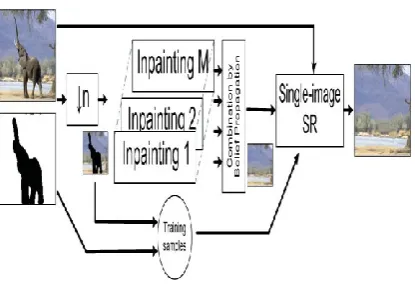
approach. Fig. 1 illustrates the main concept underlying the proposed method namely: 1) A low-resolution image is first built from the original picture;
2) An inpainting algorithm is applied to fill in the holes of the low-resolution picture.
Different settings are used and inpainted pictures are combined;
3) The quality of the inpainted regions is improved by using a single-image super-resolution method.
Fig 1: The framework of the proposed method
This new method is generic since there is no constraint on both the number and the type of inpainting methods used in the first pass. The better the inpainting of low-resolution images, the better the final result should be. Regarding the number of methods, one could imagine using different settings (patch size, search
windows etc) or methods to fill-in the low-resolution images and to fuse results. We believe that it would increase the robustness and the visual relevance of in-Painting.
2.4 Multiple Examplar-based Inpainting: This section aims at presenting the proposed inpainting method and the combination of the different inpainted images.
2.4.1 Examplar-Based Inpainting :
The proposed examplar-based method follows the two classical steps as described in [4]: the filling order computation and the texture synthesis. These are described in the next sections.
1) Patch Priority:
The filling order computation defines a measure of priority for each patch in order to distinguish the structures from the textures. Classically, a high priority indicates the presence of structure. The priority of a patch centered on px is just given by a data and confidence term. term, a tensor-based [9] and a sparsity-based [16] data terms have been used. These terms are briefly described below. (a)The tensor-based priority
One of the main advantages of a structure tensor is that a structure coherence indicator can be deduced from its eigen values. Based on the discrepancy of the eigen values, the degree of anisotropy of a local region can be evaluated.
International Journal of Research (IJR)
e-ISSN: 2348-6848, p- ISSN: 2348-795X Volume 2, Issue 07, July 2015Available at http://internationaljournalofresearch.org
It been proposed recently by. In a search window, a template matching is performed between the current patch ψpx and neighbouring patches ψpj that belong to the known part of the image. By using a non-local means approach [15], a similarity weight wpx,pj (i.e. proportional to the similarity between the two patches centered on px and pj) is computed for each pair of patches.
2) Texture Synthesis:
The filling process starts with the patch having the highest priority. To fill in the unknown part of the current patch ψuk px , the most similar patch located in a local neighborhood W centered on the current patch is sought. A similarity metric is used for this purpose. The
chosen patch ψ∗ px maximizes the similarity
between the known pixel values of the current patch to be filled in ψk px and co-located pixel values of patches belonging to W:
The coherence measure Coh simply indicates the degree of similarity between the synthesized patch ψuk px and original patches. Therefore, the constraint in equation prevents pasting in the unknown regions a texture that would be too different from original textures. If none of the candidates fulfil the constraint , the filling process is stopped and the priority of the current patch is decreased. The process
restarts by seeking the patch having the highest priority. It is interesting to note that a recent study [19] uses a similar term to predict the quality of the inpainting. Compared to our previous work [10], there is another substantial difference: we only use the best match to fill in the hole whereas a linear combination of the K most similar patches is
generally performed to compute the patch ψ∗
px in [10], [15], [16], [20]. In these cases, the estimated patch is then given by:
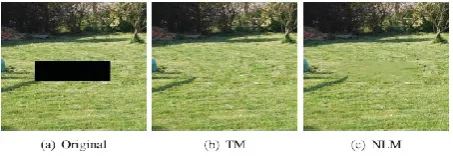
where K is the number of candidates which is often adapted locally so that the similarity of chosen neighbours lies within a range (1+α)×dmin, where dmin is the distance between the current patch and its closest neighbours. Combining several candidates increases the algorithm robustness. However, it tends to introduce blur on fine textures as illustrated by Fig. 2. In our method, only the best candidate is chosen. Its unknown parts are pasted into the missing areas. A Poisson fusion [23] is applied to hide the seams between known and unknown parts.
3. Implementation
3.1 Image in painting:
In painting is the process of
International Journal of Research (IJR)
e-ISSN: 2348-6848, p- ISSN: 2348-795X Volume 2, Issue 07, July 2015Available at http://internationaljournalofresearch.org
skilled art conservator or art restorer. In the digital world, in painting refers to the application of sophisticated algorithms to replace lost or corrupted parts of the image data.
3.2 Image restoration:
Image restoration is the operation of taking a corrupted/noisy image and estimating the clean original image. Corruption may come in many forms such as motion blur, noise, and camera miss focus.
3.3 Super-resolution:
Super resolution (SR) is a class of techniques that enhance the resolution of an imaging system. In some SR techniques—termed
optical SR—the diffraction limit of systems is
transcended, while in others—geometrical
SR—the resolution of digital imaging sensors is enhanced.
3.4 Super-resolution algorithm:
Once the in painting of the low-resolution picture is completed, a single-image super-resolution approach is used to reconstruct the high resolution of the image. The idea is to use the low-resolution in painted areas in order to guide the texture synthesis at the higher resolution. The problem is to find a patch of higher-resolution from a database of examples.
1. Dictionary building: it consists of the correspondences between low and high resolution image patches. The unique constraint is that the high-resolution patches
have to be valid, i.e. entirely composed of known pixels. In the pro- posed approach, high-resolution and valid patches are evenly extracted from the known part of the image. The size of the dictionary is a user-parameter
which might influence the overall
speed/quality trade-off. An array is used to store the spatial coordinates of HR patches (DHR). Those of LR patches are simply deduced by using the decimation factor; 2. Filling order of the HR picture: the computation of the filling order is similar to the one described in Section 3. It is computed on the HR picture with the sparsity-based method. The filling process starts with the patch HRp 10 Olivier Le Meur and Christine Guillemot having the highest priority. This improves the quality of the in painted picture compared to a raster-scan filling order;
International Journal of Research (IJR)
e-ISSN: 2348-6848, p- ISSN: 2348-795X Volume 2, Issue 07, July 2015Available at http://internationaljournalofresearch.org
The second term is the distance between the known parts of the HR patch HRp and the HR patches corresponding to the LR neighbors of LRp . Say differently, the similarity distance is the distance between two vectors composed of both pixels of LR and HR patches. The use of pixel values of HR patches allows to constraint the nearest neighbour search of LR patches.
5. A HR candidate is finally deduced by using a linear combination of HRpatches with the weights previously computed:
HRp =Xpj2DHRwp,pj × p,pj (4)
with the usual conditions 0 ≤ wp,pj ≤ 1, andPk wp,pk = 1.
6. Stitching: the HR patch is then pasted into the missing areas. However, as an overlap with the already synthesized areas is possible, a seam cutting
the overlapped regions is determined to further enhance the patch blending. The minimum error boundary cut [21] is used to find a seam for which the two patches match best. The similarity measure is the Euclidean distance between all pixel values in the overlapping region. More complex metrics have been tested but they do not substantially improve the final quality. At most four overlapping cases (Left, Right, Top and Bottom) can be encountered. There are sequentially treated in the aforementioned order. The stitching algorithm is only used when all pixel values in the overlapping region are known or already
synthesized. Otherwise, the stitching is disabled. After the filling of the current patch, priority value is recomputed and the afore-mentioned steps are iterated while there exist unknown areas.
4. Experimental Results
In this section, the proposed approach is tested on a variety of natural images and compared to five state-of the-art in painting methods. 4.1 Intrinsic performance of the proposed method:
International Journal of Research (IJR)
e-ISSN: 2348-6848, p- ISSN: 2348-795X Volume 2, Issue 07, July 2015Available at http://internationaljournalofresearch.org
Fig 2: Results of the Proposed Method. 4.2 Parameters analysis:
1) K-NN Patches for Inpainting:
In the number of KNN for the examplar-based inpainting to 1 preventing blur apparition as illustrated by Fig. 2. However, as the inpainting is applied on a low-resolution picture, it might make sense to use more than one candidate. We compare results obtained by the baseline approach to those obtained for three different K values: 1 (baseline algorithm), 4 and 8. Results are illustrated in Fig.5. Results are similar for K = 4. For K = 8, the inpainted quality is not as visually pleasing as the one obtained by the two previous settings
2). pace Versus Y Component:
The color space, used to perform the candidate search for instance, might play an important role. By using the luminance component only, results are visually less good than the baseline one, especially for the first picture.
3).Downsampling Factor Equal to 2:
By performing the inpainting at a higher resolution, results are not as good as those obtained by the baseline approach, especially on the first to improve the performance, the template matching could be replaced by an approximate nearest neighbour search [7].
5. Conclusion
The unique thing of the proposed method is easier to in paint low resolution than its counterpart. To make in painting image less sensitive to the parameter, it has in painted several times by different configurations. Results are combined using the loppy belief propagation and by using the super resolution details are recovered. The proposed algorithm results are compared with the different existing methods; results shown performance and efficiency are more accurate and reliable. . A novel algorithm is presented for examplar-based inpainting. In the proposed algorithm initially inpainting is applied on the coarse version of the input image, latter hierarchical based super resolution algorithm is used to find the information on the missing areas. Here we included a new method i.e, Bergmen Iteration to get better PSNR peak signal to noise ratio. These PSNR values are shown above table.
5. References
[1] M. Bertalmio, G. Sapiro, V. Caselles, and C. Ballester, ―Image inpainting,‖ in Proc. 27th Annu. Conf. Comput.
[2] Efros and T. K. Leung, ―Texture synthesis inProc. 7th IEEE Comput. Vis. Pattern Recognit., Sep. 1999, pp. 1033–1038.
International Journal of Research (IJR)
e-ISSN: 2348-6848, p- ISSN: 2348-795X Volume 2, Issue 07, July 2015Available at http://internationaljournalofresearch.org
[4] P. Harrison, ―A non-hierarchical procedure for resynthesis of complex texture,‖ in Proc. Int. Conf. Central Eur. Comput. Graph. Vis. Comput.Vis., 2001, pp. 1–8.
[5] O. Le Meur, J. Gautier, and C. Guillemot, ―Examplarbased inpainting based on local geometry,‖ inProc. 18th IEEE Int. Conf. Image Process., Sep. 2011, pp. 3401–3404. [6] O. Le Meur and C. Guillemot, ―Super-resolution-based inpainting,‖ in Proc. 12th Eur. Conf. Comput. Vis., 2012, pp. 554–567. by non-parametric sampling,‖
[7] O. Le Meur, J. Gautier, and C. Guillemot, ―Examplarbased inpainting based on local geometry,‖ inProc. 18th IEEE Int. Conf. Image Process, Sep. 2011, pp. 3401–3404. [8] Z Xu and J.Sun, ―Image inpainting by patch propagation using patch sparsity,‖ IEEE Trans. Image Process., vol. 19, no. 5, pp. 1153–1165, May 2010.
[9] N. Komodakis and G. Tziritas, ―Image completion using efficient belief propagation via priority scheduling and dynamic pruning,‖IEEE Trans. Image Process., vol. 16, no. 11, pp. 2649–2661, Nov. 2007.
[10] O. Le Meur and C. Guillemot,
―Super-resolution-based inpainting,‖ inProc. 12th
Eur. Conf. Comput. Vis., 2012, pp. 554–567. [11] S. Dai, M. Han, W. Xu, Y. Wu, Y. Gong, and A. Katsaggelos, ―SoftCuts: A soft edge smoothness prior for color image
super-resolution,‖ IEEE Trans. Image Process., vol.
18, no. 5, pp. 969–981, May 2009.
[12] W. T. Freeman, T. R. Jones, and E. C. Pasztor, ―Example-based superresolution,‖
IEEE Comput. Graph. Appl., vol. 22, no. 2, pp. 56–65, Mar.–Apr. 2002.
[13] D. Glasner, S. Bagon, and M. Irani, ―Super-resolution from a single image,‖ in
Proc. IEEE Int. Conf. Comput. Vis., vol. 10. Oct. 2009, pp. 349–356.
[14] H. Chang, D.-Y. Yeung, and Y. Xiong,
―Super-resolution through neighbor
embedding,‖ in Proc. IEEE Comput. Vis.
Pattern Recognit., vol. 1. Jun.–Jul. 2004, pp. 275–282.
[15] Y. Wexler, E. Shechtman, and M. Irani,
―Space-time video completion,‖ in Proc. IEEE
Comput. Vis. Pattern Recognit., Jun.–Jul. 2004, pp. I-120–I-127.
[16] Z. Xu and J. Sun, ―Image inpainting by
patch propagation using patch sparsity,‖ IEEE
Trans. Image Process., vol. 19, no. 5, pp. 1153–1165, May 2010.
[17] S. Di Zenzo, ―A note on the gradient of a
multi-image,‖ Comput. Vis., Graph., Image
Process., vol. 33, no. 1, pp. 116–125, 1986.[18] J. Weickert, ―Coherence-enhancing diffusion filtering,‖ Int. J. Comput. Vis., vol. 32, nos. 2–3, pp. 111–127, 1999.
[19] J. Kopf, W. Kienzle, S. Drucker, and S. B. Kang, ―Quality prediction for image
completion,‖ ACM Trans. Graph., vol. 31, no.
6, p. 131, 2012.
International Journal of Research (IJR)
e-ISSN: 2348-6848, p- ISSN: 2348-795X Volume 2, Issue 07, July 2015Available at http://internationaljournalofresearch.org
for image inpainting,‖ IEEE Trans. Image
Process., vol. 19, no. 10, pp. 2634–2644, Oct. 2010.
[21] D. D. Lee and H. S. Seung, ―Algorithms for non-negative matrix factorization,‖ in
Advances in Neural Information Processing System. Cambridge, MA, USA: MIT Press, 2000.
[22] A. Buades, B. Coll, and J. Morel, ―A non
local algorithm for image denoising,‖ in Proc.
IEEE Comput. Vis. Pattern Recognit., vol. 2. Jun. 2005, pp. 60–65.
[23] P. Pérez, M. Gangnet, and A. Blake,
―Poisson image editing,‖ in Proc.
SIGGGRAPH, 2003, pp. 313–318.
[24] N. Komodakis and G. Tziritas, ―Image completion using efficient belief propagation via priority scheduling and dynamic pruning,‖
IEEE Trans. Image Process., vol. 16, no. 11, pp. 2649–2661, Nov. 2007
Authors Profiles
Y.Anjali pursuing her M.Tech, From Vijaya Engineering College, Telangana, India.
Email:[email protected]
N.VEERAIAH completed his M.Tech Working as a Associate Professor, From Vijaya Engineering college, Telangana,India,
Email: [email protected]
D. Vijay Kumar completed his M.Tech Working as a Associate Professor, HOD, 14-years Experiencefrom Vijaya Engineering College, Telangana,India,