Click the Balls
Yashwanth Byalla1
1
III / IV CSE, Mahatma Gandhi Institute of Technology, Hyderabad, Telangana 500075
Abstract
-
This paper provides evolutionary game theory studies the behavior of large populations of agents who repeatedly engage in strategic interactions. This paper also deals with strategic decision making. Specifically, it is the study of mathematical models ofconflict and cooperation between
intelligent rational decision makers. This also deals with how we should think while we playing the game to score more. In this paper we discuss about the strategy of how to play with the provided conditions and to score more. The subject first addressed zero-sum games, such that one person's gains exactly equal net losses of the other participant or participants.
Keywords: evolutionary game theory,
video games development, decision makers
1 Introduction
Game development is the software
development process. Games are
developed as a creative outlet and to generate profit. Well-made games bring profit more readily. In fact, the majority of commercial games do not produce profit. Most developers cannot afford changing development schedule and require estimating their capabilities with available resources before production. The game production has similar distribution methods to those of music and film industries. The publisher's marketing team targets the game for a specific market and then advertises it.
The team advises the developer on target demographics and market trends, as well as suggests specific features.
The games go through
development, alpha, and beta stages until finally being released. Modern games are advertised, marketed, and showcased at trade show demos. Even so, many games do not turn a profit. Mobile games are, in general, much quicker to develop than the mainstream PC and console games. Usually mobile games are published as early as possible, often after five months of development, in order to see how they perform. Consequently, mobile games can still be
developed by a lone developer.
However, the largest game studios can have up to 100 people working for a single project.
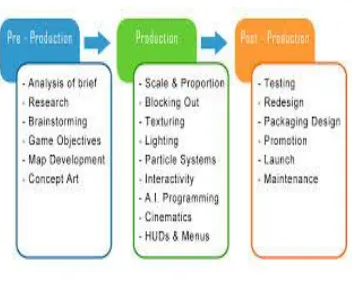
Figure 1: tasks in Production
tools since they have uses beyond development. The game tools may or may not be released along with the final game, depending on what the tool is used for. For contemporary games, it is common to include at least level editors with games that require them.
Game tools change very often during the development process. The look and facility of a tool from the beginning of a project to the end may change dramatically. Often features are added with very little testing to assist other developers as fast as possible. The use of a tool also changes so much that users may have difficulty operating it from one day to the next as late-added features change how it is to be used. Since facility is often the primary goal
for tools, they may be very
user-unfriendly, with little or no built-in help. For tools that are to be shipped with the game, often debugging and user-friendly features are done near the end of the development process.
The first Video games were
developed in the 1950s, but required mainframe computers and were not
available to the general public.
Commercial game development began in the 1970s with the advent of first generation video game consoles and home computers. Due to low costs and low capabilities of computers, a lone programmer could develop a full game. However, approaching the 21st century, ever-increasing computer processing
power and heightened consumer
expectations made it difficult for a
single developer to produce a
mainstream console or PC Game. The average price of producing a video game slowly rose from US $1–4 million in 2000 to over $5 million in 2006, then to over $20 million by 2010. However, mobile, web-based and indie games can cost much less.
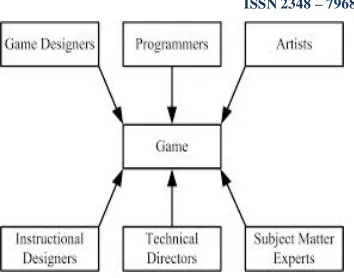
Figure 2: Members involved in designing game
Development is undertaken by a game developer, which may range from a single person to a large business. Traditional commercial PC and console games are normally funded by a publisher and take several years to develop. Indie games can take less time and can be produced cheaply by individuals and small developers. The indie game industry has seen a rise in recent years with the growth of new online distribution systems and the MOBILE GAME market.
A game is structured playing, usually undertaken for enjoyment and sometimes used as an educational tool. Games are distinct from work, which is usually carried out for remuneration, and from art, which is more often an expression of aesthetic or ideological elements. Key components of games are goals, rules, challenge, and interaction. Games generally involve mental or physical stimulation, and often both. Many games help develop practical skills, serve as a form of exercise, or otherwise perform an educational, simulational, or psychological role. Tug
of war is an easily organized,
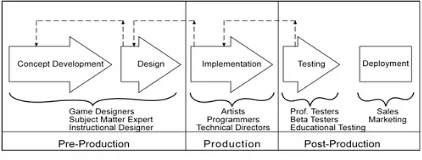
Figure 3: Process of game development
2 Tools
A game development tool is a specialized software application that assists or facilitates the making of a computer or video game. Some tasks handled by tools include the conversion of assets (such as 3D models, textures, etc.) into formats required by the game, level editing and script compilation. Almost all game development tools are developed by the developer custom for one game. Though tools may be re-used for later games, they almost always start out as a resource for a single game.
Games are often classified by the components required to play them (e.g. miniatures, a ball, cards, a board and pieces, or a computer). In places where the use of leather is well established, the ball has been a popular game piece throughout recorded history, resulting in a worldwide popularity of ball games such as rugby, basketball, football, cricket, tennis, and volleyball. Other tools are more idiosyncratic to a certain region. Many countries in Europe, for instance, have unique standard decks of playing cards. Other games such as chess may be traced primarily through the development and evolution of its game pieces.
Many game tools are tokens, meant to represent other things. A token may be a
pawn on a board, play money, or an intangible item such as a point scored.
Games such as hide-and-seek or tag do not utilise any obvious tool; rather, their
interactivity is defined by the
environment. Games with the same or
similar rules may have different
gameplay if the environment is altered. For example, hide-and-seek in a school building differs from the same game in a park; an auto race can be radically different depending on the track or street course, even with the same cars.
Figure 4: Requirements of production
3 Process
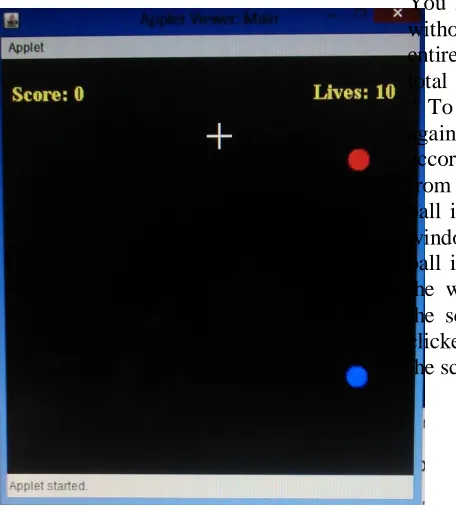
Figure 5: When the game starts
After double tap, the game starts and the balls start moving from the middle of the window. We have to click the balls in order to score the points. If we click on the ball, again the corresponding ball will start from the middle of the window and the score will be added accordingly.
Figure 6: when we double tap the window
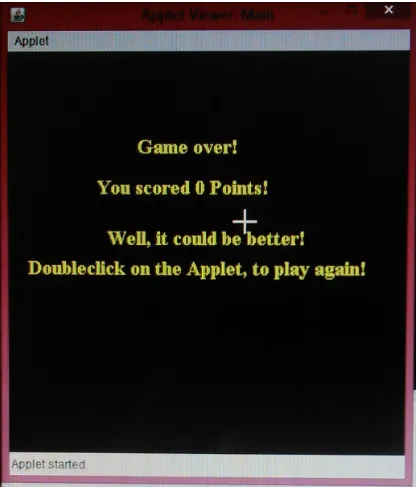
We have to make sure that the balls should not touch the walls of the window, if it touches, one life will be lost. Totally, you are provided with 10 lives.
Figure 7: when we loose lives for every touch of the ball to a wall
Figure 8: when total lives are completed
4 Conclusion
We discussed about the strategy of playing the game and scoring without losing lives, that means it develops our fast thinking, it will also train our reflexes to react faster. So we can improve our thinking ability. We also play games for entertainment purpose. In that way, this game will also play a prominent role. One can become good decision makers by playing these kind of games.
References
1. David P. Swain, David L.
Gallahue, and Frances Cleland
Donnelly (2003). Developmental
Physical Education for Today's
Children. Human Kinetics.
pp. 571–573.
ISBN 0-7360-3388-2.
2. Rink J. (2001). Investigating the Assumptions of Pedagogy in Journal of Teaching in Physical
Education. Human Kinetics
Publishers Inc. pp. 112–128 Vol 20, No. 2.
3. Eric Solomon (1984). Games
Programming. Cambridge
University Press. pp. 10–11.
ISBN 0-521-27110-X.
4. Victor C. Strasburger and
Barbara J. Wilson (2002).
Children, Adolescents and the
Media. Sage Publications.
pp. 122–123.
ISBN 0-7619-2125-7.
5. Jorg Bewersdorff (2004). Luck,
Logic,and White Lies: The Mathematics of Games. AK
Peters. p. xi.