10.15662/ijareeie.2014.0310037
Secure Communication of Images with
Bandwidth Conservation Scheme
J.Sai Harsha
1, B.VivekVardhan
2B.Tech Final Year, Dept. of ECE, Acharya Nagarjuna University, Guntur, A.P, India 1 B.Tech Final Year, Dept. of ECE, Acharya Nagarjuna University, Guntur, A.P, India2
ABSTRACT:We proposed a novel approach for highly secure, stable and simplified communication system. — In this
paper we use 2 level DWT and DCT watermarking to bring a complex and secure system. Other main aim of the paper is to implement watermarking of several images under single cover.
The paper also review the advantages of using proposed system in particular watermarking of several (4) images under single cover reduces the bandwidth required to transmit the data. This paper describes the proposed algorithm, implementation and results. Four images and single cover is used to test the system and the results are much efficient than existing systems.
KEYWORDS:DCT, DWT, Watermarking, Compression.
I.INTRODUCTION
We are living in the era of information where billions of bits of data is created in every fraction of a second and with the advent of internet, creation and delivery of digital data (images, video and audio files, digital repositories and libraries, web publishing) has grown many fold. Since copying a digital data is very easy and fast too so, issues like, protection of rights of the content and proving ownership arises. There are many encrypting systems to overcome copyright and also for security purpose.
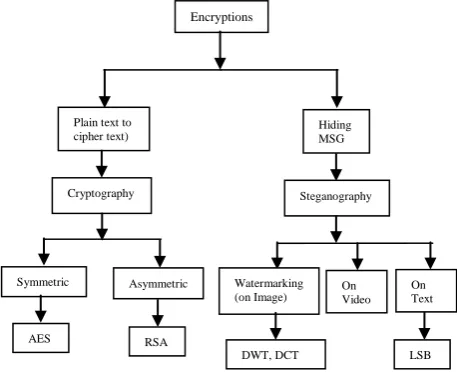
Fig. 1 Encryption Classification
The classification of encrypting system can be described by above Figure 1.
Encryptions
Plain text to
cipher text) Hiding MSG
Cryptography Steganography
Symmetric Asymmetric Watermarking (on Image)
On Video
On Text
RSA AES
For efficient protection against copyrights and also for secure and efficient communication we proposed this approach, it is a combination of Watermarking and Bandwidth Conservation Scheme. This proposed system will satisfies most important aims of cyber world i.e., Security, Stability and Simplicity.
Security and Stability can be increased by complicating the encryption system. That is why I used 2 level DWT and DCT watermarking in encoding process. Stability can also be improved by changing the format of encrypted image into other format such as .mat, which cannot be accessed by others.
Simplicity means reducing the size of data that to be transmitted i.e. bandwidth conservation. In general to implement watermark on an image we need a cover (i.e. for single image we need single cover). If we want to implement watermark on two or more images we require two or more covers, this lead to increase the data size enormously. But in this system I used single cover for multiple images for watermarking, this in return reduces the size of datathat to be transmitted.
II.EXISTING WATERMARKING SYSTEM (2 LEVEL DWT & DCT)
Presently for each secure image that to be transferred we use a cover for single image, to transfer more images we required more cover images.
For each image we use watermarking, that watermarking involves three steps
1. Decomposition of colour image into its RGB channels.
2. Each colour channel is decomposed into three spatial components using DWT. 3. Applying DCT to convert these components into respective frequencies.
The input cover image is decomposed into its R, G and B colour channels. For each colour channel, spatial components (LH, HL, HH) are generated by using DWT transform. Further, frequency components can be generated by applying DCT to every spatial component. Among these frequencies, mid frequencies are used to embed the watermark. To enhance security, a code can be created in which the coefficients of one colour channel signify the indices of the other colour channel.
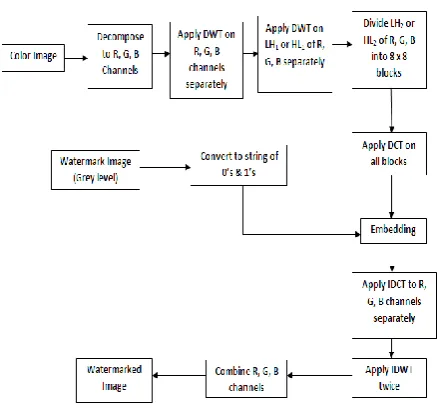
2.1 Watermark Embedding Algorithm
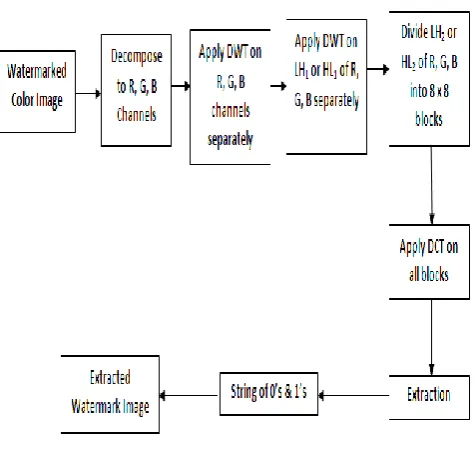
10.15662/ijareeie.2014.0310037 2.2 Watermark Extraction Algorithm
Fig. 3 Watermark embedding process
Figure 3 shows the block diagram of watermark extraction algorithm.
III.PROPOSED SYSTEM & EXPERIMENTAL RESULTS
Our proposed method will provide secure and efficient communication. This method uses single cover image to secure many confidential images.
In this project we considered four secure images that is Watermarked under single cover.
Our proposed method involves four steps
1. Create a blank image.
2. Combine four images into one image.
3. Use 2 level DWT & DCT method of watermarking on blue component of cover. 4. Send the Watermarked image to the receiver.
3.1 Considered Confidential Images
Fig. 6 Image C Fig. 7 Image D
3.2 Create a Blank Image
Create a blank image of size equal to 4 times single image considered.
Size of each image (considered) is 128*128.
Therefore size blank image is 4*128*128 = 256*256.
fori=1:256
for j=1:256
Z(i,j)=0;
end end
3.3 Combined Four Images
1. Take four confidential images A, B, C and D. 2. Resize each image into 128*128 resolution.
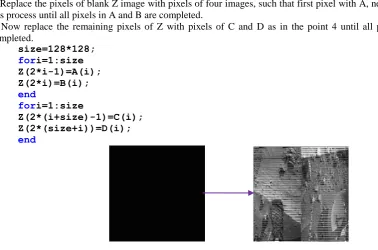
3. Replace the pixels of blank Z image with pixels of four images, such that first pixel with A, next pixel with B repeat this process until all pixels in A and B are completed.
4. Now replace the remaining pixels of Z with pixels of C and D as in the point 4 until all pixels in C and D are completed.
size=128*128;
fori=1:size
Z(2*i-1)=A(i); Z(2*i)=B(i);
end
fori=1:size
Z(2*(i+size)-1)=C(i); Z(2*(size+i))=D(i);
end
Fig. 8 Created Image Z Fig. 9 Compound Image Z
10.15662/ijareeie.2014.0310037
3.4 Apply 2 level DWT & DCT method of watermarking on blue component of cover
Modify the existing watermark system as prescribed below.
A. Watermark embedding over cover
Step involved in watermark embedding are
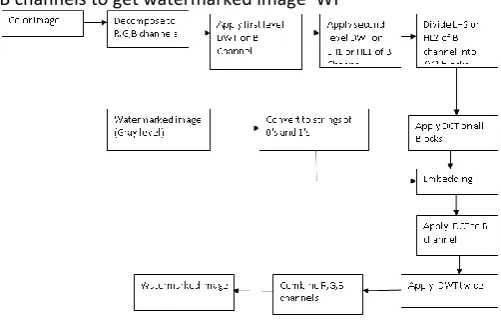
1) Select any color image as cover image, denote it by ‗I‘. Obtain R, G and B channels of cover image ‗I‘. 2) Apply DWT to B channel separately to get the multi-resolution sub-bands LL1, HL1, LH1, and HH1.
3) Apply DWT again to HL1 (or LH1) sub-bands of R, G and B channels and select HL2 (or LH2)sub-bands of B
channel.(Decomposition is continued only up to 2 levels as the energy becomes 0 at the third level.) 4) Divide the HL2 (or LH2) sub-bands of R, G and B channels into blocks of size 4X4.
5) Apply DCT to each of the blocks obtained in previous step. 6) Convert the watermark ‗w‘ into string of 0‘s and 1‘s.
7) To embed bits, first calculate average of middle band coefficients of first block of B component. 8) Repeat this process for all bits of the watermark.
9) Apply IDCT to the blocks of B channels. 10) Apply IDWT for 2 levels to B channels.
11) Combine R, G and B channels to get watermarked image ‘WI’
Fig. 10 Watermark Embedding in proposed system
Modified watermark embedding process is as shown in figure 10 (Watermark Embedding in proposed system)
B. Watermark Extraction
Steps involved in watermark extraction from cover are
1) Obtain R, G and B channels of watermarked image ‗WI‘.
2) Apply DWT to B channel to obtain the multi-resolution sub-bands LL1, HL1, LH1, and HH1.
3) Apply DWT again to HL1 sub-bands of B channel and select HL2 sub- B channel.
4) Divide the HL2 sub-bands of B channel into blocks of size 4×4.
5) Apply DCT to B block obtained in previous step.
6) Water marking bits are extracted from first block of B channel and repeat this process until extraction of all bits from all 4X4 blocks
Fig. 11 Watermark Extraction in proposed system
Modified watermark extraction process is as shown in figure 11 (Watermark Embedding in proposed system)
Experimental inputs and Results
Cover image and Watermark image (Z) are shown in figures 12 and figure 13 respectively.
By using this system, watermarked image is same as of cover image, no human eye can distinguish them. This makes the image appears as normal image with no significant information.
Fig. 12 Cover Image
Fig. 13 Z Image (Watermark)
10.15662/ijareeie.2014.0310037 Fig. 14 Resultant of watermarking
3.5 Decoding Process
Decoding Process is exactly the reverse process of Encoding. Steps
1. Extracting Watermark image Z.
2. Extract four confidential images from Z.
Extracting each images from Z can be implemented using below code.
fori=1:128
for j=1:128
A(i,j)=w(2*i-1,j+128); end
end
A. Experimental Results
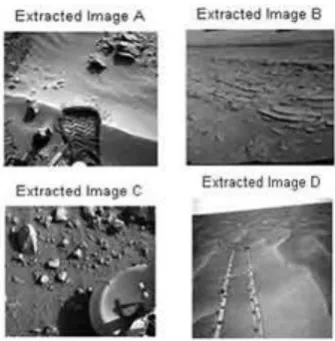
The decoding architecture (process) of proposed system is as shown in figures below.
Fig. 17 Extracted confidential images A, B, C & D from Z
IV. FUNCTIONS USED FOR PROPOSED SYSTEM & EXECUTION RESULTS
TABLE 1: DESCRIBES THE MATLAB FUNCTION USED IN THE PROPOSED SYSTEM AND ITS EXECUTION RESULTS.
IV. COMPARISONOFRESULTS
In my proposed system we need single cover to transmit many images (4).
In this paper I used 4 images of each 120 KB and a cover image of 1MB. The resultant output size is 1MB.
In general four images require 4 covers i.e. 4 images of each 120KB require 4MB of covers (4 covers of each 1MB).
Thus data is compressed logically which results in efficient communication. Test Function Expected Result
Observed Result
Pass/ Fail
Main
Loads four confidential images and a cover image
A,B,C,D & Cover images are loaded
Pass
Create_ Image()
Create an image of size 4 times the each image.
Blank image of size 256*256 is created
Pass
Combine4() Combine 4 images in one
Image Z is created
Pass
Watermark_ encrypt()
Watermark Z on cover 2 level DWT & DCT is applied Pass Watermark_
decrypt()
Extract Z image from Watermarked cover
Z image is extracted Pass
Split4()
Extract 4 images from Z A,B,C & D images are extracted
10.15662/ijareeie.2014.0310037
TABLE 2: COMPARISON BETWEEN CRYSTOMARKING (PROPOSED SYSTEM) AND GENERAL WATERMARKING SYSTEM No of images to hide Size of total image to hide No of covers Size of covers Total size of data Band width conserv ed Crystoma rking 4 (120KB each ) 480 KB 1 (1 MB each)
1 MB 1504
KB 3072 KB General Watermar king
4 480 KB 4 4 MB 4576
KB
0 KB
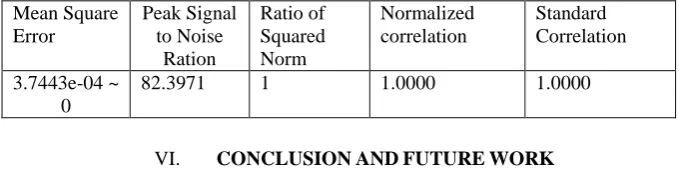
TABLE 5.1: COMPARISON BETWEEN ORIGINAL COVER AND WATERMARKED IMAGES
VI. CONCLUSIONANDFUTUREWORK
This paper introduces the effective and efficient method of communication in unreliable environment that can modify the previous techniques. This method is simpler to use and very reliable. Special configuration (hardware) is not a necessity. Using this method efficient bandwidth consumption for transmitting the data worked out practically and the results are displayed.
The above proposed method can be made more secure, stable, and efficient by implementation of the best lossless compression algorithm and also by providing a biometric or face recognition as an authentication to access this algorithm.
ACKNOWLEDGMENTS
We would like to acknowledge the help from all my classmates and faculty especially Dr. P. Siddaiah (Principal& H.O.D), Dr. E. Srinviasa Reddy (Dean), Er.S.NagakishoreBhavanam (Asst Prof) and Mr.GouthamBommidi.
REFERENCES
[1] Vladimir Britanak, Patrick C. Yip and K.R. Rao, "Discrete Cosine and Sine Transforms", Boston: Academic Press, 2006. [2] Gonzalez, Woods, and Eddins, "Digital image processing using MATLAB
[3] Guangmin Sun, Yao Yu, ― DWT Based Watermarking Algorithm of Color Images‖, Second IEEE [4] Conference on Industrial Electronics and Application‖,2007, PP 1823-1826.
[5] Stefan Katzenbeisser and Fabien A. P. Petitcolas, "Information Hiding Techniques for Steganography and Digital Watermarking," Artech house, Computer security series, pp. 15-23, 97-109, 2000.
[6] Neil F.Johnson, Zoran Duric and SushilJajodia, "Information Hiding, Steganography and Watermarking-Attacks and Counter Measures" Kluwer academic publisher, pp. 15-29, 2003.
[7] Douglas R. Stinson "Cryptography Theory and Practice", Chapman & Hall/CRC Press, 3rd Edition, pp. 211-214, 2006
[8] Nan Li, ―Research on Diffie – Hellman Key Exchange Protocol‖, IEEE 2nd International Conference on Computer Engineering and Technology, 2010, Volume 4, pp 634 – 637
[9] N .Provos, ―Defending Against Statistical Steganography,‖ Proc 10th USENEX Security Symposium 2005.
[10] Steven W. Smith , The Scientist and Engineer's Guide to Digital Signal Processing.M. G. J. Fridrich. Practical steganalysis of digital images - state of the art. Security and Watermarking of Multimedia Contents IV, 4675:1–13, 2002..
[11] D. E. R. Denning, Cryptograghy and Data Security, Reading, Massachusetts: Addison-Wesley, 1982. Mean Square Error Peak Signal to Noise Ration Ratio of Squared Norm Normalized correlation Standard Correlation 3.7443e-04 ~ 0
[12] C. C. Chang, M. S. Hwang, and T. S. Chen, "A new encryption algorithm for image cryptosystems," The Journal of Systems and Software, vol. 58, pp. 83-91, 2001.
[13]A Fragile Watermarking Scheme for Image Authentication with Tamper Localization Using Integer Wavelet Transform[J]. P. MeenakshiDevi, Journal of Computer Science, 2009, 5: 831-837.
[14]R.G.V. Schyndle, A.Z. Tirkel, C.F. Osbrone, "A digital watermark," Proceedings of IEEE International Conference on Image Processing, vol.2, 1994, pp. 86-90.
BIOGRAPHY
Jorige Sai Harsha, He is a Final Year BTech student in Dept. of Electronics and Communication Engineering atAcharyaNagarjuna University, Guntur (A.P), India. He has published andpresented several papers in different national and international conferencesand journals. His research areas are Digital Image Processing, NetworkSecurity, Communication and Embedded Systems. Currently he is working in field of Embedded System.