THE IMPLEMENTATION
OF THE FRENCH SUBJECT CURRICULUM
IN ITS INFLUENCE
ON PERFORMANCE
IN PUBLIC SECONDARY
SCHOOLS IN SIAYA COUNTY,
KENYA
BY
OWINO CHRISTINE ACHIENG'
E55/CEI11956/08
A RESEARCH
PROJECT
SUBMITTED IN PARTIAL FULFILMENT
FOR THE REQIDREMENTS
OF THE DEGREE OF MASTER OF
EDUCATION
IN THE DEPARTMENT
OF EDUCATIONAL
MANAGEMENT,
POLICY AND CURRICULUM
STUDIES OF
KENYATTA UNIVERSITY
DECLARATION
This research project is my original work and has not been presented for the award of the degree of Master of Education in any other university.
&t)
Date: ---=~--~+---~-13
/06
ko,t-f-I
IOwino Christine Achieng' E55/CEIl1956/08
This project has been submitted with our approval as University Supervisors.
---:=? ~
1.__--'~_•.•...
~====-i
=<...L} __ ~_~...::.""~.----Prof. Grace W.BunyiDate:
---~---~---Associate Professor ~
Department of Educational Management, Policy and Curriculum Studies
Kenyatta University
2.
,i.
':L
'£A?~
Date:Dr.Levi 1.Libese Senior Lecturer
Department of Educational Management, Policy and Curriculum Studies
DEDICATION
ACKNOWLEDGEMENTS
First, I thank the Almighty God for the gift of life and for enabling me complete this project.
My sincere appreciation goes to my two supervisors, Prof. Grace Bunyi and Dr. Levi Libese whose expertise and guidance have made this project take shape into completion.
I am also grateful to Mr. Maurice Nyadhianga who was always available to advise me and Mrs. Grace Otieno for her invaluable moral and material support during the preparation of this document.
TABLE OF CONTENTS
Content Page
Title Page i
Declaration ii
Dedication iii
Acknowledgements iv
Table of Contents v
List of Tables x
List of Figures xi
Abbreviations and Acronyms xiii
Abstract xiv
CHAPTER ONE: INTIWDUCTION 1
1.1 Background to the study 1
1.2 Statement ofthe problem , 14
1.3 The Purpose of the Study 14
1.4 Objectives of the Study 15
1.5 Research Questions 15
1.6 Significance of the Study 15
1.7 Assumptions of the Study 16
1.8 Limitations of the Study 16
1.9 Delimitations of the Study 17
1.10.1 Gardner's socio-educational model oflanguage learning motivation 17
1.10.2 Vygotsky's sociocultural theory ofleaming 18
1.11 Conceptual Framework 18
1.12Definition of operational terms 20
CHAPTER TWO: LITERATURE REVIEW 21
2.1 Introduction 21
2.2 Determinants of French Language Selection 21
2.3 Instruction Strategies Used to Teach French 25
2.4 Challenges facing Curriculum Implementation 31
2.5 Summary of the Literature Review. 35
CHAPTER THREE: METHODOLOGY AND DESIGN 36
3.1 Introduction 36
3.2Research Design 36
3.3 Locale of the study ., 37
3.4 Target Population 38
3.5 Sampling 38
3.6 Data Collection Instruments 39
3.6.1 Pilot Study 40
3.6.2 Validity 41
3.6.3 Reliability 41
3.7 Data Collection Procedures 42
3.8 Data Analysis 42
3.9Logical and Ethical Considerations 42
CHAPTER FOUR: DATA ANALYSIS, PRESENTATION OF FINDINGS AND
DISCUSSION , 43
4.1 Introduction 43
4.2 Background Data ofthe Respondents 43
4.2.1 Gender of students 44
4.2.2 Teachers Gender 45
4.3 Determinants of Selecting the French Subject 45
4.3.1 Reason for not Choosing French 46
4.3.1.1 School-Related Reasons 46
4.3.1.1.1 Method of Subject Selection 46
4.3.1.2 Subject-Related Reasons 48
-
.
4.3.1.3 Student-Related Reasons 50
4.4 Reasons why Students choose to Study French 54
4.4.1 Reasons why Students choose to Study French 54
4.4.2 Type of motivation of students who study French 57
4.5 Instruction Strategies used by Teachers 58
4.5.1 Use of Translation Method 58
4.5.2 Use of Rote Method in French Instruction 59
4.5.3 Use of Grammar and not much communication 60
4.5.4 Use of Participatory Approach in French Instruction 61
4.5.6 Use of Audio-visuals in French Instruction 63 4.5.7 Use of Read Alouds in French Instruction 64 4.5.8 Use of shared reading in French Instruction 65 4.5.9 Use of guided reading in French Instruction 66 4.5.10 Use of reading in small groups in French Instruction 67 4.5.11 Use of Independent Reading in French Instruction 68 4.5.13 Use of chalk and talk in French Instruction 69 4.5.12 Use of use Individual Instruction in French Instruction 70 4.6 Challenges facing implementation of the French Subject curriculum 71
4.6.1 Availability of a French Room 71
4.6.2 Adequacy of class textbooks 72
4.6.3 State of Resources for Learning French 73
4.6.4 Number of French.Lessons 75
4.6.5 Adequacy of the French Lessons 75
4.6.6 Influence oflearning resources on performance in KCSE 77
CHAPTER FIVE: SUMMARY, CONCLUSION AND RECOMMENDATIONS
5.1 Introduction "' 79
5.2 Summary of the Study 79
5.3 Summary of the findings ~ 80
5.4 Conclusion 82
5.5 Recommendations 82
References 84
Appendix I: Students' Questionnaire 89
Appendix II: Teachers' Questionnaire 95
Appendix III: Interview Schedule for Principals 103
Appendix N: Research Budget. 1034
Appendix V:Work Schedule 1035
Appendix VI:Letter of Authorisation 1056
LIST OF TABLES
Table Page
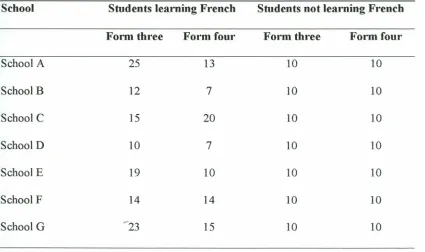
Table 1.1KCSE French candidature from 2005-2010 8 Table 1.2: Students' grades in KCSE French from 2005-2010 (in %) 11 Table 3.1 Respondents to be included in the study 39
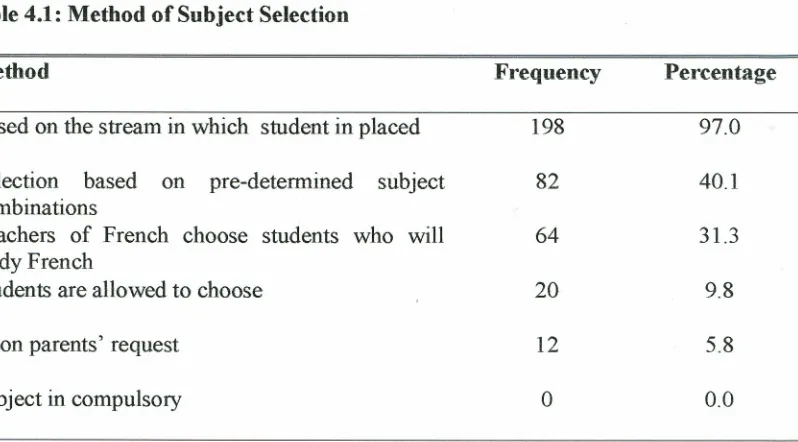
Table 4.1:Method of Subject Selection 46
4.3.1.2 Subject-Related Reasons 48
Table 4.2: Subject-Related Reasons 48
Table 4.3: Student-related reasons for choice ofthe French Subject 50
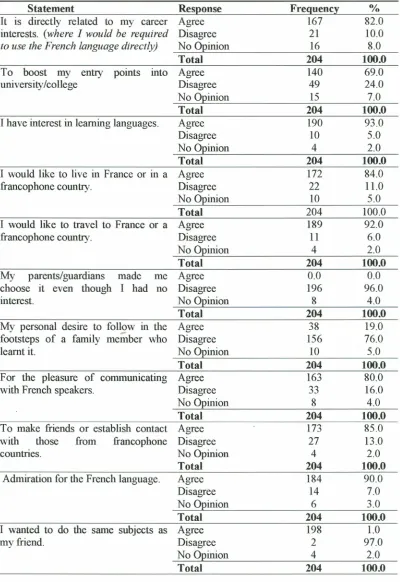
Table 4.4:Reasons for choice of the French Subject according to Teachers 53 Table 4.5:Responses showing reasons why students choose to Study French 55
Table 4.6: Type of motivation of students who study French 57
Table 4.7:Availability ofa French Room 71
Table 4.8: Adequacy of class textbooks 72
Table 4.9: Students' responses on adequacy of class textbooks 72
Table 4.10: Number of French Lessons 75
LIST OF FIGURES
Figure Page
Figure 1.1 Conceptual Framework of the Study 19
Figure 3.1:Map ofSiaya County 37
Figure 4.1:Distribution of Respondents in the Study 44
Figure 4.2: Gender of Students 44
Figure 4.3: Teachers' Gender : 45
Figure 4.4:Use of Translation Method 58
Figure 4.5:Use of Rote Method in French Instruction 59
Figure 4.6:Use of Grammar and not much communication 60
Figure 4.7:Use of Participatory Approach in French Instruction 61
Figure 4.8:Use of Songs in French Instruction 62
Figure 4.9:Use of Audio-visuals in French Instruction 63
Figure 4.1 0:Use of Read Alouds in French Instruction 64
Figure 4.11: Use of shared reading in French Instruction 65
Figure 4.12 : Use of guided reading in French Instruction 66
Figure 4.13: Use of reading in small groups in French Instruction 67
Figure 4.14: Use of Independent Reading in French Instruction 68
.Figure 4.15: Use of chalk and talk in French Instruction 69
Figure 4.16: Use of use Individual Instruction in French Instruction 70 Figure 4.17: Teachers' responses on availability and adequacy of other resources 73
Figure 4.18: Teachers' responses on the effect oflearning resources on performance in
Figure 4.19: Students'Responses on Effects ofLeaming Resources on performance
COE
FSL
GOG
JHS
KATF
KCSE
KNEC
MOE
OCT
SHS
SLA
ABBREVIATIONS AND ACRONYMS
Colleges Of Education
French As A Second Language
Government Of Ghana
Junior High School
Kenya Association of Teachers of French
Kenya Certificate of Secondary Education
Kenya National Examinations Council
Ministry of Education
Ontario College Teachers
Senior High School
ABSTRACT
The study was based on the fact that students joining universities with grade A had (and still have) difficulty expressing themselves in French since these results are usually a reflection of concerted efforts between the learners and the teacher and do not therefore always reflect the true level of communicative competence of the learner. The objectives of the study were to fmd out determinants of the selection of the French subject by students, instruction strategies used by teachers, challenges facing the implementation of French subject curriculum and to suggest solutions to these challenges. The study was based on Gardner's socio-educational model of language learning motivation and Vvgotsky's sociocultural theory of learning. The study adopted both the descriptive survey design and ex post facto design and targeted 1,300 students and 13 teachers of French. Questionnaires and interviews were used to collect data. A pilot study was conducted to establish the reliability and validity of the instruments. Both qualitative and quantitative data analyses were employed. Quantitative analysis involved derivation of statistical descriptions and interpretation by use of descriptive statistics such as tables,
pie charts and bar graphs. The study revealed that students do not choose French due to negative attitudes towards the subject, perceived difficulty of the subject and aversion to learning three languages in schools. The study also revealed that teachers were using a number of instruction strategies to varying degrees. They include translation method,
rote instruction, grammar is an instruction, participatory approach, use of songs, use of audio visuals, use of read alouds, shared reading, use of guided reading, reading in small groups, independent reading and the chalk and talk instruction strategy. It was further established that most schools did not have adequate class texts and other resources such as audio and video cassettes, necessary to the teaching and learning of French. In addition, none of the schools has embraced the use of modern technology (internet resources) in teaching of French. The study recommended that the government should introduce a policy where students must study one foreign language during their four-year secondary cycle. The Ministry of Education should provide in-service training for teachers of French on the instruction strategies to use so as to enhance curriculum delivery. Teachers training curriculum should be modified to emphasise more on various instructional strategies. The government should encourage the teaching and learning of French in public secondary schools through building of French resource centres well-equipped with other learning materials such as French magazines and electronic media.
CHAPTER ONE
INTRODUCTION
1.1 Background to the study
The teaching of foreign languages has been regarded as important in education curricula
throughout the world. Huebner (1959) says that foreign languages are the most
broadening and most cultural elements of a liberal education. Learning a foreign language
presents so many interesting facets. These include, expanding one's view of the world,
encouraging critical reflection on the relation between language and culture, expands
meaningful leisure activities such as travel and viewing of foreign language films and
television programmes. It also helps develop one intellectually, encourages good learning
habits, memorization, combining course content and skills in a meaningful way, not
forgetting opening up job opportunities for individuals.
Finnocchiaro (1973) summarizes the value of studying foreign languages in the following
ways: it gives one the ability to speak a foreign language with people of another culture,
either for business or pleasure. Additionally, it gives one the ability to read the language
with greater ease and enjoyment, making possible the broadening effects of direct
acquaintance with the recorded thoughts of another people or making possible for
vocational or professional purposes.
In addition to geographical reasons, there are also reasons in line with global standards
responsible for the emphasis placed on French. Languages originating from the European
continent such as German, Spanish, Portuguese, English and French have gained a lot of
recognition and have consequently become foreign languages to non-native users and
The inclusion of French is not surprising as it is considered a major European language with a
long tradition of being a foreign language.
According to Gregory (2003), French, along with English, is the working language of: The
United Nations (UN), United Nation Educational, Scientific and Cultural Organization
(UNESCO), International Olympic Committee, 31 Member Council of Europe, European
Committee, Universal Postal Union, International Red Cross, Union of International
Associations (UIA) and a host of others. It is also one of the international languages mostly
used in areas such as commerce, scientific and technological research, administration,
education, literature, and medicine. French is the second most frequently taught foreign
language in the world (Gregory, 2003).
In 2003, the Canadian federal government released The Next Act: New Momentum for
Canada's Linguistic Duality, an action plan demonstrating the government's commitment
to promoting the country's two official languages, English and French. An important
-educational goal outlined in this document was to double the number of Canadian
secondary school graduates with a functional level of bilingualism in their second official
language by the year 2013 (Government of Canada, 2003). The government pledged to
improve core English and French programs, revitalize immersion programs and increase
the number of qualified teachers by providing financial support that would enable
provinces and territories to recruit second language (L2) specialists and provide teachers
with professional development opportunities.
Following the completion of The Next Act in 2008, the federal government introduced
several courses of action regarding Canada's two official languages, including
"emphasizing the value of linguistic duality amongst all Canadians" and building the
future of French and English in Canada by investing in youth. The Government
reaffirmed its pledge to support programs aimed at education in the language of
official-language minority communities, and in second-official-language (L2) education (Government of
Canada, 2008).
According to this document, surveys have revealed an increased interest in learning the
second official language in Canada, particularly amongst young people, who believe that
learning a L2 is important for their communities and children, who will be afforded better
job opportunities in the future due to their linguistic abilities (Government of Canada,
2009). The Roadmap also states that a majority of those surveyed are interested in
learning more about the culture of those who speak the other official language. Following
Roadmap for Canada's Linguistic Duality 2008-2013, which ended on March
31, 2013, the Government of Canada released the Roadmap for Canada's Official
Languages 2013-2018: Education, Immigration, Communities (Government of Canada,
2013), which reaffirms the previous commitment to promote the country's official
languages and enhance the vitality of official-language minority communities in the areas
of education, immigration and communities.
l.
This focus on L2 education in Canada undoubtedly led to an increase in the demand for
French as a Second Language (FSL) teachers. Salvatori (2009) reports that ofthe 212,000
members of the Ontario College of Teachers (OCT) in good standing, 24,000 hold
the demand, and therefore, the OCT grants a large number of temporary letters of approval each year to Ontario school boards, allowing those who do not have a specific qualification to be assigned FSL positions. However, most Canadian provinces and territories, including Ontario, continue to have a greater demand for FSL teachers than the supply can meet, and sometimes unqualified and ill prepared FSL teachers are being placed in the classroom (Salvatori, 2009). The question arises as to how effective these teachers are, and for the purpose of this study, how effective they feel they are.
The Government of Ghana (GOG), with support from the French Embassy, has been promoting and supporting French language teaching through Ghana's public education system particularly at the second cycle and tertiary levels of education since the early 1980s. Over the last two years, the Ministry of Education (MOE), with French Embassy support, has placed particular emphasis on supporting the Colleges of Education (COE) in three regions of the country: Eastern, Ashanti and Northern regions, where a fund to .support the training of tutors and lecturers at the teacher training level was set up to
develop the quality of French language teaching at the tertiary level.
The report also emphasized the need to introduce French into all Colleges of Education to
equip newly trained teachers to teach French in basic schools.
The White Paper on Report of the Education Reform Review Committee (Oct 2004)
clearly stated the Government of Ghana's intention to ensure that French became a
compulsory subject at the Senior High School (SHS) level and that efforts be made to
ensure that the Junior High School (JHS) curriculum prepares students to meet this
benchmark The White Paper on the Education Reform Review Committee's findings
also stated that: "It's also well established that an early and routine acquaintance with
second, third and fourth language confers on children great advantages in their life-long
proficiency in those languages... the facts of geography impose on Ghana a necessity to
promote among wide segments of the commercial and financial sector's workforce a
proficiency in the French language; Being an English-speaking country is also a source of
considerable competitive advantage in international economic and political relations
which Ghana needs to build upon. Therefore, government has in the past encouraged a policy of early introduction to English and French, ...in a balanced way with the primary
use of mother tongues in KG and Primary school and then with increasing intensity in
high school (GOG, 2004: P. 29).
National level interviews with the Deputy Minister of Education, Directors of the Teacher
Education Division, Curriculum Research and Development Division and Basic
Education and Secondary Education Division revealed that there had been limited
promotion of the teaching of French across the country and that very few students were
suggested that one of the main reasons for the lack of interest in French teaching has
stemmed from the challenges faced by SHS leavers who do not obtain a firm grounding
in French at JHS level. Other reasons for lack of French teachers and French language learning at all levels related to: limited numbers opting for French at teacher training
level, and a shortage of books and teaching/learning materials at all levels to encourage
the strong uptake of French among students.
According to Adepeju and Yetunde (2012), in Nigeria's present educational policy,
French is to be officially introduced to learners in Primary IV. Unfortunately, not only is
the teaching of French completely absent at this level in public primary schools, it has
also been observed that most Nigerian public secondary schools do not offer French, and
those that do so lay a lot of emphasis on the use of textbooks. This implies that textbooks
serve as the basis for most of the language input learners receive and the language
practice that take place in the class. Most worrisome is the fact that after such exposure of
students to French, they are still unable to use the language for meaningful
communication.
Adepeju and Yetunde (2012) further note that textbooks have been observed to be the
major resource used in the Nigerian French language classroom in the Junior Secondary
School (JSS). Those who are presently being taught French at this level, which is the
starting point for many Nigerian learners, do not demonstrate communicative proficiency
in it.Yet, the stipulation of the National Policy on Education (FGN, 2004) that French is the second official language in Nigeria implies that learners are expected to be able to use
student does not speak French because the textbooks used, which are a major resource in
the Nigerian classroom at this level, may not have appropriate communication activities
and exercises that may promote such communication. It is therefore necessary to assess
the activities and exercises in the recommended French textbooks for JSS students.
In Kenya, the French language was introduced into the system of education in direct
liaison with three of the objectives of Secondary School education which are: To enhance
understanding and respect for own and other people's cultures and their place in
contemporary society, enhance understanding and appreciation of inter-relationships
among nations, build a firm foundation for further education and training and to build a
foundation for technological and industrial development. A study done by Kimaru (1987) shows that before independence, French was only taught in schools for Europeans as only
Europeans were considered deserving the prestige, then associated with the language.
Later, it was introduced in two of the leading African schools- Alliance and Mangu High
Schools, as well as in Asian schools such as the then Duke of Gloucester - now Jarnhuri
High School.
Iraki (2006) states that for Kenya, several reasons explain the esteem with which the
French language is held by Kenyans. First, Kenya has many political and economic ties
with the Francophone countries around her. Secondly, a large number of international commercial organisations are found in Nairobi. Nairobi, the capital of Kenya, plays host
to various regional and international conferences. It is also one of the cities where the
working languages for the United Nations so this creates a need for teachers of Fren ~
interpreters and bilingual translators.
At independence, the Government of Kenya recognized French as one of the foreign languages to be taught in the country's secondary schools. Kenya Education Commission Report (1964) Paragraph 281 states ..."As regards other languages, we place French high up on the list because it is the common language of the more numerous half of Africa." Since its introduction in 1964, the French language has registered tremendous growth
with the number of secondary schools now standing at around 400 in 2011, according to the Kenya Association of Teachers of French (KATF). The number of learners, according to the same source, is around 30,000 (2011). This number would appear impressive but in effect, only about 3000 pupils sit the yearly Kenya Certificate of Secondary Examination (KCSE) at the end of the secondary school cycle. This is due to the high rate of discontinuation due to various reasons, most of which are derived from difficulties facing both learners and teachers of this language. In 1989, candidature ofKCSE students taking French was 1,376, rose to 1,783 in 1999 and only managed to hit the 2000 mark in the year 2003 with 2064 candidates. The table below shows candidature for KSCE French in the recent past (Kenya National Examination Council, 2011).
Table 1.1 KCSE French candidature from 2005-2010
Year Boys Git'ls Total Enrolment
2005 736 1525 2261
2006 869 1400 2269
2007 800 1345 2145
2008 754 1479 2233
2009 689 1520 2209
2010 730 1639 2369
The total KCSE candidature was 337, 404 and 357,488 in 2009 and 2010 respectively.
the total number of students who sat for KCSE examinations ill 2009 and 2010
respectively. It can therefore be observed that despite the increase in the number of
schools which offer the subject in the last three decades, the number of students who learn
French up to Form four level are negligible as compared to the total number of students
who register for the KCSE examination.
According to Chokah (2013) French was introduced in Kenya at the time of the
audio-visual approach. The Method used at the time was "Voix et Image de France" (1955
-1965). The evolution in teaching methods from the Traditional Method right through to
the Communicative Approach in the Kenyan situation has always been interspersed with
recourse to the Grammar - Translation method. Some of the main elements of the
Traditional Method: grammar, writing and translation still form an integral part of the
learning of French in Kenya. The dependency on written material in the Kenyan system is
born from the fact that a lot of emphasis is placed on success in written exams (as stated
•..
above) in all subjects, languages included. Learners, from primary to university, know
that they need notes to revise for exams; a habit which, unfortunately, negatively impacts
on the acquisition of the other skills in language learning. Observation in language classes
reveals that in a lot of cases, lessons are organized around a grammar point which serves
to evaluate the progress of the learner (Richards and Rodgers, 1986).
According to Richards, (2002) the Structuro-Global Audiovisual method (SGAV) that
was developed in the early sixties saw the arrival of different texts beginning with Voix et
Image de France (1960), De Vive Voix (1972), C'est le Printemps I (1975) and C'est le
have much impact on the teaching of French due to the fact that only some schools had
access to them. The Whitmarsh French Course and Practical French were tried but found
unsuitable for different reasons. In the meantime, the number of schools was growing so
fast that the Ministry of Education found it necessary to intervene and introduce one text
for all schools: Pierre et Seydou. The methodology here was based on the four stages of
the SGAV method: Presentation of the conversation, explanation, repetition, adaptation
and re-use of content and transposition (Richards, 2002).
Morin (2009) notes that the teacher was at the center of the whole process, first acting out
the different speakers while manipulating the figurines on the flannel graph and then
moving on to the rest of the steps. Pierre et Seydou was used and widely appreciated until
the Communicative Approach arrived with as its main objective, to center the learning
process on the learner and enable him to communicate in the foreign language. The
shortcomings of Pierre et Seydou became evident and another text considered more
suitable, Contact 1,II, III made its appearance in schools that had the means to access it.
Indeed, this text would have had greater impact had the Kenya Institute of Education
(hereafter KIE) not decided to take advantage of the change in the education system
(1985) to write a text that would be specific to the Kenyan situation: Parlons Francais
(Morin, 2009).
According to Barthelemy (2007), although.Parlons Francais has enjoyed popularity since
its release into the education system, not everyone is completely satisfied with it, hence
efforts by Kenyan teachers to come up with other texts: Au Sommet 1, 2,3 and 4 (2003 to
common in that they are based on the communicative approach. However, this has not
stopped experts from raising concerns about the performance of learners of French.
Whereas these concerns at secondary level may be limited to performance in the national
examination, Kenya Certificate of Secondary Education (KCSE), those at university level
are more in the area of communication skills (both oral and written). This then brings us
to the question of the challenges in the learning and teaching of French as a foreign
language. Why, after nearly fifty years of French in the education system, are there so
many gaps in the teaching and learning of this language? Under the current educational
system, French is offered as an optional subject in secondary school. Students can study it for 2 or 4 years depending on whether they decide to retain it as an examinable subject for
the final examination - KCSE. The subject is also offered in most private primary
schools.At this level, it is not examined nationally (Barthelemy, 2007).
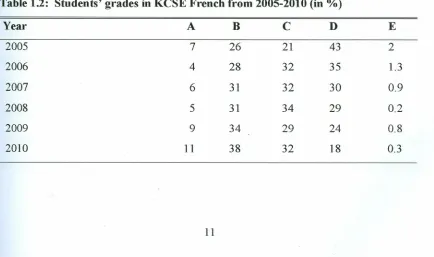
Table 1.2 presents grading of students who sat for KCSE French examination from the years 2005 to 2010. The figures are expressed as a percentage of the total number of
candidates for the respective years. (see Table 1.1)
Table 1.2: Students' grades in KCSE French from 2005-2010 (in %)
Year A B C D E
2005 7 26 21 43 2
2006 4 28 32 35 1.3
2007 6 31 32 30 0.9
2008 5 31 34 29 0.2
2009 9 34 29 24 0.8
The language policy in Kenya has over the years given prominence to English as the
official language and Kiswahili as the national language. With the change of the system
of education in 1985, Kiswahili, while maintaining its status, also became a compulsory
examinable subject at both primary and secondary level. The Constitution of Kenya (2010) further gives Kiswahili the status of official language alongside English. The
status of local languages in the education system has continued to diminish over the same
period (i.e. since independence in 1963) to an extent where they have a very minor role in
the early years of learning and even then, only in a small number of schools in the rural
areas. What is important to note is the fact that the more than 42 main local languages
have the same linguistic status.
According to Mutua (2005) foreign languages have suffered from lack of clear policies
that should guide their status and place in the education system. Even though they have
had their place in the education system for over 45 years, there has never been a proper
system of sensitization to their importance. The introduction of French in some schools,
for instance, has been guided by the personal interest of the administration of the
particular school. The way France and the French language are portrayed plays an important role in this decision. Whereas foreign languages are virtually non-existent in
public primary schools, the system of clustering of subjects in secondary schools has had
a negative impact on all foreign languages. French has been placed in one "Group" with
German, Arabic, Sign Language, Music and Business Studies. For choice of subject,
French is then put in unfair competition with subjects such as Agriculture, Religion, Fine
importance is laid on success in examinations, students will choose subjects where they
are likely to get good grades with fewer challenges.
Muya, (2010) further argues that the change of the education system in 1985 reducing the
secondary school period from sixto four years had an impact on the teaching and learning
of French and the quality of teacher education that is still felt today. Public universities,
unprepared for the large numbers admitted through the Joint Admissions Board (JAB),
had concentrated on revising academic course content in order to cater for the new crop
of learners without compromising quality. While this could be done with relatively little
effort for the traditional subjects such as History, Geography, English, Christian
Education and the Sciences, it was not so for foreign languages such as French which is
only introduced at secondary school level in public schools. Kenyatta University found
itself admitting into the REd programme learners who only had 300 hours of French (or
level A2 of the Common European Framework for Reference), but who were expected to
go out and teach after only four years of concurrent academic and professional training.
According to Muya (2010) due to numerous challenges faced by both teachers and
learners in secondary school, even those coming into the university with grade A had (and
still have) difficulty expressing themselves in French since these results are usually a
reflection of concerted efforts between the learners and the teacher and do not therefore
always reflect the true level of communicative competence of the learner. Once at the university where they are expected to work independently, they often become
scholarship system for teachers of French. The scholarships to study in France have now
become few and far between with attention turning to the Doctorate level and other fields
outside the teaching and training of teachers of French: History, Agriculture,
Environmental Studies, to name a few.
1.2 Statement of the problem
Despite the growth in number, of schools offering French and the support received from
the Kenyan and French governments, the number of students opting to learn the language
is small and has remained constant especially in the last five years, as shown in Table 1.2
above. The current study therefore sought to establish factors influencing the selection of
the French subject by students. According to Muya (2010), students joining universities
with grade A had (and still have) difficulty expressing themselves in French since these
results are usually a reflection of concerted efforts between the learners and the teacher
and do not therefore always reflect the true level of communicative competence of the
learner. The current study therefore investigated instruction strategies used by teachers
when teaching the French subject as well as the challenges facing the implementation of
the French curriculum in secondary schools in Siaya County.
1.3 The Purpose of the Study
The purpose of the study was to assess the implementation of the French Curriculum in
1.4 Objectives of the Study
The proposed study focused on the following objectives:
1. To find out determinants of the selection of the French subject by students in
secondary schools in Siaya County.
11. To establish instruction strategies used by teachers to teach the French subject in
secondary schools in Siaya County.
111. To identify challenges facing the implementation of French subject curriculum in
secondary schools in Siaya County.
IV. To suggest solutions to challenges facing the implementation of the French
curriculum.
1.5 Research Questions
The study was guided by the following research questions:
1. What are the determinants of the selection of the French subject by students in
secondary schools in Siaya County?
11. What instruction strategies do teachers use to teach the French subject m
secondary schools in Siaya County?
lll. What challenges do teachers face when implementing the French subject
curriculum in secondary schools in Siaya County?
IV. What are the solutions to challenges facing the implementation of the French
curriculum?
1.6 Significance of the Study
The findings of the study had both theoretical and practical implications for the future of
advancement of knowledge in this field of study. Other researchers can use it as a basis
on which to develop their studies. Practically, it will be useful to curriculum developers as
it will shed more light into the needs and interests of the learners. It will also help
practitioners make their classroom teaching experiences more fruitful. Rivers (1983),
states that the value of SLA research for teachers of second and third languages is that it
provides them with knowledge to devise the most effective learning situation.
1.7 Assumptions ofthe Study
In the project report, the following assumptions were made:
All respondents will be cooperative and provide reliable responses.
All students selected for the study have gone through the same level of tuition in
terms of teaching time and covered the same syllabus.
Teachers of French included in the study are qualified to teach.
The study will be carried out smoothly within the stipulated time, with no problems.
1.8 Limitations of the Study
The study limited itself to schools in Siaya County, therefore findings may not apply
elsewhere. For a more conclusive result, more schools should have been included.
However, this is not possible due to constraints such as time and finances.
Secondly, samples to be used for the study were small. This is due to the fact that
schools in the region that offer French as a subject are few. Additionally, given that it
is an optional subject, few students select it.
In Kenya, there is a dearth of literature on factors that influence choice of and
1.9Delimitations of the Study
• The proposed study will confine itself to secondary school students taking French in Siaya County.
• Additionally, the students to be included in the sample were those in session in the respective institutions as at the time of the study. Those absent were
not included though their input would have been of benefit for this research. • Student respondents were selected without considering gender.
1.10 Theoretical Framework
This study is based on two theories: Gardner's socio-educational model of language learning motivation and Vvgotsky's sociocultural theory of learning. Gardner's model is applied to the dependent variable of choice, in this study, while the sociocultural theory is applied to the variable of performance.
1.10.1 Gardner's socio-educational model of language learning motivation
Gardner (1985), developed a socio-educational model in the field of language learning motivation. He proposed that in order to understand why learners were motivated to learn a language, it is necessary to understand the learner's ultimate goal and purpose for .
done by Masogret & Gardner (2003), found that there was a positive correlation between
both types of motivation and achievement.
1.10.2 Vygotsky's sociocultural theory of learning
Mansoor&Haghani (2012) state that in the sociocultural theory, learning is thought of.as
a social event taking place as a result of interaction between the learner and his
environment. One of the key contributors of sociocultural theory to the issue of language learning is that of participation, which combines the social context with individual
acquisition. In order for an individual to be a competent speaker, mere personal effort
would not result in mastery of the language unless he benefits from other people.
It applies to this study in that performance of learners in foreign language examination is
not only attributed to a learner's inherent characteristics such as aptitude but depends on
the interaction of the learner with his learning environment - the teacher, learning
resources and opportunities to practice the language outside the classroom and school.
Mansoor et al. (2012), state that the sociocultural theory lays great stress on the dynamic nature of interconnections among teachers, learners and tasks and advocates concepts of
learning which stems from interactions among individuals.
1.11 Conceptual Framework
Orodho (2009), states that a conceptual framework is a model presentation where a
researcher shows the relationship between variables graphically and diagrammatically. It
Figure 1.1 Conceptual Framework of the Study
IMPLEMENTATION OF THE
FRENCH SUBJECT CURRICULUM
Determinants of Instruction strategies Challenges Facing French subject used by teachers Implementation of the
selection by students French curriculum
I
STUDENTS' ACIDEVEMENT IN FRENCH LANGUAGE
Source: Researcher
The conceptual framework presents an interaction of dependent and independent
variables. The framework shows that students achievement in the French subject is
determined by reasons behind students choosing the subject and instruction strategies
used by teachers. This is however influenced by numerous challenges that affect the
1.12Definition of operational terms
Foreign language - a language learnt primarily for contact outside one's own community.
The language has no established functions inside the learner's community (Littlewood,
1984).For purposes of this research it will be used interchangeably with the term second
language.
Learner - a person who learns a foreign language in a formal environment e.g. In a
classroom.
Performance - the final grade a learner gets in KCSE French after learning it as a subject
CHAPTER TWO
LITERATURE REVIEW
2.1 Introduction
This chapter presents the reviewed literature on the implementation of the French
curriculum under the following themes: Determinants of French subject selection,
instruction strategies used to teach French, challenges facing curriculum implementation
and ends with the summary of the literature review.
2.2 Determinants of French Language Selection
In a study by Adelakan (2007) on the relativeness of French textbook methods on selected
outcomes in French, interviews revealed that stakeholders believed that fewer students are
taking French at junior high school (JHS) and senior high school (SHS) levels due to the
shortage of teachers, lack of books and the fact that French is not a core subject at either
level. Another study by Anderson (1998) titled motivational and cognitive influences on
conceptual knowledge: The combination of science observation and interesting texts
revealed that of the 26 students surveyed, 92% who knew someone who could speak
French (either a parent, teacher or friend) said that person influenced their choice to study
French. When asked whether or not they felt their parents encouraged them to study
French, 90% ofthe students agreed. Eighty-four percent of them agreed that their parents
stressed the importance that French will have for them when they leave high school.
A teacher observed that: "It's rare that parents care about what grade their student gets in
French" (Landry, & Allard, 1999), but are very concerned about what grades they get in
upon their children the importance of learning French, they encourage them to listen to
French programs on the radio, to read and write letters in French, and to maintain good
relations with their Senegalese counterparts. Parents could also emphasize the practical
importance of knowing French by referring to the growing number of francophone
companies in The Gambia, like Elf and Gamtel. These seem like valid suggestions,
especially considering that 96% of the students surveyed agreed that knowing French will
be useful in getting a good job, and 77% agreed that studying French is important to them
so they can make good friends more easily among French-speaking people. These studies
relied on interviews as the only data collection instruments which are susceptible to
interview bias and thus compromising the accuracy of the findings. The current study will
in addition use questionnaires where responses are gathered in a standardised way, so
they are more objective, certainly more so than interviews.
In a meta-analysis of comprehension strategy instruction for upper elementary and middle
-school students in Gambia by Huguet (2010), poor quality of teaching coupled with
insufficient class time further exacerbates the conditions of French classes and may
discourage students even more from continuing to study French. In fact, the total number
of grade 9 students has increased by 48.2% in the last five years, while the number of
grade 9 students taking French has decreased by 12.43% (Huguet, 2010). One reason
according to the study is they simply do not see the value in knowing French. According
to on teacher, the Gambia does not attract as many French tourists as German and
Swedish, so there is little motivation to learn French in order to communicate with
tourists. The teacher noted that, "if there were French tourists, perhaps students, or
aspiring to go to France someday." The current study seeks to establish whether the same
conditions influence students' selection of French as a subject in Kenyan schools.
The study by Huguet (2010) further established that while it is true that The Gambia is
surrounded by francophone Senegal and is neighbours with many other French-speaking
West African countries, French is not the preferred means of communication among the
majority of people. The presence of several widely spoken African languages, Mandinka
and Wolof for example, allows citizens of different countries to communicate in
languages other than the official languages of French and English. This study relied on
interviews as the only data collection instruments which are susceptible to interview bias
and thus compromising the accuracy of the findings. The current study will in addition
use questionnaires where responses are gathered in a standardised way, so they are more
objective, certainly more so than interviews.
-Dagenais, (2008) in a study on availability, acquisition and use of teaching/leaming
resources of French language in secondary schools in Cameroon found the crowded
timetable was such a problem that school administrations added a ninth period to get the
French students back. One vice principal, said the best French students were often the
science students, the very ones who were unable to take French because of scheduling
conflicts. They also moved technical drawing classes to the weekend so those students
could take French. According to the study, another factor that affects which classes
students choose are end-of-the-year exams. In addition to the core subjects of English,
grades 7 to 8 count as "pass", and grade 9 counts as"fail." For ninth graders, only the two
best exam grades for elective subjects are calculated into the final JSSCE grade,
regardless of how many exams a student takes. The final exam for grade 12, the
WASSCE (West African Senior Secondary School Certificate Examination), is graded
the same way, but the three or four best exam grades for elective subjects are considered.
It is therefore in students' best interest to take only the exams they feel they will earn
credit for (Dagenais, 2008).
The study further notes that given the fact that the rate of failure for French exams is
usually over 50%, it "is not among the recommended subjects for success." It is important
to remember that only students who have a grade of "success" will be able to count the
French exam into their final JSSCE grade. The overwhelming rate of failure is
undoubtedly discouraging to students studying French, but the fact that most western
universities do not accept the WASSCE as high school completion causes students to lose
even more confidence in these exams (Dagenais, 2008).
According to Dagenais, (2008), even if a student, at either the junior or senior secondary
level, appreciated the value of knowing French, and was able to fit it into their schedule,
and maybe even wanted to take the final exam, there is still the issue of low quality,
uncaptivating teaching to dissuade them from taking French. As one teacher put it,
"Students don't want to learn French because of the teachers." Teachers with limited
pedagogical training or access to multimedia resources may not be familiar with effective
methods of teaching. In this case, they may resort to nothing more than written grammar
instruction, simply writing words without relating them to real life situations seems
pointless, notably at the junior secondary school level where students first learn French
(Dagenais, 2008).
2.3 Instruction Strategies Used to Teach French
In a study by Kembo (2007) titled inferencing in a second language, many of teachers
interviewed in the Ashanti and Northern regions indicated that they use translation methods
(moving from English to French) in teaching French at JHS level. Teachers in the rural areas
were particularly constrained in using this method because most of their pupils do not
understand English and therefore the French teachers were compelled to use the local
language in order to teach French. French teachers interviewed complained of students not
being able to understand them in class and they being unable to teach in French alone, having
to first translate from English or local language into French. On probing further, teachers
admitted that many of their children also did not have a strong grasp of English therefore they
had to use the local language in their classroom lessons.
Kembo (2007) also established that teachers of French also used the rote method where
pupils repeat what their teachers have spoken and memorize words. Teachers also mentioned
that they focused on grammar and not much communication was carried out in the classroom.
Interviews with training college tutors suggest that this was due to the lack of language
facilities where there is very little listening and oral practice in French. This study used the
descriptive research design in which often respondents are not truthful as they feel the
need to tell the researcher what they think the researcher wants to hear. This is
particularly difficult during interviews. Participants may also refuse to provide answers to
can turn an observation into an event where people are acting how they perceive they
should act. The current study used mixed methods research design to fill this gap.
The study byKhosravi (2009) on the effect of scanning and skimming on the rate of and
reading comprehension of Iranian EFL learners suggested thatthe in-service training at the
CREF exposed teachers to the use of more participatory approaches to teaching French (e.g.
small group methods and the introduction of songs and drama in their lessons) but this study
was unable to assess whether these were being applied at the classroom level thus the need
for the current study. Interviews with children revealed limited usage of songs and stories in
the teaching of French; more audiovisual materials such as radio, TV etc were needed to
make lessons more interesting. Interviews with JHS pupils also suggested that sometimes
teachers were harsh on their learners and that this dissuaded pupils from opting for French.
These studies relied on interviews as the only data collection instruments which are
susceptible to interview bias and thus compromising the accuracy of the findings. The
-current study will in addition use questionnaires where responses are gathered in a
standardised way, so they are more objective, certainly more so than interviews. This also
used the descriptive research design in which often respondents are not truthful as they
feel the need to tell the researcher what they think the researcher wants to hear. This is
particularly difficult during interviews. Participants may also refuse to provide answers to
questions they view to be too personal. Furthermore, the idea that someone is watching
can turn an observation into an event where people are acting how they perceive they
should act. The current study used mixed methods research design to fill this gap.
Ogunniyi (2004) in a study on effects of two instructional techniques on pupils
that teachers of French used read aloud(s) when teaching French. In read-aloud(s) the
teacher reads to the whole class or to a small group, using reading material that is at the
listening comprehension level of the students. According to one teacher, reading aloud
exposes students to new vocabulary, a variety of genres and contributes to oral and
written language development. The study also revealed that shared reading was also being used by teachers. In shared reading, the teacher would guide the whole class or a small
group in reading enlarged text that the students can see - for example, a big book, a
reading passage on overhead, a chart, a poster, or a book. The text could be read several times, first by the teacher and then with students joining in. Shared reading involved
active participation and considerable interaction on the part of both the students and the
teacher. According to Ogunniyi (2004), it is important that the teacher takes into account the difficulty of the text and the skills, knowledge, and experiences of the students when
structuring this activity. Shared reading provides the teacher of French with the
opportunity to model effective reading, promote listening comprehension, teach
vocabulary and reinforce letter-sound relationships. According to the study, the following
resources were used for shared reading: big books (Grade 4); texts taken from French
programs; word walls; sample of environmental print; poetry, songs and text written on
overhead or charts. This study used a survey research design while the current study used
a mixed method research design which allowed the researcher to build the study based on
the strength of both quantitative and qualitative research methods. In this study, data were
collected using interviews which mean that the researcher was not in a position to confirm
whether teachers applied these instruction strategies in class. The current study used
A study by Udosen (2010) on motivation for reading: the role of Instruction in Nigeria
revealed that teachers were using guided reading as an instruction strategy. Guided
reading was a small group, teacher-directed activity. It involved teachers using carefully
selected books at the student's instructional level. The teacher would support a small group of students as they read, talk and think their way through a text. Guided reading
groups usually consisted of four to six students who could apply the same reading
strategies and who were able to read similar texts with support. The teacher's role was to
help students to consolidate their reading strategies, provide opportunities for students to
apply strategies they have learned, supporting them in the correct application of the
strategies, and re-teaching the strategies if necessary. The study recommended that
teachers should select books that address the interests of their students and that are also
age and language appropriate. This study relied mainly on classroom observation which
was susceptible to observer bias and has Hawthorne effect where teachers performed
better knowing they were being observed. Observation also did not increase
understanding of why teachers and pupils behaved the way they did during French
lessons. The current study will on the other hand used questionnaires and interviews
which will help in establishing reasons behind the use of these instruction strategies by
teachers of French.
A study by Jahromi (2002) on the relationship between Cameroon French learners' sex
and level of proficiency and their reading comprehension strategy use reported that
independent reading was a strategy being applied in a number of the sampled schools.
During independent reading, students were given the opportunity to practise reading texts
and taught. According to Jahromi (2002) independent reading: allows students to practise and consolidate strategies that they have learned in the FSL class; fosters a positive
attitude towards reading; allows students to see themselves as competent readers in the
French language. The study recommends that that teachers should have a variety of
reading materials available at different levels. Texts may be selected by the student with
or without teacher support, or by the teacher. Reading materials at an appropriate level
and an interesting topic as well as brightly co loured illustrations will motivate the student
to read in a second language.
According to the study findings, independent reading was preceded by book talks and/or
mini lessons on book selection and reading strategies. In a book talk, the teacher would
introduce one or two sample texts to the students. This would take one or two minutes
and was used to stimulate student interest in the books. Students could then read on their
own or with a partner. It was observed that teachers would circulate in the room to observe reading behaviours and confer with students about what they were reading.
During the mini lesson, the teacher would model a specific reading strategy and the
students apply that strategy during the independent reading time. This study used mainly
classroom observation to collect data which did not increase understanding of why
teachers and pupils behaved the way they did during French lessons. The current study
will on the other hand used questionnaires and interviews which will help in establishing
reasons behind the use of these instruction strategies by teachers of French (Jahromi,
A study by Kwako (2011) on enhancing the development of vocabulary knowledge in
French language in Ghana reported that teachers of French were using "chalk and talk"
methods of teaching or lecture style of teaching French in the classrooms. Teachers of
French confirmed that the vast majority of the class was spent lecturing students,
particularly if the class size was large. Teachers of large class sizes spoke of how they
could hardly give out exercises for the students to do since they were unable to mark all
the notebooks. This study used a survey research design while the current study used a
mixed method research design which allowed the researcher to build the study based on
the strength of both quantitative and qualitative research methods.
Otieno (2009) in an investigation into pre-service teachers' perceptions of the value of
proficiency in spoken French: implications for teacher training programmes in Kenya,
classroom observation revealed that comprehensive reading instruction included the
teachiIig of a variety of reading strategies to help French language learners read with ease
and think critically about what they are reading. It also included whole class, small group,
and individual instruction to help students move from guided reading, shared reading and
reading aloud to independent reading. This study relied mainly on classroom observation
which was susceptible to observer bias and has Hawthorne effect where teachers
performed better knowing they were being observed. Observation also did not increase
understanding of why teachers and pupils behaved the way they did during French
lessons. The current study used interviews and questionnaires get feedback on the
A study by Mutea (2010) on performance in French at Kenya Certificate of Secondary
Examination (KCSE) revealed that no approach has had as strong an impact on the
teaching of French as the Communicative Approach which places the leamer at the centre
of the learning process. Unfortunately, an observation of classes in the Kenyan situation
shows that the teaching/learning culture of dependence on the teacher does not easily
allow for the complete independence of the learner. It is easy to see, even when it is not intentional, that the teacher is central in most classroom interactions. The study revealed
that the first thing that learners do when they arrive in class is to take out their exercise
books and pens, ready to take down notes from the teacher and this, whatever their level.
The teacher, rather than playing the role of "mediator" or "facilitator" or "guide" is forced
to play center role and very often resorts to drilling the learners to get expected results.
This study relied mainly on classroom observation which was susceptible to observer bias
and has Hawthorne effect where teachers performed better knowing they were being
observed. Observation alse did not increase understanding of why teachers and pupils
behaved the way they did during French lessons. The current study used questionnaires
and interviews to fill this gap.
2.4 Challenges facing Curriculum Implementation
In a study by Rogers and Richards (2005) on approaches and methods in French language
teaching, interviews with teachers of French and observation at the classroom level
suggested there were very few French materials or audio visual equipment available.
Teachers in the Ashanti districts spoke of bringing in their own cassette recorders on
some occasions or allowing the children to watch a French video. Less endowed schools
apart from the textbooks. The researchers only observed very few classroom lesson plans
for French and no use of the syllabus to guide teachers of French. Teachers and students
interviewed disclosed that they do not have access to the prescribed French language
textbooks for 3 to 4 years; the French language textbooks pupils' ratio was between 1:3
and 1:4. This study relied on interviews and classroom observation to collect data while
the current study will in addition use questionnaires which reduces chance of evaluator
bias because the same questions are asked of all respondents and respondents feel more
comfortable responding to a questionnaire item than participating in an interview.
In a study by Anqueti (2009) titled "La mediation en classe de langue" observation of most
of the classrooms suggested that about2 to 3 hours were devoted to the study of French per
week on the timetable. Given that most of the schools have at most one French teacher, these
French teachers were often overworked. Interviews with the students confirmed that their
teachers often did not teach them during the whole allocated period. Another finding from the
study suggests that some of zhe French teachers were teaching in the private schools while at
the same time working in the public school system. This study relied on interviews and
classroom observation to collect data while the current study will in addition use
questionnaires which reduces chance of evaluator bias because the same questions are
asked of all respondents and respondents feel more comfortable responding to a
questionnaire item than participating in an interview.
In a study by Kazadi (2006), the vast majority of schools teachers of French and
headteachers interviewed spoke of the limited availability of teaching and learning materials
such as textbooks to effectively teach French and to motivate pupils to learn French. Most
and reports from the teachers and CREF directors/staff suggested that the French teachers in
remote areas were not able to practice speaking French on a regular basis. Another major
constraint to the teaching and learning of French was the shortage of teachers and those
posted to schools were often not long-term (e.g. planning for study leave or volunteers, etc).
Observation and interviews with teachers of French suggested they were stressed due to the
high pupil teacher ratios, with examples of French teachers handling more than 500 students
in one school. This study relied on interviews and classroom observation to collect data
while the current study will in addition use questionnaires which reduces chance of
evaluator bias because the same questions are asked of all respondents and respondents
feel more comfortable responding to a questionnaire item than participating in an
interview.
In a study by Seminega (2006), one of the greatest challenges found in French teaching of is
the large class size that teachers have to contend with; this is a cause of stress since many
-teachers of French teach about 12 hours a week.For instance, in one of the schools, a teacher
was in charge of over 400 students and two streams were operating at the school. She
reported having on average 100 students at anyone time to teach and this limited her ability
to provide effective teaching in French. This study used classroom observation as the only
data collection method that there it could not benefit from teachers explanation of the
reasons behind reason behind teachers having to teach large classes. The current study in
addition obtained information from teachers' interviews to fill this gap.
In a study by Cuq and Gruca (2003), all schools reported not having access to
supplementary readers or literature in French, lack of library facilities and no audio-visual
schools had no operational language laboratories and their satellite dish had broken down.
Unfortunately none of the school heads and teachers were using their capitation grants to
support the purchase of teaching and learning materials in French which could be one
approach to improving the learning environments for French teaching. This study relied
on interviews and classroom observation to collect data while the current study will in
addition use questionnaires which reduces chance of evaluator bias because the same
questions are asked of all respondents and respondents feel more comfortable responding
to a questionnaire item than participating in an interview
In a study of instructional practices used by teachers of French in Public Secondary
Schools in Nairobi Province Nyongesa (2008), the difficulties that the Kenyan teachers
and learners face in the learning/teaching of French have their basis in many factors, one
of which is the lack of clear language policies. The foreign languages in the system of
education are given the same attention (if not less), as the other subjects. While accepting
that the communicative approach is the best for language learning, not much has been
done to provide a conducive learning environment. Since the clustering of subjects at the
secondary school level was introduced, French, like the other foreign languages in the
system, has lost a lot of the privileged status it enjoyed before the change in the education
system (1985). The implications of this system are many and far-reaching. This study
used a case study research design which represents depth of information rather than
2,5 Summary of theLiterature Review
The reviewed literature focused on studies carried out on determinants of choosing the
French subject, instruction strategies used by teachers and challenges facing the
implementation of the French curriculum. A number of reviewed studies relied on
interviews as the only data collection instruments while the current study used
questionnaires and classroom observation. Other studies used the descriptive research
design while the current study used mixed methods research design to fill this gap. One
study used a survey research design while another study used mainly on classroom
observation to collect data. A study further used a case study research design which
represents depth of information rather than breadth. The current study utilised the mixed
CHAPTER THREE
METHODOLOGY AND DESIGN
3.1 Introduction
This section outlined the method of study. It described the research design, locale of the
study, the target population, sampling techniques research instruments, validity and
reliability of the instruments, data collection procedures, and data analysis plan of the
study.
3.2 Research Design
The study had two dependent variables - choice and performance. Thus it adopted both
the descriptive survey design and ex post facto design to investigate the factors
influencing choice of French as a school subject and performance of students in French at
KCSE leveL The survey design was chosen in relation to the variables that are to be
studied. Orodho (2009), says that the survey is the most frequently used method for
collecting information about people's attitudes, habits or any of the variety of educational
or social issues. In addition, Borg & Gall (1989), state that a descriptive survey research
is intended to produce statistical information about aspects of education that interest
policy makers and educators.
To find out performance in KCSE French in the last three years, an ex post facto
approach was used. This is because there was no manipulation of variables since the
phenomenon under investigation had already taken place. Kerlinger (1973) defines
direct control of the independent variables because their manifestations have already
occurred or because they are inherently not manipulable.
3.3 Locale of the study
Figure 3.1: Map ofSiaya County
The locale of the study was Siaya County. It is located in the south-western parts of
Kenya bordering Busia County to the north and Kisumu County. Siaya County has an
area of 2,530.5 square kilometers and has a population of 842,304 people. The main
town centres are Siaya, Ugunja, Yala and Ukwala. The principal economic activities
in the county include fishing and fishing trade, agriculture and peasant farming. The
researcher works in Rarieda District, one of the six districts in the county, therefore