User Authentication Using Multimodel
Finger-Print Recognition
Prashant Jain Dr. Shailja Shukla Dr. S. S. Thakur
Associate Professor, Professor, Professor,
Head, Dept. of Information Technology, Head, Dept. of Computer Science, Vice Principal,
J.E.C. Jabalpur J.E.C. Jabalpur J.E.C. Jabalpur
Abstract: The biometric systems that source the single biometric identifier with the purpose of personal identification are considered poor in the performance evaluation of requirements. In this paper the study of fingerprint verification is carried out using the integration of three unimodal techniques. A Fuzzy based decision making model is employed for accepting inputs from three recognition methods to reveal identity of recognized person. Preliminary results explore the superiority of algorithm over other parallel methods in terms of reliability against identity recognition and established techniques.
Keywords: Finger Print Recognition, Correlation Based Recognition, Minutia Matching, Ridge Feature Analysis, Fuzzy Fusion.
INTRODUCTION
Biometrics is defined as the study of recognizing an individual based on his/her behavioral and physical aspects [1]. The biometric systems are defined as the measurement of physiological and behavioral characteristics of human beings that are used to verify the identity of any individual. In last few decades the identification of human identity has gained considerable interest over the globe. Multiple authentication algorithms are integrated as Multimodal Biometric Person Authentication and have served for purpose of security at airports, defense, and government and surveillance systems. Biometric systems that employ physical aspects of any individual to determine the identity, ensures a high accuracy and reliability in security parameters than password and number systems. However, like every other system the biometrics is featured with some limitations and strengths, thus the single biometric systems could not be considered as effective for satisfaction of requirements and verification and identification of applications. For the systems communicating with large data sets of identity, the single biometric security fails to deliver accuracy and precision in detection. Another considerable drawback of single biometric systems is the scarcity of available and readable source of physical characteristics of an individual. The multimodal systems were developed to overcome the limitations of these issues with considerable improvement in the performances and to cope with increase in database of enlisted population for the systems and discouragement of fraud. The multimodal systems studied in literature could be classified in terms of four parameters [2]:
1. Architecture.
2. Sources that provide multiple evidence.
3. Level of fusion.
4. Methodology used for integrating the multiple verifiers.
In this paper a novel biometric system is proposed, that integrates three methods of finger print detection.
1. Correlation based finger print Matching 2. Minutia based Finger Print Matching 3. Ridge feature based Finger Print Matching
Based on the result of above three methods the fuzzy system is engaged for integration of inputs to present a final decision. The results demonstrate that identity recognized by the integrated system is highly reliable and accurate in comparison with the identity established by other methods (single/multi-model) of finger print recognition system.
RELATED WORKS
Many researchers developed the multimodal systems using various modalities.
Ratha et al. [3] proposeda unimodal distortion tolerant Fingerprint Authentication technique based on representation of graphs. A weighted graph of minutiae was constructed by employing Fingerprint minutiae features for both reference and query fingerprint. The algorithm proposed by author delivered excellent results tested on a large private database with use of optical biometric sensor. Normally, the single or unimodal biometric fingerprint recognition systems are encountered with certain limitations such as dependency on unique biometric feature that results in different drawbacks. For example, feature acquisition, feature distinctiveness, features and processing errors if temporarily available can lead to undesired accuracy of system. A multimodal biometric recognition system needs to overcome such aforementioned limitations by integration of two or more biometric recognition systems.
Yang and Ma in [5] used hand geometry, Fingerprint and palm print methods for identification of personal identity and verification in next step. The author argued that three biometric features can be employed for detection unlike the unimodal detection schemes for same image. The authors implemented the matching score fusion at different levels of process for establishment of identity. All three techniques were configured in pairs consisting two each. Like for the example first pair is of Palm print features and fingerprint, followed by successive pairs with matching-score fusion among the palm-geometry and multimodal system unimodal system. The database consisting features self-constrained by 98 subjects was utilized for the testing purpose.
Besbes et al. [6] stated a combined approach for multimodal biometric system that employs Fingerprint and Iris features. The hybrid approach is based on 1) Iris template encoding via representation of extracted Iris region in mathematical form and 2) Fingerprint minutiae extraction. The approach was configured for two recognition modalities with every part contributing its own decision. With concerns of unimodal decision though “AND” operator the final decision is devised. The work of authors reported no experimental results for performance of recognition process.
Aguilar et at. in [7] described the multi-biometric method that combines elementary Gabor filters and Fast Fourier Transform (FFT) for enhancement of fingerprint imaging. Successively, for purpose of recognition a novel stage employing statistical parameters and local features were employed. The fingerprints of both the thumbs were examined in the work of author. Processing of individual fingerprints was decided to be analyzed separately. Successively, in order to decipher the final fused results of unimodal were compared. The tests were performed on a database of fingerprints composed of total 50 subjects obtaining FRR=1.4% and FAR=0.2%.
Subbarayudu and Prasad [8] tested in an experiment composed of the unimodal palm print system, multi-biometric system (Iris and palm print) and unimodal Iris system. The matching score feature is the decisive factor in the system fusion that is accessed by matching score of each system indicating the similarities in template vector and the feature vector. The Hong Kong Polytechnic palm print database was sourced for the purpose of experimentation with total of 600 images collected from 100 different subjects.
In contrast to the approaches depicted in literature, the system proposed in this paper introduces a novel idea to homogenize and unify final biometric decipher by integrating the unimodal techniques in environment of fuzzy c-means clustering. The experimental results validates the efforts with elevated performance for adoption of fusion process at template level followed by comparative analysis of the unimodal, classic multimodal and proposed hybrid architecture in terms of matching scores.
FINGER PRINT PROCESSING
Figure 1: Fingerprint Authentication Process
The basic design process for the finger print identification is shown in figure 1.The two stages for operation of generic biometric system are Acquiring and comparing the new samples of biometrics with corresponding reference signals. The proposed system of Multimodal Biometric Authentication for fingerprint processing is union of following steps:
1. Image Acquisition 2. Image Pre-processing 3.
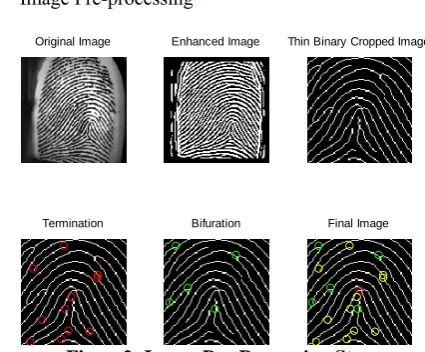
Figure2: Image Pre-Processing Steps
These Pseudo Codeis as discussed below: 1. Image Acquisition
The samples of biometric features are collected by the multimodal biometric authentication system. The proposed system is featured with the fingerprint images adopted via publicly available open source database that have 8 fingerprints of every single individual. The images are of order 256*256 composed in Red-Green-Blue saved with bitmap format.
2. Image Pre-Processing
A. 3D to 2D Conversion
The Gray level scaling transforms the images from 3-dimensional structure to 2-3-dimensional plane (fig. 2(a)).
B. Location of Core Point
The detection of core point in the fingerprint is necessary. This point is located at the centre of image with minute variations in precise location. The methods: Ridge orientation and frequency domain convolution are
Original Image Enhanced Image Thin Binary Cropped Image
employed to detect the location. Finger prints are divided into segments, for the employed algorithms, to seek the core point in each block. After acknowledgment of all core points or ridge, the gradient point is calculated. This point is considered as final core point of finger.
C. Image Enhancement
The image after acquiring the core point location contains non-continuous ridges because of which they are rendered unsuitable for thinning process. The false minutia is significant parameter against which the morphological operations are executed (fig. 2(b)).
D. Thinning, Binary and Cropping
The enhanced image is transformed to binary image in next step. The output image has the thick ridge lines that are required to be eliminated. The thinning process mimic the width of ridge lines that is then cropped (see fig. 2(c)) into 141*141 pixels.
E. Termination
The termination is the end point of the ridge lines. For the fingerprint images block of 3*3 units is created to scan full print and finding the termination points (fig. 2(d)).
F. Bifurcation
Bifurcation in finger print is point where the ridges are divided into two further ridge lines. A block of 4*3 scans full print and finds the bifurcation points (fig. 2(e)).
G. Final Image Processing
The final image after complete pre-processing is given in fig. 2(f). This is the print with entire features.
RECOGNITION METHODS
Minutia Localization
The approach for localization of minutia is a novel application offered by particle filters that are employed specifically in probabilistic tracking for approximating unknown distributions. The implementation is figured on the CONDENSATION algorithm proposed by Blake and Isard [9]. The algorithm iteratively estimates the target state distribution by updating the posterior density and random sampling based on featured fresh estimations. The conditional state density can be represented as the weighted samples set instead of assuming that type of distribution is known (e.g. normal). The probability of state ( ) is represented by conditional state density ( | ) by observations ( ) at time t.
The method in this paper adapts notion of tracking for iterative refinement of minutia location over time within a static image. At iteration step t, the image region of interest is used as observation and the location of minutia point is used as target state. The following equation updates the location estimation:
| =∑∑ (1) where is the set of sample weights, is the set of samples, and t is the number of iterations.
By choosing points that correspond to highest cross-correlation scores, the N sample point set is initialized. The mathematical expression for this is:
= ∑, , ( ).( ) ̅
∑, , ∑, ( ).( ) ̅ (2)
where and are mean image intensity and mean template ̅ values, respectively, in the overlapped region formed by template , that is centered on image I at the location , .
The value 1 in above equation is the very good response in terms of matching original image and template image. 0 signifies the no correlation and -1 is inverse correlation. The locations that corresponds the highest scores of correlations are stored for further processing. An important statement about this process is that the template matching is executed only over the tiny regions of image around each minutia.
For sample set, a set of expectation points ( ) can be located by generating points randomly (normally distributed) around their respective sample points ∈ . Let
( ) = (3)
whereC is a normalizing constant, is the set of expectation points generated from , and
= −
= −
=
2 + 2
= 2
4 +
2 4
=
2 + 2
and M is the initial minutia point.
From eq. (3) a Gaussian density function, with skewing factors and , are positioned with the variable θlocated to the local ridge flow course. The ridge flow course and the direction reliability maps are discoveredcorrespondingly to the scheme proposed by Jain et al. [10].
Determining the new set of samples points, ∈ by
=∑∑ (4) Weights are allocated to the samples rooted on the cross-correlation response of template matching at every sample point. This at iteration t provides a set of sample weights . Finally, the anticipated minutia point at iteration t+1 is calculated.
Correlation-based Techniques
Let Q and T are query and template images of fingerprint respectively. Among the intensities of corresponding pixels the sum of squared differences (SSD) for two images can be employed as the measuring factor of diversity between them.
( , ) = ‖ − ‖ = ( − ) ( − ) = ‖ ‖ +
‖ ‖ − 2 (5)
various factors. Thus additional steps are mandatory before the calculation of Q and T.
Let the transformation of query image is represented by (∆ ,∇ ,θ), where ∆y and ∆x are translation parameters
along y and x direction respectively, and is rotation parameter. The similarity measure would be the function calculated by:
( , ) = ∆ , , , (∆ , , ) (6)
( , )only considers the translation and rotation factors hence cannot result in the accurate measurement for similarity. The method is rendered unsuitable for highly distorted images. In global fingerprint patterns the distortion is profound, thus to some extent the distortion can be minimized considering the local regions. [11] [12] states about the approaches for matching based on localized correlation. Factors like skin conditions, finger pressure and ridge thickness vary with different acquisitions of same finger. The cross-correlation and zero-mean normalized cross-correlation is sophisticated correlations that compensate for brightness and contrast variations and applying the proper proportions of binarization, thinning steps (performed on both Q and T) and enhancement may limit ridge thickness correlation [13]. It is very expensive to compute the maximum correlation ( ( , )) in spatial domain. The reduction of computational complexity and translation invariance can be done by calculating correlation in Fourier domain [14].
⨂ = ∗( ) × ( ) (7)
⨂denotes the correlation in spatial domain, ×denotes the point-by-point multiplication of two vectors, * denotes the complex conjugate, and F(. )andF denote the Fourier transform and inverse Fourier transform.
In this technique the rotation is dealt separately. Fourier-Mellin transform [15] is employed to gain both translation and rotation invariance.
Ridge Feature Based Matching
In ridge feature based matching, the correspondences of points sampled equidistantly on a ridge is established. The algorithm for matching of ridge can be stated in following steps.
First: The most similar pair of ridges is outlined. This pair of ridge is employed as the base pair for the comparison with upcoming ridge.
Second: The new matched ridges become the base pair that would do the same operation successively and so on. Third: The process terminates when there exists no further pair of ridge for matching. The matching score is computed based on length of matched ridges. Multiple pair of ridges are selected as initial base pairs because of the reason that first base pair of ridges may be false and above recursive matching procedure can be repeated for multiple units of time.
Fourth: The maximum score calculated from multiple procedures is employed as concluding matching score of the two fingerprints.
For the two grayscale fingerprint images I1 and I2, the ridge
image or thinned image is calculated. Next the stepsof the algorithm responsible for ridge matching of fingerprints is presented
Representation of Ridges
For removal of noise and any repulse or any adversary the ridge process is structured in convenient manner. The pre-processing steps to simulate the requirements are scripted as: 1) Disconnection of closed ridges at arbitrary point. 2) Three pair of ridges is constructed for that associated with bifurcation. 3) Removal of short ridges as being vestigial. The Ridges are sampled and classified equidistantly represented by list of samples.
Match Aligned Ridges
This section looks for the longest continuous point matched string of a given Aligned ridges couple (for details see [16]). Both the points are considered to have equivalent parameters of configuration if their Euclidean Distance value is lower than threshold value.
Find the Initial Base Pairs of Ridges
From two Ridge sets R1 and R2, coagulation of N initial
matched ridge pairs is created. The search space is limited to ridges associated with minutiae. The top N ridge pairs are selected as initial matched ridge pairs for measuring the similarity between any two ridges.
Match All Ridges
A progression of alignment and pairing the ridges in succession to the previous ridges is entertained. The ridges are classified in three broad categories as: Fully matched, partially matched and unmatched. The categories are classified based on noise interaction level at primal stages.The unmatched and partially matched images are recurred as new ridges for them to be matched later.
Consistency Constraint
In the process of matching, the in-class variations in ridge structures are dealt by segmentation of ridge in several short ridges. Parallely, the concern that ridge matching of different fingers, could be reported because of multiple splits. The theory of Haralick and Shapiro well defends against this concern [17].
Matching Score
The two fingerprints may share overlap region; this fact can be predominantly used for matching purposes. The convex hull of ridge images for two fingerprints is calculated. Intersection of two convex hulls aligned according to initial pairs of ridges is the overlapped region. The matching score for the matching procedure is given by:
= . (8) where, and are number of ridge points in overlapped region, is number of matched sample points, and
is final matching score.
Fuzzy Logic
The fuzzification interface involves the functions: • Measures the values of inputs variables,
• Performs a scale mappings that transfers the range of values of inputs variables into corresponding universes of discourse,
The rule base comprises knowledge of the application domain and the attendant control goals. It consists of a "data base" and a "linguistic (fuzzy) control rule base":
• The data base provides necessary definitions which are used to define linguistic control rules and fuzzy data manipulation in a FLC
• The rule base characterizes the control goals and the control policy of the domain experts by means of a set of linguistic control rules.
The fuzzy inference engine is the kernel of a FLC; it has the capability of simulating human decision-making based of fuzzy concepts and of inferring fuzzy control actions employing fuzzy implication and the rules of inference in fuzzy logic.
The defuzzification interface performs the following functions:
• A scale mapping, which converts the range of values of output variables into corresponding universes of discourse
• Defuzzification, which yields a non fuzzy control action from an inferred fuzzy control action. The conditions of three finger point group works in union to form the fuzzy logic system with IF-THEN rules. The output variables weighting are controlled by one group according to values of input variables for the ridges that possess matching scores of ridges images. Controlling of output variable weight is processed by second group in accordance with the values of input variables minutia point for the minutia biometric. The third group is responsible to control the output variable weighting in accordance with the values of rotation invariance and input variables translation for the Correlation biometrics.
Some chief properties of the fuzzy set rules are:
• Multiple unfavorable conditions map the output values to be low.
• For the favorable external conditions (input variables), a high is set to the output variable. • Even for any single condition being unfavorable in
system, the output variable is set to the minimum.
FUZZY LOGIC FORMULATION
Fuzzy Inference System
A Fuzzy Inference System (FIS) is a process of mapping an input dataset to an output dataset using fuzzy logic. FIS uses a collection of fuzzy membership functions and rules to obtain a conclusion from the given data.The rules in FIS (sometimes may be called as fuzzy expert system) are fuzzy production rules of the form:
For example, in a fuzzy rule: if ‘a’ is low and ‘b’ is high then ‘c’ is medium.Here ‘a’ is low; ‘b’ is high; ‘c’ is medium are fuzzy statements; ‘a’ and ‘b’ are input variables; ‘c’ is an output variable, low, high, and medium are fuzzy sets.
The rules that apply are described by the antecedent, and the conclusion assigns a suitable fuzzy function to each of the output variables. The set of rules in a fuzzy expert system is known as knowledge base.
The main functions in fuzzy expert system are 1. Fuzzification
2. Fuzzy Inferencing (apply implication method) 3. Aggregation of all outputs
4. Defuzzification
Figure3: Fuzzy Logic Process
1. Fuzzification:
Fuzzification is a process of defining the appropriate membership functions on input variables which maps their actual values to the MF so that the degree of truth for each rule premise can be identified.
Fuzzy statements in the antecedent are represented to a degree of membership and their value lies between 0 and 1. If there is only one antecedent, then this is the number to support the rule.
If there are multiple parts to the antecedent, then fuzzy logic operators are applied and antecedent isconverted to a single number between 0 and 1.
Antecedent may be joined by OR; AND operators.
For OR join we obtain the ‘max’ and for AND join we obtain the ‘min’.
2. Fuzzy Inferencing:
In the process of inference truth value for each rule is computed using the membership function and applied to the conclusion part of each rule. This gives one fuzzy set to each output variable for each rule.
If the antecedent is only partially true, i.e., the assigned value less than one, then the output fuzzy set is truncated according to the implication method. If the consequent of a rule has multiple parts, then all consequents are affected equally by the result of the antecedent. The consequent specifies a fuzzy set to be assigned to the output.
The implication function then modifies that fuzzy set to the degree specified by the antecedent.
The functions that are used in inference rules are; min or prod..‘Min’ truncates the consequent's membership function and ‘prod’rule scales the membership function.
3. Aggregation of all outputs
Here, all fuzzy sets assigned to each output variable are combined together to form a single fuzzy set for each output variable using a fuzzy aggregation operator.
Some of the most commonly used aggregation operators are the maximum: point-wise maximum over all of the fuzzy sets the sum: (point-wise sum over all of the fuzzy the probabilistic sum.
De-fuzzification
In Defuzzificztion, the fuzzy output set is converted to a crisp number. Some commonly used techniques are the centroid and maximum methods.
In the centroid method, the crisp value of the output variable is computed by finding the variable value of the centre of gravity of the membership function for the fuzzy value.
In the maximum method, one of the variable values at which the fuzzy set has its maximum truth value is chosen as the crisp value for the output variable.
Membership functions
The choice of the membership function depends on the problem and needs to be investigated. In this work we have considered the most general Gaussian and triangular MF. In this work as input membership function Gaussian is chosen. There are basically two types of Gaussian membership function (Figure 4). The first one is the symmetric Gaussian MF is given by the expression,
( )2 2
2
( ; , )
x c f xσ c e σ − −
= (9)
where the parameter crepresents the mean or in other words distance form the origin and
σ
represents the spread or width of the function.Figure 4: The Gaussian membership Function with centered at c.
Figure 5: The two sided Gaussian membership Function with centered at c and d.
The second one is two sided Gaussian function, as it contains tow Gaussian MF with centered at c and d (Figure 5).The Gaussian MF shown in figure is a truncated Gaussian function and it comprises of three functions the first left is truncated Gaussian with mean c and variance
2 1
σ
, the second Gaussian is Right side function with mean d and varianceσ
22 and in between it attains a value one. The Gaussian MF functions are smooth and they attain non –zero value everywhere.As in finger print we expect that for perfect matching the membership function takes value one, therefore symmetric Gaussian MF is selected.
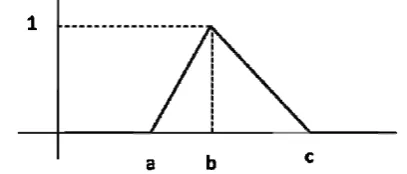
Similarly at the output of the fuzzy system the decision has to be made on the basis of the value obtained, over here a Gaussian function is not very suitable, therefore a triangular MF is taken. The triangular MF function is given by
( , , , ) max min x a c x, ,0
f x a b c
b a c b
− −
= − −
(10)
where the parameters a and c locate the feet of the triangle and the parameter b locate the peak as shown in figure 6.
Figure 6: The triangular shape membership Function
The fuzzy system estimates a crisp value to get more accurate results. The crisp value is obtained by using the weighted mean method.
1
1
[ ]
n
i i i
n
i i
u x
E u
x
=
=
=
(11)
where,
u
iis the value of the aggregate membership function at pointx
i.IfE u
[ ]
=
u
Thi.e., if the mean value of the MF function is greater than certain threshold then login is TRUE or it is FALSE.EXPERIMENTAL SETUP
The proposed multimodal biometric system achieves interesting results on standard and commonly used databases.
To show the effectiveness of our approach, the CASIA database [6] has been used for fingerprints 80 finger print images of 10 persons (8 image each person) using the flow given below:
2. Database creation for Minutia based matching process taking one finger print image of each person, pre-process it, extract its feature and save database.
3. Database creation for Ridge Feature based matching process taking one finger print image of each person, pre-process it, extract its feature and save it database. 4. Get the query image for recognition and pre process it. 5. Apply Correlation based Recognition Process and get
Features.
6. Apply Minutia matching based Recognition Process and get Features.
7. Apply Ridge Feature based Recognition Process and get Features.
8. These three Features are processed though the fuzzy logic which is designed with rules for making decisions based on input Features..
Figure 7: The Fuzzy based approach for result aggregation
RESULTS
As shown in the above figure, after feature extraction correlation based, minutia based and ridge feature based matching is applied using the database which consists of the database of all the features (Figure 8).
The next step is to decide the appropriate membership functions for each of three matching processes with given ranges of the values. The obtained values in all the three processes are normalized between 0 and 1. The obtained values are divided into three regions as 0-0.33, 0.34-0.66 and 0.67 to 1. The value between the 0-0.33 is considered to be LOW, and the values between 0.34 to 0.67 are considered to be AVERAGE and the value above 0.67 is assumed to be HIGH.
Initially all the methods are separately applied on the fingerprint under investigation. Considering the case of Correlation based matching, if the finger print exactly matches with database fingerprint then the relation co-efficient is 1 and if it doesn’t matches at all the co-co-efficient value can be as low as zero. However if the values lies between 0 and 1, then it is become very critical to set an appropriate threshold which will correctly identifies the finger prints, as the co-relation co-efficient depends also on the image quality and many other parameters.
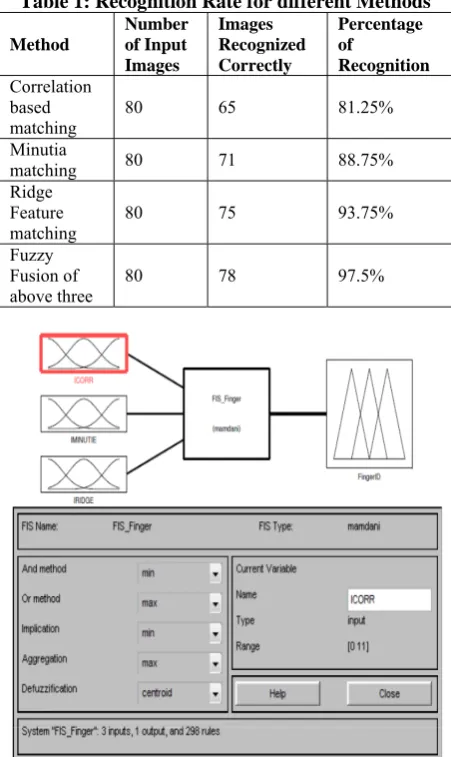
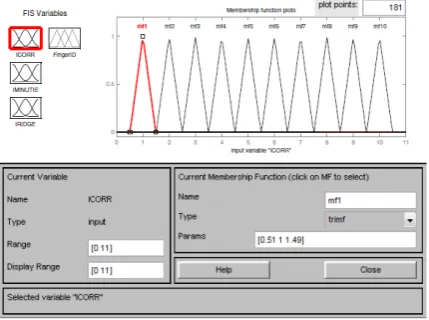
As shown in the figure, there are 298 rules are devised as shown in the figure 9. The surface plot of the devised rules in shown in figure 10. In this work Gaussian based membership function is assumed for Co-relation based,
Minutia and ridge based matching. Hence, there are three input membership function and one output function which is assumed to be triangular in shape (Figure 11).
The test as stated previously is performed in MATLAB environment and the results are as shown below in the table:
Table 1: Recognition Rate for different Methods
Method
Number of Input Images
Images Recognized Correctly
Percentage of
Recognition Correlation
based
matching 80 65 81.25%
Minutia
matching 80 71 88.75%
Ridge Feature
matching 80 75 93.75%
Fuzzy Fusion of above three
80 78 97.5%
Figure 8 Fuzzy Interference system with Minutia, Ridges and correlation based matching feature set as
Input
Figure 10 Surface plot of Fuzzy Interference system with generated Rules
Figure 11 Membership plot of fuzzy system
CONCLUSION
Biometric systems are widely used to overcome the traditional methods of authentication. But the uni-modal biometric system fails in case of biometric data for particular trait. Thus the individual Results are combined using Fuzzy Logic to develop a multimodal biometric system.
The multimodal biometric system has been tested on different congruent datasets obtained by the official CASIA database [18]. In this paper, a multi- modal biometric system (Fingerprint three extraction process) is used after converting fingerprints to a binary code, with decision level fusion combining the results.Using fuzzy logic and weighted code gives flexible result. An efficient method in fingerprint encoding is used and the fuzzy logic framework incorporates fingerprint features.The verification accuracy obtained was 97.5% when performed on 80 finger print images of 10 persons. This is higher than when only single method is used for recognition. In the future work, the effect of chosen different membership function can be investigated.
REFERENCES
1. Jain, A.K., Ross, A., Pankanti, S. “Biometrics: A Tool for
Information Security”, IEEE Transactions on Information Forensics Security, vol. 1,Issue: 2, June 2006, pp: 125-143.
2. Eugen LUPU, Petre G. POP, “MULTIMODAL BIOMETRIC
SYSTEMS OVERVIEW”, ACTA TECHNICA APOCENSIS Electronics and Telecommunications, Volume 49, Number 3, 2008.
3. N. K. Ratha, R. M. Bolle, V. D. Pandit, and V. Vaish, ―Robust
Fingerprint authentication using local structural similarity,ǁ in Proc. 5th IEEE Workshop Appl. Comput. Vis., Dec. 4–6, 2000, pp. 29–34. DOI 10.1109/WACV.2000.895399.
4. V. Conti, G. Milici, P. Ribino, S. Vitabile, and F. Sorbello, ―Fuzzy
fusion in multimodal biometric systems,ǁ in Proc. 11th LNAI Int.
Conf. Knowl.- Based Intell. Inf. Eng. Syst. (KES 2007/WIRN 2007), Part I LNAI 4692. B. Apolloni et al., Eds. Berlin, Germany: Springer-Verlag, 2010, pp. 108–115.
5. F. Yang and B. Ma, ―A new mixed-mode biometrics information
fusion based-on Fingerprint, hand-geometry and palm-print,ǁ in Proc.
4th Int. IEEE Conf. Image Graph., 2007, pp. 689–693. DOI: 10.1109/ICIG.2007.39.
6. F. Besbes, H. Trichili, and B. Solaiman, “Multimodal biometric
system based on Fingerprint identification and Iris recognition”, in Proc. 3rd Int. IEEE Conf. Inf. Commun. Technol.: From Theory to Applications (ICTTA 2008), pp. 1–5. DOI: 10.1109/ ICTTA.2008.4530129.
7. G. Aguilar, G. Sanchez, K. Toscano, M. Nakano, and H. Perez,
―Multimodal biometric system using Fingerprint,ǁ in Proc. Int.
Conf. Intell. Adv. Syst. 2007, pp. 145–150. DOI: 10.1109/ ICIAS.2007.4658364.
8. V. C. Subbarayudu and M. V. N. K. Prasad, ―Multimodal biometric
system,ǁ in Proc. 1st Int. IEEE Conf. Emerging Trends Eng.
Technol., 2008, pp. 635–640. DOI 10.1109/ICETET.2008.93.
9. A. Blake and M. Isard, "The CONDENSATION Algorithm -
Conditional Density Propogation and Applications to Visual Tracking," Advances in Neural Information Processing, vol. 29, pp. 5-28, 1996.
10. A. Jain, L. Hong, and R. Bolle, "On-line Fingerprint Verification," IEEE Trans. PAMI, vol. 19, pp. 302-314, 1997.
11. A.M. Bazen, G.T.B. Verwaaijen, S.H. Gerez, L.P.J. Veelenturf, and
B.J. van der Zwaag. A Correlation-Based Fingerprint Verification
System. In Proc. of 11thAnnual Workshop on Circuits Systems and
Signal Processing (ProRISC), pages 205{213, 2000.
12. K. Nandakumar and A. K. Jain. Local correlation-based fingerprint
matching. In Indian Conference on Computer Vision, Graphics and Image Processing, pages 503-508, 2004.
13. Anil K. Jain and David Maltoni. Handbook of Fingerprint
Recognition. Springer-Verlag New York, Inc., Secaucus, NJ, USA, 2003.
14. Louis Coetzee and Elizabeth C. Botha. Fingerprint recognition in
low quality images. In Pattern Recognition, volume 26, pages 1441-1460, 1993.
15. Vivek A. Sujan and Michael P. Mulqueen. Fingerprint identification
using space invariant transforms. Pattern Recogn. Lett. 23(5):609-619, 2002.
16. Jain, A.K., Hong, L., Bolle, R.: On-line Fingerprint Verification.
IEEE Trans. Pattern Anal. Mach. Intell. 19 (4) (1997) 302-313
17. Haralick, R., Shapiro, L.: The Consistent Labeling Problem II. IEEE
Trans. Pattern Anal. Mach. Intell. 2 (1980) 193-203