450
A New Techniques for Power Aware Routing Algorithm for
Mobile Ad Hoc Networks
Cisil Baby
1, S.Ranjitha
2Dr .H. N. Suresh
31
Research scholar, Dept. Of ECE, Jain University,Bangalore, Karnataka, India.
2
BE(ECE), Bangalore Institute of Technology, vv puram ,Bangalore-04
3
Professor & Research coordinator, Bangalore Institute of Technology, Dept. of IT, VV puram, Bangalore
Abstract —
An Ad Hoc network is an infrastructure less wireless network consisting of mobile moving nodes. In a network each mobile node act as a router as well as packet forwarder. Nodes in a Mobile Ad hoc Network (MANET) have limited battery power. Power consumption of network interfaces can be significant. In a MANET, if a mobile node continuously transmitting the data packets, more battery power consumed by that node, obviously that node energy level is insufficient for data packet transmission and becomes critical node or dead node and result is connection failure in network. When a distance is increased between mobile nodes in same MANET, those mobile nodes consumed more power for the data packet transmission. The proposed work minimises the energy consumption per packet and maximises the network lifetime. The design objective of modifying DSR is to select energy efficient paths. The main features of modified DSR are: (i) minimise energy consumed per packet (ii) maximise network lifetime for network and (iii) minimise maximum node cost. However, some intermediate nodes might act selfish and drop the packets for other nodes in order to save their own battery power. The proposed algorithm can find selfish nodes and deal with them by using a modified DSR protocol, which we call as an efficient DSR (EDSR). The simulation results show an increase in the packet delivery ratio in the network. The average node lifetime of proposed EDSR model is 45–60% longer than that of DSR model.Keywords--- Mobile Ad Hoc Network, DSR, MMBCR, Power Consumption, Network Lifetime
I.INTRODUCTION
As the technology of mobile ad hoc networks (MANETs) develops, many new kinds of applications in this field emerge. The group-oriented services which take advantage of the broadcasting nature of wireless networks are of much importance. Therefore, broadcasting/multicasting protocols in MANETs are receiving increased attention. Energy efficiency is a critical issue in MANETs and sensor networks where power of nodes is limited and difficult to recharge. This issue is crucial in the design of new routing protocols since each node acts not only as a host but also as a router. This project gives a general survey of broadcast/multicast routing protocols, network coding approaches and energy-efficient broadcast/multicast routing protocols in MANETs. In order to maximize network lifetime, we propose a new energy-efficient broadcast protocol, called EBOLSR, which adapts the EOLSR protocol to the broadcasting domain. And then we compare the performance of EBOLSR with three other broadcast protocols in two distinct MANET scenarios, Classical Flooding, Simplified Multicast Forwarding (SMF), and a coding-based broadcast protocol (CodeBCast). Simulation results show that EBOLSR protocol has less energy
consumption and longer network lifetime than Classical Flooding, and also explain the reason why it does not outperform SMF in terms of the energy consumption and network lifetime. MANET is an autonomous system of mobile routers (and associated hosts) connected by wireless links. The routers are free to move randomly and organize themselves arbitrarily; thus, the network's wireless topology may change rapidly and unpredictably. Such a network may operate in a stand-alone fashion, or may be connected to the larger Internet. Since the need to conserve energy so that battery life is maximized is important, it is obvious that energy efficient algorithms should be implemented in place of the conventional routing algorithm. In this paper we have proposed a new power efficient routing protocol which increases the network lifetime. In the conventional routing algorithm, connections between two nodes are established between nodes through the shortest path routes. It is unaware of energy budget and thus results in a quick depletion of the battery energy of the nodes along the most heavily used routes in the network. Therefore to conserve battery energy of the nodes, there are various routing algorithms and schemes designed to select alternative routes. Power aware routing schemes make routing decisions to optimize performance of power or energy related evaluation metric(s). The route selections are made solely with regards to performance requirement policies, independent of the underlying ad-hoc routing protocols deployed. Therefore the power-aware routing schemes are transferable from one underlying ad hoc routing protocol to another, the observed relative merits and drawbacks remain valid. In this paper an effort has been done to evaluate the routing performance of PER, MMBCR and DSR protocols using network simulator NS-2 and results have been analysed.
A. Routing Protocols:
In MANET, routing protocols are classified into two types: Proactive or table-driven routing protocols Reactive or on-demand routing protocols.
B. On-Demand Routing Protocols (Reactive):
451
C. Table Driven Routing Protocols (Proactive):
In proactive or table-driven routing protocols, each node continuously maintains up-to-date routes to every other node in the network. Routing information is periodically transmitted throughout the network in order to maintain routing table consistency. Thus, if a route has already existed before traffic arrives, transmission occurs without delay. Otherwise, traffic packets should wait in queue until the node receives routing information corresponding to its destination. However, for highly dynamic network topology, the proactive schemes require a significant amount of resources to keep routing information up-to-date and reliable. Certain proactive routing protocols are Destination-Sequenced Distance Vector (DSDV) [3], Wireless Routing Protocol (WRP) [4],[5], Global State Routing (GSR) [6] and Cluster head Gateway Switch Routing (CGSR) [7].
Applications of MANETs:
Military Scenarios: MANET supports tactical network for military communications and automated battle fields. Rescue Operations: It provides Disaster recovery, means replacement of fixed infrastructure network in case of environmental disaster. Data Networks: MANET provides support to the network for the exchange of data between mobile devices. Device Networks: Device Networks supports the wireless connections between various mobile devices so that they can communicate. Free Internet Connection Sharing: It also allows us to share the internet with other mobile devices. Sensor Network: It consists of devices that have capability of sensing, computation and wireless networking. Wireless sensor network combines the power of all three of them, like smoke detectors, electricity, gas and water meters.
The rest of this paper is organized as follows. Section 2 presents the . comparison of manets and sensor networks. The broadcast protocols ispresented in Section 3. Section 4 describes related research work.. Section 5& 6 describes the analysis & Design of the proposed protocol. Section 7 explains result and discussion
II. COMPARISON OF MANETS AND
SENSOR NETWORKS
MANETS (Mobile Ad-hoc NETworkS) and sensor networks are two classes of the wireless Adhoc networks with resource constraints. MANETS typically consist of devices that have high capabilities, mobile and operate in coalitions. Sensor networks are typically deployed in specific geographical regions for tracking,monitoring and sensing. Both these wireless networks are characterized by their ad hoc nature that lack pre deployed infrastructure for computing and communication. Both share some characteristics like network topology is not fixed, power is an expensive resource and nodes in the network are connected to each other by wireless communication links. WSNs differ in many fundamental ways from MANETS as mentioned below. Sensor networks are mainly used to collect information while MANETS are designed for distributed computing rather than information gathering. Sensor nodes mainly use broadcast communication paradigm whereas most MANETS are based on point-to-point communications.
The number of nodes in sensor networks can be several orders of magnitude higher than that in MANETS. Sensor nodes may not have global identification (ID) because of the large amount of overhead and large number of sensors. Sensor nodes are much cheaper than nodes in a MANET and are usually deployed in thousands. Sensor nodes are limited in power, computational capacities, and memory where as nodes in a MANET can be recharged somehow .Usually, sensors are
deployed once in their lifetime, while nodes in MANET move really in an Ad-hoc manner. Sensor nodes are much more limited in their computation and communication capabilities than their MANET counterparts due to their low cost.
III.MULTICAST/BROADCAST
PROTOCOLS
The multicast/broadcast services are critical in applications characterized by the close collaboration of teams with requirements for audio and video conferencing and sharing of text and images. Additionally, most routing protocols in MANETs rely on the broadcast function to exchange essential routing packets between mobile nodes and need the multicast function to make more efficient use of network bandwidth for some particular multimedia applications. Hence, broadcast and multicast are important operations for mobile nodes to construct a routing path in MANETs.
3.1Multicast Protocols
Multicasting is the transmission of data packets to more than one node sharing one multicasting address. It is intended for group-oriented computing. Several multicast routing protocols have been proposed for MANETs, which can be classified as unicast-based, tree-based, mesh-based, or hybrid protocols, according to how distribution paths among group members are constructed.
3.2 Protocols Classification:
3.2.1 Unicast-based multicast protocols
Some primitive broadcast/multicast protocols are just unicast-based. That is, for a source to send to N destinations, the protocol simply set up N unicast connections to achieve the function of multicast. Since few recent research focuses on this type of multicast protocols, we will not describe more about it, and will focus on the following two kinds of multicast protocols.
3.2.2 Tree-based multicast protocols
Tree-based multicast routing protocols can be further divided into source-tree-based and shared-tree based schemes, according to the number of trees per multicast group. In a source-tree-based multicast protocol, a multicast tree is established and maintained for each source node of a multicast group, and shared-tree-based multicast protocols use a single shared tree for all multicast source nodes. In the source-tree-based multicast protocol, each multicast packet is forwarded along the most efficient path, i.e. the shortest path, from the source node to each multicast group member, but this method incurs a lot of control overhead to maintain many trees. For the shared-tree-based multicast protocol, it has lower control overhead since it maintain only a single tree for a multicast group and thus is more scalable. Adaptive Demand-driven Multicast Routing (ADMR) [12] is source-tree-based and Multicast Ad Hoc On-Demand Distance Vector (MAODV) [6] is a shared-tree-based multicast protocol developed for MANETs.
3.2.3 Mesh-based multicast protocols
452
Routing Protocol (ODMRP) [5] is a mesh-based multicast protocol developed for MANETs.
3.2.4 Hybrid multicast protocols
A hybrid multicast protocol combines both the tree-based and mesh-based methods in order to achieve efficiency and robustness. It has two main procedures, the mesh creation and the tree creation. It first creates the virtual mesh links among the group members and a logic core will be selected from the members in this procedure. Then the mesh is used to establish the multicast tree which is initiated by the logical core. Ad hoc Multicast Routing (AMRoute) [7] is a hybrid multicast protocol developed for MANETs .Multicast routing protocols can also be classified as proactive or reactive, depending on whether they keep routes continuously updated, or react on demand.
3.2.5 Proactive protocols
Proactive protocols attempt to find and maintain consistent, up-to-date routes between all source nodes and destination nodes regardless of whether these routes are needed. Periodic control messages are used to maintain routes up-to-date for each node. Examples include Ad hoc Multicast Routing protocol utilizing Increasing Id number S (AMRIS) [13] and Core-Assisted Mesh Protocol (CAMP) [14].
3.2.6 Reactive protocols
Unlike proactive protocols, reactive protocols create routes only when a source node requests them. Examples include the On-Demand Multicast Routing Protocol (ODMRP) [5] and the Multicast Ad Hoc on-Demand Distance Vector (MAODV) [6] protocol.
Since SMF is an efficient multicast protocol, we will simply mention it here. Simplified Multicast Forwarding (SMF) In MANETs, unicast routing protocols can provide effective and efficient mechanisms to flood routing control messages in the wireless routing area. For example, OLSR [4] provide distributed methods of dynamically electing reduced relay sets which can optimize flooding of routing control messages in the routing layer. Similarly, simpler multicast routing protocols that can optimize the forwarding of multicast traffic to all nodes in a routing area are also useful. One such solution is the Simplified Multicast Forwarding (SMF) specification designed within the Internet Engineering Task Force (IETF) [8]. Considering the multicast efficiency of SMF, we decide to select it to compare the performance with our proposed protocol in the Section 6. SMF extends the efficient flooding concept to the data forwarding plane for IP multicast packets, which provides an appropriate multicast forwarding capability.
3.3 Broadcast Methods:
Broadcasting is the process in which a source node sends a message to all other nodes in the network, and it is also a special case of multicasting. Since even unicast and multicast routing protocols often have a broadcast component, broadcasting is important in MANETs. For instance, protocols such as DSR [1], AODV [2], Zone Routing Protocol (ZRP) [15] and Location Aided Routing (LAR) [16] use broadcasting to establish routes. Broadcasting methods have been categorized into four families utilizing the IEEE 802.11 MAC specifications [17]:
a) Classical Flooding
b) Probability-Based Methods c) Area-Based Methods
d) Neighbor Knowledge Methods
IV. RELATED RESEARCH WORK
Most of the previous work on routing in wireless ad-hoc networks deals with the problem of finding and maintaining correct routes to the destination during mobility and changing topology [8],[9]. In [10],[11], the authors presented a simple implementable algorithm which guarantees strong connectivity and assumes limited node range. Shortest path algorithm is used in this strongly connected backbone network. However, the route may not be the minimum energy solution due to the possible omission of the optimal links at the time of the backbone connection network calculation. In [4], the authors developed a dynamic routing algorithm for establishing and maintaining connection-oriented sessions which uses the idea of proactive to cope with the unpredictable topology changes.
Some other routing algorithms in mobile wireless networks can be found in [6],[7],[8], which as the majority of routing protocols in MANETs do, uses shortest-path routing where the number of hops is the path length, The problem of minimum energy routing has been addressed before in [7],[12],[10]. The approach in those was to minimize the total energy consumed to reach the destination, which minimizes the energy consumed per unit flow or packet. If all the traffic is routed through the minimum energy path to the destination, the nodes in that path will be drained of energy quickly while other nodes, which perhaps will be more power hungry if traffic is forwarded through them, will remain intact.
V. ANALYSIS OF PROPOSED ROTOCOL
Route discovery mechanism in existing DSR The source node when needs to send packet to the destination node, starts the route discovery procedure by sending the RREQ packet to all its neighbours. In this strategy, the source is not allowed to maintain route cache for longer time, as network conditions change very frequently in terms of position and energy levels of the nodes. Thus, when a node needs route to the destination, it initiates the RREQ packet, which is broadcasted to all the neighbours that satisfy the broadcasting condition. The RREQ packet of the DSR protocol is extended as RREQ packet by adding three extra fields for the modified DSR as link stability degree (LSD),energy model and bandwidth (B). The RREQ packet contains type field, source-address field, destination-address field, unique-identification number field, hop-count field, LSD, bandwidth, time-to-live field, energy model and path fields. Energy model: It is an extended metric to convert existing DSR protocol into power-aware DSR protocol to include the battery power of each mobile node in the network topology.5.1 Minimise energy consumed per packet Consider the network illustrated in Fig. 1. Here, node 6 will be selected as the route for packets going from 0→3,1→4 and 2→5. As a result node 6 will
453
Fig. 5.1 Shortest-hop routing used in DSR protocol
Let T(ni, ni + 1) is energy consumed in transmitting and receiving one packet over one hop from ni to ni + 1where ej is the total energy spent for packet j. Minimise ej for all packets j. In lightly loaded networks, this automatically finds shortest-hop path. In heavily loaded networks, because of contention it might not be shortest.
5.2 Minimise maximum node cost
In order to maximise the lifetime of all nodes in the network,the metrics other than energy consumed per packet need to be used. The path selected when using these metrics should be such that nodes with depleted energy reserves do not lie on many path. However, the minimising cost per packet significantly reduced the maximum node cost in the network. Let ci(t) is the cost of routing a packet through node i at time t. cˆ(t) is the maximum of the Ci(t)s, minimise Cˆ (t), for all t > 0.
5.3 Power-aware source routing (EDSR)
Fig. 5.2 :power-aware routing mechanism
Fig. 5.2 describes the power-aware routing mechanism with the RREQ and REP packets in the EDSR protocol. The RREQ broadcast is initiated by the number of sources. The intermediate nodes can reply to the RREQ packet from cache as in the DSR protocol. If there is no cache entry ,receiving a new RREQ packet an intermediate node does the following:
1. Starts a timer. Keeps path cost in the header as minimum cost. Adds its own cost to the path cost in the header and broadcast. 2. On receiving duplicate RREQ packet, an intermediate node re-broadcasts it only if the timer for that RREQ packet has not expired.
3. Destination also waits for a specific time after the first RREQ packet arrives. It then replies to the best path in that period and ignores others.
4. The new path cost in the header is less than the minimum cost. The path cost is added to the RREP packet and is stored in cache by all nodes that hear the RREP packets.
VI. DESIGN:
A.
Working Principle of Proposed Protocol-Basic
Algorithm
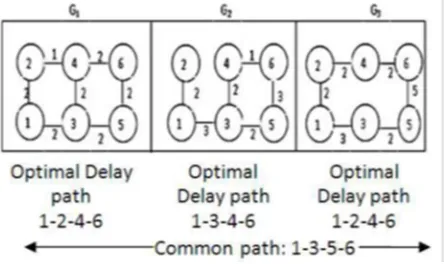
Let the sequence of network topology changes be represented by the graph sequence G1G2G3 as shown in Fig. 6.1. The source destination pair is 1 to 6. The link weights in these graphs represent the link delays. The sequence of graphs is constructed at the instants when the optimal delay path breaks. The least delay mobile path is the sequence of optimal delay paths. Running Dijkstra’s algorithm on G1, G2 and G3 would yield the optimal delay paths mentioned below the corresponding graphs. Also note that there is a common path 1–3–5–6 in all the three graphs. This is the stable mobile path .In Fig 1, the least delay mobile path is [(1–2–4–6), (1–3–4–6), (1–2–4–6)] and its weight is w1(1–2–4–6) + w2(1–3–4–6) +w3(1–2–4–6) = 5 + 6 + 6 = 17. The number of route transitions is 2. On the other hand, if we had used the stable mobile path 1–3–5–6 throughout the 1-6 session, the total end-to-end delay incurred would be w1(1–3–5–6) + w2(1–3–5–6) + w3(1–3–5– 6)= 7 + 8 + 10 = 25.
Fig 6.1: illustrate Stability Delay Trade off
The number of route transitions is 0. This simple example shows that the delay incurred by a stable mobile path can be appreciably larger than that of a least delay mobile path; on the other hand at least delay mobile path may have larger number of route transitions than that in a stable mobile path. The example also shows that the least delay mobile path and stable mobile path can sometimes have no paths in common between them.
PER protocol improves the lifetime of the network to some extent as compared to the existing power efficient protocols like on-demand DSR and MMBCR protocols. Reinitializing the route discovery process periodically at regular intervals to know the energy levels of nodes and change route accordingly results in increasing the routing overhead. Routing overhead though consumes very less amount of energy as compared to data packets, may contribute for delay and energy consumption. Thus, there is a need to overcome the routing overhead problem encountered in existing DSR protocol. To avoid unnecessary routing overhead, a new mechanism of route discovery is introduced in PER protocol. In this proposed protocol instead of reinitializing route discovery process periodically; route discovery is initialized only after transmission of an optimum number of data packets. If this number is less, i.e., if route discovery is initialized after transmitting say 100 data packets then the nodes are involved in this discovery process wherein their energy level is reduced. As a result node failure time is reduced that is nodes involved in this discovery mechanism die out quickly. If the number is more, i.e., if route discovery is initialized after transmitting say 100 packets then less frequently nodes are used up in the discovery process resulting in saving the energy of nodes. An optimum value of this number must be chosen carefully depending on the size of the network and the energy level of nodes to avoid routing overhead and maximize the lifetime of network.
B. Route Selection by PER Protocol
454
MMBCR protocols. Normalized routing load is comparatively less for PER protocol resulting in increasing the network lifetime.
Algorithm in PER is as follows: Construct a new routing cost function as the judgment whether the route is valid or invalid. This routing cost function is the kernel of PER and it will immediately influence PER 's energy-saving effect; Inherit the common characteristic of on-demand routing protocols which initiate route discovery process just when needed; During the process of selecting routes, PER introduces power factor to consider together instead of just taking the count of hops as the judgment whether the route is valid or invalid; Use the idea of DSR and MMBCR for reference, adopt different routing strategies ac-cording to the nodes' different power consumption condition. PER expects to achieve power saving and improve the performance of the network lifetime; The modification of DSR should be as light as possible and we should try to improve it just based on the original protocol so as to get higher portability.
C. Designing of Power Consumption Model in PER Protocol
The power consumption at a node in an ad hoc network can be divided into three categories: (i) energy utilized for transmitting a message, (ii) energy utilized for receiving a message and (iii) energy utilized in idle state. Energy consumption at a node would be dominated by the energy lost when the node is in idle state. Thus, in this paper, we do not consider the energy lost in the idle state and focus only on the energy consumed during the transmission and reception of messages and the energy consumed due to route discoveries. We model the energy consumed due to broadcast traffic and point-to-point traffic as linear functions of the packet transmission time, network density, transmission and reception powers per hop. For simulations without transmission power control, the fixed transmission power per hop is 1.6W. We modify the format of RREQ packet and RREP packet of the DSR. The RREQ of the DSR is extended as RREQ of the EPAR adding with two extra fields, one is cost field and another is Max-cost field is shown in table 1. It contains type field, source address field, destination field, unique identification number field, hop field, Max-cost field, cost (cumulative cost) field and path field.
The PER protocol is the improvement of the DSR protocol. However it is un-avoid able to modify some important data structures of the original DSR protocol. The PER protocol adds power aware field and residual energy field into the RREQ messages and the RREP messages. They respectively denote the energy parameter of the current route and the minimum residual energy of its member nodes. So PER has to add power aware field and residual energy field, which respectively denote the route's energy parameter and its member node’s minimum residual energy into every item of the route cache list, and their values equal to the value of power aware field and residual energy field respectively in the RREP message which is returned by the destination node in the route discovery process. Like the DSR protocol, such route cache is managed by the mechanism of overtime deletion.
D. Route Discovery Mechanism in PER Protocol
When source node S begins to communicate with destination node D, it will search its route cache to find routes to destination node D. If no route exists, route discovery process will be initiated. Source node S generates a RREQ message first, fills its IP address, destination node's IP address etc. in the corresponding fields of the RREQ message, sets the pa field to the maximum value of power aware field MAX_POWER_ AWARE and the re field to node's initial energy
INITIAL_ENERGY, and then broadcasts the RREQ message in the network. After destination node receives the RREQ message, it generates a RREP message first and sets the pa field and the re field respectively. Because it has been supposed that the PER protocol is just applicable to duplex links, the destination node just needs to reverse the “route record" of the RREQ message to be the route from the destination node to the source node, copy this reversed route to the “source route" field of the RREP message and then send it to the source node.
VII. RESULT AND DISCUSSION
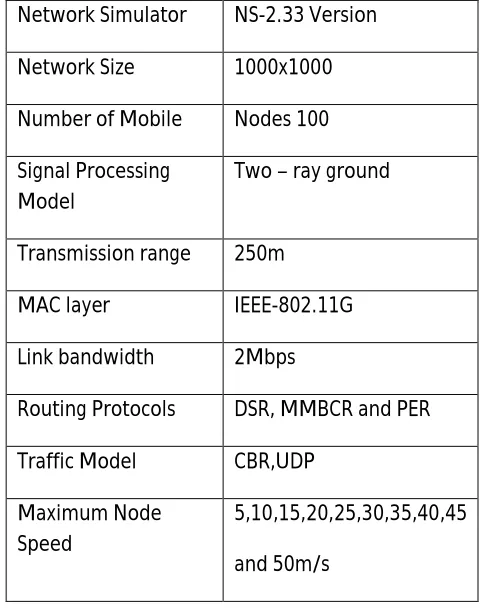
The solution has been implemented and evaluated with NS-2.33. Since, we want to know how our protocol reacts at different mobility cases. Here, we use two mobility patterns. We set up the simulation in an area of 1000 square meters for a random waypoint mobile model with 100 nodes. Simulation results show that the created protocol behaves better than the DSR and MTPR, the two main actual reactive protocols. Table 1 shows the simulation parameters used in the network setup for implementing EDSR protocol and select the alternate path for maintaining the continuous efficient network connection in the MANET. The EDSR protocol performs well in high mobility by using much less overhead than the two others mentioned before. Table 7.1
Network Simulator
NS-2.33 Version
Network Size
1000x1000
Number of Mobile
Nodes 100
Signal Processing
Model
Two – ray ground
Transmission range
250m
MAC layer
IEEE-802.11G
Link bandwidth
2Mbps
Routing Protocols
DSR, MMBCR and PER
Traffic Model
CBR,UDP
Maximum Node
Speed
5,10,15,20,25,30,35,40,45
and 50m/s
Table 7.1: Simulation parameters
7.1. Packet Delivery Ratio (PDR)
455
ultimately reducing throughput. It can be observed, that packet delivery ratio in PER is 95%, MMBCR is 86% and DSR performs 76% for high mobility up to 100 m/s.
7.2 Node Lifetime
In MANET, nodes may happen to die out. Fig.3 shows the number of nodes which die at some time instants using PER, MMBCR and DSR protocols. It can be clearly noticed that nodes in DRS die earlier than PER and MMBCR. It happens during forwarding of the query packet, when the power level of an intermediate node is found to be less than that mentioned in the power aware extension for power in the query packet. As data packet and time increases, due to lack of battery power number of mobile nodes dies.
7.3. Average End-to-End Delay
This is the time taken to start from source node to destination node for successful delivery of data packets
VIII. CONCLUSION
DSR shows the least improvement in network lifetime and PER and MMBCR show a relatively larger improvement in network lifetime as we move from scenarios of no power control and no on-demand recharging towards scenarios of power control and on-demand recharging. This can be attributed to the power-aware nature of MMBCR. The gain in network lifetime with the introduction of the energy-efficient techniques is relatively low in the case of DRS and MMBCR. Simulation results show that PER allows the connections to live longer. In MANET, all three protocols perform in same way. When mobility increases, PER outperforms than MMBCR and DSR routing protocols. Poor performances of DSR routing protocol, when mobility or load are increased, are the consequence of aggressive use of caching and lack of any mechanism to expire stale routes or determine the freshness of routes when multiple choices are available.
IX.REFERENCES
[1] S. R. Das, C. E. Perkins, E. M. Royer and M. K.Marina, “Performance Comparison of Two Ondemand Routing Protocols for Ad Hoc Networks,” in IEEE Personal Communications Magazine, special issue on Mobile Ad Hoc Networks, Vol. 8, No. 1, pp.16-29, Feb 2001
[2] MANET Simulation and Implementation at the University of Murcia, Available from http://masimum.dif.um.es/, 2006. [3] S. Kurkowski, T. Camp, and M. Colagrosso,“MANET Simulation Studies: The Incredibles,” in ACM's Mobile Computing and Communications Review, vol. 9, no. 4, pp. 50-61, October 2005
[4] Thomas D. Dyer, Rajendra V. Boppana, “A comparison of TCP performance over three routing protocols for mobile ad hoc networks,” MobiHoc 2001: 56-66, 2001
[5] MohammadReza EffatParvar, Naser Yazdani,Farshad Lahooti, Mehdi EffatParvar, ”Link Stability Approach and Scalability Method on ODMRP in Ad Hoc Networks” Seventh Annual Communication Networks and Services Research Conference,CNSRC 2009, pp.416-421.
[6] Hao Xu, Dejun Mu, ”A Cluster Based Stable Multicast Routing Protocol in Ad Hoc Network”, IEEE/IFIP International Conference on Embedded and Ubiquitous Computing, EUC 2008, Vol. 2, pp.723-728.
[7] Rajashekhar Biradar, Sunilkumar Manvi, Myalara Reddy, ”Mesh based multicast routing protocol in mobile ad hoc networks”, Proceedings of National Conference on Computer Networks, NCCN 2009, Bangalore, pp.17-22.
[8] I. Stepanov, D. Herrscher, K. Rothermel, ”On the impact of radio propagation models on MANET simulation results”, Proceedings of 7th International Conference on Mobile and Wireless Communications Networks (MWCN 2005), Marrakech, Morocco,September 2005.
[9] Qing Dai, Jie Wu, ”Computation of minimal uniform transmission range in ad hoc wireless networks”,Cluster Computing, Springer Science, Vol.8, 2005,pp.127-133.
[10] Harleen Dhillon, Hung Q. Ngo, ”CQMP: A meshbased multicast routing protocol with consolidated query packets”, IEEE Communications Society /WCNC 2005, pp. 2168-2174. [11] Y.-C. Tseng, Y.-F. Li, and Y.-C. Chang, “On Route Lifetime in Multihop Mobile Ad Hoc Networks,”IEEE Transactions on Mobile Computing, Vol. 2,No. 4, pp. 366–376, Oct.-Dec. 2003.
[12] CMU Monarch Group, “CMU Monarch extensions to the NS-2 simulator.” Available ://www.monarch.cs.cmu.edu/cmu-ns.html, 2006.mhttp://www.monarch.cs.cmu.edu/cmu-ns.html, 2006.
[13] The Network Simulator, NS-2, Available fromwww.isi.edu/nsnam/ns, 2006
[14] T. Clausen, and P. Jacquet, “Optimized Link State Routing Protocol (OLSR)”. IETF RFC3626,Available from http://menetou.inria.fr/olsr/rfc3626.txt, October 2003.
[15] R. Groenevelt, E. Altman, and P. Nain, “Relaying in Mobile Ad Hoc Networks: The Brownian Motion Mobility Model,” Wireless Networks (WINET), Vol.12, pp. 561–571, May 2006. [16] T. Spyropoulos, K. Psounis, and C. S. Raghavendra, “Performance Analysis of Mobilityassisted Routing,”ACM MobiHoc, Florence, Italy, pp. 49–60, May 2006.
[17] H. AhleHagh, and W. R. Michalson, “Statistical Characteristics of Wireless Network Traffic and Its Impact on Ad Hoc Network Performance,” in Advanced simulation Technologies Conference, Orlando, USA, pp. 66-71, April 2003. [18] J. Borch, D. A. Maltz, D. B. Jognson, Y. Hu, and J.Jetcheva, “A Performance Comparison of Multi-Hop Wireless Ad Hoc Network Routing Protocols,” in Proceedings of the 4th ACM/IEEE international conference on Mobile computing and networking, Dallas, Texas, USA, pp. 85-97, 1998.
[19] T. Camp, J. Boleng, B. Williams, L. Wilcox, and W.Navidi, “Performance Comparison of Two Location Based Routing Protocols for Ad Hoc Networks,” in Proceedings of the IEEE INFOCOM 2002, The 21st Annual Joint Conference of the IEEE Computer and communications Societies, New York, USA, June 2002.
[20] S. Lee, J. Hsu, R. Hayashida, M. Gerla, and R. Bagrodia, “Selecting a Routing Strategy for Your Ad Hoc Network,” Computer Communications, special issue on Advances in Computer Communications and Networks: Algorithms and Applications, vol. 26, no. 7, pp. 723-733, May 2003.
[21] P. Jacquet, P. Muhlethaler, T. Clausen, A. Laouiti, A.Qayyum, and L. Viennot, “Optimized Link State Routing Protocol for Ad-Hoc Networks,” in Proceedings of the 5th IEEE Multi Topic Conference (INMIC 2001), 2001.[22] C. Perkins, E. Belding-Royer, and S. Das, “Ad Hoc On- Demand Distance Vector (AODV) Routing”.IETF RFC3561, Available from http://www.ietf.org/rfc/rfc3561.txt?number=3561,July 2003. [23] David B. Johnson, David A. Maltz, and Josh Broch,“DSR: The Dynamic Source Routing Protocol for Multi-Hop Wireless Ad Hoc Networks,” in Ad Hoc Networking, edited by Charles E. Perkins, Chapter 5,pp. 139-172, Addison-Wesley, 2001.
456
First Author: Cisil Baby was born in Ernakulam, Kerala, India in 1988.She is currently pursuing Doctors Degree at Department of Electronics and Communication Engineering, Jain University, Bangalore, India. She has obtained her Bachelor of Engineering and Master of Engineering in Electronics and Communication and Power Electronics and Drives from Visvesvaraya Technological University, Belgaum, Karnataka, India and Anna University, Chennai, Tamilnadu, India in 2010 and 2012 respectively. She is currently working as Assistant Professor in the Department of Electronics and Communication Engineering, MES College of Engineering and Technology, Kunnukara, Ernakulam, Kerala, India. Her current research is focused on energy aware routing protocol for wireless Ad hoc network.