Zero-Forcing Frequency-Domain Equalization
for Generalized DMT Transceivers
with Insufficient Guard Interval
Tanja Karp
Department of Electrical and Computer Engineering, Texas Tech University, Lubbock, TX 79409, USA Email:[email protected]
Steffen Trautmann
Infineon Technologies Austria AG, Development Center Villach Siemens Strasse 2, 9500 Villach, Austria Email:steff[email protected]
Norbert J. Fliege
Institute of Computer Engineering, Mannheim University, 68131 Mannheim, Germany Email:[email protected]
Received 28 February 2003; Revised 16 September 2003
We propose a zero-forcing frequency domain block equalizer for discrete multitone (DMT) systems with a guard interval of insufficient length. In addition to the insufficient guard interval in the time domain, the equalizer takes advantage of frequency domain redundancy in the form of subcarriers that do not transmit any data. After deriving sufficient conditions for zero-forcing equalization, that is, complete removal of intersymbol and intercarrier interference, we calculate the noise enhancement of the equalizer by evaluating the signal-to-noise ratio (SNR) for each subcarrier. The SNRs are used by an adaptive loading algorithm. It decides how many bits are assigned to each subcarrier in order to achieve a maximum data rate at a fixed error probability. We show that redundancy in the time domain can be traded offfor redundancy in the frequency domain resulting in a transceiver with a lower system latency time. The derived equalizer matrix is sparse, thus resulting in a low computational complexity.
Keywords and phrases:discrete multitone modulation, insufficient guard interval, zero-forcing frequency domain equalization, noise enhancement, system latency time.
1. INTRODUCTION
Discrete multitone (DMT) modulation has been standard-ized for high data rate transmission over twisted-pair copper wires such as in asymmetric digital subscriber lines (ADSL) and very high bitrate digital subscriber lines (VDSL), which allow transmission speeds up to 8 Mbps, or 50 Mbps, respec-tively, over ordinary twisted-pair copper lines of distances up to 4 km. The block diagram of a DMT transceiver is shown in Figure 1. In order to achieve easy equalization at the receiver, a guard interval is introduced at the transmitter in form of a cyclic prefix. Its length has to be at least as long as the mem-ory of the channel.
Coupling the guard interval to the length of the chan-nel impulse response has turned out to be a severe limi-tation of DMT. For twisted-pair copper wires, the length of the impulse response increases with the length of the line. Thus, if the guard interval is fixed to a maximum
Data
S/P ...
QA
M .. . IDFT
. . .
P/S
Lsamples
Lsamples
u(k) v(k)
uM−1
u1
u0
Channel
r(n)
c(n) + S/P
. . . DFT
. . . IQAM
. . . P/S
y(k) ˆu(k)
eM−1
e1
e0
× × ×
Data
(a)
2π
M 2π
C(ejω)
ω
(b) (c)
Figure1: (a) DMT transmission scheme, (b) subchannels of the transmission channel, and (c) different possible QAM schemes.
Time-domain equalizer (TEQ)
The TEQ is a short FIR filter at the receiver input that is designed to shorten the duration of the channel impulse response. It thus allows a reduction of the guard interval [2,3,4,5,6]. Using a filter with up to 20 coefficients, the effective channel impulse response of a typical copper wire can easily be reduced by a factor of 10. Different cost func-tions such as minimum mean squared error [2,4,5], maxi-mum shortening signal-to-noise ratio (SNR) [3], maximum geometric SNR [2], minimum intersymbol interference (ISI) [6], and maximum bitrate [6] have been proposed to design the TEQ. An overview of the different methods and their performances is presented in [6]. Only the maximum bitrate method is optimal in terms of achievable bitrate, but its high computational complexity is prohibitive for a practical im-plementation [6].
Per-tone equalization
In per-tone equalization [7], the TEQ is transferred to the frequency domain, resulting in a complex frequency domain equalizer for each tone. This allows to optimize the SNR and therewith the bitrate for each tone individually. Furthermore, the equalization effort can be concentrated on the most af-fected tones by increasing the number of equalization filter coefficients for these tones. No effort is wasted to equalize unused subcarriers when setting the number of taps for their equalizers to zero. However, the computational complexity of the algorithm is still relatively high.
Multiple-input multiple-output (MIMO) equalization
The MIMO equalizer replaces either the one-tap equalizer in the DMT receiver or the sequence of guard interval removal,
DFT, and one-tap equalizer by a MIMO FIR or IIR filter [8,9,10,11,12,13]. Depending on the cost function applied to optimize the MIMO equalizer, we can distinguish between zero-forcing (ZF) equalization and minimum mean squared error (MMSE) equalization. ZF equalizers totally eliminate ISI and intercarrier interference (ICI), while MMSE equaliz-ers also include additive channel noise in the cost function. It has been shown in [8,12] that ISI and ICI can be com-pletely removed if the guard interval is at least of lengthL=1 and if theM+Lpolyphase components [14,15] of the chan-nel impulse response do not have common zeros. A sufficient condition is given for the length of the FIR equalizers, which decreases with an increase of the guard intervalL. In [12], it has been proved that perfect equalization is even possible for common zeros of the channel polyphase components if re-dundancy is not introduced in terms of a cyclic prefix but as a trailing block of zeros.
Adaptive signal processing
In [16], it is proposed to replace the fixed size fast Fourier transform (FFT) in the receiver by a variable length window. A part of the received signal and the ISI is discarded. ICI due to lost orthogonality of the new windowing technique is then removed in a matched filter multistage ICI canceller.
Generalized DMT (GDMT)
that is, subcarriers to which the adaptive loading algorithm does not assign any data due to a too low SNR. These sub-carriers do not need to be equalized at the receiver, but they contain information that can be exploited to obtain a better compensation of ISI and ICI in used subcarriers. Note that the idea of exploiting unused subcarriers is not totally new, but has already been successfully applied to reduce the peak-to-average power ratio at the transmitter [19,20,21,22,23]. We here extend the equalizer concept proposed in GDMT to the case of an existing but insufficient guard interval. The outline of the paper is as follows. In Section 2, the in-put/output relationship of a DMT transceiver is given in terms of a matrix and vector representation, assuming that the one-tap equalizer per subcarrier in a traditional DMT re-ceiver has been replaced by a block equalizer. We then derive conditions for ZF equalization, that is, perfect removal of ISI and ICI, in Section 3and show that it cannot be achieved by the proposed block equalizer in the case of a guard inter-val of insufficient length if all subcarriers are used for data transmission. Section 4 derives the equalizer coefficients if some subcarriers are not used for data transmission and thus do not need to be equalized, as well as a condition on how many unused subcarriers are needed for ZF equalization. The noise variance at the equalizer output is also derived for each subcarrier and compared to the case of a guard interval of sufficient length.Section 5describes how to exploit the de-rived subcarrier SNRs in order to assign used and unused subcarriers and to determine the bitload of used subcarri-ers in an adaptive loading algorithm.Section 6shows sim-ulation results and compares them to the performance of a TEQ.Section 7summarizes the results in a conclusion.
1.1. Notation and definitions
Bold face letters denote vectors (if lowercase) and matrices (if uppercase).AT,AH, andA† denote the transpose, Her-mitean, and pseudoinverse of matrix A, respectively. [A]k,l denotes the element in rowk and columnlof the matrix; diag(A) convertsAinto a diagonal matrix by extracting the diagonal elements, and diag(x) creates a diagonal matrix from vector x by placing the vector elements on the diag-onal of the matrix. The nullspace of A, denoted asN(A), is defined by the set of vectorsxsuch thatAx = 0and the left nullspace ofAis defined by the set of vectorsysuch that
yHA=0.
2. THE DMT TRANSCEIVER
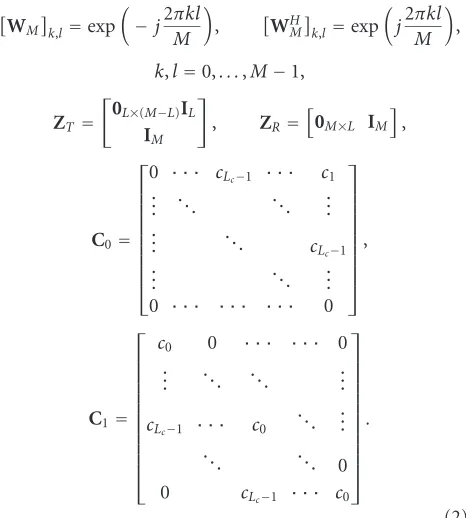
The relationship between the DMT input symbolu(k) and the output symbol ˆu(k) inFigure 1is given by [8,12,24] thonormal DFT and IDFT matrix, respectively, andZT and
ZRthe introduction and removal of the guard interval of size L, respectively.C=C0 C1
is the size (M+L)×2(M+L) channel matrix combining the P/S conversion at the trans-mitter, the convolution with the channel impulse response and the S/P conversion at the receiver, andr(k) is the addi-tive channel noise after S/P conversion. We here assume that the channel impulse responsec(n) is of lengthLcand shorter thanM, what is generally the case for ADSL and VDSL. The entries of the matrices are then given by
The capacity of each subcarrier depends on the subcar-rier output SNR and is given byCk =log2(1 + SNRk) [25]. The actual bitload per subcarrier is then given by
bk=log2
where Γ is called the SNR gap and depends on the target bit error rate, the modulation scheme, and whether chan-nel coding is performed, see [25] for details. The division of the channel frequency response into M subchannels as well as different QAM constellations are demonstrated in Figure 1. The bitrate per DMT symbol is then calculated as B=M/2
C0 C1 Lc M
L
M L M L
+ +
Figure2: Influence of introducing and removing the guard interval on the channel matrix.
algorithm [26,27,28,29,30,31,32] at the transmitter. These values are used to initialize the QAM modulator inFigure 1. Subchannels with a low SNR might end up not to carry any data since it turns out to be more favorable to spend the transmit energy of these subcarriers to increase the bitload on subcarriers with a high SNR. Since for twisted-pair cop-per wires the transmission channel can be considered as time invariant, the initialization has to be performed only once and is based on an estimate of the channel frequency re-sponse.
3. ZERO FORCING EQUALIZATION
A ZF equalizer removes the ISI and ICI introduced by the transmission channel. It is designed for the noise-free case and does not take noise enhancement into consideration. We at this point remove the restriction that the equalizer matrix
Eis diagonal, but we assume a generalM×Mmatrix. Starting from (1), ISI and ICI are removed if the following condition holds true:
ˆu(k)=0M IM u(k−1) u(k)
u(k)
+EW√M
MZRr(k), (4)
or equivalently,
1
MEWMZR
C0 C1
ZT 0 0 ZT
WHM 0
0 WHM
=0M IM.
(5)
To find the entries ofE, we first consider the influence on the channel matrixCof introducing and removing the guard interval, seeFigure 2. The gray diagonal band in the matrix inFigure 2denotes the nonzero entries. The introduction of the guard interval causes the firstLcolumns ofC0andC1, respectively, to be moved and added to their lastLcolumns. Then the removal of the guard interval reduces the matrices by its first Lrows. We call the matrix resulting from these
˜
C0 C˜1
M
M M
Figure3:C˜=[C˜0 C˜1] for a guard interval of sufficient length.
operationsC˜ with
˜
C=C˜0 C˜1=ZRC0 C1 ZT 0
0 ZT . (6)
IntroducingC˜ into (5) and splitting it into two parts, we obtain as constraints for ZF equalization the following two equations:
EWMC˜0WHM
M =0M, (7)
EWMC˜1WHM
M =IM. (8)
3.1. Guard interval of sufficient length
If the guard interval is of sufficient length, that is,L≥Lc− 1, thenC˜ = C˜0 C˜1 has the following structure, see also
Figure 3:
˜ C0=0M,
˜ C1=
c0 cLc−1 · · · c1
..
. . .. . .. ... ..
. . .. cLc−1
cLc−1 . .. . .. . ..
cLc−1 · · · · c0
. (9)
Thus, in this case (7) is always satisfied sinceC˜0 =0M, and sinceC˜1is circular,WMC˜1WHM/Min (8) becomes a diag-onal matrixDwhose entries are given by theM-point DFT of the channel impulse response. The ZF equalizerEis identical to the DMT equalizer, namely,
E=D−1, [E]k,k= 1
whereC(ej2πk/M) denotes the channel frequency response at the normalized frequencies 2πk/M. Note that the equalizer coefficients are only defined as long as the channel does not have a spectral null at one of the subcarrier frequencies. If the latter is the case, the subcarrier cannot be used for data transmission and the adaptive loading algorithm at the trans-mitter would decide not to transmit any data through that particular subchannel. Thus there is no need to equalize that subchannel. For an arbitrary channel frequency response, the equalizer coefficients can be described as
E=C†freq (11)
andC†freqbeing its also diagonal pseudoinverse,
One critical aspect of a ZF equalizer is the noise enhance-ment it may result in. Given the varianceσ2
r of the additive channel noise, we can calculate the noise varianceσ2
n,kat the output of subbandkas
diagσ2
The noise variance in a subcarrier is proportional to the inverse of the squared channel magnitude response at the subcarrier frequency, that is, it is low in “good” subcarriers and high in “bad” subcarriers. Since all ISI and ICI have been removed by the equalizer the SNR in subcarrierkis given by
SNRk=10 log10σ
ukdescribes the variance of the QAM signal
transmit-ted in subcarrierk.
3.2. Guard interval of insufficient length
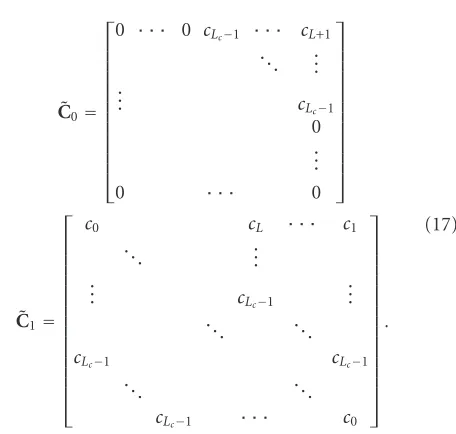
If however the guard interval is of insufficient length, that is, L < Lc−1, thenC˜0andC˜1have the following form (see also ial linear independent column vectors and sinceWHM is an orthogonal transform, the same holds true forEH. SinceC˜0 is an upper triangular matrix, we also know thatEWMmust have the following form to meet the nullspace condition:
EWM=0M×Lc−L−1 XM×M−Lc+L+1
, (18)
where XM×M−Lc+L+1 denotes a matrix of don’t care entries. We assume that the nullspace constraint is satisfied. Then, instead of solving (8) directly, we can also solve for
E E1 E0
Figure 5: Decomposition of equalizer matrix. White rows and columns denote zero entries.
since we have only added a zero matrix to the left- and right-hand sides of (8). The matrixPshifts the entries ofC˜0byL columns to the left such thatC˜circ=C˜1+C˜0Pis again a cir-cular matrix that is diagonalized through multiplication with the DFT and IDFT matrices and results in (11) as a solution for (19). However, it can be easily verified that this solution does not satisfy the nullspace constraint in (18) and therefore it is impossible to solve (7) and (8) simultaneously.
4. ZERO-FORCING EQUALIZATION FOR
TRANSMISSION WITH INSUFFICIENT GUARD INTERVAL AND UNUSED SUBCARRIERS
We now assume that K subcarriers are not used for data transmission, that is, the value zero is transmitted in these subcarriers, and that the guard interval is of insufficient length. Note that in DMT transceivers there are gener-ally some subcarriers that are not assigned any data by the adaptive loading algorithm. The block equalizerE then only needs to equalize the N = M−K subcarriers used for data transmission, since there is no need to equal-ize unused subcarriers. In particular, this means that (19) only has to be satisfied for the used subcarriers. Since
WMC˜circWHM/Mis diagonal, all rows and columns of E ac-cording to (11) corresponding to unused subcarriers can be chosen arbitrarily and (19) is still satisfied for all used subcarriers.
In the following, we splitEinto a sum of two matrices,
E0andE1, whereE1describes a particular solution of (19), where all the arbitrary entries are chosen to be zeros andE0 describes the arbitrary entries. The structures ofE1 andE0 are shown inFigure 5. Note that even forE0we have chosen the rows corresponding to unused subcarriers equal to zero. The entries in these rows are not needed since they only de-scribe the equalizer output in the unused subcarriers.
E1 can then be obtained from solving (19) for the used subcarriers only. The solution is identical to that part of (11) that corresponds to the used subcarriers and can mathemat-ically be described by
E1=S1C†freq, (21)
Figure6: Nonzero entries of equalizer matrix.
whereS1denotes a carrier selection matrix
S1=diag
1, subcarrier is used,
0, subcarrier is unused,
(22)
and ensures thatE1has zero entries in rows and columns cor-responding to unused subcarriers. We can now useE0to sat-isfy the nullspace constraint in (18). An equivalent way to ex-press (18) without including the don’t care matrixXis given by matrixWMand thus has full column rank. The only free pa-rameters available to solve (23) are theKcolumns of nonzero entries inE0and thus a solution of the linear system of equa-tions exists, ifK≥Lc−L−1. This means that for each tap that the guard interval is too short, we need one unused subcar-rier in order to design an equalizerEthat completely removes ISI and ICI. ReplacingEin (23) byE0+E1and introducing an additional matrix (IM−S1) that ensures thatE0has nonzero entries only at columns corresponding to unused subcarriers, we obtain
Using these results, the equalizer matrix is given as
E=E0+E1=S1C†freq
original DMT scheme. In addition, a linear combination of the outputs of all unused subcarriers is added. Note that the values that are received in the unused subcarriers describe ISI and ICI from used subcarriers as well as additive channel noise. The fact that the ISI and ICI component is not negligi-ble is due to the low stopband attenuation of the IDFT at the transmitter that allows significant leakage into neighboring subcarriers. This fact is generally considered as a drawback of using the IDFT and DFT for modulation and demodu-lation, respectively, but has been exploited as an advantage here. Thanks to its sparse structure, the implementation cost of the ZF block equalizer is low.
Given the equalizer coefficients and the varianceσ2 r of the additive channel noise, we can now calculate the noise vari-ance at the output of the equalizer:
diagσ2
where we have taken into account that the products E0EH1 andE1EH0 have zero diagonal elements as can be easily ver-ified fromFigure 5. The derivation of (31) from (30) is de-scribed inAppendix A. Note that the first noise term, that is, σ2
r ·diag(E1EH1), is the same as in a conventional DMT re-ceiver with diagonal entries only, see (15). The second term arises from the nonzero entries inE0. It is also proportional to the inverse of the squared channel magnitude response at the subcarrier frequency, but in addition depends on the po-sition of the used and unused carriers since it contains the carrier selection matrixS1inside the inverse matrix.
5. UNUSED SUBCARRIER SELECTION
As described in Section 2, the bitload per subcarrier in a DMT transceiver is determined by an adaptive loading al-gorithm that maximizes the bitrate per DMT symbol given the SNRs per subchannel, a target SNR gapΓ, and a given maximum transmit power. If the guard interval is of suf-ficient length, the SNRs per subcarrier are independent of each other, see (16), and the adaptive loading algorithm [26,27,28,29,30,31,32] can iteratively assign bits to the subcarriers starting with the ones having the highest SNR. In the case of an insufficient guard interval, however, we have seen from (31) that the noise enhancement in the receiver not only depends on the channel frequency response but also on the position of the used and unused subcarriers. Therefore, deciding which subcarriers to use becomes a more elaborate task than just assigning theK subcarriers with the highest channel attenuation as the unused ones. In the following, we will look at two special cases first before evaluating the gen-eral case.
5.1. Guard interval is too short by one tap
If the guard interval is just one tap too short, that is,Lc−L−
withskfrom (22). Substituting this result into (31), we obtain for the noise varianceσ2
n,kand for the SNR at the output of a used subcarrierk,
σ2
In this special case, the SNRs in used subcarriers only de-pend on the channel magnitude frequency response and the number of unused subcarriers. Thus, onceKhas been chosen (and it has to be at least one since otherwise ZF equalization is impossible) in order to select the subcarriers resulting in the highest data rate, we just have to choose thoseN=M−K ones with the highest SNRs.
Note that forK = 1 the noise variance is twice as high as in DMT with sufficient guard interval, but it reduces as K increases. The optimal value forKcan be determined it-eratively by starting with K = 1 and increasingK in steps of one until the data rate stops increasing. At each step, we can apply one of the existing adaptive loading algorithms in order to determine the data rate. The only minor modifica-tion that has to be made is to prevent the adaptive loading algorithm from assigning bits to subcarriers declared as un-used, for example, by setting the SNR in unused subcarriers to 0. For each used subcarrier that we convert into an unused one in an iteration step, the noise variance in the remaining used subcarriers reduces. In addition, we can increase the sig-nal varianceσ2
u,kin the used subcarriers, since the total signal power now has to be split over a smaller number of subcarri-ers. Both effects increase the used subcarriers’ SNRs. As long as this improvement allows us to increase the bitload by more bits than the subcarrier we removed was carrying, the total data rate increases. As the iteration continues, the improve-ment of SNRs in used subcarriers reduces and the SNR of the subcarrier that is converted from used to unused has an increasing SNR. Therefore, at some point, the total bit rate stops increasing and we have found the optimal value forK.
5.2. Unused subcarriers are spaced equidistantly
conclude that the columns of (IM−S1)W0must be orthogo-nal to each other. We at this point assume that the total num-ber of subcarriersMis a power of two. Then, if we chooseK to be also a power of two, satisfyingK≥Lc−L−1, and place the unused subcarriersM/K subcarriers apart, the nonzero entries of (IM−S1)W0form the firstLc−L−1 (rotated) col-umn vectors of a sizeKDFT matrix and are thus orthogonal. The entries of the carrier selection matrixS1are thus given by the following solution, where j is an integer value with 0≤ j < M/K:
Taking further into consideration that in a DMT setting, the data in subcarrierM−kis the complex conjugate of the data in subcarrierk, withk=1,. . .,M/2−1, in order to guar-antee real-valued data at the output of the transmitter, only two choices for j in (35) remain to place unused subcarri-ers. These are j =0 and j =M/2K. For these solutions, we obtain
WH0IM−S1
W0=K·ILc−L−1. (36)
Substituting this result into (31), the noise variance and SNR in a used subcarrierkyields
σ2
Here, the SNRs in used subcarriers depend again not only on the channel magnitude frequency response and the num-ber of unused subcarriers but also on the numnum-ber of samples by which the guard interval is too short. Since the number of combinations for the placement of the unused subcarri-ers has been significantly reduced, an extensive search can be performed to find the placement resulting in the highest data rate. Starting with the smallest power of two greater than Lc−L−1 forK, the optimal value forjin (35) can be deter-mined. Then,Kis doubled and the search for an optimaljis performed again. This procedure is repeated while the data rate keeps increasing.
5.3. General case
The noise variance at the equalizer output for a general place-ment of K unused subcarriers is given in (31). Since it de-pends on the carrier selection matrixS1, the noise variance can only be calculated once a decision has been made on which subcarriers should remain unused, not knowing how good this decision is. Some better insight can be gained when reformulating (31) using the matrix inversion lemma [33],
seeAppendix Bfor details.
diagσn2,0,σn2,1,. . .,σn2,M−1
The noise variance and SNR in a used subcarrierkthus yield using the Neumann expansion [33],
"
and thus approximated through a finite series. A possible ap-proach is to use only a few terms of the series to determine
S1. We can afterwards verify the quality of the approxima-tion by substituting the matrix S1 derived in this way into (39) comparing this result with the one obtained from the approximation.
6. SIMULATION RESULTS
The performance of the proposed frequency domain ZF equalizer was evaluated through simulation of a DMT transceiver in Matlab. The block length isM =128 and the target bit error rate is set to 10−6. The discrete channel im-pulse response, sampled at fs = 1.024 MHz, was obtained through actual measurement of a twisted-pair copper wire of 4 km length and a diameter of 0.8 mm. For simulation pur-poses, the impulse response has been artificially shortened to 35 taps, removing a tail of very small values. The impulse re-sponse and the magnitude frequency rere-sponse are shown in Figure 7.
AWGN channel noiser(n) with different variancesσ2 r was applied. The transmit signal powerσ2
u was set to be a 1/M, that is, Mi=−01σ2
ui = 1. Thus the more subcarriers are used,
0 10 20 30 40 Taps
−0.04 −0.02 0 0.02 0.04 0.06 0.08
dB
(a)
0 20 40 60 80 100 120
Subchannel index −70
−60 −50 −40 −30 −20 −10
dB
(b) Figure7: (a) Channel impulse response and (b) magnitude frequency response.
in the previous section for the different cases. Denoting the sampling rate at the transmitter output fs=1/T, the bitrate is calculated as
bitrate=Mfs
+L M/'2−1
k=1
bk, (44)
wherebkare the bits per subcarrier determined by the adap-tive loading algorithm. Only an even number of bits is as-signed per subcarrier in order to stay with square QAM con-stellations.
6.1. Example 1
In a first simulation, we investigate the case where the guard interval is just one tap too short (L= 33 taps,K ≥1). For several noise variances, the number of unused subcarriersK has been varied. TheK subcarriers with the lowest SNR ac-cording to (34) are assigned as unused subcarriers. The nor-malized bitrates are shown inFigure 8. The value given for K = 0 is the data rate achievable with a guard interval of sufficient length and is shown for comparison.
The maximum data rate occurs for values ofK greater than the required K = 1, since the noise variance at the receiver output reduces with increasing K. The higher the noise variance, the larger is the optimum value forK since an increasing number of subcarriers remains unloaded even in DMT with sufficient guard interval due to a too low SNR.
6.2. Example 2
In a second set of simulations, we space the unused subcarri-ers equidistantly (seeSection 5.2). Thus, the number of un-used subcarriers K is restricted to be a power of two. The
0 20 40 60 80 100 120
K
0 0.5 1 1.5 2 2.5 3 3.5
T
∗bit
rat
e
Figure 8: Bitrates for 10 log10(σ2
u/σr2) = 20 dB(+), 30 dB(◦),
40 dB(×), 50 dB(∗), and 60 dB( ) if the guard interval is one tap too short.
guard interval is varied fromL=Lc−2 toL =0.Figure 9 shows the achievable data rate for all possible values ofK de-pendent on the number of taps by which the guard interval is too short.
For 10 log10(σ2
0 10 20 30 40
Lc−L−1
0.24 0.26 0.28 0.3 0.32 0.34 0.36
T
∗bit
rat
e
(a)
0 10 20 30 40
Lc−L−1
1.3 1.4 1.5 1.6 1.7 1.8 1.9 2
T
∗bit
rat
e
(b) Figure9: (a) Normalized bitrates for 10 log10(σ2
u/σr2)=30 dB and (b) 50 dB.K=2(+), 4(◦), 8(×), 16(∗), 32(), 64( ).
0 10 20 30 40
Lc−L−1
0 0.5 1 1.5 2 2.5 3 3.5
T
∗bit
rat
e
Figure 10: Highest bitrates for 10 log10(σ2
u/σr2) = 20 dB(+),
30 dB(◦), 40 dB(×), 50 dB(∗), 60 dB( ) assigning unused subcar-riers equidistantly.
10 log10(σ2
u/σr2)=50 dB, we observe a reduction of the data rate when usingK=32 andK=64, since too many subcar-riers that carry bits in traditional DMT have to be reserved as unused subcarriers. Taking the maximum bitrate of allKfor each guard interval length results inFigure 10. The data rate forLc−L−1=0 is the one resulting from traditional DMT with a guard interval of sufficient length.
We observe that the data rate reduces only slightly for moderate SNRs. Reducing the guard interval results in a lower latency time of the system. In applications where la-tency time is a predominant concern, the reduction in bitrate might be acceptable.
6.3. Example 3
In this example, we assign theKsubcarriers with the highest channel frequency attenuation to be the unused subcarriers. These are the subcarriers that a traditional DMT transceiver would leave unused in case the allowed total transmit power is not high enough to assign bits to them. As we can see from the channel frequency response inFigure 7, the unused sub-carriers form two blocks: one at low frequencies and one at high frequencies.Kis varied for each value ofLfromLc−L−1 toMin steps of one, hoping that the extra redundancy intro-duced reduces the noise enhancement. Then theK with the highest data rate is chosen, resulting inFigure 11.
For small values ofLc−L−1, we obtain higher data rates than in the case of equidistant spacing of unused subcarri-ers. However, asLc−L−1 increases, the data rate reduces dramatically for 10 log10(σ2
u/σr2)>30 dB. This is because the denominator in (42) depends on the position of the unused subcarriers and grows fast for the choice made here.
6.4. Example 4
0 10 20 30 40
Lc−L−1
0 0.5 1 1.5 2 2.5 3 3.5
T
∗bit
rat
e
Figure 11: Highest bitrates for 10 log10(σu2/σr2) = 20 dB(+),
30 dB(◦), 40 dB(×), 50 dB(∗), 60 dB( ) choosing the subcarriers with the highest channel frequency attenuation to be the unused subcarriers.
0 10 20 30 40
Lc−L−1
0 0.5 1 1.5 2 2.5 3 3.5
T
∗bit
rat
e
Figure 12: Highest bitrates for 10 log10(σ2
u/σr2) = 20 dB(+),
30 dB(◦), 40 dB(×), 50 dB(∗), 60 dB( ) with TEQ channel impulse response shortening.
lengths. Since the impulse response resulting from convo-lution of the channel with the TEQ filter has nonzero taps outside the window, the SNRs also take into account the re-sulting interference.
ComparingFigure 12with Figures10and11, we observe that the TEQ performs better than our suboptimal approach, but results in lower data rates than the equidistant spacing of unused subcarriers, particularly for short guard intervals.
7. CONCLUSION
In this paper, we have presented a new ZF frequency do-main block equalizer for DMT transceivers with insufficient guard interval. The equalizer takes advantage of unused sub-carriers and allows to trade off time domain redundancy for frequency domain redundancy, thus resulting at a lower transceiver latency time for the same data rate. We have given sufficient conditions for ZF equalization and shown that the only nonzero entries in the block equalizer are the ones that are already present in conventional DMT plus additional branches that combine used subcarriers with unused subcar-riers. The equalizer thus utilizes the ISI/ICI leakage caused by the FFT operation at the receiver side. The noise enhance-ment of the equalizer has been calculated. For each subcar-rier, it depends on the channel attenuation in the subcarsubcar-rier, as well as the placement of all unused subcarriers. The noise variance at the receiver output has been calculated for guard intervals that are just one tap too short and for equidistant spacing of unused subcarriers. For the general case, an ex-pression for the noise variance has been derived that still de-pends on the placement of the unused subcarriers. Finding an optimal solution to this problem is the focus of future studies. As simulations have shown, it is not as easy as to as-sign the subcarriers with the highest channel attenuation as unused subcarriers. The redundance needed for ZF equaliza-tion is the same as in tradiequaliza-tional DMT, however, it is placed here in such a way that the system latency time can be re-duced. Also, simulations have shown that the solution with the lowest redundancy does not necessarily result in the high-est data rate. This might change when calculating the equal-izer coefficients according to an MSE criterion instead of ZF and is also the scope of future studies.
APPENDICES
A. NOISE VARIANCE
In order to derive the noise variance at the output of each subband, we first calculateE0EH0 applying (26).
E0EH0 =
$
S1C†freqW0
IM−S1
W0
†%
·$S1C†freqW0
IM−S1
W0
†%H. (A.1)
For reasons of conciseness, we introduce the abbreviation
A=IM−S1
W0
, (A.2)
yielding
E0EH0 =S1C†freqW0A†A†HWH0C†freq H
S1. (A.3)
Using singular value decomposition, one can easily show thatA†(A†)H=(AHA)†and withAfrom (A.2), this yields
AHA†=$IM−S1
W0
H
IM−S1
W0
%†
=WH0IM−S1
W0
†
=WH0IM−S1
W0
−1
and since the resulting matrix is square and always of full rank, taking the pseudoinverse was replaced by taking the in-verse in the last step. We now have
E0EH0 =S1C†freqW0
Once we have taken the diagonal of this expression (tak-ing into consideration thatS1andC†freqare already diagonal matrices), each factor is a diagonal matrix and the order of the matrices can be interchanged. WithS1·S1 =S1we
ob-B. MATRIX INVERSION LEMMA
The matrix inversion lemma [33] states that
(A+XRY)−1=A−1−A−1XR−1+YA−1X−1YA−1, (B.1)
whereAis a regularn×nmatrix,Xisn×r,Yisr×n, andR
is a regularr×rmatrix. A useful identity that can be derived from (B.1) is plying these modifications to (31) directly results in (39). We can further simplify (39) through the following modifica-tions that result in (40):
[1] W. Goralski,ADSL and DSL Technologies, McGraw-Hill, New York, NY, USA, 1998.
[2] N. Al-Dhahir and J. M. Cioffi, “Optimum finite-length equal-ization for multicarrier transceivers,” IEEE Trans. Communi-cations, vol. 44, no. 1, pp. 56–64, 1996.
[3] P. J. W. Melsa, R. C. Younce, and C. E. Rohrs, “Impulse re-sponse shortening for discrete multitone transceivers,” IEEE Trans. Communications, vol. 44, no. 12, pp. 1662–1672, 1996. [4] M. Nafie and A. Gatherer, “Time-domain equalizer training for ADSL,” inProc. IEEE International Conference on Commu-nications, vol. 2, pp. 1085–1089, Montreal, Quebec, Canada, June 1997.
[5] N. Lashkarian and S. Kiaei, “Fast algorithm for finite-length MMSE equalizers with application to discrete multitone sys-tems,” inProc. IEEE International Conference on Acoustics, Speech, and Signal Processing, vol. 5, pp. 2753–2756, Phoenix, Ariz, USA, March 1999.
[6] G. Arslan, B. L. Evans, and S. Kiaei, “Equalization for discrete multitone transceivers to maximize bit rate,”IEEE Trans. Sig-nal Processing, vol. 49, no. 12, pp. 3123–3135, 2001.
[7] K. Van Acker, G. Leus, M. Moonen, O. van de Wiel, and T. Pol-let, “Per tone equalization for DMT-based systems,” IEEE Trans. Communications, vol. 49, no. 1, pp. 109–119, 2001. [8] X.-G. Xia, “New precoding for intersymbol interference
can-cellation using nonmaximally decimated multirate filterbanks with ideal FIR equalizers,” IEEE Trans. Signal Processing, vol. 45, no. 10, pp. 2431–2441, 1997.
[9] L. Vandendorpe, L. Cuvelier, F. Deryck, J. Louveaux, and O. van de Wiel, “Fractionally spaced linear and decision-feedback detectors for transmultiplexers,” IEEE Trans. Signal Processing, vol. 46, no. 4, pp. 996–1011, 1998.
International Conference on Acoustics, Speech, and Signal Pro-cessing, vol. 6, pp. 3505–3508, Seattle, Wash, USA, May 1998. [11] T. Li and Z. Ding, “Joint transmitter-receiver optimization for
partial response channels based on nonmaximally decimated filterbank precoding technique,” IEEE Trans. Signal Process-ing, vol. 47, no. 9, pp. 2407–2414, 1999.
[12] A. Scaglione, G. B. Giannakis, and S. Barbarossa, “Redundant filterbank precoders and equalizers. I. Unification and opti-mal designs,”IEEE Trans. Signal Processing, vol. 47, no. 7, pp. 1988–2006, 1999.
[13] S. Trautmann, T. Karp, and N. J. Fliege, “Comparing TEQ and MMSE receivers for short-latency DMT transmission,” in Proc. 1st International OFDM-Workshop, Hamburg, Germany, September 1999.
[14] R. E. Crochiere and L. R. Rabiner, Multirate Digital Signal Processing, Prentice-Hall, Englewood Cliffs, NJ, USA, 1983. [15] P. P. Vaidyanathan, Multirate Systems and Filter Banks,
Pren-tice Hall, Englewood Cliffs, NJ, USA, 1993.
[16] N. Suzuki, H. Uehara, and M. Yokoyama, “A new OFDM de-modulation method to reduce influence of ISI due to longer delay than guard interval,” inProc. 8th IEEE International Conference on Communication Systems, vol. 1, pp. 239–244, Singapore, November 2002.
[17] S. Trautmann and N. J. Fliege, “A new equalizer for multitone systems without guard time,” IEEE Communications Letters, vol. 6, no. 1, pp. 34–36, 2002.
[18] S. Trautmann and N. J. Fliege, “Perfect equalization for DMT systems without guard interval,” IEEE Journal on Selected Ar-eas in Communications, vol. 20, no. 5, pp. 987–996, 2002. [19] A. Gatherer and M. Polley, “Controlling clipping probability
in DMT transmission,” inProc. 31st Asilomar Conference on Signals, Systems and Computers, vol. 1, pp. 578–584, Pacific Grove, Calif, USA, November 1997.
[20] J. Tellado and J. M. Cioffi, “Efficient algorithms for reduc-ing PAR in multicarrier systems,” inProc. IEEE International Symposium on Information Theory, p. 191, Cambridge, Mass, USA, August 1998.
[21] J. Tellado and J. M. Cioffi, “PAR reduction in multicar-rier transmission systems,” ANSI T1E1.4 contribution num-ber 97-367, Sacramento, Calif, USA, Decemnum-ber 1997 and ITU Study Group 15, contribution number D150 (WP 1/15), Geneva, Switzerland, February 1998.
[22] J. Tellado and J. M. Cioffi, “Revisiting DMT’s PAR,” ETSI/ANSI TM6 contribution number TD08, Antwerp, Bel-gium, April 1998 and ANSI T1E1.4 contribution number 98-083, Austin, Tex, USA, March 1998.
[23] J. Tellado and J. M. Cioffi, “Further results on peak-to-average ratio reduction,” ANSI T1E1.4 contribution number 98-252, San Antonio, Tex, USA, August 1998 and ETSI/ANSI TM6 contribution number TD15, Vienna, Austria, September 1998.
[24] T. Karp, S. Trautmann, and N. J. Fliege, “Frequency domain equalization of DMT/OFDM systems with insufficient guard interval,” inProc. IEEE International Conference on Commu-nications, vol. 3, pp. 1646–1650, New York, NY, USA, April 2002.
[25] J. M. Cioffi, A multicarrier primer, http://www-isl.stanford. edu/∼cioffi/papers.html.
[26] D. Hughes-Hartog, “Ensemble modem structure for imper-fect transmission media,” US patent 4,679,227 (July 1987), US patent 4,731,816 (March 1988), and US patent 4,833,706 (May 1989).
[27] J. Campello, “Optimal discrete bit loading for multicarrier modulation systems,” inProc. IEEE International Symposium
on Information Theory, p. 193, Cambridge, Mass, USA, August 1998.
[28] J. Campello, “Practical bit loading for DMT,” inProc. IEEE International Conference on Communications, vol. 2, pp. 801– 805, Vancouver, BC, Canada, June 1999.
[29] B. Farhang-Boroujeny and M. Ding, “An eigen-approach to the design of near-optimum time domain equalizer for DMT transceivers,” inProc. IEEE International Conference on Communications, vol. 2, pp. 937–941, Vancouver, BC, Canada, June 1999.
[30] B. Wang and T. Adali, “Joint impulse response shortening for discrete multitone systems,” inProc. IEEE Global Telecom-munications Conference, vol. 5, pp. 2508–2512, Rio de Janeiro, Brazil, December 1999.
[31] B. Wang and T. Adali, “Time-domain equalizer design for dis-crete multitone systems,” inProc. IEEE International Confer-ence on Communications, vol. 2, pp. 1080–1084, New Orleans, La, USA, June 2000.
[32] R. V. Sonalkar and R. R. Shively, “An efficient bit-loading al-gorithm for DMT applications,” IEEE Communications Let-ters, vol. 4, no. 3, pp. 80–82, 2000.
[33] T. K. Moon and W. C. Stirling, Mathematical Methods and Algorithms for Signal Processing, Prentice-Hall, Upper Saddle River, NJ, USA, 2000.
Tanja Karpreceived the Dipl.-Ing. degree in electrical engineering (M.S.E.E.) and the Dr.-Ing. degree (Ph.D.) from Technical Univer-sity Hamburg-Harburg, Hamburg, Germany, in 1993 and 1997, re-spectively. In 1995 and 1996, she spent two months as a Visiting Researcher at the Signal Processing Department of ENST, Paris, France, and at the Mutirate Signal Processing Group, University of Wisconsin, Madison, respectively, working on modulated filter banks. In 1997, she joined the Institute of Computer Engineering at Mannheim University, Germany, as a Senior Research and Teach-ing Associate. From 1998 to 1999, she had also taught as a Guest Lecturer at the Institute for Microsystem Technology at Freiburg University, Germany. Since 2000, she has been an Assistant Profes-sor in the Department of Electrical and Computer Engineering at Texas Tech University, Lubbock, Texas. Her research interests in-clude multirate signal processing, filter banks, audio coding, mul-ticarrier modulation, multiple description coding, and signal pro-cessing for communications. Dr. Karp is an IEEE member and reg-ularly reviews articles for several IEEE and EURASIP transactions.
Steffen Trautmannreceived the Dipl.-Ing. degree in information technology from the Dresden University of Technology, Dresden, Germany, in 1996. From October 1994 to April 1995, he was a Visiting Student at the University of Wisconsin, Madison, USA. He was a Ph.D. Student at the Hamburg University of Technology, Hamburg, Ger-many, from February 1996 to December 1996. From 1997 to 2001, he was with the
Norbert J. Fliegereceived the Dipl.-Ing. de-gree and the Dr.-Ing. dede-gree in 1971, both from the University of Karlsruhe, Germany. Since 1978, he was an Associate Professor at the same university. In 1980, he was a Visiting Professor at ESIEE in Paris. From 1982 to 1996, he was a Full Professor and Head of the Telecommunication Institute at Hamburg University of Technology, Ham-burg, Germany. Since 1996, he has been a
![Figure 3: C˜ = [C˜0˜C1] for a guard interval of sufficient length.](https://thumb-us.123doks.com/thumbv2/123dok_us/899982.1108501/4.600.68.277.72.196/figure-c-c-c-guard-interval-sucient-length.webp)