Copyright to IJIRSET www.ijirset.com 3554
AN EXPERIMENTAL STUDY ON THE
EFFECT OF THERMAL BARRIER COATING
ON DIESEL ENGINE PERFORMANCE
T.K.Chandrashekar
1, C.R.Rajshekar
2, R.Harish Kumar
3Professor, Department of Mechanical Engineering,Channabasaveshwara Institute of Technology,Gubbi,Tumkur,Karnataka,India1
Professor,Department of Mechanical Engineering ,MITE,Mangalore,Karnataka,India2,
Professor, Department of Mechanical Engineering ,Sri Siddhartha Institute of Technology, Tumkur, Karnataka,india3
Abstract: In a conventional internal combustion engine, approximately 60 % of total heat energy is lost with exhaust gases and cooling systems. In this study, the effect of insulated heat transfer surfaces inside the combustion chamber of a diesel engine was investigated. Thermal barrier Zirconium coatings are used in diesel engine piston, valves and heads. An experimental investigation into the effect of coatings on the performance of a Diesel engine was conducted. Tests were performed on a single cylinder diesel engine with eddy current dynamometer whose piston and head were coated with 0.35 mm thickness CaZrO3. The coating is evaluated
for its ability to improve the combustion characteristics. The coated engine was tested at the same operating condition as that of standard engine (without coating). The results indicate an improvement in the Brake thermal efficiency with a consequent reduction in the brake specific fuel consumption.
Keywords: Thermal barrier, Engine performance, Brake thermal efficiency, Brake, Specific fuel consumption.
I. INTRODUCTION
The quest for developing energy efficient internal combustion engines has been going on from past several decades. In recent times, research is focused on reducing the energy lost to exhaust gases, cooling systems, all and head of combustion chamber. One of the trends is to improve performance of the heat engines by engine adiabatization. The method to adibatize an engine is to cover the surfaces of the combustion chamber with a thermal barrier coating. The thermal insulation provided by coating leads to energy efficient engines. Kamo and Bryzik [1] used thermal barrier coating such as silicon nitride for insulating different surfaces of the combustion chamber and found an improvement of 7 % in engine performance. Imdat Taymaz [2] coated the head, combustion chamber surfaces, valves and piston crown faces with CaZrO3 and MgZrO3, Observed that at medium load effective efficiency improved by 2 %. However the authors have not clearly demarcated the influence of speed and the effect of thermal barrier coatings on enhancing of thermal efficiency of the engine. Abdulla Uzun and Ismet cevik [3] showed that with thermal barrier coatings on diesel engine, the thermal efficiency increases by 10 % and fuel consumption showed a 2 % decrease. I.Taymaz and K.Cakir [4] have shown that the thermal barrier coatings on the combustion chamber of a diesel engine prevent the excessive heat loss during the combustion. Imdat Taymaz [5] has shown in a LHR engine, High temperature on the combustion chamber wall surface due to insulation cause a drop in volumetric efficiency. Ekrem Buyukkaya, Tahsin Engin and Muhammet cerit [6] have developed a low heat rejection engine and showed that 1-8 % reduction in brake specific fuel consumption can be achieved. The main purpose of this study is to evaluate the performance of a Diesel Engine with and without Thermal barrier coating. Experiments were conducted on single cylinder water cooled Diesel engine with Eddy current dynamometer for loading. The results showed an improvement in Brake thermal efficiency and a reduction in Brake specific fue l consumption with a reduction in heat losses.
Copyright to IJIRSET www.ijirset.com 3555
LHR: Low heat rejection engine. SE: Standard Diesel engine
CCE: CaZrO3 coated Diesel engine. BSFC: Brake Specific fuel consumption. HE: Heat engines.
II EXPERIMENTAL DETAILS
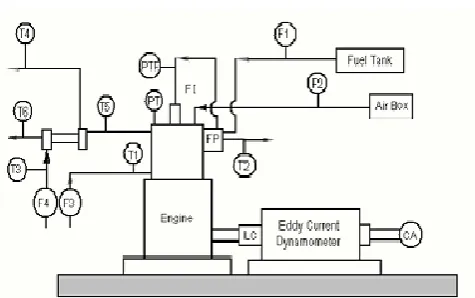
Fig. 1: Schematic Diagram of the Experimental Set-up.
PT: Combustion Chamber Pressure Sensor F Fig1. Engine set up
PTF: Fuel Injection Pressure Sensor FI: Fuel Injector
FP: Fuel Pump
T1: Jacket Water Inlet Temperature T2: Jacket Water Outlet Temperature T3: Inlet Water Temperature at Calorimeter T4: Outlet Water Temperature at Calorimeter T5: Exhaust Gas Temperature before Calorimeter T6: Exhaust Gas Temperature after Calorimeter F1: Liquid fuel flow rate
F2: Air Flow Rate F3: Jacket water flow rate F4: Calorimeter water flow rate LC: Load Cell
CA: Crank Angle Encoder EGC: Exhaust Gas Calorimeter
Copyright to IJIRSET www.ijirset.com 3556
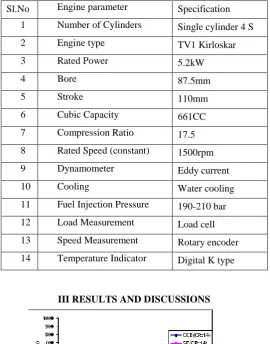
Table 1. Specification of Engine
Sl.No Engine parameter Specification 1 Number of Cylinders Single cylinder 4 S
2 Engine type TV1 Kirloskar
3 Rated Power 5.2kW
4 Bore 87.5mm
5 Stroke 110mm
6 Cubic Capacity 661CC
7 Compression Ratio 17.5
8 Rated Speed (constant) 1500rpm
9 Dynamometer Eddy current
10 Cooling Water cooling
11 Fuel Injection Pressure 190-210 bar
12 Load Measurement Load cell
13 Speed Measurement Rotary encoder
14 Temperature Indicator Digital K type
III RESULTS AND DISCUSSIONS
Copyright to IJIRSET www.ijirset.com 3557
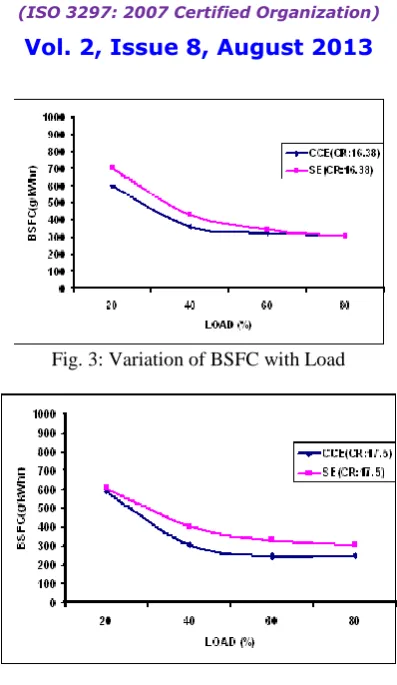
Fig. 3: Variation of BSFC with Load
Fig. 4: Variation of BSFC with Load
Figures 2, 3 and 4 represent the variation of the brake specific fuel consumption with load for different compression ratios. The results are shown for standard engine and ceramic coated engine. The results show 3 to 7 % decrease in brake specific fuel consumption for coated engine at loads lower than 50 % at low compression ratios. At higher compression ratio the brake specific fuel consumption decreases from 3 to 14 % for loads above 30 %. This is mainly due to the higher temperature reached in the combustion chamber, however the decrease in brake specific fuel consumption is marginal at low compression ratios, Therefore it appears that the thermal barrier coatings have considerable influence at higher compression ratios and tends to a higher reduction in Brake specific fuel consumption.
Copyright to IJIRSET www.ijirset.com 3558
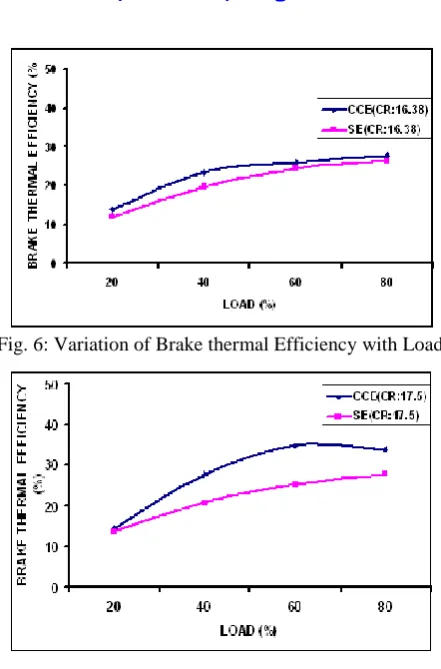
Fig. 6: Variation of Brake thermal Efficiency with Load.
Fig. 7: Variation of Brake thermal Efficiency with Load.
Fig. 8: Variation of Brake thermal Efficiency with Load for Different Compression Ratios.
Copyright to IJIRSET www.ijirset.com 3559
thermal conductivity, there by providing a better insulation allowing a higher operating temperature and reducing cooling requirement which enhances the Brake thermal efficiency.
Fig.9: Variation of Head temperature with Load.
Fig.10: Variation of Head temperature with Load.
Fig.11: Variation of Head temperature with Load.
Copyright to IJIRSET www.ijirset.com 3560
Fig. 12: Variation of Exhaust gas temperature with Load.
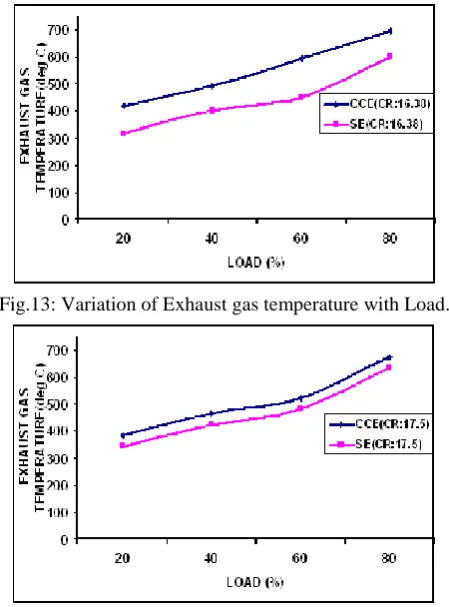
Fig.13: Variation of Exhaust gas temperature with Load.
Fig.14: Variation of Exhaust gas temperature with Load.
Copyright to IJIRSET www.ijirset.com 3561
Fig. 15: Variation of Peak pressure with Load.
Fig. 16: Variation of Volumetric efficiency with Load
The Figures 15 show clearly that the peak cylinder pressure is more for the coated engine for the same operating conditions and the fuel used. This observation is in line with the fact that the heat transferred to the piston crown surface is less for the coated engine as the thermal barrier coating acts as an insulation barrier. This fact is also reflected in Figure 16 where, because of the enhanced peak cylinder pressure and corresponding combustion temperatures, the volumetric efficiency of the coated engine has shown a marginal decrease owing to the inducted charge coming in contact with piston outer wall which are at higher temperature compared to that of standard engine.
IV CONCLUSIONS
An experimental investigation of the effect of CaZrO3 coating on diesel engine performance was conducted. Tests were carried out for different loads and compression ratios, for standard engine and the engine with its piston, head and valves insulated with ceramic coatings. The following conclusions were drawn from this investigation.
1. Brake thermal efficiency increased by 2-3 % at low compression ratios and 6-8 % for higher compression ratio for coated engine. As the thermal efficiency also increases due to increased compression ratio in general the brake thermal efficiency increases by 2-4 % due to thermal barrier coatings.
2. Brake specific fuel consumption shows a 2-10 % decrease in engines with thermal barrier coatings out of which 4-5% can be attributed to change in compression ratio.
3. Exhaust gas temperature increases between 30-55 0C for coated engine.
Copyright to IJIRSET www.ijirset.com 3562 REFERENCES
[1]. R.Kamo, W.Bryzik, "Advanced adiabatic diesel engine for passenger cars", SAE paper -840434(1984).
[2]. Imdat Taymaz, "The effect of thermal barrier coatings on diesel engine performance", Surface and Coating technology 201(2007)pp5249-5252. [3]. Abdullah uzun, Ismet cevik, Mustafa akil, "effect of thermal barrier coating on a turbocharged diesel engine performance”, Surface and Coating technology 116- 119(1999)pp505-507.
[4] I.Taymaz, K.Cakir, A.Mimaroglu, "Experimental study of effective efficiency in a ceramic coated diesel engine", Surface and Coating technology 200(2005)1182-1185.
[5]. Imdat Taymaz, "An experimental study of energy balance in low heat rejection diesel engine”, Elsevier-Energy,volume31,issue 2-3,Feb-Mar-2006 pp-364-371.