Experimental Analysis and Optimization of
Process Parameters in Machining of RCFRP
by AJM
Sargam Manikyam Reddy¹, Shaik Hussain², D.V.Srikanth³, Dr.M.Sreenivasa Rao*
P.G.Student, Department of Mechanical Engineering, Mallareddy Engineering College, Hyderabad, India¹
Associate Professor, Department of Mechanical Engineering, Mallareddy Engineering College, Hyderabad, India²
Associate Professor, Department of Mechanical Engineering, St.Martin's Engineering College, Hyderabad, India³
Professor, Department of Mechanical Engineering, JNTUH, Hyderabad, India*
ABSTRACT: In this experimental work presents the effects of process parameters on material removal rate in AJM
during machining of Rayon based CFRP composite. Abrasive jet machining (AJM) removes material through the action of focused beam of abrasive jet directed at the work piece the resulting erosion can be used for cutting, drilling and debarring etc. For this experimental work type of abrasive particles commonly used is silicon carbide (Sic). Here the process parameters are air pressure, abrasive flow rate, nozzle diameter and stand of distance. This work includes that creation and analysing of response surface. From this experiment the overall performance of parameters on metal removal rate (MRR) of work piece with statistically investigated by Response surface methodology (RSM) method was analysed and optimized were compared with ANOVA for optimal value.
KEYWORDS: process parameters, optimization, ANOVA, MRR, Abrasive Jet Machining, RSM
I. INTRODUCTION
Abrasive Jet Machining (AJM) is kind of micro blasting process. This method is most useful for hard and brittle materials like glasses, ceramics and composites. In this process metal is removed due to the erosion caused by impact of high speed of abrasive jet. Ajm is advantageous in two aspects; it has a high degree of flexibility and low stress forces with less heat generation machining process. Some attempts have been carried out to model and optimize the process parameters in AJM. For this approaches employed in this direction include design of experiments (DOE), Taguchi, RSM and ANOVA.
Rayon is manufactured regenerated cellulose produced from the naturally occurring cellulose polymer. After that cellulose converted into carbon in the presence of ammonium chloride. Properties of Rayon fibbers are high availability, low cost, non melting character and low density etc.CFRP is a Polymer Matrix Composite material reinforced by carbon fiber.It use thermosetting resins such as phenol, epoxy and polyester etc.
II. RELATED WORK
researchers interested to determining an optimal set of output variables.Chandra.B, Singh J. [6] this paper reviewed that various results of experiments have been conducted by changing pressure, nozzle tip distance on different thickness of glass plates. It was observed that as nozzle tip distance increases and kerfs width also increases in general observation of AJM. It is desirable to have a lower stand of distance which may produce smoother surface due to increase in kinetic energy.Dr.Deva Kumar.M.L.S,Anad Raju.F,Gnana Prakesh.V[8]reviewed that Abrasive Jet Machining with Silicon Carbide abrasive is suitable for hard and brittle material like glass and fiber glass. presented from the non linear regression the equation obtained can be used to predict the MRR on account of variation in all process variables.Ranjit K.Roy[3] reviewed that problem solving exercises relevant to actual engineering situations and coverage of two-,three-,four-level factor ,analysis of variance,roubust design ,combination designs.Varma.A.P[1] published a paper on the experimentation of Abrasive jet machining and focussed on the effect of parameters on MRR .Rani.M.R and Seshan[2]this paper reviewed that the current status of non-conventional machining process and discusses the unique advantages and application with various process parameters.Domiaty E.L.,EL-Hafiz H.M.,Shaker.M.A.[5]showed that the effect of nozzle diameter on material removal rate (MRR),when different size of abrasive particles are used ,It shows that the nozzle diameter is most important factor affecting the MRR.Srikanth.D.V,Dr.Sreenivasa Rao.M[4] reviewed that the use of OA with RSM to optimize the AJM process with performance characteristics Regression analysis to optimize of multiple responses was simplified through this approach. Gulhani.U.D, Patkar.P.P, Patel.S.P, Pattel.A.A. Et al [7] reviewed that DoE is performed to analyse the effect of process. Parameters on the Metal Removal Rate (MRR) and Kerfs Width of ceramic material. In these nozzle diameters was found to be the most significant factor influencing the MRR in cutting Process. The present experimental work attempts to make use of experiment to predict the process output variables from the regression models through Response surface methodology.
III. METHODOLOGY
Design of experiments (DOE) is powerful tool to determine the relation between factors affecting the process and the output of the process. By manipulated multiple functions at the same time, DOE can identify the interactions that may be missed when experimenting with one factor at a time. All possible combination factors can be investigated. The main four areas that DOE can apply are comparative, modelling, screening and optimizing.
Response surface methodology (RSM) is a collection of mathematical and statistical techniques for empirical model building.RSM was developed to model experimental responses (Box and Draper in 1987), and then migrated into the numerical experiments. By design of experiments ,the objective is to optimize a response (output variable) which is influenced by several independent variables (input variables).In this paper a series of tests called an experiment or runs, in which changes are made in the input variables in order to identify the response for changes in the output response. This includes discussions concerning response surface models with random effects, generalized linear models, and graphical techniques for comparing response surface design.
Analysis of variance (ANOVA) tests the hypothesis that the mean of two or more factor levels are equal. ANOVA assess the importance of one or more factors by comparing the response variable means at different factor levels. General linear model (GLM) is an ANOVA procedure in which expands on balanced ANOVA by allowing unbalanced designs and continuous variables. It calculating the variation about means ANOVA results for the each response. Based on F-value important parameter can be identified.
IV. EXPERIMENTAL WORK ON AJM
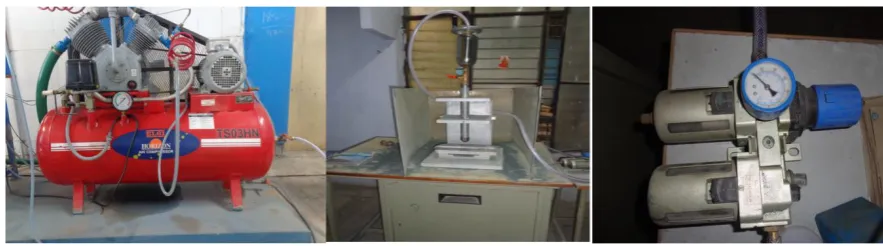
Figure 1 Experimental setup at St.Martin's Engineering College
Table 1.shows that characteristics of abrasive jet and it illustrate that type of carrier gas, type of abrasive and velocity of jet to maintain the machining process.
Table 1 Abrasive Jet Machining characteristics
This total variation of parameters in this set up was carried out according to the design of experiments (DOE) by considering the Box-Behnken design of response surface methodology with help of statistical software Minitab 17 version. The test specimens were drilled as per requirement of experimental work on AJM setup.
In this experiment,L^27 orthogonal array employed to analyse experimental results of obtained from 27 experiments by varying four process parameters are Pressure, Abrasive feed rate, Nozzle diameter and stand of distance.RSM is employed and the Analysis Of Variance (ANOVA) is also applied to identify the most significant factor.
In this experiment drilling of Rayon based CFRP composite laminate was conducted as per the variation of parameters listed in table2.shows those parameters and their levels of this experiment.
Table 2 Design scheme for setup of parameters and levels
Process Parameters Units Levels Observed values
L1 L2 L3
Metal removal rate (gm/sec)
Pressure kg/cm² 4 6 8
Abrasive Flow Rate gm/sec 3.5 4.5 5.5
Nozzle diameter mm 3 4 5
Stand of Distance mm 6 8 10
Below table.3 shows that the experimental design using of Orthogonal arrays (L˄27) based on design of experiments with Box-Behnken design. Which helps to creation of list of experimental procedure to author. It contains that serial no experiments, STD order and run order and input parameters (Pr, afr, nd and sod) and response (MRR).
Carrier gas Atmospheric air Type of Abrasive Sic (mesh size of 46)
Table 3 Box-Behnken Design based on L˄27 orthogonal array
4.1 Box-Behnken Design
No. Factors: 4 No. Replicates: 1 No. Base runs: 27 No. Total runs: 27 No. Base blocks: 1 No. Total blocks: 1 Centre points: 3
4.2 Optimal Design: Pressure, afr, nd, sod
Response surface design selected using distance-based optimality Number of candidate design points: 27
Number of design points in optimal design: 3 Number of factors: 4
4.3 Regression Coefficient
Response Surface Regression: MRR versus pr, afr, nd, sod
The analysis was done using coded units and table 4 shows that regression coefficients values for MRR and it shows that individual of parameters performance values in form of coefficient ,stranded efficient ,t and p values.
S.no Std order
Run order
Block s
Pr afr nd Sod MRR
(g/sec)
1 27 1 1 6 4.5 4 8 0.0498
2 5 2 1 6 4.5 3 6 0.0210
3 19 3 1 4 4.5 5 8 0.0586
³ 10 4 1 8 4.5 4 6 0.0713
5 21 5 1 6 3.5 4 6 0.0498
6 3 6 1 4 5.5 4 8 0.0300
7 25 7 1 6 4.5 4 8 0.0498
8 23 8 1 6 3.5 4 10 0.0498
9 11 9 1 4 4.5 4 10 0.0300
10 14 10 1 6 5.5 3 8 0.0210
11 22 11 1 6 5.5 4 6 0.0498
12 1 12 1 4 3.5 4 8 0.0300
13 15 13 1 6 3.5 5 8 0.0973
14 18 14 1 8 4.5 3 8 0.0301
15 26 15 1 6 4.5 4 8 0.0498
16 16 16 1 6 5.5 5 8 0.0983
17 6 17 1 6 4.5 5 6 0.0973
18 12 18 1 8 4.5 4 10 0.0713
19 13 19 1 6 3.5 3 8 0.0210
20 9 20 1 4 4.5 4 6 0.0310
21 20 21 1 8 4.5 5 8 0.1360
22 4 22 1 8 5.5 4 8 0.0713
23 8 23 1 6 4.5 5 10 0.0973
24 17 24 1 4 4.5 3 8 0.0126
25 7 25 1 6 4.5 3 10 0.0210
26 2 26 1 8 3.5 4 8 0.0713
Table 4 Regression Coefficients for MRR
Term Coef SE Coef T-Value P-Value
Constant 0.04980 0.00108 45.97
Pr 0.021958 0.000542 40.54 0.000
Afr 0.000083 0.000542 0.15 0.880
Nd 0.038458 0.000542 71.00 0.000
Sod 0.000000 0.000542 0.00 1.000
pr*pr 0.000867 0.000812 1.07 0.307 afr*afr 0.000054 0.000812 0.07 0.948 nd*nd 0.009492 0.000812 11.68 0.000 sod*sod -0.000072 0.000812 -0.09 0.932 pr*afr 0.000000 0.000938 0.00 1.000 pr*nd 0.015825 0.000938 16.87 0.000 pr*sod -0.000000 0.000938 -0.00 1.000 afr*nd 0.000250 0.000938 0.27 0.794 afr*sod -0.000000 0.000938 -0.00 1.000 nd*sod 0.000000 0.000938 0.00 1.000
Response surface methodology model summary of this regression values are S =0.0018763, R-sq =99.83%, R-sq (adj) =99.64%, R-sq (pred) =99.03%.
4.4 Analysis of variance for MRR
The RSM values obtained by Box-Behnken Design are validated by Analysis of variance about mean ANOVA results for each response. Based on F-values (significance factor value) important parameters can be identified. Table and Table obtained by Minitab 17 software. ANOVA table contain Degree of freedom (DF), sum of squares (SS), Mean squares (MS), Significant Factor ratio (F Ratio), Probability (P) calculated percentage contribution.
4.5 ANOVA VALIDATION
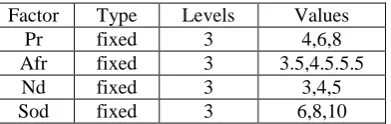
Table 5 shows that the general linear model (GLM) for response MRR versus Pr, afr, nd sod and type of machining, levels and values of each input parameters .This table illustrate the total specifications of the machining process
Table 5 Factor and levels with values
Factor Type Levels Values
Pr fixed 3 4,6,8
Afr fixed 3 3.5,4.5.5.5
Nd fixed 3 3,4,5
Sod fixed 3 6,8,10
Table 6 shows that Analysis of variance for MRR, using adjusted SS for tests, adjusted mean square ratio values; probability values and describes the significance of performance of each parameter which affects the total performance of machining process.
Table 6 Analysis of variance for MRR using Adjusted SS for test
Source DF Adj SS Adj MS F P
Pr 2 0.005790 0.002895 49.90 0.000 Afr 2 0.000000 0.000000 0.0 0.999 Nd 2 0.018229 0.009115 157.11 0.000 Sod 2 0.000000 0.000000 0.0 1.000 Error 18 0.000042 0.000058
ANOVA general linear model summary of squares values are S=0.0076166 R-sq=95.85% R-sq (adj) =94.01% R-sq (pred) =90.66%
Generated Regression Equation in Encoded Units for MRR
MRR = 0.1837 - 0.02327 pr - 0.00140 afr - 0.08608 nd + 0.00028 sod + 0.000217 pr*pr+ 0.000054 afr*afr + 0.009492 nd*nd - 0.000018 sod*sod + 0.000000 pr*afr+ 0.007913 pr*nd + 0.000000 pr*sod + 0.000250 afr*nd + 0.000000 afr*sod+ 0.000000 nd*sod
4.6 Unusual observations for MRR
Table 7 shows that unusual observation values for MRR with standard residual and fits values
Table 7 Unusual observations for MRR with std. Residual and Fits
Obs MRR Fit SE Fit Residual Std Residual
3 0.05860 0.07666 0.07580 0.01720 2.90 R
R Large residual
4.7 Response Optimization
Below table 8 shows that the response parameter for optimization to predict the target value which is based on lower and upper values of abrasive jet machining and this indicates the target value for response MRR is 0.1000 g/sec. And here machining process got that upper value is 0.1394 g/sec.
Table 8 Response optimization parameters
Response variable
Lower Target Upper Weight Import
MRR 0.0126 0.1000 0.1394 1 1
V. RESULTS
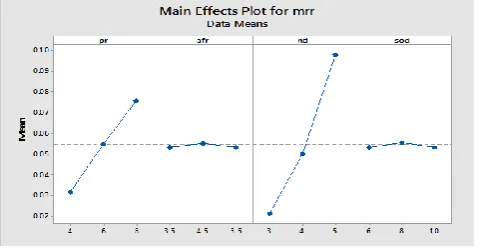
Fig 2 shows that the main effect plots of various process parameters on metal removal rate are given below and it describes that the highest performance of the parameter which effect the machining of rayon based carbon fiber reinforced plastic composite is nozzle diameter, then next follows is pressure and abrasive flow rate and stand of distance.
Figure 2 Main effect plot of MRR with all process parameter
Fig 3 shows the surface plots of various process parameters on metal removal rate are given below and also surface plots indicates combination of parameters that effect MRR value with increase in nozzle diameter and pressure and the surface plot indicate that no effect abrasive flow rate and stand of distance where surface is same level.
Figure 3 Surface plot of MRR with all process parameters
Fig 4 indicates the contour plots of various process parameters on metal removal rate are given below and shows that level of effect of pressure with nozzle diameter, abrasive flow rate and stand of distance in the left, right and middle figures.
Figure 4 contour plots of MRR with all process parameters
Global Solution
Pressure = 6, AFR =5.5, ND =5 and SOD =8 Predicted Response
MRR=0.0983, desirability=0.9833 Composite desirability=98.33%
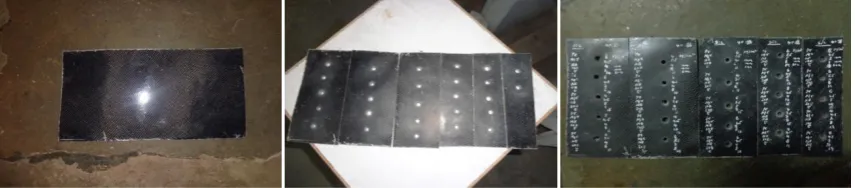
Fig 5 shows that composite before machining at left figure, after machining at middle figure and after all readings at right figure.
Figure 5 Results on RCFRP composite at different Pressure, AFR, and SOD, Nozzle diameter before and after machining
8 0 0 . 0 6 5 0.0 3 0.10 0.15 4 4 5 r r m r p d n d n , r p s v r r m f o t o l P e c a f r u S 8 6 0 0 . 0 0.05 0.10 0 . 6 0.15 5 . 7 9.0 4
5 . 0 1 r r m r p d o s d o s , r p s v r r m f o t o l P e c a fr u S 5 4 0 0 . 0 0 5.0 0.10 0 . 6 0.15 5 . 7 9.0 3
0.5 1 r r m d n d o s d o s , d n s v r r m f o t o l P e c a fr u S nd pr 5.0 4.5 4.0 3.5 3.0 8 7 6 5 4 > – – – – – < 0.02 0.02 0.04 0.04 0.06 0.06 0.08 0.08 0.1 0 0.1 0 0.1 2 0.1 2 mrr
Contour Plot of mrr vs pr, nd
afr p r 5.5 5.0 4.5 4.0 3.5 8 7 6 5 4 > – – – – – < 0.02 0.02 0.04 0.04 0.06 0.06 0.08 0.08 0.1 0 0.1 0 0.1 2 0.1 2 mrr
Contour Plot of mrr vs pr, afr
sod pr 1 0 9 8 7 6 8 7 6 5 4 > – – – – – < 0.02 0.02 0.04 0.04 0.06 0.06 0.08 0.08 0.1 0 0.1 0 0.1 2 0.1 2 mrr
VI. CONCLUSION
The effect of process parameters viz. pressure, abrasive flow rate, nozzle diameter and stand of distance on the work material (Rayon based CFRP) investigated for their effect on MRR being obtained and is presented graphically and from the Regression equation and the graphs are concluded that as follows:
Taguchi method of design of experiments has been applied for investigating the effect of machining parameters on metal removal rate (gm/sec).Results obtained from taguchi method compared with ANOVA are closely matched. Best parameters found for Larger is better MRR are: Pressure (6kg/cm²), Abrasive Flow Rate (4.5gm/sec), Nozzle diameter (5mm) and Stand of Distance (8 mm).From fig 2shows that nozzle diameter is the most significant factor which effect the MRR and then next significant factors follows are Pressure, AFR and SOD. And Predicted S value (0.00761) and Regression square value (95.85%).It is shown that performance of characteristics of AJM was improved by using this method.
REFERENCES
[1] Varma.A.P, Lal.G.K "An experimental study of abrasive jet machining", International journal of machine tools & manufacturing vol 24,
no.1, 19-29, 1983.
[2] Rani.M.R and Seshan "Abrasive Jet Machining -Process variables and current applications, Publication. Journal of Metals Material &Process,
vol.7, no.4pp, 279-290, 1995.
[3] Ranjit K.Roy: Design of experiments using the Taguchi approach: 16 steps to product and process development, Wiley-Inter science, New York,
2001.
[4] Srikanth.D.V,Dr.Sreenivasa Rao.M "Response Surface Methodology for Optimization of Process Parameters in Abrasive Jet Drilling of
Composites",IOSR Journal of Mechanical and Civil Engineering ,vol 11,Issue 3,PP 20-26,May-June 2014.
[5] A.El-Domiaty, H.M.Abd.EL-Hafiz, Shaker.M.A "Drilling of glass sheets by Abrasive Jet Machining", World Academy of Science, Engineering
and Technology, vol.32, pp.61-67, 2009.
[6] Chandra.B.,singh.J "A Study of Process Parameters of Abrasive Jet Machining", International journal of engineering science and
technology,vol.3,pp 504-513,2011.
[7] Gulhani.U.D, Patkar.P.P, Patel.S.P, Pattel.A.A et al,"Analysis of AJM Parameters on MRR, Kerfs Width of Hard a Brittle materials like
Ceramic, IJDMT, April-2013.
[8] Dr.Deva Kumar.M.L.S,Anad Raju.F,Gnana Prakesh.V ”Fiber Glass cutting By Using Abrasive Jet Machining and Analysis of Process