Copyright2000 by the Genetics Society of America
Some Features of the Mutability of Bacteria During Nonlethal Selection
V. G. Godoy, F. S. Gizatullin and Maurice S. Fox
Department of Biology, Massachusetts Institute of Technology, Cambridge, Massachusetts 02139 Manuscript received March 19, 1999
Accepted for publication September 2, 1999
ABSTRACT
We describe the mutability of the Trp2chromosomal11 frameshift mutation trpE7999 during nonlethal selection, finding that the appearance of Trp1 revertants behaves similarly to that of episomal Lac1 revertants. In addition, we show that a feature of the Lac1and Trp1mutability is the accumulation of Trp1and Lac1revertants with additional unselected mutations, most of which are not due to heritable mutators. The cells undergoing nonlethal selection apparently experience an epigenetic change resulting in a subset of bacteria with elevated mutability that often remain hypermutable for the duration of selection. The epigenetic change provoked by nonlethal selection appears to be mediated by a unique function provided by the F9128 episome.
T
HE results of inquiry into the reversion of the Lac2 a transient hypermutability in a small fraction of the population experiencing selection (Foster1997;Tor-frameshift mutation residing in the episome of
Esch-erichia coli FC40 have been both provocative and confus- kelsonet al. 1997;Roscheet al. 1999). Like the
rever-sion to Lac1 (Cairns andFoster1991), this genome-ing. The episomal substrate of these mutation studies
is a modification of episome F9128 (Holloway and wide mutability was shown to be dependent on host
Low1996), carrying lacI33 (Miller 1992), a leaky lac recombination functions (Torkelsonet al. 1997).
allele with a11 frameshift mutation. The lac-pro deleted We have been encouraged to inquire further into the strain of E. coli P90C (Miller1992) harboring this epi- features of this elevated mutability. We investigated the some-borne lac allele (lacI33) is able to mutate, re- reversion of a chromosomal11 frameshift allele in the gaining the ability to metabolize lactose, in a time-de- trpE gene of E. coli (trpE7999 allele;Bronsonand
Yanof-pendent manner during nonlethal selection in minimal sky1974;CairnsandFoster1991) in a strain isogenic lactose medium (CairnsandFoster1991;Fosterand with FC40, the strain in which the lacI33 reversion has
Cairns 1992; Foster 1993, 1998; Harris et al. 1994; been studied. As with the lacI33 reversion, Trp1
re-Rosenberget al. 1994, 1998). vertants accumulate on selection plates, although at a Recently, reports from two laboratories have helped substantially lower rate. In addition, unselected Lac1 clarify earlier observations (Foster 1997; Torkelson mutants accumulate during Trp1selection and late
ap-et al. 1997). They have shown that within the population pearing Trp1 revertants also harbor additional muta-of Lac2bacteria not only do Lac1mutations occur, but tions. However, we found that pure colonies of Lac1 mutations also occur at other unrelated sites. One group or Trp1revertants harboring additional mutations are reported a high frequency of unselected mutations much less frequent among the revertants that accumu-among late appearing Lac1revertants on the chromo- late early on the selective plates than among late ap-some, plasmid, and episome sites (Torkelson et al. pearing revertants. This observation suggests that
hyper-1997). These mutants are multiple and most of the time mutability, appearing soon after the onset of selection are clonal, i.e., with more than one mutation in the in a subset of bacteria under nonlethal selection, often same bacterium, but rarely do these mutants display persists in those same bacteria for the duration of selec-enhanced mutability after isolation. Moreover, neither tion. Our findings also show that much of the mutability the nonselected parent cells nor the Lac2bacteria that observed at both loci is the result of some as-yet-unchar-had been subjected to prolonged lactose selection ap- acterized attribute of the episome carrying the lacI33 pear to display enhanced mutability. In addition,Fos- allele. This attribute does not appear to be a feature of ter(1997) has reported that mutations that accumulate other independently isolated episomes, including epi-during lactose selection include mutations in other epi- somes that cover the same portion of the E. coli chromo-some-borne genes that do not involve lactose metabo- some that is included in F9128.
lism. These observations have led to the conclusion of
MATERIALS AND METHODS
Corresponding author: Maurice S. Fox, 77 Massachusetts Ave.,
Depart-Strains:Relevant strains and episomes used in this work are
ment of Biology 68-630, Massachusetts Institute of Technology,
Cam-bridge, MA 02139. E-mail: [email protected] shown in Table 1; they are all isogenic strains of E. coli P90C
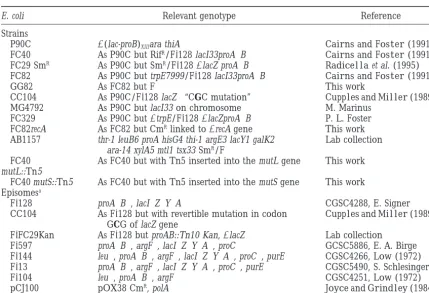
TABLE 1
E. colistrains and episomes
E. coli Relevant genotype Reference
Strains
P90C D(lac-proB)XIIIara thiA CairnsandFoster(1991)
FC40 As P90C but RifR/F9128 lacI33proA1B1 CairnsandFoster(1991)
FC29 SmR As P90C but SmR/F9128DlacZ proA1B1 Radicellaet al. (1995)
FC82 As P90C but trpE7999/F9128 lacI33proA1B1 CairnsandFoster(1991)
GG82 As FC82 but F2 This work
CC104 As P90C/F9128 lacZ2“CGC mutation” CupplesandMiller(1989) MG4792 As P90C but lacI33 on chromosome M. Marinus
FC329 As P90C butDtrpE/F9128DlacZproA1B1 P. L. Foster FC82recA As FC82 but CmRlinked toDrecA gene This work
AB1157 thr-1 leuB6 proA hisG4 thi-1 argE3 lacY1 galK2 Lab collection ara-14 xylA5 mtl1 tsx33 SmR/F2
FC40 As FC40 but with Tn5 inserted into the mutL gene This work mutL::Tn5
FC40 mutS::Tn5 As FC40 but with Tn5 inserted into the mutS gene This work Episomesa
F9128 proA1B1, lacI1Z1Y1A1 CGSC4288, E. Signer CC104 As F9128 but with revertible mutation in codon CupplesandMiller(1989)
GCG of lacZ gene
F9FC29Kan As F9128 but proAB::Tn10 Kan,DlacZ Lab collection
F9597 proA1B1, argF1, lacI1Z1Y1A1, proC1 GCSC5886, E. A. Birge F9144 leu1, proA1B1, argF1, lacI1Z1Y1A1, proC1, purE1 CGSC4266,Low(1972) F913 proA1B1, argF1, lacI1Z1Y1A1, proC1, purE1 CGSC5490, S. Schlesinger F9104 leu1, proA1B1, argF1 CGSC4251,Low(1972) pCJ100 pOX38 CmR, polA1 JoyceandGrindley(1984)
aThe episomes listed were obtained from the E. coli Genetic Stock Center, CGSC, Department of Biology,
Yale University, unless noted otherwise. The number assigned to each strain containing these episomes by the CGSC is shown in the reference column. The E. coli chromosome wild-type genes present on each episome are listed on the basis of the information given by the CGSC. CmR, chloramphenicol resistance.
(Miller1992). The recombination-deficient and mutator de- To compare the yield of Trp1mutants and Lac1mutants in the same culture, FC82 was grown as indicated above and rivatives of FC82 and FC40 were constructed by P1
transduc-tion using the deletransduc-tion recA allele, from the strain GW5180, plated on glucose (109bacteria spread/plate) and lactose (108
bacteria in soft agar/plate) minimal plates (supplemented linked to Tn10 CmR(obtained from G. Walker lab), and the
mutator alleles present in KY 232 (mutL::Tn5, lab collection) with tryptophane at 40mg/ml) along with 13109FC29 SmR
(Table 1) per plate as scavenger. To test the influence of and PR114 (M182 mutS::Tn5, lab collection), respectively.
GG82 is a P90C trpE7999 episome-free derivative of FC82 (Ta- sodium dodecyl sulfate (SDS) in Trp1 reversion, bacterial cultures were grown and plated as described above but in the ble 1), obtained by spontaneous episomal loss after growth in
Luria-Bertani (LB) medium (Miller1992). In rich medium presence of SDS at 0.01% (Radicellaet al. 1995). Cell viability on these plates was determined by taking plugs from a series (LB) the episome is lost frequently (z131023) due to the
lack of selective pressure for the pro marker present on the of independent plates as previously described (Rosenberget al. 1995).
episome of FC40. The episome-free derivative was no longer
pale blue when plated in LB-X-Gal medium and is a pro auxo- Lac1 revertants during Trp1 selection: To determine whether Lac1revertants accumulated under conditions selec-troph. Derivatives of MG4792 (Table 1) and GG82 carrying
episomes were constructed by conjugation. tive for Trp1reversion, independent cultures were grown in 0.1% glucose minimal medium to saturation, as indicated Selection of Trp1revertants:FC82 and its derivatives were
grown from inocula of 105bacteria as independent cultures above, and 1 ml of each culture was filtered through a
90-mm, 0.45-mm filter (Millipore Co., Bedford, MA). The filters in minimal glucose medium M9 (Miller 1992) containing
0.1% glucose and 40mg/ml of tryptophane. Saturated bacte- were deposited on glucose minimal plates previously overlaid with 5 ml of soft M9 agar containing 33109cells of FC329,
rial cultures (109/ml) were washed in M9 buffer, spread at
109bacteria/plate on the surface of minimal glucose medium an FC29 derivative with a trpE deletion (see Table 1) used as
scavenger. At time zero, some filters were directly deposited plates, and incubated at 378for up to 5 days. The bacterial
cell number deposited on the surface of the plates was kept on minimal lactose plates (with trytophane, 40mg/ml) with scavenger cells as above. On days 2 and 4 a set of filters was constant from experiment to experiment. Many of the Trp1
reversion experiments were carried out by depositing washed transferred to minimal plates lacking a carbon source for 1 hr, to remove any glucose that may have been carried over with bacteria on a medium containing, in addition to glucose,
0.3% casein acid-hydrolysate, an amino acid mixture lacking the filters. The filters were then transferred to lactose minimal plates with tryptophane (40mg/ml) and a layer of scavenger tryptophane (Calbiochem, San Diego and Sigma, St. Louis)
of incubation at 378. Since there is the possibility of microcol- the colony failed to grow on minimal glucose-proline plates at 308or 428. In addition, a colony Ts in the trpE gene (Trp onies of Trp1revertants present on the filters before transfer
to lactose minimal plates, 50 colonies were picked at random Ts) is one that grows on glucose-proline-tryptophane plates at 428.
from the filters on lactose plates incubated for 2 days after
filter transfer. They were patched onto minimal glucose and To investigate whether the bacteria in the lawn of unre-verted Lac2 or Trp2 cells contained unselected additional lactose (with tryptophane) plates. None of the colonies were
found to be double mutants as would be expected if the Lac1 mutations, plugs were taken from areas with no visible colonies as for testing viability (see Selection of Trp1 revertants). The had arisen within Trp1microcolonies.
Lac2reversion assays:The strains FC40 and MG4792 (Table plugs, containing a sample from the lawn, were resuspended in 1 3 M9 buffer and plated in LB medium. Colonies ap-1) and their derivatives were used as previously described in
Lac2reversion tests (Radicellaet al. 1995) with FC29 SmR pearing from the day 7 lawn of unreverted Lac2cells grown
in LB plates were replica-plated on two sets of minimal glucose as scavenger when using fewer than 109indicator bacteria per
plate. The strain CC104 (Table 1) was also used for Lac1 and LB plates and were incubated at 308 and 428. Colonies derived from a 5-day lawn of unreverted Trp2bacteria were reversion tests. This strain is similar to FC40 but carries an
episome with a regulated lac operon and a point mutation in grown on LB plates, were replica-plated onto minimal glucose and LB plates, and were incubated at 308and 428.
the triplet encoding the active site ofb-galactosidase.
Detection of additional mutations:We screened the Lac1 Characterization of multiple mutants:The auxotrophic re-quirements of Lac1revertants and Trp1revertants with addi-or Trp1 mutants that appear early or late after depositing
bacteria on the selective plates for loss-of-function mutations tional mutations were identified by the pools method de-scribed elsewhere (Holliday1956).
in a large mutational target. The selective plates were
incu-bated at 308, and the revertant colonies were tested for ability We also assessed 35 Lac1revertants harboring additional mutations for a mutator phenotype (Miller 1996). These to grow at 428. We also tested the Trp1revertants for absolute
auxotrophic mutations. The Lac1 or Trp1 revertants were clones were grown in LB and five drops of 0.02 ml of each revertant were deposited on the appropriate plates supple-screened for absence of growth under nonpermissive
condi-tions; therefore, any Trp1or Lac1revertant carrying an addi- mented with the antibiotics nalidixic acid (50mg/ml, Nal) or streptomycin (200 mg/ml, Sm). Any candidate that showed tional mutation is present on the selective plates as a pure
colony. This colony is the product of a mutational event that an elevated number of mutants on both antibiotics was further tested by growing six independent cultures of each isolate on must have occurred either before or at the same time as the
LB broth and plated again on the two antibiotics. The median Lac2or Trp2bacterium became Lac1or Trp1.
frequency of mutation of FC40 for NalRis 131028and for
Temperature-sensitive (Ts) mutants from Lac1colonies of
SmRz131029–13 10210. FC40 harboring either the mutL
FC40, CC104, MG4792, and their derivatives were screened
or mutS allele were used as a control (Table 1) since their by picking the Lac1colonies and patching them on lactose
frequency of mutation for these markers is elevated byz 100-minimal medium incubated at 308and 428. We picked Lac1
fold. Resistance to rifampicin (Fluka Chemie AG, Buchs, Swit-colonies that appeared on day 2, on day 3, and on days 7–8 after
zerland; 100mg/ml, Rif) was used to test the Trp1revertants depositing Lac2cells on selective plates. The first revertant
with the FC40 mutL derivative as a control. The median fre-colonies, appearing on day 2, are often regarded as the
prod-quency of mutation of FC82 to RifRis 131028.
uct of mutation occurring during the growth of the culture
To show that the Lac Ts phenotype is linked to the episome, (i.e., before depositing cells on the selective plates). We have
the episomes from 17 FC40 Lac Ts colonies were conjugated assumed that revertant colonies not present on day 2 and
with P90C SmR(lab collection), selecting for SmR(200mg/ml)
appearing on day 3 are products of early mutations occurring
colonies on minimal glucose plates. Products were purified on during selection. All Lac1colonies that failed to grow at 428
LB medium with X-Gal and two colonies from each isolate were further purified on LB medium with X-Gal
(5-bromo-4-were tested for growth at 308 and 428 on minimal lactose chloro-3-indolyl-b-d-galactopyranoside; Diagnostic Chemicals
plates. Limited, Oxford, CT) at 308, the permissive temperature.
Three purified colonies from each isolate were further tested on LB, lactose, or glucose minimal medium and incubated at
308 and 428. The mutants were classified into three groups RESULTS based on their growth phenotypes at 428. A Lac1Ts auxotroph
Reversion of a chromosomal mutation during
nonle-grew on LB plates but did not grow on minimal glucose or
lactose plates. Failure to grow on any growth medium was thal selection:We used the chromosomal trpE799911 classified as a Ts mutation in an essential gene. Lac1colonies frameshift mutation in E. coli FC82 (see Table 1) for that grew on LB and minimal glucose plates but failed to grow
this analysis. When bacteria with this allele are deposited on minimal lactose plates were classified as Lac Ts.
on glucose minimal agar to select for Trp1 revertants, Auxotrophic and temperature-sensitive mutants were
identi-new mutants accumulate with time. Certain features of fied among Trp1revertant colonies appearing on day 1, on
day 2, and on days 4–5 of selection on minimal glucose-casein this accumulation are shared with those of the accumu-plates incubated at 308. The mutants appearing on day 2 are lation of Lac1mutants of lacI33, in which the frameshift regarded as early products of mutations occurring during allele is episome borne.
selection. Trp1 colonies were screened for auxotrophy by
As FC82 also carries the episome with the lacI33 allele, patching colonies onto minimal glucose plus proline (40mg/
we can look for unselected Lac1mutants under condi-ml) and glucose-casein plates and incubating at 308. Proline
was added to the medium to include Trp1mutants that may tions of Trp1 selection, and we can ask for Lac1 re-have lost the episome during selection in the glucose-casein vertants and Trp1 revertants in the same culture. To medium. Temperature-sensitive auxotrophs were screened in demonstrate that unselected Lac1mutants accumulate the same manner by incubating one set of plates at 428.
Candi-during Trp1selection, indicator cells (Trp2and Lac2) date clones were further purified in minimal glucose-casein
were deposited and incubated on filters on glucose mini-plates and tested again for auxotrophy. Trp1mutants were
Trans-Figure1.—Reversion of the FC82 strain bearing the11 chromosomal frameshift allele trpE7999. (A) Trp1selection results in accumulation of unselected Lac1revertants. Graph shows the number of Lac1revertants present after a given number of days on Trp1 selection. Independent cultures are represented by bars with different shades. (B) Trp1 and Lac1 revertants accumulate in cultures of FC82. The values of the accumulation shown are the average of seven independent cultures deposited on Lac1or Trp1minimal medium selection; error bars represent one standard deviation of the mean. The inset shows the accumulation of Trp1revertants in the same experiment.
ferring the filters to lactose minimal plates supple- of viability of the recombination-deficient derivative of FC82 since we found an about threefold reduction in mented with tryptophane (40 mg/ml) permitted us to
detect Lac1mutants. We found that Lac1mutant colo- the number of viable cells present on the selective plates after 5 days of selection (93108–33108total bacteria
nies appeared on these filters after 2 days of incubation
at 378, and their number increased with time spent viable/plate). In contrast to what has been reported for the episomal Lac2 reversion (Radicella et al. 1995),
under Trp1 selection (Figure 1A). Among 50 of the
colonies appearing on the filters 2 days after transfer addition of 0.01% SDS to the selective plates did not decrease the yield of Trp1 mutants significantly (data to lactose minimal plates containing tryptophane, none
were double revertants, Trp1Lac1. not shown). Trp1revertants also accumulate in a mini-mal glucose medium supplemented with 0.3% acid-We obtained the number of Lac1and Trp1revertants
present in the same culture by depositing aliquots of hydrolyzed casein, a richer medium that lacks trypto-phane, at both 308and at 378, but by the fifth day there an FC82 culture on lactose minimal plates containing
tryptophane and on minimal glucose plates without is some loss of viability evident at the higher temperature (data not shown). Selection for Trp1revertants in this tryptophane. Viability with 1 3 109 bacteria/plate is
maintained in minimal glucose plates for at least the medium allows screening for the presence of additional auxotrophic mutations among the Trp1 revertants. first 5 or 6 days (53108–13109total viable bacteria/
plate at day 6 postplating). The first Lac1 revertant FC40 with an episomal lacI33 allele and MG4792 with a lacI33 allele on the chromosome reverted to Lac1at colonies appear on day 2 (40 hr) of incubation, and
Trp1 revertants appear after 1 day (24 hr). Figure 1B 308with similar rates to those obtained at 378in each case (data not shown). Further experiments were car-shows the accumulation of both types of mutants in a
set of seven independent cultures. The curves describ- ried out at 308 since incubation at this temperature permits us to screen for the presence of additional tem-ing the accumulation of Trp1 revertants (Figure 1B,
inset) appear to be quadratic, and the rate is substan- perature-sensitive mutations among the Lac1revertants.
Screening for Lac1or Trp1revertants bearing
addi-tially lower than that for the accumulation of Lac1
re-vertants in the same strain background. tional mutations:The early revertants that were exam-ined were the Trp1 colonies that appeared on days 1 As with reversion to Lac1of the episome-borne lacI33
allele (Cairns and Foster 1991), we observed fewer and 2 and Lac1 colonies appearing on days 2 and 3. Early Lac1 or Trp1 revertants were analyzed for two Trp1mutants accumulating in the
recombination-defi-cient DrecA::CmR derivative of FC82 (data not shown). consecutive days because of the likelihood that the first
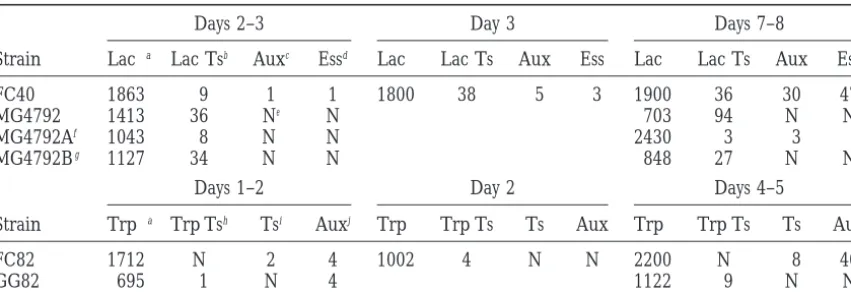
TABLE 2
Additional mutations among Lac1and Trp1revertants
Days 2–3 Day 3 Days 7–8
Strain Lac1a Lac Tsb Auxc Essd Lac1 Lac Ts Aux Ess Lac1 Lac Ts Aux Ess
FC40 1863 9 1 1 1800 38 5 3 1900 36 30 47
MG4792 1413 36 Ne N 703 94 N N
MG4792Af 1043 8 N N 2430 3 3 1
MG4792Bg 1127 34 N N 848 27 N N
Days 1–2 Day 2 Days 4–5
Strain Trp1a Trp Tsh Tsi Auxj Trp1 Trp Ts Ts Aux Trp1 Trp Ts Ts Aux
FC82 1712 N 2 4 1002 4 N N 2200 N 8 40
GG82 695 1 N 4 1122 9 N N
aTotal number of Lac1or Trp1revertant colonies tested on the given day. bLac Ts, temperature-sensitive mutation in the LacI-Z fusion protein. cAux, Lac1revertants with an auxotrophic temperature-sensitive mutation. dEss, Lac1revertants with temperature-sensitive mutation in an essential gene. eN, no colonies found with the given phenotype.
fMG4792A, strain MG4792 bearing the FC29Kan episome (Table 1). gMG4792B, strain MG4792 bearing the pCJ100 episome (Table 1). hTrp Ts, temperature-sensitive mutants in the TrpE protein.
iTs, Trp1revertants with an auxotrophic temperature-sensitive mutation.
jAux, Trp1revertants with an auxotrophic mutation. This class of mutants is different from the auxotrophs
in i.
pearing Lac1 mutants (Foster and Trimarchi 1994; Trp1 were also analyzed for additional mutations. If all bacteria maintained under selective conditions were
Rosenberg et al. 1994) are different from those that
accumulate during selection in the sequence changes hypermutable, then replating these bacteria for single colonies on complete medium and testing them would involved in the reversion of the 11 frameshift. Thus,
only Lac1and Trp1mutant colonies appearing after the be expected to reveal the presence of secondary muta-tions like those present in the late appearing Lac1and first crop are considered the product of true postplating
mutations. Those early mutants were compared to the Trp1 revertants. Analysis of 2940 Lac2 colonies and 1000 Trp2 colonies isolated from the lawns of nonre-Lac1and Trp1colonies that appeared after more
pro-longed incubation on the selection plates. verted cells after prolonged incubation on selective plates showed that, at this level of detection, neither Table 2 shows that Ts mutants are found among Lac1
revertants isolated early or much more frequently late the Lac2 nor Trp2 cells appear to accumulate other mutations during nonlethal selection.
after plating. We found Ts mutants in both biosynthetic
and essential genes at high frequency, and these mu- By testing the double mutants for the presence of a stable mutator phenotype, we were able to identify the tants accumulate with time.
For the Trp1 revertants appearing at 308 on plates fraction of revertants that also carried such mutations. We found 2/35 late appearing Ts clones of FC40 Lac1 supplemented with casein acid-hydrolysate, some were
Ts and others were auxotrophs at either temperature and 1/25 FC82 Trp1 auxotrophs with a recognizable mutator phenotype. Only these clones display a fre-as seen in Table 2. The frequency of Trp1 revertants
with additional mutations increases with time as well, quency of resistance to one or more antibiotics similar to the mutator mutS or mutL controls, and 100-fold much like their Lac1counterparts.
The mutants that have a Lac Ts phenotype in the higher than the frequency found with the wild-type par-ent (seematerials and methodsfor the median fre-FC40 or Trp Ts phenotype in the FC82 strains are not
being considered as having additional mutations, since quencies to NalR, SmR, and RifR). The remaining
colo-nies with additional mutations showed no significant they are likely to reflect changes in the hybrid
repressor-b-galactosidase protein or in the TrpE protein. Transfer difference in mutability from the parent. This frequency of genetic mutators is consistent with that reported by of the episomes from 15 Lac1Ts mutants to P90C SmR
showed that the Ts phenotype was linked to the epi- Miller(1996). Genetic mutability is a small contributor to the cause of the high mutability that is evident. somes in each case.
Figure 2.—Accumulation of re-vertants in derivatives with different episomes. (A) Accumulation of Trp1 revertants measured on casein-glucose medium for FC82 is compared to that of GG82, the episome-free strain, and GG82 harboring F9CC104 (F9128 de-rivative) and F9597 (independently iso-lated) episomes. Other independently isolated episomes gave similar results to that of GG82/F9597 (seeresults). (B) FC29Kan episome, a derivative of F9128, provides for the accumulation of chromosomal Lac1revertants. Accu-mulation of Lac1revertants in MG4792 is compared in the presence and ab-sence of the F9128 episome. Values shown are the average of 10 cultures; error bars represent one standard devi-ation of the mean.
showed similar characteristics, although the Trp1accu- with a frequency similar to FC82 when plated in minimal glucose medium with acid-hydrolyzed casein. However, mulation was quantitatively lower than the
accumula-tion of Lac1. Both kinds of late appearing revertants subsequent accumulation of Trp1 revertants (Figure 2A) was slow or absent. By day 5 there are z10-fold display frequent additional mutations, although the
trpE7999 allele is located on the chromosome of the fewer Trp1 mutants accumulated in GG82 compared to FC82, even though the number of viable cells remains strain FC82 and lacI33 is on the episome, a derivative
of F9128 (Miller1992). We asked whether an episome- constant for both strains during the selective incubation (13109–53108viable bacterial cells/plate). The fact
free derivative of FC82 would revert and accumulate
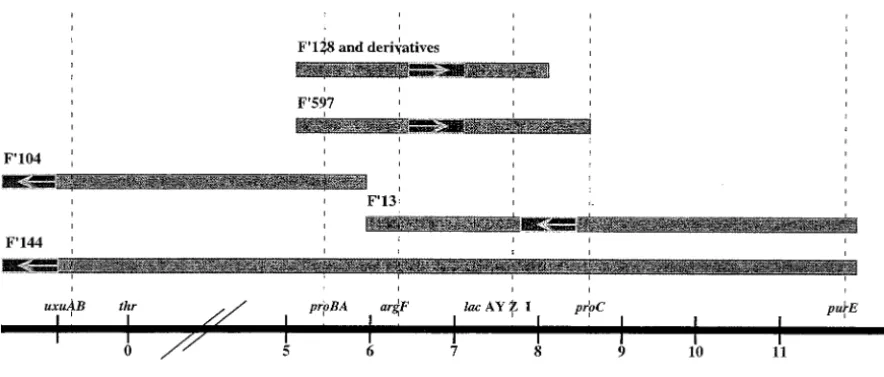
Figure3.—Linear representation of the episomes used in this report. The map is not drawn to scale. The thick line at the bottom of the figure represents the linear sequence of the E. coli map, shown in minutes. Each minute corresponds toz46 kb. The episomes are represented by the horizontal bars. Each bar is sized approximately depending on the sequences of the E. coli chromosome carried by a given episome. The darker bar with an arrow represents the F portion of the episomes, but it is not clear where the F factor limits are in these episomes. The ends of each episome are drawn based on the genetic information given by CGSC andHollowayandLow(1996, and references therein). The origins of the other episomes are as follows: F9597 episome originates from P4X, F9144 from PO1 of Hfr Hayes, F913 from PO57 of W3213, F9104 from PO1 of Hfr Hayes, and F9128 from PO65 of P804 (HollowayandLow1996).
Due to its chromosomal location, the reversion or and other independently isolated episomes harboring portions of the chromosomal region present in F9128. accumulation of Lac1 of lacI33 in MG4792 occurs at a
much lower frequency than in the case of the same These strains were tested for reversion and accumula-tion of Trp1and/or Lac1mutants (pCJ100, F913, F9104, mutation allele located on the episome (Foster and
Trimarchi1995). Thus, we expected the chromosomal F9597, F9144; see Table 1 and Figure 3 for chromosomal content, except for pCJ100 which carries the polA gene,
lacI33 Lac2 allele of MG4792 might display a higher
reversion frequency to Lac1 when the episome from not shown in Figure 3). The initial frequencies of Trp1 mutants in the derivative strains of GG82 bearing these FC40 was present. Figure 2B displays an experiment in
which the accumulations of Lac1revertants of MG4792 episomes and the episome free-GG82 strain are not distinguishable, and there is little or no subsequent ac-strains with and without the episome are compared.
The evidence shows that the presence of the FC29 cumulation of revertants (see Figure 2A, half-solid squares, for strain GG82/F9597). The data on the
accu-proAB::TnKan episome (F9FC29Kan, a lac-deleted
deriv-ative of the episome present in FC40, F9128; see Table mulation of additional mutations in these strains are in Tables 2 and 3. Table 2 shows that additional mutations 1) increases the rate of accumulation of mutations of
the chromosomal allele. were not found in the Lac1revertants of MG4792, bear-ing the chromosomal lacI33 allele. The same holds true To learn which episome or regions of the episome are
important to this process, a series of episome-containing for MG4792/pCJ100 Lac1revertants (MG4792B in Ta-ble 2) and GG82 Trp1revertants (Table 2). In contrast, derivatives of GG82 was constructed. The first episomes
analyzed were all related to the FC40 episome, episome the data in Table 3 show that GG82/F9FC29Kan and GG82/F9CC104 Trp1 revertants that accumulate late F9128, present in the strain CC104 and FC29Kan (see
Table 1). We found that GG82 containing any of these do harbor additional mutations. In Table 2 only a few additional mutations are also evident in MG4792/ episomes accumulates Trp1mutants in a manner
simi-lar to that of the parental FC82 strain. The results of F9FC29Kan bacteria (see MG4792A). We do not under-stand why the frequency of secondary mutations is so one of these experiments are displayed in Figure 2A
for GG82/F9CC104 (open circles). Similar results were low in this strain, which carries an F9128 episome. A limited investigation with other episomes containing observed with the derivatives of GG82 harboring the
FC29Kan episome (not shown). We then investigated the same chromosomal region present in F9128 (see Table 3) showed few or no secondary mutations, in whether specific regions present in F9128 derivatives are
responsible for the elevated rate of accumulation of contrast to the yield evident with F9128 derivatives. CC104, a strain similar to FC40, contains an F9128 mutations to Lac1or to Trp1. To address this question
TABLE 3
Additional mutations among Trp1revertants harboring different episomes
Days 1–2 Days 4–5
Strain Trp1tested Trp Ts Ts Aux Trp1tested Trp Ts Ts Aux
GG82/F9CC104a 1195 N N N 960 1 6 18
GG82/F9FC29Kana 953 N N N 900 5 N 19
GG82/F9128 385 N N 1 450 N 6 6
GG82/F9597 1001 N N N 600 N 1 N
GG82/F9144 666 N N N 492 1 N N
GG82/F9104 1288 N N N 891 3 N N
GG82/F913 1233 4 N N 811 5 N 3
aDerivatives of F9128 (Table 1 and Figure 3). Headings are as in Table 2. Episome descriptions are in Table
1 and Figure 3.
amino acid at the active site ofb-galactosidase, in which hypermutable cells that are evident during lactose selec-tion of FC40.
only a C:G to A:T transversion at that specific site (
Cup-plesandMiller1989) permits a Lac1phenotype. Al- It would appear that the F9128-derived episomes pres-ent in FC40 or in FC82 play a role in the accumulation though it would seem that the target for reversion in
the lacI33 allele is much larger than the one in CC104, of Trp1or Lac1revertants in those strains.
Characterization of Lac1 and of Trp1 multiple
mu-the frequency of revertants appearing on mu-the second
day of incubation is approximately the same for CC104 tants:The auxotrophic requirements have been identi-fied for a number of multiple mutants that are either and FC40 (approximately seven to nine Lac1 mutants
in 109bacteria). CC104 gives rise to Lac1revertants that Lac1 or Trp1. Out of 35 FC40 Ts and Lac1 mutants
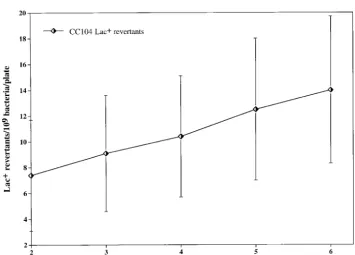
analyzed, 3 had a single requirement for methionine, appear on day 2 (early) but accumulates few revertants
(see Figure 4). We tested for additional mutations in 4 had a double requirement (arginine and ornithine; cysteine and methionine; tryptophane and PABA [p-1745 Lac1colonies that were present on day 2 and in
504 of the rare Lac1 revertants that appeared on day aminobenzoic acid]; riboflavin and nicotinic acid), and 1 had multiple requirements (serine, cysteine, PABA, 7, finding none with additional mutations. Therefore,
it seems that the specific transversion required for the methionine). The Lac1 revertants of MG4792/ F9FC29Kan that were Ts had multiple requirements. reversion of CC104, which does not seem to accumulate
during selection, does not appear to occur among the In the case of those Trp1 revertants that were
lyzed, we found that 11 clones out of 25 FC82 Trp1 We have examined Lac1or Trp1clones for additional unselected mutations at early or at late times after plat-auxotrophs (Ts and non-Ts) have a single requirement
(3 histidine, 2 leucine, 2 threonine, 1 serine, 1 tyrosine, ing to ask whether the bacteria that are hypermutable persist in their hypermutability. We observed that the 1 cysteine, 1 isoleucine). For GG82/F9CC104 Trp1 7
clones out of 18 have a single requirement (3 leucine, fraction of Lac1or Trp1colonies with additional unse-lected mutations is much larger for revertants that ap-2 methionine, 1 histidine, 1 threonine). The rest of the
Lac1 or Trp1 clones with additional mutations have pear late, day 5 for Trp1 and day 7 for Lac1, than for early revertants. If the hypermutable cells were the multiple requirements. We did not pursue further
char-acterization of these mutants. product of new cells, in the selected population, passing through a hypermutable state in cycles, the fraction of Lac1 or Trp1 revertant colonies with additional unse-DISCUSSION
lected mutations would not be expected to increase. Our comparison included new Trp1 mutants ap-One of the well-studied systems in which mutations
occur during nonlethal selection is the reversion of the pearing early, on day 2, and the new Lac1 mutants appearing on day 3, with mutants appearing late, on episomal 11 frameshift allele lacI33 in E. coli FC40
(CairnsandFoster1991). Roles for transfer functions, the fifth day after plating in the case of Trp reversion and on the sixth or seventh day for Lac reversion. We recombination, DNA repair, and, recently, DNA
ampli-fication underlying this phenomenon have been re- have assumed that those Trp1 mutants appearing on day 2 or later and Lac1mutants appearing on day 3 or ported (Foster and Trimarchi 1995; Foster et al.
1996;PetersandBenson1995;Radicellaet al. 1995; later were the products of mutations occurring after selection had been initiated.
Harris et al. 1996, 1997a,b; Rosenberg et al. 1996;
Andersonet al. 1998). The additional unselected mutations screened for were loss-of-function mutations, that is, temperature-Here we have described the reversion of the E. coli
chromosomal allele trpE7999 during nonlethal selec- sensitive and auxotrophic mutations, which constitute large mutational targets. This choice limited our search tion, and we have shown some features that are similar
to those of reversion of lacI33 in FC40. These include to Trp1or Lac1colonies that were pure for those addi-tional mutations. Thus, early and late Lac1 and Trp1 the ability to give rise to both selected and unselected
revertants under nonlethal selection (Foster1997), the colonies were screened for failure to grow under non-permissive conditions. We show that revertants ap-presence of additional mutations (Hall1990;
Torkel-sonet al. 1997; Rosche et al. 1999) in late appearing pearing early during selection are much less frequently mutant at other sites. Furthermore, we find no muta-Trp1mutants, and the dependence of reversion on the
presence of the episome F9128. One difference that tions in the population of Trp2 or Lac2 bacteria that had experienced 1 week of selection; thus, it is indeed appears in the reversion of this chromosomal allele is
that treatment expected to disable episome transfer only a small fraction of bacteria experiencing this ele-vated mutability (Rosenberget al. 1998;Rosche et al.
functions, 0.01% SDS (Radicellaet al. 1995), does not
interfere with reversion (data not shown). This suggests 1999). In agreement with previous reports (Torkelson et al. 1997;Rosenberget al. 1998), only a small fraction
that, although there is a role for the episome, there
may be no role for episomal transfer function in the of the double mutants harbored heritable mutator phe-notype. Therefore, the presence of additional mutations Trp1mutability.
Torkelsonet al. (1997) showed that, among late ap- appears to be due to hypermutability in a fraction of the selected population during selection. We suggest pearing FC40 Lac1mutants containing additional
muta-tions, in most cases (74%) the additional mutation was that a subset of bacteria experiences an epigenetic change, becoming hypermutable when deposited on present in all the bacteria of the revertant colonies, i.e.,
in pure colonies. In the remaining cases, only half or the nonlethal selection medium. They remain so for the duration of the selection. Thus, bacteria that experience one-fourth of the Lac1mutants were mutants at another
site. Mutations were detected in genes throughout the reversion after prolonged selection often have experi-enced other mutations by the time the reversion that genome (Torkelsonet al. 1997;Rosenberget al. 1998).
These observations suggest that the additional mutation allows growth occurs. This mechanism would account for the increase in the likelihood of additional muta-occurred temporally earlier than or at the same time
as the Lac1 reversion, so that when a bacterium con- tions among the bacteria that had undergone longer and longer periods of selection (see Tables 2 and 3). taining a mutation became Lac1, it was often clonal for
both mutations. Since most of the double mutants did It would also account for the fact that clones of re-vertants with additional, recognizable mutations are so not have a heritable mutator phenotype and Lac2
bacte-ria from the selection plates did not show additional frequently pure. Since one of the criteria that we have used for additional mutations is temperature sensitivity, mutations, they concluded that a small subpopulation
of E. coli was experiencing hypermutability that affected it seems that the mutability is not likely to be confined exclusively to frameshift mutations.
If the revertants that occur during selection are present on the episome is responsible for the observed differences among episomes. For the case of the F9128 among bacteria whose mutability is established soon
after the selection is imposed and persists, we suggest episome that bears the CC104 transversion mutation, there is evidence of very little, if any, accumulation of the establishment of an altered epigenetic mutable state
that disappears when a mutation that allows growth Lac1 reversion mutations during selection (Figure 4). However, the presence of this episome permits accumu-occurs. Such an epigenetic state would be characteristic
of selection conditions that are not tight; that is, some lation of revertants at the trpE7999 chromosomal allele (Figure 2A) as well as additional mutations in these b-galactosidase is synthesized during Lac1selection, and
presumably some TrpE gene product is synthesized dur- revertants (Table 3).
CC104 reverts to Lac1by a specific change of a C:G ing Trp1 selection. We assume that this leakiness is
not sufficient to allow bacterial multiplication. Such an to A:T, a single base pair transversion in a triplet encod-ing the active center ofb-galactosidase (Cupplesand epigenetic state for which, at least in this case, F9128
appears to play a role operates on the chromosome Miller1989). Therefore, it would appear that mutabil-ity that is manifested during the selection process does and on the episome of the bacteria. The capacity to
conjugate, important for the accumulation of episomal not apply to this class of transversion mutations, C:G to A:T, required to revert CC104. Perhaps similarly,
Fos-mutations, may reflect an additional process,
superim-posed on the process that operates everywhere in the ter (1994) failed to find accumulation of rifampicin-resistant mutants, rpoB, during lactose selection. In this cell.
This behavior is consistent with the notion proposed case only 17 specific base pair changes, affecting 14 amino acids, in the rpoB gene lead to RifR (Jin and
byNinio(1991), in which the mutability is the
conse-quence of a small fraction of bacteria with a flawed Gross1988). These mutations appear to be insensitive to the particular hypermutability mechanism discussed protein involved in DNA replication or DNA repair that
is present as a result of a rare failure in the fidelity of here that is manifested during nonlethal selection, caus-ing mutation by a different mechanism.
transcription or translation.
The mechanism that mediates this hypermutability in An interesting implication of these experiments de-rives from the recent report of a mutator phenotype, bacteria under nonlethal selection is poorly understood,
although a number of models involving recombination present in mammalian cells under conditions of contact inhibition, and apparently absent during their growth functions and mismatch repair have been advanced
(Foster1998;Rosenberget al. 1998). We have found (Loeb1997;Richardset al. 1997; Meuthet al. 1999).
They are also reminiscent of the observations of
Ken-no additional mutations among 1000 Trp1 revertants
that appear to have accumulated in a recA FC82 strain nedyet al. (1980) in which C3H 10T 1/2 mouse cells
appear to spawn transformed foci at or after reaching (data not shown), suggesting again that reversion of the
chromosomal trpE7999 frameshift shares some features contact inhibition. If a subset of mammalian cells were to experience hypermutability when they had ceased with the reversion of the episomal lacI33, and they may
be both mediated, at least in part, by the same mecha- dividing, the appearance of the multiple mutations, a general feature of cancer cells, could become possible. nism. It also suggests that the ability to accumulate
re-vertants and hypermutability may be connected. Inter- Veronica Godoy is a MERCK postdoctoral fellow. We thank Forres-estingly, one prominent, perhaps essential, role in this ter Liddle for his constant drive and useful discussions throughout this work, the G. Walker Lab at MIT, M. Marinus, P. L. Foster, and
process may be played by the F9128 episome. Its absence
the E. coli Genetic Stock Center at Yale for bacterial strains. V.G.
in GG82 or MG4792 results in a decrease of both the
thanks Dr. D. Raychaudhuri and especially R. Gallegos for their help
rate of accumulation of Lac1 or Trp1 mutants as well and support during this work. This work was supported by National as the accumulation of additional mutations in the Lac1 Institutes of Health grant R37AI 05388.
or Trp1clones (Tables 2 and 3). Furthermore, episomes carrying the same chromosomal regions present in
F9128 (F913, F9104, F9144, F9597) are not interchange- LITERATURE CITED able with F9128 (Figure 3). There is little or no
accumu-Anderson, D. I., E. S. SlechtaandJ. Roth,1998 Evidence that
lation of Trp1 mutants in the presence of these epi- gene amplification underlies adaptive mutability of the bacterial
lac operon. Science 28: 1133–1135.
somes (Figure 2A), and additional mutations in late
Bronson, M. F.,andC. Yanofsky,1974 Characterization of
muta-appearing clones of Trp1revertants are rare when these
tions in the tryptophan operon of Escherichia coli by RNA
nucleo-other episomes are present (Table 3). The dinB gene, tide sequencing. J. Mol. Biol. 88: 913–916.
Brotcorne-Lannoye, A.,andG. Maenhaut-Michel,1986 Role of
which has been implicated in elevated mutagenesis
RecA protein in untargeted UV mutagenesis of bacteriophage
(Brotcorne-Lannoye and Maenhaut-Michel 1986;
lambda: evidence for the requirement for the dinB gene. Proc.
Kimet al. 1997) and for which the F9128 episome holds Natl. Acad. Sci. USA 83: 3904–3908.
Cairns, J.,andP. L. Foster,1991 Adaptive reversion of a frameshift
a copy (V. G. Godoy, unpublished results), may be a
mutation in Escherichia coli. Genetics 128: 695–701.
good candidate for a gene with some special feature on
Cupples, C. G.,andJ. H. Miller,1989 A set of lacZ mutations in
F9128 that could be responsible for the hypermutability. Escherichia coli that allow rapid detection of each of the six base
substitutions. Proc. Natl. Acad. Sci. USA 86: 5345–5349.
Foster, P. L.,1993 Adaptive mutation: the uses of adversity. Annu. Kim, S. R., G. Maenhaut-Michel, M. Yamada, Y. Yamamoto, K. Matsuiet al., 1997 Multiple pathways for SOS-induced muta-Rev. Microbiol. 47: 467–504.
Foster, P. L.,1994 Population dynamics of Lac2strain of Escherichia genesis in Escherichia coli: an overexpression of dinB/dinP re-sults in strongly enhancing mutagenesis in the absence of any
coli during selection for lactose utilization. Genetics 138: 253–261.
Foster, P. L.,1997 Nonadaptive mutations occur on the F9episome exogenous treatment to damage DNA. Proc. Natl. Acad. Sci. USA
94:13792–13797. during adaptive mutation conditions in Escherichia coli. J.
Bacte-riol. 179: 1550–1554. Loeb, L. A.,1997 Transient expression of a mutator phenotype in cancer cells. Science 277: 1449–1450.
Foster, P. L.,1998 Adaptive mutation: has the unicorn landed?
Genetics 148: 1453–1459. Low, K. B.,1972 Escherichia coli K-12 F-prime factors, old and new.
Bacteriol. Rev. 36: 587–607.
Foster, P. L.,andJ. Cairns,1992 Mechanisms of directed mutation.
Genetics 131: 783–789. Meuth, M., B. RichardsandB. Scheneider,1999 The conditional mutator phenotype in human tumor cells: correction. Science
Foster, P. L.,andJ. M. Trimarchi,1994 Adaptive reversion of a
frameshift mutation in Escherichia coli by simple base deletions in 283:641.
Miller, J. H.,1992 A Short Course in Bacterial Genetics: A Laboratory
homopolymeric runs. Science 265: 407–409.
Foster, P. L.,andJ. M. Trimarchi,1995 Conjugation is not re- Manual and Handbook for Escherichia coli and Related Bacteria. Cold
Spring Harbor Laboratory Press, Cold Spring Harbor, NY. quired for adaptive reversion of an episomal frameshift mutation
in Escherichia coli. J. Bacteriol. 177: 6670–6671. Miller, J. H.,1996 Spontaneous mutators in bacteria: insights into pathways of mutagenesis and repair. Annu. Rev. Microbiol. 50:
Foster, P. L., J. M. TrimarchiandR. A. Maurer,1996 Two
en-zymes, both of which process recombination intermediates, have 625–643.
Ninio, J.,1991 Transient mutators: a semiquantitative analysis of opposite effects on adaptive mutation in Escherichia coli. Genetics
142:25–37. the influence of translation and transcription errors on mutation rates. Genetics 129: 957–962.
Hall, B. G.,1990 Spontaneous point mutations that occur more
often when advantageous than when neutral. Genetics 126: 5–16. Peters, J. E., andS. A. Benson, 1995 Redundant transfer of F9 plasmids occurs between Escherichia coli cells during nonlethal
Harris, R. S., S. LongerichandS. M. Rosenberg,1994
Recombina-tion in adaptive mutaRecombina-tion. Science 264: 258–260. selections. J. Bacteriol. 177: 847–850.
Radicella, J. P., P. U. ParkandM. S. Fox,1995 Adaptive mutation
Harris, R. S., K. J. RossandS. M. Rosenberg,1996 Opposing roles
of the Holliday junction processing systems of Escherichia coli in Escherichia coli: a role for conjugation. Science 268: 418–420.
Richards, B., H. Zhang, G. PhearandM. Meuth,1997 Condi-in recombCondi-ination-dependent adaptive mutation. Genetics 142:
681–691. tional mutator phenotypes in Hmsh2-deficient tumor cell lines. Science 277: 1523–1526.
Harris, R. S., H. J. BullandS. M. Rosenberg,1997a A direct role
for DNA polymerase III in adaptive reversion of a frameshift Rosche, W. A., P. L. FosterandJ. Cairns,1999 The role of transient hypermutators in adaptive mutation in Escherichia coli. Proc. Natl. mutation in Escherichia coli. Mutat. Res. 375: 19–24.
Harris, R. S., G. Feng, K. J. Ross, R. Sidhu, C. Thulinet al., 1997b Acad. Sci. USA 96: 6862–6867.
Rosenberg, S. M., S. Longerich, P. GeeandR. S. Harris,1994 Mismatch repair protein MutL becomes limiting during
station-ary-phase mutation. Genes Dev. 11: 2426–2437. Adaptive mutation by deletions in small mononucleotide repeats. Science 265: 405–407.
Holliday, R.,1956 A new method for the identification of
biochem-ical mutants of micro-organisms. Nature 178: 987. Rosenberg, S. M., R. S. HarrisandJ. Torkelson,1995 Molecular handles on adaptive mutation. Mol. Microbiol. 18: 185–189.
Holloway, B.,andK. B. Low,1996 F-prime and R-prime factors, pp.
2413–2420 in Escherichia coli and Salmonella: Cellular and Molecular Rosenberg, S. M., R. S. Harris, S. LongerichandA. M. Galloway,
Biology, edited byR. Curtiss III, J. L. Ingraham, E. C. C. Lin, 1996 Recombination-dependent mutation in non-dividing
K. B. Low, B. Magasaniket al. ASM Press, Washington, DC. cells. Mutat. Res. 350: 69–76.
Jin, D. J.,andC. A. Gross,1988 Mapping and sequencing of muta- Rosenberg, S. M., C. ThulinandR. S. Harris,1998 Transient and tions in the Escherichia coli rpoB gene that lead to rifampicin heritable mutators in adaptive evolution in the lab and in nature. resistance. J. Mol. Biol. 202: 45–58. Genetics 148: 1559–1566.
Joyce, C. M.,andN. D. F. Grindley,1984 Method for determining Torkelson, J., R. S. Harris, M. J. Lombardo, J. Nagendran, C.
whether a gene of Escherichia coli is essential: application to the Thulinet al., 1997 Genome-wide hypermutation in a
subpopu-polA Gene. J. Bacteriol. 158: 636–643. lation of stationary-phase cells underlies
recombination-depen-Kennedy, A. R., M. Fox, G. MurphyandJ. B. Little,1980 Relation- dent adaptive mutation. EMBO J. 16: 3303–3311. ship between X-ray exposure and malignant transformation in